As an Amazon Associate I earn from qualifying purchases. Links in this article may be affiliate links. How we choose gear
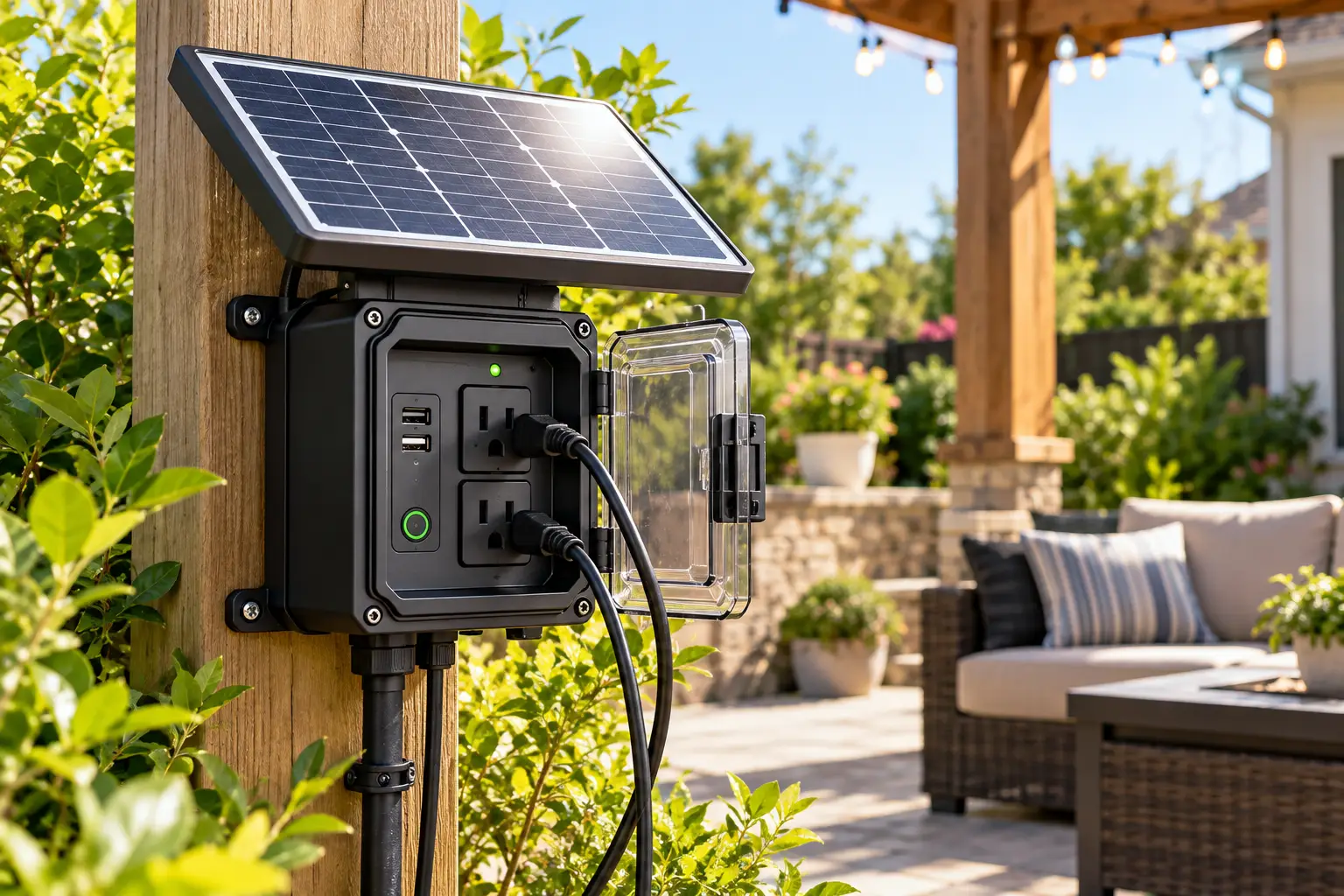
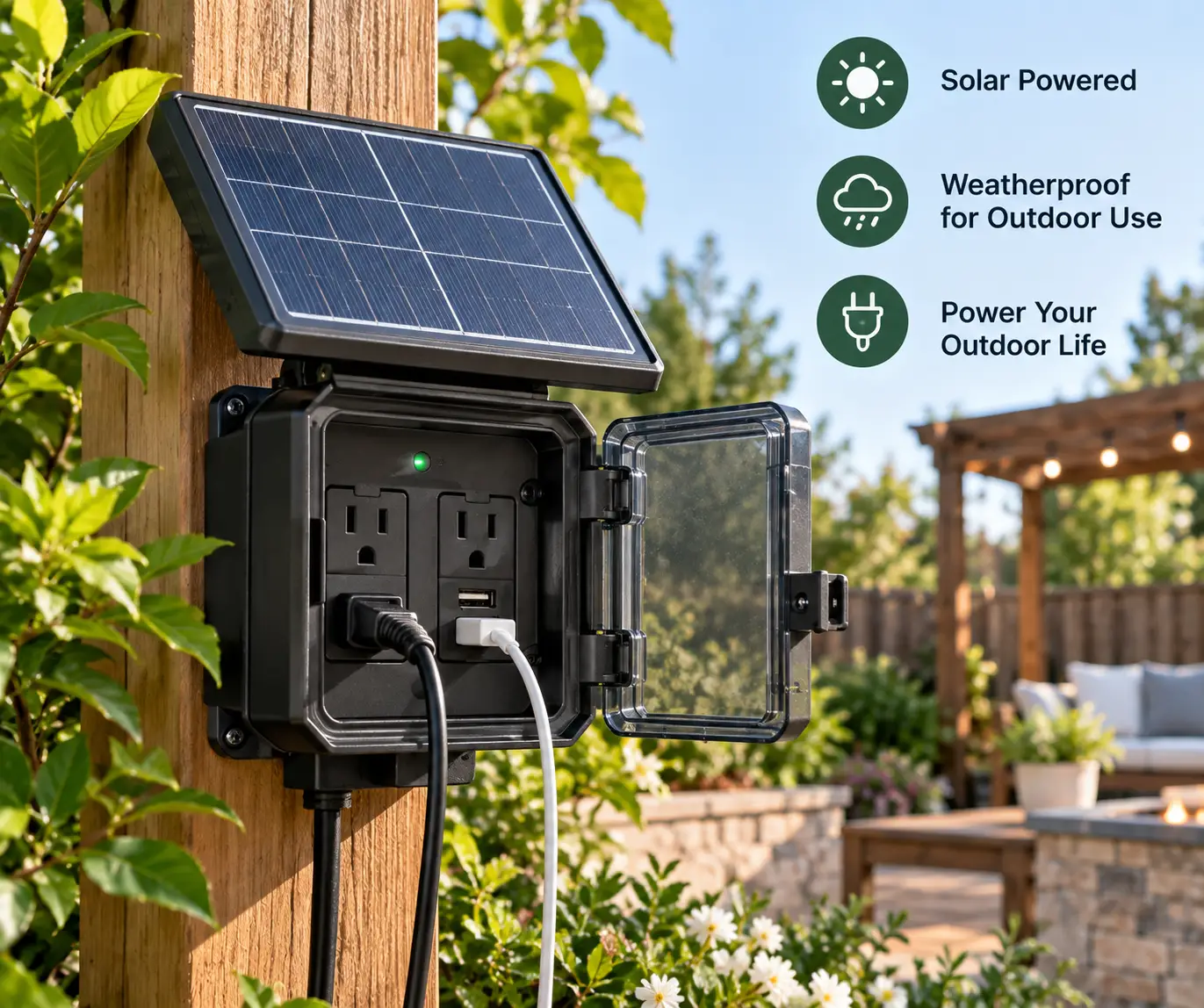
Yes, solar outlets for outdoors exist, but nearly all of them are a battery box with sockets on the front rather than a receptacle you bolt to a fence post. That difference decides what you can run, how you keep it dry and what it costs, and it is the thread through this 2027 guide to getting dependable power into a garden, shed or patio without trenching a cable.
Maker spec sheets, power-station tests from OutdoorGearLab and Outdoor Life, an electrical-trade guide to weatherproof receptacles and a state-by-state tracker of plug-in solar laws sit behind the advice, which is why watt-hours, water protection and local rules come up again and again.
Two questions settle most of the buying decision: how many watt-hours the loads use per day, and how wet the spot gets.
Is there a solar powered outlet? Two makers, two definitions
Renogy’s buyer guide describes the outdoor version as a small, light unit fed by panels, with a built-in inverter that turns panel DC into AC and no battery at all. It delivers power only while the sun shines, suits devices between 100 W and 300 W, and cannot run a fridge. That is the design behind most listings for a solar power outlet plug: a panel, a box and a socket.
Bluetti’s guide uses the same phrase for something else, a self-contained system with a panel, an internal battery, an inverter and sockets that keeps working at night and under cloud. Both companies sell solar generators, so each definition leans toward its own catalog. The spec line settles it: a listing that states battery capacity in watt-hours is a power station, and one that does not is panel-direct.
Do they make solar powered outlets for outdoors that mount on a wall like a normal receptacle? Bluetti mentions permanent versions with fixed panels and weatherproof enclosures, yet tying a battery and inverter into a building circuit is electrician work, and Fine Homebuilding notes that many jurisdictions require licensed electricians for outdoor receptacle jobs. For a rental, a garden or a shed, the portable station is the practical route.
Is an outdoor solar outlet legit? What the listing has to show
The category is real. The risk sits in vague listings, where an outdoor solar panel outlet appears with a wattage claim and no battery figure, no continuous output and no water rating. Five lines on a spec sheet separate a usable product from a vague one:
Battery capacity in watt-hours, or a plain statement that there is no battery
Continuous AC watts, plus the surge figure
Maximum solar input in watts
A named IP rating with its conditions, not the word “weatherproof” alone
A safety standard named on the sheet (Goal Zero, for example, says the Yeti 700 is designed to meet UL 2743)
Water protection deserves the closest reading. Outdoor Life’s lineup of power stations lists the EcoFlow Delta 2 at IP20 and describes it as not water resistant, the Goal Zero Yeti 700 at IPX4, and only the Dakota Lithium PowerBox + 60 Waterproof at IP67, with several others carrying no rating. The author’s conclusion is that most of these stations were not designed for use in any kind of weather.
Makers do not agree on this either. Bluetti’s outlet guide says its outdoor stations handle normal weather, including rain, while a separate Bluetti page says rain protection depends on the model’s manufacturer instructions rather than its IP rating alone, and unrated units should stay dry. Where sources conflict, the manual for the exact unit wins.
Ratings also do not transfer between components. Bluetti warns that a tough panel plugged into an unsealed station does not make a waterproof system, and an etrailer expert reply about a Go Power portable panel says its built-in controller is not weatherproof, so no water should touch it. One reply is a single data point, but it shows why the controller and every connector need their own rating.
From watt-hours to weatherproofing: the setup in order
Solar outlets for outdoors come together most smoothly when the arithmetic comes first, so the steps run from loads to weather protection.
Total the daily watt-hours. Multiply each device’s watts by its hours of use and add the results. Bluetti’s sizing guide works one example: 40 W of lights for 6 hours, a 250 W projector for 2 hours and 60 W of speakers for 3 hours add up to about 920 Wh, and the guide pads that to at least 1,200 Wh.
Pick the architecture. A panel-direct unit suits a daytime lamp or small pump, because Renogy says it works only while the sun shines. A battery-backed station suits evening loads, and a fixed receptacle suits a permanent install that an electrician should handle.
Size the panels from the daily total. Panel watts, times usable sun hours, times system efficiency gives daily energy, so the panel size is the daily need divided by those two figures. Winter shortens the sun hours, and Bluetti adds that snow can halt production until it is cleared while dust slowly trims output.
Sample calculation: a hypothetical backyard runs 40 W string lights for 6 hours (240 Wh) and a 30 W fountain pump for 8 hours (240 Wh), which totals 480 Wh. A 25% cushion for losses and cloudy days raises the target to 600 Wh. Assuming 4 peak sun hours and 75% system efficiency, one 100 W panel yields about 300 Wh a day (100 x 4 x 0.75), so a pair of 100 W panels, or one 200 W panel, covers the target. The cushion, sun hours and efficiency are assumptions to replace with local figures.
Keep the panel and the station apart. Panels are built for open sky and most stations are not, so the panel sits in the sun and the station stays under cover. Jackery’s guidance tells owners to have a quick plan to cover or move panels if rain arrives, and a member of the 4WDTalk forum suggests placing panels a good distance from the unit so the station stays protected. Outdoor Life’s author singled out Anker’s 100 W panel, which has a built-in sundial for aiming.
Protect the cord and socket end. Outdoor Life’s notes on the earlier Anker C1000’s fully exposed ports and the Yeti 700’s lift-up outlet flap show how little shielding station sockets get. Keep the plug connection off wet ground and under a cover, and read the unit’s manual for ground-fault protection before powering anything that sits in water, such as a fountain pump.
Re-check each season. Bluetti says cold lowers lithium battery efficiency and that output falls in winter, especially in cloudy or northern areas. Wipe dust from the panels, clear snow, and expect a smaller daily total from December to February than the summer math suggests.
What type of outlet for outdoors? GFCI, WR and the in-use cover
Fixed outdoor outlets follow a different rulebook from station sockets. Leviton’s outlet brochure says weather-resistant receptacles, marked WR on the face, must be protected on a GFCI circuit and may be GFCI models themselves. Locations exposed directly to weather call for an extra-duty while-in-use cover, while a covered porch can use any suitable approved weatherproof cover.
A standard flip lid shields the receptacle only while nothing is plugged in, and an in-use cover keeps its seal around the cord. Fine Homebuilding’s guide to protecting outdoor outlets stresses boxes and covers that shed water, and its author describes his own deck: the receptacle had GFCI protection but was not a weather-resistant type, and the cover was the wrong kind, installed in the wrong orientation, so water likely got in from the start.
The magazine adds that its guide does not replace local code. A fixed outlet fed by a battery inverter is a job for an electrician, who can say how the local code treats it.
Solar panel plug in outlet for outdoor use: why plug-in kits are a different product
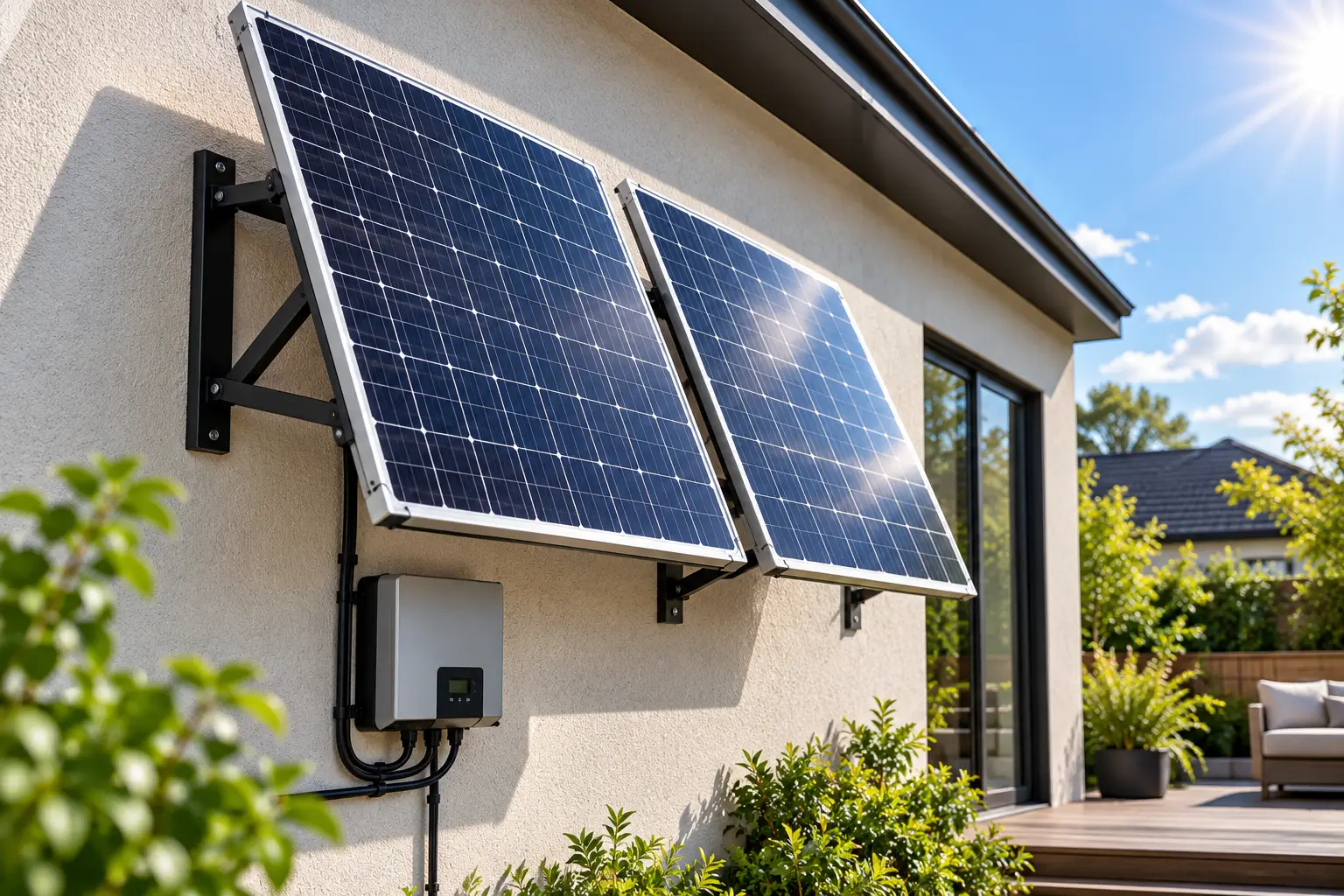
A solar panel plug in outlet for outdoor use sounds like the missing piece, but plug-in (balcony) solar solves another problem. Solar.com describes kits that plug straight into a normal 120-volt wall outlet instead of being hardwired by an electrician, and PromptQuorum’s legal explainer notes that the power flows back through that socket into the home’s wiring, the reverse of what the socket normally does. The aim is a smaller electric bill, not a socket that works when the grid is down. An advocate quoted by PV Tech says such inverters shut down within milliseconds of an outage, a claim the article itself suggests checking against standards.
The legal map moves fast. Utah went first in 2025 with a 1,200 W cap, and PV Tech counted nine states with signed laws by September 2026, among them Colorado, Connecticut, Maryland, New Hampshire, New Jersey, Maine, Utah, Vermont and Virginia. TaiyangNews reported California as the tenth in early October. New Jersey’s law takes effect March 1, 2027, Bright Saver’s state tracker lists California’s as effective January 1, 2027, and KQED expects compliant models on sale in mid-2027.
Certification is catching up. UL Solutions published UL 3700 for plug-in solar in December 2025, and Electrek reported in July 2026 that the Hoymiles HiFlow Pro became the first US microinverter certified to it. Renters and HOA members should still check local rules, since PV Tech notes that tenant protections and utility rules differ by state.
Where outdoor solar setups go wrong, and the fix for each
Water reaches the unrated ports first
Outdoor Life’s test lineup supplies the main evidence: its author reports that the earlier Anker SOLIX C1000’s ports are fully exposed, the EcoFlow Delta 2 is not water resistant, and the Yeti 700’s silicone flap must be lifted each time it is used. On a 4WDTalk thread about a larger Jackery, one member warns that leaving a charging unit out through a shower or sprinklers could be catastrophic. Goal Zero’s support page for the Yeti 1000 and 1500 goes further, advising against live loads in rain and asking owners to keep port doors closed.
A test, a forum member and a maker all point the same way. The fix is cheap: station under cover, panel in the sun, and a cable between them.
Rated watt-hours are not usable watt-hours
OutdoorGearLab measured about 890 Wh of usable AC output from the Anker SOLIX C1000 Gen 2 against a claimed 1,056 Wh, and about 260 Wh from the Jackery Explorer 300 against a 293 Wh claim. Those are one tester’s measurements, yet they fit Bluetti’s habit of padding every daily total.
In the sample backyard above, the 480 Wh of loads fits inside the Anker with room to spare. The Jackery carries the string lights for the evening but not the fountain pump on top.
The solar input cap quietly limits recharge
Maximum solar input differs sharply between stations: OutdoorGearLab lists 600 W for the C1000 Gen 2 and Outdoor Life lists 200 W for the Yeti 700. Panels beyond a station’s cap add nothing, so a 400 W array on a 200 W input leaves half the array idle.
Panel quality matters too. Outdoor Life’s author says EcoFlow’s panels tended to warp after a few months in storage, one tester’s observation that argues for storing any foldable panel flat and dry.
The gear that fits each step
Three power stations cover steps one to four, and one outlet kit covers step five. The table lines up the stations on the figures that decide outdoor use.
Power station
Claimed capacity
AC output
Max solar input
Weight
Water protection listed
Anker SOLIX C1000 Gen 2
1,056 Wh
1,800 W (2,400 W surge)
600 W
25.2 lb
None in OutdoorGearLab’s review
Jackery Explorer 300
293 Wh
300 W (500 W surge)
100 W panel used in the test
7.1 lb
None in OutdoorGearLab’s review
Goal Zero Yeti 700
677 Wh
600 W (1,000 W surge)
200 W
20.3 lb
IPX4
The Goal Zero Yeti 700 holds about 36% less claimed energy than the Anker SOLIX C1000 Gen 2, and in return it is the only one with a listed water rating. The Jackery Explorer 300 is the one-hand carry, and the Anker SOLIX C1000 Gen 2 is the only one that can absorb a large panel array.
OutdoorGearLab names this station its best-value pick, and Outdoor Life gave the earlier C1000 its solar-generator category win, so the Anker family has two independent endorsements. The Gen 2 claims 1,056 Wh, 1,800 W of AC output with a 2,400 W surge, six AC outlets and up to 600 W of solar input, and it weighs 25.2 lb. For the sample backyard, a 600 Wh target sits comfortably inside its measured 890 Wh, and the input ceiling leaves room for a bigger array later. Check the current price on Amazon.com, because OutdoorGearLab saw it discounted well below its launch price.
Pros:
Measured usable energy covers a full evening of lights and a pump
Six AC outlets mean no power strip is needed for a small yard
A 600 W input ceiling lets the panel array grow
Cons:
OutdoorGearLab calls the fan noisy
Anker dropped expansion-battery support on this generation, per the same review
No water rating appears in the review, so it needs a dry spot
Panel bundles and current stock are listed on the Amazon.com page.
Anker SOLIX C1000 Gen 2See current price, sizes and reviews on Amazon.
Capacity is the limit here. Jackery lists 293 Wh and a 300 W inverter with a 500 W surge, OutdoorGearLab measured 260 Wh, and the review recommends it for phones, laptops and other low-wattage devices, which matches a string of lights better than a pump. It has two AC outlets, weighs 7.1 lb, and OutdoorGearLab notes it has no built-in LED light.
Paired with Jackery’s 100 W foldable panel, the maker says the station recharges from 0 to 80% in about 3.5 hours in full sun. Check the current price on Amazon.com. Jackery’s kit page lists the panel’s operating range as 14 to 149 degrees Fahrenheit.
Jackery Explorer 300See current price, sizes and reviews on Amazon.
Retailers such as Scheels and Campmor list this station at roughly $600 to $700. That money buys a housing rated IPX4, a 677 Wh LiFePO4 battery, 600 W of AC output with a 1,000 W surge and a 20.3 lb body, and Outdoor Life named it the most reliable station in its lineup.
Goal Zero says the 200 W solar recharge takes as little as 3.8 hours, and its spec page notes that a 200 W panel needs an HPP-to-8mm connector. IPX4 means splash resistance, not rain-proofing: the maker’s support page for the larger Yeti 1000 and 1500 says the same rating is not fully waterproof and recommends against live loads in rain.
Pros:
The only station in this group with a listed water rating
A 677 Wh battery covers the sample 480 Wh day with some margin
Outdoor Life rated its reliability above the rest of its lineup
Cons:
Solar input tops out at 200 W
The outlet flap has to be lifted each time, per Outdoor Life
Panels beyond 200 W add no recharge speed
Goal Zero Yeti 700See current price, sizes and reviews on Amazon.
Step five ends at a fixed outdoor socket, and this kit is a complete way to build one. It bundles a non-metallic box, a Hubbell weather-resistant, tamper-resistant 15 A self-test GFCI receptacle and a clear in-use cover with an attached gasket, mounting hardware and a lockable tab. Fine Homebuilding picked it as a surface-mount example, and listings there and on electrical-supply sites run between roughly $20 and $35.
The listing reads 5-7/8 inches tall, 5 inches wide and 2-3/4 inches deep, and it weighs 1.52 lb. Match the catalog number exactly: MKG420CS is the non-metallic kit with the GFCI receptacle, while the similar MG420CS listings describe a metallic version. Wiring from an inverter or a house circuit belongs to a licensed electrician where local code requires one. Hubbell’s spec sheet lists the kit as UL Listed and NEMA 3R.
TayMac MKG420CS In-Use Cover KitSee current price, sizes and reviews on Amazon.
Straight answers on solar outlets, plugs and weather
Do they make solar powered outlets for outdoors?
Yes, in two forms. Battery-backed solar generators put AC sockets on a portable box charged by a foldable panel, while smaller panel-direct units run devices only in daylight. Neither is a wall receptacle you can hardwire without an electrician.
Is an outdoor solar outlet legit or a gimmick?
The hardware is real, but names are used loosely. Makers disagree on whether an outlet includes a battery, so check the listing for watt-hours, continuous watts, maximum solar input and a specific water-protection rating before trusting any claim.
What type of outlet is needed outdoors?
Look for a weather-resistant receptacle marked WR on a GFCI-protected circuit, with a cover suited to the exposure. Leviton says locations hit directly by weather need an extra-duty while-in-use cover. Local code and a licensed electrician have the final word.
Can a solar panel plug into a regular outdoor outlet?
Only certified plug-in solar kits are meant to, and only where state law allows it. Utah set a 1,200-watt cap in 2025, and nine states had signed laws by September 2026. Camping panels are built to feed a power station, not a wall outlet.
Will a solar power outlet plug keep working at night or in winter?
Panel-direct units stop when the sun does, per Renogy. Battery-backed stations keep supplying stored energy, but Bluetti notes that winter output drops, snow can block panels entirely and cold reduces lithium battery efficiency, so size the system with a buffer.
The setup the evidence favors
Solar outlets for outdoors earn their keep when the watt-hour total is settled before any product is chosen. For a garden-lights-and-pump load like the sample above, the evidence favors the Anker SOLIX C1000 Gen 2 when the station can live under cover, because its measured usable energy and 600 W of solar headroom leave room to grow. A wetter spot points to the Goal Zero Yeti 700, the only station here with a listed IPX4 rating, at the cost of a 200 W solar ceiling. The Jackery Explorer 300 fits phone, laptop and single-light duty, and the TayMac MKG420CS In-Use Cover Kit belongs wherever a licensed electrician installs a fixed receptacle. Plug-in solar is a separate product, so check your state’s rules before buying one. Check current availability below once your numbers are final.