In This Article
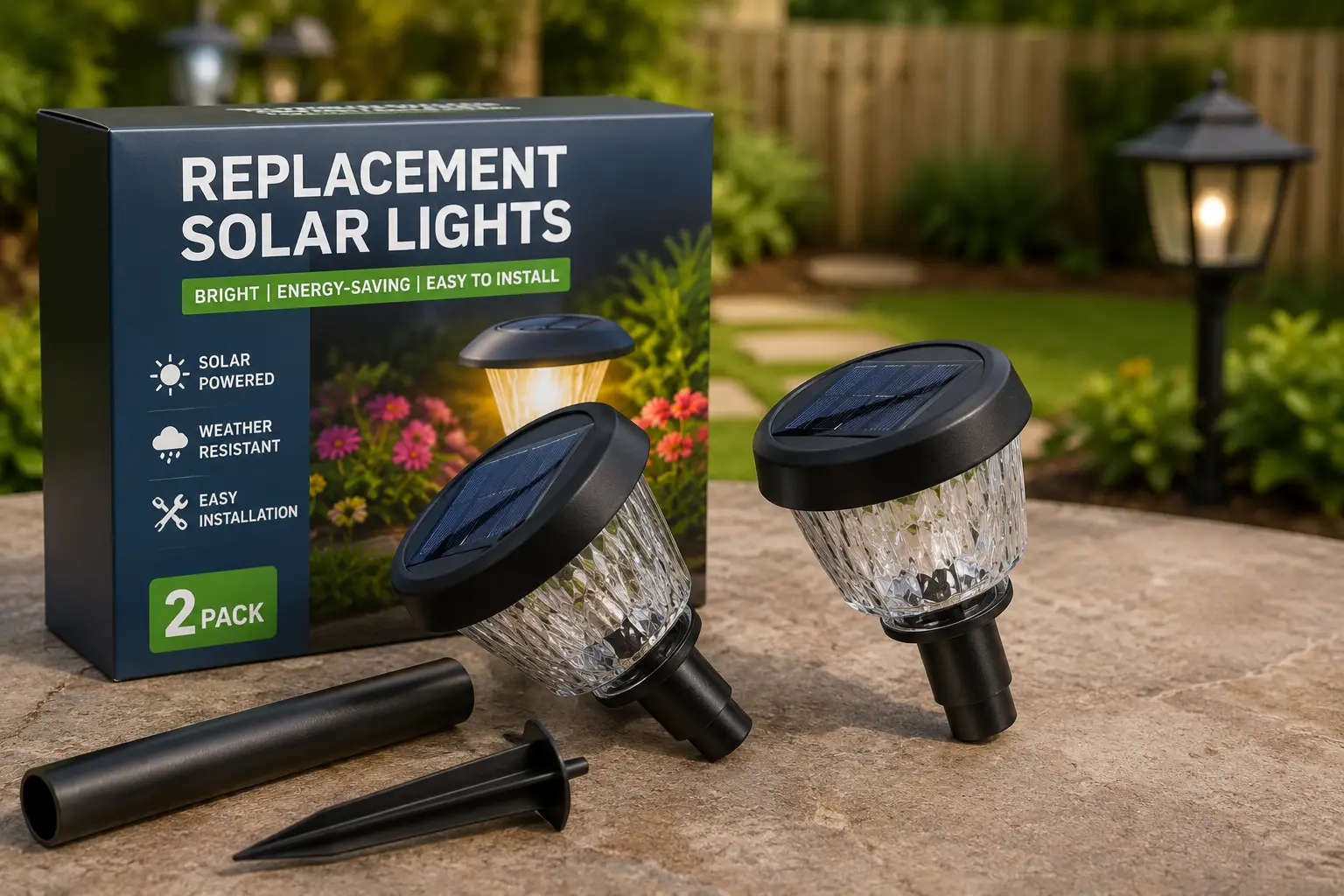
Replacement solar lights are the small fix that saves a whole fixture: swappable bulbs, batteries, solar panels, or ground stakes designed to restore a dead or dim solar light to full brightness without buying an entirely new unit. If your pathway lights have gone dark after two or three summers, odds are good the problem isn’t the fixture itself — it’s one worn-out part inside it.
That distinction matters more than most retailers let on. A solar light is really three components working together: a photovoltaic panel that charges during the day, a rechargeable battery that stores the power, and an LED that burns it off at night. Any one of those three can fail on its own timeline, and when it does, tossing the whole fixture in the trash is usually the most expensive way to fix a $15 problem. Reviews across garden forums and product pages consistently point to the same culprit: batteries lose charge capacity years before the housing, lens, or solar cell wear out.
This guide walks through seven real, US-available replacement solar lights and parts — covering bulbs, post caps, lantern tops, batteries, and ground stakes — so you can match the right fix to whatever actually broke. You’ll also get a plain-English breakdown of how to choose a replacement, how to install one in minutes, and when it genuinely makes more sense to replace the entire fixture instead. According to the U.S. Department of Energy’s overview of solar photovoltaic technology, the panels used in small consumer devices rely on the same basic cell technology as rooftop solar arrays — just scaled down, which is exactly why a $10 replacement part can restore a light that looks, on the surface, like it needs to be thrown out.
Quick Comparison: Replacement Solar Lights at a Glance
Before diving into full reviews, here’s a fast-reference table matching each replacement type to the problem it actually solves.
| Product | Best For | Price Range | Install Difficulty |
|---|---|---|---|
| Gama Sonic Replacement Solar LED Light Bulb (A50WW10W) | Exact-fit swap for Gama Sonic post and wall lights | around $25–$35 | Easy (screw-in) |
| Classy Caps Windsor Solar Post Cap | Upgrading a single fence or deck post | around $20–$30 | Easy (drop-on) |
| NFEVER Solar Post Cap Lights (8-Pack) | Relighting an entire fence line on a budget | around $30–$45 | Easy (snap-on) |
| TAKE ME Solar Lantern Replacement Top | Saving a decorative lantern base that still looks good | around $8–$15 | Easy (twist-on) |
| Tenergy Solla NiMH AA Batteries (12-Pack) | Reviving lights that dim early every night | around $18–$25 | Easy (battery swap) |
| BONAI AA Rechargeable Batteries (20-Pack) | Bulk battery replacement across many fixtures | around $25–$35 | Easy (battery swap) |
| Metal Replacement Stakes (10-Pack) | Fixing wobbly, cracked, or snapped ground stakes | around $12–$18 | Easy (push-in) |
Looking at the table, the fastest wins for most households are batteries and stakes — they’re the cheapest fixes and address the two most common failure points reported in customer reviews. If your light’s housing itself is cracked, faded, or waterlogged, though, a bulb or cap swap like the Gama Sonic Replacement Solar LED Light Bulb or Classy Caps Windsor Solar Post Cap solves the whole problem in one part rather than layering repairs. Homeowners managing more than a handful of fixtures typically save the most by buying batteries in bulk, since the per-unit cost drops sharply compared to replacing fixtures one at a time.
💬 One click helps other shoppers make an informed choice too! 😊
Top 7 Replacement Solar Lights and Parts for 2026
Each of these seven picks addresses a different point of failure — the bulb, the battery, the panel, or the stake — and spans budget, mid-range, and premium options so you can match the fix to your fixture and your patience level.
1. Gama Sonic Replacement Solar LED Light Bulb (A50WW10W) — factory-exact fit for a trusted brand
If you own one of Gama Sonic’s popular lamp post or wall sconce fixtures, this is the manufacturer’s own replacement bulb, built to drop into the original housing with no adapters or rewiring. The bulb packs the photovoltaic cell, battery, and LED into a single screw-in unit, so replacing it resets the whole light back to factory condition in one step rather than three.
The 2700K warm white output matches the original color temperature Gama Sonic fixtures ship with, which matters more than it sounds — mismatched color temperatures between old and new bulbs on a multi-light post are one of the more common complaints in outdoor lighting reviews. Dusk-to-dawn sensing is built in, so there’s no separate photocell to align. Based on comparing the specs against generic universal bulbs, the tradeoff here is straightforward: you pay a premium for guaranteed fit and finish, and in exchange you skip the trial-and-error of sizing a universal part to a branded housing.
Aggregated customer feedback on Gama Sonic’s replacement bulbs points to consistent brightness and a straightforward, tool-free install as the main draws, with occasional notes that the bulb doesn’t fit non-Gama-Sonic fixtures despite similar-looking sockets — worth double-checking your model before ordering.
Pros:
- ✅ Guaranteed factory fit for Gama Sonic fixtures
- ✅ No rewiring or tools required to install
- ✅ Integrated battery and panel simplify future swaps
Cons:
- ❌ Priced higher than generic replacement bulbs
- ❌ Only compatible with Gama Sonic-style sockets
Expect to pay around $25–$35 per bulb; for Gama Sonic owners specifically, the exact-fit convenience is worth the premium over a universal alternative.
2. Classy Caps Windsor Solar Post Cap — premium finish for fence and deck posts
The Classy Caps Windsor Solar Post Cap replaces a dead or plain post cap on a 4×4 or 3.5×3.5 fence or deck post with a weather-resistant, auto-on solar fixture that noticeably upgrades curb appeal in one swap. Classy Caps has built its reputation specifically on post-cap lighting, and it shows in the fit-and-finish compared to generic alternatives.
The auto dusk-to-dawn sensor and high-output LED mean there’s genuinely nothing to program — you set it on the post and it works that night. What most buyers overlook with post caps specifically is that they double as a functional cap, sealing the post from moisture even when the light eventually fails, which is a real advantage over solar stake lights that offer no weatherproofing function beyond illumination.
Reviews consistently describe the build quality as sturdier than big-box-store equivalents, with the durable resin or aluminum housing holding up through multiple seasons without the yellowing or cracking some cheaper caps develop. This makes it a strong pick for a single prominent post — a gate, a mailbox post, a deck corner — where you want a lasting fixture rather than the cheapest possible one.
Pros:
- ✅ Sturdy, weather-resistant housing built specifically for post caps
- ✅ Universal fit for standard 4×4 and 3.5×3.5 posts
- ✅ Reputable brand with a long track record in this category
Cons:
- ❌ Per-unit price adds up quickly for a long fence line
- ❌ LED isn’t separately replaceable if it eventually fails
Priced around $20–$30 per cap, it’s a strong value for the one or two most visible posts on your property, even if it’s not the most economical choice for relighting a whole fence.
3. NFEVER Solar Post Cap Lights (8-Pack) — cheapest way to relight an entire fence line
When you’re not fixing one post but replacing caps across an entire fence or deck railing, the math changes, and that’s where the NFEVER Solar Post Cap Lights 8-pack earns its spot. Buying in bulk drops the effective per-unit price well below what you’d pay swapping caps individually, which matters when you’re outfitting eight, ten, or more posts at once.
Each cap fits both 4×4 and 5×5 posts and includes two lighting modes (warm and cool white), letting you match the tone to your existing outdoor lighting rather than being stuck with one temperature across the whole yard. The panel and battery are sealed into the cap housing, so installation is a snap-on job with zero tools — genuinely a 30-second-per-post project.
Here’s what the spec sheet doesn’t say, but aggregated reviews reveal: the plastic housing on budget multi-packs like this one tends to show UV fading a season or two sooner than premium single-cap options like the Classy Caps Windsor Solar Post Cap. For most homeowners doing a full fence replacement, that tradeoff is worth it — you’re not paying premium prices per post, and by the time fading becomes noticeable, you’ve already gotten several seasons of light for a fraction of the cost of individual premium caps.
Pros:
- ✅ Bulk 8-pack dramatically lowers the cost per post
- ✅ Two lighting modes let you match your existing fixtures
- ✅ Tool-free snap-on installation across every post
Cons:
- ❌ Housing shows UV fading sooner than premium single caps
- ❌ Reviews note shorter overall lifespan under intense sun exposure
Expect to pay around $30–$45 for the full 8-pack — roughly $4 to $6 per post — making this the clear value pick for large-scale fence or deck relighting projects.
4. TAKE ME Solar Lantern Replacement Top — universal fit for garden lantern tops
Decorative solar lanterns — the mason-jar-style or hanging glass lanterns popular in garden and patio decor — almost never fail because the glass base cracked. It’s the electronic top, holding the panel, battery, and LED, that gives out first. The TAKE ME Solar Lantern Replacement Top is built specifically to solve that mismatch: you keep the decorative base you already own and swap only the failing top.
At 3.2 inches, it’s sized to fit a range of common lantern openings rather than one specific brand, which is the whole appeal — you’re not hunting for an exact-match part number, just a top that fits your jar’s opening. The waterproof LED and panel combination is functionally identical to what ships inside most decorative solar lanterns, so brightness and run time land close to what the lantern delivered when new.
Reviews are largely positive on the “it just fits” front for standard-sized openings, though a meaningful minority of buyers report needing to check measurements carefully first, since garden lantern openings aren’t fully standardized across brands. Based on comparing this against buying a whole new lantern, the math strongly favors the replacement top when your base is otherwise in good shape — you’re paying a fraction of the cost to keep decor you already like.
Pros:
- ✅ Keeps a decorative base you already own out of the landfill
- ✅ Significantly cheaper than replacing the whole lantern
- ✅ Simple twist-on or snap-on installation, no tools needed
Cons:
- ❌ Fit varies across lantern brands — measure before buying
- ❌ Output runs dimmer than dedicated post or pathway lights
At around $8–$15 per pack, this is one of the lowest-cost fixes on this list and a smart first move before assuming a lantern needs full replacement.
5. Tenergy Solla Rechargeable NiMH AA Battery (1000mAh, 12-Pack) — the longest-proven battery swap for solar lights
If there’s a single most common reason solar lights die, it’s the battery — and the Tenergy Solla Rechargeable NiMH AA Battery is one of the most consistently recommended fixes for that exact problem. These are UL-certified 1000mAh NiMH cells built with an anti-leak design and rated for five-plus years of outdoor duty cycles, which is well beyond what the batteries originally bundled inside most budget solar lights are built to handle.
Here’s the practical case for batteries as your first troubleshooting step: a solar light that turns on but goes dim within an hour or two of dark almost always has a battery that can no longer hold a full charge, even though the panel and LED are both still functioning fine. Swapping in fresh, higher-quality cells like these is dramatically cheaper than buying a new fixture, and it works across nearly any solar light that uses standard AA batteries, not just one brand.
Reviews consistently single out Tenergy’s UL certification and real-world longevity as standout factors — a detail that matters given how many uncertified rechargeable batteries on the market lose noticeable capacity within a single season of outdoor heat and cold cycling.
Pros:
- ✅ UL-certified for safety and consistent performance
- ✅ Reviewers report multi-year longevity outdoors
- ✅ Fits nearly any AA-battery-powered solar light, not one brand
Cons:
- ❌ Costs more upfront than generic rechargeable batteries
- ❌ A 12-pack is more capacity than small households may need
Priced around $18–$25 for 12 batteries, this is arguably the single best value pick on this entire list, since a battery swap alone resolves the majority of “my solar lights stopped working” complaints.
6. BONAI AA Rechargeable Batteries (1100mAh, 20-Pack) — best bulk value for large yards
For yards with eight, ten, or more solar fixtures needing batteries at once, the BONAI AA Rechargeable Batteries 20-pack is built for exactly that scale. At 1100mAh, the rated capacity edges slightly above the Tenergy Solla cells, and the larger pack size spreads the cost down meaningfully on a per-battery basis — a real advantage if you’re doing a full-yard battery refresh rather than fixing one or two lights.
Batteries arrive precharged and ready to install, which means your lights can be back to full brightness the same evening rather than waiting through a slow first charge cycle. Practically speaking, this makes the BONAI pack a good match for anyone tackling a “replace every solar light battery in the yard this weekend” project rather than a single fixture repair.
Aggregated reviews are largely positive on initial brightness and value, though a recurring theme in longer-term feedback is that capacity retention after roughly two years of cycling doesn’t quite match what Tenergy’s UL-certified cells deliver — a tradeoff that’s reasonable given the lower per-unit cost, but worth knowing going in if you want the absolute longest-lasting option.
Pros:
- ✅ Large 20-pack meaningfully lowers the cost per battery
- ✅ Higher 1100mAh rated capacity than standard replacement cells
- ✅ Arrives precharged, so lights work the same evening
Cons:
- ❌ Reviews suggest faster capacity fade after heavy multi-year use
- ❌ No UL certification listed, unlike premium alternatives
Priced around $25–$35 for the full 20-pack, this is the strongest budget pick when you’re replacing batteries across many fixtures at once rather than just one or two lights.
7. Metal Replacement Stakes for Solar Lights (10-Pack) — fixes wobbly, cracked, or snapped stakes
The stake is the least glamorous part of any pathway solar light, and it’s also one of the most frequently broken. Freeze-thaw cycles heave the plastic, lawnmowers clip them, and years of pushing them into hard soil eventually cracks the plastic at the base — even while the light head above still works perfectly. This 10-pack of metal replacement stakes, sized at roughly 0.78 by 5.35 inches to fit standard 3/4-inch light poles, solves that specific failure point.
Swapping a stake takes seconds: unscrew or unclip the old plastic stake, attach the metal replacement, and push it back into the ground. The metal construction resists the cracking that does in most original plastic stakes within two or three seasons, and it holds more securely in soft or recently watered soil than a plastic equivalent — a detail multiple reviewers specifically call out compared to their original stakes.
This is a repair worth doing before you consider the light head itself defective. Based on comparing common complaint patterns across pathway light reviews, “my light won’t stay upright” and “my light fell over and stopped working” are overwhelmingly stake problems, not electronic ones — meaning a $15 fix often solves what looks like a dead $30 light.
Pros:
- ✅ Metal construction resists the cracking that ends most plastic stakes
- ✅ Fits most standard pathway light poles around 3/4 inch
- ✅ A clear upgrade over the original plastic stakes in holding power
Cons:
- ❌ Not compatible with narrower or specialty pole diameters
- ❌ Sold only as a 10-pack, more than a single-light fix needs
At around $12–$18 for 10 stakes, this is one of the cheapest and most overlooked fixes on this list, and it’s worth checking before assuming a wobbly light needs full replacement.
How to Replace Solar Light Parts Yourself: A Step-by-Step Guide
Replacing solar light bulbs, batteries, or panels is one of the simplest DIY fixes in outdoor home maintenance, and most jobs take under 10 minutes with no tools beyond a small screwdriver. Start by identifying the actual failure: if the light doesn’t turn on at all, check the battery compartment first — corrosion or a fully dead cell is the most common cause. If the light turns on but fades quickly, that’s almost always a battery holding a reduced charge rather than a panel or LED problem.
For a solar light bulb replacement, most fixtures use a simple twist-lock or screw-in mechanism; match the base type and thread size to your existing bulb before ordering. When swapping solar light replacement batteries, always replace the full set at once rather than mixing old and new cells, since a single weak battery in a multi-cell fixture drags down the whole unit’s performance. Wipe down the solar panel with a damp cloth before reassembling — a surprising number of “dead” lights are actually just panels coated in pollen, dust, or grime blocking the cell from charging fully.
Once reassembled, give the light a full, uninterrupted charge cycle (ideally a full sunny day) before judging its new performance, since a partial charge on day one can make a perfectly good replacement part look underwhelming.
✨ Don’t miss these exclusive deals!
🔍 Take your outdoor lighting to the next level with this carefully curated lineup. Click a highlighted item to check current pricing and availability. These picks will help you get your yard glowing again — no full fixture replacement required!
Real-World Scenarios: Which Replacement Fits Your Yard
Picture three different homeowners, each with a different “my solar lights aren’t working right” problem, because the right fix genuinely depends on your situation.
The first is a renter with six pathway lights along a walkway who just wants them working again on the smallest possible budget. For that profile, the Tenergy Solla Rechargeable NiMH AA Battery 12-pack is the obvious starting point — it’s cheap, fixes the single most common failure point, and doesn’t require identifying a specific fixture brand.
The second is a homeowner with a 40-foot fence topped with post caps that have faded and stopped charging after five years of exposure. Replacing each cap individually with something premium like the Classy Caps Windsor Solar Post Cap would be a meaningful expense across a dozen posts, so the NFEVER Solar Post Cap Lights 8-pack is the more sensible large-scale fix, saving the premium option for one or two focal posts near the entrance.
The third is a gardener with a decorative mason-jar lantern collection whose glass bases are still beautiful but whose electronic tops have died one by one. Rather than replacing four or five lanterns outright, the TAKE ME Solar Lantern Replacement Top lets them keep the decor they’ve collected over the years and simply refresh the failing hardware — a repair that costs a fraction of new lanterns and keeps usable glass out of the trash.
Common Solar Light Problems and How to Fix Them
Most solar light complaints trace back to one of five root causes, and matching the symptom to the fix saves both money and frustration.
Problem: The light doesn’t turn on at all. This is almost always a dead battery or a stuck power switch inside the housing (many fixtures ship with an “off” switch that gets bumped or left in shipping position). Check the switch first, then move to a battery swap using solar light replacement batteries like the Tenergy or BONAI packs above.
Problem: The light turns on but is dim or fades within an hour. This is a battery that’s lost most of its charge capacity — a near-universal sign it’s time for fresh cells rather than a new fixture.
Problem: The light doesn’t charge during the day. Check for a dirty or shaded panel first; a persistent no-charge issue after cleaning usually means the panel itself has degraded and needs a bulb or panel-integrated replacement, like the Gama Sonic option above.
Problem: The light physically won’t stay upright. This is a stake problem, not an electronic one — a metal replacement stake set resolves it in seconds.
Problem: The color or brightness looks mismatched next to other lights on the same run. This usually means a generic replacement bulb with a different color temperature was used; matching the original manufacturer’s replacement bulb, where available, avoids the mismatch.
How to Choose Replacement Solar Lights
Buying guides like Forbes Vetted’s roundup of the best outdoor solar lights tend to focus on brand-new fixtures, but the same underlying criteria apply just as well to picking a replacement part. Picking the right replacement part comes down to answering a handful of questions honestly, in this order:
- Identify what actually failed — battery, panel, LED, or housing/stake — before shopping, since guessing wrong wastes money on the wrong part.
- Check brand and model compatibility for bulb or cap replacements; universal parts work for generic fixtures, but branded fixtures like Gama Sonic often need manufacturer-specific parts.
- Match battery chemistry and size — most solar lights use AA or AAA NiMH cells, but a few premium fixtures use lithium-ion packs that require a different replacement entirely.
- Prioritize UL certification on batteries specifically, since outdoor battery fires, while rare, are a documented safety issue the industry takes seriously.
- Buy in bulk if you’re fixing multiple fixtures at once — per-unit costs drop meaningfully on 8-, 12-, and 20-packs compared to single-unit purchases.
- Factor in your climate — homeowners in high-UV regions should expect faster panel and housing degradation and may want to budget for replacements on a shorter cycle than the “3-5 year” estimate often quoted.
- Weigh replacement cost against a new fixture’s price — if more than two components have failed on a budget light, full replacement is often more economical than piecemeal repair.
Common Mistakes to Avoid When Buying Replacement Solar Lights
The most expensive mistake buyers make is replacing the wrong component — swapping a whole bulb assembly when the actual problem was a $10 battery, or vice versa. Diagnosing the failure before ordering saves real money.
A second common misstep is ignoring color temperature when buying a generic replacement bulb for a multi-light setup; a 6000K cool white bulb next to a run of 2700K warm white fixtures stands out immediately after dark. Third, buyers frequently assume all AA rechargeable batteries are interchangeable with solar-specific cells — while physically compatible, generic consumer AAs (built for remote controls or clocks) aren’t engineered for the outdoor heat-and-cold cycling solar lights demand, and tend to fail faster. Finally, skipping the “give it a full charge day before judging” step leads many buyers to return perfectly good replacement parts, assuming they’re defective when they simply haven’t had a complete first charge cycle.
Replacement Solar Lights vs. Buying Brand-New Fixtures
| Factor | Replacement Parts | Brand-New Fixture |
|---|---|---|
| Typical cost | around $10–$35 per part | around $20–$80+ per fixture |
| Time to fix | Minutes, no rewiring | Minutes to hours, plus disposal of the old unit |
| Environmental impact | Keeps housing/hardware in use | Adds to e-waste, even if the housing was fine |
| Best when | Only one component (battery, bulb, stake) has failed | Housing is cracked, multiple parts failed, or style needs updating |
The clearest takeaway from this comparison is that replacement parts almost always win on cost and speed when the failure is isolated to one component — which, per the diagnostic steps above, is the case far more often than shoppers assume. A brand-new fixture only pulls ahead in value once the housing itself is compromised (cracked lens, water intrusion, broken mounting hardware) or when you’re intentionally upgrading style or brightness rather than repairing a working design.
💬 One click helps other shoppers make an informed choice too! 😊
What to Expect: Everyday Performance
Once a replacement part is installed correctly, most solar lights reach full brightness within one to two complete charge cycles — expect the first night’s performance to be noticeably dimmer than the second or third as the new battery reaches its full capacity. Run time varies by season more than most buyers expect: a light that comfortably runs 8-10 hours on a long summer charge day may only manage 4-6 hours in the shorter daylight of winter, regardless of how new the battery is.
Warm white (2700K-3000K) replacement bulbs, like the ones used in the Gama Sonic and Classy Caps products above, tend to read as more inviting for pathway and post lighting, while cool white (5000K-6000K) options read brighter and more security-focused — a distinction worth matching intentionally rather than by accident when ordering a generic replacement. Motion-triggered brightness boosts, found on some higher-end replacement bulbs, noticeably extend battery life between charges compared to fixtures that run at full brightness continuously from dusk to dawn.
Replacement Solar Lights for Different Yards and Homeowners
Renters and short-term residents benefit most from battery-only fixes, since they’re the cheapest option and don’t involve modifying fixtures that may not belong to them. Homeowners with mature landscaping and multiple fixture types (post caps, pathway stakes, lanterns) generally save the most by diagnosing each fixture individually rather than replacing everything with one uniform product, since a mixed yard usually has mixed failure points. Buyers in hot, high-UV climates (the Southwest and Deep South, in particular) should expect to replace batteries and panels on a shorter cycle — often closer to 2-3 years rather than the 5-year estimates common in product marketing — and may find it worth budgeting for UL-certified batteries like the Tenergy Solla pack specifically for their proven heat tolerance.
Long-Term Cost and Maintenance
Over a five-year period, a household maintaining 10 pathway lights through battery and stake replacements alone typically spends far less than replacing all 10 fixtures outright every 2-3 years, even accounting for the labor of periodic swaps. A rough estimate: 10 battery replacements every 2 years (roughly $20-$25 per set of AA batteries covering 2-3 lights) totals somewhere in the $80-$125 range over five years, compared to $200-$400+ for 10 brand-new budget fixtures replaced twice in that same window. Minimal ongoing maintenance — an occasional panel wipe-down and a battery check each spring — meaningfully extends the interval between necessary replacements and is the single highest-leverage habit for getting the most life out of any solar light.
Safety, Regulations, and Standards
Outdoor solar lighting is generally low-risk, but it isn’t risk-free — battery and lighting fixture recalls do happen. In 2019, for example, the Consumer Product Safety Commission announced a recall of solar and battery-powered light fixtures due to a documented fire hazard, a useful reminder that choosing replacement batteries with independent safety certification (UL listing, in particular) isn’t just a nice-to-have. When shopping for replacement batteries specifically, prioritizing UL-certified options like the Tenergy Solla pack over uncertified alternatives adds a real layer of protection, especially for lights left unattended outdoors for months at a time.
Beyond fire safety, disposal matters too: NiMH rechargeable batteries shouldn’t go in household trash. The EPA’s guidance on used household batteries recommends recycling rechargeable batteries through designated drop-off programs, many of which are available at major hardware and electronics retailers, rather than discarding them with regular waste.
What Are Replacement Solar Lights?
Replacement solar lights are individual components — bulbs, batteries, solar panels, post caps, or ground stakes — sold to restore a failing solar-powered light fixture without replacing the entire unit. Because most solar lights fail in one part at a time (usually the battery), a targeted replacement is typically far cheaper and faster than buying a whole new fixture.
Frequently Asked Questions
❓ How do I know if my solar light needs a replacement part instead of a whole new fixture?
❓ Are replacement solar light batteries different from regular AA batteries?
❓ How long do replacement solar panels and batteries typically last?
❓ Can I use any replacement bulb on any solar light?
❓ Where can I buy replacement solar lights and parts online?
Conclusion
The core insight worth carrying away from all of this: a dead-looking solar light is rarely a dead fixture. In the overwhelming majority of cases documented across product reviews and repair guides, one component — almost always the battery, occasionally the panel or bulb, sometimes just the stake — has failed while the rest of the fixture is perfectly fine. Diagnosing that failure correctly, using the steps in the “How to Choose” and “Common Problems” sections above, turns what looks like a $30-$80 fixture replacement into a $10-$35 part swap that takes minutes.
Whether that means a UL-certified battery pack like the Tenergy Solla Rechargeable NiMH AA Battery, a factory-exact bulb like the Gama Sonic Replacement Solar LED Light Bulb, or something as simple as the Metal Replacement Stakes, matching the fix to the actual failure point is the single most cost-effective habit in maintaining outdoor solar lighting long-term. Check current availability and pricing on any of the seven picks above before assuming your yard needs an entirely new lighting setup.
Recommended for You
- Battery Pack for Holiday Light: 7 Best Picks for a Brighter 2026 Season
- 7 Best Off Grid Solar Systems for 2026 (Ranked & Reviewed)
- Solar Panels Lightweight: 7 Best Picks for RV & Camping (2026)
Disclaimer: This post contains affiliate links. As an Amazon Associate, I earn from qualifying purchases made through these links, at no additional cost to you.
✨ Found this article helpful? Share it with someone who needs it! 💬🤗