As an Amazon Associate I earn from qualifying purchases. Links in this article may be affiliate links. How we choose gear
Introduction: Why Flex Solar Panels RV Owners Love (and Sometimes Regret)
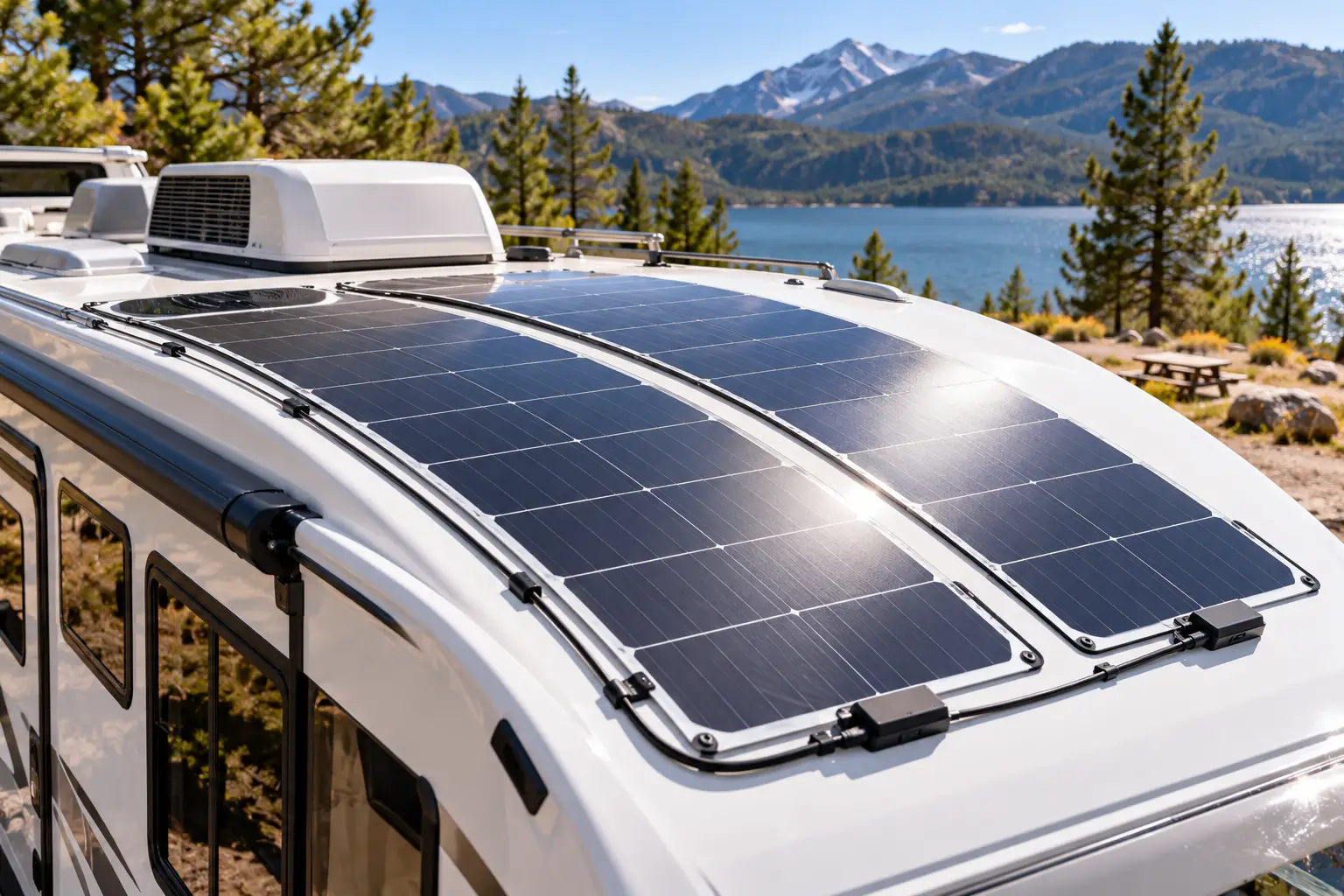
Picture this: you’re boondocking at a quiet BLM site in Utah, the coffee maker is gurgling, and not a single generator is humming nearby. That calm comes down to one thing: watts on your roof. And for a growing number of RVers, those watts come from flex solar panels rv owners can glue, screw, or strap onto curved, crowded, or weight-sensitive roofs where a 24-pound glass panel just won’t work.
Here’s the honest truth, though: flex solar panels rv buyers pick up today are not all created equal. Some are brilliant engineering. Others are bargain sheets that lose output fast once a few Arizona summers cook them flat against a roof. The difference usually hides in details most listings gloss over: cell type, surface coating, operating voltage, and how heat escapes (or doesn’t).
What Are Flex Solar Panels RV Owners Buy?
A flexible RV solar panel is a thin, lightweight photovoltaic module (usually 0.1 inch thick and 4–8 lb) built on a bendable polymer or fiberglass backing instead of glass and aluminum. It conforms to curved roofs, mounts without racking, and trades some heat tolerance and lifespan for dramatically lower weight and a stealthy profile.
If you want a refresher on how solar cells turn light into usable DC power, the U.S. Department of Energy’s solar PV basics guide is a clear, no-fluff primer. In this guide, we’ll go further: seven real products available to US shoppers, side-by-side analysis grounded in published spec sheets and aggregated owner feedback, plus installation, troubleshooting, and cost-of-ownership advice you won’t find on a product page.
Quick Comparison: The 7 Best Flexible Solar Panels for RV Roofs at a Glance
Looking at the table, the real split is between the 200W “new generation” panels and the 100–130W value tier. The BougeRV Arch Pro 200W and Renogy Flex ShadowFlux 200W cost more per panel but pack double the wattage into one footprint with modern N-type cells, while the ECO-WORTHY 130W Flexible wins on raw cost per watt if you can live with more modest real-world output. The BougeRV Yuma 200W CIGS is the outlier: pricier and less efficient on paper, but built around a completely different cell chemistry that handles bending and partial shade in ways crystalline panels can’t.
The Renogy Flex ShadowFlux 200W exists to solve the single most annoying problem in RV solar: a vent cap, an antenna, or a pine branch killing output across the whole panel.
Renogy’s spec sheet lists a 270° bend radius, a 0.1-inch profile, and roughly 7.7 lb for a 62.2 x 27.4-inch panel. In practice, that’s a 200W panel weighing about a third of Renogy’s rigid 200W N-type, which matters on a lightweight travel trailer near its cargo limit. Electrically, its 37.8V Vmp and 44.1V Voc mean you’ll need an MPPT controller; a cheap 12V PWM unit would waste a big slice of that voltage.
Based on comparing the specs, this is the panel for people who camp under trees or run cluttered roofs with AC shrouds and fans. The ShadowFlux design aims to keep usable power flowing when part of the panel is shaded, rather than letting one shadow drag the entire string down.
Because the flexible version is relatively new, review volume is still building, so long-term durability data is thinner than for Renogy’s older flex line. Early aggregated feedback centers on build quality and shade performance; treat any multi-year claims cautiously.
Pros:
Anti-shading design keeps output steadier under partial shade
200W in one panel means fewer roof penetrations
Very thin, low-drag profile at highway speeds
Cons:
High voltage requires an MPPT charge controller
Limited long-term field data on the flex version
Expect roughly $250–$320; solid value if shade is your daily reality, overkill if you always camp in full sun.
Renogy Flex ShadowFlux 200WSee current price, sizes and reviews on Amazon.
The BougeRV Arch Pro 200W brings rigid-panel cell technology into a bendable package, and on paper, it’s the efficiency leader of this roundup.
It uses N-type TOPCon cells with 16 busbars and a stated 25% cell efficiency, laminated with ETFE on a fiberglass base, weighing about 7.9 lb and bending up to 270°. Translation: more busbars shorten the path electrons travel, which helps the panel tolerate micro-cracks from road vibration, a real concern on anything that bounces down washboard forest roads. ETFE is also far more resistant to yellowing and delamination than cheap PET coatings.
The 31.1V Vmp makes it ideal for 24V systems or a 12V bank behind an MPPT controller. Given the 5-year materials warranty and 25-year, 80% output guarantee, this is the panel for full-timers building a “set it and forget it” 400–600W array.
Review sentiment across retailer listings is consistently positive, with buyers praising the stiffness of the fiberglass backing and stable output in partial shade; owners on RV forums are actively weighing it as an upgrade over older flex panels. Long-term data is still accumulating.
Pros:
25% cell efficiency squeezes more watts per square foot
ETFE and fiberglass resist delamination better than PET
Strong 25-year output warranty for a flexible panel
Cons:
Fiberglass backing feels stiffer than ultra-thin competitors
Not a match for basic 12V PWM controllers
At around $240–$320, it’s the best all-around value among premium 200W flex panels.
BougeRV Arch Pro 200WSee current price, sizes and reviews on Amazon.
The BougeRV Yuma 200W CIGS isn’t just “more flexible”; it’s a fundamentally different kind of solar panel, and that’s exactly why it earns a place here.
Instead of silicon wafers, it uses copper indium gallium selenide (CIGS) thin-film cells, which bend a full 360° and can even be rolled for storage. BougeRV lists 16% cell efficiency, a 25V Vmp, and a temperature coefficient of −0.38%/°C, and independent teardown coverage has noted 48 bypass diodes inside. That diode count is the secret sauce: shade one corner and only a small section drops out.
The tradeoff is size. At about 86 x 27 inches, it needs roughly 40% more roof area than a 200W N-type flex panel for the same rating. So it’s ideal for Airstream-style curved roofs, boats with curved hardtops, or owners who’ve already cracked a crystalline flex panel, but not for cramped roofs where every square foot counts.
Expert reviews from StorageReview and SolarReviews were favorable on durability and versatility, while flagging the steep price relative to silicon panels. Some owner feedback specifically credits CIGS with outlasting crystalline flex panels they replaced.
Pros:
True 360° flexibility for dramatic curves
Dozens of bypass diodes soften partial-shade losses
Thin-film cells resist micro-cracking from vibration
Cons:
Large footprint for its 200W rating
Highest price per watt in this lineup
Typically $400–$600; worth it only if your roof shape or durability needs genuinely demand CIGS.
BougeRV Yuma 200W CIGSSee current price, sizes and reviews on Amazon.
The Renogy 100W Flexible (model RNG-100DB-H) is the panel that made flexible RV solar mainstream, and it remains the safest entry-level bet for first-time buyers.
It’s 48 x 21.6 x 0.08 inches, weighs 4.2 lb, flexes up to 248°, and uses 36 monocrystalline cells. Renogy rates it for 2,400 Pa wind loads and 5,400 Pa snow loads, which in practical terms means it’s designed to survive highway gusts and a winter of snow sitting on a parked rig. Six metal-reinforced mounting holes make mechanical fastening an option, not just adhesive.
Its voltage plays nicely with a basic 12V PWM controller, which keeps a starter system cheap and simple: two of these, a 20A controller, and a single lithium battery is a classic weekend-warrior setup for a teardrop or small travel trailer.
Across years of retailer reviews, sentiment is broadly positive on ease of install and initial output. The most common complaint, shared across the whole crystalline flex category, is gradual output loss after years of being glued flat with zero airflow underneath.
Pros:
Huge review history and well-documented installation guides
Works with inexpensive 12V PWM controllers
5-year material and output warranty coverage
Cons:
Older cell technology than the 200W N-type options
Heat-related degradation if mounted with no air gap
Around $100–$150, it’s fair value for a trusted name with strong support.
Renogy 100W FlexibleSee current price, sizes and reviews on Amazon.
The Rich Solar MEGA 100 FLEX targets RVers who want a no-surprises 12V panel with modern cells and every mounting option included out of the box.
The current RS-F100B version uses 10-busbar monocrystalline cells rated up to 22.8% efficiency, an IP68 rating, and arrives with pre-drilled holes, adhesive backing, and pre-attached 3-foot MC4 leads. Its 17.1V Vmp and 20.4V Voc sit squarely in classic 12V territory, so it pairs cleanly with almost any charge controller, including the PWM unit already built into many RV converters’ solar ports.
Rich Solar also sells a MEGA 100 PRO FLEX 24V variant, a smart detail: if you’re building a 24V house bank, buying the matched-voltage version saves you wiring headaches later.
Honest caveat: verified customer review volume for the newest B revision is limited, and some retailer listings carry inconsistent bend-angle specs between revisions. What is verifiable is the published electrical data and Rich Solar’s established presence in the US RV market.
Pros:
True 12V voltage pairs with nearly any controller
Adhesive backing and grommets both included
24V sibling available for higher-voltage builds
Cons:
Limited verified reviews for the latest revision
Spec sheets differ between older and newer versions
Expect roughly $130–$170; decent value for anyone who prioritizes compatibility over peak efficiency.
Rich Solar MEGA 100 FLEXSee current price, sizes and reviews on Amazon.
The ECO-WORTHY 130W Flexible answers one question better than anything else on this list: how do I cover my roof with the most rated wattage for the least money?
ECO-WORTHY lists 12-busbar monocrystalline cells at 23.5% efficiency, a 2.4 mm profile, roughly 4.4 lb, and up to 245° of bend. The brand claims up to 520Wh per day with four hours of sun, a best-case figure that assumes ideal angle and temperature. On a flat RV roof in midsummer heat, a realistic expectation is meaningfully lower.
Here’s what to weigh: at its frequent price point, you could buy four of these for the cost of one premium 200W panel. That makes it ideal for budget builds, secondary arrays on cargo trailers, or anyone experimenting before committing to a premium system.
Aggregated buyer sentiment, especially in deal-community discussions, praises the value but repeatedly advises tempering expectations; at least one long-term user running a large batch reported real-world output well below the 130W nameplate. That’s typical of budget flex panels, and worth planning around.
Pros:
Lowest cost per rated watt in this roundup
Often sold in 2-packs and controller kits
Light enough to mount almost anywhere
Cons:
Real-world output often falls short of nameplate
Shorter expected lifespan than ETFE fiberglass panels
Usually $50–$80 each; outstanding value as long as you size your array with a generous margin.
ECO-WORTHY 130W FlexibleSee current price, sizes and reviews on Amazon.
The DOKIO 100W Flexible is the featherweight of this group, best treated as a low-risk experiment rather than the backbone of a full-time power system.
Its listing shows a 38.4 x 22.2-inch footprint and an item weight around 2.4 lb, the lightest here by a wide margin. It uses monocrystalline cells and corner grommets, and DOKIO sells it as singles, 2-packs, and a 400W four-pack. That weight makes it a natural fit for pop-up campers, rooftop tents, or a portable “chase the sun” panel you prop on a windshield.
Honest analysis: DOKIO publishes less detailed technical data than Renogy, BougeRV, or Rich Solar, and warranty terms are harder to verify. We can’t confirm long-term durability claims, so we’d steer full-timers toward a better-documented panel for permanent roof mounting.
Aggregated buyer feedback generally describes it as a functional budget panel that does what it says for light-duty charging, with the usual budget-flex caveats around longevity.
Pros:
Extremely light for pop-ups and portable use
One of the lowest entry prices available
Multi-pack options scale cheaply
Cons:
Sparse published specs and warranty details
Not ideal for permanent full-time roof installs
At roughly $45–$70, it’s fair value strictly for light-duty or portable use.
DOKIO 100W FlexibleSee current price, sizes and reviews on Amazon.
The most overlooked column here is “Controller Match.” The two premium 200W panels deliver their best value only with an MPPT controller, so budget an extra $80–$200 if your RV currently has a basic PWM solar port. Meanwhile, the Renogy 100W Flexible, Rich Solar MEGA 100 FLEX, and ECO-WORTHY 130W Flexible slot into an existing 12V PWM setup with zero electrical redesign.
Don’t miss these off-grid upgrades!
Take your RV power system to the next level with this carefully curated lineup. Click a highlighted panel to check current pricing and availability. These picks will help you get quieter, generator-free mornings the whole family will enjoy!
RV Flexible Solar Panel Installation: A Step-by-Step Guide
Most flex panel failures aren’t manufacturing defects; they’re installation mistakes. Here’s a proven rv flexible solar panel installation sequence that protects both the panel and your roof.
Before You Climb Up
Identify your roof membrane. EPDM rubber, TPO, and fiberglass each react differently to adhesives. Check your owner’s manual or the manufacturer’s sticker before buying any tape or glue.
Dry-fit everything. Lay panels out, mark corners with painter’s tape, and confirm nothing shades them from AC shrouds or vent fans at midday.
Plan your cable entry. A single weatherproof roof entry gland beats drilling a fresh hole for every panel.
Mounting Options, Ranked
Best: Mount on thin aluminum or corrugated plastic standoff panels, then attach those to the roof. This creates an air gap that lowers panel temperature.
Good: VHB-type tape on clean, primed surfaces combined with self-leveling lap sealant around the edges.
Avoid: Full-coverage construction adhesive glued flat. It traps heat and makes removal nearly impossible without destroying the panel.
First 30 Days
Check edges for lifting after your first long highway drive, re-seal any lap sealant gaps, and log daily solar harvest from your controller app. That baseline number becomes your early-warning system: if output drops sharply later, you’ll know something changed.
Real-World Scenarios: Matching Flexible Solar Panels for RV Roof Types and Travel Styles
Specs only matter in context. Here are three realistic profiles and how the products above fit each one.
The Weekend Teardrop Couple
Budget: under $400. Use: two-night trips, LED lights, a 12V fridge, phone charging. A pair of the Renogy 100W Flexible panels with a 20A PWM controller and one 100Ah lithium battery covers this easily. Why not premium? Because 200W of proven panels on a short trip schedule rarely runs out of energy, and the simpler wiring keeps maintenance minimal.
The Full-Time Boondocking Family
Budget: $1,500+. Use: daily living, laptops for remote work, a residential fridge running through an inverter. Three BougeRV Arch Pro 200W panels (600W) feeding a 40–60A MPPT controller is the right backbone. The higher efficiency means more harvest from a crowded fifth-wheel roof, and the 25-year output warranty matches the long horizon of full-time living. If your favorite campsites are wooded, swap in the Renogy Flex ShadowFlux 200W for its shade behavior.
The Curved-Roof Vintage Trailer Owner
Budget: $600–$1,200. Use: moderate loads on a rounded aluminum roof. Here the BougeRV Yuma 200W CIGS earns its premium: it follows the curve without stressing cells, and its thin-film chemistry tolerates the inevitable flexing of a rolling aluminum skin. Pair two with an MPPT controller and expect solid, steady harvest with fewer micro-crack worries.
Problem → Solution: Fixing Common Flex Panel Headaches
Even well-installed panels run into trouble. These are the five issues RV owners report most often, with practical fixes.
1. Output dropped after the first summer. Heat is the usual culprit. Solar cells lose efficiency as they warm, as explained in the Department of Energy’s solar PV performance and efficiency basics. Fix: future installs should use standoff mounting; for existing ones, keep the panel clean and verify wiring before blaming the cells.
2. One shaded vent kills the whole array. Fix: wire shade-prone panels in parallel rather than series, or upgrade that position to the Renogy Flex ShadowFlux 200W or BougeRV Yuma 200W CIGS, both designed to limit shading losses.
3. Corners lifting at highway speed. Fix: clean, re-prime, and re-tape the corner, then seal the leading edge facing forward. Adding mechanical fasteners through reinforced grommets (on panels like the Renogy 100W Flexible) adds insurance.
4. Controller shows high voltage but little charging current. Fix: you probably paired a 30V+ panel with a PWM controller. Upgrade to MPPT.
5. Yellowing or bubbling surface. Fix: this signals coating breakdown, common with PET-laminated budget panels. Document it and contact the seller under warranty; for replacements, choose ETFE-coated options like the BougeRV Arch Pro 200W.
How to Choose the Best Flexible Solar Panel for RV Use
Choosing the best flexible solar panel for rv use takes seven quick decisions:
Calculate daily energy needs. Add up watt-hours from your fridge, lights, fans, and devices. Everything else depends on this number.
Measure usable roof space. Subtract AC units, vents, and shade zones. This decides whether you need high-efficiency 200W panels or can spread out cheaper 100W ones.
Match system voltage. 12V PWM setups want ~17–19V Vmp panels; 24V banks or MPPT controllers unlock the 30V+ premium panels.
Choose your coating. ETFE outlasts PET in UV-heavy climates, so it’s worth paying for in the Southwest.
Check shade exposure. Frequent tree camping justifies anti-shading designs or CIGS.
Weigh warranty strength. A 25-year output guarantee signals manufacturer confidence; a vague one-year warranty signals a disposable product.
Budget for the full system. Controller, cabling, fuses, and sealant can add 30–60% to panel cost.
Get steps 1 and 3 right and you’ll avoid the two most expensive beginner mistakes: buying too little capacity and buying panels your controller can’t use efficiently.
Flexible vs. Rigid: Which Belongs on Your RV Roof?
Rigid glass panels still dominate large, flat motorhome roofs for good reason. They run cooler on tilt-able or raised racks, typically last longer, and cost less per watt. But flex solar panels rv owners choose win decisively in specific situations.
Factor
Flexible Panels
Rigid Glass Panels
Best For
Weight (200W)
~6–8 lb
~23–24 lb
Flexible: weight-limited trailers
Curved roofs
Conforms easily
Needs custom racking
Flexible: Airstreams, vans
Heat management
Weaker when glued flat
Better with air gap
Rigid: hot-climate full-timers
Typical lifespan
Shorter (varies by coating)
Longer
Rigid: long-term ownership
Aerodynamics/stealth
Nearly invisible
Raised profile
Flexible: stealth camping
The table makes the decision clearer than any marketing claim: flexible wins on weight, shape, and stealth, while rigid wins on heat and longevity. For example, Renogy’s rigid 200W N-type panel weighs about 23.8 lb, roughly three times the Renogy Flex ShadowFlux 200W, which can be the difference between staying under or over a small trailer’s cargo rating. If weight and curves aren’t your problem, rigid usually delivers more lifetime energy per dollar.
CIGS Flexible Solar Panel vs. Semi Flexible Solar Panels
Most products marketed as “flexible” are really semi flexible solar panels: thin slices of crystalline silicon laminated onto a bendable backing. They bend, but only within limits, and repeated flexing or vibration can micro-crack the brittle silicon underneath.
A CIGS flexible solar panel takes a different approach. As Wikipedia’s overview of CIGS solar cells explains, the light-absorbing layer is so thin that it can be deposited onto flexible substrates, though commercial CIGS modules have historically trailed silicon in module-level efficiency.
What this means for you:
Semi flexible solar panels (like the BougeRV Arch Pro 200W or Renogy 100W Flexible) deliver more watts per square foot. Choose them when roof space is tight.
A CIGS flexible solar panel (like the BougeRV Yuma 200W CIGS) tolerates extreme curves, rolling, and partial shade better. Choose it when shape or durability is the priority.
Don’t buy CIGS expecting high efficiency, and don’t buy budget semi flexible solar panels expecting them to survive tight bends repeatedly.
The practical rule: space-constrained roofs favor crystalline; curved or high-vibration installs favor CIGS.
Features That Actually Matter (and Ones That Don’t)
Marketing for flex solar panels rv shoppers see is packed with numbers. Here’s how to cut through it.
Features That Matter
Coating material (ETFE vs. PET): ETFE resists UV yellowing and delamination far better. This affects lifespan more than almost any spec.
Busbar count: More busbars (10BB, 12BB, 16BB) give current more paths around micro-cracks, which matters on a vibrating vehicle.
Operating voltage: It determines your controller choice and system cost.
Output warranty length: A long, specific output warranty is a manufacturer putting money behind durability claims.
Features That Matter Less Than You Think
Maximum bend angle beyond your roof’s curve: If your roof bends 15°, a 360° rating doesn’t help you.
Headline “cell efficiency”: Cell efficiency is not module efficiency. Laboratory and cell-level records, tracked in NREL’s Best Research-Cell Efficiency Chart, always run higher than what a finished panel delivers on your roof. Compare rated watts per square foot instead.
“Daily watt-hours” claims: These assume ideal sun and temperature. Divide them by roughly 1.3–1.5 for a realistic flat-mounted estimate.
Long-Term Cost and Maintenance
Price tags don’t tell the full story; cost per useful year does. Here’s a simplified value view based on typical price ranges at the time of writing.
Panel
Approx. Cost per Rated Watt
Expected Durability Signal
Best For
ECO-WORTHY 130W Flexible
~$0.40–$0.60
Budget-tier
ECO-WORTHY 130W Flexible: lowest upfront cost
Renogy 100W Flexible
~$1.00–$1.50
5-yr material/output
Renogy 100W Flexible: balanced value
BougeRV Arch Pro 200W
~$1.20–$1.60
25-yr/80% output
BougeRV Arch Pro 200W: long-term ROI
BougeRV Yuma 200W CIGS
~$2.00–$3.00
CIGS durability
BougeRV Yuma 200W CIGS: special roofs
The budget panel looks unbeatable until you factor in replacement. If a $60 panel needs replacing every few years while a premium panel keeps producing for a decade, the “expensive” choice can cost less per year of service, especially once you count your time on the roof and fresh sealant for each swap. For part-time campers, though, the ECO-WORTHY 130W Flexible may never wear out before the RV is sold.
Simple Maintenance Schedule
Monthly (while traveling): Rinse dust and bird droppings with water and a soft brush.
Every 3 months: Inspect edges, sealant, and cable glands.
Yearly: Re-check lap sealant, torque any fasteners, and compare harvest logs year-over-year.
Common Mistakes to Avoid When Buying Flexible Solar Panels for RV Roof Installs
Most regrets with flexible solar panels for rv roof installs trace back to a handful of avoidable errors:
Buying by price per watt alone. Cheap panels with weak coatings can lose output fast; factor lifespan into your math.
Ignoring controller compatibility. A 30V+ panel on a PWM controller wastes a large share of its potential.
Gluing panels flat with permanent adhesive. It’s the quickest path to overheating and an unremovable mess.
Underestimating shading. One rooftop AC unit can shade a panel for hours in the late afternoon.
Skipping fuses. Every panel string needs proper overcurrent protection matched to the manufacturer’s series fuse rating.
Mixing panel types in one string. Pairing a 31V panel with an 18V panel in series creates mismatched currents and losses. Keep strings uniform.
Avoid these six, and even a mid-range panel will outperform a premium one installed carelessly.
Safety, Regulations, and Standards
RV solar runs on low-voltage DC, but “low voltage” doesn’t mean low risk. A short circuit across a lithium battery can deliver enough current to melt wiring and start a fire.
Key Safety Practices
Fuse at the battery and the panel side. Match fuses to each panel’s listed series fuse rating (for example, 15A on the Renogy 100W Flexible and BougeRV Arch Pro 200W spec sheets).
Check cold-weather voltage. Panel Voc rises in freezing temperatures. Make sure your controller’s maximum input voltage has headroom above the panel’s Voc, especially for high-voltage panels like the Renogy Flex ShadowFlux 200W wired in series.
Use correctly sized, UV-rated cable. Undersized wire wastes energy as heat and can become a hazard.
Standards to Recognize
In the US, the National Electrical Code’s Article 690 governs solar PV systems and is widely referenced by RV electricians, while the RV Industry Association’s standards apply to factory-installed systems. Look for panels and controllers with recognized safety listings (such as UL or ETL marks on controllers and inverters), and keep your installation documented in case your insurer or a warranty claim requires it.
If you’re not comfortable with DC wiring, a certified RV technician can review your plan for a modest fee, which is cheap insurance on a rolling home.
FAQs
How many watts of flex solar panels rv owners need for boondocking?
Most boondocking couples do well with 400–600W paired with 200–300Ah of lithium storage. Lighter weekend users often get by on 200W. Calculate your daily watt-hours first, then add 30–50% margin for flat mounting.
Can I walk on flexible solar panels on my RV?
It's best not to. Crystalline flex panels can micro-crack under concentrated weight, even if they look fine afterward. CIGS panels tolerate more abuse, but stepping on any panel risks hidden damage and voided warranties.
Do flexible solar panels work with my RV's built-in solar port?
Usually, if voltage matches. Many factory ports feed a PWM controller, which pairs best with 12V-class panels near 18V Vmp. High-voltage 200W panels need an MPPT controller to perform properly.
Are flexible solar panels worth it compared to rigid panels?
They're worth it when weight, curves, or stealth matter. For large, flat roofs with room for racking, rigid panels typically deliver more lifetime energy per dollar. Many RVers mix both types on separate controllers.
How long do flexible solar panels last on an RV roof?
Lifespan varies widely by coating and mounting. ETFE-coated panels with airflow underneath last noticeably longer than PET budget panels glued flat. Check output warranty terms; they're the best durability signal available.
Conclusion: Choosing Flex Solar Panels RV Adventures Deserve
The right panel depends less on which brand is “best” and more on which problem you’re solving. For most full-time RVers, the BougeRV Arch Pro 200W offers the strongest mix of efficiency, coating quality, and warranty backing. If your favorite campsites sit under trees, the Renogy Flex ShadowFlux 200W is purpose-built for that frustration. Owners of rounded vintage trailers, or anyone who has already cracked a crystalline panel, should seriously consider the BougeRV Yuma 200W CIGS despite its premium.
On a tighter budget, the Renogy 100W Flexible remains the trustworthy starter panel, the Rich Solar MEGA 100 FLEX keeps 12V systems refreshingly simple, and the ECO-WORTHY 130W Flexible or DOKIO 100W Flexible let you experiment cheaply, as long as you size generously and expect shorter lifespans.
Whatever you choose, remember that installation decides lifespan as much as the panel itself. Leave an air gap, match your controller to your panel voltage, fuse everything, and log your daily harvest. Do that, and your flex solar panels rv setup will quietly power your coffee, lights, and laptop for many seasons of generator-free mornings.
Ready to power your next off-grid adventure?
Pick the panel that fits your roof, your budget, and your travel style. Click any highlighted product above to check current pricing and availability, and start enjoying quiet, sun-powered campsites the whole family will love!
Disclaimer: This post contains affiliate links. As an Amazon Associate, I earn from qualifying purchases made through these links, at no additional cost to you.
Found this article helpful? Share it with someone who needs it!