As an Amazon Associate I earn from qualifying purchases. Links in this article may be affiliate links. How we choose gear
The Honda EU7000iS is the quiet pick and the Champion 7500-Watt Dual Fuel Generator is the budget pick, yet the right 240vac generator in 2027 depends less on either name than on one receptacle: the 120/240-volt outlet on the panel has to match the inlet, cord or appliance it will feed. Wattage badges say little about that. A 4,500-watt inverter can ship with 120-volt outlets only, and then a 240-volt well pump or central air unit never gets a connection.
Maker spec sheets, instruction manuals, dealer listings, specialist-press reviews and owner threads shape the six picks below, which run from a 7,000-watt gas inverter to a 6,000-watt battery unit and the 10-foot cord that links either one to a house. Everything is sorted by plug first, watts second and weight third.
Which 240vac generator plug fits your inlet or appliance
Receptacle codes look like noise until one is wrong. The twist-lock L14-30R is a 30-amp, 120/240-volt outlet, and 30 amps at 240 volts works out to 7,200 watts. That is the ceiling for anything drawn through that single outlet, even when the engine is rated higher. A 7,500-watt machine pushing everything through one L14-30R would need about 31 amps.
The 14-50R is the 50-amp straight-blade outlet. AC WORKS describes the 14-30R as the dryer outlet and the 14-50R as the range outlet, and the two differ mainly in the shape of the neutral pin. One owner on the r/Generator subreddit notes that the 14-50R on his genset is limited to 37.5 amps by the machine, so the printed 50 can overstate what the panel delivers.
Two similar-looking outlets carry no 240 volts at all. Champion’s manual describes the TT-30R as a 120-volt, 30-amp RV receptacle, and the L5-30R is likewise a 120-volt twist-lock. “RV ready” on a box therefore says nothing about 240 volts; a Forest River forum thread notes Champion uses that phrase for either a TT-30R or a 14-50R.
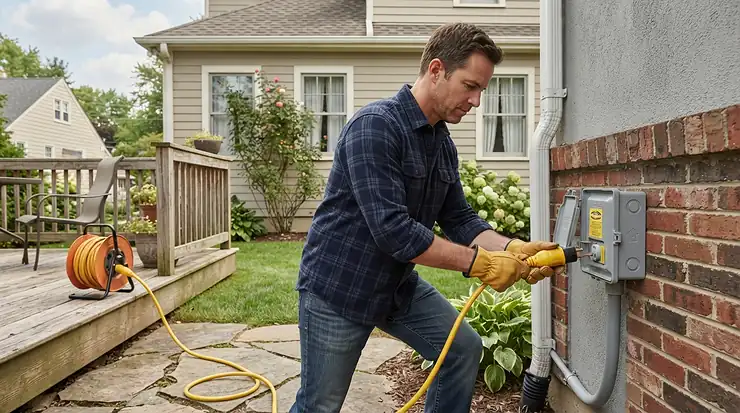
For house connections, Norwall describes the preferred method as running the generator’s 120/240-volt receptacle to a matching plug on a transfer switch inlet box, which feeds every circuit in the switch without cords through windows. A utility’s GenerLink compatibility guide goes further and warns that a generator can fail on plug type, wattage, voltage or GFCI, then lists each model’s neutral as bonded or floating. An electrician should confirm those details before anything is wired.
The filter: a 240-volt receptacle named on a maker page
We kept only models whose maker or retailer page names a 240-volt receptacle. Gas units also carry the carbon monoxide rule from the Consumer Product Safety Commission, which says to run portable generators outside only, at least 20 feet from the house, and never on a porch or in a carport. That distance shapes the cord section later.
Receptacle, watts and weight across the six picks
Pick
240-volt connection
Rated output
Energy
Weight
Main limit
Honda EU7000iS
30A 125/250V locking
5,500 W (7,000 W max)
Gasoline
About 261 to 263 lb
Weight and price
WEN DF680iX
L14-30R
5,100 W gas, 4,500 W propane
Gas or propane
About 95 to 99 lb
Small 2.9-gallon tank
Champion 7500-Watt Dual Fuel Generator
L14-30R
7,500 W gas, 6,750 W propane
Gas or propane
About 205 to 213 lb
74 dB(A)
EcoFlow DELTA Pro 3
L14-30R and 6-20R
4,000 W (8,000 W surge)
4,096 Wh battery
113.5 lb
Needs wiring gear for a house
Anker SOLIX F3800
L14-30 and 14-50 (version dependent)
6,000 W (9,000 W surge)
3,840 Wh battery
132.3 lb
Small base capacity
DuroMax XP3010GC
L14-30P to L14-30R
30 A cord
Not applicable
Not listed
10-foot length
The table shows a clear split. Gas machines trade weight and noise for runtime, while the two battery units trade capacity for silence and zero exhaust. Only the WEN DF680iX comes in under 100 pounds, which is why it earns a place next to the much pricier Honda.
240vac inverter generator picks for tight neighborhoods
A neighborhood with close lots is where this machine earns its price. Honda dealer pages list 52 to 58 dB(A) in operation, while Champion lists 74 dB(A) for its open-frame unit; the two figures come from different setups, but the gap is wide.
Honda’s own page rates the EU7000iS at 5,500 watts running and 7,000 watts maximum on 120/240 volts, which is 22.9 amps and 29.1 amps at 240 volts. A selector switch chooses 120/240-volt mode or 120-volt only, and in the second mode the full output can reach any 120-volt outlet, limited only by that outlet’s own capacity. The panel carries two GFCI 20-amp duplex receptacles, a 30-amp 125-volt locking outlet and a 30-amp 125/250-volt locking outlet, according to a Sportsman’s Warehouse listing. Some dealer pages swap the two ratings and print 7,000 as running watts, so read the 5,500 on Honda’s page as the sustained figure.
Dealer pages cite a 5.1-gallon tank, roughly 6.5 hours at rated load, and 16 to 18 hours at quarter load depending on the page. Weight is the sore spot: dry weight is listed near 261 to 263 pounds. One poster on the AirForums owners thread says he has spoken with three owners who use a Harbor Freight-style lift to load and unload it, which is anecdotal but fits the number.
Pros:
Selectable 120/240-volt or 120-volt-only output
CO-MINDER shutdown listed on Honda’s page
Optional parallel kit for a second unit, which a dealer says reaches 11,000 watts
Cons:
Dry weight above 260 pounds
Dealer listings from Overtons, Tractor Supply and Sportsman’s Warehouse sit between roughly $4,000 and $5,100
Check the current price on Amazon.com.
Honda EU7000iSSee current price, sizes and reviews on Amazon.
2. WEN DF680iX — dual-fuel inverter under 100 pounds
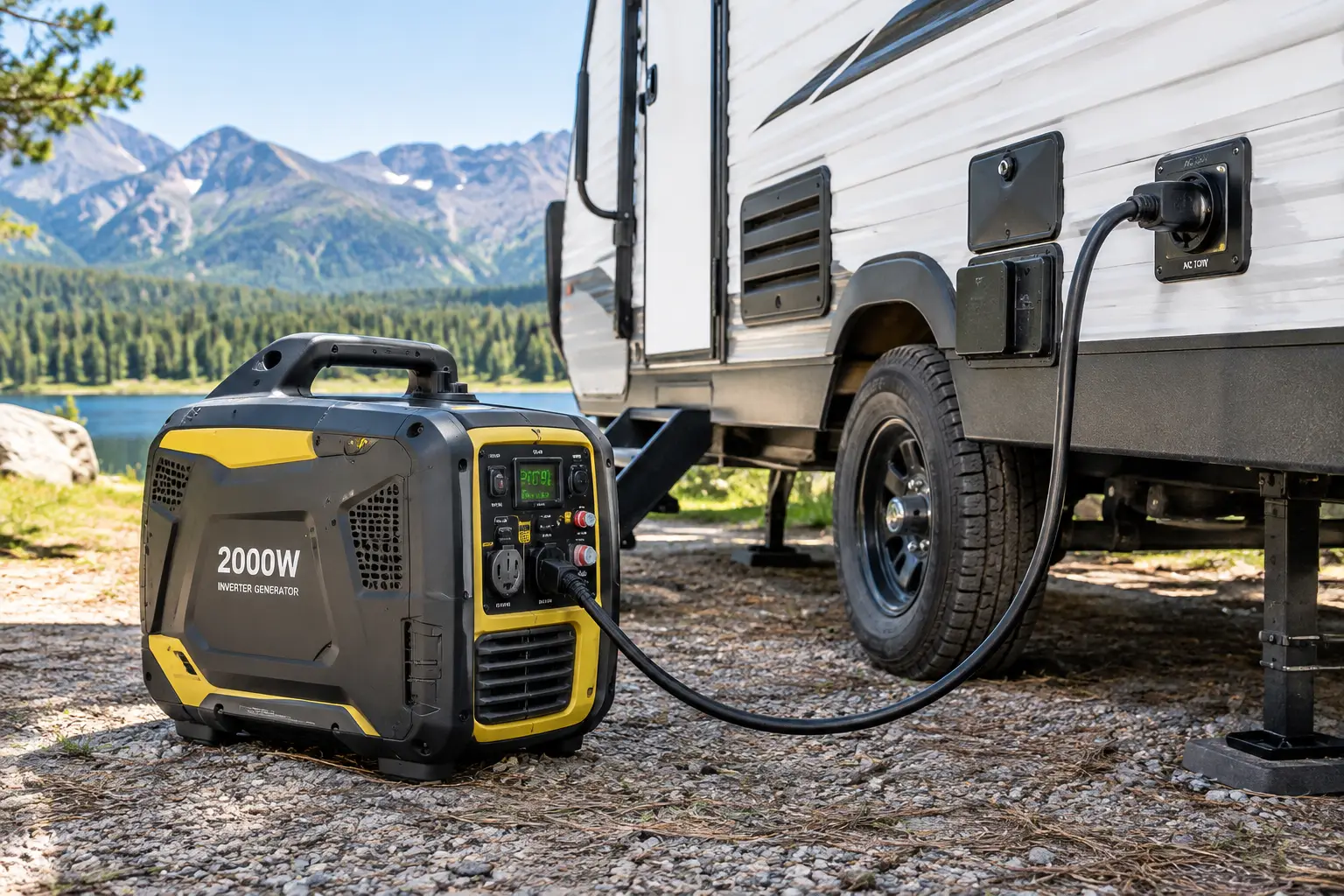
Weight separates the WEN from the Honda first: retailer pages list about 95 to 99 pounds, a little over a third of the Honda’s dry weight. Output drops with it, though a 240vac inverter generator in this class still serves a 30-amp inlet. The manual rates gasoline at 6,800 watts surge and 5,100 watts running, propane at 6,000 and 4,500, and quotes 21.25 amps at 240 volts on gas and 18.75 amps on propane.
The panel holds an L14-30R, two 5-20R household outlets, a TT-30R RV outlet, a 12-volt DC outlet and two USB ports. A Lowe’s listing describes a bonded-neutral 240-volt configuration meant for low-power Level 2 EV charging, which is worth passing to an electrician before the unit is tied to a transfer switch. A CO sensor and parallel capability are also listed.
A buyer on a Desertcart listing praises the 240-volt output for a house transfer switch and the low noise, but calls the gas runtime low and the unit heavy to lift though easy to wheel. That buyer had not yet run it on gasoline, so treat the runtime point as a flag, not a measurement. The tank holds 2.9 gallons, and the same buyer reports about 10 hours on propane at 75% load. Check the current price on Amazon.com.
WEN DF680iXSee current price, sizes and reviews on Amazon.
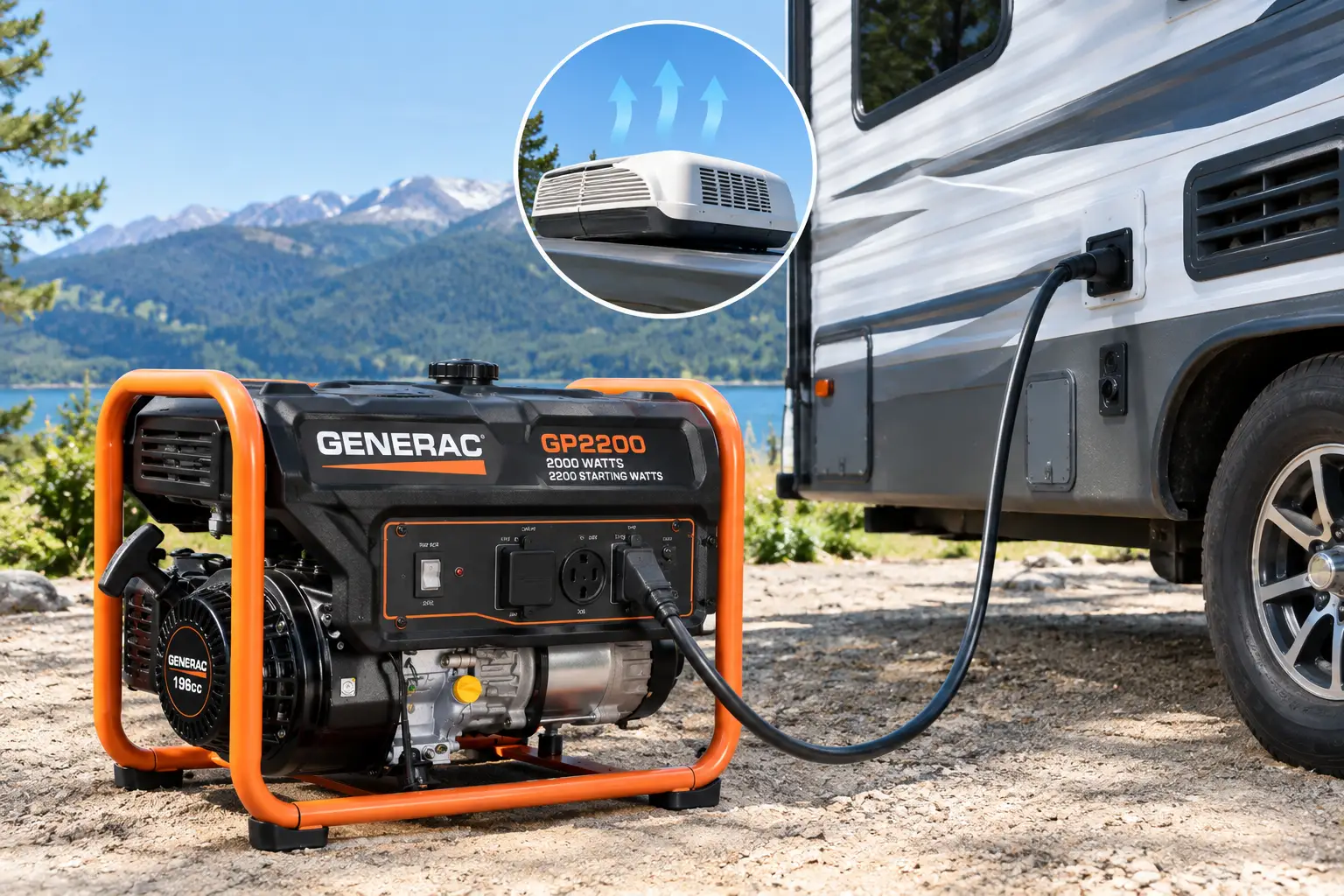
Noise is the limit to settle first. Champion lists 74 dB(A), and Bob Vila’s reviewer measured 74 dBA at 23 feet on a closely related model, saying it suits no campground that caps generators near 60 dBA. In the same Bob Vila review, Mark Wolfe ran the 100891 for a month: a table saw, miter saw and air compressor together for 8.5 hours, then a refrigerator, deep freezer and space heaters through extension cords during a 4-hour outage. He said extension cords took more effort than a transfer switch would, and that moving 205 pounds over soft ground was hard work.
Ratings are 7,500 running and 9,375 starting watts on gasoline, and 6,750 and 8,400 on propane, from a 439 cc engine per Champion’s pages. Bob Vila lists about 10 hours at half load on a 7.7-gallon tank and about 5.5 hours on a 20-pound propane cylinder, and calls it a good value near $1,000 and a solid starter backup unit. Dealer pages put it between roughly $1,000 and $1,400.
Among open-frame choices, this 240vac portable generator is the one whose outlet sets change between model numbers: the 100891 has four 5-20R outlets, an L5-30R and an L14-30R, a Camping World listing for the 100153 shows a TT-30R, a 14-50R, an L14-30R and a 5-20R, and the 201040 and 201281 pair two GFCI duplexes with an L5-30R and an L14-30R. Compare the exact model number before buying, because the plug mix decides which cord and inlet fit.
Pros:
Runs on gasoline or propane
An L14-30R appears on every variant described above
Electric start with a battery on the listed variants
Cons:
205 to 213 pounds
74 dB(A) at the engine
Uses more fuel per watt than the most efficient portables, per Bob Vila
Champion 7500-Watt Dual Fuel GeneratorSee current price, sizes and reviews on Amazon.
The change from its predecessor is the headline. The older EcoFlow DELTA Pro needed two units tied through the EcoFlow Double Voltage Hub, which dealer pages list at 7,200 watts and 30 amps maximum for around $139 to $159, before it could reach 240 volts. The DELTA Pro 3 builds the split-phase output in.
B&H lists four 5-20R outlets, one TT-30R, one 6-20R and one L14-30, with 4,000 watts continuous and 8,000 surge from a 4,096 Wh lithium iron phosphate pack. Firefold’s listing puts the L14-30R at 16.7 amps, which is 4,000 watts at 240 volts. Three home connections are listed: an L14-30R inlet box, a manual transfer switch that can swap between 120-volt and 240-volt output, and EcoFlow’s Smart Home Panel 2 at up to 4,000 watts.
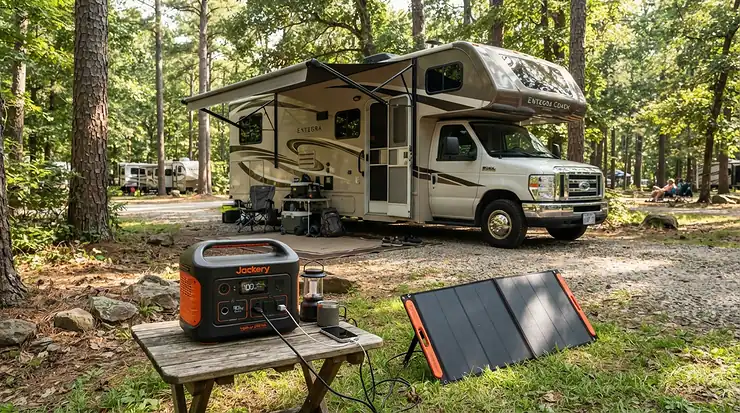
TechRadar’s review praises 240-volt power without a gas generator’s fumes or venting, puts AC charging to 80% near 50 minutes and rates solar input up to 2,600 watts. The reviewer also calls it heavy at 113.5 pounds, advises help or avoiding stairs, and notes that whole-home backup needs extra wiring equipment. Price at review time was near $3,700, with a sale price near $3,200. Check the current price on Amazon.com.
EcoFlow DELTA Pro 3See current price, sizes and reviews on Amazon.
Six thousand watts is half again the DELTA Pro 3’s 4,000. Anker lists 3,840 Wh of lithium iron phosphate storage, 9,000 watts surge, and 120/240-volt split-phase output from a single unit, with an L14-30 and a 14-50 each rated at 6,000 watts at 240 volts. Up to six BP3800 expansion batteries stretch capacity to 26.88 kWh.
Anker’s US store now lists the F3800 Plus, which adds a generator bypass and 3,200 watts of solar input. Outlet sets and charging limits differ between the two, so match the listing to the plug you need. A CleanTechnica tester found that three EV chargers errored out in the standard 110-volt mode and charged once 240-volt mode was switched on with a double press, and called the 132.3-pound weight a strain on the word portable.
Pros:
6,000 watts from one unit
Both 14-50 and L14-30 outlets named on Anker pages
Capacity expandable to 26.88 kWh
Cons:
Heavy at 132.3 pounds
Anker’s FAQ says that while the unit recharges from AC, only the 120-volt outlet can power devices
The base 3.84 kWh covers roughly a third of the 11 kWh a typical US home uses daily, using the figure CleanTechnica cites
Check the current price on Amazon.com.
Anker SOLIX F3800See current price, sizes and reviews on Amazon.
The two twist-lock ends are the whole product. Retailer listings describe an L14-30P at one end and an L14-30R at the other on 10 feet of 10-gauge wire, rated 30 amps at 240 volts, with an SJT jacket that stays flexible to minus 40 degrees Fahrenheit and UL listing, per Norwall. It joins a generator’s 30-amp 240-volt outlet to a transfer switch inlet.
Length needs planning, because a 240vac generator plug is only half the connection. The CPSC’s 20-foot rule means a 10-foot cord alone leaves the machine too close if the inlet sits on a wall, and DuroMax sells the same cord in 25 and 50-foot lengths. Generators that carry only a 14-50R need a different cord, since an L14-30P does not mate with it. Norwall and Home Depot list it at around $40.
DuroMax XP3010GCSee current price, sizes and reviews on Amazon.
A sample calculation, with stated assumptions: take a hypothetical 1,500-watt, 240-volt load and ignore conversion losses, which make real battery times shorter. The EcoFlow DELTA Pro 3 holds 4,096 Wh, so it runs that load for about 2.7 hours. The Anker SOLIX F3800 holds 3,840 Wh, or about 2.6 hours, and a 7,680 Wh pair with one BP3800 reaches about 5.1 hours.
The Honda EU7000iS at a quarter of its 5,500-watt rating draws about 1,375 watts, and dealer pages list up to 16 to 18 hours on a tank. The comparison explains the split. Batteries suit short, silent, evening-sized needs, and gas covers a multi-day outage once the tank is refilled. A 240vac solar generator has no exhaust, but it still needs the right plug.
Mismatches that send a 240-volt generator back
A 120-volt-only inverter at a 240-volt job is the first. Norwall lists the Westinghouse iGen4500c with two 120-volt household outlets and a 120-volt TT-30R and no 240-volt receptacle, so a 240-volt inlet has nothing to connect to.
Reading peak as running is the second. Honda dealer pages that print 7,000 as running watts and a WEN page that shows 4,500 next to 5,100 (propane versus gasoline) both create the same confusion.
A neutral or compatibility mismatch is the third: the utility guide above and the WEN listing’s bonded-neutral wording both show neutral configuration matters when a transfer device is involved.
Charging limits are fourth, as Anker’s FAQ about the unavailable 240-volt outlet during AC recharging shows. Fifth, distance: the CPSC’s 20 feet is longer than the 10-foot cord.
Quick answers on 240-volt outlets, plugs and sizing
What does 240vac mean on a generator?
It names a 240-volt alternating-current output, normally a split-phase 120/240-volt receptacle such as the 30-amp L14-30R. That outlet supplies both 120-volt and 240-volt circuits, which is what well pumps, central air units and EV chargers need according to maker pages.
Can a 120-volt generator run a 240-volt appliance?
Not directly. A panel with only 120-volt household outlets and a TT-30R, as on a 4,500-watt inverter, has no 240-volt receptacle. A 240-volt pump or air conditioner needs a model with a listed L14-30R or 14-50R.
What plug does a 240-volt portable generator use?
A 240vac generator plug on a 30-amp model is usually the twist-lock L14-30R, and some larger open-frame models add a 14-50R. A TT-30R or L5-30R is 120-volt only. Match the cord end to the inlet, and have an electrician confirm the inlet wiring.
Can a solar generator output 240 volts?
Yes, on models built for it. Current split-phase battery units from EcoFlow and Anker create 120/240-volt output from one unit, while the earlier EcoFlow design needed two units and a Double Voltage Hub.
Can a 240-volt generator power a house?
Only through a transfer switch or inlet wired by a licensed electrician. Norwall describes plugging the generator's 120/240-volt receptacle into a matching inlet box. Plugging a cord into a wall outlet is not a substitute.
Which 240-volt setup to buy
For a household that wants a quiet 240vac generator, the Honda EU7000iS is the strongest of the six on noise and clean inverter output, and the WEN DF680iX is the lighter dual-fuel alternative if 95 to 99 pounds matters more than a Honda badge. The Champion 7500-Watt Dual Fuel Generator is the budget choice for long gas runtimes, provided the neighbors tolerate 74 dB(A). The EcoFlow DELTA Pro 3 and Anker SOLIX F3800 fit short, silent outages, and the DuroMax XP3010GC is the piece that connects any L14-30R generator to an inlet.
The decision rule is simple: write down the receptacle on your inlet or appliance first, then pick the machine that offers it. Check current availability on Amazon.com for the one that matches your plug.