As an Amazon Associate I earn from qualifying purchases. Links in this article may be affiliate links. How we choose gear
Someone with a 100Ah lithium battery, a 12V fridge and roof space for exactly one panel needs a number before spending anything: how much does a hundred watt solar panel actually hand over by sunset? RV Travel’s electrical columnist puts it near 300 watt-hours on an ordinary day, about a quarter of that battery’s capacity, while Renogy’s product copy claims 400 to 500. The distance between those two figures decides how long a battery takes to recover and what one panel can realistically feed in 2027.
The wiring order, test tolerances and spec numbers below come from Renogy’s own manuals and datasheets, while OutdoorGearLab’s measurements, an RV-electrical columnist and forum and retailer reviews supply the real-world output.
Short answer first: wire the battery to a charge controller before the panel, plan on 300 to 400 watt-hours a day in decent sun, and check the panel with a multimeter against the label on its back before blaming the rest of the system.
Connecting a 100 watt solar panel to a battery without damaging the controller
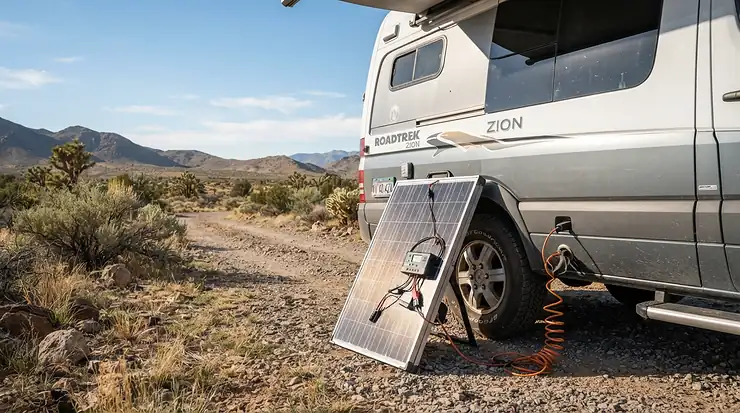
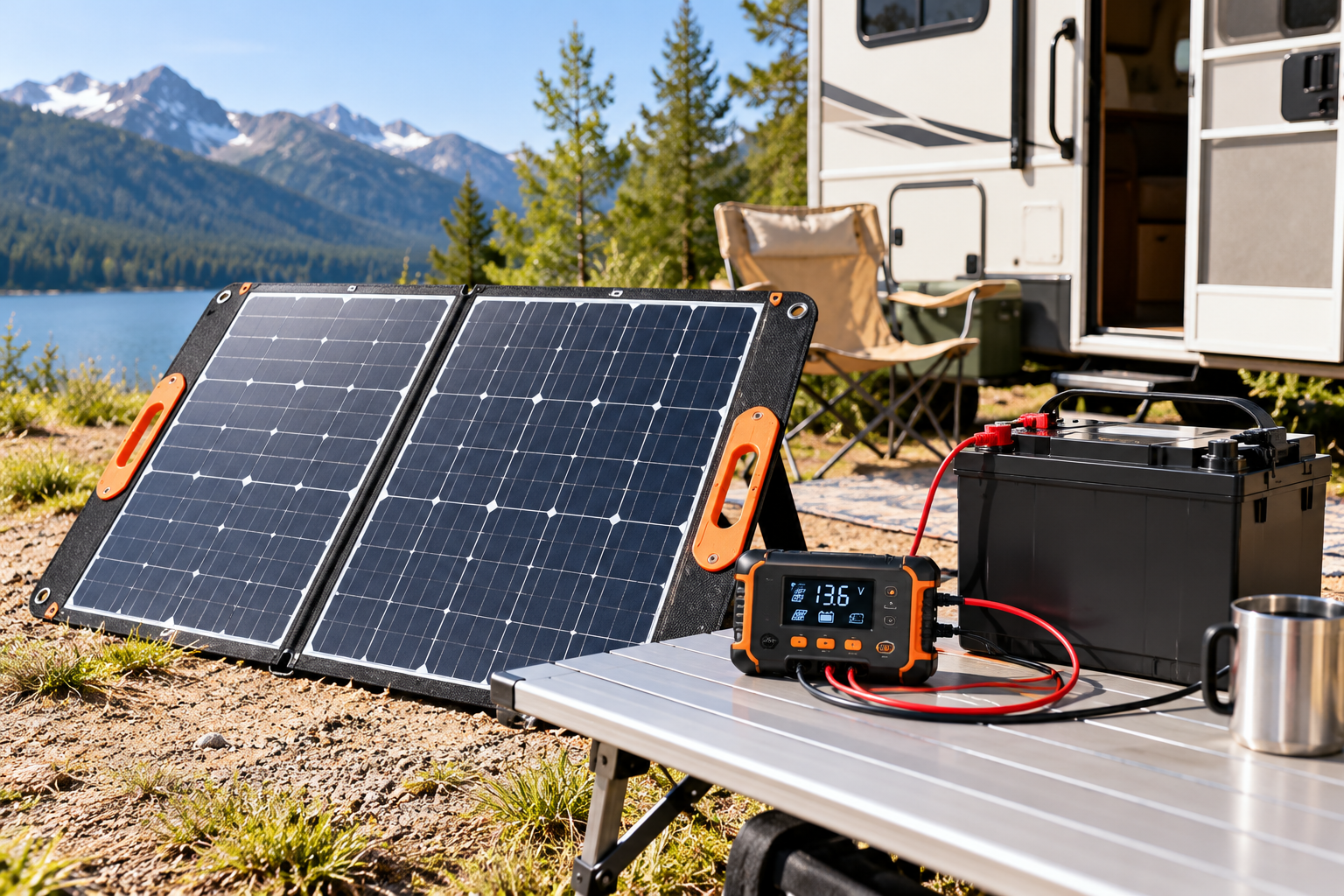
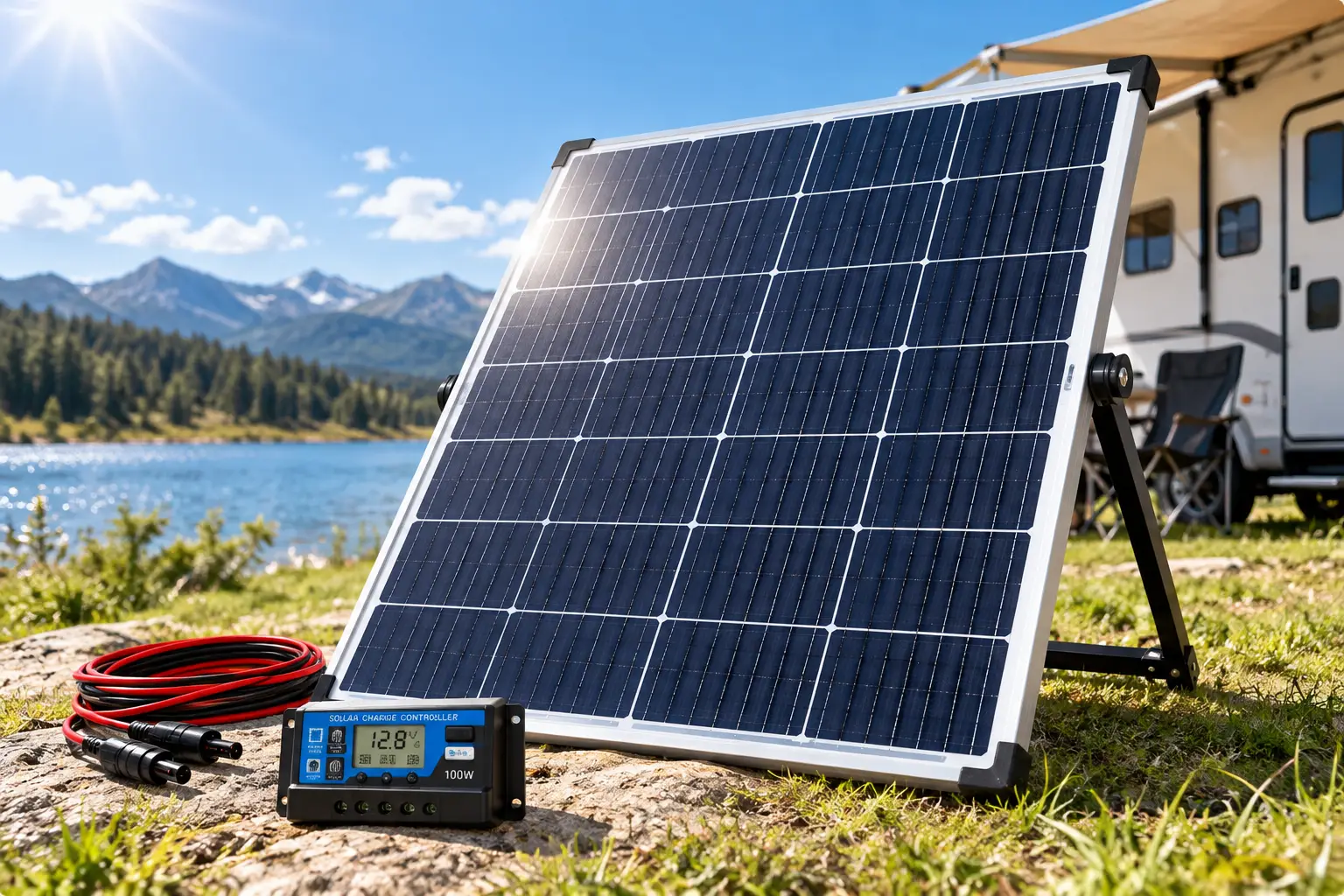
A one-panel system has four parts: the panel, a charge controller, a battery and the cables between them, plus an inverter only when something needs household AC. Footprint Hero’s walkthrough is blunt about the shortcut to avoid, which is wiring the panel straight to the battery, because that can damage the battery. Renogy’s system setup guide gives the sequence, and the order is the part that matters: battery terminals to the controller first, panel second.
Cover the panel face with a towel or blanket so it makes no voltage while you work; one Australian retailer’s wiring guide recommends exactly that.
Run the controller’s battery terminals to the battery with short cables. The Samlex manual says the controller should sit as close to the battery as possible to limit voltage drop.
Put an inline fuse on the panel lead. A Renogy controller FAQ sizes the PV-side fuse at 1.56 times the PV current, so this panel’s 5.21 amps works out to about 8.1 amps, and the 10-amp MC4 inline fuse in Footprint Hero’s build is the next size up.
Join the panel’s MC4 leads to the controller’s PV terminals through adapter cables, which Renogy says are needed between panel and controller.
Remove the cover. In sun the controller should show charging; Footprint Hero describes a flashing green PV light when panel, controller and battery are all connected correctly.
Disconnect in reverse: panel first, battery last.
A second panel changes one thing. Renogy’s blog says a PWM controller charging a 12V bank needs the panels in parallel, which keeps voltage the same and adds amps, so two compact panels reach about 10.4 amps of short-circuit current. Series wiring raises voltage and suits MPPT controllers, which Renogy says accept up to 100 volts, making long runs on thin wire practical. Grape Solar’s quick-start guide for its 100-watt kit adds the placement rule: face the panel due south at roughly the angle of your latitude, in full sun and clear of shade.
One compatibility detail deserves arithmetic before anything is ordered. The compact Renogy panel lists 24.3 volts open-circuit, and Renogy’s Wanderer 30A controller lists 25 volts as its maximum PV input. Open-circuit voltage climbs as cells get colder, at 0.28 percent per degree Celsius on Renogy’s datasheet. Sample calculation, assuming cells near 14°F (-10°C) on a clear winter morning: that is 35 degrees below the 25°C test condition, which adds about 9.8 percent and lifts 24.3 volts to roughly 26.7, above the controller’s stated ceiling. Cells warm up in sun, so the exposure is cold early hours, but an MPPT controller with a higher input limit removes the question.
How to use a 100 watt solar panel: plan in watt-hours, not watts
The 100-watt label is peak output in full sun under lab conditions, so daily energy depends on peak sun hours, the equivalent hours of full-strength light a location receives. NREL’s PVWatts calculator returns that solar-resource figure for a U.S. address.
Sample calculation, assuming 5 peak sun hours and a 0.75 real-world derate: 100 W × 5 h × 0.75 is about 375 Wh, or roughly 31 amp-hours at 12 volts. That lands inside the 300 to 400 watt-hour range RV Travel’s columnist gives and the 30 to 35 amp-hours etrailer’s support team quotes for a 100-watt panel over five to six hours of direct sun. It sits well under the 500 watt-hours in Renogy’s marketing copy.
Against a 100Ah lithium battery holding about 1,200 watt-hours, 375 Wh a day returns a fully drained battery to full in a little over three days. RV Travel’s columnist reaches the same conclusion from the other direction, saying four panels are needed to refill that battery in a single day.
Small loads fit comfortably. A solar FAQ site puts a 19-to-24-inch LED TV at 25 to 35 watts, so three hours uses about 75 to 105 watt-hours, roughly a fifth to a quarter of one day’s harvest.
Location moves the numbers more than most buyers expect. A solar-calculator site puts the Southwest at 5.5 to 7.0 peak sun hours and the Northeast at 3.5 to 4.5. With the same 0.75 derate, that stretches the 375 Wh example to roughly 260 to 340 Wh in the Northeast and 410 to 525 Wh in the Southwest. A retail buyer’s report of 180 watts from a 200-watt portable panel at the winter peak is a single data point, but it shows why a December plan needs a wider margin than a July one.
100 watt solar panel for RV roofs, vans and trailers
Roof space usually settles the choice between rigid and flexible. Renogy’s datasheet gives the compact rigid panel at 41.8 by 20.9 inches and 14.1 pounds. Renogy’s flexible 100-watt panel measures 43.0 by 22.9 inches, 0.1 inch thick and 5.3 pounds, though its listed module efficiency is 15.7 percent against 17.8 percent for the rigid one.
A buyer on Renogy’s flexible-panel page runs two on a van roof for a fan, lights, a 12V fridge and a small inverter, which is one owner’s report of what two panels carry. A poster on the BobIsTheOilGuy forum expects about 85 watts at most from a 100-watt panel in the two hours either side of noon, March through September; that is also a single voice, but it matches the measured-versus-claimed gaps in the portable-panel tests later in this guide.
How to test a 100 watt solar panel with a multimeter
Two readings answer most questions: open-circuit voltage (Voc) and short-circuit current (Isc). Renogy’s troubleshooting page says results are valid only on a sunny day with nothing shading the panel, at solar noon, facing true south in the Northern Hemisphere and tilted about 30 degrees, with multi-panel arrays disconnected so each panel is checked alone. Redarc’s guide adds that the panel should be unplugged from the regulator and battery.
Find Voc and Isc on the sticker on the back of the panel; Bluetti’s guide points to the same place.
For Voc, set the meter to DC volts with the black lead in COM and the red in the V port, then touch the red lead to the positive MC4 connector and the black to the negative. A negative reading means the probes are swapped, per Footprint Hero.
For Isc, move the red lead to the amp port and set the dial to DC amps. Bluetti says the meter’s fuse rating must exceed the panel’s short-circuit current, and DroneBot Workshop warns that measuring current wrongly can blow the meter’s fuse, so take the voltage reading first.
Compare both readings with the label using Renogy’s tolerances.
For the compact Renogy panel, whose label shows 24.3 volts and 5.21 amps, those tolerances work out as follows.
Reading
Label value
Passing range per Renogy
Open-circuit voltage
24.3 V
21.87 to 26.73 V (within 10 percent)
Short-circuit current
5.21 A
2.6 A or higher (at least 50 percent)
The current floor is loose on purpose. Renogy notes that any drop below its 1,000 watts-per-square-meter rating lowers short-circuit current, so haze or an off-angle panel can cut the reading sharply. Sunwize’s module-testing guide lists reverse polarity, loose wiring and failed bypass diodes among the usual causes of bad readings at the panel itself.
Older versions publish different numbers, with 22.5 volts and 5.75 amps on the larger RNG-100D according to dealer pages. The label on the panel in your hands, not another model’s datasheet, sets the target.
Renogy’s page lists no electrical safety warnings for the procedure, so the meter’s own manual governs. A Klein manual for its MM400 calls for CAT III or CAT IV rated leads, fully seated plugs and fingers kept away from the probe contacts.
Where a hundred watt setup loses output or damages gear
Most failures trace back to a short list of causes.
Order of connection comes first. Renogy’s manual language is that the panel should never go to the controller before the battery, and KitchPrep’s 100W wiring guide warns that one reversed connection can destroy a controller.
Chasing the rated number comes next. OutdoorGearLab measured a FlexSolar 100W portable at 70 watts, or 70 percent of its claim, and its Renogy 200W Portable at 177 watts, or 88 percent. Both fall short of the label, and the BobIsTheOilGuy poster’s 85 watts fits the same pattern. Heat explains part of the gap. Renogy’s datasheet lists a power temperature coefficient of -0.37 percent per degree Celsius, so under a sample assumption of cells at 65°C (149°F) on a hot roof, 40 degrees above the 25°C test condition costs about 14.8 percent, leaving roughly 85 watts before wiring and dust losses. These measurements suggest planning around 70 to 90 percent of rated watts at noon.
Version mix-ups cost money too. A controller chosen against one revision’s 22.5-volt Voc may sit closer to its limit with another revision’s 24.3 volts, and a roof template cut for the 47.3-inch RNG-100D will not suit the 41.8-inch compact panel.
Wiring a PWM controller with panels in series on a 12V bank is the fourth trap, since Renogy says that setup requires parallel. Last comes the meter: DroneBot Workshop’s guide describes blowing a meter fuse by measuring current incorrectly, a slip the Klein Lead Alert LEDs discussed below are meant to flag.
Cable gauge is the quiet sixth. Renogy’s Wanderer 10A manual pairs a 100-watt, 5-amp panel input with 16 AWG wire for runs up to 10 feet, 16 to 14 AWG from 11 to 20 feet and 14 to 12 AWG from 21 to 30 feet. The panel’s own 14 AWG leads are about 2 feet long, so the extension, not the panel, usually decides how much voltage disappears on the way to the controller.
Beyond one panel: 200 watt, 220 watt and the 5000 watt question
The listings below state different voltages and currents, which is why the options are not interchangeable.
Option
Rated watts
Voc listed
Isc listed
Listed detail
Renogy 100 Watt 12 Volt Monocrystalline Solar Panel (Compact Design)
100
24.3 V
5.21 A
41.8 × 20.9 in, 14.1 lb
Renogy 200W Portable Solar Panel
200
23.4 V
10.5 A
25.0 × 21.1 in folded, 17.6 lb in one listing
Newpowa 220W 12V Monocrystalline Solar Panel
220
20.52 V
13.41 A
10 busbar cells per a dealer listing
Renogy Bifacial 220 Watt 12 Volt Monocrystalline Solar Panel
220
21.86 V
–
1547 × 763 mm (about 61 × 30 in), 12.4 kg
The 200 and 220 watt panels carry roughly twice the current of the 100-watt unit at similar voltage, so cable gauge and controller amperage rise with them. Renogy’s Wanderer 10A manual lists about 130 watts at 12 volts, which suits one 100-watt panel and nothing bigger, while the Wanderer 30A’s 400-watt ceiling at 12 volts covers either 220-watt panel or two 100-watt panels in parallel.
A 200 watt portable solar panel earns its price by folding and moving. Two fixed 100-watt panels at around $90 to $100 each per Sprinter Store and Battery World come to roughly $180 to $200, a sum below the portable panel’s price, but they stay on the roof.
The 220 watt solar panel class is the middle step. The Newpowa 220W 12V Monocrystalline Solar Panel sells around $215 to $240 across two dealer pages, Battle Born and a Newpowa reseller. The Renogy Bifacial 220 Watt 12 Volt Monocrystalline Solar Panel is promoted by dealers as producing up to 30 percent more energy by catching light on both sides, a maker claim and not a measurement.
The 5000 watt solar panel search covers two different things. No single residential panel is rated near 5,000 watts; the number describes a 5 kW array or, in some listings, inverter or power-station output. Jackery’s own 5kW page features its Jackery Explorer 5000 Plus, a 10 kWh power station with a pure sine wave inverter, as a solar generator and not as a panel.
Sample calculation: at 100 watts each, 5,000 watts is 50 panels, and at about 6.07 square feet apiece (41.8 × 20.9 inches) that is roughly 303 square feet of glass before any gaps. Climate Biz counts 12 to 13 panels of 400 watts for a 5 kW system. A hundred watt solar panel is a battery-charging tool, and past a few hundred watts, larger panels with an MPPT controller are what installers size around.
Gear for the job: panel, controller, meter and a folding second option
Each piece below ties to a step above. Spotted one that suits your roof or campsite? Take a closer look at the listing.
Versions of the Renogy 100 watt 12 volt monocrystalline solar panel line differ enough that the label matters more than the product title. The current compact revision’s datasheet lists 24.3 V open-circuit, 5.21 A short-circuit, 20.4 V and 4.91 A at maximum power, 36 cells, an IP65 rating and a 15-amp maximum series fuse. Dealer pages for an older revision show 22.3 volts and 5.75 amps, and the original RNG-100D carries a 47.3-inch length. Compare the exact model number against the sticker before wiring or ordering controller parts.
At 41.8 by 20.9 inches and 14.1 pounds it fits roofs a larger old-style panel cannot, and Best Buy’s listing notes 20 pre-drilled mounting holes. Dealer pages including Sprinter Store and Battery World show it at around $90 to $100. Renogy’s copy claims 400 to 500 watt-hours a day; the 300 to 375 range from earlier sections is the safer planning figure.
Pros:
Smaller footprint than the older 47.3-inch RNG-100D
Pre-drilled holes for mounting and grounding
Junction box and PV leads included, per a Shop Solar Kits listing
Cons:
Rigid glass-and-aluminum build at 14.1 pounds, against 5.3 for Renogy’s flexible version
Output leads of about 2 feet, so most roofs need extension or adapter cables
Renogy 100 Watt 12 Volt Monocrystalline Solar Panel (Compact Design)See current price, sizes and reviews on Amazon.
The 25-volt PV input ceiling is the limit that matters most for this guide, because the compact panel’s cold-weather voltage can climb past it, as the earlier calculation shows. Renogy’s page lists a 12 VDC nominal system, 30 A rated charge current and under 10 mA self-consumption. A dealer listing adds 400 W maximum PV input at 12 V, support for AGM, gel, flooded and lithium (LiFePO4) batteries, and protections against overcharge, over-discharge, overload, short circuit and reverse polarity.
There is no LCD, and Bluetooth monitoring needs the optional BT-1 module, according to the same dealer. Renogy’s page and Solartown’s listing together put the controller around $30 to $40. Footprint Hero’s review calls the 30A Wanderer the best PWM controller for most people and says it suits 12V systems of 400 watts or less, one reviewer’s judgment that agrees with Renogy’s figures. A 10-amp Wanderer, rated near 130 watts at 12 volts, handles a single panel but leaves no room to add a second.
Renogy Wanderer Li 30A PWM Charge ControllerSee current price, sizes and reviews on Amazon.
The two readings in the testing section need DC volts up to the mid-20s and a DC amp range above the panel’s 5.21 A. Klein’s selection guide lists the MM420 with 600 V DC, a 10 A DC range and a CAT III 600V rating, and its product page describes an auto-ranging TRMS meter. Dealer datasheets add Lead Alert LEDs that flag test-lead placement, which addresses the wrong-jack mistake DroneBot Workshop warns about.
The kit includes leads with CAT III/CAT IV safety caps, a thermocouple and two AAA batteries, per Klein’s European page. The manual-ranging Klein Tools MM325 offers the same 10 A DC and 600 V ratings with fewer functions, which can suit anyone who only plans to read panels. Check the current price on Amazon.com.
Klein Tools MM420 Digital MultimeterSee current price, sizes and reviews on Amazon.
Around $250 to $330 across OutdoorGearLab, EnergySage and dealer listings puts this above two fixed 100-watt panels in cost, in exchange for folding to a carryable size. OutdoorGearLab’s portable-panel roundup named it Editors’ Choice, measured 177 watts against the 200-watt claim, and noted a setup time of about 35 seconds, sturdier kickstands than budget rivals and a two-year warranty. Its drawbacks there were Velcro legs that are harder to adjust and an IP65 rating, lower than the IP68 on two rivals.
Listings disagree on weight: 17.6 pounds on EnergySage and a Wellbots page, 14.8 pounds in OutdoorGearLab’s review, and 13.89 pounds on a newer listing that claims 25 percent efficiency. Buyers on a retailer listing report about 170 watts on a fairly sunny day near 60°F and a winter peak of 180 watts feeding an EcoFlow River 3 Max. Each is one buyer’s report, but both sit near OutdoorGearLab’s 177 watts. One buyer also needed a 10-foot, 12-gauge MC4-to-XT60 cable to reach an Anker power station, a connector detail to settle before ordering.
Pros:
Folds to 25.0 × 21.1 × 2.2 inches, per a listing
OutdoorGearLab measured 88 percent of rated output
Adjustable kickstands for tilting toward the sun
Cons:
IP65 rating, below the IP68 of some rivals
A listed 23.4 V open-circuit voltage suits 12V systems and little beyond them, according to one buyer
Renogy 200W Portable Solar PanelSee current price, sizes and reviews on Amazon.
Quick answers on daily watt-hours, wiring order and a 5,000-watt array
How many watt-hours does a 100 watt solar panel make in a day?
Plan on roughly 300 to 400 watt-hours in decent sun. RV Travel's columnist estimates about 300, while a sample calculation using five peak sun hours and a 0.75 derate gives 375. Renogy's marketing claims 400 to 500, which needs unusually strong sun.
Do I need a charge controller for a 100 watt solar panel?
Yes. Footprint Hero warns that wiring a panel directly to a battery can damage the battery, and a controller regulates the charge. Renogy's 10-amp Wanderer manual lists about 130 watts at 12 volts, so even a small system has an inexpensive controller option.
Do I connect the battery or the solar panel first?
Battery first. Renogy's manual says never to connect the panel to the controller before the battery, and to disconnect in reverse, panel first and battery last. That order lets many controllers initialize correctly and protects the controller from damage.
How do I know if my 100 watt solar panel is working?
Measure open-circuit voltage and short-circuit current in strong midday sun with the panel unplugged. Renogy's tolerances are within 10 percent of the label for voltage and at least half the label for current. A 24.3-volt panel should read 21.87 to 26.73 volts.
How many 100 watt solar panels make a 5000 watt system?
Fifty, since 5,000 divided by 100 is 50, covering about 300 square feet at the compact panel's 41.8 by 20.9 inch size. Residential systems use fewer, larger panels, and Climate Biz counts 12 to 13 panels at 400 watts each.
Matching one panel to the job it can actually do
A hundred watt solar panel works best as a battery-topping tool: around 300 to 400 watt-hours a day, enough for lights, a laptop and a small TV, not a camper’s whole kitchen. The decision rule is short. Connect the battery to the controller first, then the panel. Confirm the controller’s voltage ceiling clears the panel’s cold-weather open-circuit voltage. Test the panel against its own label before assuming a fault.
For a fixed roof in mild climates, the Renogy 100 Watt 12 Volt Monocrystalline Solar Panel (Compact Design) with the Renogy Wanderer Li 30A PWM Charge Controller matches the datasheets, with the Klein Tools MM420 Digital Multimeter as the verification tool. Where mornings drop below freezing, an MPPT controller with a higher input limit removes the 25-volt question. Anyone who moves camp often gets more from the Renogy 200W Portable Solar Panel, which OutdoorGearLab measured at 177 watts.
Found a combination that suits your roof or campsite? Take a closer look at each listing on Amazon.com.