As an Amazon Associate I earn from qualifying purchases. Links in this article may be affiliate links. How we choose gear
Generac quiet source refers to the QuietSource series, the company’s liquid-cooled home standby line sold in 22, 27, 36, and 48 kW sizes, and dealers now mark its QT-series models as discontinued. Their pages point shoppers to Generac’s Protector line, where the premium liquid-cooled units carry a “QS” label that echoes the old name. Anyone shopping in 2027 therefore has two jobs: work out which current Generac fits the house, and decide how much noise is acceptable.
This guide covers the series itself, the fuel question behind “what is the power source for Generac generators,” and four Generac models sold through Amazon for different homes and budgets. The details rest on Generac’s spec and support pages, dealer listings, specialist-press reviews, and buyer reviews on retailer sites, and each figure is attributed to the page it came from.
Where the QuietSource name went, and what Generac sells now
The QT022 spec sheet describes the 22 kW QuietSource as a naturally aspirated 2.4 L gas engine inside a sound-attenuated enclosure, running on natural gas or LP with a two-year limited warranty. The engine turns at 1,800 rpm, which a Power Equipment Direct listing frames as half the speed of other engines at 3,600 rpm. Slower is quieter: dealer listings put the weekly exercise cycle at 61 dB at 23 feet and compare it to an idling car.
That hardware cost space and weight. Dealer pages list the 22 kW unit at 843 pounds and roughly 62 by 29 by 33.5 inches.
Dealer pages for the generac quiet source series now mostly read “discontinued.” Electric Generators Direct marks the 22, 27, 36, and 48 kW QT models that way and redirects to Protector replacements, including a Protector QS 48 kW. Lowe’s lists a Protector QS 22 kW with a five-year warranty and shows it out of stock.
Two paths follow from that. A buyer who wants the liquid-cooled, 1,800 rpm design should look at the Protector family, whose exercise-mode ratings in Generac’s table run from 59 dB at 25 kW up to 65 dB at 60 kW. A buyer who mainly wants a quiet unit at a lower cost should look at the air-cooled Guardian line, which Generac’s own brochure calls its top-selling home standby generator.
Searches for generac guardian quiet source blend two different products. Guardian is the air-cooled line and QuietSource was the liquid-cooled one. What they share is Quiet-Test, a lower-speed weekly exercise mode.
What is the power source for Generac generators?
It depends on the type, and the power source also decides how much noise you get.
Home standby units, whether Guardian, Protector, or the old QuietSource, run on natural gas or liquid propane from the home’s own supply. Lowe’s notes on a Protector 22 kW that the installer sets the fuel in the field and that the setting cannot be changed afterward. Generac’s page for the Guardian 22 kW lists 22 kW on propane and 21 kW on natural gas. Some Protector models run on diesel instead, which Generac positions for homes with no gas or LP service.
Portable inverter models such as the iQ line burn gasoline. Generac’s power stations are different again: the GB2000 stores electricity in a lithium battery that a wall outlet, a car charger, or solar panels refill.
Generac type
What powers it
Pick in this guide
Air-cooled home standby
Natural gas or LP from the home supply
Generac Guardian 22kW (7042)
Liquid-cooled home standby
Natural gas or LP, diesel on some Protector models
Covered in the section above
Portable inverter generator
Gasoline
Generac iQ3500 (7127), Generac iQ2000 (6866)
Portable power station
Lithium battery, charged from outlet, car, or solar
Generac GB2000 (8026)
The fuel line is permanent and refills itself, the gas can needs a trip to the pump, and the battery runs out. That last point matters later, because only the battery option makes no engine noise at all.
Reading Generac’s decibel figures without fooling yourself
Generac’s support page on decibel ratings says its figures are taken 23 feet from the front of the unit at normal load, and that other sides may measure louder. It lists air-cooled Guardian units at 61 dB(A) for 10 kW, 65 for 14 and 18 kW, 67 for 20 to 24 kW, and 68 for 26 kW. It gives no separate exercise-mode figures for them, and it publishes no decibel ratings for portable generators.
Generator
Cooling
Sound at 23 ft
Condition and source
QuietSource QT022, 22 kW
Liquid
61 dB
Exercise mode, dealer listing
Protector, 25 kW
Liquid
59 dB(A)
Exercise mode, Generac table
Protector, 36 kW
Liquid
61 dB(A)
Exercise mode, Generac table
Guardian, 18 kW
Air
65 dB(A)
Normal load, Generac support
Guardian, 22 kW
Air
67 dB(A)
Normal load, Generac support
Guardian, 26 kW
Air
68 dB(A)
Normal load, Generac support
The rows do not compare cleanly, because an exercise cycle runs the engine slower than an outage does. A dealer page for a 32 kW Protector shows both numbers: 58 dB in test mode and 64 while running, a six-decibel gap. Distance and pad placement relative to bedrooms and property lines will change what you hear more than the series name will.
Buyer reviews are split on the point. Reviews of Generac home standby units on Sam’s Club’s site, which cover several sizes, mix praise for quiet running with complaints: one from 2017 calls a unit very noisy and one from 2026 cites excessive noise. That is a mixed result and not a consensus.
Two more criteria separate one quiet Generac from another. The first is engine design, since slower liquid-cooled engines run lower than air-cooled ones but weigh far more. The second is the load itself: Norwall’s sizing FAQ says a 22 kW standby unit can back up a large home with power management handling heavy 240-volt loads, while a portable inverter covers selected circuits and a power station covers short, quiet jobs.
Matching a quiet Generac to the house, the worksite, or the campsite
The four picks below cover a whole house, a 30-amp portable hookup, a lightweight camp setup, and a battery option with no engine. Each is a Generac model sold through Amazon, and none is a QuietSource; Generac’s current standby lineup sits in the Guardian and Protector families.
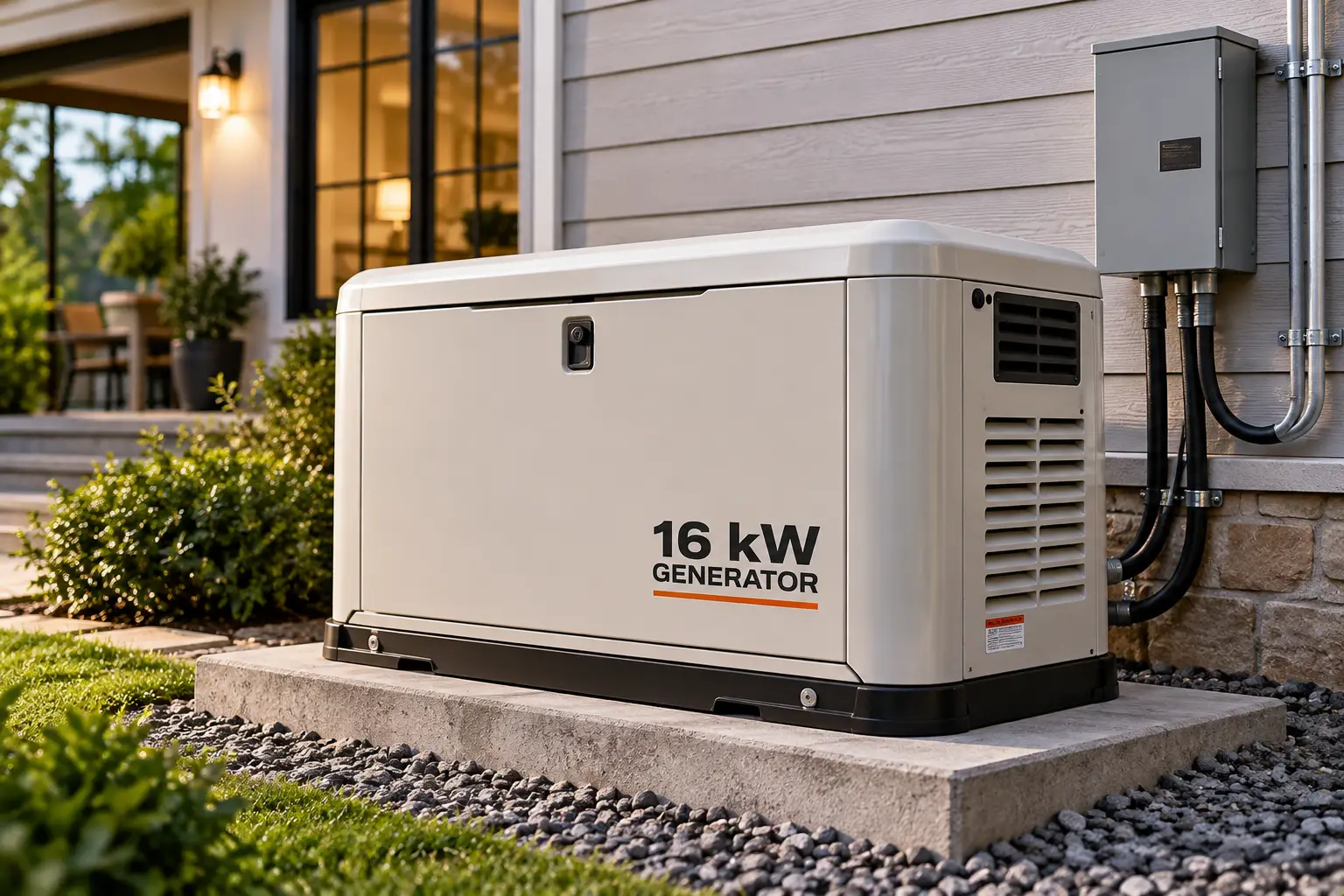
A large house with central air, an electric water heater, and a well pump is the kind of load a 22 kW standby unit gets sized for. The Generac Guardian 22kW (7042) is the air-cooled answer to the old generac quiet source generator for that house. Generac’s 22 kW page lists a 999 cc G-Force 1000 engine, an aluminum enclosure, a five-year limited warranty, and free Mobile Link Wi-Fi monitoring.
The footprint is smaller than the liquid-cooled design it replaces. Generac lists 48 by 25 by 29 inches and 466 pounds, against the 843 pounds dealers list for the QuietSource 22 kW. The trade is volume: Generac’s chart puts a 22 kW Guardian at 67 dB(A) under load, and Quiet-Test applies only to the five- or twelve-minute scheduled exercise run. Fuel use scales with the load, with 3.71 gallons of propane per hour at full load and 221 cubic feet of natural gas per hour at half load on Generac’s page.
Buyer reviews mirrored from an Amazon listing on Desertcart show a 4.4 average across 421 ratings. Praise centers on automatic starts within seconds and quiet running, with one buyer saying it was hard to hear from a nearby bedroom. Complaints cluster around delivery: several units arrived with dents or a bent access panel, one buyer described minimal packaging, and others note that the battery is not included and that a cold-weather kit is recommended in cold climates. One buyer reported a low-oil-pressure fault and about two months before a dealer visit, while other buyers described quick, professional support.
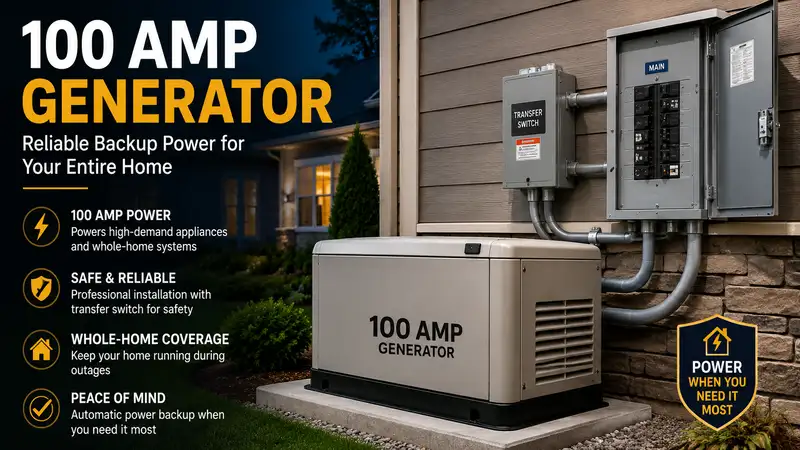
What ships in the box varies by model code. Norwall lists a 7043 version with a 200-amp transfer switch and Abt lists a 70433 package with a whole-house switch, and one buyer on the mirrored page said the switch included with their order was not suited to whole-house use. Compare the exact model code against the transfer switch you need before buying. Check the current price on Amazon.com.
Generac Guardian 22kW (7042)See current price, sizes and reviews on Amazon.
Dealer pages at Build.com, Empire Rigging, and GME Supply put the iQ3500 at roughly $1,000 to $1,300. For that it delivers 3,000 running and 3,500 starting watts from a 212 cc engine, with electric start, a 30-amp twist-lock outlet, two USB ports, and an economy mode that lowers engine speed to cut noise and fuel use. The 2.6-gallon tank is listed at 8.9 hours at half load, and a parallel kit (7668, sold separately) joins two units.
Generac does not publish a decibel rating for portables, and retailers fill the gap inconsistently: Norwall lists 54 dB while an industrial supplier’s catalog lists 57.5 dBA. Generator Mechanics, a review site that says it used the unit for six months, found the noise lower than it expected next to a Honda inverter and called the Generac the winner of that comparison. A Busted Wallet review likes the LCD readouts but says the fuel gauge is hard to find.
Pros:
3,000 running watts with a 30-amp twist-lock outlet
Economy mode lowers engine speed, noise, and fuel use
Parallel-ready with a separate kit
Cons:
Listings put the weight between roughly 109 pounds on Build.com and 120 on USA BlueBook
No official decibel rating from Generac
Norwall also lists a separate 7723 version with COsense carbon monoxide shutdown and says it is not for sale in California.
Generac iQ3500 (7127)See current price, sizes and reviews on Amazon.
At 46.2 pounds in iBoats’ listing, the iQ2000 is the lightest engine-driven pick here. It is rated for 1,600 running and 2,000 starting watts from an 80 cc overhead-valve engine, starts with a recoil pull, and carries a 1.06-gallon tank that a Power Equipment Direct listing rates at 5.7 hours at half load. Consumer Reports describes it as gasoline-powered and manual-start, with parallel capability.
Real-world reports show where the ceiling sits. A GearJunkie review found it handled small electronics with ease, but a saw cutting hardwood pushed it past its limit and it shut down; the review notes that sanders, circular saws, and drill presses can draw 1,800 watts or more. One owner review on Power Equipment Direct, posted in 2019, reports that the inverter failed after 32 hours of use and that a repair shop three hours away kept the unit for four months, which is a single report and not a pattern.
On noise, one AirForums poster citing a third-party acoustic study put it 1.0 dBA below a comparable Honda at half load. That is a secondhand claim, and Generac itself gives no figure.
Power Equipment Direct lists a two-unit kit at 3,200 combined watts, and Generac’s parallel kit for the iQ2000 is model 6877.
Generac iQ2000 (6866)See current price, sizes and reviews on Amazon.
No engine means no fuel, no exhaust, and no engine noise. The Generac GB2000 (8026) stores 2,106 watt-hours in a lithium battery and delivers 1,600 watts continuous with 3,200 watts of surge through three 120-volt outlets, two USB-A and two USB-C ports, a 12-volt outlet, and a wireless charging pad. A solar charge controller is built in, and Norwall’s listing adds a three-year limited warranty. Retailer pages such as ToolUp and AP Electric list it between roughly $1,500 and $1,700.
Bob Vila’s roundup of quiet generators lists 0 dB in its spec table and rates the GB2000 five out of five for noise. Its reviewer ran a fridge, lamps, electronics, and a miter saw from it, and recharged from 28 percent to full in just under five hours using 400-watt solar panels. The reviewer also notes that solar panels are not included and that 43 pounds is cumbersome over long distances.
The limit is runtime. As a sample calculation that ignores conversion losses, which shorten real runtime, 2,106 watt-hours covers a steady 400 watts for about five hours but a full 1,600 watts for only about 80 minutes. That suits a refrigerator-and-lights outage or a quiet campsite, and it does not stand in for a standby unit.
Pros:
Zero decibels listed in Bob Vila’s spec table
Eight output ports plus a wireless charging pad
Solar charging controller built in
Cons:
Solar panels are sold separately
Heavy at 43 pounds for long carries
Check current availability on Amazon.com before choosing the battery route.
Generac GB2000 (8026)See current price, sizes and reviews on Amazon.
Four ways a quiet Generac turns into a return or a regret
Reading an exercise-mode figure as the outage volume is the first. A 61 dB number for a QuietSource or a 59 dB number for a Protector describes the weekly test run, while a Guardian’s 67 dB describes normal load. Compare units under the same condition or expect a surprise.
Assuming a Guardian is a QuietSource is the second. Guardian engines are air-cooled and, in the 24 kW case, a listing from AP Electric states a maximum of 3,600 rpm, twice the QuietSource speed. Same brand, different engine, different sound.
Skipping the box contents is the third. Reviews describe missing batteries, optional cold-weather kits, and transfer switches that differ by model code. One buyer on a mirrored Amazon review page for another Generac standby unit also said the switch panel in their delivery looked used, and that the warranty claim bounced between the seller and the maker. Reading the return window and warranty terms before a heavy delivery arrives is cheap insurance.
Sizing from the wrong number is the fourth. A 3,000-watt portable and a 22 kW standby unit are different tools, so list the circuits that must run, add the largest motor’s starting surge, and match the generator to that total.
QuietSource, Guardian, and Protector: short answers on fuel and noise
Is the Generac QuietSource series still made?
Dealer pages list the QT-series 22, 27, 36, and 48 kW models as discontinued and point to Protector replacements, including units labeled QS. Any leftover unit deserves a close look at its warranty terms before ordering.
What fuel does a Generac QuietSource generator run on?
The QT022 spec sheet lists natural gas or LP operation. On the current Protector 22 kW, a Lowe's listing says the installer sets the fuel type in the field and that the choice cannot be changed once it is set.
How loud is a Generac Guardian home standby generator?
Generac's support chart lists 61 dB(A) for the 10 kW model, rising to 67 for the 22 kW and 68 for the 26 kW, measured from the front at 23 feet under normal load. Quiet-Test lowers engine speed during scheduled exercise only.
Is a Generac Guardian the same thing as a QuietSource?
No. Guardian units are air-cooled, and the 22 kW size uses a 999 cc G-Force engine. QuietSource units used a liquid-cooled 2.4 liter engine running at 1800 rpm. Searches for generac guardian quiet source tend to blend the two lines.
Can a portable Generac power a whole house?
Not the way a standby unit does. A 3,000-watt portable inverter generator covers selected circuits or appliances, while a 22 kW standby unit is rated at more than seven times that output on propane. Whole-house coverage starts with sizing a standby model to the home's loads.
Which Generac to settle on
Buyers who came looking for a generac quiet source generator for the whole house will find the closest current answer in the Guardian family, and the Generac Guardian 22kW (7042) is the pick here: air-cooled, five-year warranty, Wi-Fi monitoring, and a smaller, lighter footprint than the QuietSource it replaces. Those who want the liquid-cooled design itself should price the Protector line through a Generac dealer.
For portable needs, the Generac iQ3500 (7127) suits 30-amp hookups, the Generac iQ2000 (6866) suits light loads and easy carrying, and the Generac GB2000 (8026) suits short, silent outages. Match the pick to the circuits that must stay on, and check current availability below for the one that fits.