
In This Article
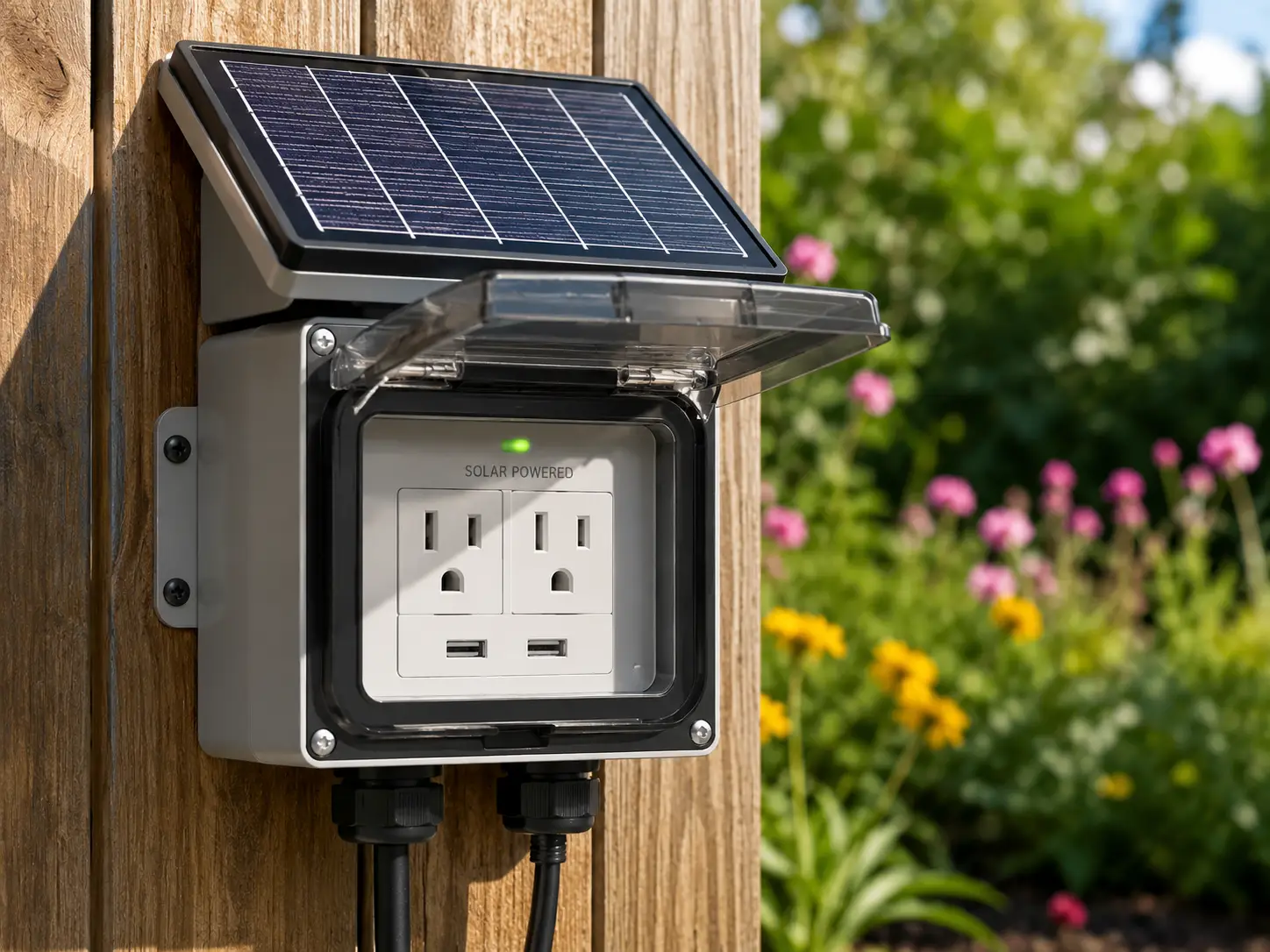
A solar electrical outlet is a battery-based power system — usually a portable power station paired with a solar panel — that gives you a standard AC plug anywhere sunlight reaches, without trenching a yard or hiring an electrician. If you’ve ever run an extension cord across a lawn to power a shed light, a sump pump, or a laptop at a campsite, you already understand the problem this solves.
The appeal is obvious once you think it through. A detached garage, a chicken coop, a backyard studio, a boat slip, or a remote cabin often sits just far enough from the house panel that running conduit is expensive, disruptive, or against code. A solar powered outlet sidesteps all of that: charge a battery from the sun (or a wall outlet as backup), then plug in tools, lights, chargers, or small appliances whenever you need them. For campers and RVers, the same technology becomes a portable solar generator with outlets that rides in a trunk instead of bolting to a wall — a category sometimes referred to more broadly as a solar generator, the umbrella term for any battery system charged primarily by photovoltaic panels.
This guide breaks down seven real, currently available options — from compact entry-level units under 300 watt-hours to full-size stations that can run a mini-fridge for a weekend. We researched actual spec sheets, cross-referenced aggregated customer feedback, and compared total cost of ownership so you’re not just staring at a wall of numbers. According to the U.S. Department of Energy’s consumer resources on solar technology, battery-backed solar systems have become dramatically more affordable and efficient over the past decade, which is exactly why this category has exploded on Amazon.
Whether you’re shopping for a solar power outlet for shed use, a backup power source for storms, or a lightweight rig for weekend trips, you’ll find a genuine fit below — along with the buying criteria, common mistakes, and maintenance habits that actually separate a five-year investment from a paperweight.
Quick Comparison: Solar Electrical Outlet Options at a Glance
| Product | Battery Capacity | AC Output | Best For | Price Range |
|---|---|---|---|---|
| Jackery Explorer 300 Plus | 288Wh | 300W (600W surge) | Lightest daily carry | Under $300 |
| EcoFlow RIVER 3 Plus | 288Wh | 300W (600W surge) | Quiet indoor recharge | Around $250-$320 |
| Anker SOLIX C300X | 288Wh | 300W (600W surge) | App-controlled charging | Around $250-$320 |
| BLUETTI AC180 | 1,152Wh | 1,800W (2,700W surge) | Whole-shed backup | Around $500-$750 |
| Goal Zero Yeti 500X | 505Wh | 300W continuous | Expandable ecosystem | Around $400-$550 |
| Renogy Phoenix 300 | 337Wh | Dual 200W outlets | Dedicated outlet use | Around $300-$400 |
| Rockpals 300W | ~280Wh | 300W (600W surge) | Budget entry point | Under $250 |
Looking at the table, the split is fairly clean: the sub-300Wh units from Jackery Explorer 300 Plus, EcoFlow RIVER 3 Plus, Anker SOLIX C300X, and Rockpals 300W are built for portability and light loads (phones, laptops, small fans, shed lighting), while the BLUETTI AC180 and Goal Zero Yeti 500X step up to run power tools or a mini-fridge for an extended stretch. The Renogy Phoenix 300 sits in the middle but earns its spot with two independent 200W outlets, which matters more than raw capacity if you’re powering two separate items at once instead of one big draw.
💬 One click helps other shoppers make an informed choice too! 😊
Top 7 Solar Electrical Outlet Options: Expert Analysis
1. Jackery Explorer 300 Plus — lightest pick for everyday carry
The Jackery Explorer 300 Plus trims down to about 7.5 pounds without sacrificing a full-size AC outlet, which is the trade-off most compact stations get wrong. Inside is a 288Wh LiFePO4 (lithium iron phosphate) battery rated for roughly 3,000 charge cycles before it drops below 80% capacity — a meaningfully longer lifespan than the older lithium-ion chemistry used in budget units from just a few years ago. The 300W continuous output (600W surge) handles laptops, CPAP machines, mini-fans, and most shed lighting setups without issue, and an included 100W solar input port means a compatible panel can recharge it in roughly 3.5 hours of good sun.
What most buyers overlook with this model is how well it fits the “grab and go” use case rather than the “leave it wired to a shed” use case — it’s the pick for someone who wants one solar electrical outlet that moves between the car, the patio, and a weekend trip. Reviews consistently report high satisfaction with the build quality and the LiFePO4 safety margin, though a recurring theme is that the single AC outlet becomes limiting once you’re trying to run more than one appliance at a time.
Pros:
- ✅ LiFePO4 battery rated for roughly 3,000 cycles
- ✅ Compact 7.5-pound build for portable use
- ✅ Fast 100W solar recharge in good sun
Cons:
- ❌ Only one AC outlet limits simultaneous use
- ❌ 300W ceiling rules out larger power tools
At around $250-$300, the Jackery Explorer 300 Plus delivers strong value for anyone prioritizing portability over raw capacity, especially given the extended battery lifespan.
2. EcoFlow RIVER 3 Plus — quietest recharge in its class
The EcoFlow RIVER 3 Plus matches the Jackery on paper — 288Wh LiFePO4 battery, 300W continuous output, 600W surge — but distinguishes itself with a notably quieter cooling fan and a far faster AC recharge, reportedly reaching 80% in about an hour when plugged into a wall outlet as backup. That speed matters more than it sounds: if a storm knocks out power and you’ve forgotten to top off the battery, a one-hour top-up beats the 3-4 hours common on competing units.
App connectivity is the other differentiator worth calling out. The companion app lets you monitor charge level, toggle outlets, and schedule charging remotely, which is genuinely useful for anyone using this as a solar power outlet for shed appliances they don’t want to walk out and check manually. Reviews aggregate around strong praise for the near-silent operation during charging — a common complaint about rival units — while some buyers note the app’s remote features feel more like a nice-to-have than a must-have for pure off-grid use.
Pros:
- ✅ Fast roughly one-hour AC recharge to 80%
- ✅ Noticeably quieter fan than most competitors
- ✅ App-based monitoring and outlet scheduling
Cons:
- ❌ Same 300W ceiling as entry-level rivals
- ❌ App features add little value fully off-grid
Priced around $250-$320, the EcoFlow RIVER 3 Plus is an easy recommendation for anyone who recharges indoors between outdoor uses and wants that step done fast.
3. Anker SOLIX C300X — fastest app-controlled charging
The Anker SOLIX C300X brings Anker’s charging-hardware pedigree to the solar outlet category, with a 288Wh LiFePO4 pack, a 300W AC outlet (600W surge), and support for up to 200W of combined solar input across two ports — nearly double what the entry-level competitors accept. In practical terms, that means pairing it with two mid-size panels can cut recharge time roughly in half compared to single-port designs, which is a real advantage if you’re relying entirely on sunlight rather than a wall outlet.
Based on comparing the specs against its closest rivals, the Anker SOLIX C300X earns its place through charging flexibility rather than raw capacity — useful for a solar powered outlet setup mounted somewhere without easy wall access, like a detached workshop. Reviews consistently highlight Anker’s companion app as more polished than competitors’ offerings, with granular control over charge speed and outlet scheduling. The recurring critique is that Anker’s ecosystem pricing (extra panels, expansion batteries) runs a bit higher than buying generic third-party accessories.
Pros:
- ✅ Accepts up to 200W combined solar input
- ✅ Polished, well-reviewed companion app
- ✅ LiFePO4 chemistry for long-term durability
Cons:
- ❌ Anker-brand accessories cost more than generic ones
- ❌ 300W output still modest for heavier tools
Expect to pay in the $250-$320 range, putting it squarely against the Jackery and EcoFlow — the deciding factor usually comes down to whether faster solar charging or faster AC charging matters more to you.
4. BLUETTI AC180 — most outlets for whole-shed backup
Step up to the BLUETTI AC180 and the numbers change meaningfully: a 1,152Wh LiFePO4 battery, 1,800W continuous AC output (2,700W surge), and four separate AC outlets instead of one. That output ceiling is high enough to run a mini-fridge, a sump pump, and a string of shop lights simultaneously — a genuinely different use case from the compact units above. The 500W maximum solar input also means a full recharge from panels alone can happen in roughly 2.5-3 hours under strong sun, which is fast for a battery this size.
What the spec sheet doesn’t say, but reviews reveal, is how much the multiple-outlet design changes daily usability. Buyers in the aggregated review data repeatedly mention being able to run a router, a fan, and a laptop charger at once without an outlet splitter — something the single-outlet compact units simply can’t do. This is the model to consider if “solar electrical outlet” for you means backing up an entire small structure rather than charging one device. The trade-off is size and weight: at roughly 34 pounds, it’s not something you’re tossing in a backpack.
Pros:
- ✅ Four AC outlets run multiple devices at once
- ✅ 1,800W output handles a mini-fridge or sump pump
- ✅ Fast 500W max solar input for quick recharge
Cons:
- ❌ At ~34 lbs, it’s not built for portability
- ❌ Meaningfully pricier than compact alternatives
At around $500-$750 depending on bundled panels, the BLUETTI AC180 is the value pick for anyone whose “shed” or “garage” genuinely needs to run several things at once rather than one.
5. Goal Zero Yeti 500X — most expandable ecosystem
The Goal Zero Yeti 500X carries a 505Wh lithium battery and a 300W continuous AC inverter through a single outlet, positioning it between the compact entry-level units and the high-capacity BLUETTI on raw numbers. Where it distinguishes itself is brand ecosystem: Goal Zero’s Yeti line is compatible with a wide range of expansion batteries and panel configurations, so buyers who start small can scale capacity later without replacing the whole unit — a genuinely useful option for a solar power outlet for shed use that might need to grow.
Based on comparing this against newer LiFePO4-based competitors, the trade-off is battery chemistry: the Yeti 500X uses a different lithium chemistry with a shorter rated cycle life than the LiFePO4 packs in the Jackery, EcoFlow, and Anker units above, meaning it may need replacing sooner under heavy daily use. Reviews consistently credit Goal Zero’s build quality and after-sales support, with retailers like REI backing the product, though a recurring theme is that the 300W ceiling feels conservative for a battery this size compared to what the BLUETTI AC180 delivers at a similar price point.
Pros:
- ✅ Expandable with Goal Zero’s battery and panel ecosystem
- ✅ Strong build quality and retailer support network
- ✅ 505Wh capacity outlasts compact competitors
Cons:
- ❌ Shorter-rated cycle life than LiFePO4 rivals
- ❌ 300W output modest relative to its capacity
Priced around $400-$550, the Goal Zero Yeti 500X makes the most sense for buyers who value a proven brand and future expandability over squeezing out the highest specs per dollar.
6. Renogy Phoenix 300 — built for dedicated dual-outlet use
The Renogy Phoenix 300 takes a different design approach: instead of one AC outlet on a compact chassis, it packs a 337Wh LiFePO4 battery behind two independent 200W AC outlets, plus an 18W USB-A port and a 60W USB-C port. For anyone whose actual need is a genuine solar electrical outlet setup — not a single-device charger but a small structure with two things running at once — this dual-outlet layout solves the exact bottleneck that the single-outlet compact units run into.
Here’s what to weigh: splitting output across two 200W outlets means neither outlet alone can push the full 300W a single-outlet competitor offers, so it’s better suited to two moderate loads than one demanding one. Reviews aggregated from major retailers consistently mention the dual-outlet design as the standout feature, with buyers specifically citing shed, CPAP-plus-fan, and small-workshop use cases. The common complaint centers on the display panel being harder to read in direct sunlight — a minor but recurring annoyance for anyone using it outdoors.
Pros:
- ✅ Two independent 200W AC outlets built in
- ✅ LiFePO4 battery for extended cycle life
- ✅ Includes both USB-A and fast USB-C ports
Cons:
- ❌ Each outlet capped below the unit’s total output
- ❌ Display panel hard to read in bright sunlight
At roughly $300-$400, the Renogy Phoenix 300 is the most literal interpretation of “solar electrical outlet” on this list, and it’s priced fairly for what it solves.
7. Rockpals 300W — best budget entry point
Rounding out the list, the Rockpals 300W (sold as the RockPower 300) is the lesser-known name here, but it’s a real, established brand with a track record of budget power stations reviewed by outlets like PCWorld and Forbes. It packs roughly 280Wh of capacity into a 300W continuous output (600W surge) through a pure sine wave inverter — the same inverter type used in far pricier units, which matters because it protects sensitive electronics like laptops and medical devices from the power fluctuations a modified sine wave inverter can introduce.
What most buyers overlook with budget picks like this is that “cheap” doesn’t have to mean “unsafe” — the pure sine wave output here is a genuine feature, not a marketing term. Reviews consistently describe it as a capable starter unit for camping and light shed use, with the recurring caveat that battery longevity and customer support respond slower than the bigger brands above. If your budget is the primary constraint and your loads are modest, this is a legitimate way into the category rather than a compromise.
Pros:
- ✅ Pure sine wave inverter protects sensitive electronics
- ✅ Lowest price point of the seven options
- ✅ Reviewed favorably by established tech outlets
Cons:
- ❌ Slower customer support than major brands
- ❌ Shorter track record on long-term battery life
At under $250, the Rockpals 300W is the pick for buyers testing the waters before committing to a pricier ecosystem.
How to Set Up Your Solar Electrical Outlet: A Step-by-Step Getting Started Guide
Getting a new unit running correctly in the first week prevents most of the frustration buyers report later. First, fully charge the battery via wall outlet before the first solar charge — most manufacturers recommend this to calibrate the battery management system accurately. Second, position the solar panel at a direct angle to the sun rather than flat on the ground; even a rough tilt toward true south (in the Northern Hemisphere) can meaningfully increase daily input.
Third, start with light loads for the first few cycles — a phone charger or small fan — before testing the unit’s rated maximum, since this lets you confirm the inverter and outlets are functioning as expected. Fourth, download the companion app immediately if the unit has one (the EcoFlow RIVER 3 Plus and Anker SOLIX C300X both do); firmware updates delivered through these apps often fix early bugs and improve charge efficiency. Fifth, keep the unit in a dry, moderate-temperature space between uses — battery degradation accelerates sharply above roughly 104°F, so a hot shed in July is worse for longevity than a garage.
Sixth, set a monthly maintenance charge if the unit sits unused; lithium batteries left fully depleted for extended periods lose capacity faster than those kept around 40-60% charge. Finally, label your outlets and cables if you’re running a multi-outlet unit like the BLUETTI AC180 or Renogy Phoenix 300 — it sounds trivial, but mixing up which outlet powers what becomes a real annoyance once you’re juggling three or four devices in a dim shed.
Real-World Scenarios: Which Solar Electrical Outlet Fits Your Life?
Consider a college student commuting to campus who wants backup power for a laptop and phone during outages — the Jackery Explorer 300 Plus or Rockpals 300W covers that need at the lowest price point, with enough capacity for a few days of light device charging without ever touching an outlet.
A family with a detached backyard studio used a few times a week for hobbies or remote work fits the Renogy Phoenix 300 well: two 200W outlets comfortably run a space heater or fan alongside a laptop and monitor, which single-outlet units can’t handle without a splitter. A homeowner converting a shed into a small workshop with power tools, lighting, and a mini-fridge should look at the BLUETTI AC180 — its 1,800W ceiling and four outlets are built for exactly that load profile, and the fast solar recharge keeps it topped off between weekend sessions.
Weekend campers and overlanders who prioritize brand reliability and future expandability tend to gravitate toward the Goal Zero Yeti 500X, since its ecosystem lets a starter setup grow into a larger one without a full replacement. And anyone who splits time between RV trips, tailgating, and emergency prep — needing fast solar input to top off quickly between uses — should weigh the Anker SOLIX C300X, whose dual solar ports cut recharge time when panels (not a wall outlet) are the only power source available.
Problem → Solution: Common Solar Electrical Outlet Issues
Problem: The battery charges slower than expected from the solar panel. This usually traces back to panel angle and cloud cover rather than a defective unit — a panel angled 20-30 degrees off direct sun can lose a substantial share of its rated input. Solution: reposition the panel every few hours to track the sun, or invest in a panel with a built-in kickstand for easier angling, which the Renogy Phoenix 300‘s compatible panels include.
Problem: The unit shuts off under a load that seems within its rated wattage. Many “300W” ratings refer to continuous output, and a single power tool’s start-up surge can briefly spike well above that before settling — tripping the overload protection. Solution: check the appliance’s surge (not just running) wattage against the unit’s surge rating before assuming a defect.
Problem: Battery capacity seems to degrade faster than expected. This is most often a storage issue rather than a manufacturing defect — repeatedly running the battery to 0% or leaving it fully depleted in storage accelerates lithium degradation. Solution: follow the 40-60% storage guideline above and avoid deep discharges when avoidable.
Problem: The unit won’t recharge fully via solar alone in winter. Shorter days and a lower sun angle reduce total daily solar-hours substantially compared to summer. Solution: treat solar as a supplement to a wall-outlet top-up during winter months rather than the sole charging method, especially for units like the BLUETTI AC180 with larger capacities that need more sun-hours to fill.
How to Choose a Solar Electrical Outlet
- Match battery capacity (Wh) to your actual loads. A phone and laptop need far less than a mini-fridge or power tools — don’t overspend on capacity you won’t use, or underspend and end up frustrated by short runtimes.
- Check continuous AND surge wattage, not just one number. A tool rated 250W running might briefly demand 500W+ at startup; make sure the unit’s surge rating covers that spike.
- Count your outlets, not just your watts. If you need to run two things simultaneously, a single-outlet unit like the base Jackery Explorer 300 Plus will frustrate you regardless of capacity — look at the Renogy Phoenix 300 or BLUETTI AC180 instead.
- Confirm the battery chemistry. LiFePO4 (used in most of the units above except the Yeti 500X) generally offers a longer cycle life and better thermal stability than older lithium-ion chemistries.
- Look at solar input wattage, not just battery capacity. A large battery paired with a slow solar input port takes far longer to recharge from the sun alone — the Anker SOLIX C300X‘s dual 200W input is a direct answer to this.
- Weigh portability against runtime. The lightest units (Jackery, Rockpals) trade capacity for convenience; heavier units (BLUETTI) trade convenience for staying power.
- Factor in the ecosystem, not just the unit price. Brands like Goal Zero and Anker offer expansion batteries and additional panels — worth checking if you expect your needs to grow.
For a deeper technical grounding on how solar-battery systems are engineered and rated, the Department of Energy’s solar energy consumer resources walk through capacity, efficiency, and system sizing in plain language.
Common Mistakes to Avoid When Buying a Solar Electrical Outlet
The most common mistake is buying based on battery capacity alone while ignoring outlet count — a large-capacity, single-outlet unit still can’t run two devices from two different plugs at once. The second is underestimating surge wattage requirements; power tools, compressors, and refrigerator compressors all spike well above their running wattage on startup, and an underrated unit will shut off repeatedly rather than simply run slower.
A third mistake is assuming solar input scales linearly with panel wattage regardless of angle, weather, or season — real-world solar charging routinely falls short of the “rated” numbers printed on the box, especially outside of peak summer sun-hours. A fourth is skipping the storage guidelines entirely; buyers who leave a battery depleted for months at a time in a hot shed are the ones most likely to report premature capacity loss in aggregated reviews. Finally, don’t assume every “solar outlet kit” bundle includes a panel — some listings sell the power station alone, so double-check what’s actually included before comparing prices across brands.
Solar Electrical Outlet vs. Gas Generators and Extension Cords
The traditional alternatives to a solar electrical outlet are running a long extension cord from the house or installing a small gas generator, and both come with real downsides the solar option avoids. Extension cords lose voltage over long runs, create trip hazards, and simply aren’t practical for anything more than a few hundred feet from the panel — plus, running one across a wet lawn during a storm (exactly when backup power matters most) is a genuine safety risk.
Gas generators solve the distance problem but introduce new ones: fuel storage, carbon monoxide risk if used indoors or too close to windows, regular maintenance, and ongoing fuel costs that a solar-recharged battery doesn’t have. A solar electrical outlet setup has a higher upfront cost per watt than a comparable generator, but the total cost of ownership evens out over a few years once you factor in the gas, oil changes, and maintenance a generator demands — and it runs silently, which matters if you’re using it near living spaces or during quiet hours at a campsite.
| Factor | Solar Electrical Outlet | Gas Generator | Extension Cord |
|---|---|---|---|
| Noise | Silent | Loud | Silent |
| Ongoing Cost | Minimal (sun is free) | Fuel + maintenance | Minimal |
| Indoor-Safe Use | Yes | No (CO risk) | Depends on run length |
| Setup Effort | Low | Moderate | Low but distance-limited |
| Best For | Sheds, camping, backup | High continuous loads | Short distances only |
The table above makes the trade-offs concrete: a gas generator still wins on raw continuous output for something like running an entire home’s HVAC system, but for sheds, campsites, boats, and moderate backup needs, a solar setup wins on safety, noise, and ongoing cost every time.
What to Expect: Everyday Performance
On paper, a 288Wh battery sounds abstract, so here’s what it translates to in practice: that’s roughly enough to charge a smartphone 20+ times, run a laptop for 4-5 hours, or keep a small fan running for most of a day. Step up to the 1,152Wh BLUETTI AC180, and you’re looking at running a mini-fridge for roughly 15-20 hours or a sump pump intermittently through a multi-day outage.
Real-world solar recharge time rarely matches the “ideal conditions” number on the box — expect 20-40% longer charge times on partly cloudy days, and budget for a wall-outlet top-up as backup rather than relying purely on sunlight during unpredictable weather. The units with LiFePO4 batteries (all except the Goal Zero Yeti 500X on this list) hold their charge notably better in storage, losing only a few percentage points per month versus a faster drain on older lithium-ion packs — worth knowing if the unit sits idle between camping trips or emergencies.
Long-Term Cost and Maintenance
Total cost of ownership for a solar electrical outlet is front-loaded — you pay upfront for the battery and panel, then spend close to nothing on “fuel” for years. LiFePO4 units rated for 2,500-3,000+ cycles can realistically last a decade or more under normal weekend use, which changes the cost-per-year math substantially compared to a generator’s recurring fuel and oil expenses.
| Product | Rated Cycles (approx.) | Est. Cost Per Cycle* |
|---|---|---|
| Jackery Explorer 300 Plus | ~3,000 | Under $0.10 |
| EcoFlow RIVER 3 Plus | ~3,000 | Around $0.10 |
| BLUETTI AC180 | ~3,500 | Around $0.15-$0.20 |
| Goal Zero Yeti 500X | ~500-1,000 | Around $0.50+ |
*Estimated by dividing the current price range midpoint by the rated cycle count; actual value depends on usage patterns and depth of discharge.
Looking at the table, the LiFePO4-based units cost meaningfully less per charge cycle over their lifetime than the Yeti 500X’s older chemistry, even though the Yeti’s upfront price sits in the middle of the pack. Maintenance itself is minimal: keep vents unobstructed for cooling, avoid deep discharges, store at moderate temperatures, and give the unit a maintenance charge every month or two if it’s sitting unused. Unlike a gas generator, there’s no oil to change, no fuel to stabilize, and no carburetor to clean — the main “maintenance” is simply charging habits.
Safety, Regulations, and Standards
Lithium battery safety deserves real attention, not an afterthought. Every unit on this list uses either LiFePO4 or standard lithium-ion chemistry inside a manufactured, UL-tested enclosure, but battery fires — while rare — do happen, and the Consumer Product Safety Commission’s guidance on lithium-ion battery safety is worth reading regardless of which brand you choose. Key takeaways: never charge a unit unattended overnight in a way that blocks your exit, keep units away from extreme heat sources, and stop using any unit that shows swelling, unusual heat, or a burning smell.
Look for UL 2743 or UL 62133 certification (covering portable power station and battery cell safety, respectively) on the product listing or manual — reputable brands publish this openly, and it’s worth confirming before you buy rather than after.
Features That Actually Matter (and Ones That Don’t)
Battery chemistry (LiFePO4 vs. standard lithium-ion), continuous AND surge wattage, outlet count, and solar input wattage are the four specs that genuinely determine whether a unit fits your use case — everything else is secondary. Flashy app features, RGB lighting, or a slightly higher peak wattage rating that you’ll never actually draw are the kind of specs that look impressive on a listing but rarely change day-to-day usability.
One spec worth double-checking that’s easy to overlook: pure sine wave vs. modified sine wave inverters. Every product reviewed above uses a pure sine wave inverter, which is important if you’re powering sensitive electronics like laptops, CPAP machines, or camera equipment — a modified sine wave inverter (common in some ultra-budget off-brand units not covered here) can cause erratic behavior or even damage certain devices over time.
On marketing claims specifically, be skeptical of listings that lean heavily on vague sustainability language without backing it up — the FTC’s Green Guides on environmental marketing claims require terms like “eco-friendly” or “green” to be substantiated with specifics, not used as a blanket assumption of superiority over a comparable product.
Frequently Asked Questions
❓ What is a solar electrical outlet, exactly?
❓ How long does a solar electrical outlet last on a full charge?
❓ Can a solar electrical outlet power a refrigerator?
❓ Is a solar power outlet for shed use worth it compared to running electrical wiring?
❓ How long do solar electrical outlet batteries typically last before replacement?
Conclusion
A solar electrical outlet solves a genuinely common problem — power somewhere your house wiring doesn’t reach — without the noise, fumes, and fuel costs of a gas generator. The right pick depends less on brand recognition and more on matching capacity, outlet count, and solar input to your actual use case: light daily carry favors the Jackery Explorer 300 Plus or Rockpals 300W, dual-device shed use favors the Renogy Phoenix 300, whole-structure backup favors the BLUETTI AC180, and buyers who want room to expand later should look at the Goal Zero Yeti 500X or Anker SOLIX C300X.
Whichever you choose, the buying criteria above — battery chemistry, continuous vs. surge wattage, outlet count, and solar input speed — will serve you better than chasing the highest capacity number on the box. Take the time to match the spec sheet to how you’ll actually use it, and a solar electrical outlet setup can realistically outlast a decade of weekend projects, camping trips, and storm outages.
✨ Don’t miss these exclusive deals!
🔍 Take your off-grid power setup to the next level with this carefully curated lineup. Click a highlighted item to check current pricing and availability. These picks will help you keep the lights on — and the family comfortable — wherever the sun reaches!
Recommended for You
- USB Powered Solar Panel: 7 Best Options to Try in 2026
- Rigid Solar Panels: 7 Best Picks for RV & Off-Grid in 2026
- 7 Best Solar Shed Setups for 2026: Lights & Power Kits Ranked
Disclaimer: This post contains affiliate links. As an Amazon Associate, I earn from qualifying purchases made through these links, at no additional cost to you.
✨ Found this article helpful? Share it with someone who needs it! 💬🤗