As an Amazon Associate I earn from qualifying purchases. Links in this article may be affiliate links. How we choose gear
A household that needs a freezer, a sump pump and a window air conditioner to stay on through a multi-day outage is shopping for a different machine than a couple towing a 30-amp travel trailer, yet both end up searching for a Champion dual fuel generator. The lineup runs from 3,500 watts to well past 10,000, and model numbers, surge ratings and noise levels vary far more than the names suggest. This 2027 guide sorts six Champion dual fuel models by what they can start, how loudly they run and what they ask of you on propane.
The spec sheets and operator manuals set the ratings, retailer listings add run times and price ranges, and owner threads on RV and generator forums show how those ratings hold up after a few seasons of use. The short version: the 4,500-watt inverter suits campsites and a handful of home essentials, the 3,650-watt open frame is the straightforward outage pick, and the 11,000-watt inverter is the one that can carry most of a house quietly.
Watts, surge, noise and fuel: how these six differ
Every pick runs on gasoline or propane from a selector dial and publishes running watts for both fuels. Champion’s pages for the 3,500, 3,650, 4,500, 9,200 and 11,000-watt models list a three-year limited warranty with free lifetime technical support. The U.S. Consumer Product Safety Commission tells shoppers to look for a portable generator with a carbon monoxide shut-off feature, and Champion’s CO Shield sensor appears on the 3,650, 4,500, 9,200 and 11,000-watt listings here, plus one version of the 3,500.
Model
Gas running / starting watts
Propane running watts
Noise
Listed gas run time
Champion 3500-Watt Dual Fuel Portable Generator
3,500 / 4,375
3,150
68 dBA
up to 14 h
Champion 3650-Watt Dual Fuel Portable Generator
3,650 / 4,550
3,285
68 dBA
up to 14 h at 50% load
Champion 4250-Watt Dual Fuel Open Frame Inverter
3,500 / 4,250
3,150
64 dBA
up to 22 h
Champion 4500-Watt Dual Fuel Inverter Generator
3,500 / 4,500
3,150
61 dBA
up to 14 h
Champion 9200-Watt Dual Fuel Portable Generator
9,200 / 11,500
8,280
74 dBA
10 h at 50% load
Champion 11,000-Watt Dual Fuel Inverter Generator
9,000 / 11,000
8,100
64 dB(A)
up to 15 h at 1/4 load
Run times are not an even comparison. Champion bases the 3,650 and 9,200 figures on half load and the 11,000 figure on quarter load, so the inverter’s 15 hours reflects a lighter draw than the open frame’s 10. Propane running watts land at 90 percent of the gasoline rating on every unit that publishes both numbers, and the 9,200 propane figure comes from the 201194 version of that model.
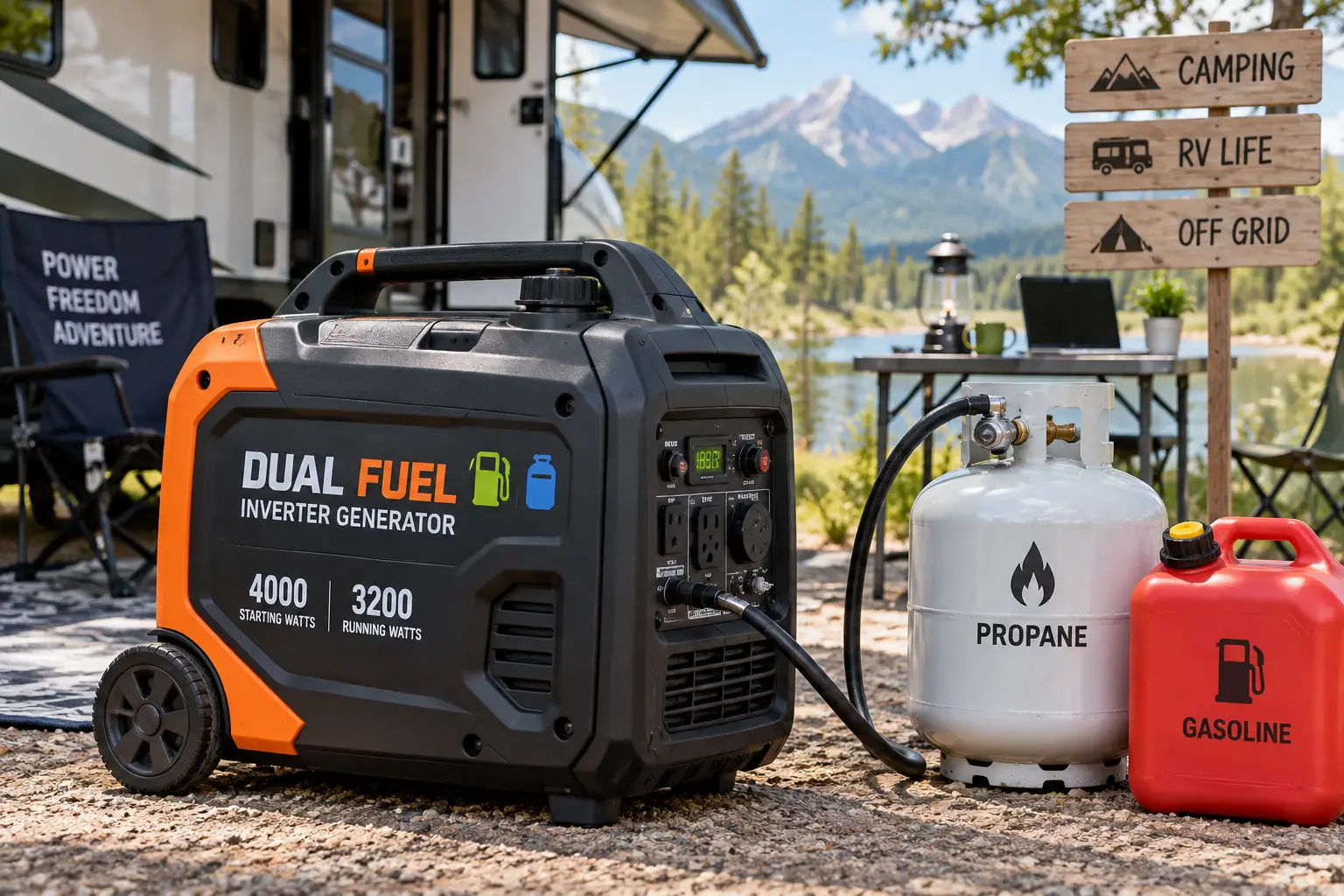
Shoppers who type Champion dual fuel generator 3500 into a search box land on a small family of machines rather than one. Model 200967 pairs a 212cc engine with a 4.7-gallon tank and an RV-ready TT-30R outlet, and retailer spec pages list 4,375 starting watts, up to 14 hours on gasoline and 10.5 hours on a 20-pound propane cylinder. Model 201213 adds CO Shield and trims surge to 4,000 watts on gasoline and 3,600 on propane. Champion’s page for the electric-start 200966 lists a wheel kit, a battery and a weight of 123 pounds.
The Sam’s Club listing for the 3,500/4,375-watt version shows 4.7 out of 5 across 2,148 ratings. One reviewer there bought it after Hurricane Florence because gas stations had lines, and another says Champion’s support shipped a replacement propane regulator at no charge. A three-star reviewer, meanwhile, received a box with no manual, propane hose or funnel, a good reason to inspect the contents before the return window closes.
Owners on a 2021 RV forum thread, which mixes 3,400-watt and 3,500-watt buyers, report running either rooftop air conditioner but not both at once. One has logged six years on propane alone. Another describes a dead starter battery out of the box that Champion’s customer service sorted out, and calls the unit a two-person lift. Those are anecdotal posts, not lab tests, and they pair praise for reliability and quiet running with a note that the unit uses propane quickly.
Check the current price on Amazon.com.
Champion 3500-Watt Dual Fuel Portable GeneratorSee current price, sizes and reviews on Amazon.
Any Champion 3600 W dual fuel generator review is really about this 3,650-watt line, because that is the rating Champion prints on models 201076, 201157 and 200970. A 224cc engine delivers 3,650 running and 4,550 starting watts on gasoline, and 3,285 running and 4,100 starting on propane. Champion lists up to 14 hours on a full 4.7-gallon tank at half load, or 10.5 hours on propane, at 68 dBA.
The extras matter more than the extra watts. Volt Guard surge protection, an Intelligauge meter, an RV-ready 30-amp outlet and CO Shield all appear on the listings. The recoil-start 200970 sits around $650 to $700 at Tractor Supply. Champion also sells electric-start versions, and one of those listings includes a wheel kit, while the spec table for the 201076 shows no wheels at all.
Pros:
135 to 150 more running watts than the 3,500-watt model, depending on fuel
CO Shield and Volt Guard on the same listing
Up to 14 hours per tank at half load
Cons:
Open-frame noise at 68 dBA is louder than the inverter entries
Some versions ship without wheels
On propane, the 4,100 starting watts land close to the 4,000 that the CO Shield 3500 manages on gasoline, so the real gain shows up mostly in running watts.
Champion 3650-Watt Dual Fuel Portable GeneratorSee current price, sizes and reviews on Amazon.
An open-frame inverter skips the enclosed case, and this model uses that to save weight. Champion says it is 50 percent quieter and 20 percent lighter than a traditional 3,500-watt generator, with a 64 dBA rating, 4,250 starting watts and 3,500 running watts on gasoline. A retailer listing gives 3,150 running watts on propane and run times of 22 hours on gasoline and 21 on propane, from a 4-gallon tank, though the load behind those figures varies by listing.
Champion lists clean power under 3 percent total harmonic distortion, and two USB ports sit beside the 120-volt 20-amp outlets. Dimensions run about 27.9 by 23.4 by 21.7 inches. Champion’s optional parallel kit links it with a second inverter of 2,800 watts or more.
Owners of several dual fuel brands in a TractorByNet thread describe running on propane only so the carburetor never sees stale gasoline, and one of them bought a new 4250 mainly for a house in Virginia. The Cool Down makes the same point in its coverage of dual fuel shopping: propane avoids the carburetor problems that stale gas can cause.
Narrowed it to this one? Open its listing and compare the fuel line first.
Champion 4250-Watt Dual Fuel Open Frame InverterSee current price, sizes and reviews on Amazon.
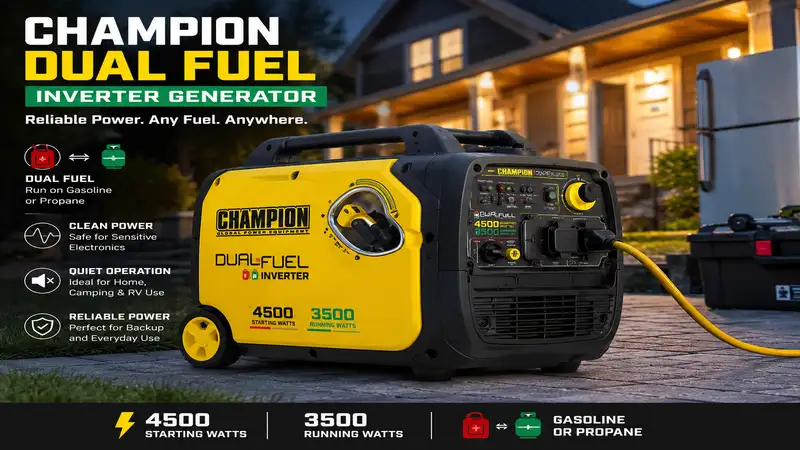
At 61 dBA, this is the quietest entry in the group, and at 99 pounds with electric start, a fold-down handle and two wheels it is also lighter than the 123-pound 3,500-watt version. A listing for the 201319 gives 4,500 starting watts on both fuels, 3,500 running watts on gasoline and 3,150 on propane, with up to 14 hours on gasoline and 21 on propane. Norwall lists the weight at 99 pounds. Outlets include two 120-volt 20-amp receptacles and a TT-30R for the RV cord.
Sam’s Club buyers rate the 4,500-watt RV-ready dual fuel inverter 4.9 out of 5 across 168 ratings. One reviewer boondocking with a 25-foot Airstream says it started on the first try, and another reports finishing the five-hour break-in on propane without trouble. Champion’s operator manual explains why that first stretch matters: the first five hours are the break-in period, with load held at or below half the running rating and an oil change afterward.
Pros:
61 dBA is the lowest noise rating of the six
99 pounds with wheels and a folding handle
Surge stays at 4,500 watts on propane
Cons:
3,150 running watts on propane limits what can run together
Eco mode must be switched off for high or fluctuating loads, according to the manual
The included six-foot hose and regulator fit standard 20 and 30-pound cylinders.
Champion 4500-Watt Dual Fuel Inverter GeneratorSee current price, sizes and reviews on Amazon.
Bob Vila’s team put the close sibling, an 8,500-watt Champion with the same 459cc engine size, through a hands-on test and scored it 9.2 out of 10. It started first time on gasoline and propane, ran a travel trailer on propane for three hours without tripping a breaker, and used roughly a quarter of its tank in four hours, which the reviewer called a realistic basis for the 10-hour claim. The same review says the 209-pound frame needs help getting on or off a truck bed.
The 9,200-watt version raises the ratings to 9,200 running and 11,500 starting watts on gasoline. The 201302 listing adds electric start, a 7.7-gallon tank, CO Shield, 74 dBA noise and up to 10 hours at half load, and Norwall flags it as not for sale in California. A listing for the 201194 version shows 8,280 running and 10,350 starting watts on propane, with a retailer quoting about 5 hours of propane run time. Camping World and Overton’s list the dual fuel version between roughly $900 and $1,100.
Pros:
9,200 running watts and 11,500 starting watts on gasoline
Electric start with an included battery
CO Shield auto shutoff
Cons:
74 dBA is the loudest rating in this group
The tested sibling weighs 209 pounds
Its 11,500 starting watts top the 11,000 listed for the inverter in the next entry.
Champion 9200-Watt Dual Fuel Portable GeneratorSee current price, sizes and reviews on Amazon.
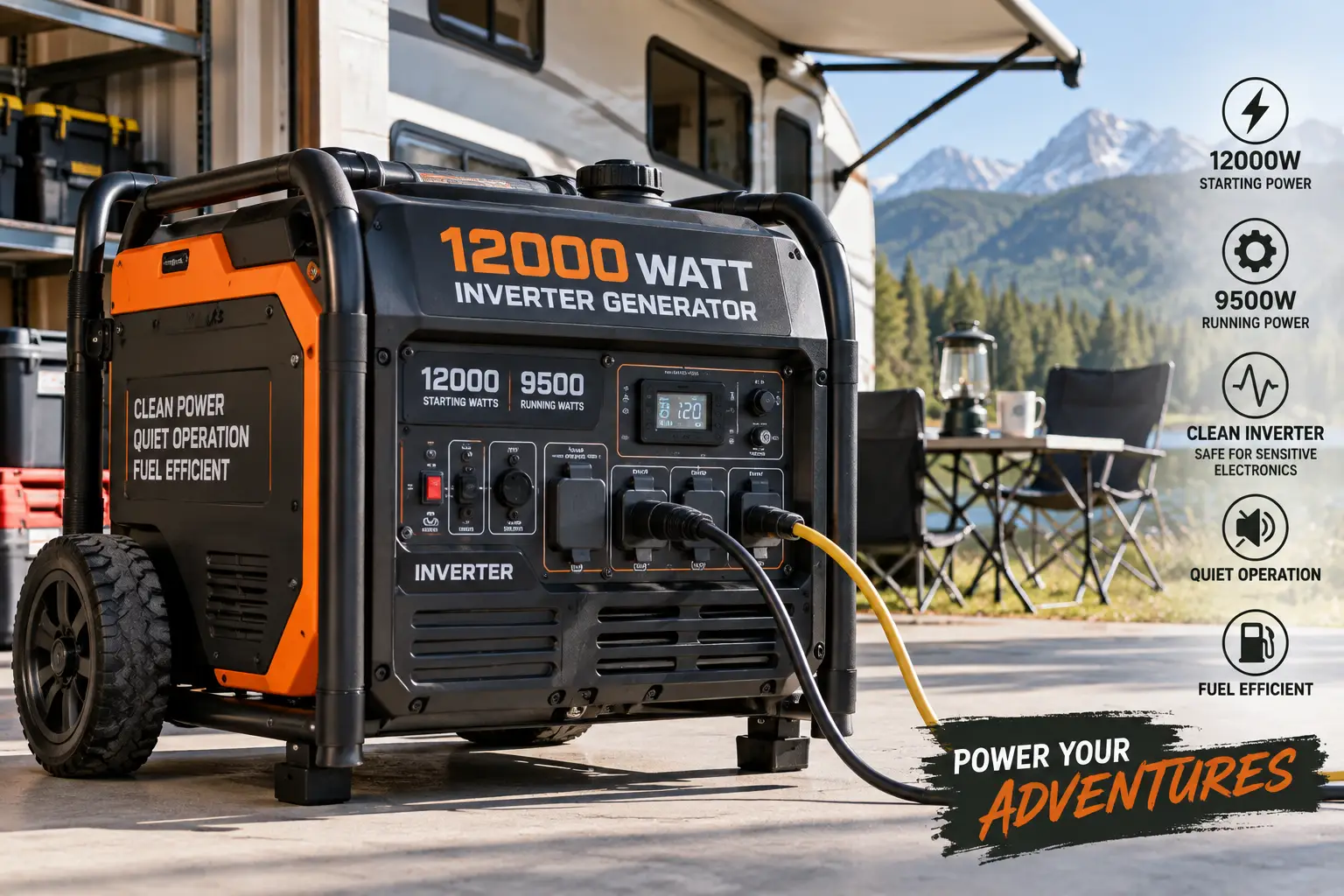
Champion’s page for the 201417 lists 9,000 running watts on gasoline, 8,100 on propane and 11,000 starting watts on both, from a 459cc engine with electric and recoil start. Noise is 64 dB(A) measured from 23 feet. Run times are up to 15 hours on a 6.08-gallon tank at quarter load and 8 hours on a 20-pound propane cylinder. The unit weighs 205.1 pounds, cannot be paralleled, and carries a 14-50R outlet, an L14-30R locking outlet, two GFCI 20-amp duplexes and a 12-volt port.
Retail ratings run high. Walmart.com shows 4.8 stars across 146 ratings, and the Sam’s Club listing shows 4.9 out of 5 across 125 ratings, none below four stars. One Walmart.com reviewer ran a house, furnace included, for five hours on it, while another, who bought a 5,500-watt Champion in 2019 and found it very loud, moved up to this inverter. A Sam’s Club reviewer bought it after six days without power following a hurricane.
Pros:
Clean power under 3 percent total harmonic distortion
64 dB(A) is quieter than the 3,500, 3,650 and 9,200-watt open frames
A 14-50R outlet alongside the 30-amp locking outlet
Cons:
205.1 pounds is a two-person job
Propane run time is about half the gasoline figure
Check the current price on Amazon.com.
Champion 11,000-Watt Dual Fuel Inverter GeneratorSee current price, sizes and reviews on Amazon.
What the surge numbers mean on a Champion dual fuel generator
Starting watts are a momentary peak, the burst a compressor or pump motor draws for a fraction of a second. Champion’s operator manual tells owners to add up the running watts of everything they plan to run together and then add the highest starting wattage among those devices.
Propane complicates that math in a way the model names hide. Open-frame units lose about 10 percent of their surge capacity on propane: Champion 3650-Watt Dual Fuel Portable Generator drops from 4,550 to 4,100, the CO Shield version of Champion 3500-Watt Dual Fuel Portable Generator from 4,000 to 3,600, and Champion 9200-Watt Dual Fuel Portable Generator from 11,500 to 10,350 on the 201194 version. The inverter models listed here hold their starting watts on both fuels, at 4,250, 4,500 and 11,000.
Sample calculation, with assumed loads: a refrigerator at 700 running watts, a sump pump at 800 and lights and electronics at 400 total 1,900 running watts. If the pump needs 2,400 starting watts, Champion’s method gives 4,300 watts. Champion 3650-Watt Dual Fuel Portable Generator clears that on gasoline at 4,550 but not on propane at 4,100, while Champion 4500-Watt Dual Fuel Inverter Generator clears it on both fuels at 4,500.
Champion 11000 dual fuel inverter generator: model differences chart
The 11,000-watt name covers three variants. The chart separates them by fuel, start method and the running watts each can sustain.
25-ft natural gas hose kit; 11,000 starting watts on all three fuels
Sources disagree on the fuel line of the middle variant: Norwall’s page for the 201407 calls it a dual fuel generator, while Batteries Plus lists the wireless version under gasoline, so the label on the unit settles it. Norwall and Batteries Plus put the wireless version between roughly $1,900 and $2,150, and Tractor Supply lists the tri-fuel version a little above $2,000. Several of these listings carry California shipping limits, and Norwall adds Massachusetts for the 201423.
Across all three, the 459cc engine, a tank of about 6 gallons and the 64 dB(A) rating stay the same, so the choice comes down to remote start and the fuel options.
9,200 watts or 11,000: how the two big Champions compare
The larger number is not the more capable machine. Champion 9200-Watt Dual Fuel Portable Generator starts at 11,500 watts and runs 9,200, while Champion 11,000-Watt Dual Fuel Inverter Generator starts at 11,000 and runs 9,000, so the open frame holds a slight edge on raw ratings. On propane the gap is 8,280 against 8,100 running watts.
What the inverter buys is everything else. Noise is 64 dB(A) against 74 dBA, power is rated under 3 percent harmonic distortion for electronics, and the 15-hour quarter-load run time comes from a 6.08-gallon tank, compared with 10 hours at half load from 7.7 gallons. Camping World and Overton’s list the open frame at roughly $900 to $1,100, while Norwall and Batteries Plus put the wireless-start 11,000-watt variant at $1,900 to $2,150, so quiet and clean power carry a gap of roughly $800 or more.
How to start a Champion dual fuel generator on propane
Champion’s 4500-watt manual lays out the sequence, and the open-frame quick-start guides follow the same logic with a choke lever in place of the EZ Start dial. Disconnect every load first, because Champion says never to start or stop the generator with devices plugged in or switched on.
Set the generator on level ground outdoors and connect the regulator hose to the cylinder and the generator’s LPG inlet. Brush soapy water on the fittings to check for leaks, never a flame.
Open the cylinder valve slowly. Commenters in a Reddit thread reported by The Cool Down blamed most propane no-starts on opening the tank valve too fast or skipping the regulator’s priming step, and the report named no confirmed brand defect.
On an inverter with an EZ Start dial, turn it to CHOKE, press and hold the ignition switch for two to three seconds, turn the dial to RUN, then hold the switch for up to five seconds. If the engine does not catch, wait ten seconds and repeat.
On a recoil model, turn the fuel select dial to PROPANE RUN and set the choke to CHOKE, then pull slowly three to five times to prime. Move the choke to RUN and pull until resistance, then rapidly.
Let the engine stabilize for three to five minutes before plugging anything in.
One owner of a smaller 2,500-watt Champion on a Forest River owners forum found propane starts hard until the choke was backed off slightly, and a commenter in the same thread attributes this to the regulator waiting for intake vacuum before releasing gas. That is one owner’s report on a smaller model.
When switching fuels, turn the generator off first. The manual says to disconnect the propane hose before starting on gasoline, because leaving it attached in the gasoline position can keep the engine from starting.
How to use a Champion dual fuel generator without overloading it
Plug in the largest load first, let the output settle, then add the next item. If the AC overload light blinks, unplug some items and press the reset button. Turn Eco mode off for high or fluctuating loads, and, per the 4500-watt manual, keep loads at or below half the running rating during the first five hours.
To stop on propane, unplug everything, let the engine run without load for several minutes, close the cylinder valve and only then turn the dial to STOP. The manual calls frost on the cylinder or regulator normal; if output drops, swap cylinders or pour warm water over it. It also says to inspect the hose every eight hours of use and replace it every three years.
Location matters more than any spec. Champion’s labels and the CPSC both say to run a portable generator only outdoors and far from windows, doors and vents, even when doors are open. CO Shield is a backstop, and CPSC’s winter-storm tips also tell households to check their carbon monoxide and smoke alarms.
Propane runtime, watt loss and break-in: straight answers
Can a Champion dual fuel generator run on propane only?
Yes. The fuel selector dial lets the engine run on propane alone, and owners on an RV forum report years of propane-only use. Gasoline stays optional, though running-watt ratings drop to roughly 90 percent of the gasoline figure whenever the dial sits on propane.
How long does a 20-pound propane tank last?
Champion lists 10.5 hours for a 3500-watt open-frame model on a 20-pound cylinder and 8 hours for an 11,000-watt inverter at quarter load. Heavier loads shorten both figures, so treat them as light-to-moderate-load estimates rather than guarantees.
How many watts are lost when running on propane?
Running watts fall to about 90 percent of the gasoline rating: 3,500 becomes 3,150, 3,650 becomes 3,285 and 9,000 becomes 8,100. Starting watts hold steady on the inverter models but drop roughly 10 percent on open-frame units.
Does a new Champion inverter need a break-in period?
Champion's 4500-watt manual treats the first five hours as break-in: keep the load at or below half the running rating, vary it, check the oil often and change the oil afterward. Other models' manuals can differ, so confirm yours.
Is it safe to run a Champion generator in a garage with the door open?
No. Champion's labels and the Consumer Product Safety Commission say to run a portable generator only outdoors, far from windows, doors and vents, even with doors open. CO Shield adds an automatic shutoff, but it does not make indoor use acceptable.
Picking the right size for your load
For most households, a Champion dual fuel generator in the 3,650 to 4,500-watt range covers a refrigerator, a sump pump and a few lights, and the 4,500-watt inverter does it at 61 dBA while keeping 4,500 starting watts on propane. Bigger loads, such as a furnace blower plus a well pump, point to the 11,000-watt inverter when noise and clean power matter, or to the 9,200-watt open frame when budget matters more. Buyers who mostly camp and want the longest listed run time can look at the 4,250-watt open-frame inverter. Add up running watts, add the largest starting figure, and take 10 percent off the running side for propane before comparing any model. Found a size that matches your math? Open that model’s page and take a closer look.