In This Article
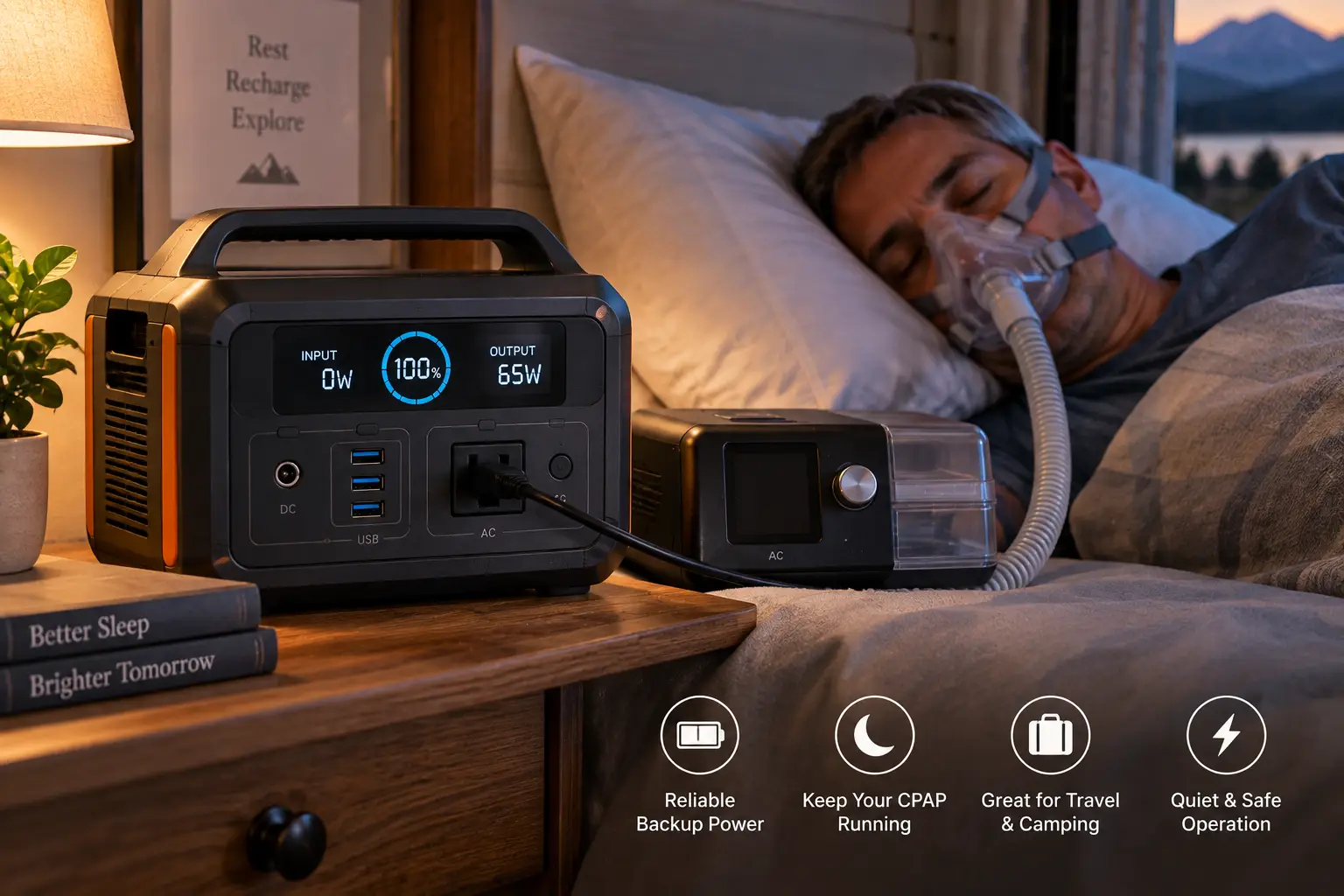
A portable power station for CPAP isn’t a gadget you buy for fun — it’s the difference between a full night of therapy and a night without it. Continuous positive airway pressure therapy only works if it’s actually running, and consistent nightly use is what the research keeps pointing back to: regular, uninterrupted CPAP use is closely tied to better long-term outcomes, from lower daytime sleepiness to better cardiovascular health. Storms knock out grid power, campgrounds don’t have outlets, and hotel rooms occasionally have a dead plug behind the nightstand. None of that should mean skipping therapy.
What is a portable power station for CPAP? It’s a rechargeable lithium battery pack — usually LiFePO4 chemistry — with an AC outlet, DC port, or both, sized to run a CPAP machine for one or more nights without a wall outlet. The best ones deliver clean, stable power your machine’s sensitive electronics can actually use.
That last point matters more than most buyers realize. Not every battery pack on Amazon is built the same way, and the wrong one can cause your CPAP to reboot mid-cycle or simply refuse to power on. The specs that separate a genuinely CPAP-ready unit from a generic camping battery are pure sine wave output, a fast UPS switchover time, and a capacity that’s honestly matched to your machine’s real-world draw — not a marketing number.
This guide breaks down seven real, currently available power stations, what each one actually delivers overnight, and how to think through the tradeoffs between capacity, weight, and price. We’ll also cover setup, common mistakes, and the regulations that matter if you’re flying with one. Below are today’s top picks, along with the full breakdown of how we got there.
Quick Comparison: Top Portable Power Stations for CPAP
| Power Station | Capacity | UPS Switchover | Best For |
|---|---|---|---|
| Jackery Explorer 1000 v2 | 1,070Wh | <20ms | Best all-around pick |
| BLUETTI Elite 30 V2 | 288Wh | 10ms | Fastest switchover, compact |
| EASYLONGER ES960 PRO | 297.6Wh | Pass-through | Purpose-built for CPAP |
| Jackery Explorer 1500 v2 | 1,536Wh | <20ms | Whole-home backup + CPAP |
Looking at the table, the pattern is clear: capacity and switchover speed pull in different directions, and no single unit wins on both fronts. The Jackery Explorer 1000 v2 covers multiple nights and general household loads, while the BLUETTI Elite 30 V2 wins on the millisecond-level reaction time that matters most for a machine mid-breath cycle. Budget-conscious buyers should note that the EASYLONGER ES960 PRO skips general-purpose bulk for a design built entirely around CPAP compatibility, which is worth a look before assuming bigger is always better.
💬 One click helps other shoppers make an informed choice too! 😊
7 Best Portable Power Stations for CPAP in 2026
Coverage below spans entry-level travel batteries, purpose-built CPAP units, and full-size power stations that double as home backup. Every model here uses pure sine wave output — the non-negotiable spec for any CPAP-safe battery, since modified sine wave inverters can cause a CPAP’s internal motor to run rough or trigger error codes.
1. Jackery Explorer 1000 v2 — best all-around pick for CPAP backup
The Explorer 1000 v2 earns its “best all-around” tag by not asking you to compromise between CPAP duty and everything else a power outage throws at you. Its 1,070Wh LiFePO4 battery pairs with a 1,500W continuous pure sine wave inverter and a 3,000W surge rating, which means it comfortably handles a CPAP alongside a mini-fridge, router, and a few phone charges without flinching. In practice, that translates to roughly two full nights of CPAP use on a single charge when the humidifier stays off, based on manufacturer runtime estimates for the unit’s rated capacity. What most buyers overlook with this model is the charging speed: a full 0-to-100% recharge in about an hour means you can top it off during a lull in a multi-day outage instead of waiting overnight. Owner-reported feedback across several independent reviews consistently flags the fast recharge and sub-24-pound weight as the two features people notice first, while a smaller number of reviewers note the battery isn’t user-expandable if you outgrow it later. The unit is UL2743-certified and backed by a 5-year warranty, both reasonable proxies for build quality in a category where safety testing varies widely between brands.
Pros:
- ✅ Two full nights of CPAP runtime without humidifier
- ✅ One-hour fast recharge from any AC outlet
- ✅ Handles fridges, routers, and CPAP simultaneously
Cons:
- ❌ Not expandable with add-on battery packs
- ❌ Heavier than dedicated CPAP-only batteries
Expect to pay somewhere between $400 and $800 depending on current promotions — check the current price before buying, since Jackery runs frequent sales. For most households that want one battery to cover both CPAP backup and general outage prep, this is the strongest value-for-money pick on the list.
2. EASYLONGER ES960 PRO — purpose-built for CPAP compatibility
Unlike the general-purpose stations on this list, the ES960 PRO was engineered from the ground up around one job: keeping a CPAP running. Its 297.6Wh LiFePO4 battery ships with four DC cables covering ResMed AirSense 10/11, AirCurve, AirMini, and Philips DreamStation 1/2 — meaning it can bypass the AC inverter entirely and feed your machine DC power directly, which is more efficient than routing through an AC-to-DC conversion. That efficiency gain is the real story here: skipping the inverter step typically preserves more usable capacity per watt-hour than a general power station running the same load through an AC outlet. Reviews and product Q&A consistently describe two nights of coverage without the heated tube or humidifier, with some owners reporting closer to three nights depending on pressure settings. The unit is also FSA/HSA eligible, a detail worth flagging since it can meaningfully lower the effective cost for anyone with a flexible spending account. On the downside, its DC-first design means it’s less useful as a general backup battery for other household electronics, and at 297.6Wh, it exceeds the FAA’s carry-on threshold, so this is a car-camping and home-backup unit, not a flight companion.
Pros:
- ✅ Direct DC connection skips inefficient AC conversion
- ✅ FSA/HSA eligible as a qualified medical expense
- ✅ Cables included for most major CPAP brands
Cons:
- ❌ Limited usefulness for non-CPAP devices
- ❌ Too large for carry-on air travel
Pricing typically falls between $200 and $300 depending on whether you buy the standalone unit or a solar panel bundle — always check the current price, since bundles shift the value equation. For anyone who wants a battery that’s genuinely optimized for CPAP rather than adapted to it, this is the most honest option on the list.
3. BLUETTI Elite 30 V2 — fastest UPS switchover, compact build
If home power outages are your main concern rather than travel, the Elite 30 V2’s headline feature is the one that matters most: a 10-millisecond UPS switchover, among the fastest published figures in this capacity class. Most competing stations switch over in 20 to 30 milliseconds, a gap that can be enough to make some sensitive CPAP units briefly stutter or reboot. At 288Wh with a 600W continuous output (1,500W lifting power for brief loads), it’s sized for one to three nights of CPAP use depending on your pressure settings, with the heated humidifier roughly halving that runtime — a tradeoff worth understanding before you buy, since it applies to nearly every unit on this list. The UltraCell battery technology behind it also claims standby draw as low as 4.5W, which matters if you leave the unit plugged in and topped off for months waiting for an outage that may never come. Independent reviewers have generally described its under-30dB noise floor as effectively inaudible next to a CPAP’s own airflow sound, making it a genuinely bedroom-friendly option. The tradeoff for that fast switchover and quiet operation is capacity — this isn’t the unit for multi-night outages without a recharge plan.
Pros:
- ✅ 10ms UPS switchover, among the fastest available
- ✅ Whisper-quiet operation under 30dB
- ✅ Low standby power draw for long-term readiness
Cons:
- ❌ Runtime shrinks fast with humidifier enabled
- ❌ 288Wh capacity limits multi-night use
Current pricing generally runs from around $200 to $250 — as always, prices may vary, so check the current price at checkout. This is the pick for anyone whose top priority is a seamless, undetectable transition to battery power the instant the grid drops.
4. Anker SOLIX C300X — best smart app control and UPS reliability
The SOLIX C300X splits the difference between the general-purpose Explorer 1000 v2 and the CPAP-specific ES960 PRO, offering a 288Wh LiFePO4 battery with a sub-10ms UPS switchover and full app-based monitoring over Bluetooth or Wi-Fi. What sets it apart from Anker’s own non-X C300 variant is precisely that UPS function — it’s the version built for anyone who wants their CPAP, router, or home server to keep running through even a brief interruption without a reboot. Reviewers who tested it against common home office and medical equipment reported successful, undetected switchovers across repeated trials. The dual 140W USB-C ports are a genuine convenience upgrade over competitors that top out at 60-100W, letting you fast-charge a laptop and a phone simultaneously while the CPAP runs. Anker backs the unit with a 5-year warranty, roughly 2.5 times the industry norm, and rates the InfiniPower cells for around 3,000 cycles — call it eight to ten years of realistic use. The main limitation is the 300W continuous output ceiling, which rules out higher-draw appliances like a full-size fridge or a hair dryer, so pair this one with realistic expectations about what else it can run alongside your CPAP.
Pros:
- ✅ Sub-10ms UPS switchover with app monitoring
- ✅ Dual 140W USB-C ports for fast device charging
- ✅ 5-year warranty, well above industry standard
Cons:
- ❌ 300W output limits higher-wattage appliances
- ❌ Costs more than the standard C300 for the UPS feature
Expect a price in the $280 to $320 range, with occasional sales bringing it lower — check the current price before ordering. If dependable UPS behavior backed by real testing data matters more to you than raw capacity, this is a strong contender.
5. EcoFlow River 3 Plus — best budget pick for occasional backup
Not everyone needs — or wants to pay for — a full-size power station, and the River 3 Plus is built for that reality. At roughly 296Wh with 600W continuous output (1,200W via EcoFlow’s X-Boost surge technology), it’s sized to comfortably run a CPAP for five to nine hours on a single charge without the humidifier, according to EcoFlow’s published runtime data. The X-Stream fast-charging technology recharges the unit from empty to full in about an hour on AC power, a genuinely useful feature if you’re topping off between short outages rather than planning for a multi-day event. All three of its AC outlets carry UPS protection with pure sine wave output, and its sub-30dB noise floor puts it in the same “won’t wake anyone up” category as the pricier BLUETTI unit above. What the spec sheet doesn’t say, but the price tag reveals, is the real tradeoff here: at under 300W of realistic sustained appliance-plus-CPAP load, this unit is built for CPAP-only or CPAP-plus-light-electronics duty, not as a general household backup during extended outages.
Pros:
- ✅ Five to nine hours of CPAP runtime per charge
- ✅ One-hour full recharge via X-Stream fast charging
- ✅ Whisper-quiet under 30dB, safe for bedroom use
Cons:
- ❌ Not sized for multi-night outages without recharging
- ❌ 600W ceiling excludes higher-draw appliances
Pricing generally lands between $150 and $250 depending on ongoing promotions and whether a solar panel bundle is included — check the current price, since this model sees frequent discounts. For CPAP users on a tighter budget who mainly need overnight coverage rather than whole-outage resilience, this is the most cost-effective entry point on the list.
6. Jackery Explorer 1500 v2 — best for whole-home backup plus CPAP
For buyers thinking beyond a single night’s therapy toward genuine storm-season preparedness, the Explorer 1500 v2 is the high-capacity option that still stays realistic to carry. Its 1,536Wh LiFePO4 battery and 2,000W pure sine wave inverter (4,000W surge) cover the essential circuit load most households actually need during an outage: a refrigerator, some lighting, phone charging, and a CPAP running alongside all of it. Jackery markets this unit as the lightest 1.5kWh LiFePO4 station currently available at just under 32 pounds — genuinely portable for its capacity class, though still a two-handed lift compared to the compact units earlier in this list. A 64-minute full recharge from a wall outlet is one of the fastest published figures for this capacity tier, and the battery is rated for roughly 6,000 cycles to 70% capacity, translating to a realistic decade or more of regular use. Independent comparisons against Jackery’s own Explorer 1000 Plus found the 1500 v2 wins on cost-per-lifetime-kWh by nearly half, though the tradeoff is that it’s a sealed, non-expandable unit rather than one you can grow with add-on batteries over time.
Pros:
- ✅ 1,536Wh covers CPAP plus fridge and lighting
- ✅ 64-minute recharge, among the fastest in its class
- ✅ Rated for roughly 6,000 charge cycles
Cons:
- ❌ Sealed design, no expandable battery add-ons
- ❌ Heaviest unit on this list at nearly 32 pounds
Pricing typically runs between $650 and $1,000, with the unit frequently discounted from its original list price — check the current price before purchasing. If your outage-prep plan needs to cover more than just the CPAP, this is the pick that scales with that ambition.
7. EASYLONGER ES400 AIR — best for air travel and TSA compliance
Anyone who’s tried to fly with a full-size power station has run into the same wall: the FAA’s 160Wh hard ceiling on lithium batteries makes nearly every general-purpose unit on this list illegal to bring on a commercial flight, full stop. The ES400 AIR was built specifically around that constraint, holding 148Wh — just under the FAA’s carry-on threshold — while still delivering a full night of CPAP runtime with the humidifier off, according to the manufacturer’s published specs. It ships with the same four-cable set covering ResMed and Philips machines as its larger ES960 sibling, along with a 160W cigarette lighter socket, 30W USB-C, and 18W USB-A output for charging other devices alongside the CPAP. Pass-through UPS mode means it can also double as a simple home backup for shorter outages, not just a travel companion. The obvious tradeoff for staying under the airline weight limit is reduced runtime — this isn’t the battery for a multi-night camping trip without access to an outlet, and reviewers consistently note it’s best treated as a single-night solution rather than an extended backup plan.
Pros:
- ✅ Under the FAA’s 160Wh carry-on threshold
- ✅ Full night of CPAP runtime, humidifier off
- ✅ FSA/HSA eligible, cables included
Cons:
- ❌ Limited to roughly one night per charge
- ❌ Not sized for extended off-grid backup
Expect to pay somewhere around $150 to $200, though prices may vary by retailer — check the current price before booking your next trip. For frequent flyers who need CPAP-compatible backup power without a gate-side confiscation risk, this is the clear pick.
Full Comparison: All 7 Power Stations Side by Side
| Model | Capacity | Continuous Output | Est. CPAP Runtime | Price Range | Best For |
|---|---|---|---|---|---|
| Jackery Explorer 1000 v2 | 1,070Wh | 1,500W | ~2 nights | $400–$800 | All-around backup |
| EASYLONGER ES960 PRO | 297.6Wh | ~180W (DC) | 2–3 nights | $200–$300 | CPAP-specific setup |
| BLUETTI Elite 30 V2 | 288Wh | 600W | 1–3 nights | $200–$250 | Fastest UPS switchover |
| Anker SOLIX C300X | 288Wh | 300W | 1–2 nights | $280–$320 | Smart monitoring |
| EcoFlow River 3 Plus | 296Wh | 600W | 5–9 hours | $150–$250 | Budget pick |
| Jackery Explorer 1500 v2 | 1,536Wh | 2,000W | 2–4 nights | $650–$1,000 | Whole-home + CPAP |
| EASYLONGER ES400 AIR | 148Wh | 160W (DC) | ~1 night | $150–$200 | Air travel |
Reading across this table, the split between “CPAP-only” units (the two EASYLONGER models) and general-purpose stations becomes obvious — the former squeeze more usable CPAP runtime per watt-hour by skipping AC conversion, while the latter trade some efficiency for the flexibility to run other devices too. If you already own a separate battery backup for the rest of your home, a CPAP-specific unit like the ES960 PRO or ES400 AIR is the more efficient dollar-for-dollar choice; if this is your only backup power source, the broader flexibility of the Jackery or Anker units justifies their higher price.
✨ Don’t miss these exclusive deals! 🔍 Take your CPAP backup power setup to the next level with this carefully curated lineup. Click a highlighted item to check current pricing and availability. These picks will help you sleep soundly through outages, travel, and off-grid trips alike!
How to Set Up Your CPAP on a Portable Power Station
Getting a power station running your CPAP correctly the first time avoids the most common source of frustration: assuming it works and finding out otherwise at 2 a.m. during an actual outage.
- Check your CPAP’s power label first. Most modern CPAP machines draw between 30 and 60 watts on their own, with heated humidification adding another 20 to 40 watts on top. This number, not the marketing capacity of the battery, is what determines real runtime.
- Choose AC or DC based on your battery. If your power station includes a CPAP-specific DC cable (like the EASYLONGER models above), use it — DC bypasses the inverter and typically stretches runtime further than routing through an AC outlet.
- Confirm pure sine wave output. Never plug a CPAP into a modified sine wave inverter; it can cause erratic motor behavior or trigger fault codes on sensitive models.
- Test a full night before you need it. Run the CPAP on battery power during a normal night at home first, so you know your real runtime rather than a manufacturer estimate.
- Turn off the humidifier for backup nights. This single change can roughly double your available runtime, based on manufacturer runtime charts across nearly every model reviewed here.
- Keep the unit charged and ready. A power station sitting at 20% capacity in a closet isn’t backup power — set a monthly reminder to top it off.
Following this sequence turns an unfamiliar piece of equipment into a routine part of your setup, and it’s the single best way to avoid discovering a compatibility issue during an actual emergency rather than a test run.
Real-World Scenarios: Which Power Station Fits Your Life?
Different CPAP users have genuinely different needs, and matching the battery to the scenario avoids both overspending and under-preparing.
The hurricane-season homeowner: Someone living in a region prone to multi-day grid outages needs capacity first. A setup built around the Jackery Explorer 1500 v2 or Explorer 1000 v2 covers the CPAP plus a fridge and some lighting across several nights, with fast AC recharge letting you top off during any brief return of grid power.
The frequent business traveler: Someone flying several times a month needs FAA compliance above all else. The EASYLONGER ES400 AIR, sitting under the 160Wh carry-on ceiling, solves the single biggest headache travelers face — getting through TSA screening without a confiscated battery.
The weekend car camper: Someone who camps a few nights a month but always has trunk space doesn’t need airline compliance, just solid overnight runtime. The EcoFlow River 3 Plus or BLUETTI Elite 30 V2 both deliver quiet, reliable single-night coverage without the weight of a full-size station.
The budget-conscious first-time buyer: Someone buying their first backup battery, uncertain how often they’ll actually need it, benefits from starting with a purpose-built, moderately priced option like the EASYLONGER ES960 PRO rather than overspending on capacity they may rarely use.
Common CPAP Power Problems and How to Solve Them
Problem: The CPAP reboots or shows an error when switching to battery power. Solution: This almost always traces back to a modified sine wave inverter or a UPS switchover time too slow for the machine’s internal sensors. Confirm pure sine wave output and, if the issue persists, look for a unit with a sub-15ms UPS rating like the BLUETTI Elite 30 V2 or Anker SOLIX C300X.
Problem: The battery drains faster than expected. Solution: Heated humidifiers and heated tubing are almost always the culprit, often doubling or tripling draw compared to the CPAP alone. Running the humidifier at a lower setting or turning it off for backup nights meaningfully extends runtime.
Problem: The power station won’t charge from a wall outlet during an active outage. Solution: A power station can only recharge from AC power, solar, or a car outlet — not from itself. Pair any unit with a portable solar panel if extended outages are a realistic concern in your area.
Problem: A battery that worked at the store fails to power the CPAP at home. Solution: Double-check the DC cable matches your specific CPAP model — ResMed and Philips machines often use different voltage requirements, and using the wrong cable can prevent the connection from completing even though both ends physically fit.
How to Choose a Portable Power Station for CPAP
- Confirm pure sine wave output. This is non-negotiable — it’s the single spec most likely to determine whether your CPAP runs smoothly or throws errors.
- Calculate your actual wattage need. Multiply your CPAP’s rated watts by expected hours of use, then add 25 to 50% as a buffer for inverter inefficiency.
- Check the UPS switchover time. Look for 20ms or faster if home backup during outages is your main use case.
- Match capacity to your realistic scenario. Don’t buy a 1,500Wh unit if you only need one CPAP-only night; don’t buy a 150Wh unit if multi-day outages are common where you live.
- Verify battery chemistry. LiFePO4 (LFP) batteries last roughly three times longer than standard lithium-ion cells and pose a meaningfully lower thermal runaway risk.
- Consider portability if you travel. Check FAA watt-hour limits before assuming any power station can fly with you.
- Factor in FSA/HSA eligibility. Several CPAP-specific batteries qualify as medical expenses, which can meaningfully offset the sticker price.
Common Mistakes to Avoid When Buying a CPAP Power Station
Buyers new to this category tend to repeat a handful of avoidable errors. The most common is assuming any lithium power bank will work — modified sine wave and low-quality inverters are still widely sold, and they’re a real risk to sensitive CPAP electronics, not just a theoretical one. A second mistake is ignoring humidifier draw entirely when estimating runtime, which routinely leads to batteries that die hours earlier than expected. A third is buying based on capacity alone without checking UPS switchover speed, which matters more than raw watt-hours for anyone whose main concern is uninterrupted overnight power during a brief outage rather than multi-night endurance. Finally, travelers frequently overlook the FAA’s watt-hour limits until they’re standing at a TSA checkpoint — checking that number before purchase avoids an unpleasant surprise at the airport.
Portable Power Station vs. Dedicated CPAP Battery: What’s the Difference?
| Factor | General Power Station | CPAP-Specific Battery |
|---|---|---|
| Flexibility | Runs CPAP plus other devices | Optimized mainly for CPAP |
| Efficiency | AC conversion loses some capacity | DC connection preserves more capacity |
| Weight | Heavier for equivalent CPAP runtime | Lighter, purpose-built |
| Best For | Households needing broad backup | Travel and CPAP-only backup |
The efficiency gap in this table is worth dwelling on: a CPAP-specific unit like the EASYLONGER ES960 PRO routes power directly to the machine via a matched DC cable, avoiding the conversion losses inherent in running a CPAP through an AC outlet on a general power station. That efficiency advantage shrinks in importance, though, the moment you also need to run a fridge, lights, or a phone charger — at that point, the flexibility of a general-purpose unit like the Jackery Explorer 1000 v2 outweighs the modest efficiency gain of a dedicated battery.
What to Expect: Everyday Performance and Runtime
Spec sheets tend to advertise best-case runtime, and real-world performance is almost always a bit lower once you account for a few practical factors. Inverter efficiency typically runs between 85% and 90%, meaning a portion of every watt-hour is lost as heat rather than delivered to your CPAP. Battery capacity also degrades gradually over hundreds of charge cycles — a reason LiFePO4 chemistry’s 3,000-plus cycle rating matters more than it might initially seem, since it keeps that degradation curve flatter for years longer than older lithium-ion cells. Cold weather reduces usable capacity as well, an easy factor to forget if your main use case is winter storm backup rather than summer camping. None of this means the runtime estimates in this guide are unreliable — it means treating them as a solid planning baseline rather than a guaranteed floor, and building in the 25 to 50% buffer mentioned earlier in the buying criteria.
Long-Term Cost and Maintenance
The sticker price on a portable power station is only part of the real cost of ownership. LiFePO4 batteries rated for 3,000 to 6,000 cycles translate to roughly eight to fifteen years of realistic weekly use before capacity noticeably degrades, which is why cost-per-cycle is often a more useful comparison than upfront price alone — a $700 unit rated for 6,000 cycles can end up cheaper over its lifespan than a $250 unit rated for 500. Maintenance itself is minimal: keep the unit partially charged (most manufacturers recommend 40-60% for long-term storage rather than a full or empty charge), store it somewhere temperature-stable, and top it off every month or two if it’s sitting unused as emergency backup. Warranty length is a reasonable proxy for how confident a manufacturer is in their own hardware — the 5-year warranties on the Jackery Explorer 1000 v2 and Anker SOLIX C300X are both well above the 1-to-2-year terms common on cheaper, unbranded alternatives.
Safety, Regulations, and Standards
Lithium battery safety isn’t a hypothetical concern in this category. The U.S. Consumer Product Safety Commission has issued multiple recalls and warnings for portable power stations whose lithium-ion cells posed overheating and fire risks — a reminder to favor established brands with documented safety certifications like UL2743 over unfamiliar names selling on price alone. LiFePO4 chemistry, used in every model on this list, is inherently more thermally stable than older lithium-ion or lithium-cobalt formulations, which is part of why it’s become the standard for medical-adjacent backup power.
Air travel adds its own layer of regulation. According to FAA guidance on lithium batteries, batteries up to 100Wh are allowed in carry-on baggage without special approval, batteries between 101 and 160Wh need airline approval, and anything over 160Wh is prohibited outright on commercial flights — a rule that eliminates every general-purpose power station on this list except the EASYLONGER ES400 AIR from air travel entirely. Notably, the CPAP machine itself is exempt from standard carry-on limits as a medical device, but that exemption does not extend to its battery, a distinction that surprises a lot of first-time travelers. For more detail on the health case for keeping therapy consistent even while traveling, Sleep Foundation’s guide to CPAP battery backups is a useful starting point.
Frequently Asked Questions
❓ Can a portable power station damage my CPAP machine?
❓ How long will a portable power station run my CPAP without a humidifier?
❓ Can I bring a portable power station for CPAP on an airplane?
❓ Is a portable power station for CPAP covered by insurance or FSA/HSA?
❓ What size portable power station do I need for one night of CPAP use?
Conclusion
A portable power station for CPAP isn’t a single product — it’s a category with real tradeoffs between capacity, portability, switchover speed, and price, and the right pick depends entirely on your own situation. Frequent travelers should prioritize the FAA-compliant EASYLONGER ES400 AIR, homeowners bracing for storm season are better served by the higher-capacity Jackery Explorer 1500 v2, and anyone whose top concern is a flawless, undetectable switchover during a sudden outage should look closely at the BLUETTI Elite 30 V2‘s 10ms response time. What all seven models share is the baseline that actually matters: pure sine wave output, LiFePO4 battery chemistry, and enough documented, real-world runtime data to plan around rather than guess at.
Whichever unit you land on, the single best thing you can do is test it before you need it — plug your CPAP in, run it through a full night on battery power, and confirm the runtime matches what you’re expecting. That fifteen minutes of setup is what turns a purchase into genuine peace of mind.
✨ Ready to sleep soundly through the next outage, flight, or camping trip? Check today’s price on your top pick above and add reliable CPAP backup power to your setup before you need it.
Recommended for You
- Solar Panel Xmas Lights: 7 Best Picks for 2026 (Pros & Cons)
- 7 Best Christmas Lights With Solar Panel for 2026 (Pros & Cons)
- Generator for RV 30 Amp: 7 Best Picks for 2026 (Quiet & Powerful)
Disclaimer: This post contains affiliate links. As an Amazon Associate, I earn from qualifying purchases made through these links, at no additional cost to you.
✨ Found this article helpful? Share it with someone who needs it! 💬🤗