In This Article
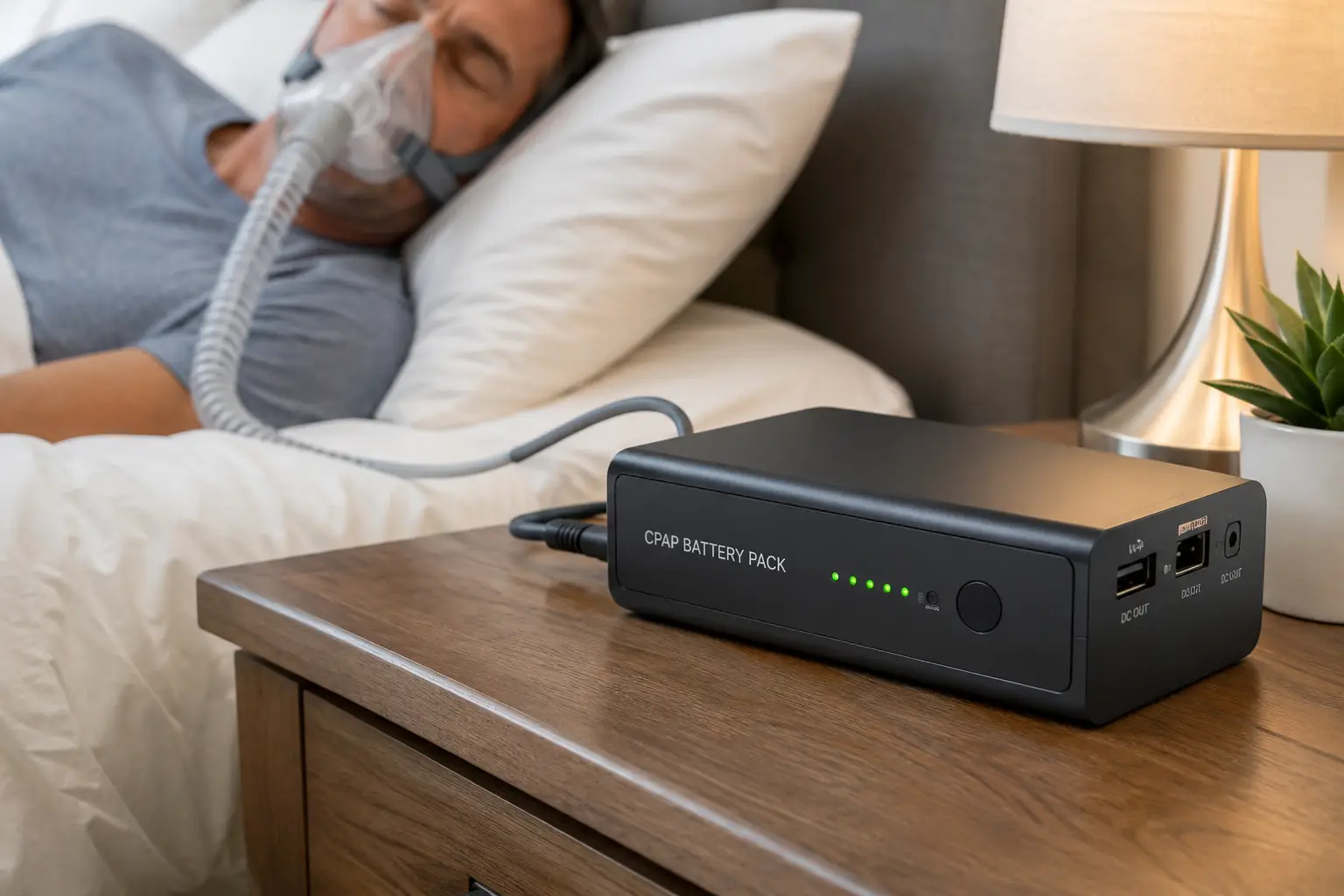
A cpap battery pack is a portable power source — usually a lithium-ion or LiFePO4 unit — that runs your CPAP machine when there’s no wall outlet available, whether that’s during a flight, a camping trip, or a storm-related blackout. If you depend on positive airway pressure therapy every night, a single skipped session isn’t just an inconvenience. Research on treatment adherence consistently links inconsistent CPAP use with a return of daytime sleepiness, poor concentration, and elevated cardiovascular strain, which is exactly why sleep clinicians push so hard for nightly consistency, not just “most nights.”
That’s the practical case for owning a dedicated cpap battery pack instead of hoping the power stays on or that your hotel room has an outlet within reach of the bed. The market has split into two camps: slim, purpose-built travel batteries designed to plug directly into machines like the ResMed AirSense or Philips DreamStation, and general-purpose portable power stations that happen to run a CPAP well among other things. Neither is automatically “better” — the right pick depends on how many nights of runtime you need, whether you’re flying, and whether you also want to charge a phone, a CPAP humidifier, or a laptop from the same unit.
Below, we’ve research seven real, currently available options spanning entry-level travel batteries to whole-home backup power stations, along with the buying criteria, common mistakes, and setup advice that actually matter once you’re relying on this thing at 2 a.m. This article contains affiliate links, and as an Amazon Associate we may earn from qualifying purchases — full disclosure at the bottom.
Quick Comparison: Best CPAP Battery Packs at a Glance
| Product | Capacity | Best For | Approx. Price |
|---|---|---|---|
| Medistrom Pilot-24 Lite | ~99Wh | Flying + UPS backup | $250–$300 |
| Zopec Explore Mini | ~97Wh | Lightest travel pick | $150–$200 |
| EASYLONGER ES270 | 99.9Wh | Airline carry-on ceiling | $150–$200 |
| EASYLONGER ES960 | 297.6Wh | Multi-night, high cycle life | $300–$380 |
| BLUETTI X30 | 297Wh | CPAP-specific cable kit | $280–$350 |
| EcoFlow River 2 | 256Wh | Versatile AC/DC power | $180–$240 |
| EcoFlow DELTA 3 Plus | 1,024Wh (expandable) | Home outage backup | $900–$1,100 |
Looking at this table, the split is really about trip length and airline rules. The Medistrom Pilot-24 Lite, Zopec Explore Mini, and EASYLONGER ES270 all sit under the FAA’s 100 watt-hour carry-on ceiling, which makes them the only realistic choices if you’re flying with a CPAP. The EASYLONGER ES960, BLUETTI X30, and EcoFlow River 2 trade flight-friendliness for two to four nights of runtime, and the EcoFlow DELTA 3 Plus is really a home backup system that happens to handle CPAP duty exceptionally well during multi-day outages.
💬 Save this comparison — bookmark the page so you can check back before your next trip or storm season! 😊
Top 7 CPAP Battery Packs: Expert Analysis
1. Medistrom Pilot-24 Lite — purpose-built UPS backup for home outages
The standout here isn’t raw capacity, it’s the uninterruptible power supply (UPS) design: plug it between your CPAP and the wall, and it silently takes over the instant the power drops, so you never wake up mid-apnea event because the machine reset.
On features, the Pilot-24 Lite pairs directly with six popular CPAP machines using the same power supply cable, so you’re not hunting for a separate adapter, and its LED charge indicators give you an at-a-glance read on remaining runtime before bed. In practice, that UPS mode is the feature that matters most for anyone who lives somewhere with frequent grid instability — it turns “battery backup” into something completely passive rather than a device you have to remember to switch on.
Who it’s for: primarily people who want set-it-and-forget-it outage protection at home, and secondarily travelers, since the compact shape and sub-100Wh rating also make it flight-legal. Reviews consistently report smooth compatibility with DreamStation-series machines and praise the roughly 14-hour runtime on a full charge, though actual nightly runtime shifts depending on your pressure setting and whether a heated humidifier is running.
Pros:
- ✅ True UPS mode switches over automatically during outages
- ✅ FAA-compliant capacity for carry-on air travel
- ✅ Compatible cabling with popular CPAP power supplies
Cons:
- ❌ Premium price relative to its sub-100Wh capacity
- ❌ Rated for around 500 charge cycles, fewer than LiFePO4 rivals
Expect to pay in the $250–$300 range; given the UPS functionality alone, that’s a fair value trade for anyone treating this as insurance against outages rather than a pure travel accessory.
2. Zopec Explore Mini — lightest pack for weight-conscious travelers
If packing light is your top priority, the Explore Mini’s headline feature is a 90-minute recharge time — the fastest in this lineup — which matters more than it sounds when you’re bouncing between hotel rooms with limited outlet access overnight.
Its compact cell delivers close to two full nights of runtime with a ResMed AirMini at a 10 cm pressure setting, though full-size machines like the AirSense 10 or 11 will draw it down faster, closer to 10 hours without humidification. That gap is worth understanding before you buy: this battery shines with efficient travel CPAPs and is a one-night bridge, not a multi-day solution, for full-size home units.
Who it’s for: frequent flyers and backpackers running a compact travel CPAP who value low pack weight above all else. Aggregated reviews highlight the fast recharge and light carry weight as the deciding factors for repeat buyers, with the main complaint being that full-size machine users sometimes overestimate how many nights they’ll get from it.
Pros:
- ✅ Fastest recharge time in this comparison
- ✅ Excellent runtime with efficient travel CPAPs
- ✅ Genuinely pocketable, low pack weight
Cons:
- ❌ Noticeably shorter runtime on full-size home machines
- ❌ Limited output ports compared to general power stations
Priced in the $150–$200 range, it’s a smart value pick specifically for travel-CPAP owners, less so for anyone running a full-size AirSense at home.
3. EASYLONGER ES270 — hits the airline weight limit exactly
What sets the ES270 apart is that it’s engineered right up against the FAA’s carry-on ceiling at 99.9 watt-hours, so you get essentially the maximum legal capacity in a single spare battery without needing airline pre-approval.
Beyond raw capacity, it layers on a wireless charging pad on top and a 100-watt USB-C PD output, meaning it doubles as a general travel power hub for your phone or tablet rather than being a single-purpose CPAP accessory. In practice, that versatility is the real selling point: you’re not packing three separate chargers for a weekend trip.
Who it’s for: travelers who want one device to cover CPAP backup, phone charging, and tablet charging without juggling multiple bricks. At 1.3 pounds it’s genuinely easy to slide into a carry-on side pocket, and reviewers note the wireless pad is a nice space-saver in cramped hotel rooms, though a handful mention the wireless charging draws down the main cell faster than expected if used heavily.
Pros:
- ✅ Maximizes legal carry-on capacity at 99.9Wh
- ✅ Wireless charging pad doubles as a phone charger
- ✅ High-output 100W USB-C for laptops too
Cons:
- ❌ Heavy wireless-pad use shortens CPAP runtime
- ❌ Only single-night coverage for full-size machines
At around $150–$200, it competes directly with the Explore Mini but wins on versatility for travelers who want a multi-device charger, not just a CPAP battery.
4. EASYLONGER ES960 — best cycle life for frequent, long-term use
The defining spec here is battery chemistry: this pack uses LiFePO4 cells rated for more than 3,000 full charge cycles, versus the roughly 500-cycle lifespan typical of the lithium-ion cells in slim travel packs — meaning it can realistically outlast several travel-battery replacements over the same period.
At 297.6Wh, it delivers more than four nights of CPAP runtime without a humidifier, and six output ports — including a 12-volt car socket with adjustable voltage — mean it can double as general camping or car-accessory power, not just a CPAP backup. What that longer cycle life means in practice is a lower effective cost per year of use for anyone running the battery regularly, even though the sticker price is higher than the compact travel packs above.
Who it’s for: CPAP users who camp or work off-grid often enough that they’ll cycle the battery dozens of times a year, where cycle life becomes the dominant cost factor rather than upfront price. One recurring theme in aggregated reviews is a charge-percentage display that can stick near 99% even at full charge — a cosmetic quirk that doesn’t appear to affect actual runtime, based on user reports.
Pros:
- ✅ LiFePO4 cells rated for 3,000+ charge cycles
- ✅ Multi-night runtime without a humidifier
- ✅ Six ports including a 12V car socket
Cons:
- ❌ At 6.6 lbs, too heavy and bulky for air travel
- ❌ Charge-level display can be inconsistent near full
Expect a price in the $300–$380 range — a solid long-term-value pick if you cycle it often, less ideal if you only need it once or twice a year.
5. BLUETTI X30 — dedicated CPAP cable kit, no guesswork
The BLUETTI X30‘s biggest practical advantage is in the box: it ships with cables for nearly every major CPAP brand, so you’re not separately sourcing a DC adapter that fits your specific machine’s port.
At 297Wh, it’s positioned to run a mid-size machine like the ResMed AirSense 11 for more than two nights with the humidifier off, and the pack skips an AC inverter entirely, which keeps weight and cost down since CPAP machines run on DC power anyway. That design choice does mean it can’t double as a general AC outlet for other devices, so if you also want to run a CPAP humidifier’s heating element or plug in a lamp, this isn’t the unit for that.
Who it’s for: buyers who specifically want a no-adapter-hunting, CPAP-first battery and don’t need AC output for anything else. Reviewers consistently point to the included cable variety and the multi-night runtime as the reasons they’d buy again, with the missing AC outlet as the one recurring trade-off mentioned.
Pros:
- ✅ Ships with cables for nearly every major CPAP brand
- ✅ Multi-night runtime on mid-size machines
- ✅ Lighter and cheaper by skipping an AC inverter
Cons:
- ❌ No AC outlet for non-CPAP devices
- ❌ Not flight-legal at nearly 300Wh
At a price in the $280–$350 range, the BLUETTI X30 earns its keep primarily through convenience — you’re paying to skip the cable-hunting exercise as much as for the capacity itself.
6. EcoFlow River 2 — the flexible AC/DC all-rounder
Unlike the CPAP-specific packs above, the EcoFlow River 2 is a genuine portable power station, which means both AC outlet and 12V DC output are built in — so it runs your CPAP directly off DC (the more efficient path) while still handling a lamp, fan, or phone charger off the same unit.
At 256Wh, it covers one to two nights of CPAP use without a humidifier, and because it’s a mainstream power station rather than a niche medical accessory, replacement parts, spare batteries, and troubleshooting support are easier to find than with boutique CPAP-only brands. What that broader ecosystem means in practice: if something goes wrong at 11 p.m., you’re far more likely to find a fix online than with a niche CPAP battery.
Who it’s for: buyers who want one device that covers CPAP backup, camping power, and general household blackout prep — not just sleep therapy. Aggregated feedback highlights the fast recharge speed and app-based monitoring as standout features, with occasional notes that the fan can be audible on higher discharge loads.
Pros:
- ✅ Both AC and DC output for broader use cases
- ✅ Fast recharge via wall outlet or car
- ✅ App monitoring for real-time battery status
Cons:
- ❌ Audible fan noise under heavier loads
- ❌ Bulkier than purpose-built CPAP travel batteries
Priced around $180–$240, the EcoFlow River 2 is the best pick for anyone who wants CPAP backup and general blackout preparedness from a single, well-supported product.
7. EcoFlow DELTA 3 Plus — scalable power for multi-day outages
The EcoFlow DELTA 3 Plus stands apart on scalability: it starts at 1,024Wh and can expand to 5kWh with add-on battery packs, making it the only option here built to cover a multi-day outage without swapping in a second unit.
Its 10-millisecond UPS transfer time is fast enough that some sensitive auto-CPAP machines, which continuously monitor supply voltage, won’t register a power gap or trigger an alarm cycle during the switch — a detail that matters more than it might seem, since a few ResMed AirSense models are known to reset if the power interruption lasts too long. Beyond CPAP duty, the DELTA 3 Plus can run a full-size humidifier, a mini fridge, or a CPAP heated hose simultaneously, which none of the compact travel batteries above can realistically do.
Who it’s for: households in storm-prone or grid-unstable regions who want CPAP therapy protected as part of a broader home backup plan, not a standalone travel accessory. It’s overkill — and overweight — for a weekend trip, but reviewers consistently cite the expandability and UPS speed as the reasons they chose it over a smaller CPAP-specific pack.
Pros:
- ✅ Expandable from 1,024Wh up to 5kWh
- ✅ 10ms UPS transfer avoids CPAP power-gap resets
- ✅ Can run a humidifier and other devices at once
Cons:
- ❌ Far too heavy and bulky for travel
- ❌ Highest upfront cost in this lineup
Expect a price in the $900–$1,100 range depending on configuration — a serious investment, but one that functions as whole-home backup, not just a cpap battery pack.
Comparing the Top 7: Runtime, Weight, and Flight Rules
| Product | Runtime (no humidifier) | Weight | Flight-Legal |
|---|---|---|---|
| Medistrom Pilot-24 Lite | ~14 hours | Very light | Yes |
| Zopec Explore Mini | ~10–15 hours | Lightest | Yes |
| EASYLONGER ES270 | ~1 night | 1.3 lbs | Yes |
| EASYLONGER ES960 | 4+ nights | 6.6 lbs | No |
| BLUETTI X30 | 2+ nights | Moderate | No |
| EcoFlow River 2 | 1–2 nights | Moderate | No |
| EcoFlow DELTA 3 Plus | 3–4+ nights | Heaviest | No |
This table makes the trade-off explicit: every battery under the FAA’s 100Wh carry-on threshold tops out around one to two nights of runtime, while anything offering true multi-night coverage crosses that line and becomes checked-baggage-or-leave-it-home territory. If your trips are short and involve flying, prioritize the top three rows; if you’re driving to a cabin or preparing for hurricane season, the bottom four make far more sense.
Purpose-Built CPAP Batteries vs. General Power Stations
This is the single biggest decision buyers face, and it’s worth unpacking directly instead of leaving it implied in a spec sheet. Purpose-built CPAP batteries — like the Medistrom Pilot-24 Lite, Zopec Explore Mini, and BLUETTI X30 — are engineered narrowly: DC-only output, machine-specific cables in the box, and compact shapes designed to sit next to a CPAP on a nightstand or slide into a carry-on.
General-purpose power stations — the EcoFlow River 2 and EcoFlow DELTA 3 Plus here — trade some of that CPAP-specific convenience for flexibility. They add AC outlets, support far more devices, and typically scale to much higher capacities, but you’re usually sourcing your own DC cable to match your CPAP’s port, and they’re bulkier per watt-hour than dedicated medical-accessory batteries.
The practical rule: if CPAP backup is the only job you need done, and you travel with it, a purpose-built pack wins on weight and simplicity. If you want one device to also cover phone charging, a laptop, a mini fridge, or whole-home outage prep, a general power station is the better long-term investment even though it costs more upfront and weighs more per trip.
Getting Started: Setting Up Your CPAP Battery Pack the First Night
Before you rely on any cpap battery pack during an actual outage or trip, run it through a test night at home first — this is the step most first-time buyers skip, and it’s the one that prevents a nasty surprise later.
- Match the connector before you travel. Confirm the DC output plug matches your specific CPAP model’s power port; ResMed and Philips machines often use different barrel-connector sizes, and a loose or mismatched plug is the most common source of a “dead battery” complaint that’s actually a cable issue.
- Charge to 100% and run a full night without a wall outlet. This single test tells you your machine’s real-world runtime at your actual pressure setting far better than any manufacturer estimate, which is typically measured under ideal lab conditions.
- Turn off the humidifier for backup nights. Heated humidification can roughly double to triple your CPAP’s power draw, so if you’re stretching runtime during an outage or multi-night trip, running dry (or with a cool-mist alternative) meaningfully extends how many nights you get.
- Store it partially charged, not empty or full. Lithium and LiFePO4 cells both degrade faster when stored fully depleted or at 100% for long stretches; aim for roughly 50-70% charge if the battery will sit unused for more than a month.
- Re-test every few months, not just before a trip. Batteries lose capacity gradually, and the worst time to discover a degraded cell is during an actual power outage.
A common first-30-days mistake worth flagging: buyers frequently assume the manufacturer’s stated runtime already accounts for their specific pressure and humidifier settings — it doesn’t, and running a real test night is the only way to know your actual number.
Real-World Scenarios: Which CPAP Battery Pack Fits Your Situation
The frequent flyer with a travel CPAP. If you’re flying monthly with a compact machine like the ResMed AirMini and mostly staying in hotels, the Zopec Explore Mini or EASYLONGER ES270 make the most sense — both stay under the FAA’s carry-on limit, and the fast recharge on the Explore Mini means you’re not stuck waiting between one-night hotel stops.
The hurricane-zone homeowner running a full-size machine. If you live somewhere outages regularly stretch past a single night, the EcoFlow DELTA 3 Plus is worth the higher upfront cost, since its expandable capacity and fast UPS transfer mean CPAP therapy simply continues in the background without you manually swapping in a backup mid-outage.
The weekend camper who wants one flexible device. For someone splitting use between CPAP backup, running a camp light, and charging a phone, the EcoFlow River 2 covers all three without needing separate gear, and its DC output still runs the CPAP more efficiently than routing it through an AC inverter.
Common CPAP Battery Problems and How to Solve Them
Problem: The battery drains faster than the runtime estimate suggests. Solution: check whether your humidifier or heated tube is running — these draw significantly more power than the blower motor alone, and turning them off can nearly double your realistic runtime.
Problem: The CPAP won’t recognize the battery at all. Solution: verify the connector type and polarity match your exact machine model; a battery rated for the right wattage can still fail to power on if the plug doesn’t seat correctly.
Problem: The battery is too large to bring on a flight. Solution: switch to a sub-100Wh pack like the Medistrom Pilot-24 Lite or EASYLONGER ES270 for air travel specifically, and reserve higher-capacity units like the EASYLONGER ES960 for road trips and home backup.
Problem: Charge level display seems inaccurate. Solution: this is a known cosmetic quirk on several LiFePO4-based packs, including the EASYLONGER ES960 — topping off for a few extra minutes past the indicated “full” typically resolves it without affecting real capacity.
Problem: You’re not sure how many nights you’ll actually get. Solution: run the test-night process outlined above rather than trusting the spec sheet alone, since your specific pressure setting and mask type both affect real draw.
How to Choose a CPAP Battery Pack
- Start with your machine’s actual wattage draw. Most CPAP machines pull between 15 and 30 watts without humidification, and 40 to 80 watts with a heated humidifier and heated tube running — check your specific power supply’s label rather than assuming.
- Decide if you’re flying with it. If air travel is part of your use case, you’re limited to sub-100Wh packs like the top three in our comparison table; anything larger needs airline pre-approval or has to stay home.
- Match capacity to nights, not just hours. A battery rated for “10 hours” may only cover one real sleep session once you factor in your pressure setting, so round down when estimating multi-night coverage.
- Weigh cycle life against upfront price. If you’ll use the battery dozens of times a year, a LiFePO4 pack with 3,000+ cycles costs less over time than repeatedly replacing a cheaper lithium-ion unit rated for around 500 cycles.
- Check the cable situation before buying. Purpose-built CPAP batteries often include the right connector out of the box; general power stations usually require you to source your own DC cable separately.
- Consider whether you need AC output too. If you only need to run the CPAP itself, a DC-only pack is lighter and cheaper; if you want to charge other devices or run a humidifier’s heating element, an AC-equipped power station is worth the extra bulk.
- Factor in UPS-style automatic switchover if you’re buying for home outages. A true UPS design means zero manual intervention when the power drops, which matters most for anyone sleeping through the actual outage.
What Is a CPAP Battery Pack?
A cpap battery pack is a rechargeable, portable power source — typically lithium-ion or LiFePO4 — built or repurposed to run a CPAP (continuous positive airway pressure) machine without a wall outlet, used for travel, camping, or as backup during power outages…
Common Mistakes to Avoid When Buying a CPAP Battery Pack
The most frequent mistake is buying based on watt-hour capacity alone without checking flight rules first — a buyer picks a high-capacity pack for “safety margin,” only to discover at TSA that it exceeds the FAA’s lithium battery limits and can’t fly at all. A second common error is ignoring humidifier draw when estimating runtime, which can cut real-world coverage nearly in half compared to the dry-mode figure printed on the box. Third, buyers sometimes assume any USB power bank will run a CPAP — most won’t, since CPAP machines typically need a dedicated DC barrel connector at a specific voltage, not a USB-C port. Finally, skipping the first-night test run (covered above) means discovering compatibility or runtime issues during an actual emergency rather than in a controlled setting at home.
Long-Term Cost and Maintenance
Sticker price only tells part of the story. A $180 lithium-ion travel battery rated for roughly 500 charge cycles that gets used weekly will likely need replacing within two to three years, while a $350 LiFePO4 pack rated for 3,000+ cycles used at the same frequency could last well over a decade before capacity noticeably degrades — meaning the “expensive” option is often cheaper per year of real use. Maintenance itself is minimal: avoid storing any lithium battery fully depleted for extended periods, keep it away from extreme heat (a hot car trunk in summer is a common culprit for accelerated degradation), and recharge every few months if it’s sitting unused in a hurricane-prep kit. None of the packs in this guide require any user-serviceable maintenance beyond that — there are no filters or parts to replace on the battery itself.
Safety, Regulations, and Standards
Air travel is the area with the clearest, most binding rules. Under FAA and TSA lithium battery guidance, rechargeable batteries up to 100 watt-hours fly in carry-on baggage without restriction, batteries between 101 and 160Wh require airline approval and are capped at two spares per passenger, and anything above 160Wh is prohibited from passenger aircraft entirely — which is why every 200Wh-plus power station in this guide, including the EcoFlow DELTA 3 Plus, stays on the ground. Spare lithium batteries must always travel in carry-on, never checked luggage, regardless of size. Beyond flight rules, look for UL or ETL safety certification on any battery pack, which indicates independent testing against recognized electrical safety standards — reputable brands list this on the product page or spec sheet. None of this replaces medical guidance: consistent nightly CPAP use remains the priority, and research on long-term CPAP adherence reinforces why having a reliable backup power plan matters as much as the machine itself.
✨ Don’t get caught without backup power! 🔋 🔍 Compare the seven picks above and pick the one that matches how you actually travel or where you live. Click through to check current pricing and availability before your next trip or storm season.
CPAP Battery Pack for Frequent Travelers
If you’re on the road or in the air multiple times a month, the calculus shifts toward weight and flight-legality over raw capacity. A sub-100Wh pack like the Zopec Explore Mini or EASYLONGER ES270 should be the default, and it’s worth keeping a spare charging cable in a separate bag in case one gets misplaced mid-trip. Frequent travelers also benefit from packs with fast recharge times, since hotel stays rarely leave more than a few hours between arrival and bedtime to top off a depleted battery. Finally, always carry the battery in your personal item or carry-on, never checked luggage — airline and federal rules require it, and it also means you have quick access if you need to swap power sources mid-flight on a red-eye.
Features That Actually Matter (and Ones That Don’t)
Watt-hour capacity, flight-legal weight, connector compatibility, and cycle life genuinely determine whether a battery works for your situation — prioritize those first. Marketing terms like “military-grade” casing or flashy app dashboards, on the other hand, rarely affect real-world CPAP performance and often just add cost; a simple LED charge indicator does the same practical job as an elaborate smartphone app for most users. Built-in flashlights, found on several purpose-built CPAP batteries, are a genuinely useful low-cost extra during an actual outage, while wireless charging pads are convenient but can meaningfully cut into your CPAP runtime if used heavily on the same charge cycle — worth factoring in rather than treating as a pure bonus.
Frequently Asked Questions
❓ How many watt-hours does a CPAP battery need?
❓ Can I bring a CPAP battery pack on a plane?
❓ Will a CPAP battery pack work with any CPAP machine?
❓ How long does a CPAP battery pack last on a full charge?
❓ Is a CPAP battery pack covered by insurance?
Conclusion
Choosing the right cpap battery pack really comes down to answering one question honestly: are you protecting against a single missed night while traveling, or preparing for multi-day outages at home? For flights and short trips, the Medistrom Pilot-24 Lite, Zopec Explore Mini, and EASYLONGER ES270 all fit comfortably under FAA carry-on rules while still delivering a full night of therapy. For heavier, more frequent use, the EASYLONGER ES960 and BLUETTI X30 trade portability for multi-night runtime and better long-term cycle life. And if you’re building genuine whole-home backup, the EcoFlow River 2 and especially the EcoFlow DELTA 3 Plus scale well beyond CPAP duty alone. Whichever you choose, run a real test night before you actually need it — that single step does more to prevent a bad night than any spec sheet comparison ever will.
Recommended for You
- Battery for CPAP Machine: 7 Best Backup Picks for 2026
- Generator for 30 Amp Camper: 7 Best Options for Reliable RV Power
- 7 Best 8kW Solar System Kits and Inverters (2026)
Disclaimer: This post contains affiliate links. As an Amazon Associate, I earn from qualifying purchases made through these links, at no additional cost to you.
✨ Found this article helpful? Share it with someone who needs it! 💬🤗