In This Article
A power outage at 2 a.m. shouldn’t mean choking on your own snoring for the rest of the night. If you rely on positive airway pressure therapy, a dependable battery for CPAP machine backup isn’t a luxury accessory — it’s closer to insurance for your airway. Hurricane season, a rural power grid that flickers every time the wind picks up, a cross-country flight, or a tent three miles from the nearest outlet: all of these can strand your therapy at exactly the moment you need it most.
The good news is that the market has matured fast. What used to be a short list of bulky, proprietary battery packs is now a genuinely diverse lineup spanning ultralight, flight-legal units under 100Wh all the way up to multi-night LiFePO4 power stations that double as home backup. Picking the right one comes down to matching watt-hours to your actual pressure settings, humidifier habits, and travel patterns — not just grabbing whatever has the highest number on the box.
This guide breaks down seven real, currently available options — from a featherweight travel battery built specifically for ResMed machines to a general-purpose power station that can also run a mini-fridge — with honest analysis of who each one is actually for. You’ll also get a plain-English framework for choosing between them, common mistakes to dodge, and answers to the questions CPAP users search for most. Let’s get your therapy off the wall outlet’s leash.
Disclosure: This post contains affiliate links. As an Amazon Associate, we earn from qualifying purchases made through these links, at no additional cost to you.
Quick Comparison: Best Batteries for a CPAP Machine at a Glance
| Battery | Capacity | Best For | Price Range |
|---|---|---|---|
| Medistrom Pilot-24 Lite | 95Wh | Lightest for flights | $220–$270 |
| EASYLONGER ES400 AIR | 148Wh | Budget one-night backup | $130–$180 |
| EcoFlow RIVER 2 | 256Wh | Fastest recharge | $180–$240 |
| Anker SOLIX C300 | 288Wh | Multi-device versatility | $230–$300 |
| EASYLONGER ES720 PRO | 276Wh | Mid-range CPAP-specific | $200–$260 |
| BLUETTI CPAP Battery Backup X30 | 297Wh | Complete cable compatibility | $200–$300 |
| EASYLONGER ES960 | 297.6Wh | Multi-night, high-capacity | $240–$320 |
Looking at the table, the split really comes down to portability versus runtime. The Medistrom Pilot-24 Lite wins on weight and flight rules, but at 95Wh it’s a one-night, no-humidifier tool. The three high-capacity picks — the BLUETTI CPAP Battery Backup X30, EASYLONGER ES960, and Anker SOLIX C300 — all land in the 280-300Wh range, which is the sweet spot for running a heated humidifier through most of the night without babysitting the charge level.
💬 Ready to stop worrying about power outages? Compare these picks side-by-side and pick the one that matches your travel habits and pressure settings.
What Is a Battery for a CPAP Machine?
A battery for CPAP machine use is a portable, rechargeable power source — typically lithium-ion or LiFePO4 — that runs a continuous or automatic positive airway pressure device when wall power isn’t available. It connects either through the machine’s native DC port or through an AC outlet built into the battery itself, letting therapy continue during outages, flights, or off-grid nights, usually for anywhere from 4 to 20-plus hours depending on capacity and settings.
Not every “power bank” qualifies. A CPAP draws a steady, moderate load all night — very different from the quick burst a phone charger delivers — so the battery needs enough sustained wattage and a clean enough waveform (more on that below) to keep the motor and pressure sensors happy for six-plus hours straight.
Top 7 Batteries for a CPAP Machine: Expert Analysis
We researched real spec sheets, verified current Amazon availability, and pulled aggregated customer sentiment for each pick below. Coverage spans entry-level flight batteries, CPAP-specific power supplies, and general-purpose power stations that pull double duty around the house.
1. Medistrom Pilot-24 Lite — lightest option that’s built for flying
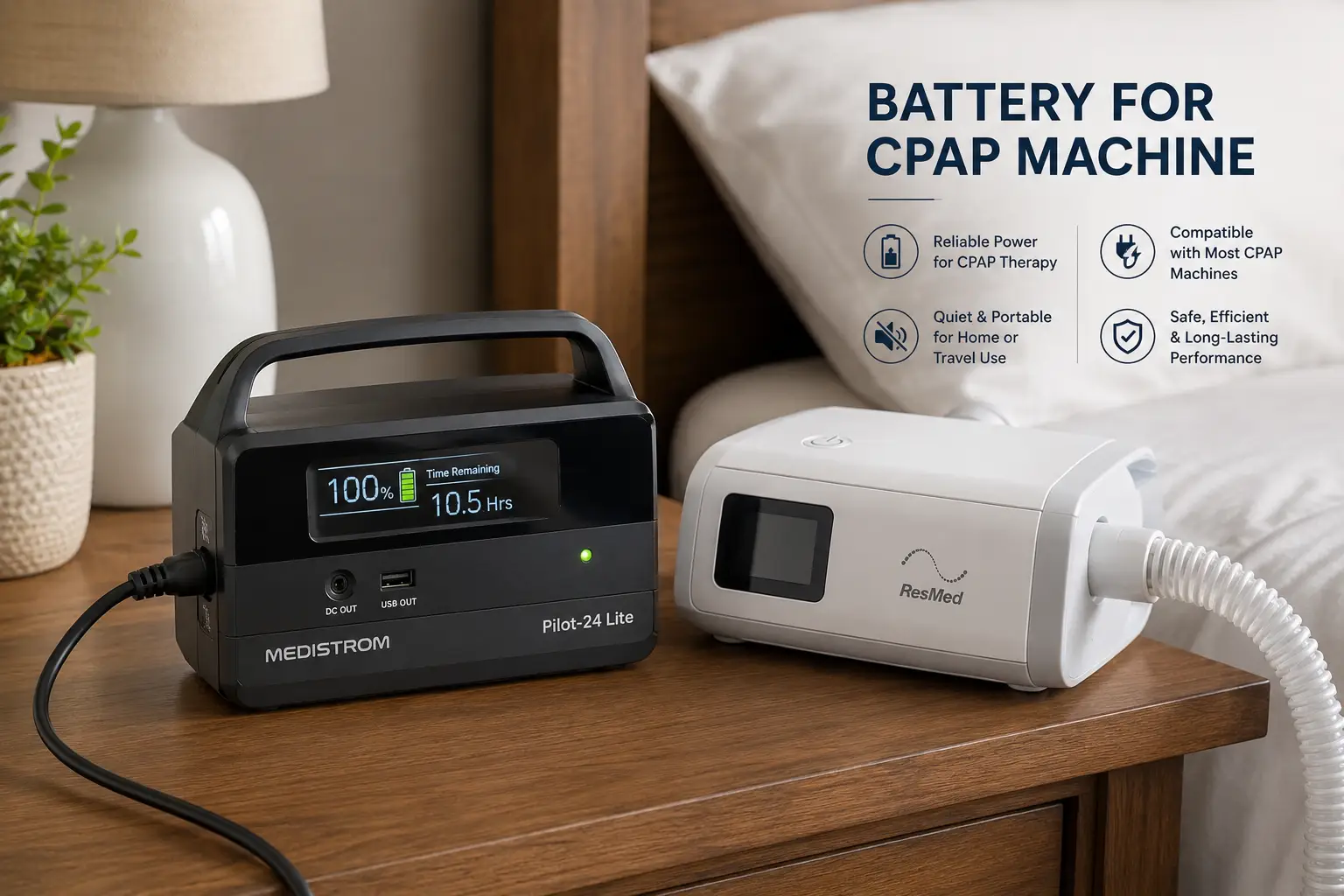
The standout feature here is what it leaves out: at 1.3 pounds and 95Wh, the Medistrom Pilot-24 Lite is designed from the ground up to slide under airline lithium-battery limits without a second thought. It delivers native 24V DC power, meaning it plugs straight into the DC port on a ResMed AirSense 10, AirMini, or S9 without converting to AC and back — a conversion step that wastes energy on bulkier units. That efficiency is exactly why a battery less than half the size of some competitors still claims up to 16 hours of runtime with accessories off.
In practice, expect closer to one full night with the humidifier and heated tubing disabled; turning those on will cut runtime meaningfully, since heating elements are by far the biggest power draw in any CPAP setup. This model is best suited to frequent flyers and minimalist campers who prioritize weight and airline compliance over multi-night capacity — it’s not the right pick for anyone who wants to keep the humidifier running through a three-night camping trip.
Aggregated feedback across CPAP retailers and Amazon reviews consistently describes reliable, seamless switchover during outages and straightforward setup with the included ResMed cables, though some buyers note the AirSense 11 cable is sold separately and easy to overlook at checkout.
Pros:
- ✅ Meets the FAA’s 100Wh threshold with real margin to spare
- ✅ Native 24V DC connection skips lossy AC conversion
- ✅ Doubles as a phone and tablet charger via USB
Cons:
- ❌ Not enough capacity for multi-night use with a humidifier
- ❌ AirSense 11 and some other cables cost extra
Pricing typically falls in the $220–$270 range depending on which cable bundle you choose, and at that price it’s a strong value specifically for the traveler who needs airline-proof peace of mind rather than maximum runtime.
2. EASYLONGER ES400 AIR — budget-friendly one-night backup
The clear hook is price-to-capacity ratio: 148Wh for meaningfully less than most CPAP-specific competitors, which makes the EASYLONGER ES400 AIR the entry point for anyone who just wants a safety net for occasional outages. The lithium-ion cell array pairs with included cables for ResMed S9, AirSense 10/11, AirCurve 10/11, AirMini, and Philips DreamStation, so compatibility isn’t the bottleneck — capacity management is.
Practically speaking, 148Wh comfortably covers a full 7-to-8-hour night at a moderate pressure setting with the humidifier off; add heated tubing and you’re rolling the dice on making it to sunrise. This battery is best for someone who experiences occasional grid outages a few times a year rather than someone who travels off-grid weekly, and it’s a sensible starter purchase for a first-time buyer who isn’t sure how much they’ll actually use a backup battery.
Review sentiment for this budget tier of EASYLONGER batteries tends to praise straightforward plug-and-play setup and a genuinely compact form factor, while a recurring theme in the feedback is that runtime drops noticeably once the humidifier is engaged — consistent with what the specs would predict.
Pros:
- ✅ Lowest entry price among dedicated CPAP batteries here
- ✅ Cables included for most major CPAP brands
- ✅ Compact and easy to toss in a travel bag
Cons:
- ❌ Humidifier use can cut runtime well below a full night
- ❌ Not TSA/FAA airline-approved for spare-battery rules the same way sub-100Wh units are
At roughly $130–$180, this is the value pick for buyers who want basic outage protection without paying for capacity they won’t use.
3. EcoFlow RIVER 2 — fastest recharge in this lineup
What sets the EcoFlow RIVER 2 apart isn’t capacity — it’s speed. A 256Wh LiFePO4 battery that recharges from empty to full in about 60 minutes on AC power is unusual at this price point, and that matters more than it sounds for CPAP users who forget to plug in and only remember at bedtime. The 300W continuous output (600W surge) also means this isn’t a single-purpose device: it runs a CPAP, charges a laptop, and keeps a phone topped off simultaneously through its mix of AC outlets and USB-C ports.
Because it’s a general power station rather than a CPAP-specific unit, you’ll need your machine’s own AC power supply rather than a proprietary DC cable — a minor extra step, but one that also means it works with virtually any CPAP or BiPAP brand out of the box. LiFePO4 chemistry rated for roughly 3,000 charge cycles to 80% capacity means this battery should outlast several generations of lithium-ion competitors, which matters for long-term cost of ownership.
Owner feedback aggregated from retailer and marketplace reviews highlights the fast charging and EcoFlow’s companion app for monitoring charge level as standout conveniences, with the most common critique being that 256Wh feels tight if you’re also running a mini-fridge or CPAP humidifier on the same charge.
Pros:
- ✅ Full recharge in about an hour, rare at this capacity
- ✅ Runs a CPAP plus multiple other devices at once
- ✅ LiFePO4 cells rated for roughly 3,000 cycles
Cons:
- ❌ Requires your CPAP’s own AC power brick, not a direct DC cable
- ❌ 256Wh is on the smaller side for humidifier-heavy multi-night use
Typical pricing runs $180–$240, making it a strong value pick for anyone who wants a power station that earns its keep beyond just CPAP duty.
4. Anker SOLIX C300 — best all-around versatility
The Anker SOLIX C300 distinguishes itself with genuinely fast UPS-style switchover — reported around 10 milliseconds — plus a 288Wh LiFePO4 battery that comfortably covers a full night of CPAP use even with moderate humidification. Three AC outlets rated for a combined 300W (600W surge) and dual 140W USB-C ports mean it handles a CPAP, a phone, and a laptop without breaking a sweat, and Anker backs the battery with a 5-year warranty, longer than most competitors in this category.
What that fast switchover means in practice: during a sudden outage, the pressure delivered to your mask shouldn’t noticeably dip or stutter, which matters for anyone whose apnea makes even a brief pressure gap uncomfortable. This unit suits buyers who want one device that pulls CPAP backup duty at home and general power-station duty on camping or work trips, rather than a purpose-built single-use battery.
Aggregated reviews and third-party lab testing point to reliable real-world switchover performance and quiet operation (rated near 25dB), with the main caveat being that the 300W output ceiling rules out high-wattage appliances if you were hoping to use it for anything beyond CPAP-scale loads.
Pros:
- ✅ Roughly 10ms UPS switchover protects against pressure interruption
- ✅ 5-year warranty, longer than most competitors
- ✅ Doubles as a genuinely useful general power station
Cons:
- ❌ 300W ceiling means it’s not built for larger appliances
- ❌ No CPAP-specific DC cable included; uses your machine’s AC brick
Expect to pay in the $230–$300 range, which reflects the added warranty length and switchover speed relative to comparable capacity competitors.
5. EASYLONGER ES720 PRO — mid-range CPAP-specific power supply
The EASYLONGER ES720 PRO sits deliberately between the brand’s budget and flagship tiers, offering 276.48Wh of LiFePO4 capacity purpose-built for CPAP use, with cables included for ResMed AirSense 10/11, AirCurve 10/11, AirMini, and Philips DreamStation 1/2. That capacity is enough to realistically cover two nights of CPAP-only use without a humidifier, or one full night with moderate humidification — a meaningfully longer runway than the budget-tier EASYLONGER models.
The LiFePO4 chemistry here is the more important upgrade over lithium-ion budget units: a 3,000-cycle-plus lifespan means this battery should still hold a useful charge years after a comparable lithium-ion pack has degraded past usefulness. For campers who go out several times a season or anyone in a hurricane-prone region who wants more margin than a single-night battery provides, this is the practical middle ground.
Review themes across this EASYLONGER tier consistently point to solid battery-management-system protection (overcurrent, overheat, short-circuit) and included cable variety as strengths, with recharge time — several hours on standard AC — flagged as the main limitation for anyone needing a same-day turnaround.
Pros:
- ✅ LiFePO4 cells rated for 3,000-plus charge cycles
- ✅ Two-night runway without a humidifier
- ✅ Cable kit covers most major CPAP brands out of the box
Cons:
- ❌ AC recharge takes several hours, slower than fast-charge power stations
- ❌ Not flight-legal due to capacity exceeding the 160Wh airline ceiling
Pricing generally sits between $200–$260, positioning it as a genuine mid-tier value between the entry-level and multi-night flagship options.
6. BLUETTI CPAP Battery Backup X30 — broadest cable compatibility
The single biggest selling point of the BLUETTI CPAP Battery Backup X30 is the sheer breadth of what’s in the box: a comprehensive set of DC cables (12V, 15V, 24V outputs) plus a USB-A port, engineered to cover roughly 90% of CPAP and BiPAP machines on the market, including older models like the Philips System One and Respironics REMstar that other CPAP-specific batteries sometimes overlook. At 297Wh with a ternary lithium cell and a claimed noise floor around 20dB, it’s built to be silent enough to sit on a nightstand without becoming its own sleep disruptor.
That broad compatibility matters most for households with more than one CPAP user, or for anyone who’s switched machines over the years and doesn’t want to hunt down a new proprietary cable every time. Manufacturer estimates put runtime at 5-to-7 nights without a humidifier at typical pressure settings, though that figure assumes conservative use; expect meaningfully less with heated tubing engaged.
Aggregated marketplace feedback highlights the multi-cable kit and quiet operation as the most-cited strengths, while a recurring caution — echoed in the product’s own documentation — is that it can only charge one CPAP and one USB device simultaneously, so it’s not meant to run a full campsite of gear at once.
Pros:
- ✅ Cable kit covers roughly 90% of CPAP and BiPAP models
- ✅ Rated near 20dB, quiet enough for bedside use
- ✅ Built-in handle and carrying case for travel
Cons:
- ❌ Only powers one CPAP and one USB device at a time
- ❌ Ternary lithium cells generally cycle fewer times than LiFePO4
Prices have ranged widely from promotional lows near $200 up to a $300–$400 list price, so this is one where checking the current price before buying genuinely pays off.
7. EASYLONGER ES960 — highest capacity for multi-night backup
For sheer runway, the EASYLONGER ES960 tops this list at 297.6Wh of LiFePO4 capacity, explicitly marketed and reviewed by real users for multi-night use — independent testing by outdoor bloggers has reported six-plus nights of CPAP-only runtime (no humidifier, no heated hose) on a single charge. Six output ports, including dual 12V/15A cigarette-lighter sockets and a 60W USB-C PD port, mean it can run a CPAP while simultaneously charging a phone, tablet, or even a small car fridge.
This is the pick for hurricane-prone homeowners who might lose grid power for days, not hours, and for extended off-grid campers or overlanders who need one battery to outlast a full trip rather than a single night. The trade-off for that capacity is weight and bulk — noticeably heavier than the travel-focused options on this list — and the fact that its 297.6Wh capacity sits well above the FAA’s 160Wh ceiling, so it’s a car-and-camper battery, not a carry-on.
Real-world reviews, including detailed multi-night testing logs from CPAP users, consistently back up the manufacturer’s multi-night runtime claims for humidifier-free use, while noting that solar recharging (supported via a compatible panel, sold separately) adds welcome flexibility for extended off-grid stretches.
Pros:
- ✅ Verified multi-night runtime in independent user testing
- ✅ Six output ports support CPAP plus multiple devices at once
- ✅ 3,000-plus cycle LiFePO4 cells built for years of use
Cons:
- ❌ Too large for FAA/TSA carry-on rules
- ❌ Bulkier and heavier than every other pick on this list
Expect a price in the $240–$320 range — a fair value given that no other battery here matches its documented multi-night capacity.
Setting Up Your CPAP Battery for the First Time
Getting a new battery for CPAP machine backup working correctly the first time prevents the worst possible discovery: finding out it doesn’t actually power your machine during an actual outage. Here’s the process worth following before you ever need it in an emergency.
Start by fully charging the battery before first use — most lithium and LiFePO4 units ship at a partial charge, and running a capacity test from empty gives you an honest read on real-world runtime rather than the manufacturer’s best-case number. Next, confirm which cable or adapter your specific CPAP model needs; DC-native batteries like the Medistrom Pilot-24 Lite require a machine-specific cable, while AC-based power stations like the EcoFlow RIVER 2 and Anker SOLIX C300 simply need your CPAP’s existing power brick plugged into an outlet on the unit.
Run a supervised test night with the humidifier and heated tubing turned off first, so you get a clean baseline runtime reading before adding those power-hungry accessories back in. Once you know your no-humidifier runtime, test again with humidification on at your normal setting to see the real gap — for most machines, that’s the single biggest variable affecting how long any of these batteries will last you.
Finally, build a simple maintenance habit: recharge to 100% after every use rather than letting it sit partially depleted, store it at room temperature away from direct sun or extreme cold, and top off the charge every one to two months if it’s sitting unused in a hurricane kit or travel bag, since even inactive lithium cells slowly self-discharge over time.
Real-World Scenarios: Which CPAP Battery Fits Your Life
Matching capacity to lifestyle is where most buyers get it wrong, so here are three realistic profiles to check yourself against. A frequent business flier who travels two or three times a month, sleeps with the humidifier off in hotel rooms, and mainly wants insurance against a canceled outlet at a layover gate is the textbook case for the Medistrom Pilot-24 Lite — its FAA-friendly capacity and native ResMed compatibility solve exactly that narrow, recurring problem without adding bulk to a carry-on.
A hurricane-zone homeowner who’s lost grid power for two to four days at a stretch during past storm seasons needs to think past a single overnight and toward genuine multi-night resilience; that points squarely at the EASYLONGER ES960 or the BLUETTI CPAP Battery Backup X30, both of which are large enough to bridge several nights of humidifier-free therapy and can also trickle-charge a phone for emergency communication.
A weekend car-camper who splits time between tent sites and the occasional cabin with power, and who also wants a battery that’s useful for more than just CPAP duty — running a cooler, charging camera batteries, powering a headlamp — fits best with a general-purpose station like the Anker SOLIX C300 or EcoFlow RIVER 2, since both handle a CPAP competently while doubling as an all-around trip battery the rest of the group can borrow too.
Common CPAP Power Problems — and How to Solve Them
Runtime shorter than advertised is the single most common complaint across every battery on this list, and the fix is almost always the same: heated humidification and heated tubing are by far the biggest power draws on a modern CPAP, often doubling or tripling total wattage draw compared to the blower motor alone. Running the humidifier on a low setting, or skipping it entirely for one or two backup nights, is the single biggest lever for extending any battery’s real-world life.
A battery that won’t power the machine at all, despite showing a charge, is usually a cable or adapter mismatch rather than a dead unit — DC-native batteries in particular require the exact voltage cable for your specific CPAP model, and a cable built for a 24V AirSense won’t correctly power a different voltage machine even if the physical connector happens to fit.
Slow recharge times catching people off guard before a trip is a planning problem more than a hardware one: batteries like the EcoFlow RIVER 2 recharge in about an hour, but multi-night LiFePO4 units like the EASYLONGER ES960 can take four to six hours on standard AC, so charging the night before travel — not the morning of — avoids a scramble.
Confusion over airline rules causes a fair number of batteries to get flagged or confiscated at security; the fix is checking the printed watt-hour rating before you fly, since anything above 100Wh needs airline pre-approval and anything above 160Wh generally can’t fly at all in carry-on baggage, per the TSA’s lithium battery guidelines, which cap unapproved spare batteries at 100 watt-hours and limit larger 101-160Wh batteries to two per passenger with airline sign-off.
Finally, an unexpectedly short battery lifespan over one to two years is often a storage issue: lithium and LiFePO4 cells degrade faster when stored fully depleted or in extreme heat, so keeping a backup battery charged and in a temperature-stable spot — not the trunk of a car in July — meaningfully extends its usable life.
✨ Don’t get caught mid-trip with a dead battery — pick your backup now and set it up before you actually need it.
How to Choose a Battery for a CPAP Machine
Choosing the right battery for CPAP machine backup comes down to seven practical criteria, roughly in order of importance for most buyers.
- Calculate your real wattage draw first. Check your CPAP’s data sheet or the sticker on the power brick for its rated wattage, then multiply by the hours you need — this single number does more to narrow your options than any marketing claim.
- Decide if you need humidification during backup use. If yes, budget for roughly double the watt-hours you’d need for blower-only operation.
- Match connection type to your machine. Native DC batteries like the Medistrom Pilot-24 Lite are more efficient but machine-specific; AC power stations like the Anker SOLIX C300 are universal but lose a little efficiency in conversion.
- Check the battery chemistry. LiFePO4 cells, used in the EcoFlow RIVER 2, EASYLONGER ES720 PRO, and EASYLONGER ES960, last roughly three to six times longer than standard lithium-ion before capacity fades meaningfully.
- Confirm airline rules if you travel. Anything over 160Wh generally can’t fly in carry-on luggage at all, which rules out the larger units on this list for air travelers.
- Weigh recharge speed against your routine. Frequent, spontaneous trips favor fast-charging units like the EcoFlow RIVER 2; planned, occasional backup use tolerates a slower charge.
- Factor in noise and port count if it’ll sit bedside. A unit rated near 20-25dB, like the BLUETTI CPAP Battery Backup X30 or Anker SOLIX C300, won’t add its own hum to your sleep environment.
According to SleepApnea.org’s CPAP battery guidance, a portable outlet-style battery with roughly 159Wh of lithium-ion capacity typically delivers 8 to 10 hours of runtime for most CPAP machines — a useful mental benchmark: if a battery you’re considering falls well below that capacity, plan on skipping the humidifier during backup use.
Common Mistakes to Avoid When Buying a CPAP Battery
Buying based on price alone, without checking watt-hours against your actual machine’s draw, is the most expensive mistake in this category — a cheap battery that only delivers three hours of real-world runtime isn’t actually cheap once you’re awake at 3 a.m. without therapy. Close behind that is assuming every battery works with every CPAP; DC-native units require a model-specific cable, and buying the wrong one means an unusable battery until the correct cable ships.
Ignoring the humidifier math is another recurring trap — buyers frequently size a battery for blower-only use, then are surprised when a single night with heated tubing engaged cuts runtime by 40% or more. Skipping the airline watt-hour check before a flight is a mistake that can mean losing the battery at security entirely, not just an inconvenience.
Finally, treating a CPAP battery as a “buy it and forget it” purchase — never testing it, never topping off the charge — is how people discover a dead or degraded battery exactly when a real outage hits. A five-minute test night once every few months is cheap insurance against that outcome.
Battery for CPAP Machine: Best Options for Frequent Travelers
Frequent travelers weighing a portable battery for CPAP machine backup have narrower requirements than home-backup buyers: airline compliance, low weight, and fast setup at a hotel or campsite matter more than raw capacity. The Medistrom Pilot-24 Lite remains the clearest pick for this group — its 95Wh rating sits comfortably under FAA and TSA thresholds, and at 1.3 pounds it barely registers in a carry-on.
For travelers who also want a general-purpose power bank for laptops and cameras alongside CPAP backup, the EcoFlow RIVER 2 is a reasonable step up, though its 256Wh capacity puts it in the 101-160Wh-plus tier that requires airline pre-approval and is limited to two spare batteries per passenger under current rules — worth confirming directly with your airline before departure, since policies vary. Rechargeable batteries between 101 and 160 watt-hours require approval from the air carrier, while batteries exceeding 160Wh are forbidden entirely on passenger aircraft. That makes the larger units on this list — the EASYLONGER ES960 and BLUETTI CPAP Battery Backup X30 — better suited to road trips and car camping than to flights.
Safety, Regulations, and Standards for CPAP Batteries
Every battery on this list uses a built-in battery management system (BMS) that protects against overcurrent, overcharging, overheating, and short circuits — a baseline safety feature worth confirming on any CPAP battery before you buy, since thermal runaway in damaged or poorly regulated lithium cells is a genuine fire risk. LiFePO4 chemistry, used in several picks here including the EASYLONGER ES960 and EcoFlow RIVER 2, is inherently more thermally stable than standard lithium-ion or ternary lithium cells, which is part of why it’s increasingly the default choice for higher-capacity units.
Air travel rules deserve special attention because they’re strict and specifically about watt-hours, not physical size. Per the FAA’s PackSafe guidance on airline passengers and batteries, batteries rated 0 to 100 watt-hours are allowed on passenger aircraft without special approval, batteries rated 101 to 160 watt-hours require air carrier approval, and anything exceeding 160 watt-hours is forbidden from both carry-on and checked baggage. Spare batteries, including CPAP batteries not connected to the machine, must travel in carry-on luggage only — never in a checked bag — regardless of capacity.
Damaged or recalled batteries carry their own risk category. If a battery has been physically damaged, recalled, or shows swelling, it shouldn’t be carried onto a plane or used at all until it’s been safely removed from service; checking a manufacturer’s recall list before a big trip takes a few minutes and avoids a genuinely dangerous situation. At home, standard practice — keeping any lithium battery away from direct heat sources, not charging it unattended overnight on a flammable surface, and using only the manufacturer’s specified charger — applies just as much to a CPAP battery as to a phone or laptop battery.
Long-Term Cost and Maintenance: Is a CPAP Battery Worth It?
Sticker price is only part of the real cost story here. A budget lithium-ion battery like the EASYLONGER ES400 AIR costs less upfront but typically holds a useful charge for 500 to 800 cycles before capacity fades meaningfully, while LiFePO4 units like the EASYLONGER ES720 PRO, EASYLONGER ES960, and EcoFlow RIVER 2 are commonly rated for 3,000 or more cycles — often described as roughly six times the usable life of comparable lithium-ion cells. Amortized over years of occasional use, the higher-capacity LiFePO4 options frequently work out cheaper per year of service, even at a higher purchase price.
Insurance rarely covers CPAP batteries, since most insurers classify the CPAP machine itself, not backup power accessories, as durable medical equipment — a detail worth confirming with your own provider, since coverage policies vary. That makes this an out-of-pocket purchase for most buyers, which is one more reason cycle life and warranty length matter as much as the sticker price; the 5-year warranty on the Anker SOLIX C300, for instance, meaningfully changes its cost-per-year math compared to units backed by a standard one-year warranty.
Maintenance costs stay low across the board — no consumable parts to replace, just periodic recharging — but replacement cables for CPAP-specific units like the BLUETTI CPAP Battery Backup X30 or EASYLONGER ES960 can add $15 to $30 if a cable is lost or a new CPAP model requires a different connector, a small but real ongoing cost worth budgeting for. As Sleeplay’s CPAP battery guide notes, cold temperatures reduce lithium battery performance — worth factoring in for spring and fall camping trips — and high altitude can increase CPAP motor effort, reducing overall runtime; both environmental factors that can shorten a battery’s effective service life faster than cycle count alone would suggest.
CPAP Battery vs. Traditional Power Bank or Generator
| Feature | Dedicated CPAP Battery | Standard Power Bank | Gas Generator |
|---|---|---|---|
| Runtime for CPAP | 4–20+ hours | Usually insufficient | Unlimited with fuel |
| Noise | Silent to near-silent | Silent | Loud, often 60dB+ |
| Airline legal | Often yes (under 160Wh) | Varies | No |
| Indoor bedside use | Yes | Yes | No (carbon monoxide risk) |
| Setup complexity | Low | Low | Moderate to high |
The table makes the trade-offs clear: a standard USB power bank simply can’t deliver the sustained wattage a CPAP motor and heater need for a full night, which rules it out despite its low cost and wide availability. A gas generator solves the runtime problem but introduces carbon monoxide risk that makes it unsafe for bedside or indoor use — a dealbreaker for a device meant to sit next to someone while they sleep.
A purpose-built battery for CPAP machine backup, whether CPAP-specific like the EASYLONGER ES960 or a general power station like the Anker SOLIX C300, is the only option in this comparison that’s simultaneously silent, safe indoors, and sized correctly for realistic CPAP runtime — which is exactly why it’s become the standard recommendation from sleep medicine resources rather than either alternative.
💬 See the full spec breakdown above and pick the battery that matches your travel and outage needs — your future 3 a.m. self will thank you.
FAQs
❓ How many watts does a CPAP machine use?
❓ Can I bring a CPAP battery on a plane?
❓ How long will a battery for CPAP machine last during an outage?
❓ Does insurance cover a CPAP backup battery?
❓ What's the difference between LiFePO4 and lithium-ion CPAP batteries?
Conclusion
There’s no single best battery for CPAP machine backup — there’s only the best one for your specific pressure setting, humidifier habits, and travel patterns. If you fly often and just need a safety net, the Medistrom Pilot-24 Lite‘s featherweight, airline-friendly design is hard to beat. If a hurricane season or an unreliable rural grid is your real concern, the multi-night capacity of the EASYLONGER ES960 or BLUETTI CPAP Battery Backup X30 buys genuine peace of mind. And if you want one device that handles CPAP backup today and doubles as a general camping or emergency power station tomorrow, the Anker SOLIX C300 or EcoFlow RIVER 2 earns its keep well beyond the bedroom.
Whichever one you choose, the real value isn’t the battery sitting in a drawer — it’s testing it before you need it, sizing it honestly against your humidifier habits, and treating it as a genuine part of your sleep therapy setup rather than an afterthought. A single missed night of therapy can mean a rough next day; a charged, correctly sized battery means that outage, flight, or campsite never has to cost you your sleep.
✨ Ready to stop leaving your therapy at the mercy of the power grid? Check current pricing and availability on today’s top pick and get your backup sorted before you need it! 🔋
Recommended for You
- Generator for 30 Amp Camper: 7 Best Options for Reliable RV Power
- 7 Best 8kW Solar System Kits and Inverters (2026)
- 5 Best 2000 Watt Solar Panel Kits in 2026: Expert Hands-On Review
Disclaimer: This post contains affiliate links. As an Amazon Associate, I earn from qualifying purchases made through these links, at no additional cost to you.
✨ Found this article helpful? Share it with someone who needs it! 💬🤗