
In This Article
Nothing derails a camping trip faster than staring at a dead rooftop AC on a 95-degree afternoon because the generator you brought can’t handle the startup surge. A generator for 30 amp camper needs to deliver roughly 3,600 watts of continuous power, clean enough for sensitive electronics, and quiet enough not to get you kicked out of a campground during posted quiet hours…
That last part matters more than most first-time buyers expect. Many developed campgrounds and national park campgrounds restrict generator use to specific daytime windows and enforce strict quiet hours around 10 p.m. to 6 a.m., so a generator that’s merely powerful isn’t enough — it also has to be genuinely quiet at the campsite next to you.
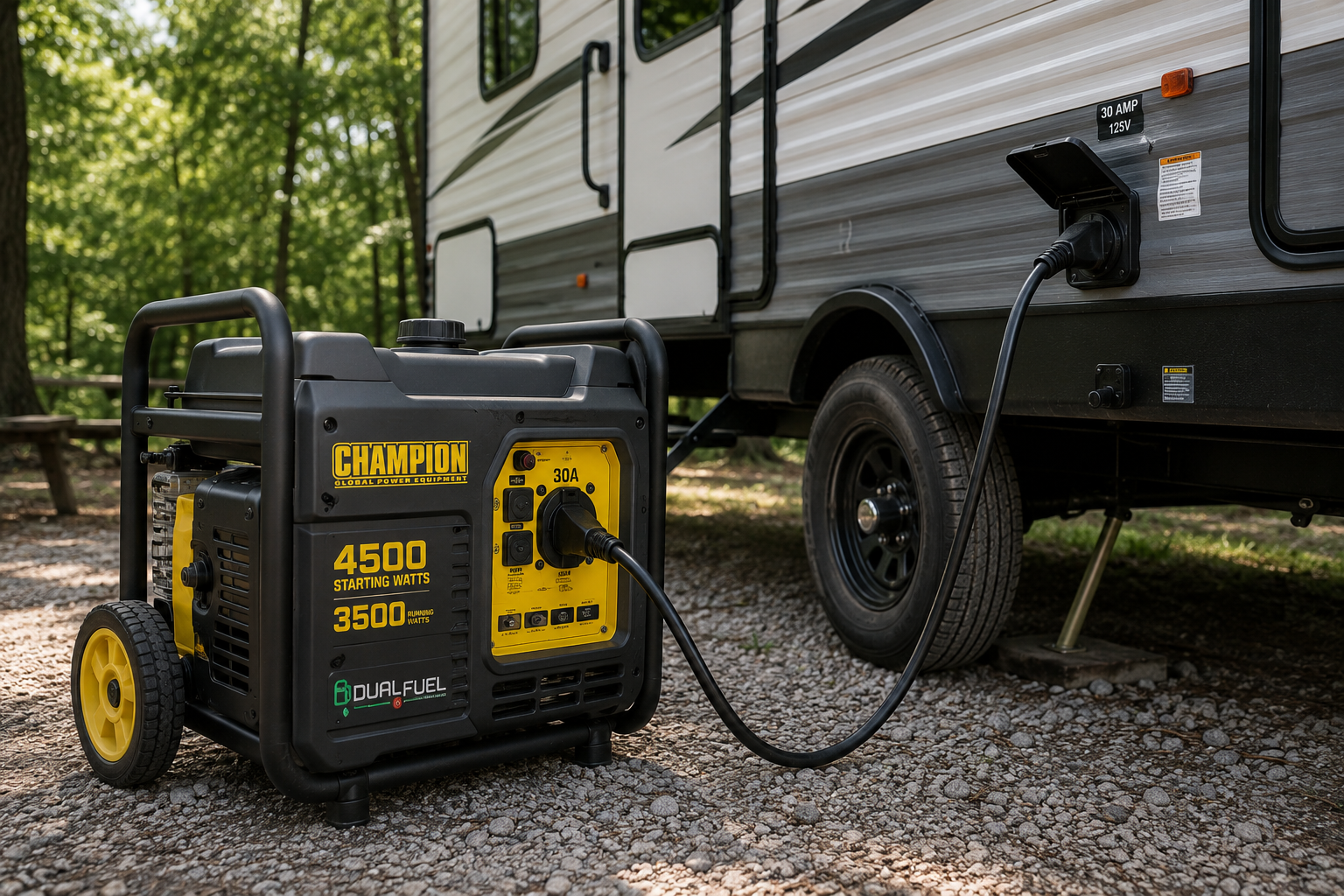
This guide compares seven real, currently available generators sized for 30 amp RV and travel-trailer use, from a compact 2,200-watt inverter to a 4,500-watt dual-fuel unit and a battery-based alternative with no engine noise at all. We’ll cover watts vs. amps math, TT-30R outlets, dual-fuel vs. gas-only tradeoffs, and the carbon monoxide safety rules every generator owner should know. As an Amazon Associate, this post contains affiliate links, and we may earn a commission on qualifying purchases at no extra cost to you.
What Size Generator Do You Actually Need for a 30 Amp Camper?
A standard 30 amp RV service runs on 120V, so the math is straightforward: 120V x 30A = 3,600 watts maximum. In real-world use, most 30 amp campers do best with a generator in the 3,500 to 4,500-watt class, since the extra headroom above the theoretical 3,600-watt ceiling covers the startup surge from a rooftop air conditioner compressor kicking on.
Running watts matter more than the bigger peak-watt number printed on the box. A generator that sustains 3,000-3,700 running watts reliably will serve a 30 amp camper better than one that only hits a high peak number for a few seconds before settling lower.
Quick Comparison: 7 Generators for 30 Amp Campers at a Glance
| Generator | Running Watts | Outlet | Noise | Price Range | Best For |
|---|---|---|---|---|---|
| Honda EU2200i | 1,800W | Standard 120V (no TT-30R) | 48-57 dBA | Around $1,100-$1,300 | Light loads, no rooftop AC |
| Champion 100809 4000W | 3,000W | 120V 25A TT-30R | 64 dBA | Around $600-$750 | Lightest solo-carry 4000W-class unit |
| Champion 4500W Dual Fuel | 3,500W (gas) | 120V 30A TT-30R | 61-64 dBA | Around $900-$1,050 | Best all-around 30A RV power |
| Westinghouse iGen4500 | 3,700W | 120V 30A TT-30R | 52-53 dBA | Around $800-$950 | Best noise-to-power balance |
| Predator 4200 Dual Fuel | 3,200W (gas) | 120V 30A TT-30R | 61 dBA | Around $600-$700 | Best budget dual-fuel value |
| WEN 56477i | 3,800W | 120V 30A TT-30R | 62 dBA | Around $700-$850 | Budget alternative with strong specs |
| Jackery Explorer 2000 Plus | 3,000W (2,042Wh) | Standard outlets + adapter | 30 dB | Around $1,600-$1,900 | Silent, fuel-free campground power |
Looking at the table above, the Westinghouse iGen4500 and Champion 4500W Dual Fuel cover the core 30 amp RV use case — one rooftop AC plus normal camper loads — most effectively, while the Honda EU2200i is better suited to boondockers who mainly need lights, a fridge, and device charging rather than full AC support. Budget-focused shoppers should look closely at the Predator 4200 Dual Fuel, and anyone camping somewhere generators aren’t allowed during quiet hours should consider the Jackery Explorer 2000 Plus instead.
💬 One click helps other travelers make an informed choice too! 😊
Top 7 Generators for a 30 Amp Camper: Expert Analysis
1. Honda EU2200i — the quietest option for light camper loads
For campers who mostly need to run lights, a fridge, a fan, and charge devices rather than a full rooftop AC, this is the generator that built Honda’s camping reputation. The 2,200-watt inverter weighs just over 47 pounds, runs on a 0.95-gallon tank for 3.2 to 8.1 hours depending on load, and operates at a genuinely quiet 48 to 57 dBA.
Based on comparing the specs against larger 30A-ready units, what sets the Honda EU2200i apart is that it’s actually usable during posted campground quiet hours where a louder 4,000-watt unit might not be, and it’s light enough for one person to lift into a truck bed without strain. It does not include a native TT-30R RV outlet, so it’s the right choice specifically for campers running lighter loads or pairing two units in parallel to reach AC-capable output, not for single-unit AC support.
Reviews consistently report exceptional reliability and resale value on this model, with owners regularly noting Honda’s Eco Throttle System stretches runtime further than competitors at the same load, though several mention the premium price compared to less refined alternatives.
Pros:
- ✅ Genuinely quiet at 48-57 dBA, ideal for strict quiet hours
- ✅ Lightweight at just over 47 pounds for solo transport
- ✅ Parallel-capable with a second unit for more power
Cons:
- ❌ No native TT-30R outlet included on this model
- ❌ Alone, it can’t reliably start a typical rooftop RV AC
At around $1,100-$1,300 at the time of writing, the Honda EU2200i commands a premium, but its resale value and reliability record make that a defensible long-term investment for light-load camping.
2. Champion 100809 4000W — lightest 4000-watt class option for solo travelers
Hauling a full-size generator alone is a real physical task, and this Champion model is built specifically around solving that problem. At 48.1 pounds, it’s genuinely one of the lightest 4000-watt-class inverters available, delivering 4,000 starting watts and 3,000 running watts from a 149cc engine, with a 120V 25A TT-30R outlet built in.
What most buyers overlook with generators in this weight class is that the tradeoff for lighter weight is usually a smaller fuel tank and shorter runtime; here, the 1.54-gallon tank delivers roughly 10 hours at 25% load, which comfortably covers an overnight but requires more frequent refueling than heavier competitors. Reviews consistently praise how easily one person can load and unload this unit without wheels or assistance, though some buyers note the 64 dBA noise level is noticeably louder than premium inverters at the same load.
This generator is the right call for solo or couple RV travelers who prioritize easy handling over maximum runtime or ultra-quiet operation.
Pros:
- ✅ Genuinely one-person portable at 48.1 pounds
- ✅ Built-in TT-30R outlet, no adapter required
- ✅ 3-year warranty with free lifetime technical support
Cons:
- ❌ Smaller 1.54-gallon tank means more frequent refueling
- ❌ 64 dBA noise level is louder than premium competitors
Priced around $600-$750 at the time of writing, the Champion 100809 4000W delivers strong value for RVers who value easy handling above all else.
3. Champion 4500W Dual Fuel — best all-around pick for 30A RV power
For most 30 amp camper owners, this is the generator that checks every box at once: enough running watts for one rooftop AC, a native TT-30R outlet, and the flexibility to run on gasoline or propane. The 212cc engine produces 4,500 starting watts and 3,500 running watts on gasoline, running up to 14 hours at 25% load, or 3,150 running watts for up to 21 hours on a 20-pound propane tank.
Here’s what to weigh: dual-fuel flexibility genuinely matters for boondockers who already carry propane for cooking or heating and don’t want to store extra gasoline cans. Based on comparing this against single-fuel competitors, the Champion 4500W Dual Fuel trades a small amount of running watts on propane for meaningful convenience and extended runtime, making it the strongest all-around choice for owners who camp for more than a weekend at a time.
Aggregated review sentiment highlights the CO Shield automatic shutoff system as genuine peace of mind for families, and the EZ Start fuel-selector dial as simpler than expected, while some buyers note the unit runs closer to 64 dBA than the advertised 61 dBA under real AC-starting loads.
Pros:
- ✅ Dual-fuel flexibility between gasoline and propane
- ✅ Native 30A TT-30R outlet plus household outlets
- ✅ CO Shield automatic carbon monoxide shutoff system
Cons:
- ❌ Heavier than single-fuel competitors in this wattage class
- ❌ Real-world noise runs slightly above the advertised rating under load
Expect to pay around $900-$1,050 at the time of writing, and the Champion 4500W Dual Fuel earns that price through genuine day-to-day versatility for regular RV travel.
4. Westinghouse iGen4500 — best noise-to-power balance for campgrounds
Noise is often the deciding factor for campground generator use, and this Westinghouse model is built specifically around that priority. It delivers 3,700 running watts and 4,500 peak watts from a 224cc engine while operating at just 52-53 dBA, among the quietest ratings in the 4,500-watt class, with a native TT-30R RV outlet and never-flat wheels for easier transport.
What the spec sheet doesn’t fully convey is how much that noise difference matters in practice: campgrounds enforcing a 60 dBA limit will accept the Westinghouse iGen4500 where a 64 dBA competitor might draw complaints from neighboring sites. Reviews consistently mention the variable-speed engine’s fuel efficiency, delivering up to 18 hours of runtime at 25% load on a 3.4-gallon tank, though several owners note the unit’s nearly 105-pound weight makes solo transport genuinely difficult without the built-in telescoping handle and wheels.
This generator is the right pick for RVers prioritizing quiet operation and fuel efficiency over minimizing weight.
Pros:
- ✅ Among the quietest units in its wattage class at 52-53 dBA
- ✅ Native TT-30R outlet plus remote electric start
- ✅ Up to 18 hours of runtime at 25% load on one tank
Cons:
- ❌ Nearly 105 pounds, difficult for one person to lift
- ❌ Gasoline-only, no dual-fuel flexibility on this base model
At around $800-$950 at the time of writing, the Westinghouse iGen4500 delivers exceptional value for campers who prioritize quiet operation above weight.
5. Predator 4200 Dual Fuel — best budget dual-fuel value
Harbor Freight’s in-house Predator line has built a reputation for strong specs at aggressive prices, and this dual-fuel 4200-watt model is a clear example. It delivers 4,200 starting watts and 3,200 running watts on gasoline, includes CO Secure automatic shutoff technology, and comes with a native TT-30R RV outlet alongside standard household outlets.
Based on comparing this against name-brand dual-fuel competitors, what most buyers overlook is that Predator’s shorter 90-day warranty is the real tradeoff for the lower price, not build quality; the underlying performance specs are genuinely competitive with units costing considerably more. The Predator 4200 Dual Fuel is the right call for budget-conscious owners comfortable sourcing their own parts and troubleshooting minor issues rather than leaning on an extended manufacturer support line.
Reviews consistently highlight strong startup power for RV AC units, with some owners specifically noting improved performance after adding an aftermarket soft-start device for their air conditioner compressor, while a handful mention the automatic fuel switchover between propane and gasoline works more smoothly than expected at this price point.
Pros:
- ✅ Strong 4,200 starting watts at a budget-friendly price
- ✅ Dual-fuel flexibility with automatic switchover
- ✅ CO Secure automatic carbon monoxide shutoff
Cons:
- ❌ Warranty is just 90 days, shorter than name-brand competitors
- ❌ Parts and support are less accessible than established brands
Priced around $600-$700 at the time of writing, the Predator 4200 Dual Fuel offers some of the strongest performance-per-dollar in this guide.
6. WEN 56477i — strong specs at a mid-range price
WEN has carved out a reputation for competitive specs without the premium-brand markup, and this 4,000/4,800-watt inverter fits that pattern closely. It includes a native TT-30R receptacle for direct RV connection, an encased design that helps manage noise compared to open-frame alternatives, and a dry weight of 72.7 pounds manageable with its integrated wheels and telescoping handle.
What most buyers overlook with mid-tier brands like WEN is that the core engineering — inverter technology, clean sub-3% THD power, RV-ready outlets — is largely equivalent to premium brands, with the difference showing up mostly in warranty length and brand-name support rather than day-to-day performance. The WEN 56477i is a solid pick for RVers who want dependable 30A-ready power without paying for a name-brand premium.
Aggregated review sentiment points to reliable startup performance for rooftop AC units and straightforward maintenance access, though some owners note the 62 dBA noise level puts it in the middle of the pack rather than among the quietest options here.
Pros:
- ✅ Native TT-30R outlet for direct RV connection
- ✅ Wheels and telescoping handle ease transport
- ✅ Clean sub-3% THD power safe for electronics
Cons:
- ❌ Mid-pack noise level compared to premium quiet models
- ❌ Shorter brand track record than Honda or Champion
At around $700-$850 at the time of writing, the WEN 56477i is a smart middle-ground choice between budget and premium options.
7. Jackery Explorer 2000 Plus — best fuel-free, silent alternative
Not every campground allows generator use during the hours you actually need power, and that’s exactly the gap this battery-based power station fills. With 2,042Wh of LiFePO4 battery capacity and up to 3,000W of continuous AC output, it can run a portable AC unit or camper appliances with zero engine noise, operating at roughly 30 dB when charging — quieter than a whisper.
Here’s what to weigh: this isn’t a direct swap for a fuel generator in every situation, since 2,042Wh provides limited runtime for continuous high-draw loads like a rooftop AC compared to a fuel tank that can simply be refilled. What most buyers overlook is that the real advantage is flexibility — solar recharging in as little as two hours with compatible panels means boondockers can sustain power indefinitely without carrying fuel, and the Jackery Explorer 2000 Plus can run silently through quiet hours when a combustion generator legally can’t.
Reviews consistently praise the unit’s genuine silence and reliability during multi-day power outages and RV trips, with several owners specifically noting it kept trailer house batteries charged for days during extended use, though some mention the roughly 43-pound weight and handle design could be sturdier for repeated loading and unloading.
Pros:
- ✅ Completely silent operation, usable during quiet hours
- ✅ Solar-rechargeable for indefinite fuel-free operation
- ✅ Zero exhaust, safe for closer placement to the camper
Cons:
- ❌ Limited runtime for sustained high-draw loads like AC
- ❌ Significantly higher upfront cost than fuel generators
Expect to pay around $1,600-$1,900 at the time of writing; the Jackery Explorer 2000 Plus is worth that premium specifically for quiet-hours compliance and off-grid solar flexibility, and less essential for campers who mainly use developed campgrounds with standard shore power.
Getting Started: Setting Up Your Generator for 30 Amp Camper Use
Before your first trip, confirm your camper’s shore power inlet is a standard TT-30R and check whether your chosen generator includes that outlet natively or requires an adapter. Generators like the Champion 4500W Dual Fuel and Westinghouse iGen4500 include a TT-30R outlet directly, simplifying setup considerably compared to units requiring a twist-lock adapter.
Run the generator for a short break-in period per the manufacturer’s instructions before your first camping trip, and always start it with the RV’s air conditioner and major appliances powered off, then bring them online one at a time to avoid unnecessary startup surge stacking.
Finally, practice your fueling and startup routine at home first. Dual-fuel units like the Predator 4200 Dual Fuel require understanding the fuel-selector switch before you’re standing in a dark campsite trying to figure it out for the first time.
Real-World Scenarios: Matching a Generator to How You Camp
A weekend boondocker who mostly needs lights, a fridge, and device charging without running AC is well served by a single Honda EU2200i, especially in campgrounds enforcing strict noise limits where its 48-57 dBA rating keeps things comfortable for neighboring sites.
A family running a rooftop AC regularly through summer travel should prioritize the Champion 4500W Dual Fuel or Westinghouse iGen4500, both sized to handle AC startup surge reliably while including the native TT-30R connection that simplifies daily setup.
A full-time boondocker who spends extended periods off-grid and values quiet, sustainable power gets the most long-term value from the Jackery Explorer 2000 Plus paired with solar panels, trading higher upfront cost for indefinite fuel-free operation and full compliance with quiet-hours restrictions that limit combustion generators.
Problem → Solution: Fixing Common 30 Amp Generator Headaches
Generators that shut down or trip when the RV air conditioner starts usually indicate insufficient starting-watt headroom; sizing up to a 4,000-4,500-watt class unit like the WEN 56477i or adding an aftermarket AC soft-start device typically resolves this without buying an entirely larger generator.
Campground noise complaints usually trace back to running a generator rated above 60 dBA during posted hours; switching to a quieter unit like the Westinghouse iGen4500, or a silent option like the Jackery Explorer 2000 Plus, solves this directly rather than hoping neighbors won’t notice.
Running out of fuel mid-trip is a common frustration for smaller-tank units like the Champion 100809 4000W; carrying an extra approved fuel container or choosing a dual-fuel model that can switch to propane extends your effective runtime considerably.
Finally, carbon monoxide risk is a real safety concern, not just an inconvenience — always run generators outdoors, well away from windows, doors, and vents, following CPSC’s carbon monoxide safety guidance regardless of which model you choose.
How to Choose a Generator for a 30 Amp Camper
- Start from your RV’s actual amp rating, not the biggest generator you can afford — 120V x 30A = 3,600 watts is your real ceiling, and a 3,500-4,500-watt inverter typically covers it with startup headroom.
- Confirm the outlet type — a native TT-30R outlet simplifies setup versus needing a separate adapter for a twist-lock or household plug.
- Weigh noise level against your camping style — a sub-55 dBA unit matters far more for quiet campgrounds and national parks than for isolated boondocking sites.
- Consider fuel type based on your trips — dual-fuel models add flexibility for boondockers already carrying propane, while gas-only units are typically lighter and cheaper.
- Check clean power specs (THD) — anything under 3% total harmonic distortion is safe for laptops, routers, and CPAP machines.
- Factor in weight and your ability to lift it — a 48-pound unit and a 105-pound unit both look similar on a spec sheet but feel very different loading a truck bed alone.
- Verify CO shutoff safety features are included, since federal safety standards for portable generators increasingly expect this technology as standard, not optional.
Common Mistakes to Avoid When Buying a Generator for a 30 Amp Camper
The most common mistake is buying based on peak/starting watts alone without checking running watts; a generator advertising a huge peak number may still fall short of sustaining your actual AC and appliance load for more than a few seconds.
A second frequent mistake is skipping the outlet check entirely. Buyers assume any 30-amp-rated generator will plug directly into their camper, then discover they need an adapter because the unit has a twist-lock L5-30R outlet instead of the straight-blade TT-30R most RVs use.
Buyers also tend to underestimate how much noise ratings vary by measurement distance and load; a generator rated at 52 dBA at 25% load and 23 feet will sound noticeably louder at full load or from 10 feet away, so treat published dBA figures as a floor, not a guarantee.
Finally, many first-time buyers overlook local campground and park generator rules entirely. Checking posted quiet hours and generator-use windows before your trip avoids an unpleasant surprise after you’ve already set up camp for the night.
Fuel Generators vs. Battery-Based Power Stations
The core tradeoff between a fuel generator and a battery-based unit like the Jackery Explorer 2000 Plus comes down to runtime versus silence. Fuel generators can run indefinitely as long as you keep refueling, while battery units are capped by their watt-hour capacity unless paired with solar panels for ongoing recharge.
Noise is the other major differentiator. A fuel generator, even a quiet one like the Westinghouse iGen4500, still produces mechanical and exhaust noise in the 52-64 dBA range, while a battery station operates at roughly 30 dB, quiet enough to run through posted quiet hours without violating campground rules.
The practical upshot: campers who primarily stay at developed campgrounds with generator-use windows do fine with a fuel unit like the Champion 4500W Dual Fuel, while boondockers seeking flexibility in restricted areas, or campers who simply want to avoid fuel storage and engine noise altogether, get more real-world value from a battery-based system.
Generators for Different Types of Camping Trips
Weekend campers at developed RV parks with standard hookups mostly need a generator as backup rather than a primary power source, making a lighter, more affordable option like the Champion 100809 4000W or Predator 4200 Dual Fuel a sensible fit.
Boondockers spending extended time off-grid should weight their decision toward runtime flexibility and fuel efficiency, favoring dual-fuel models like the Champion 4500W Dual Fuel or a solar-rechargeable battery system like the Jackery Explorer 2000 Plus.
Tailgaters and short-trip campers who value portability above all else are typically better served by a lighter unit like the Honda EU2200i, accepting reduced total wattage in exchange for genuinely easy one-person handling.
Full-time RVers running AC regularly through hot climates should prioritize sustained running watts and noise control together, making the Westinghouse iGen4500 a strong long-term fit given its balance of quiet operation and dependable AC-starting power.
Long-Term Cost and Maintenance
Generators require regular oil changes, air filter checks, and periodic carburetor cleaning if gasoline sits unused for extended storage periods; skipping this maintenance is the single most common cause of hard-starting or non-starting units after winter storage.
Budgeting for annual maintenance costs — oil, filters, occasional spark plugs, and fuel stabilizer — is a realistic expectation for any combustion generator, while battery-based units like the Jackery Explorer 2000 Plus trade that ongoing maintenance for a higher upfront cost and eventual battery degradation over many charge cycles.
The real total cost of ownership favors matching the generator to your actual camping frequency: an occasional weekend camper spending less on a lighter unit like the Predator 4200 Dual Fuel often comes out ahead of overspending on premium features that rarely get used.
Safety, Regulations, and Standards
Carbon monoxide poisoning remains the most serious risk associated with portable generators, and CPSC’s safety guidance is unambiguous: never run a generator indoors, in a garage, or in any partially enclosed space, and always position it well away from windows, doors, and vents, regardless of which model you own.
Look specifically for CO shutoff technology, now standard on most current-generation inverter generators including several picks in this guide, since federal rulemaking around portable generator safety has pushed the entire industry toward built-in carbon monoxide sensors as a baseline safety feature rather than a premium add-on.
Beyond CO safety, always check the specific campground or park’s generator-use hours and noise limits before your trip, since rules vary meaningfully between developed campgrounds, national parks, and dispersed public land.
Frequently Asked Questions
❓ What size generator do I need for a 30 amp RV?
❓ Will a 2,000 watt generator run a 30 amp RV air conditioner?
❓ What outlet does a 30 amp camper generator need?
❓ How loud can a generator be at a campground?
❓ Is a dual-fuel generator worth it for RV camping?
Conclusion
Choosing a generator for a 30 amp camper comes down to matching running watts, outlet type, and noise level to how you actually camp, not just chasing the highest peak-watt number on the box. For most RV owners running a rooftop AC regularly, that means a 3,500-4,500-watt inverter like the Champion 4500W Dual Fuel or Westinghouse iGen4500, both offering a native TT-30R outlet and enough startup headroom to handle real-world loads.
Lighter campers who mostly need power for lights, a fridge, and devices get more practical value from a genuinely portable unit like the Honda EU2200i, while boondockers and quiet-hours-conscious campers should seriously weigh a battery-based option like the Jackery Explorer 2000 Plus. Whichever direction you go, prioritize CO shutoff safety features and confirm your specific campground’s generator rules — those two factors matter more for a smooth trip than any single spec on the label.
✨ Don’t miss these exclusive deals! 🔌 Take your next camping trip to the next level with this lineup of 30 amp-ready generators. Click a highlighted item to check current pricing and availability. These picks will keep your RV powered wherever the road takes you!
Recommended for You
- 5 Best 2000 Watt Solar Panel Kits in 2026: Expert Hands-On Review
- 5 Best 12v Solar Panel with Battery Kits (2026 Field Tested)
- 10kw Solar System Cost: 5 Best Equipment Options in 2026
Disclaimer: This post contains affiliate links. As an Amazon Associate, I earn from qualifying purchases made through these links, at no additional cost to you.
✨ Found this article helpful? Share it with someone who needs it! 💬🤗