
In This Article
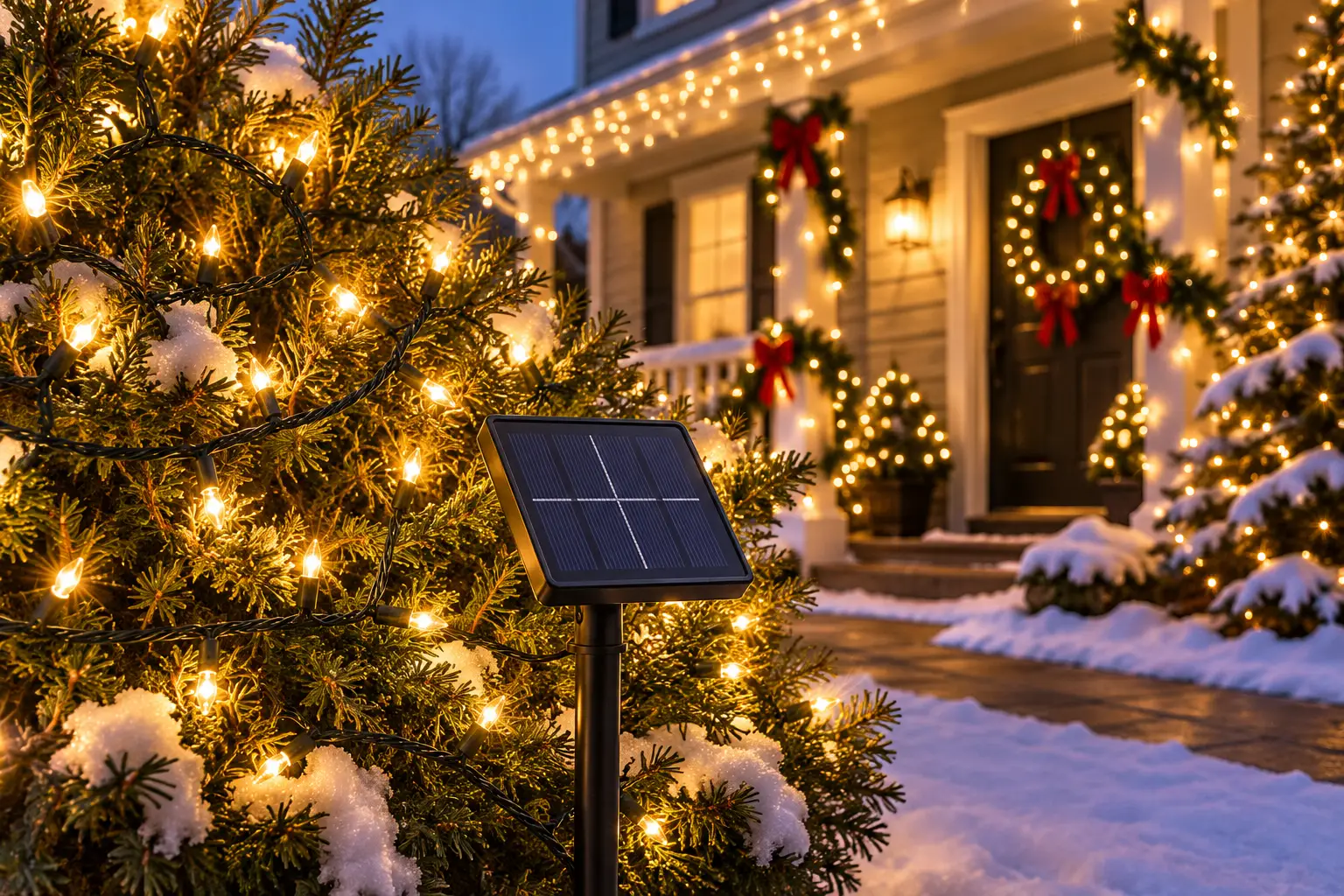
If your electric bill spikes every December, christmas lights with solar panel setups are worth a serious look. These strings ditch the outlet entirely: a small ground-mounted or clip-on panel soaks up daylight, stores it in a rechargeable battery, and releases it as a warm glow once the sun goes down. In practice, that means zero added kilowatt-hours, no extension cords snaking across the lawn, and no midnight trip outside to flip a switch — the built-in light sensor handles that automatically.
This guide breaks down seven real, currently available solar-powered Christmas light sets — from budget-friendly 2-packs to a commercial-grade Edison bulb string — based on published specs and aggregated customer feedback rather than guesswork. You’ll see how sunlight striking the photovoltaic cells inside each panel gets converted into the electrical charge that eventually powers your lights, a process explained in more technical depth by the U.S. Department of Energy. We’ll also walk through setup, common troubleshooting, and the buying criteria that actually matter — so by the end, you’ll know exactly which solar christmas string lights fit your yard, your budget, and how much sun your house actually gets.
Affiliate partnership disclosure: This article contains Amazon affiliate links. As an Amazon Associate, we earn from qualifying purchases at no extra cost to you.
Quick Comparison: Solar Christmas Lights at a Glance
Before diving into full reviews, here’s a fast snapshot of how the seven picks stack up on length, LED count, and ideal use case.
| Product | Length / LEDs | Style | Price Range | Best For |
|---|---|---|---|---|
| Joomer Solar Christmas Lights | 72 ft / 200 LED (2-pack) | Fairy string | Around $25–$35 | All-purpose yard decorating |
| Brightech Ambience Pro Solar | 27 ft / 12 Edison bulbs | Bistro/patio | Around $50–$70 | Premium porch ambience |
| Toodour Solar Christmas Lights | 72 ft / 200 LED (2-pack) | Fairy string | Around $20–$30 | Budget-conscious buyers |
| Dazzle Bright Solar Snowflake Lights | 39 ft / 100 LED | Snowflake shapes | Around $20–$28 | Winter-themed window/porch |
| GIGALUMI Solar Firework Lights | Flexible / 120 LED (2-pack) | DIY copper wire | Around $15–$22 | Creative garden shapes |
| Huacenmy Solar Pathway Lights | 23 ft / 20 C9 bulbs | Vintage pathway | Around $18–$28 | Driveway and walkway borders |
| iBaycon Solar Net Mesh Lights | 4 ft x 6 ft / varies | Net/mesh | Around $18–$30 | Bushes and low shrubs |
Looking at the table, the Joomer Solar Christmas Lights and Toodour Solar Christmas Lights are nearly interchangeable on paper — both are 72-foot, 200-LED, 2-pack fairy strings — so the tiebreaker usually comes down to price at the time you check and which brand’s warranty support you trust more. If your yard has a distinct style requirement, like a bush that needs even coverage or a walkway that needs definition, the iBaycon Solar Net Mesh Lights and Huacenmy Solar Pathway Lights solve very different problems than a generic string ever could. The Brightech Ambience Pro Solar sits in its own category entirely — it’s less a “Christmas light” and more a year-round patio fixture that happens to look great over the holidays.
💬 Ready to compare specs side by side? Scroll down to see the full breakdown for each pick — including honest pros, cons, and what buyers keep saying in reviews! 😊
The 7 Best Christmas Lights With Solar Panel: Full Reviews
Coverage below spans entry-level string lights, mid-range all-purpose sets, and one commercial-grade premium option, plus a few shape variants (snowflakes, net mesh, pathway bulbs) that solve specific yard-decorating problems a plain string can’t.
1. Joomer Solar Christmas Lights — best all-around value for most yards
The Joomer Solar Christmas Lights earns the top spot because it covers the most ground for the least hassle. Each 2-pack delivers a combined 400 LEDs across 144 feet, which is enough to wrap a mid-size tree, line a fence, or drape across porch railings without buying a second set.
The panel comes with a built-in memory chip, so it remembers your last lighting mode instead of resetting to “steady on” every evening — a small detail, but one that saves you from re-clicking through eight modes each night. It’s rated IP65 waterproof, meaning the string and panel are sealed against rain and snow spray, though the light sensor still needs a genuinely sunny spot to charge fully. Based on comparing the spec sheet against similar 200-LED strings, six hours of direct sun typically buys more than eight hours of nighttime glow, which comfortably covers a full evening from dusk to bedtime.
Aggregated buyer feedback for Joomer’s solar lineup consistently praises the coverage-per-dollar and the flexible copper-toned wire that bends around branches without kinking; a recurring critique is that colors run slightly cooler than “warm white” implies straight out of the box. This is a strong pick for anyone decorating a full yard on a single budget rather than a small accent area — the two-pack format means you’re rarely stuck one strand short.
Pros:
- ✅ 400 total LEDs across two strands cover large areas
- ✅ Memory chip skips the daily mode reset
- ✅ IP65 rating handles rain and snow reliably
Cons:
- ❌ Needs consistently strong sun for a full charge
- ❌ Warm white reads slightly cool per some reviews
Expect to pay around $25 to $35 for the two-pack at the time of writing (prices may vary); given the total footage, it’s one of the better values in this roundup.
2. Brightech Ambience Pro Solar — best premium option for porch ambience
The Brightech Ambience Pro Solar trades LED count for atmosphere. Instead of hundreds of tiny points of light, you get 12 shatterproof S14 Edison-style bulbs strung along 27 feet of heavy-duty cord — the kind of look you’d associate with a café patio rather than a typical string of holiday lights.
What most buyers overlook with this model is that it’s built for year-round outdoor use, not just December. Brightech’s “WeatherTite” cord is rated to withstand winds up to 50 mph along with rain and snow, and the bulbs themselves are heat-resistant plastic rather than glass on most variants, so they won’t shatter if a branch brushes against them. The panel-to-bulb lead is six feet, giving you flexibility to tuck the solar panel into a sunnier spot even if your porch itself faces north. On a full charge, expect five to six hours of light — noticeably shorter than the fairy-light strings in this list, which makes sense given each Edison bulb draws more power than a single LED.
This is the one product here with real aggregated review weight behind it: the broader Ambience Pro solar line has amassed roughly 4.4 stars across more than 36,000 reviews on Amazon, which is a substantial sample for a niche category like solar patio lighting. Reviewers consistently single out the retro bulb aesthetic and 2-year warranty as standouts, while the shorter runtime versus LED fairy lights is the most common trade-off mentioned.
Pros:
- ✅ Commercial-grade cord rated for 50-mph winds
- ✅ Backed by a 2-year limited warranty
- ✅ Vintage Edison look works well past the holidays
Cons:
- ❌ Only 5–6 hours of runtime per charge
- ❌ Higher price than fairy-light alternatives
Price typically falls in the $50 to $70 range depending on length and bulb count (check the current price); given the build quality and multi-season use, it’s a reasonable value-for-money pick if ambience matters more than raw brightness.
3. Toodour Solar Christmas Lights — best budget-friendly two-pack
If the Joomer Solar Christmas Lights is the safe middle-of-the-road choice, the Toodour Solar Christmas Lights is its scrappier, typically cheaper sibling. Spec for spec, it’s nearly identical — a 2-pack totaling 400 LEDs across 144 feet with eight lighting modes and a light-sensor auto on/off — but Toodour tends to list for a few dollars less at the time of writing.
The trade-off shows up less in the light output and more in the accessory quality: the included ground stakes and mounting clips are slightly less rigid than Joomer’s, according to aggregated review themes, which matters if you’re planning to leave the panel staked in loose or sandy soil through a windy winter. On the plus side, the on/off and mode buttons are positioned identically to Joomer’s, so switching brands mid-project (say, extending an existing display) won’t confuse anyone doing the setup.
Here’s what to weigh: Toodour is a reasonable pick specifically when budget is the deciding factor and you’re comfortable reinforcing the stakes yourself with a bit of extra soil or a small rock. Reviews describe the light output as comparable to pricier competitors once fully charged, which tracks with the nearly identical LED specs.
Pros:
- ✅ Same 400-LED, 144-ft coverage as pricier options
- ✅ Frequently the lowest price per foot in this list
- ✅ Simple two-button control matches other brands
Cons:
- ❌ Stakes and clips feel less durable per reviews
- ❌ Fewer color/finish variants than competitors
At around $20 to $30 for the pack (prices fluctuate, so check the current listing), this is the pick for anyone decorating on a tight holiday budget without sacrificing much brightness.
4. Dazzle Bright Solar Snowflake Lights — best for a distinct winter look
Not every yard wants generic fairy lights, and that’s where the Dazzle Bright Solar Snowflake Lights comes in. Instead of plain LED points, 100 bulbs are shaped into small snowflake silhouettes along a 39-foot string — a detail that reads as intentional winter décor rather than leftover summer patio lights repurposed for December.
The panel uses a Ni-MH AA rechargeable battery rather than the lithium-ion cells common in cheaper string lights, which historically hold a charge less efficiently in cold weather but are simpler and cheaper to replace when they eventually degrade. What the spec sheet doesn’t say, but pattern-matching against similar Ni-MH solar lights suggests, is that performance dips noticeably during short winter days with limited direct sun — plan on placing the panel somewhere it gets unobstructed light for most of the daylight hours, not just a few hours near noon. The eight lighting modes are standard for this price tier, and the snowflakes themselves are reinforced with non-toxic glue so they’re less prone to bulb popouts than cheaper novelty shapes.
This is a strong option for anyone decorating a window box, porch railing, or small tree where the snowflake silhouette will actually be visible up close — on a large tree wrapped at a distance, the shape detail mostly disappears into a general glow, so it’s better suited to accent lighting than whole-yard coverage.
Pros:
- ✅ Snowflake shapes add distinct winter styling
- ✅ Non-toxic glue reduces bulb popout risk
- ✅ Eight lighting modes for varied ambiance
Cons:
- ❌ Ni-MH battery is more sensitive to cold, short days
- ❌ Shape detail is lost when viewed from a distance
Expect a price in the $20 to $28 range (at the time of writing); it’s fair value for the novelty factor, though buyers wanting maximum brightness per dollar should look elsewhere on this list.
5. GIGALUMI Solar Firework Lights — best for creative, custom shapes
The GIGALUMI Solar Firework Lights is the outlier in this roundup — a lesser-known but genuinely useful pick for anyone who wants to build a custom shape rather than drape a pre-formed string. Each 2-pack includes 120 LEDs on flexible copper wire that holds its shape once bent, so you can form a star, wreath outline, or starburst pattern around a mailbox or planter.
Because the wire is copper rather than the more common rubber-coated fairy-light cord, it’s more moldable but also more fragile at sharp folds — bend it too many times in the same spot and the wire can weaken. The built-in 800mAh AA battery is on the smaller side compared to the string lights above, which explains the more modest coverage area; this product is designed for accent decorating, not blanketing an entire yard. Reviews of Gigalumi’s solar firework and garden-accent lines describe the DIY flexibility as the standout feature, while battery longevity after a full season or two draws more mixed feedback, which tracks with the smaller cell size doing more charge cycles per winter than a longer string would.
What most buyers overlook with this style of light is that it doubles as decor well beyond Christmas — the same shapeable string works for spring garden accents or a Fourth of July display, which softens the cost-per-season math if you’re budget-conscious.
Pros:
- ✅ Shapeable copper wire for custom designs
- ✅ Reusable well beyond the holiday season
- ✅ Compact and easy to store off-season
Cons:
- ❌ Smaller battery limits total coverage
- ❌ Copper wire weakens with repeated sharp bends
Pricing typically sits in the $15 to $22 range for a 2-pack (check current pricing), making it one of the most affordable entries here — appropriate given its role as an accent piece rather than a primary light source.
6. Huacenmy Solar Pathway Lights — best for driveways and walkways
Most of this list covers trees, bushes, and porches, but the Huacenmy Solar Pathway Lights solves a different problem entirely: defining the edge of a driveway or walkway. The set includes 20 large C9-style bulbs on stakes spanning roughly 23 feet, giving each bulb its own ground anchor rather than relying on a continuous strand draped over a surface.
The vintage, oversized bulb shape gives this set a nostalgic look reminiscent of classic incandescent C9 strings, but with the low-voltage safety and zero electricity cost of solar. On paper, this means you get the aesthetic of old-school pathway lighting without the shock risk of running a plug-in cord across wet grass or pavement — a genuine safety upgrade for anyone whose walkway lighting has traditionally meant an extension cord taped to the ground. Because each bulb has its own stake, spacing is fully adjustable, which matters if your driveway is longer or shorter than the stock 23-foot layout; you can simply space the stakes further apart at the cost of a less continuous glow.
This product’s IP65-rated housing is designed for direct ground contact and exposure to sprinkler runoff or rain pooling, which is a meaningfully different durability requirement than a string light hanging in open air. It’s a niche pick, but for the specific job of lining a path, it’s hard to beat with a general-purpose fairy-light string.
Pros:
- ✅ Individually staked bulbs allow custom spacing
- ✅ Vintage C9 bulb shape adds classic curb appeal
- ✅ Rated for direct ground and runoff exposure
Cons:
- ❌ Shorter total length than the fairy-light options
- ❌ Not designed for wrapping trees or bushes
Price generally runs $18 to $28 (prices may vary at checkout); for pathway-specific decorating, the value proposition is strong since a comparable plug-in C9 pathway set typically costs more once you factor in the required outdoor-rated extension cord.
7. iBaycon Solar Net Mesh Lights — best for bushes and low shrubs
Wrapping a bush with a linear string is fiddly and rarely looks even — which is exactly the problem the iBaycon Solar Net Mesh Lights is built to solve. Instead of a single strand, the LEDs are woven into a 4-foot by 6-foot mesh grid that drapes over a shrub or small bush like a blanket, giving even coverage in a fraction of the time a wrapped string would take.
Here’s what to weigh: net lights trade flexibility for speed. You can’t easily reshape a mesh grid around an oddly shaped tree the way you can a loose string, but for a rounded bush or low hedge, the netting drapes naturally and holds its position without constant readjustment. The eight lighting modes are standard for this price category, and the waterproof rating is appropriate for direct contact with wet foliage, which is a harsher environment than open-air string lights typically face. Based on comparing similar solar net lights’ specs, expect six to eight hours of charging to translate into roughly the same runtime after dark — solid but not class-leading.
Reviews consistently report that the netting format saves significant setup time compared to wrapping the same bush with a linear string, though buyers with larger or unusually shaped shrubs sometimes need to connect two nets side by side (check whether the specific listing you’re considering supports end-to-end connection before assuming it does).
Pros:
- ✅ Even coverage on bushes in minutes, not hours
- ✅ Netting holds its shape without extra clips
- ✅ Waterproof rating suited to direct foliage contact
Cons:
- ❌ Less adaptable to irregular tree shapes
- ❌ May require multiple nets for larger shrubs
Expect a price around $18 to $30 depending on pack size (check the current price); for anyone decorating hedges or foundation shrubs, it’s a genuine time-saver worth the modest premium over a generic string.
Full Product Comparison: Features, Price, and Best Use
| Product | Waterproof Rating | Charge Time | Runtime | Best For |
|---|---|---|---|---|
| Joomer Solar Christmas Lights | IP65 | ~6 hrs | 8+ hrs | Full yard coverage |
| Brightech Ambience Pro Solar | Weather-resistant, wind-rated | ~6 hrs | 5–6 hrs | Patio/porch ambience |
| Toodour Solar Christmas Lights | IP65 | ~6 hrs | 8+ hrs | Budget decorating |
| Dazzle Bright Solar Snowflake Lights | IP65 | Varies (Ni-MH) | Up to 10 hrs | Window/porch accents |
| GIGALUMI Solar Firework Lights | Waterproof | 4–6 hrs | 8–10 hrs | Custom DIY shapes |
| Huacenmy Solar Pathway Lights | IP65 | ~6–8 hrs | 8+ hrs | Driveways/walkways |
| iBaycon Solar Net Mesh Lights | Waterproof | ~6–8 hrs | 6–8 hrs | Bushes and shrubs |
Reading across this table, the runtime differences aren’t random — Edison-bulb strings like the Brightech Ambience Pro Solar simply draw more current per bulb than a string of tiny LEDs, so shorter runtime is the direct trade-off for a warmer, more atmospheric glow. If your priority is maximum hours of light with minimal fuss, the LED fairy-light options (Joomer, Toodour, GIGALUMI) outperform the Edison-style pick on pure endurance, even though they can’t match its ambience.
💬 Found the spec that matters most to you? Compare current prices before you decide — availability shifts fast during the holiday season! 😊
How to Set Up Solar Christmas Lights for Maximum Brightness
Getting a solar light set to perform at its rated runtime comes down to placement and a proper first charge, not luck. Skipping these steps is the single biggest reason people end up disappointed with a perfectly good product.
Full-sun placement first. Stake or mount the solar panel — not the light strand — in the spot that gets the most unobstructed daylight, even if that’s several feet from where the lights themselves hang. A panel in dappled shade under a porch roof will underperform badly compared to one staked in open lawn, even with a long lead cable.
Pre-charge before the first use. Most manufacturers recommend leaving the panel switched on and exposed to a full day of sun before judging performance, since the battery ships partially depleted. Judging brightness on night one, right out of the box, is a common source of unfair one-star reviews.
Angle the panel toward the winter sun path. The sun sits lower in the sky during December than in summer, so a panel angled flat on the ground catches less light than one propped at a slight tilt facing south. A small rock or the included stake angle is usually enough to make a real difference.
Clean the panel surface regularly. Dust, frost, and fallen leaves block the photovoltaic cells even on a sunny day. A quick wipe with a dry cloth every week or two during the season keeps charging efficiency consistent.
Check the on/off switch after storms. Wind and heavy rain occasionally jostle the panel’s switch or knock the stake loose; a quick visual check after bad weather prevents a multi-day gap in charging that you won’t notice until dusk.
Real-World Scenarios: Matching Solar Christmas Lights to Your Home
Different households need genuinely different setups, and matching the product to the situation matters more than chasing the single “best” option on this list.
The full-yard decorator on a moderate budget. If you’re wrapping a tree, lining a fence, and draping a porch railing all in one season, the Joomer Solar Christmas Lights or Toodour Solar Christmas Lights two-packs make the most sense — their combined 400-LED, 144-foot coverage stretches across multiple areas without needing a third or fourth set.
The renter or small-patio owner who wants ambience over quantity. If you’re decorating a single balcony or a small patio and want it to look intentional rather than crowded with novelty LEDs, the Brightech Ambience Pro Solar delivers a more upscale look for a smaller footprint — and it doubles as year-round patio lighting once the holidays end, which matters if storage space is limited.
The gardener with an oddly shaped bush or hedge. Trying to wrap a dense, irregularly shaped shrub with a linear string usually ends in gaps and frustration. The iBaycon Solar Net Mesh Lights drapes evenly in a fraction of the time, which is worth the modest price premium for anyone decorating foundation plantings every year.
Solar Christmas Lights vs. Plug-In Christmas Lights
The core trade-off between solar and plug-in lighting comes down to placement freedom versus raw brightness and runtime consistency. Plug-in LED strings draw continuous power from the outlet, so they don’t depend on how sunny the week has been — they’ll run at full brightness every single night regardless of weather. Solar strings, by contrast, are entirely dependent on how much usable daylight the panel captured, which means a stretch of overcast December days can visibly dim performance by evening three or four.
Where solar clearly wins is placement flexibility and safety. You can decorate a tree, mailbox, or garden bed that’s nowhere near an outdoor outlet without running an extension cord across a walkway (a genuine trip and moisture hazard the CPSC has repeatedly flagged in its holiday decorating safety guidance). Solar strings also add zero measurable amount to your electric bill, while a season of plug-in lights running six to eight hours nightly does add a small but real cost, particularly with older incandescent-style bulbs.
The honest verdict: if your decorating area is near an outlet and you want guaranteed, weather-independent brightness every night, plug-in LEDs remain the more predictable choice. If your decorating area is far from power, or safety and off-grid convenience matter more than guaranteed peak brightness on cloudy days, christmas lights with solar panel setups are the better fit.
How to Choose Christmas Lights With a Solar Panel
Picking the right set comes down to seven criteria, roughly in order of importance for most buyers:
- Coverage area needed. Measure the tree, fence, or railing you’re decorating before shopping — buying two shorter sets to reach a length is usually cheaper than one long specialty set.
- Panel placement options. Check the lead cable length between the panel and the first light; a short 3-foot lead is limiting if your decorating spot doesn’t get direct sun.
- Waterproof rating. Look for at least IP44 for light rain exposure, and IP65 if the panel or lights will sit in standing water, snow drifts, or sprinkler zones.
- Battery type. Lithium-ion batteries generally hold charge better in cold weather than older Ni-MH cells, which matters more the further north you live.
- Lighting modes and memory function. A memory chip that saves your last-used mode is a small but genuinely convenient feature worth prioritizing.
- Shape and format. Decide whether a linear string, net mesh, or staked pathway format actually fits your decorating surface before comparing brightness specs.
- Warranty and return policy. Since solar products can underperform in low-light climates, a real warranty (not just a 30-day return window) is worth paying slightly more for.
Common Mistakes to Avoid When Buying Solar Christmas Lights
Assuming any sunny-looking spot will charge the panel fully. Partial shade from a roof overhang or nearby tree can cut charging efficiency dramatically, even if the spot looks bright to the eye at midday.
Buying based on LED count alone. A 400-LED string spread across 144 feet is dimmer per foot than a 200-LED string across 30 feet — total brightness density matters more than the raw number printed on the box.
Ignoring the lead cable length. If the distance from your ideal light placement to the nearest full-sun spot exceeds the cable length, you’ll be forced into a compromise placement that hurts performance.
Skipping the return window during a test period. Because solar performance genuinely varies by climate and placement, testing a set for a week during the return window catches problems before you’re stuck with a light strand that never gets enough sun.
Overlooking battery replaceability. Some solar light sets use a sealed, non-replaceable battery; once it degrades after a couple of seasons, the whole unit becomes disposable rather than repairable.
Features That Actually Matter (and Ones That Don’t)
Marketing copy for solar Christmas lights tends to lean hard on flashy numbers, but not every spec translates to a noticeably better experience in your yard.
Actually matters: waterproof rating, lead cable length, and battery type all directly affect whether the product performs as advertised once it’s outside your control in real weather. A memory function also matters more than it sounds — resetting through eight modes every single night for a month adds up to genuine daily friction.
Matters less than it sounds: the specific number of “lighting modes” beyond about six or eight is mostly redundant, since most buyers settle on one or two favorite settings within the first week and rarely touch the rest. Similarly, marketing claims about “ultra bright” LEDs are hard to verify without a lumen rating, which most budget listings don’t publish — treat vague brightness claims with mild skepticism unless the listing states an actual lumen figure.
Safety, Regulations, and Standards for Outdoor Holiday Lighting
Even though solar Christmas lights run on low-voltage battery power rather than mains electricity, basic outdoor safety practices still apply. The Consumer Product Safety Commission recommends using only lights tested for safety by a nationally recognized testing laboratory, and while most budget solar sets aren’t UL-listed the way plug-in lights typically are, checking for any safety certification on the packaging is still worthwhile. Before using lights outdoors, verify the packaging specifically states the product is certified for outdoor use — some inexpensive novelty lights are indoor-rated only, despite marketing photos showing outdoor scenes.
Because solar strings run on low-voltage DC power from a small rechargeable battery, they carry a meaningfully lower shock risk than plug-in incandescent strings, and they eliminate the extension-cord tripping hazard entirely. That said, standard precautions still apply: fasten strings securely so wind doesn’t pull them down onto walkways, keep panels and connectors clear of standing water where possible even on waterproof-rated products, and inspect the wiring each season for cracks or exposed copper before reusing a set from the previous year.
If you’re mixing solar accent lights with any plug-in decorations elsewhere in your display, the CPSC’s broader holiday guidance on GFCI-protected outlets and fused plugs still applies to those separate components — solar lighting doesn’t change the safety requirements for anything you’re still running from an outlet.
Long-Term Cost and Maintenance of Solar Christmas Lights
The upfront price of a solar Christmas light set is typically comparable to, or slightly higher than, an equivalent plug-in LED string — but the ongoing cost story favors solar significantly over a few seasons. A plug-in LED string running six hours nightly for a six-week holiday season adds a modest but real amount to your electric bill every single year; a solar string adds essentially nothing beyond the one-time purchase.
The maintenance side is where solar asks more of you upfront: batteries in cheaper Ni-MH-based sets typically start showing reduced runtime after two to three seasons of use, especially in northern climates with limited winter daylight. Lithium-ion-based sets tend to hold up longer, which is part of why premium options like the Brightech Ambience Pro Solar carry a real multi-year warranty — the manufacturer is betting on better battery longevity to back that promise. Realistically, budget for replacing a lower-tier solar light set every three to four seasons, and treat a premium set with a strong warranty as the better long-term value if you plan to reuse the same lights annually rather than replace them each year.
Frequently Asked Questions
❓ Do christmas lights with solar panel setups work in cloudy or snowy climates?
❓ How long do solar Christmas lights typically last before needing replacement?
❓ Can I leave solar Christmas lights outside all winter?
❓ Are solar Christmas lights bright enough to replace plug-in lights entirely?
❓ Do solar christmas string lights need direct sunlight, or does indirect light work?
Conclusion
Choosing among christmas lights with solar panel options really comes down to matching the format to your yard rather than chasing the single “best” set on paper. For most people decorating a full yard on a reasonable budget, the Joomer Solar Christmas Lights or Toodour Solar Christmas Lights two-packs deliver the most coverage per dollar. If ambience and year-round use matter more than raw brightness, the Brightech Ambience Pro Solar is worth the higher price tag. And for specific problem spots — bushes that need even coverage, pathways that need definition, or windows that want a distinct winter shape — the iBaycon Solar Net Mesh Lights, Huacenmy Solar Pathway Lights, and Dazzle Bright Solar Snowflake Lights each solve a job a generic string can’t.
Whichever set you choose, remember that solar performance lives and dies by panel placement — the single biggest factor separating a happy buyer from a disappointed one is simply staking the panel somewhere it gets real, unobstructed sun. For more on how affiliate recommendations like the ones in this article should be disclosed to readers, see the FTC’s guidance on endorsement and affiliate disclosures.
Recommended for You
- Generator for RV 30 Amp: 7 Best Picks for 2026 (Quiet & Powerful)
- Off Grid Battery Guide: 7 Best Picks to Power Your Home in 2026
- Portable Power Station for Refrigerator: 7 Best Picks (2026)
Disclaimer: This post contains affiliate links. As an Amazon Associate, I earn from qualifying purchases made through these links, at no additional cost to you.
✨ Found this article helpful? Share it with someone who needs it! 💬🤗