
In This Article
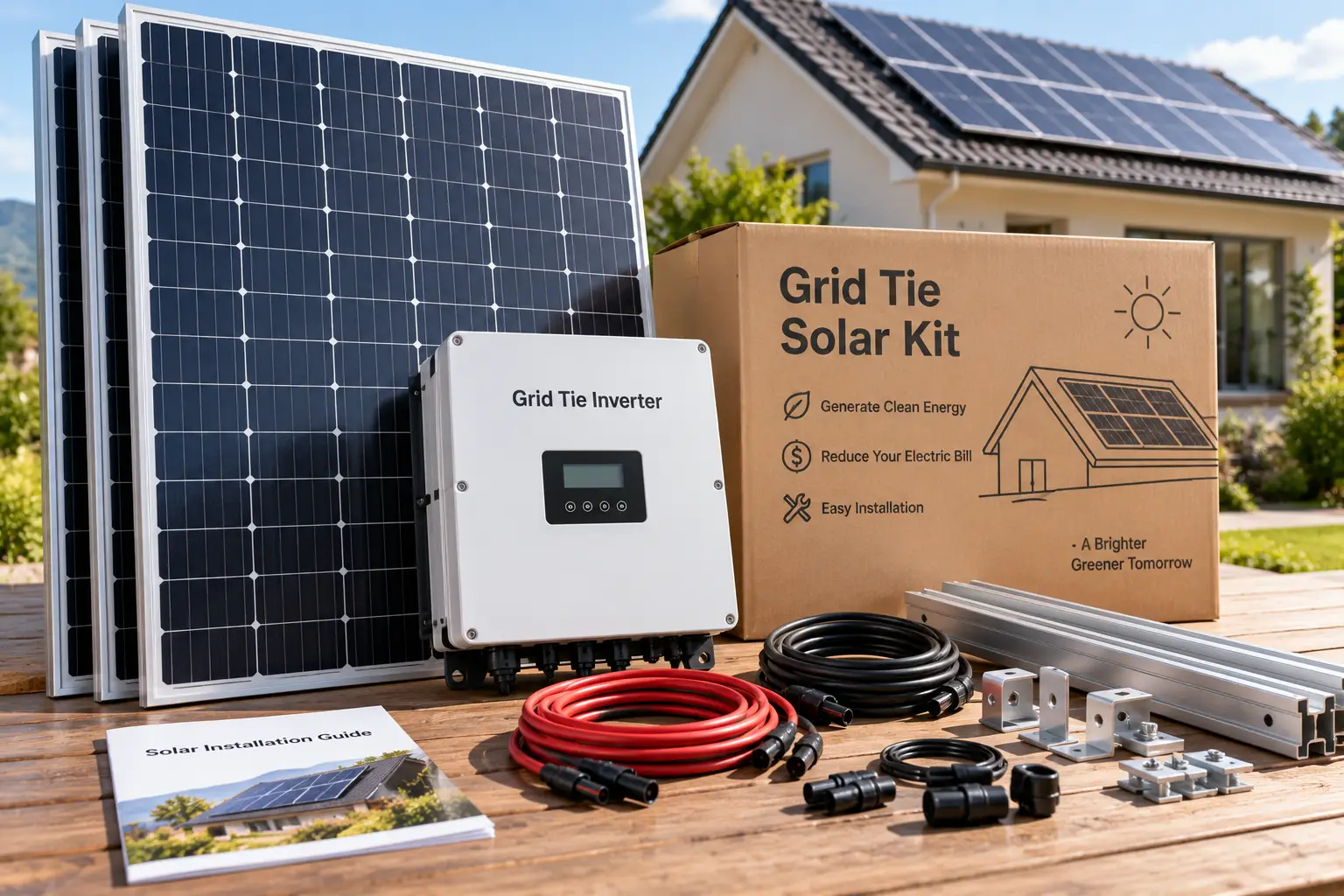
If your electric bill has crept from mildly annoying to genuinely painful, you’ve probably typed some version of “grid tie solar kit” into a search bar more than once this year. That’s a reasonable instinct. A grid tie solar kit is, in plain terms, a bundle of solar panels, an inverter, and the wiring needed to generate your own electricity and send any surplus straight into the utility grid — no battery bank required.
That last part is what separates a grid tie solar kit from the off-grid RV kits also cluttering Amazon’s solar category. You’re not trying to go fully independent from your utility. You’re trying to shrink a monthly bill, and possibly bank a few credits through net metering, while keeping the grid as your backup. According to the U.S. Department of Energy, more than three million American homeowners have already gone this route, and the Homeowner’s Guide to Going Solar is a genuinely useful starting point before you spend a dollar.
What’s changed in the last couple of years is how accessible a grid tie solar kit has become. You no longer need a five-figure installer quote to get started — plug-and-play microinverter kits now let renters clip panels to a balcony railing, while DIY rooftop kits let handy homeowners install a legitimate multi-kilowatt on grid solar kit themselves, provided they handle permitting and interconnection correctly. The tradeoff is that “DIY-friendly” doesn’t mean “regulation-free,” and a poorly chosen grid tie solar kit can leave you with equipment your utility won’t approve for interconnection.
This guide breaks down seven real, currently available grid tie solar kits spanning entry-level plug-in systems to whole-home installations, with honest analysis of who each one actually fits. We’ll also walk through how net metering works, what mistakes trip up first-time buyers, and how to avoid buying more (or less) system than your roof and your utility actually support.
Grid Tie Solar Kit Quick Comparison
Before the deep dive, here’s how the seven kits stack up at a glance. Full specs and analysis follow in the next section.
| Kit | Power Class | Setup Type | Best For |
|---|---|---|---|
| EcoFlow PowerStream | 800W | Plug-in microinverter | Renters, apartments, balconies |
| Cosmoxstar 800W | 800W | Plug-in microinverter | Budget-conscious balcony solar |
| AUECOOR 1200W Kit | 1,200W | DIY rooftop string | Small homes, sheds, first-time DIYers |
| AUECOOR 1500W Kit | 1,500W | DIY rooftop string | Farmhouses, larger roofs |
| Giosolar 2000W Kit | 2,000W | DIY rooftop string | Mid-size homes wanting real bill offset |
| PluggedSolar 5KW Kit | 5,000W (expandable) | Professional-grade DIY | Whole-home, future expansion |
| Grape Solar GS-5300-KIT | 5,300W | Microinverter (Enphase) | Buyers who want a name-brand warranty |
A pattern shows up immediately: as wattage climbs, so does installation complexity, and the jump from a plug-in kit to a rooftop-mounted grid tie solar kit is a bigger leap than the wattage numbers alone suggest. The 800W plug-in options need essentially no rewiring, while anything above 1,200W typically involves a dedicated circuit, a combiner box, and a conversation with your utility before you flip the switch. Budget shoppers should also note that a bigger kit isn’t automatically a better value — a 5,300W system sized for a home that only uses 4,000 kWh a year just ships more electricity to the grid at often-reduced net billing rates instead of offsetting your own draw.
💬 One click helps other shoppers make an informed choice too! 😊
Top 7 Grid Tie Solar Kits: Expert Analysis
Here’s the detailed breakdown of all seven picks, covering what each spec actually means for your electric bill, who each grid-tie solar panel kit is genuinely built for, and where the real trade-offs are.
1. EcoFlow PowerStream — easiest plug-and-play entry point
The EcoFlow PowerStream is built around a simple premise: solar power for people who rent, and who will never install a breaker-panel interconnection. It’s a grid-tied microinverter that accepts up to 800W of combined DC input from two panels and pushes AC power straight into a standard wall outlet.
The dual-MPPT design means each panel tracks its own optimal power point independently, so partial shading on one panel doesn’t tank the output of the other — a meaningful advantage over cheaper single-MPPT microinverters. The IP67 rating and 97.5% conversion efficiency mean the unit is genuinely built to live outdoors year-round, not just marketed that way. WiFi app monitoring lets you watch real-time generation, which matters more than it sounds: most first-time buyers dramatically overestimate what an 800W system produces on a cloudy day.
Based on comparing the specs against competing microinverters, this is the strongest pick for anyone whose main obstacle to solar is “I don’t own my roof.” Reviews of plug-in solar systems in this class consistently flag setup time (often under an hour) and app reliability as strengths, while the most common complaint across the category is confusion over local interconnection rules rather than the hardware itself — worth researching before you buy, not after.
Pros:
- ✅ No electrician or rewiring needed for setup
- ✅ Dual MPPT handles partial shading well
- ✅ Real-time app monitoring of generation
Cons:
- ❌ 800W ceiling won’t meaningfully offset a full home
- ❌ Battery add-on required to avoid wasting excess power
Paired with two 400W panels, total cost typically lands in the $600 to $800 range at the time of writing; check the current price before buying, since panel bundling varies. For a renter with a sunny balcony, it’s a fair value entry into a genuine grid tie solar kit.
2. Cosmoxstar 800W Micro Inverter — budget alternative to name-brand plug-in kits
The Cosmoxstar 800W Micro Inverter covers the same basic use case as the EcoFlow — dual-MPPT, WiFi app control, IP67 waterproofing, plug-and-play setup — at what is typically a noticeably lower price point, since it comes from a smaller brand without EcoFlow’s marketing overhead or battery ecosystem.
The 16.4-foot AC cable is a small but practical detail: it gives you more flexibility to route the inverter away from direct weather exposure or awkward balcony geometry without needing an extension cord, which some competing microinverters don’t include. Functionally, the specs are close enough to the category leader that the honest analysis here is about ecosystem, not raw performance — Cosmoxstar doesn’t offer a companion battery or the years of firmware support that EcoFlow has built up.
What most buyers overlook with lesser-known microinverter brands is the warranty and support pipeline. The hardware may perform identically on day one, but a five-year-old inverter needing a software update or an RMA is where an established brand’s infrastructure starts to matter. Reviews for budget microinverters in this category commonly mention initial WiFi pairing as a minor early hiccup, a pattern shared across most plug-and-play grid tie solar kit brands, not unique to this one.
Pros:
- ✅ Meaningfully lower price than name-brand microinverters
- ✅ Long 16.4-ft AC cable adds placement flexibility
- ✅ Same core dual-MPPT, IP67 spec sheet as pricier rivals
Cons:
- ❌ No official battery or storage ecosystem
- ❌ Smaller brand means thinner long-term support history
Typically listed in the $350 to $500 range for the inverter alone (panels sold separately); check the current price, as budget microinverter pricing shifts often. It’s a solid value pick if your budget is tight and you’re comfortable being your own tech support.
3. AUECOOR 1200W Grid Tie Kit — first real step into rooftop DIY
The AUECOOR 1200W Grid Tie Kit moves you out of balcony territory and into an actual rooftop-mounted on grid solar kit: twelve 100W monocrystalline panels wired to a 1,200W MPPT grid-tie inverter, plus a PV combiner box and cabling.
That combiner box matters more than it looks. Combining twelve individual panel strings into a manageable set of conductors before they reach the inverter is exactly the kind of detail budget kits sometimes skip, forcing buyers to source it separately. Here it’s included, which is a real time (and safety) saver during installation. The 1,200W ceiling is honest about its limits: this is a bill-trimming system for a small home, shed, or workshop, not a whole-house replacement.
Here’s what to weigh: monocrystalline cells generally squeeze more wattage per square foot than the polycrystalline panels found on some competing budget kits, which matters if your usable roof space is limited. Aggregated feedback on kits in this exact power class tends to center on the wiring diagram and the DC-to-AC voltage range (18-60V) being the trickiest part for first-time installers, so buyers with zero electrical background should budget extra time or a consultation with an electrician for the interconnection step specifically.
Pros:
- ✅ Combiner box and cabling included, not sold separately
- ✅ Monocrystalline panels are space-efficient
- ✅ Modest size keeps DIY installation manageable
Cons:
- ❌ 1,200W won’t offset a full-size home’s usage
- ❌ Interconnection wiring intimidates true beginners
Kits in this power class commonly list in the $900 to $1,300 range on Amazon; always check the current price, as component costs shift. For a small structure or a first foray into DIY grid tie solar, it’s a genuinely reasonable value.
4. AUECOOR 1500W Grid Tie Kit — more headroom for larger roofs
The AUECOOR 1500W Grid Tie Kit steps the same basic formula up: fifteen 100W polycrystalline panels paired with a 2,000W grid-tie inverter, aimed at farmhouses and larger residential roofs that can absorb more panel area.
Pairing a 1,500W array with a 2,000W-rated inverter gives you real headroom — the inverter isn’t working near its ceiling under normal conditions, which tends to mean cooler operation and a longer service life than a system where the inverter and array are matched watt-for-watt. The polycrystalline panels here trade a couple of efficiency percentage points versus monocrystalline for a lower price per watt, which is a fair trade if you have roof space to spare and are optimizing for cost rather than square footage.
What the spec sheet doesn’t say, but adjacent product reviews reveal, is that polycrystalline panels in this price bracket tend to perform slightly worse in high-heat conditions and hazy light than monocrystalline equivalents — a real but modest difference, generally in the low single-digit percentage range on annual output. For a farm or rural property with plenty of unshaded roof, that gap is easily worth the savings.
Pros:
- ✅ Inverter headroom above array size aids longevity
- ✅ Lower cost per watt than monocrystalline competitors
- ✅ Well suited to larger roofs and outbuildings
Cons:
- ❌ Slightly lower efficiency than monocrystalline options
- ❌ Fifteen individual panels mean a longer mounting day
Expect a price generally between $1,000 and $1,400 at the time of writing; prices may vary, so check current listings. For rural properties with ample roof area, this is a strong value-for-space pick.
5. Giosolar 2000W Home Grid Tie Solar Kit — the bill-offset sweet spot
The Giosolar 2000W Home Grid Tie Solar Kit — twenty 100W monocrystalline panels and a 2,000W MPPT grid-tie inverter — sits at what a lot of DIY buyers are actually looking for: enough capacity to make a visible dent in a real household electric bill, without crossing into whole-home installer territory.
Twenty individual 100W panels rather than fewer, larger panels is a deliberate design choice. It gives you more layout flexibility across an irregular roofline (garages, sheds, multiple roof faces) at the cost of more individual mounting points and wiring runs during installation. The 2,000W MPPT inverter is matched directly to the array size, which keeps the system efficient without over-provisioning inverter capacity you’ll never use.
Based on comparing this kit against the smaller AUECOOR options above, the practical jump is real: a well-sited 2,000W array in a moderate-sun region can offset a meaningful chunk of a typical household’s daytime electricity draw, whereas the 1,200-1,500W kits are better described as supplemental. Reviews of comparable 2,000W-class kits commonly cite panel count (twenty separate units) as the main installation-time factor, more than any single technical hurdle — plan a full weekend, not an afternoon.
Pros:
- ✅ Genuinely meaningful bill offset for an average home
- ✅ Twenty smaller panels ease irregular roofline layouts
- ✅ Inverter capacity matched to array, no waste
Cons:
- ❌ Twenty panels mean a longer, more labor-intensive install
- ❌ Still requires utility interconnection approval before use
Typical listings fall between $1,300 and $1,800; check the current price at the time of purchase. For a household serious about meaningfully trimming its bill through a DIY on grid solar kit, this is where the value curve peaks.
6. PluggedSolar 5KW Expandable Kit (SMA Inverter) — professional-grade DIY
The PluggedSolar 5KW Expandable Kit is aimed at buyers who want a genuinely professional-grade system without hiring a full installer, pairing Unirac roof mounting hardware — the same rail system commercial installers use — with an SMA inverter, one of the most established names in grid-tie inverter manufacturing.
That SMA inverter is the headline feature here, and it’s worth explaining why it matters: SMA is a German manufacturer with decades in utility-scale and residential grid-tie equipment, and its inverters are widely accepted by U.S. utilities during interconnection review, which is not something every budget grid-tie inverter can claim. The Unirac mounting system is similarly a step up from generic aluminum rails — it’s rated and used in licensed commercial installs, which matters for wind and snow load ratings on your roof.
The “expandable” design is the other differentiator: the kit is engineered to scale toward a 10kW system by adding panels later, without replacing the inverter or mounting infrastructure. What most buyers overlook is that this forward compatibility is genuinely valuable if your household energy use is likely to grow (an EV purchase, a home addition), since re-engineering a grid-tie system later is far more expensive than over-provisioning the inverter up front.
Pros:
- ✅ SMA inverter has strong utility-approval track record
- ✅ Unirac mounting is commercial-grade hardware
- ✅ Expandable toward 10kW without replacing core gear
Cons:
- ❌ Meaningfully pricier than budget MPPT-inverter kits
- ❌ Overkill for buyers who only want a small offset
Given the premium mounting and inverter brand, expect a price in the $3,500 to $5,000-plus range depending on configuration; always check current pricing, as expandable kits are often configured to order. For a homeowner planning a real whole-home system with room to grow, the extra spend buys real long-term flexibility.
7. Grape Solar GS-5300-KIT — the name-brand microinverter pick
The Grape Solar GS-5300-KIT pairs twenty 265W Grape Solar monocrystalline panels with Enphase M215 microinverters — and Enphase is arguably the most recognized microinverter brand in U.S. residential solar, used extensively by licensed installers nationwide.
Microinverters attached to each individual panel, rather than one central string inverter, mean that shading or a fault on one panel doesn’t drag down the output of the rest of the array — a real advantage over the single-inverter designs used in most of the kits above. Grape Solar’s own figures put annual output for this 5,300W system between 3,800 and 8,900 kWh depending on location and sun exposure, a wide range that underscores how much regional climate affects real-world output from any grid tie solar kit, this one included.
Here’s what to weigh: Enphase microinverters carry one of the longer warranty track records in the industry and are a known quantity to utility interconnection reviewers, which can meaningfully speed up approval compared to a lesser-known inverter brand. The trade-off is panel wattage — at 265W per panel, these are lower-output units than more modern monocrystalline panels on the market, meaning a wider physical footprint for the same generation capacity.
Pros:
- ✅ Enphase microinverters are a known, trusted name
- ✅ Per-panel inverters limit the impact of shading faults
- ✅ Real published annual output range, not vague marketing
Cons:
- ❌ 265W panels are lower-output than newer alternatives
- ❌ Larger roof footprint needed for the same generation
Systems in this class commonly run from $4,500 to $6,500 at the time of writing, and prices may vary meaningfully by region and retailer; check current pricing before committing. For buyers who prioritize brand reliability and utility-approval ease over squeezing out every last watt per square foot, this is a defensible premium pick.
Full Comparison: All 7 Grid Tie Solar Kits Side by Side
| Kit | Panels | Inverter | Setup Difficulty | Best For |
|---|---|---|---|---|
| EcoFlow PowerStream | 2 x 400W (sold separately) | 800W microinverter | Easy | Renters |
| Cosmoxstar 800W | Sold separately | 800W microinverter | Easy | Tight budgets |
| AUECOOR 1200W Kit | 12 x 100W mono | 1,200W MPPT | Moderate | Small homes/sheds |
| AUECOOR 1500W Kit | 15 x 100W poly | 2,000W MPPT | Moderate | Farms, large roofs |
| Giosolar 2000W Kit | 20 x 100W mono | 2,000W MPPT | Moderate-High | Real bill offset |
| PluggedSolar 5KW Kit | 16 panels (expandable) | SMA string inverter | High | Whole-home, growth |
| Grape Solar GS-5300-KIT | 20 x 265W mono | Enphase M215 micro | High | Brand reliability |
Looking at the table above, the two plug-in microinverter kits are in a different category entirely from the other five — they need no roof penetration, no combiner box, and no dedicated circuit, which is exactly why they cap out around 800W. The AUECOOR 1200W Kit through the Giosolar 2000W Kit occupy the realistic DIY-rooftop middle ground most homeowners actually shop in, while the PluggedSolar 5KW Kit and Grape Solar GS-5300-KIT are aimed at buyers ready to treat this as a real home improvement project, complete with permits and possibly a licensed electrician for the final tie-in.
Getting Started: Your First 30 Days With a DIY Grid Tie Solar Kit
Buying the hardware is the easy part. Here’s what the first month actually looks like once your grid tie solar kit arrives.
Week 1 — Permits and utility paperwork. Before a single panel goes on the roof, contact your utility about interconnection requirements. Most require an application, and some require your inverter’s UL 1741 certification number before they’ll approve net metering. Skipping this step is the single most common first-30-days mistake, because it can delay activation by weeks even after installation is finished.
Week 2 — Site prep and mounting. Panel orientation and shading matter far more than most first-time buyers expect; a south-facing roof with even partial afternoon shade from a tree can cut annual output by 15-20%. This is also when you’ll confirm your roof’s structural load rating can handle the mounting hardware, particularly for larger kits like the Giosolar 2000W Kit or PluggedSolar 5KW Kit.
Week 3 — Wiring and inverter installation. Combiner box wiring and the DC-to-AC conversion stage are where most DIY installers hit their learning curve. If your kit’s voltage range or wiring diagram isn’t intuitive, this is the point where hiring a licensed electrician for a few hours of oversight is money well spent — it’s far cheaper than a failed inspection.
Week 4 — Inspection and activation. Your local authority having jurisdiction typically inspects before your utility grants permission to operate. Only after that sign-off should your grid tie solar kit actually start feeding the grid. Common mistakes in this window include forgetting to schedule the inspection early enough, and assuming the system is “done” the day it’s physically installed rather than the day it’s legally approved.
Real-World Scenarios: Which Grid Tie Solar Kit Actually Fits You?
The apartment renter. Budget: under $800. Use case: wants to see solar work before committing to more. The EcoFlow PowerStream or Cosmoxstar 800W fit best — no landlord permission for roof penetration needed, and setup takes an afternoon, not a permitting cycle.
The suburban homeowner with a $250/month bill. Budget: $1,300-$1,800. Use case: wants a real, visible dent in the bill without a five-figure installer quote. The Giosolar 2000W Kit is the clearest fit, sized to make a genuine difference for a household using average residential electricity.
The rural property owner planning ahead. Budget: $3,500+. Use case: large roof or ground-mount space, expects energy needs to grow (EV, workshop, addition). The PluggedSolar 5KW Kit‘s expandability toward 10kW is built exactly for this profile, letting the system grow with the household instead of requiring a second installation later.
What Is a Grid Tie Solar Kit?
A grid tie solar kit is a bundled system of solar panels and a grid-tie inverter that converts DC power from the panels into AC power synchronized with your utility grid, letting you offset your electricity use and, where available, earn net metering credit — with no battery storage required.
How to Choose a Grid Tie Solar Kit
- Confirm your utility’s interconnection rules first. Not every utility offers full net metering, and some require specific certified inverters before approving a system.
- Size the kit to your actual usage, not your roof space. Pull last year’s kWh usage from your utility bill and match wattage to it, rather than buying the biggest kit that fits.
- Match panel type to your roof. Monocrystalline panels save space; polycrystalline panels save money if space isn’t tight.
- Check the inverter’s certification. Look for UL 1741 listing, since most utilities won’t approve interconnection without it.
- Factor in installation difficulty honestly. A 2,000W-plus rooftop kit is a real electrical project; budget for a licensed electrician if your DIY experience is limited.
- Compare warranty length, not just price. Inverter warranties in particular vary widely and matter more over a 20-25 year panel lifespan than most buyers initially assume.
- Plan for future growth if your usage might rise. An expandable kit costs more upfront but avoids a second full installation later.
Grid Tie Solar Kit vs Off-Grid Solar System: Which Is Right for You?
A grid tie solar kit and an off-grid solar system solve different problems, and confusing the two is one of the most expensive mistakes a first-time buyer can make. A grid tie solar kit relies on the utility grid as its backup and storage mechanism — no batteries, lower upfront cost, and it typically shuts down automatically during a grid outage for safety (a feature called anti-islanding, required by most interconnection standards). An off-grid system includes battery banks specifically so it can operate independently of the utility entirely, at a significantly higher upfront cost.
For most homeowners whose goal is lowering a monthly bill while staying connected to reliable grid power, a grid tie solar kit is the more cost-effective choice — it’s why five of the seven kits above skip batteries entirely. Off-grid makes more sense for remote properties with no utility access, or for buyers specifically prioritizing outage resilience over upfront cost. If backup power during outages matters to you but full off-grid independence doesn’t, a hybrid grid-tie-with-battery-backup system is worth researching separately, since it sits between the two categories.
Common Mistakes to Avoid When Buying a Grid Tie Solar Kit
Oversizing the system relative to actual household usage is the most frequent and costly mistake — excess generation beyond your usage is often credited at a lower rate than retail electricity under many current net metering and net billing policies, per EnergySage’s net metering breakdown, so bigger isn’t automatically better for your wallet. Skipping the utility interconnection application until after installation is a close second, and it can delay activation by weeks. Underestimating shading is a third: even a young tree that seems harmless today can meaningfully reduce output within a few years as it grows. Finally, buying an inverter without confirming UL 1741 certification is a mistake that can result in an outright rejected interconnection application, forcing a costly equipment swap after the fact.
What to Expect: Everyday Performance
On paper, wattage ratings represent peak output under ideal lab conditions — full sun, optimal panel temperature, zero shading. In practice, a grid tie solar kit rated at 2,000W will typically produce meaningfully less on an average day once you factor in cloud cover, morning and evening angle, panel temperature derating, and inverter efficiency losses. A well-installed system in a moderate-sun U.S. region commonly delivers somewhere in the range of 60-80% of its rated wattage as a realistic daily average across a full year, with clear winter-to-summer swings. This is exactly why matching kit size to real household usage data, not the marketing wattage number, produces the best financial outcome.
Safety, Regulations, and Standards for Grid Tie Solar Kits
Every inverter in a legitimate grid tie solar kit sold for U.S. residential use should carry UL 1741 certification, the primary safety and performance standard covering inverters used to interconnect with the utility grid, and installations generally must follow National Electrical Code Article 690 for solar photovoltaic systems. Utilities also commonly require compliance with IEEE 1547, the technical standard governing how distributed generation like solar interacts with grid stability, including anti-islanding protection that automatically disconnects your system during a grid outage to protect utility line workers. None of the seven kits above bypass these requirements, but it’s worth verifying certification documentation directly with the manufacturer before purchase, since compliance details can change between product revisions. Local permitting and inspection requirements vary significantly by city and county, so a call to your local building department early in the process saves real time later.
Long-Term Cost and Maintenance
A grid tie solar kit has minimal moving parts, so maintenance costs are genuinely low compared to most home systems — periodic panel cleaning and an occasional visual inspection of wiring and mounting hardware cover most of it. The real long-term cost variable is the inverter, which typically carries a shorter warranty (often 10-25 years depending on brand) than the 25-year panel warranties common across the industry; budget mentally for a possible inverter replacement roughly halfway through a system’s life. Total cost of ownership should also account for how your local net metering or net billing policy compensates exported energy, since policies vary meaningfully by state and utility and have been shifting toward lower export credit rates in several states in recent years — a factor that changes the real payback period more than almost any hardware spec.
Problem → Solution: Fixing the Most Common Grid Tie Solar Kit Headaches
Problem: Utility rejected my interconnection application. Solution: Confirm your inverter’s UL 1741 listing number and resubmit with full documentation; many rejections stem from missing paperwork rather than equipment issues.
Problem: Output is lower than the kit’s rated wattage. Solution: This is largely normal (see the performance section above), but check for new shading sources and confirm panels are angled toward true south where possible.
Problem: App or WiFi monitoring keeps disconnecting. Solution: Common on plug-in microinverters like the EcoFlow PowerStream and Cosmoxstar 800W; router placement and firmware updates resolve most cases.
Problem: Combiner box wiring is confusing during a DIY install. Solution: This is the top-cited sticking point across budget kits like the AUECOOR 1200W Kit; a few hours of paid electrician time here is far cheaper than a failed inspection.
✨ Don’t miss these exclusive deals! 🔍 Take your home energy setup to the next level with this carefully curated lineup. Click a highlighted kit to check current pricing and availability. These picks will help you get real bill savings the whole household will notice!
Grid Tie Solar Kits for Renters and Small Spaces
Not everyone shopping for a grid tie solar kit owns a roof, and the plug-in microinverter category exists specifically for that reality. A grid tie solar system for renters typically means the EcoFlow PowerStream or Cosmoxstar 800W clipped to a balcony railing or freestanding rack, with zero roof penetration and no permanent modification to the property. The honest caveat: local and HOA rules on plug-in balcony solar vary significantly across the U.S. and are less standardized than they are in parts of Europe, so confirming your lease terms and local code before ordering saves a returned shipment. For small spaces generally — sheds, tiny homes, detached garages — the entry-level DIY kits in the 1,200-1,500W range offer a better balance of real generation capacity against a genuinely small footprint than trying to squeeze a 2,000W-plus array onto a small roof.
FAQs
❓ How much does a grid tie solar kit cost?
❓ Do I need a permit for a grid tie solar kit?
❓ Can I install a grid tie solar kit myself?
❓ What happens to a grid tie solar kit during a power outage?
❓ Is a grid tie solar kit worth it without net metering?
Conclusion
A grid tie solar kit is no longer an all-or-nothing decision between a full installer contract and doing nothing. The seven kits above cover a real spread — an EcoFlow PowerStream for a renter testing the waters, a Giosolar 2000W Kit for a homeowner ready to meaningfully cut a monthly bill, and a Grape Solar GS-5300-KIT or PluggedSolar 5KW Kit for buyers building a whole-home system with a name-brand warranty behind it. What separates a good outcome from a frustrating one usually isn’t the hardware at all — it’s whether the utility paperwork and sizing math happened before installation day instead of after. Start with your actual electric bill, confirm your utility’s interconnection process using the Department of Energy’s step-by-step consumer guide, and pick the kit that matches your usage rather than the biggest number on the box.
✨ Ready to start cutting your electric bill? Compare these grid tie solar kits and pick the one that fits your roof, your budget, and your utility’s rules! 🔆
Recommended for You
- Solar Panel Xmas Lights: 7 Best Picks for 2026 (Pros & Cons)
- 7 Best Christmas Lights With Solar Panel for 2026 (Pros & Cons)
- Generator for RV 30 Amp: 7 Best Picks for 2026 (Quiet & Powerful)
Disclaimer: This post contains affiliate links. As an Amazon Associate, I earn from qualifying purchases made through these links, at no additional cost to you.
✨ Found this article helpful? Share it with someone who needs it! 💬🤗