
In This Article
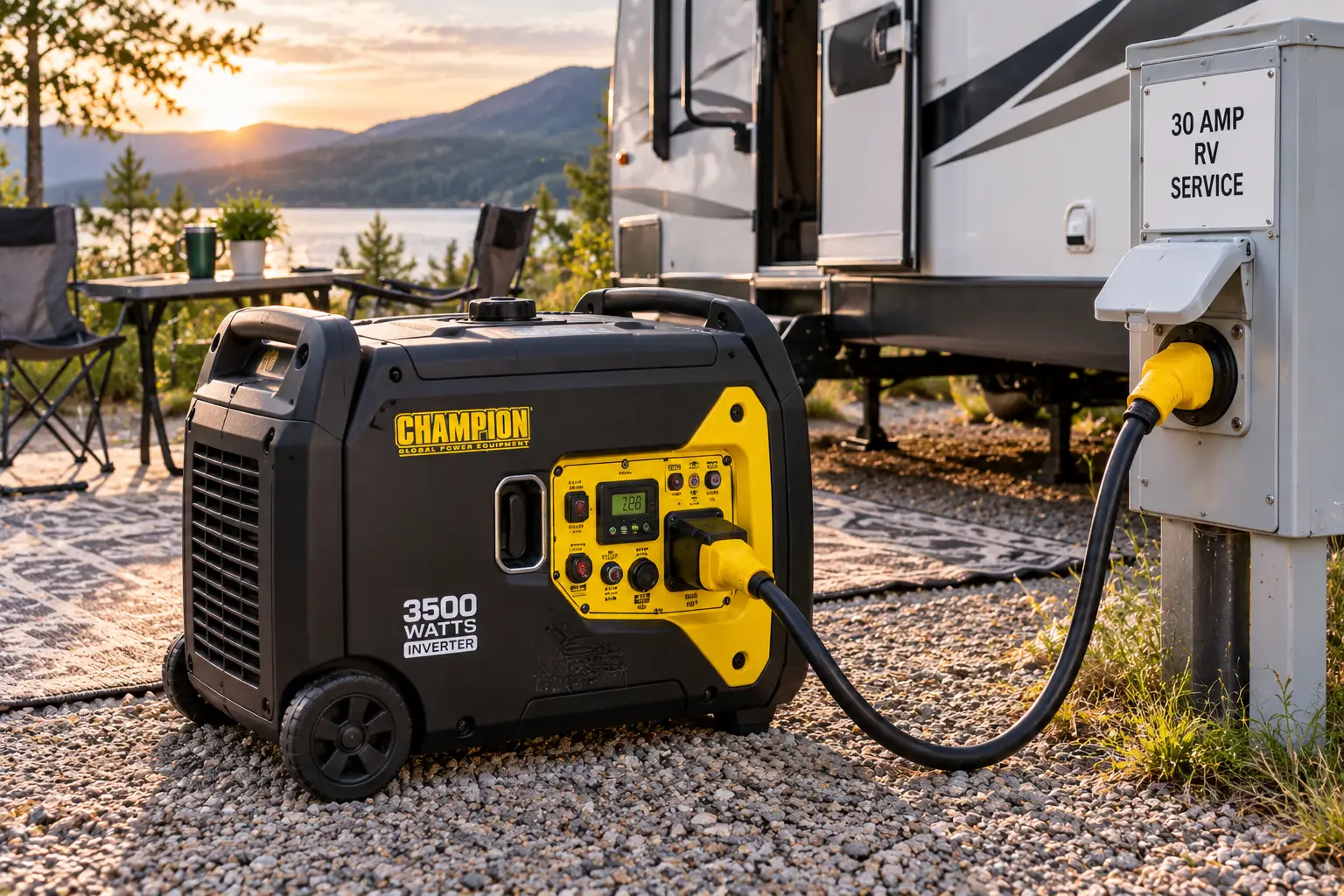
If you’ve ever sat in a hot travel trailer wondering whether your rooftop air conditioner is about to trip a breaker, you already understand why picking the right generator for rv 30 amp service matters more than most shoppers realize. A generator for rv 30 amp hookups isn’t just “a generator that’s big enough” — it’s a specific balance of running watts, starting surge, noise level, and outlet compatibility that has to line up with how a 30-amp RV electrical system actually behaves. A generator for rv 30 amp use is a portable power unit sized to safely deliver up to 3,600 watts of continuous 120-volt power (30 amps x 120 volts) while providing enough surge capacity to start motor-driven appliances like a rooftop air conditioner or a refrigerator compressor.
That distinction trips people up constantly. A 30-amp shore power connection has a hard ceiling of 3,600 watts, so buying a generator rated at 10,000 watts doesn’t actually give you more usable power at the RV’s plug — it just gives you more surge cushion and, often, a heavier and louder machine to haul around. On the other hand, undersizing your generator for rv 30 amp use means nuisance trips every time the air conditioner compressor kicks on. This guide walks through seven real, currently available generators spanning entry-level, mid-range, and premium price points, explains what actually matters when you’re shopping, and gives you the honest trade-offs — including the ones the product listings won’t tell you. Carbon monoxide safety is a real concern with any fuel-powered generator, and the U.S. Consumer Product Safety Commission has published detailed guidance on operating portable generators safely that’s worth reading before your first trip (cpsc.gov).
Quick Comparison: Generator for RV 30 Amp Shoppers
Before diving into the full write-ups, here’s a snapshot of how these seven models stack up on the numbers that matter most for 30-amp RV use.
| Generator | Running Watts | Starting Watts | Noise Level | Best For |
|---|---|---|---|---|
| Predator 3500 | 3,000W | 3,500W | 56-57 dBA | Budget-conscious first-time buyers |
| Yamaha EF2200iS | 1,800W | 2,200W | 57-65 dBA | Light loads, no AC, backup charging |
| WEN 56475 | 3,750W | 4,750W | 67 dBA | Maximum wattage on a tight budget |
| Champion 4000-Watt RV Ready | 3,500W | 4,000W | 64 dBA | Lightweight parallel-ready setups |
| DuroMax XP4400E | 3,500W | 4,400W | Moderate (open-frame) | Dual-fuel flexibility, tool use |
| Westinghouse iGen4500 | 3,700W | 4,500W | 52 dBA | All-around 30-amp RV use |
| Honda EU3000iS | 2,800W | 3,000W | 50-57 dBA | Reliability and resale value |
Looking at the table, the Westinghouse iGen4500 and Champion 4000-Watt RV Ready models sit in the sweet spot most 30-amp RV owners actually need — enough running wattage to cover a rooftop AC plus the fridge and a few extras, without the bulk of a full-size job-site generator. The Honda EU3000iS trades some raw wattage for class-leading quiet operation and long-term reliability, which matters if you camp near other people often. Budget shoppers should note that the WEN 56475 delivers the most running watts per dollar, but it’s a conventional open-frame design rather than a quiet inverter, so it’s a noisier trade-off for the price.
💬 One click helps other shoppers make an informed choice too! 😊
Top 7 Generators for RV 30 Amp Service: Expert Analysis
We researched real spec sheets, verified current availability on amazon.com, and cross-referenced aggregated customer feedback to build this list. Every model below can be found with a 30-amp RV-compatible outlet, either built in or through a widely available adapter.
1. Westinghouse iGen4500 — best all-around pick for one rooftop AC
The iGen4500 earns the top spot because it hits the wattage sweet spot for 30-amp RVs without the noise or bulk of a job-site generator. It delivers 3,700 running watts and 4,500 peak watts from a 224cc engine, which gives most single-AC travel trailers real breathing room after the compressor kicks on. Because it runs at less than 3% total harmonic distortion, it produces genuinely clean power — a detail that matters if you’re running laptops, a CPAP machine, or a flat-screen TV off the same circuit as your appliances. What most buyers overlook with this model is the remote start feature: on a cold or rainy morning, being able to fire it up from inside the RV via key fob is a bigger quality-of-life upgrade than the spec sheet suggests.
Reviews consistently report that the iGen4500 runs noticeably quieter than similarly priced open-frame units, with owners specifically calling out the noise suppression as a standout feature compared to rivals in the same price bracket. A common theme in aggregated feedback is that the digital data center display makes it easy to track fuel level and maintenance needs at a glance, which cuts down on surprise shutdowns mid-trip.
Pros:
- ✅ Strong running wattage margin for one RV air conditioner
- ✅ Remote electric start from up to 100+ yards away
- ✅ Clean, low-THD power safe for sensitive electronics
Cons:
- ❌ Nearly 100 pounds, so it’s not a one-hand carry
- ❌ Dual-fuel version costs more than the gas-only model
Expect to pay in the $800 to $950 range for the gas-only version, with the dual-fuel iGen4500DF running somewhat higher. At the time of writing, this is a strong value pick for anyone who wants one generator to comfortably cover a 30-amp RV with a single rooftop unit.
2. Honda EU3000iS — the reliability benchmark
The Honda EU3000iS distinguishes itself less through raw wattage and more through decades of engineering refinement. It’s rated at 2,800 running watts and 3,000 peak watts from a Honda GX200 engine, which is genuinely lower than several competitors on this list — but Honda’s Eco Throttle system and inverter design mean that wattage goes further, and the noise output (50-57 dBA) is among the quietest of any gas generator sold for RV use. Based on comparing the specs, the trade-off is straightforward: you get less surge margin for a large 15,000 BTU air conditioner, but you get a machine that’s earned a reputation for starting reliably after years of storage.
Consumer Reports has tested the EU3000iS directly and found it delivered enough wattage to power its test appliances, handled surges well, and provided especially clean power with consistently high voltage — an independent data point worth weighing against the higher price tag (consumerreports.org). What the spec sheet doesn’t say, but owner discussions reveal, is that the stock outlet is a NEMA locking plug rather than a true TT-30R, so most RV owners will need a simple adapter cable to connect directly to their shore power cord — a minor added cost that’s easy to miss when comparing sticker prices.
Pros:
- ✅ Exceptionally quiet at 50-57 dBA under real load
- ✅ Long track record of reliability and parts availability
- ✅ Runs up to nearly 20 hours on a quarter load per tank
Cons:
- ❌ Lower running wattage than most rivals on this list
- ❌ Premium price relative to its wattage class
The Honda EU3000iS typically sells well above $1,800, often approaching or exceeding $2,000, making it the most expensive entry here — but for buyers who camp frequently and value long-term dependability over sheer wattage, the price reflects the reputation.
3. Champion 4000-Watt RV Ready Inverter — best lightweight parallel-capable option
The Champion 4000-Watt RV Ready generator (also sold as the “Digital Hybrid” open-frame inverter) is built specifically with RV owners in mind, delivering 3,500 running watts and 4,000 starting watts while weighing under 49 pounds in its enclosed-case version — genuinely light for this power class. The open-frame “Digital Hybrid” variant reduces noise to roughly 64 dBA, about 50% quieter than a traditional uninsulated portable, according to Champion’s own testing data. In practice, that wattage is enough to run a single RV air conditioner alongside the fridge, a microwave, and basic lighting, provided you’re not running everything simultaneously at full draw.
What sets this model apart from a pure spec comparison is the parallel-kit option: buy a second identical unit and a parallel cable, and you can combine outputs to run two air conditioners, something none of the single-unit models on this list can do without an upgrade. Reviews frequently point to the CO Shield automatic shutoff system as a meaningful safety upgrade compared to older Champion models, and the built-in TT-30R outlet means no adapter shopping is required.
Pros:
- ✅ One of the lightest 4,000-watt-class inverters available
- ✅ Native TT-30R outlet, no adapter needed
- ✅ Parallel-kit compatible for doubling output later
Cons:
- ❌ Recoil-only start on the base gas model (no electric start)
- ❌ Smaller fuel tank means shorter runtime between fill-ups
Pricing generally falls between $650 and $800 depending on whether you choose the gas-only or dual-fuel version. For RV owners who might eventually want to run two air conditioners, this is one of the few entries here with a clear upgrade path.
4. DuroMax XP4400E — best for buyers who also need tool-grade power
The DuroMax XP4400E takes a different approach than the inverter models on this list: it’s a conventional generator built around a 210cc OHV engine, rated at 3,500 running watts and 4,400 peak watts. Because it isn’t an inverter, it’s a heavier, louder unit, but that same conventional design tends to tolerate the inductive loads of power tools and shop equipment more forgivingly than some inverter models. The included MX2 technology lets you draw full power from either the 120V or 120V/240V circuits, which DuroMax specifically markets as useful for RV owners who want flexibility beyond a single 30-amp connection.
Based on comparing the specs, this is the generator on our list best suited to someone who splits their time between RV trips and job-site or workshop use, since the 120/240V twist-lock outlet and GFCI-protected household outlets cover both use cases without needing a second machine. Reviews describe the DuroMax engine platform as a dependable workhorse, though the trade-off for that ruggedness is a noise profile and weight closer to a traditional job-site generator than to a purpose-built RV inverter.
Pros:
- ✅ Dual-purpose: RV power and job-site/tool power in one unit
- ✅ MX2 technology maximizes 120V output flexibility
- ✅ Dual-fuel (XP4400EH) version available for propane backup
Cons:
- ❌ Not an inverter, so power isn’t as clean for sensitive electronics
- ❌ Noticeably louder and heavier than the inverter models here
Expect a price in the $450 to $600 range for the gas-only XP4400E, with the dual-fuel XP4400EH priced somewhat higher. This is a strong value pick if your generator needs to multitask beyond the campground.
5. WEN 56475 — most running watts for the money
If your priority is simply maximizing running wattage per dollar, the WEN 56475 is hard to beat. It’s rated at 3,750 running watts and 4,750 peak watts from a 223cc engine — more running wattage than every other entry on this list — while typically retailing under $500. It includes a TT-30R RV receptacle alongside a separate 30-amp three-prong outlet and two household plugs, so compatibility with a 30-amp RV cord is straightforward out of the box.
Here’s what most buyers overlook: this is a conventional generator, not an inverter, and at 67 dBA it’s the loudest unit in this roundup — noticeably louder than the 50-57 dBA range of the Honda and Westinghouse picks. Reviews consistently report satisfaction with the value proposition and the keyless electric start, but a recurring theme in aggregated feedback is that campground neighbors notice the extra noise, which matters if you frequent parks with generator-hour restrictions or noise-conscious neighbors.
Pros:
- ✅ Highest running-watt rating of any model on this list
- ✅ Keyless electric start included at a budget price point
- ✅ TT-30R outlet built in, no adapter required
Cons:
- ❌ Loudest generator in this comparison at 67 dBA
- ❌ Not inverter-clean power, so pair a surge protector with sensitive electronics
Pricing typically runs under $500, making this the best-value pick for buyers who prioritize raw wattage and don’t mind the extra noise or the heavier 112-116 pound frame.
6. Predator 3500 — best budget inverter for occasional use
Sold through Harbor Freight, the Predator 3500 Super Quiet Inverter Generator is rated at 3,000 running watts and 3,500 peak watts from a 212cc engine, and it undercuts most inverter competitors on price while still offering a legitimately quiet 56-57 dBA noise rating. For 30-amp RV owners who camp occasionally rather than full-time, this combination of low price and inverter-clean power is compelling — reviews and RV forum discussions repeatedly note that owners have successfully started 13,500 BTU RV air conditioners with it, provided other loads are managed carefully.
What the spec sheet doesn’t say, but forum discussions reveal, is that the stock outlet is a NEMA L5-30R twist-lock rather than a TT-30R, so you’ll need a simple L5-30P-to-TT-30R adapter cable to connect it directly to most RV shore power cords — a small added cost worth budgeting for. Community feedback on build quality is mixed compared to Honda or Yamaha, with some owners noting shorter long-term durability, though the price gap helps explain that trade-off.
Pros:
- ✅ Inverter-clean power at a genuinely budget price
- ✅ Quiet 56-57 dBA operation for its price class
- ✅ Runs up to roughly 11 hours at a quarter load
Cons:
- ❌ Requires an L5-30 to TT-30R adapter for most RVs
- ❌ Shorter warranty coverage than premium competitors
Pricing generally lands between $600 and $800, with periodic sales bringing it lower. This is the pick for buyers who want inverter quiet without inverter pricing, as long as they budget for the adapter cable.
7. Yamaha EF2200iS — lightest option for light-load camping
The Yamaha EF2200iS is the smallest generator on this list by design, rated at just 1,800 running watts and 2,200 peak watts from a compact 79cc engine. It won’t start most RV rooftop air conditioners on its own, but it includes a built-in TT-30R RV outlet and a genuinely quiet 57-65 dBA noise profile, making it well suited to charging house batteries, running lights, a fan, and small electronics during dry camping when AC isn’t the priority. Its Twin Tech parallel function also allows two units to be linked for roughly double the output if your needs grow later.
It’s worth being upfront here: Yamaha has discontinued production of this model, so current retail listings reflect remaining dealer and online inventory rather than an active product line — worth knowing since long-term parts support may become more limited over time compared to a currently produced model. Reviews consistently describe it as extremely quiet and easy to start via the Smart Dial knob, with the CO sensor auto-shutoff feature frequently cited as reassuring for tent camping and RV use alike.
Pros:
- ✅ Among the lightest and quietest generators available
- ✅ Native TT-30R outlet built in
- ✅ Twin Tech parallel function for future expansion
Cons:
- ❌ Not enough running wattage to start most rooftop RV air conditioners alone
- ❌ Discontinued model, so long-term parts support is a question mark
Pricing varies widely, generally between $900 and $1,400 at standard retail, though clearance and secondhand listings can be considerably lower. This is the right choice only if AC power isn’t part of your plan — for anything else on this list, it’s outclassed on wattage.
Full Spec Comparison: Top 7 Generators for RV 30 Amp Use
| Generator | Engine | Weight | Outlet Type | Price Range | Best For |
|---|---|---|---|---|---|
| Westinghouse iGen4500 | 224cc | ~98 lbs | TT-30R | $800-$950 | One rooftop AC + electronics |
| Honda EU3000iS | 196cc (GX200) | ~131 lbs | Locking plug (adapter needed) | $1,800+ | Long-term reliability |
| Champion 4000-Watt RV Ready | 149-212cc | ~49 lbs | TT-30R | $650-$800 | Lightweight, parallel-ready |
| DuroMax XP4400E | 210cc | ~99 lbs | 120/240V twist-lock | $450-$600 | RV + job-site dual use |
| WEN 56475 | 223cc | ~112-116 lbs | TT-30R | Under $500 | Max wattage per dollar |
| Predator 3500 | 212cc | ~62 lbs | L5-30R (adapter needed) | $600-$800 | Budget inverter power |
| Yamaha EF2200iS | 79cc | ~55 lbs | TT-30R | $900-$1,400 | Light loads, no AC |
The analysis here reinforces the quick-comparison takeaway: the Westinghouse iGen4500 and Champion 4000-Watt RV Ready models offer the best balance of wattage, weight, and native TT-30R compatibility for typical 30-amp travel trailers. Buyers prioritizing brand reliability above all else should budget for the premium the Honda EU3000iS commands, while the WEN 56475 and DuroMax XP4400E serve shoppers who are willing to trade quiet operation for lower upfront cost.
What Is a Generator for RV 30 Amp Service?
A generator for rv 30 amp service is a portable power source sized and equipped to safely supply a recreational vehicle’s 30-amp, 120-volt electrical system — a maximum of 3,600 watts of continuous draw. These generators typically fall in the 3,000 to 4,500 running-watt range, which provides enough surge capacity to start a rooftop air conditioner’s compressor without tripping the generator’s own overload protection or the RV’s internal breaker.
The math behind that number is simple: 120 volts multiplied by 30 amps equals 3,600 watts. That’s the absolute ceiling of what a 30-amp shore power connection — or a generator plugged into it — can deliver to the RV at any given moment, regardless of how large the generator itself is rated.
How to Choose a Generator for RV 30 Amp Use
Picking the right unit comes down to matching a handful of specs to how you actually camp, not just chasing the highest wattage number on the box.
- Match running watts to your actual appliance load. Add up the running wattage of what you’ll use simultaneously — air conditioner, fridge, microwave — and choose a generator with headroom above that total, not just above your RV’s 30-amp ceiling.
- Check the starting watts, not just running watts. Air conditioner compressors and refrigerator motors draw a brief surge on startup that can be double their running wattage; a generator with too little surge capacity will shut down or trip when the AC kicks on.
- Confirm the outlet type before you buy. Some generators ship with a NEMA TT-30R RV-ready outlet built in, while others use an L5-30R or similar industrial twist-lock that requires an inexpensive adapter cable — a detail explained well in the general reference on NEMA connector standards.
- Weigh noise level against where you camp. A 52-57 dBA inverter is noticeably less disruptive at a quiet campground than a 64-67 dBA conventional model, which matters if you camp near other RVers regularly.
- Decide if inverter-clean power actually matters to you. If you’re running laptops, medical equipment, or sensitive electronics, prioritize a true inverter generator with low total harmonic distortion; if you mainly power basic appliances, a conventional generator can save money.
- Consider weight and portability realistically. A 49-pound inverter is a one-person lift; a 116-pound conventional unit generally isn’t — factor in who will actually be loading and unloading it on every trip.
- Think about fuel type and runtime. Dual-fuel models add propane flexibility for long-term storage and remote camping, while gas-only models are usually lighter and slightly cheaper.
Common Mistakes to Avoid When Buying an RV 30 Amp Generator
The most frequent mistake buyers make is assuming bigger is automatically better. A 10,000-watt generator won’t push more than 3,600 watts through a 30-amp RV connection, so that extra capacity is wasted weight, wasted fuel, and often wasted money unless you specifically plan to run 240-volt equipment separately. A second common error is ignoring the outlet type entirely — buyers frequently discover after delivery that their new generator uses an L5-30R or L14-30R receptacle rather than the RV-standard TT-30R, and end up scrambling for an adapter cable before their next trip.
A third mistake is underestimating starting watts. Because RV air conditioner compressors draw a substantial surge when they cycle on, a generator that looks adequate based on running watts alone can trip repeatedly if its starting-watt rating is too close to the AC’s surge demand. Finally, many first-time buyers skip reading the noise rating altogether, only to discover at a quiet, restriction-enforcing campground that their generator’s dBA rating makes it unwelcome during quiet hours.
Inverter Generator vs Conventional Generator for RV 30 Amp Use
The core difference comes down to how the electricity is produced. An inverter generator runs its engine at a variable speed, converts the output to DC, and then inverts it back to a clean, stable AC sine wave — typically under 3% total harmonic distortion. A conventional generator runs at a fixed engine speed and produces AC power directly, which is usually louder, less fuel-efficient at partial loads, and less consistent in voltage.
| Factor | Inverter Generators | Conventional Generators |
|---|---|---|
| Noise level | 50-57 dBA typical | 64-70+ dBA typical |
| Power quality | Clean, low-THD, safe for electronics | Can have voltage fluctuation |
| Weight | Generally lighter | Generally heavier |
| Fuel efficiency at partial load | Higher (variable engine speed) | Lower (fixed engine speed) |
| Typical price | Higher per running watt | Lower per running watt |
For 30-amp RV use specifically, the Westinghouse iGen4500, Honda EU3000iS, Predator 3500, Champion 4000-Watt RV Ready, and Yamaha EF2200iS are all inverter models, while the WEN 56475 and DuroMax XP4400E are conventional designs. If you’re powering sensitive electronics or camping somewhere quiet hours are strictly enforced, the inverter premium is usually worth paying; if your loads are simple appliances and your budget is tight, a conventional generator can deliver more raw wattage for less money.
What to Expect: Everyday RV Generator Performance
On paper, a 3,500-running-watt generator sounds like plenty for a 30-amp RV, and in most cases it is — but real-world performance depends heavily on what’s running simultaneously. A single 13,500 BTU rooftop air conditioner typically draws 1,500 to 1,800 running watts once started, leaving meaningful headroom on a 3,500-watt generator for the refrigerator, a few lights, and device charging. Add a microwave or a hair dryer to that mix, though, and you can approach the generator’s ceiling quickly, which is why load management — running high-draw appliances one at a time rather than simultaneously — matters more than the spec sheet alone suggests.
Fuel consumption also varies more than headline runtime numbers imply, since most manufacturers publish runtime at 25% load, not the 50-75% load a running air conditioner actually demands. In practice, expect real-world runtime on a single tank to land closer to half of the advertised “quarter load” figure once the AC is cycling regularly, which is worth factoring into how much fuel you pack for a boondocking trip.
Generator for RV 30 Amp Service for Boondockers and Weekend Campers
Not every 30-amp RV owner has the same power needs, and matching the generator to the trip type avoids both overspending and underpowering.
The weekend campground camper who mostly uses hookups but wants generator backup for travel days is usually well served by a lighter, quieter inverter like the Champion 4000-Watt RV Ready or Predator 3500 — enough wattage for the AC during a lunch stop, without the weight of a full-size unit that mostly sits unused.
The frequent boondocker who relies on the generator as a primary power source for days at a time benefits more from the extra running-watt headroom and dual-fuel flexibility of the Westinghouse iGen4500 or DuroMax XP4400EH, since propane storage solves the fuel-shelf-life problem that comes with sitting gasoline.
The minimalist camper who dry-camps without air conditioning needs and mainly wants to keep batteries topped up and small electronics running can save significant money and weight with something like the Yamaha EF2200iS, provided they’ve confirmed in advance that AC isn’t part of the plan.
Long-Term Cost and Maintenance of an RV 30 Amp Generator
The sticker price is only part of the total cost of ownership. Fuel consumption adds up over a camping season — a generator running at 50% load for six hours a day during a week-long boondocking trip can burn through several gallons of gasoline, so a slightly more fuel-efficient inverter model can offset a higher upfront price over a few seasons of regular use. Oil changes, typically recommended every 50-100 hours of runtime, are a modest but recurring cost across every model on this list, and spark plugs and air filters need periodic replacement regardless of brand.
Warranty coverage varies meaningfully: Honda and Westinghouse both back their inverter models with multi-year limited warranties and established service networks, while some budget conventional models carry shorter coverage windows. For buyers planning to use their generator heavily over many seasons, a slightly higher purchase price paired with a longer warranty and stronger parts availability can work out cheaper in total cost of ownership than the lowest sticker price alone.
Getting Started: Your First 30 Days With a New RV Generator
Bringing a new generator for rv 30 amp use home is straightforward, but a few early habits prevent the most common first-month problems. Start with a proper break-in run per the manufacturer’s manual — most inverter generators specify an initial oil change after the first 20-25 hours, and skipping this step is one of the most common causes of premature engine wear reported in owner forums. Before your first camping trip, do a dry run at home: connect it to your RV, start the air conditioner, and confirm the generator handles the surge without tripping, so you’re not troubleshooting for the first time at a campsite.
Store fuel stabilizer-treated gasoline if the generator will sit between trips, since stale fuel is one of the most frequently reported startup failures across every brand in this comparison. Finally, register your warranty immediately and keep the manual and receipt together — most manufacturers require proof of purchase for warranty claims, and having it organized from day one saves a headache if something needs service later.
Generator Problems on the Road and How to Solve Them
Problem: The generator trips or shuts off when the AC starts. This usually means the starting-watt rating is too close to the AC compressor’s surge demand. Solution: turn off other appliances before starting the AC, or upgrade to a model with more starting-watt headroom like the Westinghouse iGen4500 or WEN 56475.
Problem: The generator won’t start after sitting for weeks. Stale gasoline is the most common cause. Solution: use fuel stabilizer for any gas left in the tank between trips, and drain the carburetor before long-term storage as several manufacturers recommend.
Problem: Campground neighbors complain about noise. Solution: switch to a quieter inverter model such as the Honda EU3000iS or Predator 3500, or check the campground’s specific quiet hours before running any generator during early morning or evening.
Problem: The RV’s shore power cord doesn’t fit the generator’s outlet. This happens when a generator ships with an L5-30R or L14-30R outlet instead of a TT-30R. Solution: purchase a low-cost adapter cable matched to your specific plug types rather than forcing an incompatible connection.
Problem: Running out of fuel mid-trip during boondocking. Solution: consider a dual-fuel model like the DuroMax XP4400EH or Westinghouse iGen4500DF, which lets you carry propane as a backup fuel source that doesn’t degrade in storage the way gasoline does.
Features That Actually Matter (and Ones That Don’t)
Running watts, starting watts, noise rating, and outlet type genuinely determine whether a generator will work for your RV — everything else is secondary. Total harmonic distortion matters if you’re running sensitive electronics, but is largely irrelevant if you’re only powering basic appliances. Parallel-kit compatibility is a real value-add if you might eventually want to run two air conditioners, but it’s a wasted feature if you’ll only ever own one unit.
On the other hand, marketing terms like “quiet technology” or “super quiet” without an accompanying dBA number are essentially meaningless — always check the actual decibel rating and, when available, the distance it was measured at. Similarly, a large peak-wattage number by itself tells you little without the running-watt figure alongside it, since peak wattage is only sustained for a few seconds during startup.
Safety, Regulations, and Standards for RV Generators
Every generator on this list is required to meet EPA emissions standards for sale in the United States, and most are also CARB-compliant for sale in California; always confirm CARB compliance specifically if you live in or frequently travel through California. Carbon monoxide poisoning remains the single biggest safety risk associated with portable generators — the CPSC estimates that roughly 85 consumers die each year in the U.S. from CO poisoning tied to gasoline-powered portable generators, with the top reported use case involving campers and temporary locations. Always run any generator outdoors, well away from windows, doors, and vents, regardless of how many safety features it includes.
As an affiliate content publisher, this article also follows the FTC’s disclosure requirements for endorsements and material connections, meaning any product mentioned here that generates a commission is disclosed clearly rather than buried in fine print — a standard outlined in detail in the FTC’s own Endorsement Guides.
✨ Ready to power your next RV trip with confidence?
🔍 Compare the seven generators above side by side, click through to check current pricing and availability, and pick the one that matches how you actually camp. The right choice today means no more sweating out a hot afternoon waiting for the AC to kick back on.
Frequently Asked Questions
❓ What size generator do I need for a 30 amp RV?
❓ Can I run my RV air conditioner on a 3,000 watt generator?
❓ Do I need a special outlet for an RV generator?
❓ Is an inverter generator worth the extra cost for RV use?
❓ How long will a generator run on a full tank during RV camping?
Conclusion
Choosing the right generator for rv 30 amp use ultimately comes down to matching real running-watt and starting-watt needs to how you actually camp, rather than chasing the biggest number on the box. For most single-AC travel trailers, the Westinghouse iGen4500 offers the best overall balance of wattage, weight, and quiet operation, while the Honda EU3000iS remains the gold standard for buyers who prioritize long-term reliability above all else. Budget-focused shoppers have real, honest options too — the WEN 56475 delivers the most running watts per dollar, and the Predator 3500 brings inverter-clean power within reach of a tighter budget.
Whichever model you choose, confirm the outlet type before you buy, respect the campground’s noise rules, and always run it in a well-ventilated outdoor space. A generator for rv 30 amp service should make your trips easier, not more stressful — and with the right match between your appliances and your generator’s specs, that’s exactly what it will do.
✨ Found the right generator for your next trip?
🔍 Take another look at the comparison table above, click through on your top pick to check today’s price and availability, and get ready to camp with real, reliable power on your next adventure!
Recommended for You
- Off Grid Battery Guide: 7 Best Picks to Power Your Home in 2026
- Portable Power Station for Refrigerator: 7 Best Picks (2026)
- Best Solar Charger for Backpacking: 7 Trail-Tested Picks (2026)
Disclaimer: This post contains affiliate links. As an Amazon Associate, I earn from qualifying purchases made through these links, at no additional cost to you.
✨ Found this article helpful? Share it with someone who needs it! 💬🤗