
In This Article
Why Choosing the Right Generator for Travel Trailer AC Matters More Than You Think
Picture this: it’s 94°F at a dry campsite in Utah, the trailer is baking like a toaster oven, and you flip on the rooftop AC. The compressor groans, the generator bogs down, and then… silence. Overload light. Sound familiar? Picking the right generator for travel trailer AC is less about raw power and more about matching the generator’s surge capacity to the split-second spike your air conditioner demands when the compressor kicks on.
Here’s the short version. A typical 13,500 BTU rooftop unit settles into roughly 1,300 to 1,800 running watts once it’s cooling, but it can demand 2,800 to 3,500 watts for the first second or two of startup. That gap is exactly where most first-time buyers go wrong. They buy a generator that “runs” the AC on paper but can’t start it on a hot afternoon, at elevation, with the fridge and converter already pulling power.
What Is a Generator for Travel Trailer AC?
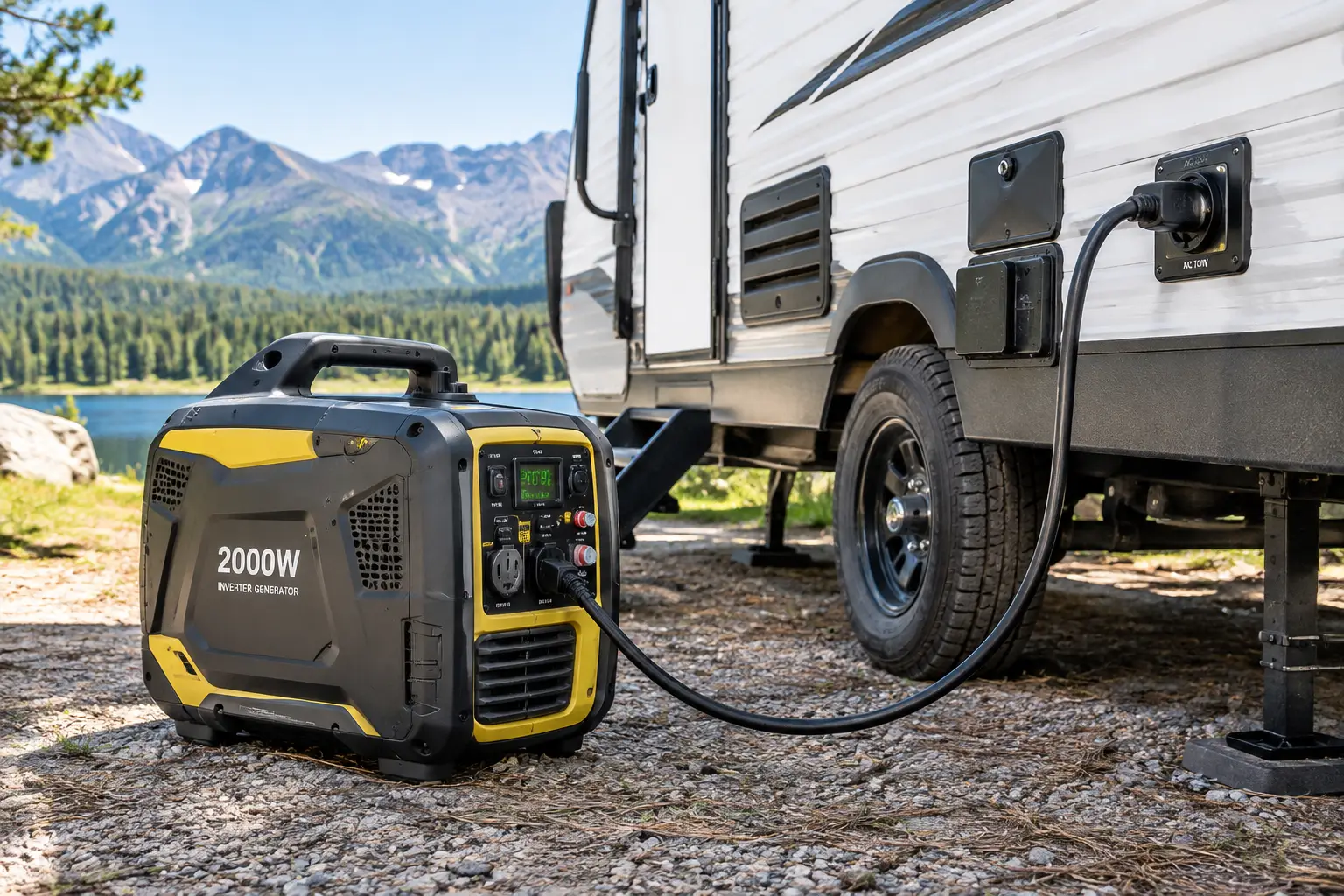
A generator for travel trailer AC is a portable engine-generator (or, increasingly, a large battery power station) sized to start and run a trailer’s rooftop air conditioner through a 30-amp RV connection. For most single-AC trailers, that means 3,000 to 4,500 starting watts with clean, stable inverter power.
In this guide, you’ll find seven real models available on amazon.com, from a budget open-frame workhorse to a premium silent battery option. Each one gets honest analysis built on manufacturer spec sheets and aggregated owner sentiment—not marketing fluff. You’ll also get sizing math, a setup walkthrough, troubleshooting fixes, and the safety rules that actually matter at a campground. Let’s find the one that keeps you cool without making you the loudest site in the loop.
Quick Comparison: The 7 Best Generators for Travel Trailer AC at a Glance
| Generator | Starting / Running Watts (Gas) | Fuel | Weight | Noise (manufacturer rating) | Best for |
|---|---|---|---|---|---|
| Champion 200988 4500-Watt Dual Fuel Inverter | 4,500 / 3,500 | Gas + propane | ~97–103 lb | 61 dBA | Champion 200988: best all-around for one AC |
| Honda EU3200i | 3,200 / 2,600 | Gas | 59.1 lb | 54–58 dB(A) | Honda EU3200i: lightest single unit that can start a 13.5K AC |
| Westinghouse iGen4500DFc | 4,500 / 3,700 | Gas + propane | ~100 lb | As low as 52 dBA | Westinghouse iGen4500DFc: longest gas run time |
| WEN 56380i | 3,800 / 3,400 | Gas | 99.2 lb | 57 dBA | WEN 56380i: budget inverter buyers |
| Honda EU2200i (parallel pair) | 4,400 / 3,600 combined | Gas | 46.5 lb each | 48–57 dB(A) each | Honda EU2200i: solo travelers who hate heavy lifting |
| Champion 3800-Watt Dual Fuel (open frame) | 4,750 / 3,800 | Gas + propane | ~119–133 lb | 68 dBA | Champion 3800-Watt Dual Fuel: lowest cost per watt |
| EcoFlow DELTA Pro 3 | 8,000 surge / 4,000 continuous | Battery (LFP) | 113.5 lb | Near-silent | EcoFlow DELTA Pro 3: quiet hours and solar setups |
Looking at the table, the Champion 200988 and Westinghouse iGen4500DFc sit in the sweet spot for most 30-amp trailers: enough surge for a 13,500 or even 15,000 BTU unit, plus headroom for the fridge and converter. The Honda EU3200i trades raw wattage for a dramatically lighter body, which matters more than you’d think when you’re lifting it into a truck bed alone. Meanwhile, the EcoFlow DELTA Pro 3 is in a different category entirely—no fuel, no fumes, but limited AC hours before it needs recharging.
💬 One click helps other shoppers make an informed choice too! Tap any highlighted generator to check current pricing and availability. 😊
Top 7 Best Generator for Travel Trailer with AC: Expert Analysis
1. Champion 200988 4500-Watt Dual Fuel Inverter — best all-around for one rooftop AC
The Champion 200988 earns the top spot because it balances surge, fuel flexibility, and noise better than anything else at its price tier.
On gasoline, it delivers 4,500 starting and 3,500 running watts; on propane, it holds the same 4,500-watt surge with 3,150 running watts. That equal surge on both fuels is a big deal: propane normally costs you startup power, but here your AC’s compressor kick gets the same headroom either way. Electric start with Cold Start Technology, a TT-30R RV outlet, and up to 14 hours on gas (or about 21 on a 20-lb propane tank) at 25% load round out the package.
Based on comparing the specs, this is the generator for the typical couple or family running one 13,500 BTU AC plus normal camp loads. It’s not light—roughly 97 to 103 pounds depending on the source—so plan on rolling it rather than carrying it.
Owner feedback across retailer listings and review roundups tends to praise how reliably it starts the AC and how easy propane switching is; the most common complaint is the weight.
Pros:
- ✅ Same 4,500-watt surge on gas and propane
- ✅ Electric start plus RV-ready TT-30R outlet
- ✅ Parallel-capable for future 50-amp needs
Cons:
- ❌ Around 100 pounds makes solo lifting tough
- ❌ Louder than Honda models at similar loads
💲 Usually in the $900–$1,200 range at the time of writing—strong value for a dual fuel generator for travel trailer use; check the current price.
2. Honda EU3200i — lightest unit that still starts a 13.5K AC
The Honda EU3200i is what you buy when portability and quiet matter more than maximum wattage.
It produces 3,200 peak and 2,600 rated watts from a fuel-injected Honda GX130 engine. In practice, fuel injection means no choke, no carburetor cleaning, and no re-jetting when you camp at altitude—a real advantage in mountain states. Honda lists it at 59.1 pounds dry and 54–58 dB(A), and it adds Bluetooth monitoring plus CO-MINDER carbon monoxide shutdown.
Here’s what most buyers overlook: 2,600 running watts handles a 13,500 BTU AC, but not much else at the same time. If you want the microwave running alongside, this isn’t your generator—unless your AC has a soft starter. Also note the 30-amp receptacle is a twist-lock (L5-30R), not a TT-30R, so you’ll need an adapter for a standard RV plug.
Aggregated owner sentiment centers on exceptional quietness and Honda’s reliability reputation, with price as the recurring complaint.
Pros:
- ✅ Under 60 pounds with two integrated handles
- ✅ Fuel injection removes altitude and carb headaches
- ✅ Very quiet for its output class
Cons:
- ❌ Limited headroom beyond the AC itself
- ❌ Twist-lock outlet needs a TT-30 adapter
💲 Typically in the $2,000–$2,500 range—premium pricing justified mostly by weight, noise, and longevity.
3. Westinghouse iGen4500DFc — longest run time on a tank of gas
The Westinghouse iGen4500DFc is the endurance pick, built around a large 3.4-gallon tank.
It’s rated at 4,500 peak and 3,700 running watts on gas, and 4,050 peak and 3,330 running on propane. The spec sheet lists up to 18 hours at 25% load—meaning you’re far more likely to sleep through the night without a refuel run. It also includes electric, recoil, and remote start, an LED data readout, and automatic CO shutdown.
On paper, 3,700 running watts gives this unit the most comfortable cushion in its class for a 15,000 BTU AC plus fridge and converter. Remote start is surprisingly useful: you can fire it up from inside the trailer before a heat wave peaks. The trade-off is that propane surge drops to 4,050 watts, so propane-only campers should check their AC’s startup demand.
Owners in review roundups frequently highlight the long run time and quiet low-load operation; weight and bulk are the usual drawbacks.
Pros:
- ✅ Up to 18 hours at 25% load on gas
- ✅ Remote start from inside the trailer
- ✅ CO sensor with automatic shutdown
Cons:
- ❌ Propane surge is lower than gas surge
- ❌ Bulky footprint in smaller truck beds
💲 Generally found between $900 and $1,300—excellent value if run time is your top priority.
4. WEN 56380i — best budget inverter for a single AC
The WEN 56380i proves you don’t need a premium brand to get clean, RV-ready inverter power.
It delivers 3,800 surge and 3,400 rated watts from a 212cc engine, with a TT-30R outlet, electric start, and roughly 8.5 hours at half load. A fuel shutoff feature burns off carburetor fuel before shutdown, which genuinely reduces the gummed-carb problem that kills many seasonal generators. WEN lists it at 57 dBA and 99.2 pounds.
Based on comparing specs, this is the right call for weekend campers with a 13,500 BTU AC who want inverter quietness without a four-figure price. Its 3,800-watt surge is enough for most 13.5K units, but it’s tighter than the 4,500-watt models for a 15,000 BTU unit on a hot day.
One third-party roundup reported a 4.6-out-of-5 average from more than 2,700 ratings; owners commonly cite good value and quiet running, while some find the 99-pound weight hard to handle alone.
Pros:
- ✅ Strong price-to-performance ratio
- ✅ Fuel shutoff protects the carburetor
- ✅ Direct TT-30R plug-in for RVs
Cons:
- ❌ Gas only, no propane option
- ❌ Two-year warranty trails Champion and Honda
💲 Often available in the $700–$950 range—hard to beat for a quiet generator for camper AC on a budget.
5. Honda EU2200i (Parallel Pair) — easiest to lift, solo-friendly
Two Honda EU2200i units linked together give you big-generator capability in two carry-friendly pieces.
Each unit makes 2,200 peak and 1,800 rated watts and weighs about 46.5 pounds dry. Paired with a parallel cable (or using the EU2200i Companion, which adds a 30-amp outlet), you get up to 4,400 watts combined. One honest caveat: a 30-amp, 120-volt cord physically caps delivery at about 3,600 watts, so that’s your practical ceiling at the trailer.
Here’s what to weigh: a single EU2200i won’t reliably start most 13,500 BTU units without a soft starter—but the pair will. And on cool days, you run just one unit for the fridge and lights, saving fuel and noise. For solo travelers or anyone with back issues, two 47-pound boxes beat one 100-pound box every time.
Owner feedback consistently praises Honda’s quietness and durability; the main complaint is total cost once you buy two units and a cable.
Pros:
- ✅ Each unit is easy for one person to lift
- ✅ Run one or two units based on demand
- ✅ Very quiet at light loads
Cons:
- ❌ Highest combined cost for 30-amp capability
- ❌ Requires parallel cable or Companion model
💲 Roughly $1,200–$1,500 per unit at the time of writing, so a pair lands near $2,500–$3,000 plus cables.
6. Champion 3800-Watt Dual Fuel (Open Frame) — lowest cost per starting watt
The Champion 3800-Watt Dual Fuel is the old-school option: louder and heavier, but cheap and powerful.
On gas it produces 4,750 starting and 3,800 running watts; on propane, 4,275 and 3,420. It includes both a TT-30R and an L5-30R outlet, electric start, and Champion’s Intelligauge for voltage, frequency, and hour tracking. Newer versions (such as model 201393) add CO Shield auto-shutoff; check the listing, because older and newer variants differ in tank size and weight.
Based on comparing the specs, this unit has more raw surge than several inverters on this list, so it starts AC units effortlessly. The catch is 68 dBA—roughly vacuum-cleaner territory—and conventional (non-inverter) power. That makes it better for boondocking on open public land than a tight campground with quiet hours.
Aggregated owner sentiment highlights reliable starts and propane flexibility; noise and weight are the most frequent complaints.
Pros:
- ✅ Highest surge watts for the money
- ✅ Two 30-amp outlet types included
- ✅ Dual fuel with propane hose included
Cons:
- ❌ 68 dBA is unwelcome at many campgrounds
- ❌ Roughly 119–133 pounds depending on version
💲 Usually in the $500–$750 range—unbeatable cost per starting watt if noise isn’t a dealbreaker.
7. EcoFlow DELTA Pro 3 — silent battery power for quiet hours
The EcoFlow DELTA Pro 3 isn’t a fuel generator at all, and that’s precisely its appeal.
It stores 4,096Wh in LFP (lithium iron phosphate) cells and outputs 4,000 watts continuous with an 8,000-watt surge—more surge than any gas unit here. It includes a TT-30R outlet, accepts up to 2,600W of solar input, and is rated for 4,000 cycles to 80% capacity. At 113.5 pounds, though, it’s on wheels for a reason.
Here’s the honest math: a 13,500 BTU AC drawing around 1,300–1,600 watts will drain 4,096Wh in roughly two and a half to three-plus hours, depending on how often the compressor cycles. So this works best for evening cool-downs during generator quiet hours, paired with solar or a small gas unit for recharging—not all-day cooling by itself.
Professional reviews have generally been very positive about its versatility and output; price and weight are the recurring criticisms.
Pros:
- ✅ Silent, fume-free operation anywhere
- ✅ Massive 8,000-watt surge capacity
- ✅ Solar recharge for off-grid trips
Cons:
- ❌ Limited AC run time per charge
- ❌ Highest upfront cost on this list
💲 Typically between $2,500 and $3,700 depending on bundle—worth it for campers who prioritize silence and solar.
✨ Don’t miss these top-rated picks!
🔍 Take your camping comfort to the next level with this carefully curated lineup. Click a highlighted generator to check current pricing and availability. These picks will help you get cool, quiet nights the whole family will enjoy! ❄️🏕️
Head-to-Head: How the 7 Generators Stack Up for AC Duty
| Generator | 13,500 BTU AC? | 15,000 BTU AC? | AC + fridge + microwave? | Price range | Best for |
|---|---|---|---|---|---|
| Champion 200988 | ✅ Yes | ✅ Usually | ⚠️ With load management | $900–$1,200 | Most families |
| Honda EU3200i | ✅ Yes | ⚠️ Marginal | ❌ No | $2,000–$2,500 | Light, quiet travel |
| Westinghouse iGen4500DFc | ✅ Yes | ✅ Yes | ⚠️ With load management | $900–$1,300 | Long overnight runs |
| WEN 56380i | ✅ Yes | ⚠️ Marginal | ❌ No | $700–$950 | Budget weekends |
| Honda EU2200i (pair) | ✅ Yes | ✅ Usually | ⚠️ Tight | $2,500–$3,000 | Solo lifting |
| Champion 3800-Watt Dual Fuel | ✅ Yes | ✅ Yes | ⚠️ With load management | $500–$750 | Boondocking |
| EcoFlow DELTA Pro 3 | ✅ Yes (hours-limited) | ✅ Yes (hours-limited) | ✅ Briefly | $2,500–$3,700 | Quiet hours, solar |
Reading across the rows, the Westinghouse iGen4500DFc and Champion 3800-Watt Dual Fuel have the most comfortable margin for a 15,000 BTU unit, while the Honda EU3200i and WEN 56380i are best matched to 13,500 BTU units with nothing else heavy running. Notice that almost nothing here runs AC, fridge, and microwave simultaneously without some juggling—a 30-amp trailer simply tops out around 3,600 watts. That’s why load management (covered below) matters as much as the generator you choose.
How to Set Up Your Generator to Run the Trailer AC (Step-by-Step)
Getting the setup right on day one prevents most of the overload headaches people blame on their generator.
1. Break it in properly. Fill the oil first—most units ship dry. Many manuals call for light loads during the first several hours; Westinghouse, for example, advises staying at or below 50% of rated watts for the first five hours. Skipping break-in is a common way to shorten engine life.
2. Position it safely. Place the generator outdoors, with exhaust pointed away from your trailer, your neighbor’s trailer, and any open windows. The CPSC’s carbon monoxide safety guidance recommends at least 20 feet from occupied structures—apply the same logic to RVs.
3. Connect through protection. Plug your 30-amp shore cord into the TT-30R outlet. A surge protector or EMS (energy management system) between the generator and trailer catches wiring faults and voltage swings before they reach your electronics.
4. Let the engine stabilize. Start the generator with nothing connected, give it a minute or two, then plug in the trailer.
5. Sequence your loads. Start the AC first, while the microwave, electric water heater, and hair dryer are off. Once the compressor is running, add smaller loads one at a time.
6. Use Eco mode wisely. Eco or economy mode idles the engine down to save fuel—great for overnight cooling. But if the AC struggles to start, switch Eco mode off for the startup, then turn it back on.
7. Plan your maintenance. Change the oil after the first 20–25 hours (or as your manual specifies), then on the manufacturer’s schedule. Run each unit monthly in the off-season, and either use a fuel stabilizer or run the carburetor dry before storage.
Real-World Scenarios: Matching the Right Generator to Your Camping Style
Specs only become useful once you map them to how you actually camp. Here are three common profiles.
🏞️ Scenario 1: Weekend family, state park campgrounds, 13,500 BTU AC
You camp 10–15 weekends a year, often at parks with generator hours, and want the AC running in the afternoon. Budget: around $1,000.
Best match: Champion 200988. The equal 4,500-watt surge on both fuels means you can run propane from your trailer’s spare tank and skip gas cans entirely. At 61 dBA, it’s reasonable for campground use, and electric start keeps things simple for any adult in the family. The WEN 56380i is the runner-up if you’d rather save a few hundred dollars and don’t need propane.
🧳 Scenario 2: Solo retiree, frequent travel, limited lifting ability
You travel two or three months a year, often alone, and lifting 100 pounds isn’t realistic. Budget: flexible.
Best match: Honda EU2200i pair (or the Honda EU3200i if you install a soft starter). Each EU2200i weighs about 47 pounds, so loading is manageable. On mild days, run one unit; on hot afternoons, link both for the AC. The weight savings justify the higher cost when your back is part of the equation.
🌵 Scenario 3: Desert boondocker with solar ambitions
You dry camp on public land for a week at a time, mostly in hot climates, and want quiet evenings.
Best match: Champion 3800-Watt Dual Fuel plus a future EcoFlow DELTA Pro 3. Start with the inexpensive open-frame Champion 3800-Watt Dual Fuel for daytime AC—noise matters less when the nearest neighbor is a quarter-mile away. Later, add the EcoFlow DELTA Pro 3 with solar for silent evening cooling and overnight power. It’s a phased approach that spreads cost over time.
Troubleshooting: Common Problems and Proven Fixes
Even a correctly sized generator for travel trailer AC can misbehave. Here are the five most common issues and what to do.
❗ Problem 1: The generator trips when the AC starts. ✅ Fix: Turn off every other load first, disable Eco mode during startup, and confirm the AC isn’t cycling on and off rapidly. If it still trips, install a soft starter. Micro-Air, a soft-start manufacturer, explains in its generator sizing guide that a soft starter can let a 13,500 BTU AC run on a roughly 2,000-watt generator.
❗ Problem 2: It runs fine at home but struggles in the mountains. ✅ Fix: Carbureted engines lose power as air thins—roughly 3–4% per 1,000 feet is a commonly cited estimate. Many manufacturers sell high-altitude carb kits; the fuel-injected Honda EU3200i avoids this issue entirely.
❗ Problem 3: The AC runs, but the trailer feels “brownout-ish.” ✅ Fix: Check your extension cord. Long or undersized cords drop voltage. Use a properly rated 30-amp cord and keep it as short as safely possible.
❗ Problem 4: The generator won’t start after winter storage. ✅ Fix: Old fuel is the usual culprit. Drain stale gas, clean or replace the carburetor bowl gasket if needed, and next time use stabilizer or the fuel-shutoff feature on units like the WEN 56380i.
❗ Problem 5: Neighbors complain about noise. ✅ Fix: Point the exhaust away from other sites, use Eco mode, and respect posted generator hours. Long-term, an inverter or battery unit is the real solution.
How to Choose a Generator for Travel Trailer AC
Use these steps in order—each one narrows the field.
- Find your AC’s BTU rating. Check the rooftop unit’s nameplate. A 13,500 BTU unit and a 15,000 BTU unit point to different generator classes.
- Size for starting watts, not running watts. Compressor startup is the bottleneck. Budget at least 3,000–3,500 starting watts for a 13.5K unit and 4,000–4,500 for a 15K unit.
- Add your other simultaneous loads. Fridge (on electric), converter charging, lights, and fans add up. Leave 15–20% headroom for heat and altitude.
- Pick inverter vs. conventional. Inverters are quieter and produce cleaner power for electronics; conventional units are cheaper per watt.
- Decide on fuel. Dual fuel adds flexibility and cleaner storage with propane, at a modest cost in running watts.
- Check the outlet. A TT-30R lets you plug straight in; anything else needs an adapter.
- Be honest about weight. If you can’t lift 100 pounds, consider parallel units or a ramp.
What Size Generator for Travel Trailer AC Do You Really Need?
This is the question that saves (or wastes) the most money, so let’s be specific.
For a single 13,500 BTU AC: most sizing guides land on 3,000–4,000 watts. Industry sizing references commonly put this unit at about 1,300–1,800 running watts and 2,800–3,500 starting watts. A 3,200-watt peak unit like the Honda EU3200i can work if the AC is the main load; a 4,500-watt unit gives breathing room.
For a single 15,000 BTU AC: step up to the 4,000–4,500 watt class. Units like the Westinghouse iGen4500DFc or Champion 200988 are right-sized here.
For two AC units (50-amp trailers): you’re typically looking at 6,000+ watts if both run at once—either a large open-frame generator or two 4,500-watt inverters paralleled through a 50-amp kit.
With a soft starter: the numbers drop significantly. Many 13,500 BTU units start on a 2,000–2,200 watt generator once a soft starter is installed, which is why the device has become one of the most popular upgrades among RVers.
The 30-amp ceiling matters too: 30 amps × 120 volts = 3,600 watts. Buying a 9,000-watt generator for a 30-amp trailer doesn’t give you more usable power at the plug—it just gives you more weight and more fuel burn.
Inverter Generator for RV Air Conditioner vs. Conventional Generator vs. Power Station
| Factor | Inverter generator | Conventional (open frame) | Battery power station |
|---|---|---|---|
| Noise | ✅ Quiet (roughly 50s–low 60s dBA) | ❌ Loud (high 60s+ dBA) | ✅ Near-silent |
| Power quality | ✅ Clean, low distortion | ⚠️ Adequate for most RV loads | ✅ Clean |
| Cost per watt | ⚠️ Moderate | ✅ Lowest | ❌ Highest |
| AC run time | ✅ All day with fuel | ✅ All day with fuel | ❌ Hours per charge |
| Best for | Champion 200988, WEN 56380i | Champion 3800-Watt Dual Fuel | EcoFlow DELTA Pro 3 |
The table makes the trade-off clear: an inverter generator for RV air conditioner duty is the default choice for campground users because it’s the only category that’s quiet and runs all day. Conventional generators win on price per watt, which is why they remain popular for remote boondocking. Battery stations shine for silence but can’t yet replace fuel for all-day cooling.
In plain terms, inverter generators adjust engine speed to the load. At night, when the AC cycles off, the engine idles down—saving fuel and dropping noise. Conventional units typically run at a fixed speed regardless of demand, which is why they’re louder and thirstier at light loads.
Features That Actually Matter (and Ones That Don’t)
Marketing sheets list dozens of features. Here’s an honest filter.
✅ Features that matter:
- Surge watts that exceed your AC’s startup demand. This is the single most important number.
- CO shutoff sensors. Champion’s CO Shield, Honda’s CO-MINDER, and Westinghouse’s CO sensor can shut the engine down if dangerous levels build.
- A TT-30R outlet. Saves you from adapter clutter and loose connections.
- Dual fuel on a dual fuel generator for travel trailer use. Propane stores indefinitely, doesn’t go stale like gas, and many trailers already carry tanks.
- Parallel capability. It’s your upgrade path if you move to a 50-amp rig.
❌ Features that matter less than you’d think:
- App connectivity. Nice to have, but you’ll mostly glance at the generator anyway.
- Maximum fuel run time at 25% load. AC duty typically pushes the load higher, so real run time will be shorter than the headline number.
- Huge wattage beyond 30 amps. As noted above, your trailer’s 30-amp inlet caps usable power around 3,600 watts.
One nuance for anyone hunting a quiet generator for camper AC: manufacturer dBA ratings are often measured at light load and a set distance (frequently about 23 feet). Under AC load, every generator gets louder, so compare them using the same conditions where possible.
Common Mistakes to Avoid When Buying a Generator for Your Trailer
Mistake 1: Buying on running watts alone. A unit that “runs” 2,000 watts may never start your AC. Always check surge.
Mistake 2: Ignoring propane derating. Most dual fuel units lose some running wattage on propane. The Champion 200988 is a notable exception on surge, but even it drops running watts from 3,500 to 3,150.
Mistake 3: Forgetting weight until delivery day. Many 4,500-watt inverters sit around 100 pounds. If you can’t load it, you won’t use it.
Mistake 4: Skipping the adapter check. The Honda EU3200i uses a twist-lock 30-amp outlet; standard RV plugs need an adapter. Buy it with the generator, not at the campground.
Mistake 5: Overbuying for a 30-amp rig. Extra wattage beyond the 3,600-watt ceiling doesn’t help at the plug.
Mistake 6: Not budgeting for a soft starter. It often costs less than stepping up a full generator class, and it reduces strain on whatever generator you choose.
Long-Term Cost and Maintenance: What You’ll Really Spend
The sticker price is just the start. Here’s how ownership costs typically break down.
Fuel: AC duty on a 4,500-watt inverter commonly burns somewhere around 0.25–0.4 gallons per hour depending on load and conditions. Over a 10-hour hot day, that adds up—roughly 3–4 gallons. Propane typically costs more per hour of runtime than gas but stores better.
Oil changes: Small engines need frequent changes—commonly after the break-in period, then around every 50–100 hours depending on the manual. Budget a few dollars per change; synthetic 10W-30 is a common choice, but follow your manual.
Wear parts: Spark plugs, air filters, and occasionally a carburetor rebuild on carbureted units. Fuel-injected engines like the Honda EU3200i largely sidestep carb issues.
Warranty and support: Champion and Westinghouse offer 3-year limited warranties; WEN offers two years; Honda’s residential warranty is three years; the EcoFlow DELTA Pro 3 carries a five-year warranty. A longer warranty lowers the risk of an expensive surprise.
Lifespan math: The EcoFlow DELTA Pro 3 has no oil, plugs, or fuel costs, and its 4,000-cycle rating means years of daily use. Its high upfront cost spreads out over time—especially if you camp often and recharge with solar. Gas generators, by contrast, are cheap to buy but carry recurring fuel and maintenance costs every trip.
Safety, Regulations, and Standards for RV Generators
A generator that runs your AC can also put your family at risk if used carelessly. Carbon monoxide is the main danger—it’s colorless, odorless, and fast.
CO protection: The CPSC’s 2026 generator safety warning urges consumers to choose portable generators with CO shut-off features and notes that models certified to PGMA G300-2023 and UL 2201-2023 include carbon monoxide safety technologies. Every gas model on this list offers a CO shutoff feature in at least some versions—verify the exact model you’re buying.
Inside the trailer: Install and test a working CO alarm and a smoke alarm. Never run a generator in a truck bed under a camper shell, in a garage, or under an awning.
Emissions and state rules: “CARB compliant” models meet California Air Resources Board standards and can be sold in all 50 states; 49-state models can’t be shipped to California. Check the listing before ordering.
Campground rules: Many public and private campgrounds restrict generator hours, and some limit noise. National forests and parks often require a USDA-approved spark arrestor—the WEN 56380i includes one, for example.
Electrical safety: Never backfeed your trailer or home panel without a proper transfer switch, and keep connections dry and off wet ground.
FAQ: Generator for Travel Trailer AC
❓ Will a 2,000-watt generator run a travel trailer AC?
❓ Is a 3,500-watt generator enough for a 30-amp travel trailer?
❓ Is propane or gas better for a travel trailer generator?
❓ How long will a generator run my RV AC overnight?
❓ Can I use a portable power station instead of a gas generator for RV AC?
Conclusion: Pick the Generator That Fits How You Actually Camp
The right generator for travel trailer AC isn’t the biggest one you can afford—it’s the one that reliably starts your compressor, fits your lifting limits, and won’t make you the least popular site in the campground.
For most families with a single rooftop unit, the Champion 200988 remains the best all-around choice: equal surge on gas and propane, RV-ready outlets, and a reasonable price. If run time is your top concern, the Westinghouse iGen4500DFc and its large tank make overnight cooling easier. Weight-conscious travelers should look at the Honda EU3200i or a pair of Honda EU2200i units, while budget shoppers get excellent inverter value from the WEN 56380i. Boondockers chasing raw surge for less money will appreciate the Champion 3800-Watt Dual Fuel, and anyone who values silence above all should consider the EcoFlow DELTA Pro 3.
Whatever you choose, remember three rules: size for starting watts, consider a soft starter, and always respect the 20-foot safety distance. Do those, and your trailer stays cool all summer long.
🚀 Ready to beat the heat on your next trip?
❄️ Stop gambling on overload lights and sweaty nights. Click a highlighted generator above to check current pricing and availability, and find the perfect match for your trailer before peak camping season! 🏕️✨
Recommended for You
- Generator for RV Air Conditioner: 7 Best Picks That Won’t Quit (2026)
- Generac 2000 Generator: 7 Best Quiet Inverter Picks for 2026
- Generac 2000 Watt Generator: 7 Smart Picks & Honest Verdict (2026)
Disclaimer: This post contains affiliate links. As an Amazon Associate, I earn from qualifying purchases made through these links, at no additional cost to you.
✨ Found this article helpful? Share it with someone who needs it! 💬🤗
