As an Amazon Associate I earn from qualifying purchases. Links in this article may be affiliate links. How we choose gear
One etrailer answer puts the minimum at 4,000 watts to start a 13,500 BTU rooftop air conditioner, nearly double the 2,200-watt peak of the Honda EU2200i. That gap explains most of what goes wrong with a camping trailer with generator power: lights, a fridge and phone chargers are easy to feed, and the air conditioner decides what you actually need to buy in 2027.
Maker spec sheets, owner threads on RV forums, a federal safety alert and national park campground rules supply the figures below, and owner reports are named wherever they change a decision. The method comes first (sizing, connecting, charging, and campground etiquette), then four inverter generators matched to different kinds of trailers.
Why most towables arrive without a generator
Most travel trailers and camping trailers leave the factory without one. Lazydays explains the logic: a built-in unit needs its own fuel supply, and a towable would need a gas tank installed much like a motorhome’s, so motorhomes get generators and trailers get a shore-power cord. Toy haulers are the likelier exception, RV Blogger’s writers note, and the Northwood Wolf Creek 850 is cited as a trailer that ships with a 2.5 kW Onan unit.
Weight is the reason the exceptions stay rare. VehHQ points out that built-in generators are much heavier than portable ones, which raises towing costs. One reply in a Good Sam travel trailer thread puts the reality bluntly for newcomers: trailers small enough for an SUV have no built-in option at all, so a portable unit is the answer.
That leaves three realistic routes: a portable inverter generator, solar with a bigger battery bank, or both together. The generator route comes first because the loads it must carry are easiest to calculate.
Sizing the generator: from appliance list to starting watts
The numbers below decide every purchase on this page, so they are worth working out before looking at a single product.
List every 120-volt item that could run at the same moment: the converter that charges the battery, a coffee maker, a microwave, a rooftop air conditioner. RV Blogger’s writers recall a first trip where the generator could not even run the coffee maker, which is the kind of surprise a list prevents.
Read the air conditioner’s nameplate for its starting current. Published guides disagree here. Renewable Wise puts a 13,500 BTU unit at roughly 1,800 running watts and 6,500 to 7,500 starting watts without a soft start, Erayak lists 1,600 to 2,200 starting watts for the same size, and etrailer’s answer says at least 4,000 watts. Compressor design, start capacitors and soft starts explain the spread, so the nameplate beats any chart.
Consider a soft start. Camping World explains that the device sits in line with the compressor and limits the first power surge, which is what lets a smaller generator start an air conditioner it would otherwise trip on. Airstream Life warns that a typical 2,000-watt RV generator can be overloaded by that surge, with a shutdown or even damage to the air conditioner as the result.
Match the outlet. A trailer’s 30-amp shore cord needs a 30-amp RV receptacle (TT-30R) on the generator, or an adapter to a 20-amp household outlet that limits what you can draw.
Add headroom. Running watts should clear the total of everything on at once, and starting watts should clear the surge of the largest motor.
A trailer with no air conditioner and a 12-volt fridge sits at the easy end: the load is small enough that a 1,000 to 2,200-watt inverter generator covers it. Add a rooftop air conditioner and the calculation moves to the 3,000-watt-plus class, or to two small units linked in parallel.
How to charge a travel trailer battery with a generator
The simplest method uses equipment the trailer already has. Camping World notes that the battery charges when the trailer is plugged into a portable RV generator, because the onboard converter turns the generator’s AC power into the DC the battery needs.
Place the generator outside, with the exhaust pointed away from the trailer. The CPSC’s portable generator safety alert says to keep these machines at least 20 feet from doors, windows and vents.
Start the generator and let it settle before connecting anything.
Plug the trailer’s shore cord into the generator’s 30-amp outlet, or use the adapter included with RV-ready models for a 20-amp outlet.
Switch off big loads while the battery is low, so the converter’s output goes to the battery and not to the air conditioner.
Watch the clock. Roamly’s guide says a 50-amp converter can fill a 100 Ah lithium battery in about two hours, while one poster on an Airstream forum says a stock converter can need around 24 hours to bring a mostly drained battery to full, so the age and rating of the converter set the pace.
Owners on a Forest River forum thread reach the same consensus: plugging the shore cord into the generator and letting the converter work is the fastest and simplest option, and the generator’s own 12-volt outlet is the slowest. Another thread adds the reason, with posters pointing out that the 12-volt output on most generators is unregulated and has no charge controller, which risks overcharging.
Lithium batteries add one check. Battle Born says the converter should support a lithium profile (bulk and absorb voltage of about 14.2 to 14.6 volts, float at or below 13.6 volts), so older lead-acid converters may be worth replacing before the first dry-camping trip.
Quiet hours and decibels: picking the best quiet generator for a travel trailer
Noise decides whether the generator can run at all. Cummins calls a generator quiet when the maker rates it between 50 and 60 dB, and says most campgrounds set a limit of 60 dB at 50 feet. The hours matter as much as the volume. The National Park Service’s Big South Fork campground rules prohibit generator use during quiet hours, 10 p.m. to 6 a.m., and ban it entirely in part of one loop. A listing for a Chattahoochee-Oconee National Forest campground on Recreation.gov allows generators for up to four hours a day between 6 a.m. and 10 p.m.
Ratings are not directly comparable. Honda lists its EU2200i at 48 dBA at quarter load and 57 dBA at rated load, Westinghouse rates the iGen4500 at 52 dBA, Champion lists its 3,400-watt dual fuel inverter at 59 dBA, and a Sportsman 1000-watt listing at Camping World gives 56 dB with no load. Makers measure at different loads, and RV Travel cautions that a new generator can exceed a national park’s limit once a real load is attached. The generator that idles at 48 dBA on a light load is not the same machine once the air conditioner is running.
Where an off-grid solar power system for a camping trailer fits
Solar is the quiet partner, not a replacement for every trailer. Camping World observes that most RVers use panels to keep the battery topped up, not to carry an extended boondocking stay. The size of the battery bank sets what that can look like.
Sample calculation: a 100 Ah lithium battery holds about 1,200 watt-hours, according to RV Electricity’s columnist, who concludes that 150 watts of panels with that single battery will not satisfy campers who run a CPAP machine and a few lights. The couple behind Roads Less Traveled describes the opposite experience: a small trailer system with 150 watts of solar and portable inverters carried them through a full year of dry camping, though they describe that size as suited to summer use and light loads. A Good Sam poster offers a rule of thumb of about 1.5 watts of solar per amp-hour of battery, which works out to 315 watts for two 105 Ah batteries.
Camping World’s roundup lists 220 watts of solar as standard on Keystone’s Coleman Legacy line, enough to hold a battery steady but not to cool a trailer. That is why owner threads keep coming back to pairing the two. One Good Sam reply calls solar on top of a Honda 2,000-watt generator “icing on the cake” because the panels charge during the daytime hours when campground rules often keep the generator off.
The best inverter generator for camping, matched to your trailer’s loads
Four models cover the range from a battery topper to an air-conditioning machine. Each ties back to a step above, and the table lines up the numbers makers publish.
Model
Output (peak / running)
Noise as listed
Fuel
30-amp RV outlet
Sportsman GEN1000i
1,000 / 800 W
56 dB, no load
Gasoline
No
Honda EU2200i
2,200 / 1,800 W
48 to 57 dBA
Gasoline
No (Companion version has one)
Champion 3400-Watt Dual Fuel Inverter
3,400 / 3,100 W on gasoline
59 dBA
Gasoline or propane
Yes
Westinghouse iGen4500
4,500 / 3,700 W
52 dBA
Gasoline
Yes
Two details matter. The Westinghouse iGen4500 is rated at 52 dBA, only a few decibels above the Honda EU2200i‘s quarter-load figure, while delivering about twice its peak watts; its far greater weight is the price. And only the two larger models carry the RV receptacle a 30-amp trailer cord plugs straight into, which matters more for convenience than for capacity.
Check current availability on Amazon.com before narrowing the list.
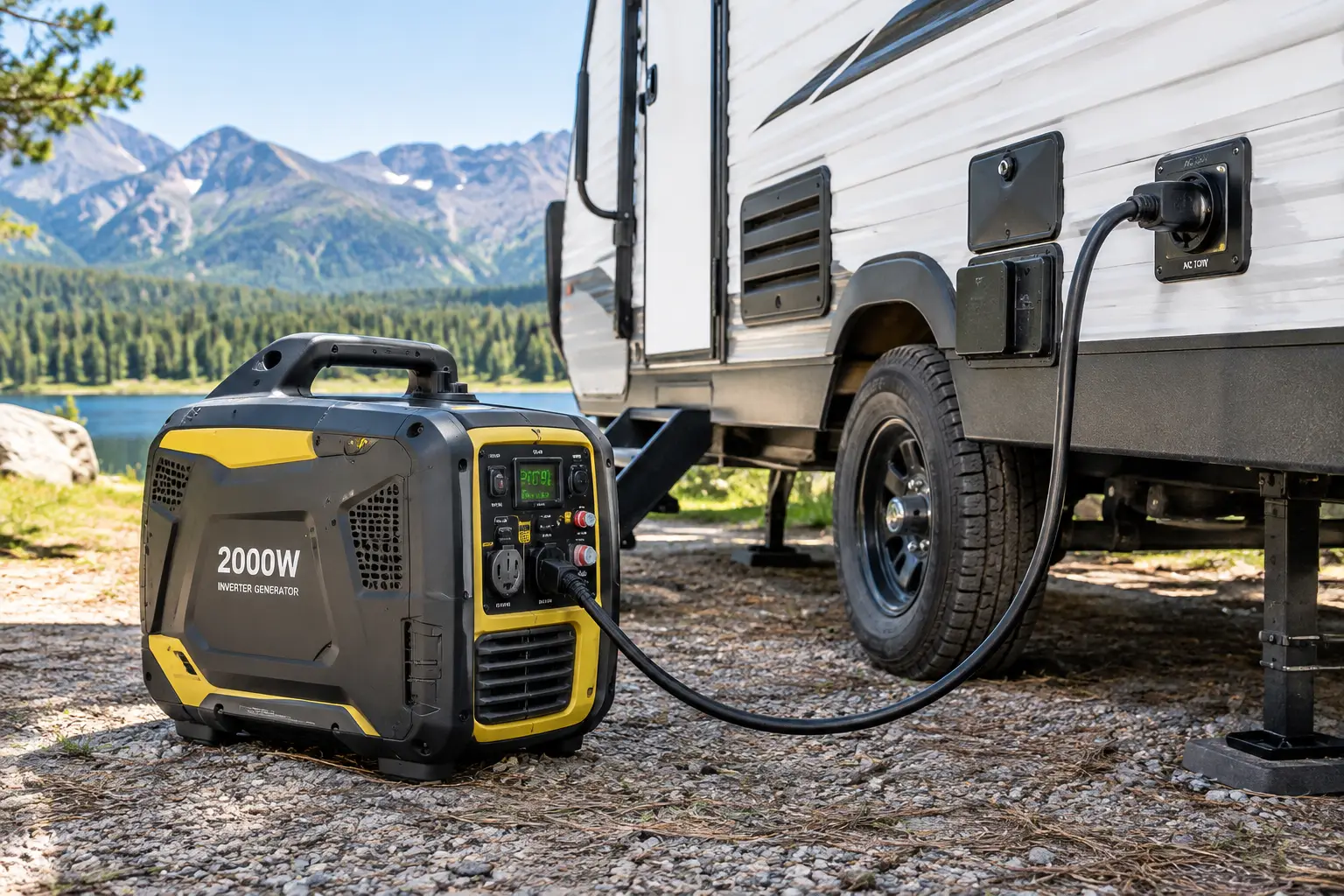
Retailer listings put this one in the low hundreds, with Tractor Supply’s page showing it under $300 and an average of 4.4 stars from 767 reviews. That price tier is the appeal for anyone whose camping trailer with generator needs are a charged battery, a laptop and phone chargers. The unit is rated 1,000 surge and 800 running watts, has one 120-volt outlet plus one 12-volt DC outlet, and includes a parallel port so a second identical unit can double the output.
The limits are in the same listings. One Tractor Supply buyer reports that anything above an 800-watt start makes the unit shut off, and that about 600 watts is all it will run without overloading, which rules out a microwave and any air conditioner. Walmart’s listing notes the unit is not recommended above 3,000 feet of altitude, a real consideration in the mountains. Shoppers searching for a Sportsman 1000i portable generator for camping should treat it as a way to keep a battery alive between hookups. It does not cover a trailer’s full electrical load.
Sportsman GEN1000iSee current price, sizes and reviews on Amazon.
2. Honda EU2200i — quiet power for lights and fridge
Honda’s own spec page lists 2,200 watts at maximum output and 1,800 rated, 47.4 pounds dry weight, a 0.95-gallon tank, and run times of 3.2 hours at rated load and 8.1 hours at a quarter load. The Eco Throttle system lowers engine speed when demand drops, which is where the long overnight run time comes from. At 48 dBA on a light load, the lowest figure of the four, it is the strongest candidate when a quiet campground is the priority.
Its ceiling is the air conditioner. Airstream Life’s warning about typical 2,000-watt units applies here as well, and the standard version has only a 20-amp household outlet. The EU2200i Companion adds a 30-amp receptacle that lets two units run in parallel through a simple cord, per Honda dealer pages, and two units would add up to 4,400 watts of peak output, just above etrailer’s 4,000-watt minimum for a 13,500 BTU unit. Check the current price on Amazon.com. Honda also lists Bluetooth monitoring, CO-Minder carbon monoxide shutoff and a three-year residential warranty.
Honda EU2200iSee current price, sizes and reviews on Amazon.
Fuel flexibility is the reason this unit keeps appearing in trailer forums. Champion lists 3,400 starting and 3,100 running watts on gasoline, 3,060 and 2,790 on propane, with run times of 7.5 hours on gas at 25% load and 14.5 hours on propane. A Lowe’s listing adds the RV-ready 30-amp outlet, two 20-amp household outlets, and a 12-volt outlet with dual USB.
Owner reports are the strongest argument. One camper on a trailer forum says it runs their air conditioner without trouble and that they have used it only on propane, with push-button start a bonus. A Good Sam poster weighing options called the propane option clean and easy to store, apart from the weight. Another owner asked about a quirk: shutting the unit down after switching from gasoline to propane takes several minutes. At 59 dBA it is louder than the Honda or the Westinghouse, which matters in strict campgrounds.
Because it burns propane and gasoline and has an RV outlet, it also doubles as the best in home dual fuel inverter generator for camping, with the same machine handling a power outage at home. Champion’s page also lists an optional parallel kit with a 50-amp outlet for a second unit.
Champion 3400-Watt Dual Fuel InverterSee current price, sizes and reviews on Amazon.
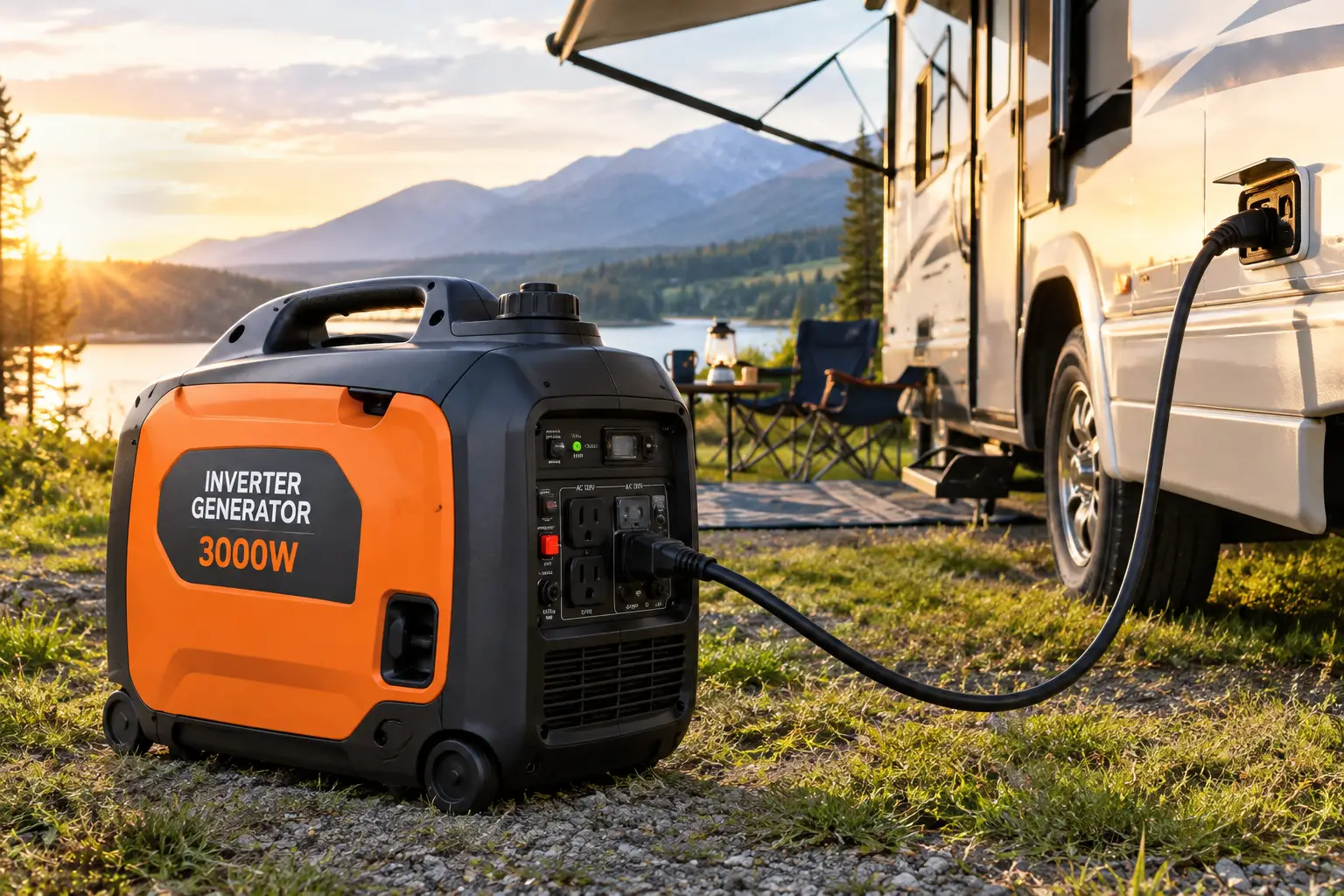
Weight is the first thing to know. Sources disagree on the exact figure, with one review listing about 104 pounds and another about 93, but both agree it ships with wheels and a telescoping handle for exactly that reason. In return, it offers 3,700 running and 4,500 peak watts, a TT-30R outlet, and a 52 dBA rating, with up to 18 hours of run time at 25% load on a 3.4-gallon tank.
The headroom is what a 13,500 or 15,000 BTU air conditioner asks for. At 4,500 peak watts it clears even etrailer’s 4,000-watt starting minimum for a 13,500 BTU unit, and the LED display shows remaining fuel, load and lifetime hours, which helps with planning overnight runs. Start options include electric, remote and recoil, and it can run in parallel with another iGen using Westinghouse’s cord. A dual fuel iGen4500DFc is a separate listing with its own specs, so confirm the exact model number before buying.
Westinghouse iGen4500See current price, sizes and reviews on Amazon.
The failures owners describe repeat. Undersizing against the air conditioner’s starting surge tops the list, and the fix is the nameplate check and soft start covered earlier. Charging through the generator’s 12-volt outlet comes next, and the answer is to let the onboard converter do the work.
Altitude catches people who camp in the mountains, since small engines lose power as the air thins, and the Sportsman listing’s 3,000-foot note is one example of a maker saying so.
Safety carries the most weight. The CPSC’s 2022 report estimates that nearly 80 people die each year from carbon monoxide poisoning caused by portable generators, and its safety alert says to run them outside only, at least 20 feet from doors, windows and vents. A battery-operated CO alarm inside the trailer is the companion step, and a unit with automatic CO shutdown such as Honda’s CO-Minder adds a second layer.
Starting watts, 12V outlets and built-in units: quick answers
Do travel trailers come with a generator?
Almost never. Lazydays and RV forums note that towables lack the fuel tank a built-in unit needs, so most owners add a portable inverter generator, with toy haulers and a few models such as the Northwood Wolf Creek 850 being the exceptions.
What size generator runs a travel trailer air conditioner?
Sources disagree because starting draw varies. One etrailer answer says at least 4,000 watts for a 13,500 BTU unit, while a soft start can bring the need down. Check the air conditioner's nameplate, then size the generator above that starting figure.
Can the generator's 12V outlet charge a trailer battery?
It can, but slowly and without regulation. RV owners on forums say the 12V outlet is the slowest route and can overcharge, so plugging the trailer's shore cord into the generator and letting the onboard converter charge is the usual advice.
What is the quietest generator for camping?
Honda's 2,200-watt inverter lists 48 dBA at quarter load, the lowest figure among the models covered here. Makers rate noise at different loads and distances, so compare like with like and check the campground's own limit; Cummins says most set 60 dB at 50 feet.
Is a 1,000-watt inverter generator enough for a camping trailer?
It covers lights, chargers and a laptop, but not a rooftop air conditioner. One Tractor Supply buyer reports a 1,000-watt unit shutting off above roughly 600 running watts, so keep loads small and use it as a battery topper.
Matching the generator to the trailer
For any camping trailer with generator power, size the machine to the air conditioner’s starting surge, not to the lights, and let the trailer’s converter handle battery charging through the shore cord. For a small trailer that never runs air conditioning, the Honda EU2200i has the quietest listed ratings of the four, and the Sportsman GEN1000i is the budget way to keep a battery alive. For a trailer with a rooftop unit, the Champion 3400-Watt Dual Fuel Inverter and the Westinghouse iGen4500 give the starting power, at the cost of more noise or more weight. Whatever you pick, confirm the campground’s generator hours before you arrive.
See the current options on Amazon.com once your nameplate numbers are in hand.