In This Article
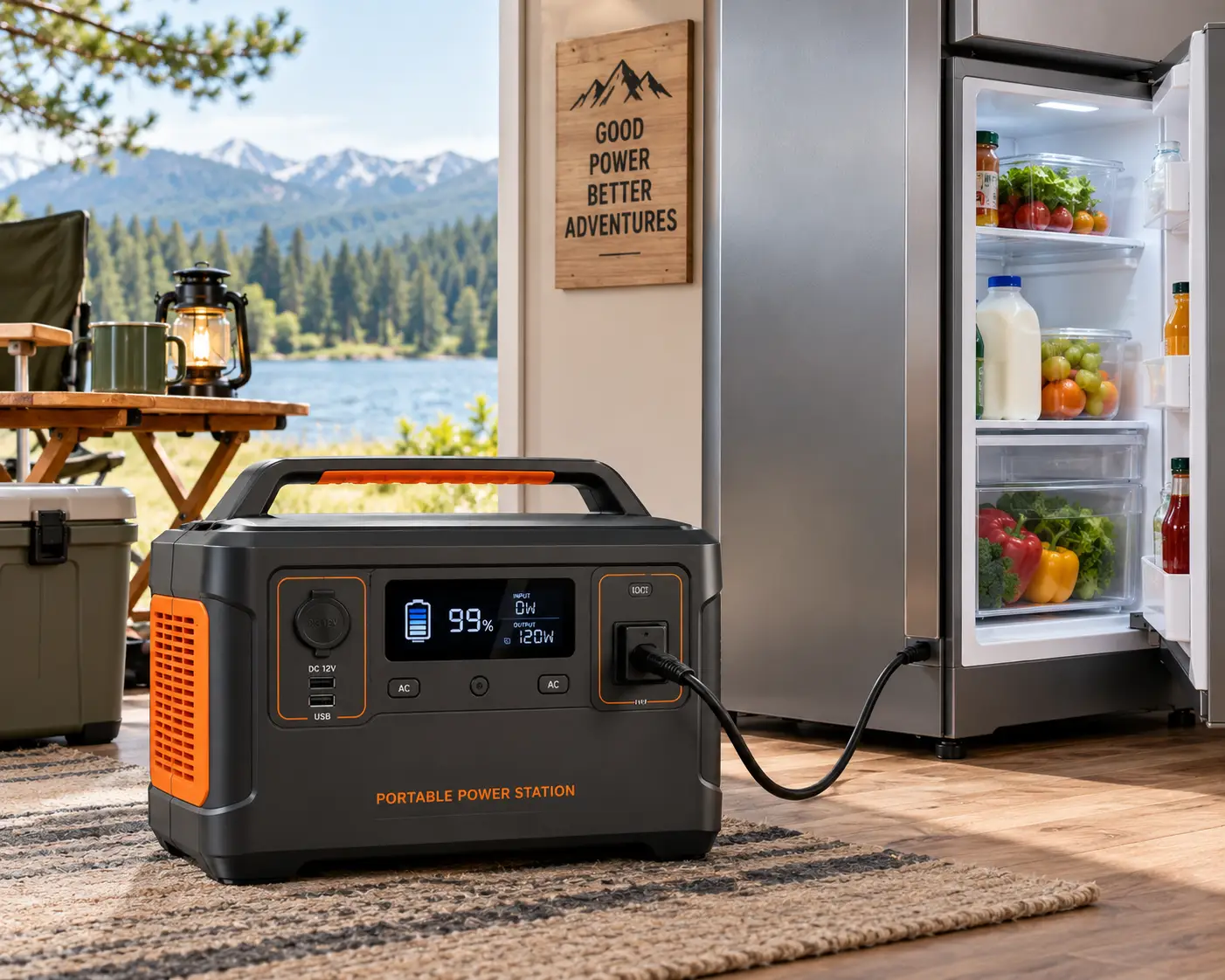
A portable power station for refrigerator backup is one of those purchases you don’t think about until the lights go out and everything in your fridge is suddenly on a countdown clock. Whether you’re bracing for hurricane season, dealing with an aging grid that blinks off every time the wind picks up, or just trying to keep a cooler cold on a long road trip, the right unit can mean the difference between a minor inconvenience and a few hundred dollars of spoiled groceries. A refrigerator only stays safely cold for about four hours once the power cuts out, according to USDA food safety guidance, so having a backup plan matters more than most people realize.
The tricky part is that refrigerators aren’t simple loads. A compressor fridge sips 100-200 watts most of the time, then spikes to several times that the instant the compressor kicks on. Buy a power station that’s undersized for that surge, and it’ll shut off mid-outage — right when you need it most. Buy one that’s oversized, and you’ve overpaid for capacity you’ll never use.
This guide breaks down what actually matters when shopping for a portable power station for refrigerator or freezer backup: real wattage math, seven genuine products spanning entry-level to whole-kitchen capacity, and the practical setup knowledge that most spec sheets leave out. We’ll also cover portable power station for RV refrigerator use, camping fridge scenarios, and how to avoid the common sizing mistakes that leave people stranded. Every price below is shown as a range rather than an exact figure, since portable power station pricing shifts constantly with promotions — always check the current listing before buying.
Quick Comparison: Best Portable Power Stations for Refrigerator Backup
| Model | Capacity | Continuous / Surge Output | Best For |
|---|---|---|---|
| EcoFlow River 2 Pro | 768Wh | 800W / 1,600W | Mini fridges, dorms, short trips |
| Jackery Explorer 1000 v2 | 1,070Wh | 1,500W / 3,000W | Best all-around value |
| Anker SOLIX C1000 | ~1,056Wh | 1,800W (fast recharge) | Fastest recharge speed |
| EcoFlow Delta 2 | 1,024Wh (expandable) | 1,800W / 2,200W X-Boost | Expandable mid-range |
| Bluetti AC180 | 1,152Wh | 1,800W / 2,700W | Best surge headroom |
| Anker SOLIX C2000 Gen 2 | 2,048Wh (expandable) | 2,400W / 4,000W | High-capacity, low idle draw |
| EcoFlow Delta 2 Max | 2,048Wh (expandable) | 2,400W / 3,400W X-Boost | Multi-day, whole-kitchen backup |
Looking at the table, there’s a clear split between the sub-$650 tier — the EcoFlow River 2 Pro, Jackery Explorer 1000 v2, and Anker SOLIX C1000 — which suits a single fridge or mini fridge for a day or two, and the 2,000Wh-plus tier led by the Anker SOLIX C2000 Gen 2 and EcoFlow Delta 2 Max, which can realistically run a full-size refrigerator for two to three days on a single charge. The EcoFlow Delta 2 and Bluetti AC180 sit in between, offering enough headroom for a full-size fridge overnight while staying under $1,000 in most listings. Your choice really comes down to how long you expect outages to last and whether you’re powering one appliance or several.
Ready to stop worrying about the next blackout? Compare these picks side by side and grab the one that matches your fridge’s wattage today.
Top 7 Portable Power Stations for a Refrigerator: Expert Analysis
Below is a closer look at seven real, currently available portable power stations, chosen to cover entry-level budgets, mid-range value, and high-capacity home backup. Specs and pricing were verified against manufacturer and retailer listings as of this writing — check the current price before purchase, since promotions shift often.
1. EcoFlow River 2 Pro — smallest footprint for mini fridges
The EcoFlow River 2 Pro is built for people who need to keep one appliance cold without hauling around a 40-pound brick. Its 768Wh LiFePO4 battery pairs with an 800W continuous output (1,600W surge), which is enough for most mini fridges, dorm refrigerators, and compact 12V compressor coolers used in cars and RVs. The unit recharges from empty to 80% in roughly 70 minutes on AC power — a genuinely useful trait if you only get a short warning before a storm knocks out the grid.
What the spec sheet doesn’t fully convey is how this unit behaves with a full-size kitchen fridge: at 800W continuous, it can technically run one, but the surge margin is thin, and heavier compressors may trip the overload protection. This makes the EcoFlow River 2 Pro a better match for smaller fridges, RV galley units, or as a secondary unit dedicated to keeping insulin, breast milk, or other sensitive items cold rather than an entire kitchen’s worth of food. Reviews consistently report that the recharge speed and compact 17-pound weight are the standout features, while some owners note the extended carrying handle eats up shelf space when stored.
Pros:
- ✅ Recharges to 80% in about 70 minutes
- ✅ Light enough to carry one-handed at 17 lbs
- ✅ Handles most mini fridges and 12V coolers comfortably
Cons:
- ❌ Thin surge margin for full-size kitchen compressors
- ❌ 800W ceiling limits it to one appliance at a time
At a price typically in the $350-$650 range depending on promotions, the EcoFlow River 2 Pro delivers strong value if your refrigerator load is modest — just don’t expect it to carry a full kitchen fridge through a multi-day outage.
2. Jackery Explorer 1000 v2 — best all-around value
The Jackery Explorer 1000 v2 is the unit most reviewers point to first, and for good reason: 1,070Wh of LiFePO4 capacity, a 1,500W continuous rating, and a 3,000W surge ceiling give it real breathing room for a compressor fridge’s startup spike. Based on comparing the specs against its closest competitors, the 3,000W surge figure is unusually generous for this capacity tier, which matters because a standard 18-22 cubic-foot refrigerator can briefly demand 800-1,200 watts at startup even though it only draws 100-150 watts running.
The battery uses LiFePO4 chemistry rated for roughly 4,000 charge cycles, translating to a decade or more of realistic home use, and the unit charges from empty to full in about one hour on AC power — dramatically faster than most first-generation power stations in this range. What most buyers overlook with this model is the built-in UPS function, which switches over automatically during an outage so a fridge on a shared circuit never fully loses power. Reviews consistently mention that it’s noticeably lighter than the original Explorer 1000, and TechRadar’s testing called it one of the more robust units they’ve reviewed in this category, though the trade-off is a slightly smaller battery cushion than the 2,000Wh-plus models further down this list.
Pros:
- ✅ 3,000W surge rating handles compressor startup easily
- ✅ Roughly one-hour full recharge on AC power
- ✅ LiFePO4 cells rated near 4,000 cycles
Cons:
- ❌ 1,070Wh capacity limits multi-day runtime for a full fridge
- ❌ No app-based load monitoring as detailed as some rivals
List price sits around $799, though it’s frequently discounted into the $450-$550 range at major retailers — check the current price, since this model sees some of the deepest and most frequent markdowns in this roundup, making it arguably the best price-to-surge-capacity ratio here.
3. Anker SOLIX C1000 (Gen 2) — fastest recharge speed
If your biggest fear is a short-notice outage, the Anker SOLIX C1000 earns its spot through sheer recharge speed. With roughly 1,056Wh of capacity and an UltraFast charging mode, Anker rates it to hit 100% in about 58 minutes — a meaningful edge when a storm warning gives you an hour, not a day, to prepare. Its 1,800W continuous output covers the vast majority of household refrigerators with room to spare for a few extra devices like lamps or a phone charger.
The practical interpretation here: fast recharge speed matters less for planned outages (where you have days of notice) and more for the rolling brownouts and grid instability that utilities are increasingly warning about. A common theme in aggregated customer feedback is that the unit’s touchscreen display and companion app make it easier to track exactly how much runtime is left on a given load, which takes some of the guesswork out of deciding whether to ration power. On the downside, its physical footprint and roughly 27-pound weight make it less convenient than the EcoFlow River 2 Pro for grab-and-go camping use.
Pros:
- ✅ Roughly 58-minute full recharge in UltraFast mode
- ✅ 1,800W continuous output covers most kitchen fridges
- ✅ App-based load tracking reduces guesswork mid-outage
Cons:
- ❌ Heavier and bulkier than River-class competitors
- ❌ Expandable battery packs add meaningfully to total cost
Typically listed around $999 MSRP but commonly found between $450 and $650 during sales events, the Anker SOLIX C1000 is a smart pick for anyone who values a fast top-off over raw capacity.
4. EcoFlow Delta 2 — best expandable mid-range option
The EcoFlow Delta 2 starts at 1,024Wh but is genuinely expandable — add a smart extra battery and you can push it to 2,048Wh, or stack two for 3,040Wh, all without buying a new base unit. Its 1,800W continuous output stretches to 2,200W with EcoFlow’s X-Boost technology, which intelligently reduces voltage draw on resistive loads so the inverter can support appliances rated slightly above its stated ceiling — useful for running a fridge and a microwave briefly on the same unit.
Here’s what most buyers overlook: expandability is really a hedge against uncertainty. If you’re not sure whether you’ll need to power one fridge or an entire kitchen during a multi-day outage, the EcoFlow Delta 2 lets you start small and scale up later rather than committing to a fixed capacity upfront. Reviews consistently praise the roughly 50-minute charge to 80% and the six USB ports plus four AC outlets, which comfortably support a fridge alongside other essentials. The trade-off is that expansion batteries aren’t cheap, so the “starter” price doesn’t reflect what most buyers end up spending once they add capacity.
Pros:
- ✅ Expandable from 1,024Wh up to 3,040Wh over time
- ✅ X-Boost lets it briefly run loads above 1,800W
- ✅ Fast 50-minute charge to 80% on AC power
Cons:
- ❌ Expansion batteries add significant extra cost
- ❌ Base unit alone is tight for multi-day, full-fridge backup
Base units generally list in the $600-$1,000 range depending on retailer promotions, making the EcoFlow Delta 2 a reasonable middle ground between the entry-level units above and the higher-capacity options below.
5. Bluetti AC180 — best surge headroom for compressor startup
The Bluetti AC180 packs 1,152Wh into a 35-pound frame, with an 1,800W continuous rating and a Power Lifting Mode that pushes surge capacity to 2,700W. That surge figure is the standout here — it’s comfortably above what even a large chest freezer or side-by-side refrigerator typically demands at startup, which means less risk of the unit tripping into overload protection mid-outage.
Based on comparing spec sheets across this list, the AC180’s charging speed is also near the top of its class: 0-80% in about 45 minutes using its 1,440W Turbo Charging mode, and full charge in roughly 1.5 hours. What the spec sheet doesn’t say outright, but user feedback suggests, is that the AC180’s 20-millisecond UPS transfer time is fast enough that most sensitive electronics on the same circuit won’t even blink during a transfer — a detail that matters if you’re also protecting a modem, medical device, or computer alongside the fridge. Its 3,500-cycle LiFePO4 battery and five-year warranty are also strong for this price tier.
Pros:
- ✅ 2,700W surge headroom in Power Lifting Mode
- ✅ 0-80% recharge in about 45 minutes
- ✅ 20ms UPS transfer time protects sensitive electronics
Cons:
- ❌ At 35 lbs, less portable than River- or Explorer-class units
- ❌ No built-in wheels despite the added bulk
MSRP typically lands around $1,199, though real-world listings frequently show it between $700 and $900 — a wide enough swing that it’s worth comparing current prices across a couple of retailers before buying.
6. Anker SOLIX C2000 Gen 2 — high capacity with low idle draw
Stepping up to whole-kitchen territory, the Anker SOLIX C2000 Gen 2 offers 2,048Wh of capacity, a 2,400W continuous rating, and a substantial 4,000W surge ceiling — enough to run a refrigerator alongside a sump pump or window air conditioner if needed. Anker rates it as one of the most efficient units in its class, with idle power draw roughly 37.5% below the category average, meaning less of the stored charge gets wasted just keeping the unit’s electronics awake between uses.
The honest analysis here: idle efficiency sounds like a minor spec, but over a multi-day outage it compounds. A unit that bleeds 15-20W just sitting idle can lose a meaningful chunk of usable capacity over 48-72 hours, so the C2000 Gen 2’s low-draw design translates into real extra runtime for your fridge, not just a marketing number. It also charges to 100% in about 58 minutes and can expand to roughly 4,096Wh with an add-on battery, putting it in range of powering a full refrigerator for well over two days on its own. Reviews highlight the inclusion of a power distribution unit and NEMA 14-50 compatibility as a plus for RV and home-panel setups, though the roughly 40-pound weight makes it a two-hand carry.
Pros:
- ✅ 4,000W surge easily covers a fridge plus other appliances
- ✅ Idle power draw about 37.5% below category average
- ✅ Expandable to roughly 4,096Wh for multi-day outages
Cons:
- ❌ Around 40 lbs makes it a stationary, not grab-and-go, unit
- ❌ Premium price puts it out of reach for casual campers
Listings for the Anker SOLIX C2000 Gen 2 have ranged from around $999 during promotions up to its higher standard price, so it’s worth watching for sales given how frequently this model gets discounted.
7. EcoFlow Delta 2 Max — multi-day, whole-kitchen backup
At the top of this lineup, the EcoFlow Delta 2 Max delivers 2,048Wh out of the box with a 2,400W continuous rating and X-Boost surge support up to 3,400W — comfortably enough for a full-size refrigerator, a freezer, and a handful of smaller devices running simultaneously. Where it separates itself is expandability: adding smart extra batteries takes total capacity up to 6,144Wh, which realistically means running a kitchen refrigerator for several days without recharging at all.
What most buyers overlook with this model is that the math changes favorably at this capacity tier: a typical fridge drawing 100-150W continuously, cycling on and off, might average closer to 50-60W of real consumption per hour once duty cycle is factored in. At that rate, the base 2,048Wh unit alone can realistically stretch to 30-40 hours of fridge-only runtime, and the expanded 6,144Wh configuration pushes that toward multi-day territory even with other devices sharing the load. Aggregated reviews describe it as the go-to pick for homeowners in hurricane- or wildfire-prone regions who want one unit capable of running an entire kitchen rather than just a single appliance, though its roughly 50-pound weight and premium price mean it’s built for stationary home backup rather than portability.
Pros:
- ✅ Expandable up to 6,144Wh for multi-day, whole-kitchen runtime
- ✅ 3,400W X-Boost surge covers a fridge plus other appliances
- ✅ Strong fit for homeowners in outage-prone regions
Cons:
- ❌ Around 50 lbs — not designed for portability
- ❌ Highest up-front cost of the seven picks here
Base pricing generally runs from roughly $1,200 up to around $1,600-plus with expansion batteries, positioning the EcoFlow Delta 2 Max as the serious home-backup choice rather than a casual camping purchase.
Comparing the Full Lineup
| Model | Capacity (Expandable To) | Recharge Speed | Weight | Best For |
|---|---|---|---|---|
| EcoFlow River 2 Pro | 768Wh | ~70 min to 80% | ~17 lbs | Mini fridges, dorms |
| Jackery Explorer 1000 v2 | 1,070Wh | ~1 hour full | ~24 lbs | Best overall value |
| Anker SOLIX C1000 | ~1,056Wh | ~58 min full | ~27 lbs | Fastest recharge |
| EcoFlow Delta 2 | 1,024Wh (up to 3,040Wh) | ~50 min to 80% | ~27 lbs | Expandable mid-range |
| Bluetti AC180 | 1,152Wh | ~45 min to 80% | ~35 lbs | Best surge headroom |
| Anker SOLIX C2000 Gen 2 | 2,048Wh (up to 4,096Wh) | ~58 min full | ~40 lbs | Low idle draw, high output |
| EcoFlow Delta 2 Max | 2,048Wh (up to 6,144Wh) | ~80 min to 80% | ~50 lbs | Whole-kitchen, multi-day |
A pattern emerges when you line these up by weight and capacity: the lighter units in the 700-1,100Wh range trade runtime for portability and price, while everything from the Bluetti AC180 upward trades portability for the surge and capacity headroom a full kitchen setup actually needs. If you’re deciding between the Jackery Explorer 1000 v2 and the EcoFlow Delta 2, the honest answer is that the Jackery wins on surge margin and recharge speed for the price, while the EcoFlow wins if you want the option to scale capacity later without replacing the whole unit.
What Is a Portable Power Station for a Refrigerator?
A portable power station for refrigerator use is a battery-based backup power system — typically built around LiFePO4 (lithium iron phosphate) cells, a pure sine wave inverter, and standard AC outlets — sized to handle both a fridge’s steady running wattage and its brief compressor startup surge without a generator’s noise, fumes, or fuel requirements.
Unlike a gas generator, these units run silently indoors, require no venting, and can recharge from a wall outlet, a car, or solar panels, which makes them a popular choice for both emergency preparedness and off-grid or RV use.
How Many Watts Does a Refrigerator Need? Sizing Your Power Station
Getting the wattage math right is the single most important step in this whole buying process, and it’s the step most people skip. Refrigerators aren’t a steady load — they cycle a compressor motor on and off, and that motor demands far more power for a second or two at startup than it does while running.
- Check the running wattage on the fridge’s data plate. Most full-size refrigerators run at 100-200 watts continuously; compact and mini fridges typically run 60-100 watts.
- Estimate the surge (startup) wattage. Compressor motors can briefly draw 2-3 times their running wattage at startup — so a 150W fridge might momentarily demand 400-800W.
- Add a safety margin of at least 20-30% to the surge figure, since older or larger compressors can spike even higher.
- Match that surge number to the power station’s rated surge output, not just its continuous wattage — this is the number that actually determines whether the unit will handle startup without tripping.
- Calculate expected runtime by dividing the power station’s watt-hour (Wh) capacity by the fridge’s average real-world draw (typically 40-70% of its running wattage once duty cycling is factored in).
- Factor in other essentials — lights, a phone charger, a CPAP machine — that might share the same unit during an outage, and add their combined wattage to your continuous load estimate.
- Round up, not down, when choosing between two capacity tiers — a power station that’s slightly oversized is a minor extra cost; one that’s undersized can leave your food unprotected mid-outage.
| Fridge Type | Typical Running Watts | Typical Surge Watts | Minimum Recommended Surge Rating |
|---|---|---|---|
| Mini/dorm fridge | 60-100W | 150-300W | 800W+ |
| Full-size fridge (18-22 cu ft) | 100-200W | 800-1,200W | 2,000W+ |
| Side-by-side/French door | 150-250W | 1,200-1,800W | 2,700W+ |
Looking at this table, it’s clear why the entry-level units on this list top out around 1,600-3,000W surge — that’s precisely the range most single-fridge households need — while the higher-capacity picks exist for households running larger fridges, freezers, or multiple appliances simultaneously.
✨ Not sure which capacity tier fits your kitchen? ⚡ Match your fridge’s wattage to one of the seven picks above and lock in backup power before the next storm warning hits.
Portable Power Station vs. Traditional Backup Generator
For refrigerator backup specifically, a portable power station and a gas or propane generator solve the same problem in very different ways, and the right choice depends heavily on how you plan to use it.
A fuel generator typically offers far more raw wattage and essentially unlimited runtime as long as fuel is available, which makes it the better fit for whole-home backup during extended, multi-week outages. But it also requires outdoor placement, careful ventilation to avoid carbon monoxide risk, regular fuel storage and rotation, and routine maintenance like oil changes — none of which a battery-based unit needs.
| Factor | Portable Power Station | Gas/Propane Generator |
|---|---|---|
| Noise | Silent | 60-80+ decibels |
| Indoor use | Safe | Never — CO risk |
| Fuel needed | None (recharge via wall/solar) | Gasoline or propane |
| Maintenance | Minimal | Regular (oil, filters, fuel) |
| Typical runtime for a fridge | Hours to days, depending on capacity | Days to weeks, fuel permitting |
The comparison above makes the trade-off clear: a portable power station wins on convenience, safety, and quiet operation for shorter outages, while a generator wins on raw endurance for prolonged, multi-week events. Many households in outage-prone regions end up owning both — a power station for quiet day-to-day reliability and quick indoor use, and a generator as a fallback for the rare extended blackout.
Getting Started: Setting Up Your Power Station for Fridge Backup
Buying the right unit is only half the job — setup determines whether it actually performs when you need it.
Start by fully charging the power station as soon as it arrives, then run a test cycle with your actual refrigerator plugged in during normal grid power, watching how the display reports load and runtime. This lets you catch any surge or overload issues before an actual outage, rather than discovering them in the dark. Next, position the unit somewhere with airflow — most models use internal fans that need clearance on at least two sides to avoid overheating during extended use.
Once you’ve confirmed the fridge runs cleanly, set a recurring reminder to top off the battery every one to three months, since LiFePO4 cells hold their charge well but still benefit from periodic maintenance charging per manufacturer guidance. Finally, label the unit’s power cord and keep it in an easily accessible spot — during an actual outage is not the time to be hunting through a closet for the right cable. A common mistake in the first 30 days of ownership is leaving the unit at a partial charge in storage; most manufacturers recommend keeping it above 50% between uses for long-term battery health.
Real-World Scenarios: Matching a Power Station to Your Situation
The apartment renter with a mini fridge. A college student or apartment dweller running a single compact fridge, a lamp, and a laptop charger during occasional outages doesn’t need more than 800-1,000Wh of capacity. The EcoFlow River 2 Pro covers this use case comfortably, and its light weight makes it easy to store in a closet between uses.
The suburban homeowner preparing for hurricane season. A family running a full-size kitchen fridge plus a few essentials — router, phone chargers, maybe a box fan — through outages that typically last anywhere from a few hours to two days benefits most from something in the 1,000-1,200Wh range with strong surge headroom, like the Jackery Explorer 1000 v2 or Bluetti AC180. Both offer enough buffer to avoid nuisance shutoffs from compressor startup spikes.
The rural homeowner or RV owner facing multi-day grid instability. For households where outages regularly stretch past 48 hours, or RV owners running a full-size fridge off-grid for days at a time, the 2,000Wh-plus tier makes more sense. The Anker SOLIX C2000 Gen 2 or EcoFlow Delta 2 Max — both expandable well beyond their base capacity — provide the runway to keep a fridge and a few other essentials running through an extended outage without daily recharging.
Common Refrigerator Power Problems — and Solutions
Problem: The power station shuts off the moment the compressor kicks on. This almost always means the unit’s surge rating is too close to (or below) the fridge’s actual startup demand. Solution: check the fridge’s data plate for running wattage, multiply by 2.5-3x to estimate surge, and choose a unit — like the Bluetti AC180 or Jackery Explorer 1000 v2 — with surge headroom comfortably above that number.
Problem: The battery drains faster than expected. Beyond the fridge itself, phantom loads from other plugged-in devices, or running the unit’s display and Wi-Fi radio continuously, can quietly eat into capacity. Solution: unplug non-essential devices during an outage and check whether the unit has a low-power or eco mode for its own electronics.
Problem: Runtime estimates on the app don’t match reality. Most apps calculate runtime based on current draw, which fluctuates as a compressor cycles on and off — so the estimate you see right after startup will look far worse than the true average. Solution: judge runtime over a full charge-to-empty cycle rather than trusting the instantaneous number.
Problem: The unit won’t recharge fast enough between outages. If your region sees frequent short outages, a slower-charging unit may never fully top off before the next one hits. Solution: prioritize fast-charging models like the Anker SOLIX C1000 or EcoFlow Delta 2, both of which can reach a substantial charge in under an hour.
Problem: Solar charging isn’t keeping up during extended outages. Cloudy weather or undersized panels can leave a unit under-charged during multi-day events. Solution: pair the power station with a solar panel rated close to its maximum solar input spec, and treat solar as a supplement to AC charging rather than a sole source during critical outages.
Common Mistakes to Avoid When Buying a Power Station for Refrigerator Backup
Buyers most often go wrong by focusing exclusively on watt-hour capacity while ignoring the surge rating — a mistake that leads directly to the shutoff problem described above. It’s worth repeating: continuous wattage tells you how long the unit will run your fridge, but surge wattage tells you whether it’ll survive the compressor turning on in the first place.
A second common misstep is underestimating weight and portability trade-offs — a 50-pound unit like the EcoFlow Delta 2 Max is fantastic for stationary home backup but a poor fit if you’re also hoping to bring it camping. Buyers also frequently skip checking cycle life, which matters more than it seems: a unit rated for 4,000 cycles will meaningfully outlast one rated for 500-800 cycles if you plan to use it regularly rather than as a once-a-year emergency tool. Finally, many shoppers overlook the total cost of expandable systems, buying a base unit assuming they’ll never need to add a battery, only to find their fridge and freezer combined exceed the base capacity within the first real outage.
Long-Term Cost and Maintenance
LiFePO4 batteries, used in every model on this list, are prized specifically because they hold up better over time than older lithium-ion or lead-acid chemistries — most are rated for 3,000 to 4,000-plus cycles to 80% of original capacity, which at roughly one cycle per month of regular use translates to well over a decade of realistic service life.
Total cost of ownership extends beyond the sticker price, though. Expandable systems like the EcoFlow Delta 2 or Anker SOLIX C2000 Gen 2 carry a lower entry price but can end up costing as much as — or more than — a higher-capacity unit once you add extra battery packs. On the maintenance side, LiFePO4 units require far less upkeep than a fuel generator: periodic top-off charging every few months in storage, occasional firmware updates through the companion app, and keeping vents clear of dust are typically the extent of it. There’s no oil to change, no fuel to stabilize, and no carburetor to clean — a meaningful long-term savings for households that would otherwise maintain a generator solely for occasional backup duty.
Safety, Regulations, and Standards for Home Battery Backup
Because these units rely on lithium-ion battery chemistry, safety standards matter more than most buyers realize. Look for UL or ETL certification on any unit you’re considering — this indicates the product has passed independent safety testing for fire and electrical risk, which isn’t guaranteed across every brand selling similar-looking power stations online. The Consumer Product Safety Commission has issued warnings about uncertified power stations whose internal lithium-ion batteries posed fire and explosion risks, underscoring why buying from established, safety-certified brands is worth the extra scrutiny rather than chasing the cheapest listing.
All seven products in this guide use pure sine wave inverters, which produce a clean, grid-quality AC waveform — a meaningful distinction from the choppier output of a modified sine wave inverter, since refrigerator compressors and other motor-driven appliances run more efficiently and with less long-term wear on true sine wave power. Beyond the unit itself, basic lithium battery safety practices apply: keep the unit out of direct sunlight and extreme heat, avoid charging it on soft or flammable surfaces, and stop using it immediately if you notice swelling, unusual odors, or excessive heat during charging.
Portable Power Station for RV and Camping Refrigerators
RV owners and campers face a slightly different sizing problem than homeowners, since many RV and camping refrigerators run on 12V DC power directly rather than pulling AC through an inverter — and running a fridge on DC output, when available, is typically more efficient than converting to AC and back again. For this use case, a compact unit like the EcoFlow River 2 Pro or Jackery Explorer 1000 v2 tends to be the sweet spot: light enough to move between the RV and a campsite, with enough capacity to run a compressor-style camping fridge for a day or two between recharges via solar panel or vehicle charging.
For larger RVs or extended off-grid stays, the 2,000Wh-plus units — the Anker SOLIX C2000 Gen 2 and EcoFlow Delta 2 Max — make more sense, particularly since both offer NEMA-compatible outlets that simplify wiring into an RV’s existing power distribution. Whichever tier you land on, prioritize solar input compatibility if extended off-grid time is part of the plan, since AC recharging obviously isn’t available away from shore power or a generator.
Frequently Asked Questions
❓ How many watts do I need to run a refrigerator on a portable power station?
❓ How long will a portable power station run a refrigerator?
❓ Can I run a refrigerator and freezer on the same power station?
❓ Is a portable power station safer than a generator for refrigerator backup?
❓ Do I need solar panels to use a portable power station for refrigerator backup?
Conclusion
Choosing the right portable power station for refrigerator backup really comes down to two numbers: your fridge’s surge wattage and how long you realistically expect an outage to last. Get those two figures right, and any of the seven models covered here — from the compact EcoFlow River 2 Pro to the whole-kitchen-capable EcoFlow Delta 2 Max — will keep your food safely cold when the grid lets you down.
For most single-fridge households, the Jackery Explorer 1000 v2 offers the strongest overall balance of surge headroom, recharge speed, and price. If fast recharging is your top priority, the Anker SOLIX C1000 stands out, while households bracing for multi-day outages or running more than one appliance should look toward the Anker SOLIX C2000 Gen 2 or EcoFlow Delta 2 Max. Whichever tier fits your situation, remember that price ranges shift constantly — always check the current listing before buying, and resist the urge to undersize your surge rating just to save a little upfront. A slightly larger power station is a minor extra cost; a fridge full of spoiled food is not.
✨ Don’t miss these exclusive deals! 🔍 Take your refrigerator backup plan to the next level with this carefully curated lineup. Click a highlighted item to check current pricing and availability. These picks will help you get reliable, quiet power the whole family can count on!
Recommended for You
- Backpacking Solar Charger: 7 Proven Picks for 2026
- Are Solar Batteries Worth It? 7 Reasons You Should Know
- Solar Panels 300 Watt: 7 Best Picks for 2026 (Ranked)
Disclaimer: This post contains affiliate links. As an Amazon Associate, I earn from qualifying purchases made through these links, at no additional cost to you.
✨ Found this article helpful? Share it with someone who needs it! 💬🤗