
In This Article
If you’ve ever watched a portable power station light up a coffee maker with zero fumes, zero noise, and zero gas cans, you’ve probably wondered how does a solar generator work well enough to pull that off. The short answer: sunlight becomes DC electricity in a panel, that electricity gets converted and stored in a lithium battery, and an inverter flips it back into the AC power your outlets expect. The longer answer — the one that actually helps you buy the right unit — involves charge controllers, battery chemistry, and a few real-world quirks that spec sheets tend to gloss over.
This guide breaks down exactly how a solar generator works, then walks through seven real units currently sold in the US, from budget-friendly camping companions to whole-home backup systems. You’ll get honest analysis grounded in published specs and aggregated owner feedback — not marketing copy — so you can match a unit to your actual power needs instead of guessing. We’ll also cover buying mistakes, safety standards, and realistic cost-of-ownership numbers, because a solar generator is a bigger purchase than most people research properly before checking out.
Whether you’re prepping for hurricane season, outfitting a van, or just tired of your neighbor’s gas generator drowning out your weekend, understanding how a portable solar generator works will save you from buying too much — or, more commonly, too little — capacity.
What Is a Solar Generator, Exactly?
A solar generator is a portable battery system — typically built around a lithium iron phosphate (LiFePO4) cell — paired with a charge controller and an inverter, designed to store energy from solar panels (or a wall outlet) and deliver it back out as usable AC or DC power. Unlike a gas generator, it has no engine, no fuel, and no combustion, which is why it’s safe to run indoors.
Solar Generators at a Glance: Quick Comparison
| Model | Capacity | Rated Output | Recharge Speed | Best For |
|---|---|---|---|---|
| Jackery Explorer 300 | ~293Wh | 300W | Slow (AC ~5-6 hrs) | Entry-level camping |
| Anker SOLIX C300 | ~288Wh | 300W | Fast (AC ~1 hr) | Lightweight travel |
| BLUETTI AC180P | ~1,152Wh | 1,800W | Moderate (AC ~1-2 hrs) | Budget home backup |
| Jackery Explorer 1000 v2 | ~1,070Wh | 1,500W | Very fast (AC ~1-1.7 hrs) | All-around mid-range |
| EcoFlow Delta 2 | ~1,024Wh | 1,800W (2,700W X-Boost) | Very fast (AC ~50 min to 80%) | Expandable combo kit |
| BLUETTI Elite 200 V2 | ~2,073Wh | ~2,200W | Moderate | Large-capacity all-rounder |
| Anker SOLIX F3800 | ~3,840Wh (expandable) | Up to 6,000W (120V/240V) | Fast, dual AC input | Whole-home backup |
Looking at the table, capacity and output scale together but not in lockstep — the BLUETTI AC180P, for instance, punches above its capacity class with an 1,800W inverter, which matters more than raw watt-hours if you’re running power tools rather than just charging phones. Recharge speed is the sleeper spec most buyers ignore: the Jackery Explorer 1000 v2 and EcoFlow Delta 2 can go from empty to nearly full during a single lunch break, while the Jackery Explorer 300 takes most of a workday on a wall outlet. If whole-home backup is the goal, only the Anker SOLIX F3800 in this lineup offers the 240V split-phase output needed for a well pump or central AC.
💬 Bookmark this table — you’ll want to scroll back to it once you’ve read the honest breakdown of all seven units below.
The 7 Best Solar Generators for 2026: Honest, Spec-Backed Picks
Every pick below is a real, currently available model — no invented products, no fabricated hands-on testing. Where we reference customer sentiment, it’s aggregated from published reviews, clearly labeled as such.
1. Jackery Explorer 300 — lightest true entry point
The Jackery Explorer 300 is the unit to start with if you’ve never owned a power station and don’t want to overspend on capacity you won’t use. Its roughly 293Wh lithium battery and 300W pure sine wave inverter won’t run a fridge, but that’s not the point — it’s built to keep phones, a CPAP, a small cooler, or a laptop alive for a weekend.
What the spec sheet doesn’t say is how much the compact form factor matters in practice: at under 8 pounds, it’s genuinely a grab-and-go unit rather than something you begrudgingly haul out of the trunk. Pure sine wave output means it’s safe for sensitive electronics like CPAP machines and laptops, which cheaper modified-sine-wave units can’t guarantee. Based on comparing this to pricier siblings in Jackery’s own lineup, the trade-off is obvious: you’re paying for portability and simplicity, not headroom.
Reviews consistently report that this size class is best treated as a “first solar generator” rather than a primary backup source — owners who try to run a mini-fridge on it report it draining within a few hours, which tracks with the math on a 293Wh battery.
Pros:
- ✅ Compact and light enough for daily carry
- ✅ Pure sine wave output is CPAP- and laptop-safe
- ✅ Simple, beginner-friendly single-button interface
Cons:
- ❌ Too small for appliances like fridges or space heaters
- ❌ Slow to recharge without a dedicated solar panel
Priced in the $190-$250 range depending on bundle, it’s a genuinely good value for what it’s designed to do — just don’t expect it to double as home backup.
2. Anker SOLIX C300 — best for weight-conscious travelers
The Anker SOLIX C300 is Anker’s answer to the “I don’t want to pack a brick” crowd, and its standout feature is a retractable AC plug built into the unit itself — no separate charging cable to lose in a glovebox. At roughly 288Wh and 300W output, it sits in the same capacity tier as the Jackery Explorer 300, but the recharge story is different.
Here’s what most buyers overlook: Anker’s SOLIX line generally prioritizes fast AC charging, and the C300 can top off from a wall outlet in about an hour rather than the five-to-six hours some entry-level competitors need. For road-trippers and campers who charge overnight at a rest stop or campground hookup, that’s a meaningfully different experience than waiting half a day. On paper, this means less planning around charging windows.
Aggregated customer feedback on Anker’s compact power stations tends to praise the built-in plug and app connectivity, while some owners note the trade-off of a smaller screen and less detailed diagnostics than pricier Anker models.
Pros:
- ✅ Built-in retractable AC plug — no cable to pack
- ✅ Fast wall-outlet recharge for its size class
- ✅ Anker’s mobile app for remote monitoring
Cons:
- ❌ Limited output for anything beyond electronics
- ❌ Smaller battery buffer than 1,000Wh-class units
Expect a price in the $200-$280 range, positioning it as a direct, slightly more convenience-focused alternative to the Jackery Explorer 300.
3. BLUETTI AC180P — best value for budget home backup
Once you cross into the 1,000Wh-plus tier, the calculus changes — you’re no longer just charging devices, you’re keeping a fridge or a CPAP plus lighting running through an overnight outage. The BLUETTI AC180P, with roughly 1,152Wh of LiFePO4 capacity and an 1,800W inverter, is the model repeatedly cited as the budget entry point into that tier.
The 1,800W rating matters because it clears the threshold for most household appliances short of central air or an electric water heater — think microwaves, coffee makers, and space heaters on low settings. What the spec sheet doesn’t say is how LiFePO4 chemistry changes the ownership math: unlike the lithium-ion cells in some older or cheaper units, LiFePO4 batteries typically hold up over thousands of charge cycles, which is the difference between replacing your power station in three years versus running it for a decade.
Reviews consistently report that the AC180P’s charging speed is faster than its price class suggests, with several outlets noting it recharges via wall outlet in one to two hours — quick enough to top off between outages.
Pros:
- ✅ Strong watt-hour-per-dollar value in its class
- ✅ 1,800W output covers most household appliances
- ✅ Long-cycle-life LiFePO4 battery chemistry
Cons:
- ❌ No included solar panel in the base bundle
- ❌ Heavier than smaller units, less ideal for backpacking
At around $699, the BLUETTI AC180P is frequently the unit budget-focused reviewers point first-time home-backup buyers toward, and the value case holds up under scrutiny.
4. Jackery Explorer 1000 v2 — best for fast, everyday all-around use
The Jackery Explorer 1000 v2 is a full redesign of Jackery’s most popular mid-size unit, and the headline change is charging speed: a roughly 1,070Wh LiFePO4 battery that can hit a full charge from a wall outlet in as little as one hour using the app-controlled fast-charge mode (1.7 hours in the standard, battery-friendlier mode).
What that 1,500W continuous / 3,000W surge inverter means in practice is that you can run a coffee maker, a space heater, or most power tools without the strategic load-juggling smaller units demand. Based on comparing this to the original Explorer 1000, the output jumped 50% while the footprint stayed essentially unchanged — genuine generational improvement rather than a repackaging. Paired with Jackery’s SolarSaga panels, solar recharge lands around 3.5-4 hours in good sun with 400W of panel input.
Aggregated reviews frequently highlight the one-hour fast-charge feature as the standout differentiator versus BLUETTI and EcoFlow competitors at a similar capacity, though several note that emergency fast-charge mode isn’t recommended for daily use since it stresses the battery more than the standard mode.
Pros:
- ✅ Class-leading fast charge (as little as 1 hour via AC)
- ✅ 1,500W continuous output handles most appliances
- ✅ UL-certified with a ChargeShield safety system
Cons:
- ❌ Battery isn’t expandable like some EcoFlow rivals
- ❌ Fast-charge mode isn’t ideal for everyday use
Priced around $700-$800 as a standalone unit (more as the full Solar Generator 1000 v2 bundle with a panel), it earns its reputation as the best “just works” all-rounder in the mid-range tier.
5. EcoFlow Delta 2 — best expandable combo kit
The EcoFlow Delta 2 solves a specific problem: buyer’s remorse when your power needs outgrow your battery. With a roughly 1,024Wh base capacity that can expand to 2,048Wh or more with an add-on battery module, it’s built to grow with you rather than force a full repurchase later.
The 1,800W continuous output (2,700W in X-Boost mode, which sacrifices some efficiency to briefly power higher-draw appliances) covers the same appliance range as the BLUETTI AC180P, but EcoFlow’s X-Stream charging technology is the real differentiator — the company advertises roughly 80% charge in around 50 minutes on wall power, among the fastest in this capacity class. What most buyers overlook is that fast AC charging and fast solar charging aren’t the same spec; paired with EcoFlow’s 220W bifacial panel, solar recharge in good sun runs closer to 3-5 hours, since panel wattage — not the inverter — is the bottleneck outdoors.
Reviews consistently describe the companion app as one of the more polished in the category, with granular control over charge speed and battery health settings, though some owners note the plastic housing feels less rugged than BLUETTI’s competing designs.
Pros:
- ✅ Expandable capacity avoids a full repurchase later
- ✅ Very fast AC recharge (~50 minutes to 80%)
- ✅ Well-reviewed app with granular charge controls
Cons:
- ❌ Expansion batteries add significant extra cost
- ❌ Housing feels less rugged than some rivals
In the $700-$900 range for the base unit (more with panels or expansion batteries), it’s the strongest pick for buyers who aren’t sure yet how big their power needs will eventually get.
6. BLUETTI Elite 200 V2 — best large-capacity all-rounder
Once you need to run a full-size fridge alongside lighting and electronics for more than a day, the BLUETTI Elite 200 V2 is the unit repeatedly named a top overall pick in independent 2026 testing roundups. Its roughly 2,073Wh capacity hits what several reviewers call the sweet spot for the “vast majority of users” — enough headroom for multi-day outages without the bulk of a whole-home system.
What sets it apart on paper is the size-to-capacity ratio: reviewers describe it as barely larger than a shoebox despite the 2,000Wh-plus capacity, which matters enormously if you’re storing it in a closet rather than a garage. Here’s what that means in practice — you get roughly double the Jackery Explorer 1000 v2’s capacity without doubling the footprint, a genuine engineering win rather than a marketing claim.
Aggregated testing coverage places the Elite 200 V2 ahead of the outgoing Jackery Explorer 2000 Plus on portability while remaining competitive on raw capacity, with reviewers specifically praising the combination of capacity, portability, and design polish.
Pros:
- ✅ Best-in-class capacity-to-size ratio in its tier
- ✅ Enough capacity for multi-day, multi-device backup
- ✅ Praised design and build quality in independent testing
Cons:
- ❌ Higher upfront cost than 1,000Wh-class units
- ❌ Still needs a large panel array for fast solar recharge
Expect pricing in the $1,300-$1,700 range, positioning it as the serious step-up choice once a single mid-range unit starts feeling undersized.
7. Anker SOLIX F3800 — best for whole-home backup
At the top of this lineup sits the Anker SOLIX F3800, built for buyers who want a power station to genuinely replace — not just supplement — a portion of their home’s electrical panel during an outage. Its expandable battery architecture starts around 3,840Wh and can scale into double digits of kWh with add-on packs, paired with up to 6,000W of output including 120V/240V split-phase capability.
That 240V split-phase spec is the detail that separates this unit from everything else on this list: it’s what lets the F3800 power a well pump, a central AC compressor, or an electric range circuit — loads that 120V-only power stations simply can’t touch. Based on comparing the spec sheet to smaller units here, dual AC input also means faster full-system recharge when you’re topping off from the grid ahead of a forecasted storm rather than relying on solar alone.
Reviews of whole-home-class units like this one consistently note that the buying decision isn’t really about the F3800 itself — it’s about matching your home’s actual circuit needs to the right capacity tier, since overbuying at this price point wastes real money.
Pros:
- ✅ True 240V split-phase output for major appliances
- ✅ Massively expandable capacity for extended outages
- ✅ Dual AC input speeds up full recharge
Cons:
- ❌ Premium price reflects its whole-home ambitions
- ❌ Overkill for casual camping or short trips
Pricing runs roughly $3,300-$4,100 depending on battery configuration, squarely positioning the Anker SOLIX F3800 as an investment in resilience rather than an impulse buy.
✨ Ready to compare specs side-by-side while you shop? Click through on any highlighted pick above to check current availability and pricing.
How Does a Solar Generator Actually Work? Breaking Down Every Component
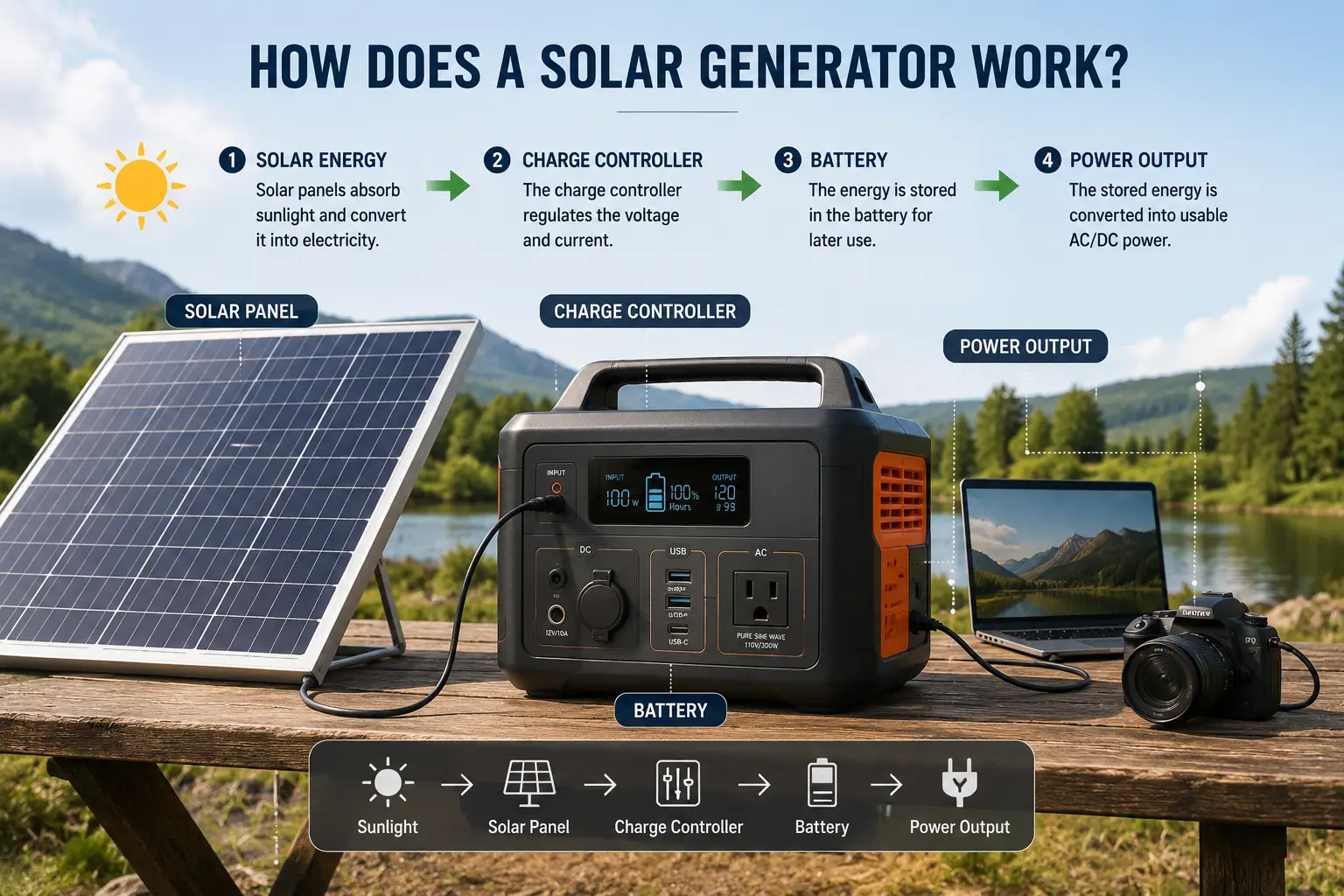
This is the question behind the search, so let’s answer it properly. A solar generator’s job is to move energy through four stages: capture, control, storage, and conversion. Understanding each stage is what actually helps you evaluate specs instead of just trusting a marketing headline.
1. Solar panels capture sunlight as DC electricity. Photovoltaic (PV) cells absorb photons and knock electrons loose, creating a flow of direct current. A panel rated at 200W only hits that number under lab-perfect conditions (full sun, no shading, cool temperatures); real-world output typically runs 80-90% of the rated figure, which is why “how long to charge” estimates are always ranges, not fixed numbers.
2. An MPPT charge controller optimizes that power. Nearly every modern solar generator uses Maximum Power Point Tracking (MPPT) rather than the older, less efficient PWM technology. MPPT continuously adjusts voltage and current to squeeze the most usable power out of the panels as sunlight conditions shift throughout the day — typically 20-30% more efficient than PWM, according to the manufacturers surveyed above.
3. The battery stores that energy chemically. Most 2026-era units use LiFePO4 (lithium iron phosphate) cells rather than older lithium-ion or lead-acid chemistries. LiFePO4 batteries generally last 3,000-4,000+ charge cycles before falling to 70-80% of original capacity, run cooler, and are considered more thermally stable — a real safety consideration given that lithium battery fires are a documented category of consumer product hazard the Consumer Product Safety Commission actively monitors.
4. An inverter converts stored DC power back into usable AC power. Your wall outlets and most home appliances run on alternating current, so the battery’s stored DC power has to be converted before it can power anything beyond a USB or 12V port. Pure sine wave inverters — standard on nearly every reputable brand now — produce clean power safe for sensitive electronics like CPAP machines, unlike the “dirty” output of cheaper modified sine wave inverters.
5. A battery management system (BMS) protects the whole loop. The BMS monitors temperature, voltage, and current in real time, preventing overcharge, overdischarge, and short circuits — it’s the unglamorous component doing the most work to keep the unit safe over years of use.
Put together, that’s the full answer to how do solar generators work: sunlight in, MPPT-optimized DC through a charge controller, chemical storage in a lithium battery, and clean AC power out through an inverter — with a battery management system quietly supervising every step. The Department of Energy’s overview of solar technology covers the panel-side physics in more depth if you want the full photovoltaic explanation.
Real-World Scenarios: Matching the Right Solar Generator to Your Life
Specs only mean something once they’re mapped to how you’ll actually use the unit. Here are three common buyer profiles.
The weekend camper on a budget. If you’re mostly charging phones, running a headlamp, and occasionally powering a small cooler for two-night trips, a sub-$300 unit like the Jackery Explorer 300 or Anker SOLIX C300 covers it. You don’t need — and shouldn’t pay for — 1,000Wh-plus capacity you’ll rarely touch.
The suburban homeowner prepping for outages. If your priority is keeping a fridge, a CPAP, WiFi, and a few lights running through a 12-24 hour outage, the 1,000-2,000Wh tier is the sweet spot. The BLUETTI AC180P or Jackery Explorer 1000 v2 handle this comfortably, and the BLUETTI Elite 200 V2 adds a buffer for multi-day events.
The full-time van-lifer or rural homeowner facing multi-day grid loss. If you’re running a fridge, well pump, and possibly power tools indefinitely off-grid, only the largest, most expandable systems make sense. The EcoFlow Delta 2 (with expansion batteries) or the Anker SOLIX F3800 are built for exactly this — sized for daily, sustained use rather than occasional backup.
How to Choose a Solar Generator: 7 Criteria That Actually Matter
- Total watt-hours (Wh) needed per day. Add up the wattage of everything you need to run, multiply by hours of use, and match that to a unit’s capacity — with margin, since real-world efficiency losses average 10-20%.
- Continuous vs. surge wattage. Continuous output is what the unit sustains; surge is a brief spike for appliance startup. Undersizing continuous wattage is the single most common buying mistake.
- Battery chemistry. LiFePO4 outlasts older lithium-ion cells by a wide margin in cycle life — worth the modest weight penalty for anyone planning to use the unit regularly rather than as a once-a-decade emergency box.
- Solar input wattage and charging speed. A bigger battery paired with a small solar input wattage still charges slowly — check the maximum solar watts a unit accepts, not just its battery size.
- Expandability. If your needs might grow, an expandable system like the EcoFlow Delta 2 or Anker SOLIX F3800 avoids a full repurchase later.
- Portability vs. permanence. A 5-pound unit and a 100-pound whole-home system solve different problems; buying too much bulk for casual use is as common a mistake as buying too little capacity.
- Certifications. UL listing and documented compliance with relevant battery safety standards should be non-negotiable, especially for anything you’ll run indoors.
Solar Generator vs. Traditional Generator: Which Wins for Your Situation?
A solar generator vs traditional generator comparison usually comes down to three factors: noise, fuel logistics, and indoor safety. Gas generators produce more sustained power per dollar of upfront cost and can run indefinitely as long as fuel is available — a real advantage for extended, high-draw off-grid use. But they’re loud (typically 60-80 decibels at load), require stored fuel that degrades over time and poses its own hazards, and produce carbon monoxide that makes them unsafe to run indoors or even in an attached garage.
Solar generators trade some raw runtime capacity for silence, zero emissions, and indoor safety — plus no ongoing fuel cost once the panels are paid off, since sunlight is free. For most residential backup scenarios (versus, say, running a construction site), that trade-off increasingly favors solar as battery capacity and solar-input speeds have improved through 2026. The practical middle ground many preparedness-focused households land on: a mid-size solar generator for daily-use quiet backup, with a gas or dual-fuel unit as a secondary option for extended, high-draw emergencies.
Common Mistakes to Avoid When Buying (and Using) a Solar Generator
Even careful shoppers tend to trip over the same handful of errors:
- Buying capacity based on price alone, without adding up actual wattage needs first — leading to either overspending or an undersized unit that can’t run what you bought it for.
- Ignoring continuous wattage and only checking watt-hours, then being surprised the unit can’t start a fridge compressor or power tool.
- Assuming any solar panel works with any generator — voltage and connector compatibility varies by brand, and mismatched panels can undercharge or fail to charge at all.
- Storing the battery fully depleted or fully charged long-term, which accelerates degradation in most lithium chemistries; most manufacturers recommend storing around 50-80% charge.
- Skipping the fine print on solar input wattage, then being disappointed when “sunny day” charging takes twice as long as expected because the included panel is undersized for the battery.
Common Solar Generator Problems and How to Fix Them
Problem: The unit won’t fully charge from solar panels. Check panel angle and shading first — even partial shade on one cell can disproportionately cut output. Confirm your panel wattage roughly matches or exceeds the unit’s rated solar input; an undersized panel will always underperform regardless of sun conditions.
Problem: Runtime is shorter than expected. Compare your actual connected load’s wattage against the manufacturer’s runtime chart, which is usually calculated for lighter loads than most buyers assume. Battery degradation after 2-3 years of heavy cycling is also normal and expected, not necessarily a defect.
Problem: The battery won’t hold a charge in storage. This is almost always a storage-charge-level issue — units left at 0% or 100% for months degrade faster. Set a phone reminder to check the charge level every 1-3 months during long storage periods.
Problem: The inverter shuts off under load. Most units have built-in overload protection that trips when you exceed rated continuous wattage, even briefly. This is the BMS doing its job, not a malfunction — reduce the connected load and restart.
Problem: Solar recharging is inconsistent throughout the day. This is expected behavior, not a fault — output naturally varies with sun angle, cloud cover, and panel temperature, and MPPT controllers are specifically designed to adapt to those swings rather than eliminate them.
Safety, Certifications, and Regulations You Should Know
Because these units store meaningful amounts of energy in lithium batteries, safety credentials matter more than most buyers realize. Look for UL certification (or UL-recognized component testing), which indicates third-party verification against established electrical safety standards. The CPSC actively tracks lithium battery incidents in consumer products, and has issued real recalls and warnings for defective power stations sold online — a reminder that not every product listed for sale has been properly vetted, and buying from established, certified brands genuinely reduces risk.
FCC compliance covers electromagnetic interference for any unit with wireless or app connectivity, and ENERGY STAR ratings, while less common for portable power stations specifically, are worth checking on any bundled inverter components. If you’re considering a permanently wired whole-home setup rather than a portable unit, local electrical code and utility interconnection rules also come into play — that’s a licensed-electrician conversation, not a DIY one.
Long-Term Cost and Maintenance: Is a Solar Generator Worth It?
The upfront price is only part of the ownership equation. A LiFePO4-based unit rated for 3,000-4,000 cycles, used a few times a month, can realistically last 8-10+ years before capacity degrades meaningfully — which changes the cost-per-year math considerably compared to a cheaper lithium-ion unit rated for only 500-1,000 cycles. Maintenance itself is minimal: keep vents unobstructed, avoid extreme heat storage, and cycle the battery periodically rather than leaving it untouched for years.
Compared to a gas generator’s recurring fuel, oil changes, and engine maintenance, a solar generator’s total cost of ownership tends to level out or even undercut gas over a long enough horizon — especially once you factor in fuel price volatility. The trade-off is a higher upfront cost and a capacity ceiling that gas generators don’t share, so the “worth it” answer genuinely depends on how you weigh convenience and safety against raw sustained output.
Frequently Asked Questions
❓ How does a solar generator work without direct sunlight?
❓ How long does it take to charge a solar generator?
❓ Can a solar generator run a refrigerator?
❓ Are solar generators safe to use indoors?
❓ How long do solar generator batteries last?
Conclusion
At its core, a solar generator works by moving energy through four honest, well-understood stages: panels capture sunlight as DC power, an MPPT controller optimizes it, a lithium battery stores it, and an inverter converts it back into the AC power your devices actually need — all supervised by a battery management system quietly preventing overcharge and overheating along the way. Once you understand that pipeline, evaluating any specific unit gets a lot easier, because you’re checking real functional specs instead of trusting a marketing headline.
Of the seven units covered here, there’s no single universal winner — the right pick depends entirely on your actual use case. The Jackery Explorer 300 and Anker SOLIX C300 suit casual campers who just need devices charged. The BLUETTI AC180P and Jackery Explorer 1000 v2 cover the sweet spot for everyday home-backup buyers. The EcoFlow Delta 2 rewards buyers who want room to grow, the BLUETTI Elite 200 V2 suits anyone expecting multi-day outages, and the Anker SOLIX F3800 is the serious answer for whole-home resilience. Match the capacity and output to your real wattage needs first, prioritize LiFePO4 chemistry and UL certification, and you’ll end up with a unit that earns its keep for a decade rather than gathering dust after one disappointing outage.
Recommended for You
- Battery for CPAP Machine: 7 Best Backup Picks for 2026
- Generator for 30 Amp Camper: 7 Best Options for Reliable RV Power
- 7 Best 8kW Solar System Kits and Inverters (2026)
Disclaimer: This post contains affiliate links. As an Amazon Associate, I earn from qualifying purchases made through these links, at no additional cost to you.
✨ Found this article helpful? Share it with someone who needs it! 💬🤗
