
In This Article
An 8kW solar system sits right in the sweet spot for a huge share of U.S. homes — large enough to offset most or all of a typical household’s electricity use, but not so large that it requires the kind of commercial-scale planning a 15kW-plus system demands. If your utility bills run in the range of 800 to 1,200 kWh a month, an 8kW system is very likely the number your solar consultant lands on, whether you’re going grid-tied, hybrid, or fully off-grid.
The category splits into two fundamentally different approaches. Grid-tie systems connect to the utility grid and use net metering to offset your bill, typically without batteries, making them the more affordable and faster-payback option for most homeowners. Off-grid and hybrid systems add battery storage and a more sophisticated inverter, giving you backup power during outages or full independence from the grid entirely, at a meaningfully higher upfront cost.
An 8kW system typically requires around 460 square feet of panel space and, under good sun conditions, can produce roughly 500 to 1,400 kWh per month. Below, we break down what actually goes into an 8kW solar system, then walk through 7 real, currently available options — from budget DIY grid-tie kits to complete off-grid systems with battery backup.
What Is an 8kW Solar System?
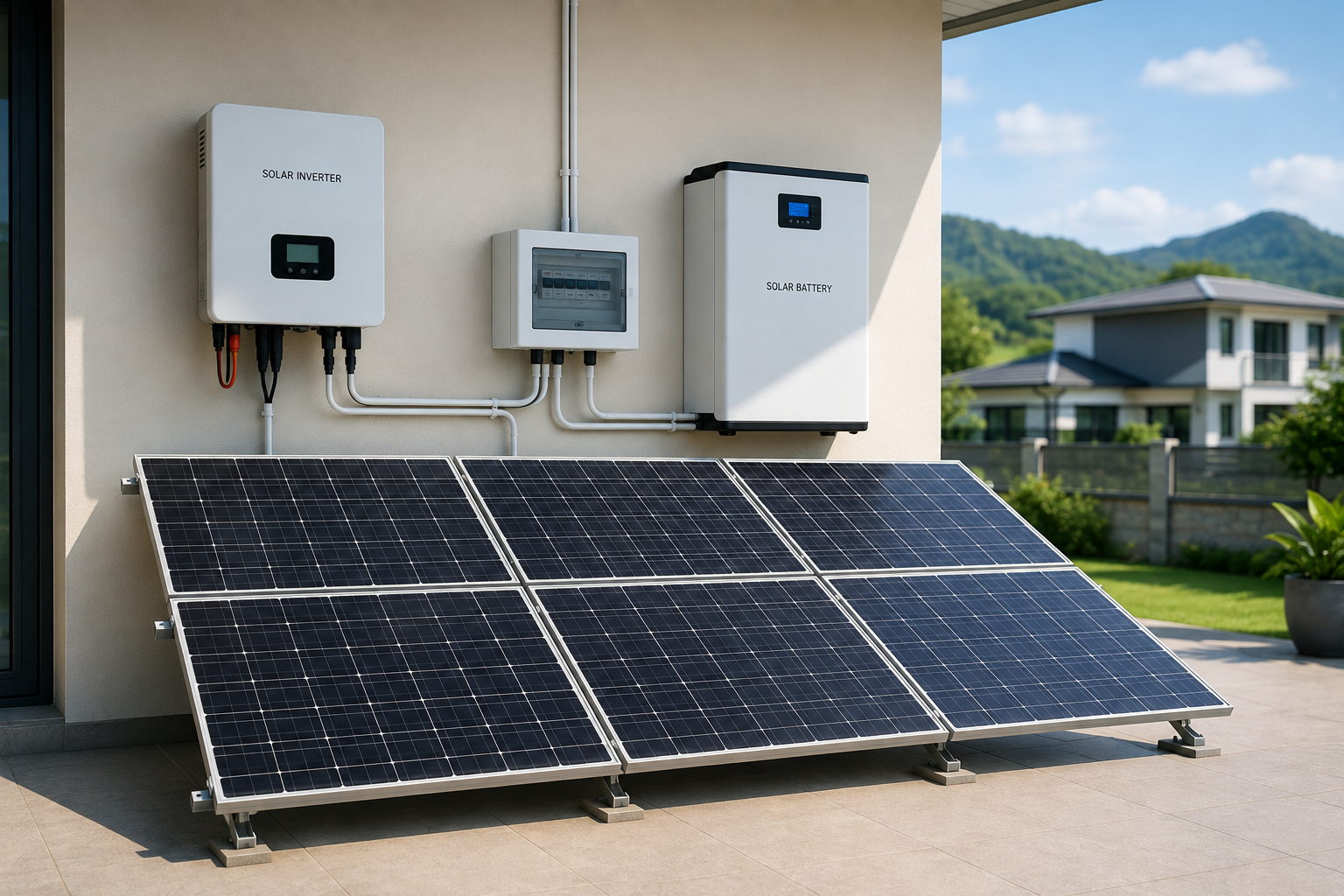
An 8kW solar system is a solar power setup rated to produce 8,000 watts of DC power under standard test conditions, typically built from 16 to 20 panels in the 400–550W range paired with an inverter sized to match. It can be configured as grid-tied (offsetting your utility bill via net metering), hybrid (grid-tied with battery backup), or fully off-grid (independent of the utility with battery storage).
Quick Comparison: 8kW Solar System Options
| Category | Product | Price Range | Best For |
|---|---|---|---|
| Grid-tie kit | GoGreenSolar 8kW DIY Grid-Tie Kit (String Inverter) | $8,000–$12,000 | Budget-conscious grid-tie installs |
| Grid-tie kit | GoGreenSolar 8kW DIY Kit with Enphase Microinverters | $10,000–$14,000 | Panel-level monitoring and shading |
| Hybrid inverter | Sol-Ark 8K-2P Hybrid Inverter | $3,500–$4,500 | Premium all-in-one grid/off-grid control |
| Off-grid inverter | EG4 6500EX-48 Off-Grid Inverter | $1,800–$2,200 | Budget off-grid and cabin builds |
Even at a glance, the range here tells the real story: the GoGreenSolar 8kW DIY Grid-Tie Kit anchors the affordable, straightforward end for homeowners simply trying to cut their electric bill, while the Sol-Ark 8K-2P Hybrid Inverter represents the premium, feature-rich end for anyone building a serious hybrid or off-grid system. We’ll cover all seven picks, including three not shown above, in detail next.
💬 Save this guide — you’ll want to compare specs again once you’ve sized your actual power needs.
Top 7 Products for an 8kW Solar System
Here are 7 real, currently available products relevant to building an 8kW solar system, spanning complete DIY grid-tie kits, premium hybrid inverters, and full off-grid setups.
1. GoGreenSolar 8kW DIY Grid-Tie Solar Panel Kit (String Inverter) — best budget-friendly grid-tie option
This kit pairs a full 8kW array of tier-1 solar panels with a string inverter, delivering a complete, ready-to-install grid-tie system at the most accessible price point in this category. It’s designed for homeowners who want to offset their electric bill through net metering without the added cost and complexity of battery storage.
What most first-time buyers overlook is how much a string inverter setup simplifies both the system and the eventual troubleshooting: with a single central inverter rather than one component per panel, there are fewer points of failure and a more straightforward wiring job for a DIY installer or local electrician. Based on comparing this to microinverter-based kits, the tradeoff is real — string inverters are more sensitive to partial shading across the array, since shading on one panel can reduce output across the whole string — but for an unobstructed roof or ground mount, that’s rarely a practical concern.
Reviews and installer feedback consistently point to this style of kit as the fastest path to a working grid-tie system for DIYers with basic electrical skills, with the main caveat being that any significant roof shading should push buyers toward a microinverter or optimizer-based kit instead.
Pros:
- ✅ Lowest cost per watt among complete 8kW grid-tie kits
- ✅ Simpler wiring with a single central string inverter
- ✅ Includes panels, inverter, and racking as a complete package
Cons:
- ❌ More sensitive to partial shading than microinverter systems
- ❌ No per-panel monitoring without an add-on
Typically priced around $8,000–$12,000 for the full kit, the GoGreenSolar 8kW DIY Grid-Tie Solar Panel Kit is the most direct route to a working, bill-offsetting system for budget-focused homeowners.
2. GoGreenSolar 8kW DIY Solar Panel Kit with Enphase Microinverters — best for shaded roofs and panel-level monitoring
This kit swaps the single string inverter for 20 Enphase grid-forming microinverters, one per panel, alongside IronRidge racking suitable for either roof or ground mounting. Because each panel has its own microinverter, shading, debris, or a partial equipment issue on one panel doesn’t drag down the output of the entire array the way it can with a string inverter setup.
What the spec sheet doesn’t fully convey is how much the built-in system monitoring changes the ownership experience day to day — real-time, panel-by-panel production data makes it dramatically easier to spot an underperforming panel early, whether that’s from a wiring fault, debris, or a developing shading issue from a growing tree. On paper, this is simply a higher-resolution version of the same 8kW system, but in practice, the visibility into per-panel performance is a genuine advantage for anyone who wants to catch problems before they meaningfully affect production.
Reviews consistently praise Enphase’s monitoring app and long track record of reliability in the microinverter space, with the primary tradeoff being a higher upfront cost per watt than a comparable string inverter kit.
Pros:
- ✅ Panel-level microinverters minimize shading losses
- ✅ Real-time, per-panel production monitoring included
- ✅ Compatible with both roof and ground mounting
Cons:
- ❌ Higher upfront cost than string inverter kits
- ❌ More individual components to install and wire
Typically priced around $10,000–$14,000, the GoGreenSolar 8kW DIY Kit with Enphase Microinverters is worth the premium for anyone dealing with partial roof shading or who values granular production data.
3. GoGreenSolar 8kW Ground Mount Solar Kit with SolarEdge Inverter — best for ground-mounted installations
Not every home has ideal roof space for an 8kW array, and this kit is built specifically for ground-mount installations, pairing an 8kW panel array with a SolarEdge inverter and power optimizers, along with the racking hardware needed for a ground-based system. SolarEdge’s power optimizer architecture sits between a pure string inverter and full microinverters, offering panel-level optimization while still centralizing the actual DC-to-AC conversion at one inverter.
What most buyers overlook is how differently a ground mount performs compared to a roof install: with full control over panel orientation and tilt angle, a ground-mounted array can often outproduce an equivalent roof system constrained by an imperfect roof pitch or orientation, at the cost of using yard space rather than existing roof area. Based on comparing this to roof-mount kits, the ground mount also makes future maintenance and panel cleaning considerably easier, since the array is at ground level rather than requiring roof access.
Reviews consistently highlight the flexibility of SolarEdge’s optimizer system for maximizing output on arrays with any partial shading, along with the practical convenience of ground-level access for maintenance, though the additional racking and trenching work adds real installation labor for anyone installing DIY.
Pros:
- ✅ Full control over panel tilt and orientation for maximum output
- ✅ SolarEdge optimizers provide panel-level performance management
- ✅ Ground-level access simplifies maintenance and cleaning
Cons:
- ❌ Requires suitable open land and additional trenching for wiring
- ❌ More installation labor than a straightforward roof mount
Typically priced around $10,000–$14,000, the GoGreenSolar 8kW Ground Mount Solar Kit is the right call for anyone without adequate roof space or with an unshaded, open piece of land.
4. Sol-Ark 8K-2P Hybrid Inverter — best premium all-in-one hybrid inverter
The Sol-Ark 8K-2P is a genuinely different category of product from the grid-tie kits above: a transformerless, all-in-one hybrid inverter that manages power flow between solar, battery, grid, generator, and home loads simultaneously. It accepts up to 11,000W of PV input across two independent MPPT trackers, delivers a continuous 8,000W AC output in split-phase 120/240V, and works with either lithium or lead-acid batteries.
What most buyers overlook is how much this inverter eliminates elsewhere in the system: with an integrated PV disconnect, ground fault detection, rapid shutdown control, and surge protection all built in, a Sol-Ark install skips the separate combiner boxes, fuses, and rapid shutdown equipment a typical DIY string-inverter system requires. Based on comparing this to budget off-grid inverters, the Sol-Ark’s ability to operate in grid-tied, off-grid, or battery-backup modes — and switch between them — makes it the more flexible long-term choice, particularly for anyone who isn’t fully certain yet whether they’ll stay grid-tied or eventually go off-grid.
Reviews consistently praise the pre-wired, clearly labeled design that makes commissioning straightforward even when paralleling multiple units, along with strong long-term reliability reports and a 5-year standard warranty (extendable), though the inverter itself is a significant investment before panels or batteries are even factored in.
Pros:
- ✅ Operates in grid-tied, off-grid, or battery-backup modes
- ✅ Integrated PV disconnect, rapid shutdown, and surge protection
- ✅ Supports both lithium and lead-acid battery chemistries
Cons:
- ❌ Significant cost as a standalone component before panels or batteries
- ❌ Best suited to installations with professional or experienced DIY support
At roughly $3,500–$4,500 for the inverter alone, the Sol-Ark 8K-2P Hybrid Inverter is the premium backbone for anyone building a serious, flexible 8kW hybrid system.
5. EG4 6500EX-48 Off-Grid Inverter — best budget off-grid inverter
The EG4 6500EX-48 delivers 6,500W of continuous output with an 8,000W max PV input at up to 500V VOC, making it a genuinely capable off-grid inverter at a fraction of the cost of premium hybrid alternatives like the Sol-Ark. It’s a favorite in the DIY off-grid community specifically because it offers a strong balance of price and real-world capability for cabins, garages, and small off-grid homes.
Here’s what to weigh: the EG4 6500EX-48 lacks some of the more advanced features found in premium hybrid inverters, like external CT clamps for whole-home backfeeding, but for a straightforward off-grid or backup power setup, that gap rarely matters in practice. Based on comparing this to the Sol-Ark 8K-2P, the EG4 trades some flexibility and integrated safety equipment for a substantially lower price, which is exactly why it’s become one of the most recommended budget inverters in DIY solar forums for off-grid builds around the 8kW PV input range.
Reviews consistently describe strong performance for the price, with community forum feedback specifically noting that two units can be paralleled for larger split-phase systems, though some owners recommend budgeting for an add-on charge controller device if you’ll need to charge batteries from a generator during extended cloudy periods.
Pros:
- ✅ Strong price-to-capability ratio for off-grid builds
- ✅ 8,000W max PV input supports a full 8kW array
- ✅ Can be paralleled with a second unit for larger split-phase systems
Cons:
- ❌ Lacks some integrated safety and backfeeding features of premium inverters
- ❌ May require an add-on device for generator charging in low-sun periods
Typically priced around $1,800–$2,200, the EG4 6500EX-48 is the budget-conscious choice for DIYers building an off-grid or backup 8kW system.
6. NETSOLAR 8kW Complete Off-Grid Solar Kit — best turnkey off-grid package
For buyers who want a single, complete purchase rather than assembling components separately, the NETSOLAR 8kW Complete Off-Grid Solar Kit bundles an 8kW split-phase pure sine wave hybrid inverter with dual MPPT trackers, a 51.2V 100Ah LiFePO4 battery rated for more than 6,000 cycles, and eight 550W bifacial solar panels producing roughly 4,400W of array output. The inverter itself can accept up to 11,000W of PV input and supports batteryless operation for added installation flexibility.
What most buyers overlook is that this kit’s bifacial panels can meaningfully boost real-world output beyond the rated wattage when mounted over a reflective surface like light gravel or concrete, since bifacial cells capture reflected light off the back of the panel in addition to direct sunlight on the front. On paper, the array wattage here is lower than a typical 8kW grid-tie kit, but the inverter’s 11,000W max PV input headroom means the system can be expanded with additional panels later without replacing the core hybrid inverter.
Reviews consistently highlight the value of getting inverter, battery, and panels in a single coordinated purchase rather than sourcing and matching components separately, with the built-in battery management system’s overcharge and short-circuit protections cited as a meaningful peace-of-mind feature for first-time off-grid builders.
Pros:
- ✅ Complete kit: inverter, LiFePO4 battery, and panels in one purchase
- ✅ Bifacial panels can outproduce rated wattage on reflective surfaces
- ✅ 11,000W max PV input allows future array expansion
Cons:
- ❌ Included panel array (4,400W) is smaller than the inverter’s full capacity
- ❌ Less established brand track record than Sol-Ark or EG4
Typically priced around $6,000–$9,000 for the complete kit, the NETSOLAR 8kW Complete Off-Grid Solar Kit is a strong turnkey option for anyone who’d rather buy a matched system than assemble one piece by piece.
7. GoGreenSolar 8kW DIY Kit with Sol-Ark Inverter and 16.2kWh Battery Bank — best complete hybrid system with backup power
This is the most complete package in this lineup: a full 8kW panel array paired with a Sol-Ark hybrid inverter/charger and a 16.2kWh battery bank, designed for homeowners who want both bill savings through net metering and genuine backup power when the grid goes down. The Sol-Ark inverter supports simultaneous AC and DC coupling, giving installers flexibility in how the system is wired relative to existing utility service.
What most buyers overlook is just how much usable backup runtime a 16.2kWh battery bank actually provides — for a typical home running essential circuits (refrigerator, some lighting, internet, well pump) rather than the entire house, that capacity can often stretch through a multi-day outage, especially with solar recharging the batteries during daylight hours even while the grid is down. Based on comparing this to a grid-tie-only kit, the added cost here is substantial, but it’s the only configuration in this lineup that keeps your home powered during a blackout rather than automatically shutting off for safety, which grid-tie systems without batteries are required to do.
Reviews and buyer feedback consistently point to the peace of mind this configuration provides in areas with frequent outages or severe weather, with GoGreenSolar’s guarantee and engineering support cited as valuable for buyers tackling a system this complex as a DIY project, though buyers should budget for module-level rapid shutdown equipment separately if the array will be roof-mounted.
Pros:
- ✅ Genuine backup power during grid outages, unlike battery-less grid-tie kits
- ✅ Sol-Ark inverter supports both AC and DC battery coupling
- ✅ 16.2kWh of storage covers essential loads through extended outages
Cons:
- ❌ Highest upfront cost of any option in this lineup
- ❌ Rapid shutdown equipment for roof mounts is a separate add-on
Typically priced around $18,000–$24,000 for the complete system, this GoGreenSolar Sol-Ark battery kit is the pick for anyone who wants both bill savings and real resilience during outages.
Product Comparison at a Glance
| Product | Type | Key Strength | Price Range | Best For |
|---|---|---|---|---|
| GoGreenSolar 8kW DIY Grid-Tie Kit (String Inverter) | Grid-tie kit | Lowest cost per watt | $8,000–$12,000 | Budget grid-tie installs |
| GoGreenSolar 8kW DIY Kit with Enphase Microinverters | Grid-tie kit | Panel-level monitoring | $10,000–$14,000 | Shaded roofs |
| GoGreenSolar 8kW Ground Mount Kit with SolarEdge Inverter | Grid-tie kit | Flexible tilt and orientation | $10,000–$14,000 | Open land, no roof space |
| Sol-Ark 8K-2P Hybrid Inverter | Hybrid inverter | All-in-one flexibility | $3,500–$4,500 | Premium hybrid/off-grid builds |
| EG4 6500EX-48 Off-Grid Inverter | Off-grid inverter | Best price-to-capability | $1,800–$2,200 | Budget off-grid builds |
| NETSOLAR 8kW Complete Off-Grid Kit | Complete kit | Matched inverter, battery, panels | $6,000–$9,000 | Turnkey off-grid buyers |
| GoGreenSolar Sol-Ark Kit with 16.2kWh Battery | Complete hybrid kit | Real backup power | $18,000–$24,000 | Outage resilience |
A clear pattern emerges here: battery storage is the single biggest cost driver in this category, far more than panel technology or inverter type. Grid-tie-only kits without batteries cluster in the $8,000–$14,000 range, while adding meaningful battery capacity roughly doubles or triples total system cost. Buyers should decide early whether backup power is a genuine need or a nice-to-have, since that single decision determines which half of this list is actually relevant.
How to Choose the Right 8kW Solar System
- Confirm 8kW actually matches your usage. Pull 12 months of utility bills — an 8kW system suits homes using roughly 800–1,200 kWh monthly; significantly higher usage may need a larger array.
- Decide between grid-tie, hybrid, and off-grid early. This single decision eliminates most of the list — grid-tie kits like GoGreenSolar’s string inverter kit for bill offset only, hybrid options like the Sol-Ark 8K-2P or GoGreenSolar’s battery kit for backup power.
- Match inverter type to your roof’s shading situation. Unobstructed roofs do fine with a string inverter; any meaningful shading pushes you toward Enphase microinverters or SolarEdge optimizers.
- Consider ground mount if roof space or orientation is poor. The GoGreenSolar 8kW Ground Mount Kit solves this directly, at the cost of using yard space and additional installation labor.
- Size your battery bank to your actual backup needs, not the whole house. A 16.2kWh bank in the GoGreenSolar Sol-Ark kit covers essential circuits for most homes — full-house backup requires considerably more capacity and cost.
- Weigh DIY component assembly against a turnkey kit. The NETSOLAR complete kit removes the guesswork of matching inverter, battery, and panel specs for buyers who’d rather not source components separately.
- Factor in the total system cost, not just the headline component price. A standalone inverter like the EG4 6500EX-48 or Sol-Ark 8K-2P still needs panels, racking, and (for off-grid) batteries added on top.
Getting Started: Planning Your First 8kW Solar Install
Before ordering any hardware, start with a load calculation: total your home’s actual monthly kWh usage from utility bills over the past year, since seasonal variation matters — a home that looks fine on an 8kW system in spring might fall short during a high-usage summer with heavy air conditioning. From there, confirm your roof or ground space can accommodate the roughly 460 square feet an 8kW array typically requires, accounting for orientation, tilt, and any shading from trees or nearby structures.
If you’re going grid-tie, contact your utility early about interconnection requirements and net metering policies, since these vary significantly by state and can affect system design decisions like inverter selection and whether production monitoring is required. For hybrid or off-grid builds, size your battery bank around which specific circuits you actually want backed up — refrigerator, well pump, and some lighting is a very different capacity requirement than backing up central air conditioning and an electric range.
For any DIY installation, budget real time for permitting and inspection, which varies by jurisdiction but is a required step for any grid-connected system and often for off-grid systems as well, depending on local code. A common first-project mistake is underestimating the electrical work involved — even a “plug-and-play” kit like the ones from GoGreenSolar still requires proper conduit runs, breaker sizing, and grounding done to code, which is exactly where many first-time DIYers choose to bring in a licensed electrician for the final connections even while doing the panel mounting themselves.
✨ Ready to start planning your system? Check current pricing and availability on the picks above before you finalize your design. ☀️
Real-World Scenarios: Matching the System to Your Situation
The homeowner just trying to cut their electric bill: For straightforward bill offset with no outage concerns, the GoGreenSolar 8kW DIY Grid-Tie Kit delivers the fastest payback with the lowest upfront cost, especially on an unshaded roof with good south-facing exposure.
The homeowner with a partially shaded roof: Trees, chimneys, or dormers that shade part of the array during the day call for Enphase microinverters or SolarEdge optimizers rather than a basic string inverter, since panel-level management prevents shading on one panel from dragging down the whole system’s output.
The rural or cabin off-grid builder: Someone without utility access, or building a detached workshop or cabin, is the classic use case for the EG4 6500EX-48 paired with a matched battery bank and panel array, offering genuine off-grid capability at a fraction of premium hybrid inverter pricing.
The homeowner in an outage-prone area: Anyone who’s experienced multi-day power outages and wants real resilience should look at the GoGreenSolar Sol-Ark Kit with 16.2kWh Battery Bank, which is the only option in this lineup that keeps essential home systems running when the grid fails.
Common Mistakes to Avoid
The most common mistake is undersizing the system based only on current usage without accounting for future changes — adding an EV, a heat pump, or a pool pump down the line can push consumption well beyond what an 8kW system comfortably covers, so it’s worth sizing with some headroom if any of those are on your horizon.
A second frequent error is choosing a battery-less grid-tie kit and assuming it will provide backup power during an outage; by design, most grid-tie inverters shut down automatically when the grid goes down for safety reasons, so if outage resilience matters, only a hybrid system like the Sol-Ark 8K-2P or a complete kit with battery storage actually delivers it. A third mistake is skipping utility interconnection research before ordering equipment, since net metering rules, interconnection fees, and inverter certification requirements vary by state and utility, and discovering a mismatch after purchasing hardware is a costly do-over.
Finally, many first-time buyers underestimate installation labor even on “DIY-friendly” kits — mounting an 8kW array, running conduit, and making code-compliant electrical connections is a substantial project, and budgeting for at least some professional help, particularly for the final utility interconnection, tends to be worth it.
8kW Grid-Tie vs. Hybrid/Off-Grid Systems
| Factor | Grid-Tie (No Battery) | Hybrid/Off-Grid (With Battery) |
|---|---|---|
| Upfront cost | Lower ($8,000–$14,000) | Substantially higher ($18,000+ with battery) |
| Backup power during outages | None — shuts off automatically | Yes, dependent on battery capacity |
| Complexity | Simpler wiring and permitting | More complex, more components |
| Best suited for | Bill offset in areas with reliable grid power | Outage-prone areas or off-grid properties |
| Ongoing maintenance | Minimal | Battery monitoring and periodic maintenance |
The core trade-off is straightforward: grid-tie systems are cheaper and simpler because they lean entirely on the utility grid as backup, while hybrid and off-grid systems take on the cost and complexity of battery storage in exchange for genuine independence or resilience. Neither is universally “better” — the right choice depends entirely on how reliable your local grid already is and how much you’re willing to pay for insurance against the times it isn’t.
Safety, Incentives, and Regulations
Before finalizing any 8kW solar system purchase, it’s worth understanding the current federal incentive landscape, since it has changed recently. According to the IRS, the Residential Clean Energy Credit offered a 30% tax credit on qualifying solar expenditures for property placed in service through December 31, 2025, but that credit is not available for systems placed in service after that date — a meaningful shift for anyone budgeting a system in 2026 who may have assumed the credit still applied. It’s worth confirming current state and utility-level incentives separately, since those vary widely and some remain in effect even after the federal credit’s expiration.
On the technical side, the U.S. Department of Energy notes that solar power connects into a home’s main electric panel with specific requirements for labeling, panel sizing, and breaker placement — details that matter for code compliance regardless of which kit or components you choose. For homes considering how solar affects grid connection and construction more broadly, the Department of Energy’s solar guide also notes that quality solar panels are expected to last 25 years or more while still producing over 80% of their original rated power, a useful benchmark when comparing warranty terms across the products above.
Problem → Solution: Fixing Common Roadblocks
Problem: Your roof has partial shading from trees or a chimney. Solution: Choose a microinverter or optimizer-based kit like GoGreenSolar’s Enphase kit or SolarEdge ground mount kit instead of a basic string inverter setup.
Problem: You don’t have adequate roof space or orientation. Solution: Consider a ground-mounted system like the GoGreenSolar 8kW Ground Mount Kit, which trades yard space for full control over panel tilt and orientation.
Problem: You want backup power during outages but battery costs feel too high. Solution: Size your battery bank to cover only essential circuits rather than the whole home — a smaller, more affordable battery paired with the Sol-Ark 8K-2P can still deliver meaningful resilience.
Problem: You’re building off-grid and don’t want to overspend on a premium inverter. Solution: The EG4 6500EX-48 delivers strong off-grid capability at a fraction of the cost of premium hybrid alternatives.
Problem: You don’t want to source and match inverter, battery, and panel specs yourself. Solution: A complete turnkey kit like the NETSOLAR 8kW Complete Off-Grid Solar Kit removes that compatibility guesswork entirely.
Frequently Asked Questions
❓ How much can an 8kW solar system save on my electric bill?
❓ Is an 8kW solar system enough to power a whole house?
❓ What's the difference between grid-tie and hybrid 8kW systems?
❓ Is the federal solar tax credit still available in 2026?
❓ Can I install an 8kW solar system myself?
Conclusion
An 8kW solar system covers a genuinely wide range of needs, and the seven options here reflect that: GoGreenSolar’s string inverter kit delivers the most affordable path to bill savings, Enphase microinverter and SolarEdge ground mount kits solve specific shading and site-layout challenges, the Sol-Ark 8K-2P and EG4 6500EX-48 cover the premium and budget ends of hybrid/off-grid inverters, and the NETSOLAR complete kit and GoGreenSolar Sol-Ark battery kit offer turnkey and outage-resilient options respectively.
The decision that matters most isn’t which brand to choose — it’s whether you need grid-tie bill offset, genuine backup power, or full off-grid independence, since that single choice narrows this list down immediately. From there, matching your roof or land situation and budget to the right product is straightforward.
✨ Don’t miss these exclusive deals! 🔍 Take the guesswork out of your next solar project with this curated lineup. Click a highlighted item to check current pricing and availability. These picks will help you build a system that actually fits your home and budget!
Recommended for You
- 5 Best 2000 Watt Solar Panel Kits in 2026: Expert Hands-On Review
- 5 Best 12v Solar Panel with Battery Kits (2026 Field Tested)
- 10kw Solar System Cost: 5 Best Equipment Options in 2026
Disclaimer: This post contains affiliate links. As an Amazon Associate, I earn from qualifying purchases made through these links, at no additional cost to you.
✨ Found this article helpful? Share it with someone who needs it! 💬🤗