
In This Article
Why a Portable 12 Volt Power Supply Beats Babysitting Your Car Battery
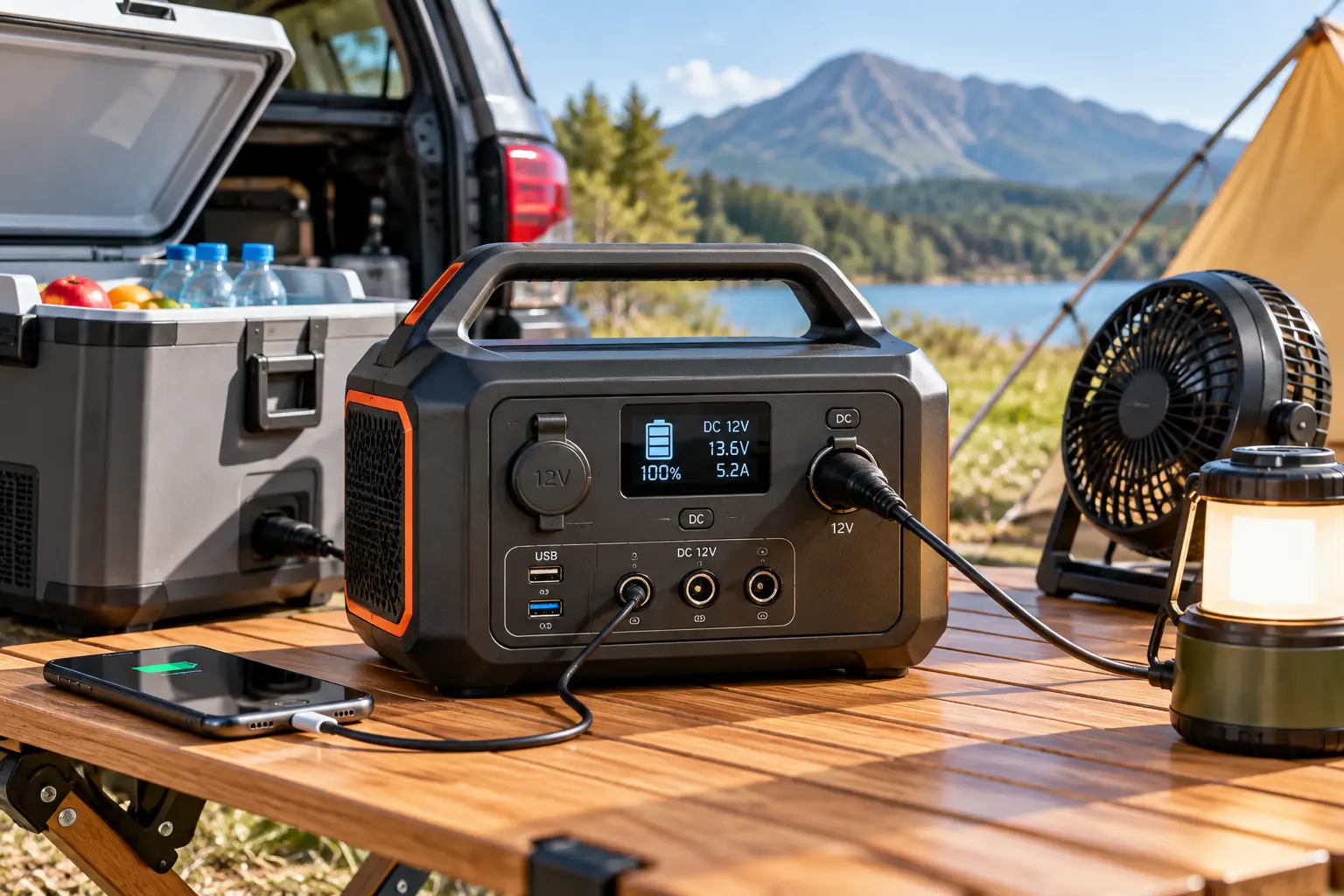
Picture this: it’s 2 a.m. at a dispersed campsite in Utah, your compressor fridge is humming, and your truck’s starter battery is quietly draining. A portable 12 volt power supply exists to end that exact gamble. Instead of leaning on your vehicle’s electrical system — or a loud, fume-belching gas generator — you carry a self-contained battery with its own 12V outlet, so your fridge, CPAP, tire inflator, or ham radio draws from a box you can refill from the wall, the sun, or your car while you drive.
The category has changed fast. A few years ago, most portable power meant heavy lead-acid boxes with a short lifespan. In 2026, nearly every serious option uses lithium iron phosphate (LiFePO4) cells rated for thousands of charge cycles, adds USB-C ports that charge laptops directly, and lets you monitor everything from a phone app. That’s great news — but it also means spec sheets are crowded with numbers that don’t all matter equally.
So here’s what this guide does differently. Rather than repeat marketing bullets, we translate each spec into what it means at your campsite, in your van, or in your living room during an outage. We compare seven real models — from a 6-pound DC-only brick to a 62-pound RV powerhouse — and we flag the details that trip people up. For example, almost every 12V car-style port tops out at 10 amps, which caps it near 120 watts no matter how big the battery behind it is.
✅ Short on time? Jump straight to the quick comparison table.
✅ Planning a road trip? The real-world scenarios section matches buyers to models.
✅ Worried about safety? We cover FAA, CPSC, and UL basics near the end.
What Is a Portable 12 Volt Power Supply?
A portable 12 volt power supply is a rechargeable battery unit — usually sold as a portable power station — that delivers steady 12V DC power through a car-style socket or barrel ports, so you can run 12V gear like fridges, pumps, and CPAP machines without a vehicle, generator, or wall outlet.
The socket on these units is the same automotive 12V auxiliary power outlet found in cars, which is typically fused at 10 to 20 amps. Here’s the catch with using your actual car: its outlet voltage wanders — roughly 12.5V with the engine off, about 14.5V with it running, and it can dip sharply during cranking. A dedicated unit holds its output steady (EcoFlow, for instance, specs its ports at 12.6V), which keeps sensitive 12V devices from cutting out.
Most modern units also add an AC inverter and USB-C ports, which is why you’ll see them marketed as a 12V portable power station or “solar generator.” A few, like the Anker SOLIX C300 DC, skip AC entirely — the purest form of a portable 12V DC power source.
Quick Comparison: 7 Portable 12 Volt Power Supply Picks at a Glance
Before we dig into each model, here’s the 30-second version. Price ranges reflect what we saw at the time of writing; prices move constantly, so always check the current listing.
| Model | Capacity | 12V DC output | Weight | Price range (USD) | Best for |
|---|---|---|---|---|---|
| Anker SOLIX C300 DC | 288Wh LiFePO4 | 1× car socket, 12V/10A (120W) | 6.2 lb | around $150–$250 | Anker SOLIX C300 DC: all-DC and USB-C gear |
| Jackery Explorer 300 Plus | 288Wh LiFePO4 | 1× car port, 12V/10A | 8.3 lb | around $200–$300 | Jackery Explorer 300 Plus: first-time buyers |
| EcoFlow RIVER 3 Plus | 286Wh LiFePO4 (expandable) | 1× car outlet, 12.6V/10A (126W) | 10.4 lb | around $250–$400 | EcoFlow RIVER 3 Plus: router backup + road trips |
| Goal Zero Yeti 500X | 505Wh NMC | 12V car port + 6mm port (120W each) | 12.9 lb | around $450–$700 | Goal Zero Yeti 500X: Goal Zero solar owners |
| Jackery Explorer 1000 v2 | 1,070Wh LiFePO4 | 1× car port, 12V/10A | 23.8 lb | around $400–$800 | Jackery Explorer 1000 v2: weekend fridge duty |
| EcoFlow DELTA 3 Plus | 1,024Wh LiFePO4 (expandable) | car outlet + 2× DC5521, 12.6V | 27.6 lb | around $550–$800 | EcoFlow DELTA 3 Plus: home backup + travel |
| BLUETTI AC200L | 2,048Wh LiFePO4 (expandable) | 12V/10A car outlet + 48V/8A DC | 62.4 lb | around $700–$1,100 | BLUETTI AC200L: RVs and boondocking |
Looking at the table, the big split is weight versus staying power. The three ~288Wh units (Anker SOLIX C300 DC, Jackery Explorer 300 Plus, EcoFlow RIVER 3 Plus) are one-hand carries but realistically cover about one night of 12V fridge use, while the 1kWh class (Jackery Explorer 1000 v2, EcoFlow DELTA 3 Plus) is where multi-day trips start making sense. Notice, too, that every 12V car port listed is capped at roughly 10 amps — so a bigger battery buys you more hours, not a stronger 12V outlet.
💬 One click helps other shoppers make an informed choice too! Tap a highlighted model to check today’s price and availability. 😊
Top 7 Portable 12 Volt Power Supply Options: Expert Analysis
Every pick below is a real, currently listed model. We compared manufacturer spec sheets, independent reviews, and the recurring themes in owner feedback — then translated the numbers into what they mean for your trip or outage.
1. Anker SOLIX C300 DC — purest DC power in a lunchbox
If your gear already runs on 12V or USB-C, paying for an inverter you’ll never use makes little sense — and the Anker SOLIX C300 DC skips it entirely.
Its 288Wh LiFePO4 pack feeds one 12V/10A car socket (120W max), four USB-C ports (two rated at 140W), and two USB-A ports, all in a 6.17-pound body under 8 inches tall. In practice, that 120W socket comfortably handles a compressor cooler or a CPAP on its 12V cord, while the 140W USB-C ports can charge a demanding laptop at full speed. Anker’s specs also confirm you can run a 140W USB-C load and the car socket at the same time.
Who’s it for? Overlanders, van-lifers with an all-DC setup, and anyone building a lightweight 12 volt power supply for camping. With no inverter idling in the background, more of the battery’s energy reaches your devices. The trade-off is obvious: no AC outlets means no coffee grinder, no standard laptop brick, nothing with a wall plug.
Hands-on coverage — including The Gadgeteer’s review — highlights how much it powers for its size and its information-dense display. We couldn’t verify a large pool of US Amazon reviews specific to the DC version, so read the listing’s latest feedback before buying.
Pros:
- ✅ Very light at 6.17 lb for 288Wh
- ✅ Two 140W USB-C ports double as fast inputs
- ✅ No inverter means less wasted energy
Cons:
- ❌ No AC outlets at all
- ❌ Car and solar charging share one 100W input path
💰 Typically around $150–$250 (check the current price) — outstanding value if your gear is DC-native.
2. Jackery Explorer 300 Plus — featherweight all-rounder with AC backup
The Jackery Explorer 300 Plus is the “one box for everything small” option: a capable 12V port plus a real wall-style outlet for the odd AC gadget.
You get 288Wh of LiFePO4 rated for 3,000 cycles to 80% capacity, a 300W pure sine wave AC outlet (600W surge), a 12V/10A car port, two 100W USB-C ports, and one 15W USB-A — at 8.27 pounds. What that means in real life: the car port runs a 12V fridge or air pump, the 100W USB-C covers most laptops, and the 300W outlet handles a fan, camera charger, or small light string. Jackery lists a 5.5-hour recharge from a 12V car adapter, so a solid day of driving can refill it.
This is the pick for first-time buyers who want flexibility without lugging 20-plus pounds. It won’t run a coffee maker or hair dryer — 300W is a hard ceiling — but for weekend camping and phone-laptop-light duty, it’s well matched.
Retailer listings emphasize its light weight and Jackery’s FCC and UL certification claims. We couldn’t confirm a large, Plus-specific body of aggregated US reviews here, so check the current Amazon review breakdown before you commit.
Pros:
- ✅ Light 8.27 lb build with AC and 12V outputs
- ✅ LiFePO4 cells rated for 3,000 cycles
- ✅ Dual 100W USB-C covers most laptops
Cons:
- ❌ 300W AC limit rules out heating appliances
- ❌ Only one 12V port for multiple DC devices
💰 Usually around $200–$300 at the time of writing — strong value for a first power station.
3. EcoFlow RIVER 3 Plus — UPS-ready middleweight that grows with you
The EcoFlow RIVER 3 Plus packs similar capacity to the Jackery but adds faster charging, a higher-voltage 12V port, and an expansion path.
Its 286Wh LiFePO4 battery drives 600W of AC (1,200W with X-Boost for resistive loads), a 12.6V/10A car outlet (126W), USB-C, and USB-A. That 12.6V figure matters: many 12V fridges have low-voltage cutoffs, and a slightly higher, steady output keeps them running longer. The 220W car/solar input refills it in about 3.3 hours from a vehicle — noticeably quicker than most 300Wh rivals — and the <10ms UPS switchover keeps a modem or router online during a blackout. Add an extra battery and capacity climbs to 858Wh.
It’s ideal if one unit must pull double duty: road trips on weekends, Wi-Fi backup during the week. At about 10.4 pounds, it’s heavier than the Jackery Explorer 300 Plus, but you’re paying that weight for speed and expandability.
StorageReview’s testing found solid energy efficiency and confirmed the <10ms transfer time, and other reviewers describe it as enough for most casual users.
Pros:
- ✅ Fast 220W car and solar recharging
- ✅ True <10ms UPS for routers and modems
- ✅ Expandable to 858Wh with add-on batteries
Cons:
- ❌ Heavier than other 300Wh-class units
- ❌ Only one 12V outlet, no barrel ports
💰 Generally around $250–$400 (prices may vary) — excellent value if you’ll use the UPS feature.
4. Goal Zero Yeti 500X — two regulated 12V ports, proven trail pedigree
The Goal Zero Yeti 500X is the only pick here with two independent 12V outputs, which is handy when you’re running a fridge and a light bar at once.
Its 505Wh lithium NMC battery feeds a regulated 12V car port (120W) and a 12V 6mm port (120W), plus 300W pure sine AC (1,200W surge) and a 60W USB-C PD port, at 12.9 pounds. Two regulated 12V outlets let you split loads without a splitter, which avoids overloading a single socket. The catch is chemistry: NMC packs more energy per pound, but Goal Zero rates it at 500 cycles to 80% — a fraction of the 3,000–4,000 cycles LiFePO4 rivals claim.
This suits owners already invested in Goal Zero’s Nomad or Boulder solar panels, and occasional users who won’t cycle it daily. Heavy weekly users will get more life per dollar from LiFePO4 models.
Customer reviews on REI are broadly positive, with owners praising the 60W USB-C and solar flexibility; the recurring caution is the older chemistry relative to its price.
Pros:
- ✅ Two regulated 12V outputs built in
- ✅ More capacity per pound than LiFePO4 rivals
- ✅ Works natively with Goal Zero solar panels
Cons:
- ❌ Only 500 rated cycles to 80% capacity
- ❌ Car charging cable sold separately
💰 Roughly $450–$700 at the time of writing — fair value only if you’re in the Goal Zero ecosystem.
5. Jackery Explorer 1000 v2 — the 1kWh sweet spot for weekend fridge duty
The Jackery Explorer 1000 v2 is where a portable 12 volt power supply stops being a gadget charger and starts running a campsite.
It holds 1,070Wh of LiFePO4 rated for 4,000 cycles, delivers 1,500W AC (3,000W surge) through three outlets, and offers a 12V/10A car port, two USB-C ports (100W + 30W), and a USB-A — at 23.8 pounds. In practical terms, 1kWh runs a typical 12V compressor fridge for roughly a day or more, depending on ambient heat. The 20ms UPS switchover is fine for most electronics, though some desktop PCs prefer faster transfer. App-activated emergency charging refills it in about an hour from the wall, but car charging takes around 12 hours, so treat your vehicle as a top-up, not a primary source.
It’s an excellent fit for families who car camp, weekend RVers, and anyone building an outage kit.
TechRadar’s field test ran three computers plus cameras, drones, and lighting for a day without issue, while noting the weight ticked up slightly versus its predecessor and that charging from a parked car drains the vehicle battery.
Pros:
- ✅ 1,070Wh in a 23.8 lb package
- ✅ 4,000-cycle LiFePO4 for long service life
- ✅ One-hour emergency wall charging via app
Cons:
- ❌ Slow 12-hour recharge from a car socket
- ❌ Single 12V port at this capacity
💰 Typically around $400–$800, with frequent swings — great value whenever it dips toward the low end.
6. EcoFlow DELTA 3 Plus — three 12V outlets and 56-minute recharges
The EcoFlow DELTA 3 Plus is the most 12V-friendly of the 1kWh units, thanks to extra barrel ports alongside its car outlet.
It offers 1,024Wh of LiFePO4 rated for 4,000 cycles, 1,800W AC (3,600W surge), a 12.6V/10A car outlet, and two DC5521 barrel ports (12.6V/3A each). Those barrel ports feed routers, LED strips, and small 12V devices without bulky car-plug adapters — just know they share one 12V power budget with the car outlet. Recharging is the headline: about 56 minutes from the wall at 1,500W, two 500W solar inputs, and an optional 800W alternator charger EcoFlow rates at 1.3 hours for a full charge. It also offers <10ms UPS and expands to 5kWh.
This is the best do-everything mid-size pick for people who split time between home backup and the road. At 27.6 pounds, though, it’s a two-hand carry.
StorageReview’s review praised the more intuitive port layout, faster charging, and quiet operation — about 30 dB under 600W loads.
Pros:
- ✅ Car outlet plus two DC5521 barrel ports
- ✅ Full wall recharge in about an hour
- ✅ Expandable to 5kWh with extra batteries
Cons:
- ❌ 12V ports share a single power budget
- ❌ 27.6 lb is heavy for frequent carrying
💰 Usually around $550–$800 (check the current price) — top value for a home-plus-road hybrid.
7. BLUETTI AC200L — RV-grade capacity with a 30A shore-power plug
The BLUETTI AC200L is built for people whose “portable” means “rolls into the RV bay,” not “fits in a backpack.”
Its 2,048Wh LiFePO4 battery (3,000+ cycles) powers 2,400W of AC (3,600W in power-lifting mode), a NEMA TT-30 RV outlet, a regulated 12V/10A car outlet, a 48V/8A DC port, two 100W USB-C, and two USB-A — at 62.4 pounds. The TT-30 port means your RV’s 30A cord plugs straight in. The 12V car outlet is still capped at 10A, though; for heavy 12V house loads, BLUETTI’s optional D40 regulator adds a 12V/30A (400W) feed. Expansion batteries push capacity to roughly 7.6–8.2kWh, depending on the packs you choose, and it carries a 5-year warranty.
It’s the clear pick for full-time RVers and serious boondockers. Everyone else will find it overkill.
Reviewers consistently flag the weight — Notebookcheck’s hands-on called it difficult to maneuver — while praising the port count and quick AC charging.
Pros:
- ✅ Huge 2,048Wh base capacity, expandable
- ✅ NEMA TT-30 plugs directly into RVs
- ✅ 5-year warranty and 3,000+ cycles
Cons:
- ❌ 62.4 lb makes it barely portable
- ❌ 12V/30A output requires the extra D40 accessory
💰 Roughly $700–$1,100 at the time of writing — excellent value per watt-hour for RV owners.
Head-to-Head: Full Spec Comparison of the Top 7
| Model | Chemistry & rated cycles | 12V ports | AC output | Car recharge | UPS | Best for |
|---|---|---|---|---|---|---|
| Anker SOLIX C300 DC | LiFePO4, 3,000 | 1 (120W) | None | Shared 100W input | No | Anker SOLIX C300 DC: ultralight DC kits |
| Jackery Explorer 300 Plus | LiFePO4, 3,000 | 1 (12V/10A) | 300W | ~5.5 hr | — | Jackery Explorer 300 Plus: beginners |
| EcoFlow RIVER 3 Plus | LiFePO4, 3,000 | 1 (126W) | 600W | ~3.3 hr (220W) | <10ms | EcoFlow RIVER 3 Plus: Wi-Fi backup |
| Goal Zero Yeti 500X | NMC, 500 | 2 (120W each) | 300W | ~4.5 hr | — | Goal Zero Yeti 500X: Goal Zero users |
| Jackery Explorer 1000 v2 | LiFePO4, 4,000 | 1 (12V/10A) | 1,500W | ~12 hr | 20ms | Jackery Explorer 1000 v2: car camping |
| EcoFlow DELTA 3 Plus | LiFePO4, 4,000 | 3 (car + 2× DC5521) | 1,800W | 1.3 hr (800W alternator charger) | <10ms | EcoFlow DELTA 3 Plus: hybrid use |
| BLUETTI AC200L | LiFePO4, 3,000+ | 1 (12V/10A) + 48V DC | 2,400W + TT-30 | ~10–20 hr via socket | Yes | BLUETTI AC200L: RVs |
The spec table makes one pattern hard to miss: recharge speed from a vehicle varies by more than tenfold. The EcoFlow DELTA 3 Plus (with its alternator charger) and EcoFlow RIVER 3 Plus refill quickly on the road, while the Jackery Explorer 1000 v2 and BLUETTI AC200L lean on wall or solar power. Meanwhile, the Goal Zero Yeti 500X is the outlier on longevity, so it only makes sense for light, occasional use.
⚡ Ready to Power Your Next Adventure?
🔍 Take your off-grid setup to the next level with this carefully curated lineup. Click any highlighted model to check current pricing and availability. These picks will help you keep the fridge cold, the CPAP running, and the whole family charged — wherever the road goes! 🚐
Getting Started: Your First 30 Days With a 12V Portable Power Station
Unboxing is the easy part. The first month is when you learn what your unit can actually do — and when most avoidable mistakes happen.
Week 1 — Charge fully and rehearse. Charge to 100% before first use (BLUETTI explicitly requires this for the AC200L). Then run a “dress rehearsal” at home: plug your actual fridge, CPAP, or light into the 12V port for an evening and watch the live watt reading on the screen or app. That number beats any estimate in a manual.
Week 2 — Go DC-first. Whenever a device offers a 12V cord, use it instead of its wall adapter. Running a 12V device through the AC outlet converts power twice (DC to AC, then back to DC), and each conversion wastes energy.
Week 3 — Learn your switches. Many units, like the EcoFlow RIVER 3 Plus, have separate DC and AC output buttons. An inverter left on with nothing plugged in still sips power — the usual culprit behind “mystery drain.”
Week 4 — Set a storage routine. Top it off between trips. Goal Zero, for example, advises keeping the Yeti plugged in or recharging it every 3–6 months.
Common mistakes in the first 30 days
- ❌ Using a 3-way socket splitter that pushes past the 10A limit
- ❌ Charging from your car with the engine off
- ❌ Leaving the unit in a closed car on a hot day
- ❌ Judging capacity before completing one full charge cycle
Real-World Scenarios: Matching the Right Unit to Your Life
Specs only matter in context, so here are four common buyer profiles and the reasoning behind each match.
🏕️ The weekend car camper (budget about $300, two nights, 12V compressor cooler plus phones). A 288Wh unit like the Jackery Explorer 300 Plus or Anker SOLIX C300 DC realistically covers about one night of cooler duty. To stretch it to two nights, recharge while driving between sites or add a small solar panel. If neither is practical, save up for the 1kWh class.
😴 The CPAP user in hurricane country (budget $600–$800, two to three nights). The EcoFlow DELTA 3 Plus or Jackery Explorer 1000 v2 fits best. Run the CPAP on its manufacturer’s 12V DC cord and skip the heated humidifier during outages to multiply runtime. Bonus: both have UPS modes that keep your router alive, too.
🚐 The full-time boondocker (budget around $1,000, 30A RV). The BLUETTI AC200L plugs straight into the rig’s 30A cord via its TT-30 outlet, and its 1,200W solar input can refill a large share of the battery in a sunny afternoon with a big enough array.
🎒 The drone photographer or digital nomad (all USB-C and 12V gear, travels light). The Anker SOLIX C300 DC is the lightest way to feed laptops and batteries — though, like every unit here, it can’t go in your airplane carry-on (more on that in the safety section).
Problem → Solution: Fixing Common 12V Headaches
Even a great portable 12 volt power supply can frustrate you if the setup is off. Here are five problems owners run into most, with precise fixes.
- Your 12V fridge keeps shutting off. Check the plug fit first — car-style plugs are notorious for vibrating loose. Then check the fridge’s low-voltage cutoff setting; a steady 12.6V output (as on the EcoFlow RIVER 3 Plus and EcoFlow DELTA 3 Plus) keeps it above typical thresholds.
- The 12V port shuts down when you run a tire inflator. Many inflators pull more than 10A at startup. Use a lower-draw inflator, or run a 120V inflator from the AC outlet of a 1kWh unit instead.
- Car recharging takes forever. A car socket delivers only around 100–120W. An alternator charger — EcoFlow’s 800W unit or BLUETTI’s 560W Charger 1 — multiplies on-road charging speed.
- The battery drops overnight with nothing plugged in. Turn off the AC inverter and enable the ECO or auto-off mode in the app.
- You need more 12V outlets than your unit has. Choose a unit with built-in extras — the Goal Zero Yeti 500X has two 12V ports, and the EcoFlow DELTA 3 Plus adds two DC5521 barrel jacks — rather than daisy-chaining splitters.
How to Choose a Portable 12 Volt Power Supply
Choosing a portable 12 volt power supply comes down to seven decisions, in this order:
- Add up your daily watt-hours. Multiply each device’s wattage by its hours of use, then add 15–20% for conversion losses. That total — not peak watts — decides your capacity class.
- Check the 12V port’s amperage. Most ports cap at 10A, or about 120–126W. If a 12V device draws more, you’ll need a high-current output (like BLUETTI’s D40 add-on) or the AC outlet.
- Pick your chemistry. Lithium iron phosphate (LiFePO4) cells typically support more than 3,000 cycles and offer better thermal stability than NMC. NMC is lighter per watt-hour but wears out sooner — which is why the Goal Zero Yeti 500X is rated for 500 cycles versus 3,000–4,000 for its LiFePO4 rivals.
- Decide AC versus DC-only. If you’ll never plug in a wall-style device, a DC-only unit like the Anker SOLIX C300 DC saves weight and money.
- Match recharge speed to your trip. Long drives favor strong car input (220W on the EcoFlow RIVER 3 Plus) or an alternator charger; long stays at one campsite favor generous solar input.
- Be honest about weight. Under about 10 pounds is a one-hand carry. Past roughly 25 pounds, it becomes a two-hand lift you’ll dread at the trailhead.
- For home backup, check UPS transfer time. Under 10ms suits routers and most PCs; 20ms suits most electronics, but not every desktop.
Portable 12V Battery Pack vs. Gas Generator vs. Your Car Battery
A portable 12V battery pack isn’t your only option for off-grid power — so how does it stack up against the traditional alternatives?
| Factor | Portable power station | Gas generator | Your vehicle’s battery |
|---|---|---|---|
| Noise | Near-silent at light loads | Loud engine noise | Silent |
| Indoor or tent use | Yes — no exhaust | Never — carbon monoxide risk | Only with the engine off |
| Energy source | Wall, solar, or car | Gasoline or propane | Your engine and alternator |
| 12V output quality | Steady, regulated | Needs an adapter or charger | Swings from about 12.5V to 14.5V |
| Main risk | Drains only itself | CO poisoning, fuel storage | A dead starter battery |
| Best for | Quiet 12V and electronics at camp or home | Heavy AC loads for days | Short top-ups while driving |
The gas generator still wins on refuelable runtime for big AC loads, but it loses badly on safety and convenience. The Consumer Product Safety Commission estimates roughly 85 U.S. deaths a year from generator-related carbon monoxide and says to run generators outdoors only, at least 20 feet from the house. A battery unit has no exhaust, so it can sit beside your bed powering a CPAP — something no generator can safely do.
What to Expect: Runtime Math for a 12 Volt Power Supply for Camping
Forget vague “powers your devices for hours” claims. Here’s a simple formula you can run yourself:
Runtime (hours) ≈ capacity (Wh) × 0.85 ÷ device watts
The 0.85 factor accounts for conversion losses and the reserve most units keep — BLUETTI’s own runtime formula uses a similar efficiency assumption. Here’s what that looks like for typical camping loads:
- 🧊 12V compressor fridge averaging 40W on a warm day: about 6 hours on a 288Wh unit, about 22 hours on 1,024Wh, and about 43 hours on 2,048Wh.
- 😴 CPAP at 30W without a heated humidifier: about 8 hours (one night) on 288Wh, or about 30 hours (three nights) on the Jackery Explorer 1000 v2.
- 💡 5W LED light string: roughly two full days on a 288Wh unit.
- 💻 60W laptop over USB-C: about 14 hours on the EcoFlow DELTA 3 Plus.
Two real-world caveats. First, fridge draw swings with heat: a 95°F afternoon can double consumption compared with a cool night. Second, cold affects batteries, too. Anker, for example, lists charging only between 32°F and 104°F for its SOLIX C300, so in winter, keep your unit inside the tent or cab when you recharge it.
Features That Actually Matter (and Ones That Don’t)
Marketing pages shout about every feature equally. Here’s how we’d rank them for someone buying a portable 12V DC power source.
Worth paying for:
- ✅ A steady, regulated 12V output — prevents fridges and CPAPs from cutting out as the battery drains.
- ✅ LiFePO4 cells — thousands of cycles means years of weekend trips.
- ✅ Fast car or alternator charging — the difference between staying topped up and running dry by day three.
- ✅ Extra 12V outlets — DC5521 jacks or a second 12V port beat a dangling splitter.
- ✅ Fast UPS switchover — essential if the unit doubles as home backup.
Mostly marketing:
- ❌ Huge surge numbers — irrelevant if you mostly run 12V gear.
- ❌ “Boost” modes — they only help resistive loads like kettles, not your 12V fridge.
- ❌ The “solar generator” label — it’s a battery with a solar input, not a generator.
- ❌ Wireless charging pads — convenient, but slow and inefficient.
Long-Term Cost and Maintenance
Sticker price tells you little about long-term value. A more honest yardstick is the cost per kilowatt-hour the battery can deliver over its rated life. We used the midpoint of each price range above, so treat these as rough estimates.
| Model | Midpoint price | Capacity | Rated cycles | Est. cost per kWh over rated life | Best for |
|---|---|---|---|---|---|
| Jackery Explorer 1000 v2 | ~$600 | 1,070Wh | 4,000 | ~$0.14 | Jackery Explorer 1000 v2: lowest lifetime cost |
| BLUETTI AC200L | ~$900 | 2,048Wh | 3,000 | ~$0.15 | BLUETTI AC200L: heavy daily use |
| EcoFlow DELTA 3 Plus | ~$675 | 1,024Wh | 4,000 | ~$0.16 | EcoFlow DELTA 3 Plus: frequent cycling |
| Anker SOLIX C300 DC | ~$200 | 288Wh | 3,000 | ~$0.23 | Anker SOLIX C300 DC: cheapest small unit |
| Jackery Explorer 300 Plus | ~$250 | 288Wh | 3,000 | ~$0.29 | Jackery Explorer 300 Plus: light use |
| EcoFlow RIVER 3 Plus | ~$325 | 286Wh | 3,000 | ~$0.38 | EcoFlow RIVER 3 Plus: feature value |
| Goal Zero Yeti 500X | ~$575 | 505Wh | 500 | ~$2.28 | Goal Zero Yeti 500X: occasional use only |
The gap is dramatic: the Goal Zero Yeti 500X costs roughly 6 to 16 times more per delivered kilowatt-hour than the LiFePO4 units, purely because of its 500-cycle rating. Meanwhile, the 1kWh-plus LiFePO4 models deliver the cheapest energy over time — if you actually use them often. These figures ignore gradual capacity fade and real-world efficiency, so read them as a comparison tool, not a promise.
Maintenance is refreshingly light: keep vents clear of sand and dust, avoid storing the unit at 0% for long, and top it off every few months in storage. Finally, register the product for warranty coverage — terms range from 24 months (Goal Zero) to five years (BLUETTI).
Safety, Regulations, and Standards
A portable 12 volt power supply stores a lot of energy in a small box, so a few rules are worth knowing.
🔌 Plugs and certifications. In the US, 12V vehicle plugs and cord sets fall under UL Standard 2089. On the power station itself, look for UL or ETL listing and FCC marks, and be wary of no-name units that list none.
✈️ Air travel is a hard no. The FAA’s PackSafe rules for lithium batteries limit spare lithium-ion batteries to 100Wh each, with airline approval allowing up to two spares of 101–160Wh. Every unit in this guide is 286Wh or larger, so none can fly in carry-on or checked bags; ship them by ground instead.
🔥 Thermal runaway. The FAA notes that any lithium-ion battery can overheat if damaged, overcharged, or exposed to water. LiFePO4 is more thermally stable than NMC, but it isn’t immune — retire any unit that swells, smells, or gets unusually hot.
🌡️ Temperature. Respect the operating range on the spec sheet, and never leave a unit baking in a closed car in summer.
🔧 Hardwiring. If you wire a unit into a van or RV system, use correctly sized cable and an inline fuse — or hire a qualified installer. Before buying a used unit, also check the CPSC recall database.
FAQ: Portable 12 Volt Power Supply Questions, Answered
❓ Can I bring a portable 12 volt power supply on a plane?
❓ Can a portable 12V battery pack jump-start my car?
❓ Can I use a 12V portable power station while it's charging?
❓ How long does a portable 12 volt power supply hold its charge in storage?
❓ Do I need a pure sine wave inverter to run 12V devices?
Conclusion: Pick the Portable 12 Volt Power Supply That Fits Your Life
The best portable 12 volt power supply isn’t the biggest one — it’s the one whose capacity, 12V ports, and recharge options match how you actually travel and live. A 6-pound DC brick and a 62-pound RV battery solve completely different problems, and buying the wrong class is the most expensive mistake in this category.
Here’s the short version of our picks:
- 🎒 Lightest all-DC setup: Anker SOLIX C300 DC
- 🏕️ Best first power station: Jackery Explorer 300 Plus
- 📶 Router backup plus road trips: EcoFlow RIVER 3 Plus
- ☀️ Goal Zero solar owners: Goal Zero Yeti 500X
- 🧊 Weekend fridge duty: Jackery Explorer 1000 v2
- 🏠 Home backup that travels: EcoFlow DELTA 3 Plus
- 🚐 RVs and serious boondocking: BLUETTI AC200L
Whichever you choose, the same three habits will serve you well: run the runtime math before you buy, go DC-first whenever a device offers a 12V cord, and respect the 10A limit on car-style ports. Do that, and your new 12 volt power supply for camping, outages, or van life will deliver years of quiet, fume-free power — no idling engine, no dead starter battery, no 2 a.m. surprises.
✨ Find Your Perfect Power Match Today!
🔍 Take your road trips and outage prep to the next level with this carefully curated lineup. Click a highlighted model to check current pricing and availability. These picks will help you keep the fridge cold, the lights on, and the whole family charged and comfortable! 🔋
Recommended for You
- Hybrid Solar Power System: 7 Best Picks That Actually Deliver (2026)
- How to Use Solar Panels: 7 Best Picks & Proven Setup Guide (2026)
- Cost of a Generac Whole House Generator: 7 Proven Picks (2026)
Disclaimer: This post contains affiliate links. As an Amazon Associate, I earn from qualifying purchases made through these links, at no additional cost to you.
✨ Found this article helpful? Share it with someone who needs it! 💬🤗
