
In This Article
Introduction: Why the 16 kw generator Class Hits the Sweet Spot
The lights flicker, the fridge goes quiet, and suddenly you’re doing math in the dark: how long until the freezer thaws, will the sump pump keep up, and can anyone sleep without the AC? That’s the moment a 16 kw generator stops being an abstract purchase and starts feeling like the smartest money you ever spent.
Here’s the thing most shoppers don’t realize until they start comparing: the 16 kw generator isn’t one product — it’s a size class. Generac’s original 16kW Guardian (model 7176) has been discontinued, and today’s lineups jump from 14kW to 18kW for home standby units, while the biggest portables cluster between roughly 12,000 and 17,500 running watts. So if you’re hunting for “the” 16kW model, you’re really shopping a band of machines built for the same job: running most of a mid-sized home, central air included, through an outage.
In this guide, we compare seven real generators in that band — four permanently installed standby systems and three heavy-duty portables — using manufacturer spec sheets and the review sentiment we could actually verify. You’ll get honest analysis, sizing math you can reuse, and the costs nobody puts on the box.
What Is a 16 kw generator?
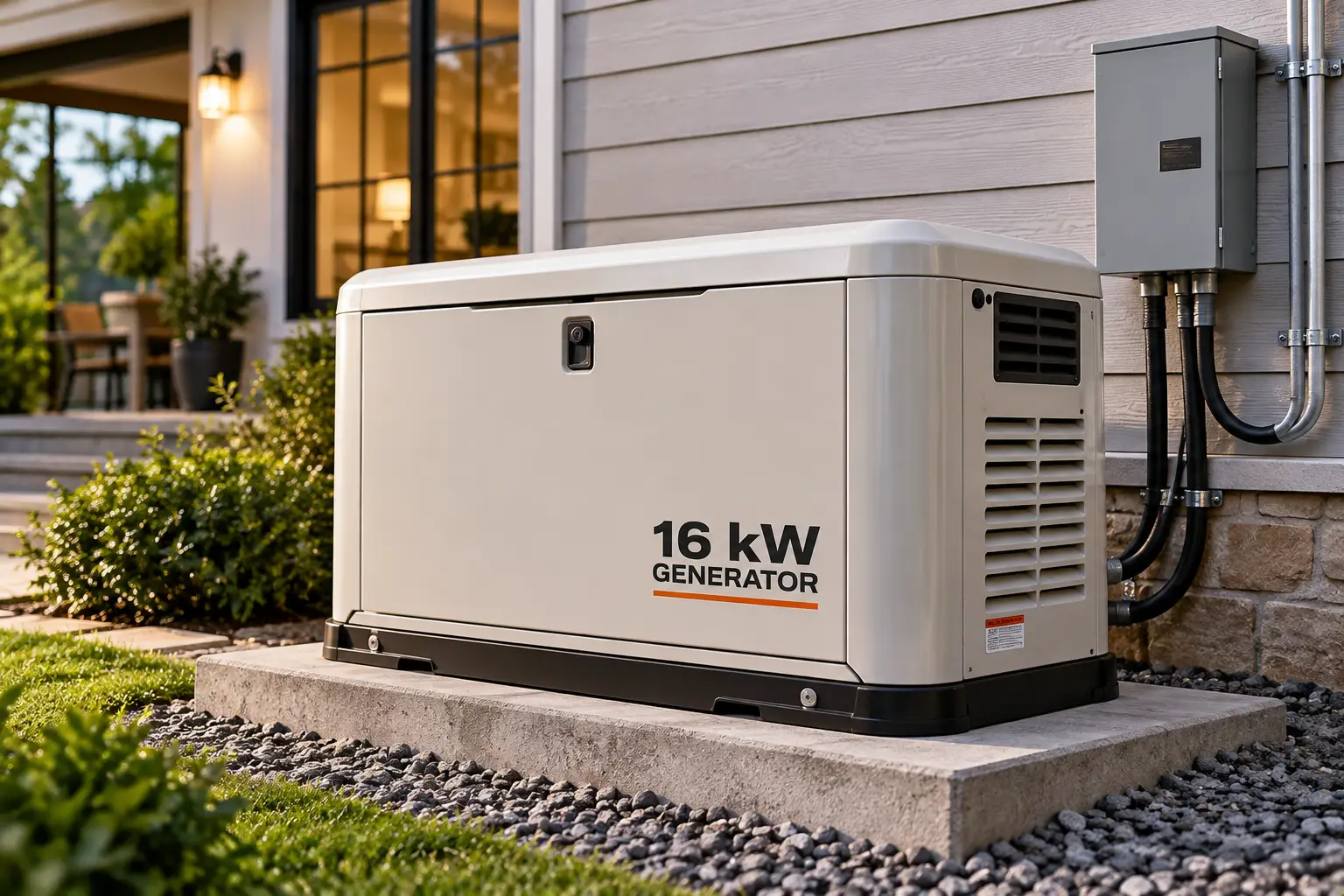
A 16 kw generator is a backup power unit that produces roughly 16,000 watts of electricity — enough to run central air, a refrigerator, a well or sump pump, lighting, and electronics in a typical 2,000–3,000 sq. ft. home. It comes as a permanently installed standby unit or a large portable. If you want the engineering background, Wikipedia’s overview of the engine–generator explains how the engine and alternator work together.
Quick Comparison: 16 kw generator Options at a Glance
| Model | Type | Rated Output | Fuel | Approx. Price Range* | Best For |
|---|---|---|---|---|---|
| Generac Guardian 18kW | Home standby | 18kW (LP) | Natural gas / LP | $5,000–$7,000 | Generac Guardian 18kW: whole-home coverage with headroom |
| Kohler 18RCAL | Home standby | 18kW LP / 18kW NG | Natural gas / LP | $6,000–$8,000 | Kohler 18RCAL: natural gas homes with big AC loads |
| Champion 14kW aXis | Home standby | 14kW | Natural gas / LP | $4,500–$5,500 | Champion 14kW aXis: long warranty, quiet neighborhoods |
| Generac Guardian 14kW | Home standby | 14kW LP / 14kW NG | Natural gas / LP | $5,000–$6,500 | Generac Guardian 14kW: budget standby with load shedding |
| DuroMax XP16000iH | Portable inverter | 16,000 peak W | Gas / propane | $5,000–$6,000 | DuroMax XP16000iH: clean power, sensitive electronics |
| Generac GP17500E | Portable | 17,500 running W | Gasoline | $3,500–$4,500 | Generac GP17500E: max portable muscle, rural homes |
| DuroMax XP15000EH | Portable | 15,000 peak W | Gas / propane | Under $2,500 | DuroMax XP15000EH: lowest entry price for whole-home backup |
*Unit-only ranges at the time of writing; standby installation is extra. Check the current price — prices may vary.
Looking at the table, the split is clear: standby units like the Generac Guardian 18kW and Kohler 18RCAL cost more up front but run on your utility gas line and start themselves, while portables like the DuroMax XP15000EH get you similar wattage for a fraction of the price — if you’re willing to refuel and connect them manually. The DuroMax XP16000iH is the odd one out: portable, but with inverter-grade power quality that rivals the standby units.
💬 One click helps other shoppers make an informed choice too! 😊
Top 7 16 kw generator Picks: Expert Analysis
1. Generac Guardian 18kW — best all-round whole-home pick
The Generac Guardian 18kW sits just above the 16kW mark, which is exactly why it’s become the go-to replacement for the discontinued 16kW Guardian. It’s sold with a 100-amp transfer switch (model 7226) or a 200-amp package (model 7228), so it can slot into most existing panels.
Generac’s TruePower technology keeps total harmonic distortion under 5%, which in practice means your TV, laptop, and furnace control board see power as clean as the grid’s. Mobile Link Wi-Fi lets you check status and maintenance alerts from your phone, and the Quiet-Test weekly exercise runs at reduced RPM so your neighbors won’t notice it.
Our take: this is the “set it and forget it” choice for homes that need 16kW of real-world capacity. Because natural gas ratings run a bit lower than propane on air-cooled engines, the extra 2kW of nameplate headroom matters more than it looks on paper. Pair it with Generac’s Smart Management Modules and it can comfortably cycle a dryer and water heater around a central AC unit.
Across retailer listings, Guardian-series feedback is generally strong, with owners praising automatic operation and app monitoring; the recurring complaints tend to involve installer scheduling and dealer service rather than the machine itself.
Pros:
- ✅ Comfortable headroom above the 16kW target
- ✅ Clean TruePower output for sensitive electronics
- ✅ Huge dealer and parts network nationwide
Cons:
- ❌ Standard warranty shorter than Champion’s ten years
- ❌ Installation can double the total project cost
Expect roughly $5,000–$7,000 for the unit and switch before installation — strong value if you want zero-effort, whole-home coverage.
2. Kohler 18RCAL — strongest natural gas output
The Kohler 18RCAL solves the problem most air-cooled generators quietly ignore: power loss on natural gas. Kohler’s spec sheet rates it at 18kW on both LP and natural gas, so you don’t give up capacity when you hook it to a utility line.
It’s packaged with a 200-amp service-entrance-rated RXT transfer switch and runs on a Kohler Command PRO OHV engine with hydraulic valve lifters — translation: no periodic valve adjustments, which is a real long-term maintenance saving. PowerBoost technology is designed to start large loads like central AC without dropping other circuits, and Kohler says its generators restore power in about 10 seconds. OnCue Plus remote monitoring is included.
Our take: if your home runs on natural gas and has a 4- or 5-ton AC, this is the unit that most honestly delivers “16kW and then some.” It’s also the most commercially minded engine in this lineup. The trade-off is price and dealer dependence — Kohler has historically required authorized-dealer startup to validate the warranty, so factor in a local dealer before you buy.
We couldn’t verify a large, model-specific Amazon review pool for the Kohler 18RCAL at the time of writing; general Kohler home-standby feedback tends to emphasize build quality and full-speed exercise reliability.
Pros:
- ✅ Full 18kW rating on natural gas
- ✅ Hydraulic lifters reduce long-term maintenance
- ✅ 200-amp service-entrance switch included
Cons:
- ❌ Usually the priciest option in this class
- ❌ Fewer reviews to verify than Generac models
In the $6,000–$8,000 range for the package (check current price), it’s a premium buy that earns its cost in natural gas homes.
3. Champion 14kW aXis — longest warranty in its class
The Champion 14kW aXis wins on peace of mind: Champion backs it with a 10-year limited warranty, double what most competitors include as standard.
Under the gullwing enclosure is a 754cc Champion V-twin rated at 14,000 watts with less than 5% THD. Champion rates it at 62 dBA operating noise — roughly the sound of a conversation — and the aXis platform uses power-line-carrier communication, so your electrician doesn’t run extra control wiring to load modules. The aXis switch manages high-demand appliances across four priority levels.
Our take: on paper, 14kW sits below our 16kW target, but smart load management narrows the gap. If you prioritize the AC and let the dryer and range wait, a 14kW unit with good load shedding behaves much like a 16kW one with none. It’s ideal for suburban lots with close neighbors and for buyers who plan to stay in the home 10+ years.
Retailer feedback for the aXis line is thinner than for Generac’s, but the warranty and quiet operation are the most cited positives. One practical note: the 100837 package requires two 12-volt Group U1 batteries that aren’t included.
Pros:
- ✅ Ten-year limited warranty is class-leading
- ✅ Quiet 62 dBA rating for close lots
- ✅ Simple wireless-style load management setup
Cons:
- ❌ Batteries not included in the box
- ❌ Only works with Champion aXis switches
Expect around $4,500–$5,500 for the generator-and-switch package — excellent long-term value.
4. Generac Guardian 14kW — smart lower-cost standby
The Generac Guardian 14kW is the budget door into the Generac ecosystem, and with the right switch it punches above its rating.
It runs on Generac’s 816cc G-Force engine, the same displacement the old 16kW Guardian used, and is rated at 14kW on both propane and natural gas. The model 7225 package bundles a load-shedding Smart Switch, which automatically drops lower-priority circuits before the generator overloads. The RhinoCoat powder-coated aluminum enclosure resists corrosion, and at about 385 pounds and 48 × 25 × 29 inches, it fits most side yards.
Our take: this is the logical pick if your realistic simultaneous load is closer to 12–14kW, or if your utility only supplies modest gas pressure. Because it shares the old 16kW model’s engine size, it handles motor-starting loads more gracefully than its nameplate suggests — but it is not a true 16kW unit, so don’t plan on running everything at once.
Owner feedback across retailers tracks the broader Guardian pattern: automatic starts and Mobile Link monitoring earn praise, while installation timelines and dealer responsiveness are the main frustrations.
Pros:
- ✅ Same 816cc engine size as old 16kW
- ✅ Load-shedding Smart Switch package available
- ✅ Equal rating on propane and natural gas
Cons:
- ❌ Real capacity sits below 16kW target
- ❌ Five-year warranty versus Champion’s ten
Around $5,000–$6,500 with a transfer switch, it’s a sensible value if load management is part of your plan.
5. DuroMax XP16000iH — biggest clean-power portable
The DuroMax XP16000iH is DuroMax’s flagship, marketed as the largest dual-fuel digital inverter on the market — and it’s the closest thing to a true portable 16 kw generator you can buy.
It delivers 16,000 peak watts on gasoline (15,200 on propane), with DuroMax listing about 13,000 running watts (some retailers list 12,000, so verify before you size your loads). Inverter output means stable, low-distortion power for computers and smart appliances. Two 120/240V 50-amp outlets make it transfer-switch ready, the 10.5-gallon tank is rated for about 10.5 hours at half load, and demand-based variable idle throttles the engine down when loads are light. A remote start, CO alert shutdown, and battery tender round it out.
Our take: this is the portable for people who want standby-quality power without standby installation costs — renters, people in areas with long permit waits, or RV owners who also want home backup. A tri-fuel sibling, the DuroMax XP16000iHT, adds natural gas for anyone with a gas hookup.
We couldn’t verify a large Amazon review count for this model; retailer listings we found show limited reviews, so treat it as a promising but less battle-tested option.
Pros:
- ✅ Inverter-clean power from a portable frame
- ✅ Two 50-amp outlets for flexible hookups
- ✅ CO alert and remote start included
Cons:
- ❌ Pricey compared with conventional portables
- ❌ Limited verified long-term owner feedback
Roughly $5,000–$6,000 (check current price) — fair value if clean power is non-negotiable.
6. Generac GP17500E — most raw portable muscle
The Generac GP17500E is the brute of this list, rated at 17,500 running watts and 26,250 starting watts — enough, Generac says, to start many 5-ton air conditioners.
It’s built around a 992cc Generac OHVI engine with full pressure lubrication and a spin-on oil filter, which is unusual on portables and a big reason it handles long run hours. A 16-gallon tank, hour meter, idle control, and low-oil-pressure shutdown add durability, and the panel includes a 50-amp 14-50R outlet plus L14-30R and L5-30R twist-locks. It weighs about 390 pounds on a steel cradle with heavy-duty wheels.
Our take: if you need the most wattage per dollar and don’t mind gasoline, this is it. It’s especially good for rural homes with well pumps and electric water heaters. Two caveats: it’s a 49-state (not California-compliant) model, and the spec sheet we reviewed doesn’t list a CO shutoff sensor — which matters, because Consumer Reports only recommends portables with CO safety technology.
Retailer feedback tends to praise the starting power and runtime; we also found isolated reports of failures during long outages, which is why break-in and oil changes matter so much.
Pros:
- ✅ Highest running watts in this roundup
- ✅ Pressure-lubricated engine with oil filter
- ✅ Starts many 5-ton central AC units
Cons:
- ❌ Gasoline only, with heavy fuel appetite
- ❌ No CO shutoff listed in specs
Around $3,500–$4,500 — strong value for sheer power, if you plan your fuel and placement carefully.
7. DuroMax XP15000EH — budget whole-home portable
The DuroMax XP15000EH is the cheapest serious path into 16kW-class territory, trading a little wattage for a much lower entry price.
Its 713cc V-twin produces 15,000 peak and 12,500 running watts on gasoline, or 14,250 peak and 11,400 running on propane. Dual fuel means you can store propane for months without worrying about stale gasoline. The panel includes a transfer-switch-ready 50-amp outlet, 30-amp twist-locks, GFCI outlets, and a digital meter showing voltage, frequency, and hours. It’s EPA and CARB compliant for all 50 states and carries a 3-year residential warranty.
Our take: this is the realistic pick for budget-conscious homeowners who already have, or plan to add, a 50-amp inlet and interlock kit. On propane you’ll be closer to 11kW running, so treat it as an “essentials plus one AC” machine rather than a true whole-home 16kW unit.
Review summaries we found describe sentiment as mixed: buyers praise its ability to run central AC and pool pumps, while complaints center on quality-control variability and the effort of moving a heavy frame.
Pros:
- ✅ Lowest entry price in this roundup
- ✅ Dual fuel with propane storage flexibility
- ✅ 50-state EPA and CARB compliant
Cons:
- ❌ Propane output drops to about 11.4kW
- ❌ Mixed reviews on quality consistency
Typically under $2,500 (check current price) — the best value per watt if you accept manual operation.
Side-by-Side Spec Comparison
| Model | Engine | Running Output | Warranty | Auto Start | Best For |
|---|---|---|---|---|---|
| Generac Guardian 18kW | G-Force V-twin | 18kW LP | 5 years | Yes | Generac Guardian 18kW: true 16kW+ coverage |
| Kohler 18RCAL | Command PRO OHV | 18kW LP/NG | 5 yr / 2,000 hr | Yes | Kohler 18RCAL: natural gas homes |
| Champion 14kW aXis | 754cc V-twin | 14kW | 10 years | Yes | Champion 14kW aXis: long ownership |
| Generac Guardian 14kW | 816cc G-Force | 14kW LP/NG | 5 years | Yes | Generac Guardian 14kW: managed loads |
| DuroMax XP16000iH | V-twin inverter | ~13,000W gas | 5 years | Remote | DuroMax XP16000iH: electronics |
| Generac GP17500E | 992cc OHVI | 17,500W gas | Check listing | No | Generac GP17500E: heavy rural loads |
| DuroMax XP15000EH | 713cc V-twin | 12,500W gas | 3 years | No | DuroMax XP15000EH: tight budgets |
The spec table shows why “16kW” is a moving target: the Generac GP17500E has the highest raw running output, yet the Kohler 18RCAL is the only unit that holds its full rating on natural gas. Meanwhile, the Champion 14kW aXis trails on wattage but leads on warranty by five years, which can outweigh a 2kW difference if you plan to keep the house long-term.
✨ Don’t miss these power-packed picks!
🔍 Take your home backup plan to the next level with this carefully curated lineup. Click a highlighted model to check current pricing and availability. These picks will help you keep the lights, the AC, and the fridge running when the whole block goes dark! ⚡
Getting Started: Your First 30 Days With a 16 kw generator
Buying the generator is the easy part. The first month is where good habits (or expensive mistakes) begin.
Week 1 — Installation and permits. For standby units, get at least three quotes. Your installer should pull an electrical permit, and if you use propane, a gas permit and tank sizing check too. Confirm the unit’s clearance from windows, doors, and vents before the pad is poured — moving it later is costly.
Week 1 — Break-in for portables. Portables like the Generac GP17500E and DuroMax XP15000EH ship without oil. Fill to spec, run at light load for the first few hours, then change the oil early as the manual directs. Early oil changes flush out metal particles from manufacturing.
Week 2 — Load test. Don’t wait for a storm to learn what your 16kw generator can actually run. Flip off the main breaker (or trigger a test from the controller), then turn on loads one at a time: fridge, lights, furnace or AC, then extras. Note when the voltage sags or load management kicks in.
Week 3 — Fuel planning. For gasoline portables, store fuel with stabilizer and rotate it. For propane, a 500-gallon tank is common for whole-home standby use; ask your supplier about automatic refills. Check runtime math against your typical outage length.
Week 4 — Set up monitoring. Pair Mobile Link, OnCue Plus, or the aXis app, and turn on maintenance alerts. Write down your dealer’s service number on the generator itself.
Common first-month mistakes: skipping the indoor CO alarm, storing gasoline in the garage next to the water heater, and never actually testing the transfer switch.
Real-World Scenarios: Which 16 kw generator Fits Your Household?
Scenario 1: Suburban family, Gulf Coast, 2,400 sq. ft., natural gas. Outages hit 3–5 times a year during hurricane season and can last a week. Central AC (4-ton), fridge, freezer, and a home office are non-negotiable. Budget: $12,000–$16,000 installed. Best fit: the Kohler 18RCAL. Its full natural gas rating means the AC starts cleanly, and a week-long outage costs nothing in refueling trips. The Generac Guardian 18kW is a close second if a Generac dealer is closer.
Scenario 2: Retired couple, Midwest, ranch home, propane. Two or three short outages a year, plus one ice storm. They value quiet and want something that will outlast their time in the house. Budget: around $10,000 installed. Best fit: the Champion 14kW aXis. The 10-year warranty matches their horizon, the 62 dBA rating keeps peace with neighbors, and load management covers their modest simultaneous load.
Scenario 3: Rural homeowner with a well pump, wood shop, and tight budget. Outages are frequent but usually under 24 hours. They’re comfortable rolling out a generator and connecting it through an interlock kit. Budget: under $4,000 all-in. Best fit: the DuroMax XP15000EH if fuel flexibility matters, or the Generac GP17500E if raw starting power for the well and shop tools matters more.
The lesson across all three: outage frequency and duration should drive the standby-vs-portable decision far more than square footage.
Troubleshooting: 5 Common Problems and How to Fix Them
1. Generator won’t start after sitting for months. On portables, stale gasoline is the usual suspect. Drain the carburetor, use fresh fuel with stabilizer, or switch to propane on dual-fuel units like the DuroMax XP16000iH. On standby units, check the starting battery first — it’s the most common no-start cause.
2. Breakers trip when the AC kicks on. That’s a starting-watts problem, not a running-watts problem. Add a soft-start kit to the AC compressor, which can dramatically cut its inrush current, or rely on load management modules to shed other loads first.
3. Lights flicker under load. Voltage dips often mean you’re near the generator’s limit or the fuel supply is undersized. For natural gas standby units, have your installer verify gas pressure and pipe diameter at full load — undersized gas lines are a classic installation shortcut.
4. Weekly exercise is too loud. Units like the Generac Guardian 14kW offer a reduced-RPM Quiet-Test mode; ask your dealer to schedule it mid-morning on a weekday.
5. App shows “offline.” Wi-Fi range is the usual culprit. A mesh node or outdoor-rated extender near the generator typically fixes it. Some newer packages use cellular connectivity, which sidesteps the problem entirely.
How to Choose a 16 kw generator
Use these seven steps to narrow the field quickly:
- Add up your running watts. List everything you must run at once. Consumer Reports’ generator sizing guide recommends exactly this approach before you pick a size.
- Add the biggest starting surge. Find your largest motor load (usually central AC or a well pump) and add its starting watts on top — that’s your peak requirement.
- Decide standby or portable. Frequent or long outages favor standby; occasional short ones favor portables.
- Check your fuel. Natural gas means unlimited runtime but often reduced output on air-cooled units; propane gives full output but needs a tank; gasoline is cheap up front but hard to store.
- Plan the connection. Standby needs an automatic transfer switch; portables need a manual transfer switch or interlock kit installed by an electrician.
- Compare warranties honestly. Five years is standard for standby; ten years (Champion) is a real differentiator.
- Find your local service. A great generator with no nearby dealer is a bad generator. Call before you buy.
16kw generator Sizing: What Will 16,000 Watts Actually Run?
Numbers on a spec sheet are abstract until you translate them into appliances. At 240 volts, 16,000 watts works out to about 66 amps of continuous capacity — roughly a third of a typical 200-amp service, which sounds small until you remember that homes rarely draw anywhere near their full service rating.
Here’s what a 16kw generator can realistically support at the same time in a typical home: a 3- to 4-ton central AC (about 3,500–5,000 running watts), refrigerator and freezer (around 1,200 watts combined while running), furnace blower, LED lighting throughout, a home office, TVs, a microwave in short bursts, and a sump or well pump. What strains it: electric ranges, electric dryers, and electric tank water heaters, each of which can pull 4,000–5,500 watts alone.
That’s why load management matters so much in this class. A 16kw whole house generator with smart load shedding can cover nearly everything — it just won’t let the dryer and water heater run while the AC compressor is starting.
Also remember the fuel derate: air-cooled standby units commonly lose output on natural gas compared with propane, and many portables lose roughly 5–10% switching from gasoline to propane (the DuroMax XP15000EH drops from 12,500 to 11,400 running watts). Size for the fuel you’ll actually burn.
16 kw standby generator vs Portable 16000 watt generator
This is the decision that shapes everything else, so let’s be blunt about the trade-offs.
A 16 kw standby generator is permanently mounted on a pad, wired through an automatic transfer switch, and plumbed to natural gas or a propane tank. When the grid fails, it starts itself within seconds and shuts itself down when power returns. You don’t have to be home, awake, or healthy for it to work — which is why families with medical equipment or elderly relatives often choose standby.
A portable 16000 watt generator, by contrast, rolls out of the garage, sits at a safe distance outdoors, and connects through an inlet box and transfer switch or interlock. It’s dramatically cheaper and you can take it to a job site or campground. But someone has to start it, refuel it, and manage loads — often in the middle of a storm.
| Factor | 16 kw standby generator | Portable 16000 watt generator | Smaller (5–8kW) portable |
|---|---|---|---|
| Startup | Automatic, in seconds | Manual or remote | Manual |
| Fuel | NG / LP, no refueling | Gas / LP, refuel often | Gas, refuel often |
| Central AC | Usually yes | Often yes | Rarely |
| Installed cost | Highest | Moderate | Lowest |
| Best for | Generac Guardian 18kW owners wanting zero effort | DuroMax XP16000iH owners wanting flexibility | Essentials only |
The table shows the core advantage of the 16kW class over traditional small portables: central air and whole-home comfort become possible. Between the two 16kW options, standby wins on convenience and safety, while a portable like the Generac GP17500E wins on cost — but only if you’re physically able to manage it during an emergency.
16 kw generator price and Long-Term Cost of Ownership
The sticker is only the beginning. For standby units, installation often costs as much as the generator — industry guides put typical installation between $5,000 and $10,000 depending on gas line runs, pad work, permits, and electrical upgrades. That means a 16 kw generator price of $5,000–$7,000 for the unit can become $10,000–$17,000 installed.
| Cost Item | Standby (e.g., Generac Guardian 18kW) | Portable (e.g., DuroMax XP15000EH) |
|---|---|---|
| Unit | $5,000–$7,000 | Under $2,500 |
| Installation / hookup | $5,000–$10,000 | $500–$2,000 (inlet + interlock) |
| Annual maintenance | $200–$400 (dealer service) | $50–$150 (DIY oil, plugs) |
| Fuel per outage day | Moderate (piped gas) | Higher (gasoline runs) |
| Best for | Generac Guardian 18kW: frequent long outages | DuroMax XP15000EH: occasional short outages |
Over ten years, the standby option costs far more, but it also adds resale appeal and eliminates refueling labor. Portables win decisively on total cost if outages are rare — the question is how much your time, safety, and comfort are worth during a multi-day event.
Maintenance matters to ROI too. Generac’s 16kW-class Guardian units have used a two-year, 200-hour oil change interval, while the Kohler 18RCAL uses hydraulic valve lifters that avoid periodic valve adjustments. Small details like these shave real money off a decade of ownership.
Features That Actually Matter (and Ones That Don’t)
Matter a lot:
- ✅ Load management. It’s the difference between a 14kW unit that feels like 18kW and an 18kW unit that keeps tripping.
- ✅ Low THD (under 5%). Modern HVAC boards, variable-speed motors, and electronics care about power quality.
- ✅ CO shutoff on portables. A built-in sensor that kills the engine when carbon monoxide builds up is a genuine lifesaver.
- ✅ Warranty length and dealer access. These decide what happens when something breaks.
Matter less than marketing suggests:
- ❌ Peak watts as a headline number. Running watts tell you what the unit can sustain; peak watts last only seconds.
- ❌ USB ports on a 400-pound generator. Nice, but irrelevant to whole-home backup.
- ❌ Fancy app dashboards. Monitoring is useful; animated graphs are not a buying reason.
A good rule: if a feature doesn’t affect starting, running, safety, or service, don’t pay a premium for it.
Safety, Regulations, and Standards
Generators are among the most dangerous appliances a homeowner can own when used carelessly. The Consumer Product Safety Commission estimates that roughly 85 consumers die in the U.S. each year from carbon monoxide poisoning linked to portable generators, and warns that a single unit can emit as much CO as hundreds of cars.
Key rules to follow:
- Never run a portable generator inside a home, garage, basement, crawlspace, shed, or on a porch — even with doors open.
- Look for portables certified to PGMA G300 or UL 2201, standards built around CO shutoff or reduced emissions.
- Install battery-backed CO alarms on every level of the home, including near bedrooms. Standby installers commonly require one.
- Never backfeed through a dryer outlet. Use a properly installed transfer switch or UL-listed interlock kit so you don’t energize utility lines and endanger line workers.
- Standby units must meet local electrical and fuel-gas codes, including manufacturer clearance rules; many modern units are rated for installation as close as 18 inches from the house, but local codes can be stricter.
- In California, check CARB compliance — the Generac GP17500E is sold as a 49-state model, while the DuroMax XP15000EH is 50-state compliant.
Common Mistakes to Avoid When Buying a 16kw whole house generator
Buying on nameplate alone. A 16kw whole house generator rated on propane may deliver noticeably less on natural gas. Always check both ratings.
Ignoring the transfer switch. The switch decides how much of your home actually gets power. A 100-amp switch on a 200-amp panel leaves circuits dark.
Skipping the gas line check. Undersized meters and pipes starve standby units under load. A good installer measures pressure at full load.
Waiting for hurricane season. Lead times, installer backlogs, and permit queues all spike before storms. Buy in the off-season.
Choosing a brand with no local dealer. Even the best warranty is useless if the nearest technician is three hours away.
Forgetting about noise rules. Some HOAs and municipalities set sound limits; units like the Champion 14kW aXis with low dBA ratings make approval easier.
Treating a portable as a standby. If nobody in the house can safely move and fuel a 300- to 400-pound generator during a storm, a portable isn’t really your backup plan.
FAQ: 16 kw generator Questions Buyers Ask
❓ How much does a 16 kw generator cost installed in 2026?
❓ Can a 16kw generator run a whole house with central air?
❓ How much propane does a 16 kw standby generator use per day?
❓ Is a 16000 watt generator worth it over a 22kW model?
❓ Where can I buy a 16kw whole house generator online?
Conclusion: Picking the Right 16 kw generator for Your Home
The best 16 kw generator isn’t the one with the biggest number on the side — it’s the one that matches your outages, your fuel, and your willingness to be hands-on.
If you want automatic, whole-home protection, the Generac Guardian 18kW is the most balanced choice, and the Kohler 18RCAL is the stronger buy for natural gas homes with heavy AC loads. If you’ll own the house for the long haul, the Champion 14kW aXis pairs smart load management with an unmatched 10-year warranty, while the Generac Guardian 14kW offers a lower-cost Generac entry with load shedding.
On the portable side, the DuroMax XP16000iH delivers inverter-clean power in a rolling frame, the Generac GP17500E brings the most raw wattage per dollar, and the DuroMax XP15000EH is the most affordable route to whole-home backup.
Whichever you choose, pair it with a proper transfer switch, a CO alarm, and a written outage plan. FEMA’s Ready.gov power outage guide is a great checklist to build that plan around. Do it before storm season, and the next blackout becomes an inconvenience instead of an emergency.
🔌 Ready to keep the lights on? Your perfect backup is one click away!
⚡ Compare the highlighted models above, check current pricing and availability, and lock in the 16 kw generator that fits your home, your fuel, and your budget — before the next storm makes the decision for you! 🏠✨
Recommended for You
- Off Grid AC Unit: 7 Best Picks That Actually Work in 2026
- Fuel Efficient Generator: 7 Best Picks That Sip Gas in 2026
- Portable Charger Rental: 7 Best Power Bank Rental Solutions
Disclaimer: This post contains affiliate links. As an Amazon Associate, I earn from qualifying purchases made through these links, at no additional cost to you.
✨ Found this article helpful? Share it with someone who needs it! 💬🤗
