
In This Article
What Is a Solar Panel for 12 Volt Battery?
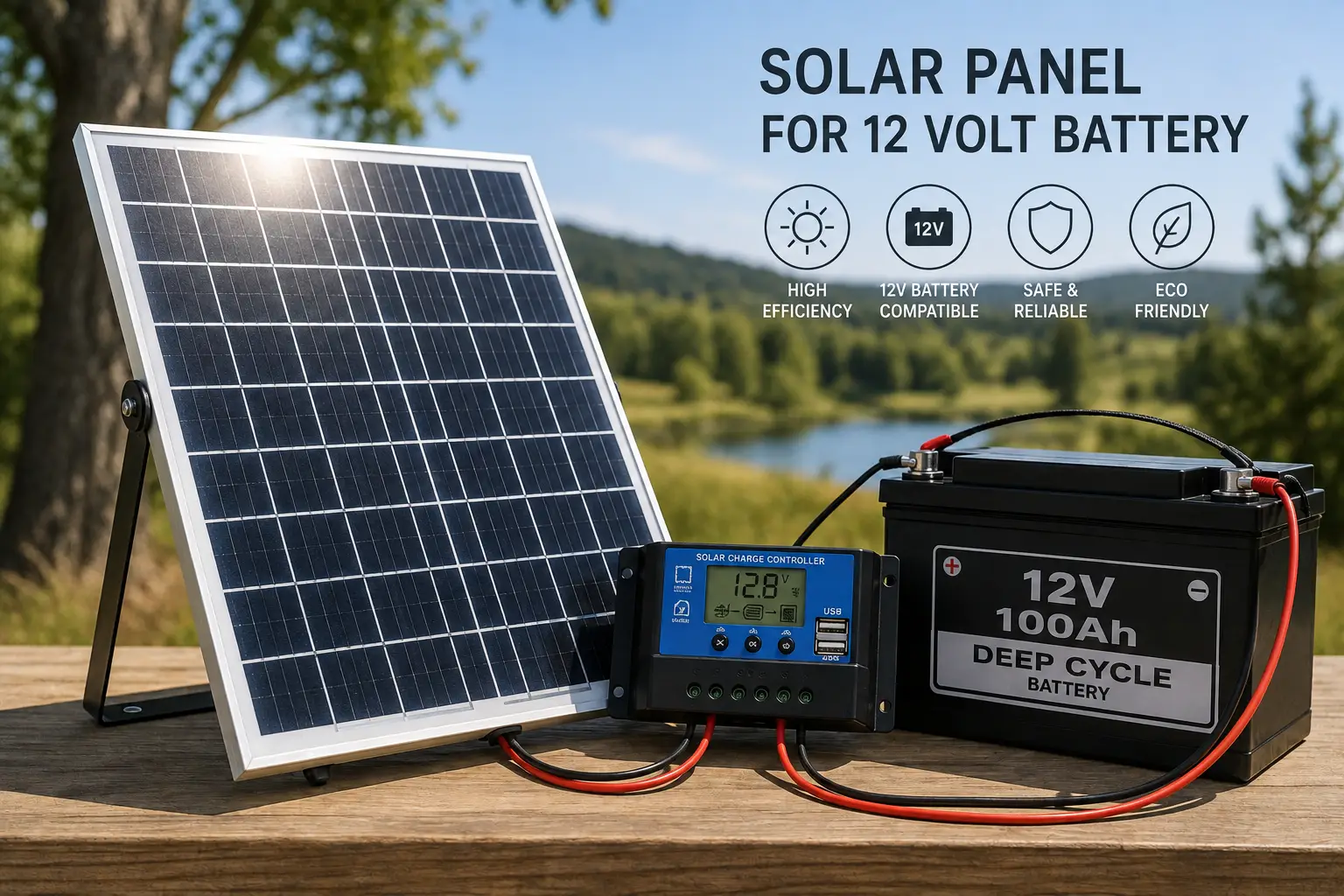
A solar panel for 12 volt battery is a solar charging system designed to provide the appropriate voltage and power needed to recharge a nominal 12V battery. These systems are commonly used for RVs, boats, camping setups, security equipment, sheds, backup power, and small off-grid applications.
One important detail is that a panel marketed as a “12V solar panel” does not actually operate at exactly 12 volts. Typical 12V nominal solar panels operate at a higher voltage — often around 17–22V under load — so there is enough voltage available for the charge controller to properly charge the battery. (Sunrich Energy)
The charge controller is therefore an essential part of the system. It regulates the electricity going from the panel into the battery and helps prevent overcharging.
There are two common controller types: PWM and MPPT. PWM controllers are generally simpler and less expensive, while MPPT controllers can convert excess panel voltage into additional charging current and are generally more efficient, particularly for larger systems. (Sunrich Energy)
The correct panel size also depends on battery capacity. A 12V 50Ah battery doesn’t require the same solar panel as a 12V 200Ah battery.
For example, current sizing guidance suggests roughly 75–100W for a 12V 50Ah battery, 150–200W for a 12V 100Ah battery, and 300–400W for a 12V 200Ah battery when the goal is practical daily recharging rather than simple maintenance. (Renogy US)
This guide compares seven useful solar panel for 12 volt battery options and explains what actually matters: panel wattage, battery capacity, charging speed, MPPT vs. PWM, panel voltage, weather resistance, portability, and charge-controller sizing.
Quick Comparison: Top Solar Panels for 12 Volt Batteries at a Glance
| Product | Power | Main Feature | Best For |
|---|---|---|---|
| Renogy 100W 12V Solar Panel | 100W | Compact rigid panel | 12V 50–100Ah batteries |
| Renogy 200W Solar Panel | 200W | Higher daily charging capacity | 12V 100Ah batteries |
| Renogy 100W Flexible Solar Panel | 100W | Lightweight flexible design | RVs & boats |
| Newpowa 100W Solar Panel | 100W | Compact monocrystalline design | Small off-grid systems |
| HQST 100W 12V Solar Panel | 100W | Budget-friendly setup | Beginners |
| BougeRV 200W Solar Panel | 200W | High-output portable option | Camping & RV |
| Renogy 400W Solar Panel Kit | 400W | Complete higher-power system | 12V 200Ah batteries |
The comparison makes one thing clear: the “best” solar panel for 12 volt battery depends on your battery capacity and how quickly you want to recharge it.
A 100W panel is a common starting point for smaller 12V systems. If you’re working with a 12V 100Ah battery and want reliable daily recharging, current sizing guides commonly place the practical range around 150–300W depending on battery chemistry, sunlight, and system losses. (Renogy US)
For a stored battery that only needs maintenance charging, however, you may not need anywhere near that much power. Current 2026 sizing guidance suggests approximately 10–30W can be enough for maintenance charging when the battery isn’t being regularly discharged. (Uniz Solar)
💬 Bookmark this comparison — it’s the fastest way to match panel wattage with your 12V battery capacity before choosing a solar charging setup.
Top 7 Solar Panels for 12 Volt Batteries: Expert Analysis
1. Renogy 100W 12V Solar Panel — best overall
The Renogy 100W 12V Solar Panel is a practical starting point for many small 12V battery systems.
A 100W panel is large enough to provide meaningful charging power without becoming excessively large or difficult to install.
With an MPPT controller, a 100W panel can theoretically provide around 8.3A at a nominal 12V battery voltage before accounting for real-world losses. Actual charging current will vary depending on sunlight, battery state, controller efficiency, wiring, and temperature. (TheGreenWatt)
This makes a 100W panel particularly suitable for smaller batteries and light-duty applications.
It can work well for RV lighting, small electronics, security systems, garden equipment, and battery maintenance.
Pros:
- ✅ 100W output
- ✅ Good starting size for 12V systems
- ✅ Compact compared with larger arrays
- ✅ Suitable for many RV and off-grid applications
Cons:
- ❌ May be too small for a frequently discharged 12V 100Ah battery
- ❌ Requires a properly sized charge controller
- ❌ Charging speed depends heavily on sunlight
If you’re building your first solar panel for 12 volt battery system, 100W is one of the easiest capacities to work with.
2. Renogy 200W Solar Panel — best for 12V 100Ah batteries
The Renogy 200W Solar Panel provides roughly twice the rated power of a 100W panel, making it more appropriate when faster charging is important.
A 12V 100Ah battery contains roughly 1,200Wh of nominal energy, although the usable amount depends heavily on battery chemistry and allowable depth of discharge.
Current Renogy guidance recommends approximately 150–200W for a 12V 100Ah battery, while other 2026 sizing calculations suggest 200–300W can provide more practical headroom depending on conditions. (Renogy US)
The additional panel capacity is especially useful when sunlight is inconsistent or when the battery is regularly cycled.
Pros:
- ✅ 200W output
- ✅ Better charging potential than 100W
- ✅ Good fit for many 12V 100Ah systems
- ✅ Useful for RV and camping applications
Cons:
- ❌ Larger installation footprint
- ❌ Requires a larger charge controller
- ❌ More expensive than a 100W setup
For a 12V 100Ah battery, 200W is a practical middle-ground when you want meaningful daily charging capacity.
3. Renogy 100W Flexible Solar Panel — best for RVs and boats
A flexible solar panel can be useful when a rigid panel isn’t practical.
The lightweight design can conform to some curved surfaces, making this format attractive for RV roofs, boats, vans, and other mobile applications.
The main benefit isn’t necessarily greater electrical performance. It’s installation flexibility.
A rigid 100W panel may be excellent on a flat roof, but a flexible panel can be easier to integrate into a mobile setup where weight and mounting height matter.
Pros:
- ✅ Lightweight
- ✅ Flexible construction
- ✅ Useful for RVs and boats
- ✅ 100W capacity
Cons:
- ❌ Flexible panels require careful installation
- ❌ Heat management can be important
- ❌ May not be as convenient to replace as rigid panels
If you’re building a mobile solar panel for 12 volt battery system, flexibility can be worth more than a conventional rigid frame.
4. Newpowa 100W Solar Panel — best compact option
The Newpowa 100W Solar Panel is another straightforward choice for smaller 12V systems.
Its 100W capacity places it in the same general category as other entry-level solar panels designed for batteries, RVs, boats, and small off-grid installations.
The main advantage of a 100W panel is simplicity.
You can build a relatively compact system around one panel and expand later if your energy requirements increase.
Pros:
- ✅ 100W output
- ✅ Monocrystalline design
- ✅ Compact footprint
- ✅ Suitable for small 12V battery systems
Cons:
- ❌ Limited for large batteries
- ❌ One panel may not provide enough daily energy for heavy loads
- ❌ Requires a separate charge controller
For smaller battery banks, a single 100W panel can be a straightforward starting point.
5. HQST 100W 12V Solar Panel — best budget setup
The HQST 100W 12V Solar Panel is aimed at users who want a basic solar charging system without immediately moving into larger arrays.
A 100W panel can be useful for battery maintenance, small off-grid systems, lighting, and light RV applications.
It also provides an easy foundation for expansion. If your energy requirements increase later, you can potentially add additional compatible panels, provided the charge controller, wiring, and battery system are designed to handle the increased capacity.
Pros:
- ✅ 100W capacity
- ✅ Simple configuration
- ✅ Suitable for small systems
- ✅ Budget-friendly category
Cons:
- ❌ Not ideal for heavy daily loads
- ❌ Expansion requires additional equipment
- ❌ Charge-controller sizing becomes more important with multiple panels
If your goal is an affordable introduction to solar charging, a 100W panel is a sensible place to start.
6. BougeRV 200W Solar Panel — best for camping and RV use
The BougeRV 200W Solar Panel moves into a higher-output category suitable for users who need more energy than a single 100W panel can provide.
A 200W system can be particularly useful for RVs and camping setups where the 12V battery may need to power lights, fans, refrigerators, electronics, and other equipment.
The larger panel capacity provides more charging potential during available sunlight.
However, it also means you need to pay more attention to charge-controller capacity and wiring.
Pros:
- ✅ 200W output
- ✅ Good for larger 12V battery systems
- ✅ Suitable for camping and RVs
- ✅ Better charging potential
Cons:
- ❌ Larger and heavier
- ❌ Requires a larger controller
- ❌ More installation space required
For a mobile setup with a 12V 100Ah battery, 200W is often a much more useful capacity than 50W or 100W when daily energy use is significant.
7. Renogy 400W Solar Panel Kit — best high-output 12V system
A 400W system is designed for significantly greater energy requirements.
This type of setup can make sense for a 12V 200Ah battery bank, RVs, cabins, larger off-grid systems, and applications with substantial daily consumption.
Current 2026 sizing guidance places approximately 300–400W in the practical range for many 12V 200Ah systems, although exact requirements depend on battery chemistry, depth of discharge, sunlight, and daily energy consumption. (Renogy US)
At this power level, charge-controller sizing becomes particularly important.
For example, a simple 400W ÷ 12V calculation produces about 33.3A, before applying a safety margin. A controller must therefore be selected based on the panel array’s actual electrical specifications rather than simply choosing a controller because its label says “12V.” (TheGreenWatt)
Pros:
- ✅ 400W total capacity
- ✅ Suitable for larger 12V battery banks
- ✅ Better for daily energy production
- ✅ Useful for RV and off-grid systems
Cons:
- ❌ Larger installation
- ❌ Higher cost
- ❌ Requires a substantially larger charge controller
- ❌ More complicated wiring
If you’re building a serious solar panel for 12 volt battery system rather than simply maintaining a battery, 400W can provide much more useful charging capacity.
How to Choose a Solar Panel for 12 Volt Battery
Choosing the right solar panel for 12 volt battery starts with the battery’s amp-hour rating.
- Check battery voltage. Confirm that the battery is a nominal 12V system.
- Check battery capacity. Look for the Ah rating, such as 50Ah, 100Ah, or 200Ah.
- Determine daily energy use. A battery powering a refrigerator needs more solar than one maintaining a security system.
- Choose panel wattage. Larger batteries and heavier loads generally require larger panels.
- Consider battery chemistry. LiFePO4, AGM, and flooded lead-acid batteries have different charging characteristics.
- Choose an appropriate controller. Match the controller to the panel voltage, current, and battery.
- Consider MPPT vs. PWM. MPPT is generally more efficient and especially useful as system size increases. (Sunrich Energy)
- Check sunlight availability. More peak sun hours mean more energy production.
- Account for losses. Heat, wiring, controller efficiency, and shading reduce actual output. (Renogy US)
- Leave some headroom. A slightly larger panel can be useful when sunlight isn’t consistently ideal.
A useful starting point is 75–100W for 50Ah, 150–200W for 100Ah, and 300–400W for 200Ah, but these are general ranges rather than universal rules. (Renogy US)
Common Mistakes to Avoid When Buying a Solar Panel for 12 Volt Battery
The biggest mistake is connecting a solar panel directly to a 12V battery without a properly designed charge-control system.
The panel’s output voltage can exceed the battery’s charging voltage, and a charge controller is used to regulate that energy safely. Current guidance specifically warns that the panel should not simply be connected directly to the battery. (Callsun Solar)
Another mistake is assuming that a 100W panel will always deliver 100W.
Rated output is measured under specified test conditions. Real-world output changes with sunlight, temperature, shading, panel angle, wiring, and controller efficiency.
People also underestimate battery capacity.
A 100W panel may be perfectly reasonable for a small battery but insufficient for a heavily used 12V 200Ah system.
Another mistake is buying the controller based only on battery voltage.
The controller must also support the panel array’s maximum voltage and current.
Finally, don’t forget fusing and cable sizing. Larger solar arrays can produce substantial current, so system protection becomes increasingly important as wattage increases. (TheGreenWatt)
Solar Panel for 12 Volt Battery vs. 12 Volt Battery Charger
| Feature | Solar Panel System | AC Battery Charger |
|---|---|---|
| Power source | Sunlight | Electrical outlet |
| Operating cost | Low after purchase | Electricity cost |
| Portability | Excellent outdoors | Limited |
| Charging speed | Weather dependent | Consistent |
| Off-grid operation | Yes | No |
| Best for | Camping & backup | Home charging |
A solar system provides independence from the electrical grid.
An AC charger is generally more predictable because it isn’t dependent on weather.
For an RV, boat, cabin, or emergency backup system, solar is especially useful because you can recharge the battery without access to mains electricity.
Solar Panel for 12 Volt Battery vs. Solar Battery Charger
These terms are often used interchangeably, but there is a practical difference.
A solar panel generates electricity.
A solar battery charger typically refers to the complete system that includes the panel, charge controller, wiring, and sometimes mounting hardware.
When shopping, check exactly what is included.
A 100W panel alone isn’t the same thing as a complete 100W solar charging kit.
For beginners, a matched kit can reduce compatibility problems because the panel and controller are designed to work together.
Solar Panel for 12 Volt 50Ah Battery
A 12V 50Ah battery is relatively small.
For maintenance charging, a small 10–30W panel may be enough in suitable conditions. Current 2026 guidance specifically places 10–30W in the general range for maintenance-only applications. (Uniz Solar)
If you’re actively cycling the battery and want meaningful recharge capability, a larger panel is appropriate.
Renogy’s current sizing table places a 75–100W panel in the range for a 12V 50Ah battery. (Renogy US)
That makes 100W a convenient all-around choice if you want more than simple maintenance charging.
Solar Panel for 12 Volt 100Ah Battery
A 12V 100Ah battery is one of the most common sizes for RVs, boats, camping, and small off-grid systems.
A nominal 12V × 100Ah battery represents approximately 1,200Wh of stored energy.
However, you don’t necessarily want to replace all 1,200Wh every day. The usable amount depends on battery chemistry and depth of discharge.
Current sizing recommendations range from approximately 150–200W to 200–300W depending on the assumptions used. (Renogy US)
For a simple setup, 200W is a useful practical target when daily charging is important.
Solar Panel for 12 Volt 200Ah Battery
A 12V 200Ah battery represents approximately 2,400Wh of nominal stored energy.
That is a considerably larger battery bank, so a 100W panel is generally not an efficient choice if you expect to recharge significant amounts of energy every day.
Current sizing guidance places approximately 300–400W in the practical range for many 12V 200Ah systems. (Renogy US)
At this size, MPPT becomes increasingly attractive because the controller can make more effective use of the panel’s higher operating voltage. (Best Generator Solar)
Solar Panel for 12 Volt Battery Charging Time
Charging time depends on much more than panel wattage.
The basic energy relationship is:
Battery energy ≈ Voltage × Amp-hours
So:
12V × 100Ah = approximately 1,200Wh
But actual charging time depends on how deeply the battery is discharged, battery chemistry, sunlight, controller efficiency, temperature, and system losses.
For example, a current 2026 analysis estimates that a 100W panel can take roughly two days of average sun to recharge a 12V 100Ah LiFePO4 battery from 20% to full under its stated assumptions, while lead-acid can take longer because of its absorption stage. (TheGreenWatt)
This is why a larger panel is often preferable when you need dependable daily recharging.
Solar Panel for 12 Volt Battery: MPPT vs. PWM
| Feature | MPPT | PWM |
|---|---|---|
| Efficiency | Higher | Lower |
| Cost | Higher | Lower |
| Large systems | Excellent | Less ideal |
| Small systems | Useful | Good |
| Voltage conversion | Yes | Limited |
| Best for | Larger arrays | Simple setups |
MPPT controllers convert excess panel voltage into additional charging current.
For example, a 100W panel may operate around 18V at the panel and produce roughly 5.55A at that point. With an MPPT controller, the battery side can theoretically receive around 8.33A at 12V before losses. (TheGreenWatt)
PWM controllers are simpler and can be perfectly appropriate for smaller, cost-sensitive systems.
As the solar array becomes larger, however, MPPT generally becomes more attractive.
How Big Should the Charge Controller Be?
Charge-controller sizing is one of the most important parts of a solar panel for 12 volt battery system.
A common sizing approach is to calculate the array current and apply a safety margin.
For a 100W panel:
100W ÷ 12V ≈ 8.3A
Applying a 25% margin gives approximately:
8.3A × 1.25 ≈ 10.4A
So a controller around 10–15A is generally the relevant range for a simple 100W/12V setup, subject to the controller and panel specifications. (itek Energy)
For larger arrays, the required controller increases accordingly.
A 200W array can require around 20–30A, while a 400W 12V array can require approximately 40–50A depending on the wiring configuration and controller architecture. (TheGreenWatt)
Always use the manufacturer’s specifications rather than relying solely on a simplified calculation.
Features That Actually Matter
Solar-panel marketing can make the decision seem complicated, but a few specifications matter more than everything else.
Wattage determines the panel’s rated power.
Operating voltage matters because the panel must work correctly with your charge controller.
Battery capacity determines how much energy you need to replace.
Panel type matters for efficiency, durability, and installation.
MPPT compatibility matters for larger systems.
Weather resistance matters for outdoor installations.
Physical dimensions matter for RV roofs, boats, balconies, and portable systems.
And finally, expansion capability matters if you expect your energy requirements to increase.
A good system isn’t necessarily the one with the largest panel. It’s the one where the panel, controller, battery, wiring, and daily energy use are properly matched.
Long-Term Cost and Maintenance
A solar panel for 12 volt battery can provide years of service when properly installed and maintained.
The main maintenance task is keeping the panel reasonably clean.
Dust, dirt, leaves, and bird droppings can reduce the amount of sunlight reaching the cells.
Inspect cables and connectors periodically for damage.
Check mounting hardware on mobile systems such as RVs and boats.
For battery systems, inspect the battery and charge controller according to their respective manufacturer’s instructions.
The biggest long-term cost isn’t usually the panel itself. It can be the battery, controller, wiring, mounting hardware, and replacement components.
A correctly sized system can reduce the need for frequent battery replacement by providing appropriate charging rather than repeatedly allowing the battery to remain deeply discharged.
Safety and Installation Considerations
A solar panel can produce electricity whenever it’s exposed to light.
For that reason, treat the panel wiring as energized during installation.
Use appropriately rated cables, connectors, fuses, disconnects, and charge controllers.
A fuse or DC breaker is commonly installed in the positive line between the controller and battery, positioned close to the battery, to provide protection against short circuits. (Uniz Solar)
Never connect a large solar panel directly to a battery without an appropriate charge-control system.
Also verify that the controller’s maximum PV voltage exceeds the panel array’s maximum open-circuit voltage, including relevant temperature considerations. (Callsun Solar)
If you’re unsure about electrical installation, have the system installed or inspected by a qualified professional.
What to Expect: Everyday Performance
The best solar panel for 12 volt battery system should provide predictable charging without requiring constant adjustment.
On a clear day with good panel orientation, the system can produce useful charging energy.
Clouds and shade will reduce production.
The battery will also accept less current as it approaches a full state of charge, depending on battery chemistry and the controller’s charging profile.
That’s normal.
A common mistake is expecting a 100W panel to deliver 100W continuously for eight hours. Solar panels produce variable power throughout the day, and real-world output is affected by weather, temperature, orientation, and system losses. (Renogy US)
Frequently Asked Questions
❓ What size solar panel do I need for a 12V 100Ah battery?
❓ Can a 100W solar panel charge a 12V battery?
❓ Do I need a charge controller for a solar panel for 12 volt battery?
❓ Is MPPT better than PWM for a 12V battery?
❓ How many watts of solar do I need for a 12V 200Ah battery?
Conclusion
Choosing the right solar panel for 12 volt battery starts with one simple question: how much energy does your battery actually need?
For small 12V systems, a 100W panel is a practical starting point. It’s compact enough for RVs, boats, small off-grid applications, and battery maintenance while providing meaningful charging capacity.
For a 12V 100Ah battery, moving up to 150–200W provides a more practical charging range, while 200–300W can provide additional headroom for daily use and less-than-perfect sunlight. (Renogy US)
For larger 12V 200Ah batteries, a 300–400W system is more appropriate when you need substantial daily recharging. (Uniz Solar)
The charge controller is just as important as the panel. MPPT controllers generally provide better efficiency, particularly as system size increases, while PWM can be a simpler choice for smaller setups. (Sunrich Energy)
The biggest lesson is simple: don’t choose a solar panel based only on the words “12V.” Look at battery capacity, wattage, charge-controller rating, battery chemistry, daily energy consumption, sunlight, wiring, and system losses.
Once those pieces are properly matched, a solar panel can provide a reliable way to recharge a 12V battery for camping, RVs, boats, backup systems, and off-grid applications.
✨ Don’t miss these exclusive deals! 🔍 Build your 12V solar charging system with confidence using this carefully curated lineup. Compare panel wattage, battery capacity, MPPT vs. PWM controllers, charging speed, installation size, and outdoor durability before choosing the solar panel for 12 volt battery setup that best fits your needs!
Recommended for You
- USB Powered Solar Panel: 7 Best Options to Try in 2026
- Rigid Solar Panels: 7 Best Picks for RV & Off-Grid in 2026
- 7 Best Solar Shed Setups for 2026: Lights & Power Kits Ranked
Disclaimer: This post contains affiliate links. As an Amazon Associate, I earn from qualifying purchases made through these links, at no additional cost to you.
✨ Found this article helpful? Share it with someone who needs it! 💬🤗