
In This Article
Solar Power Electric Bike: Why 2026 Is the Year It Finally Makes Sense
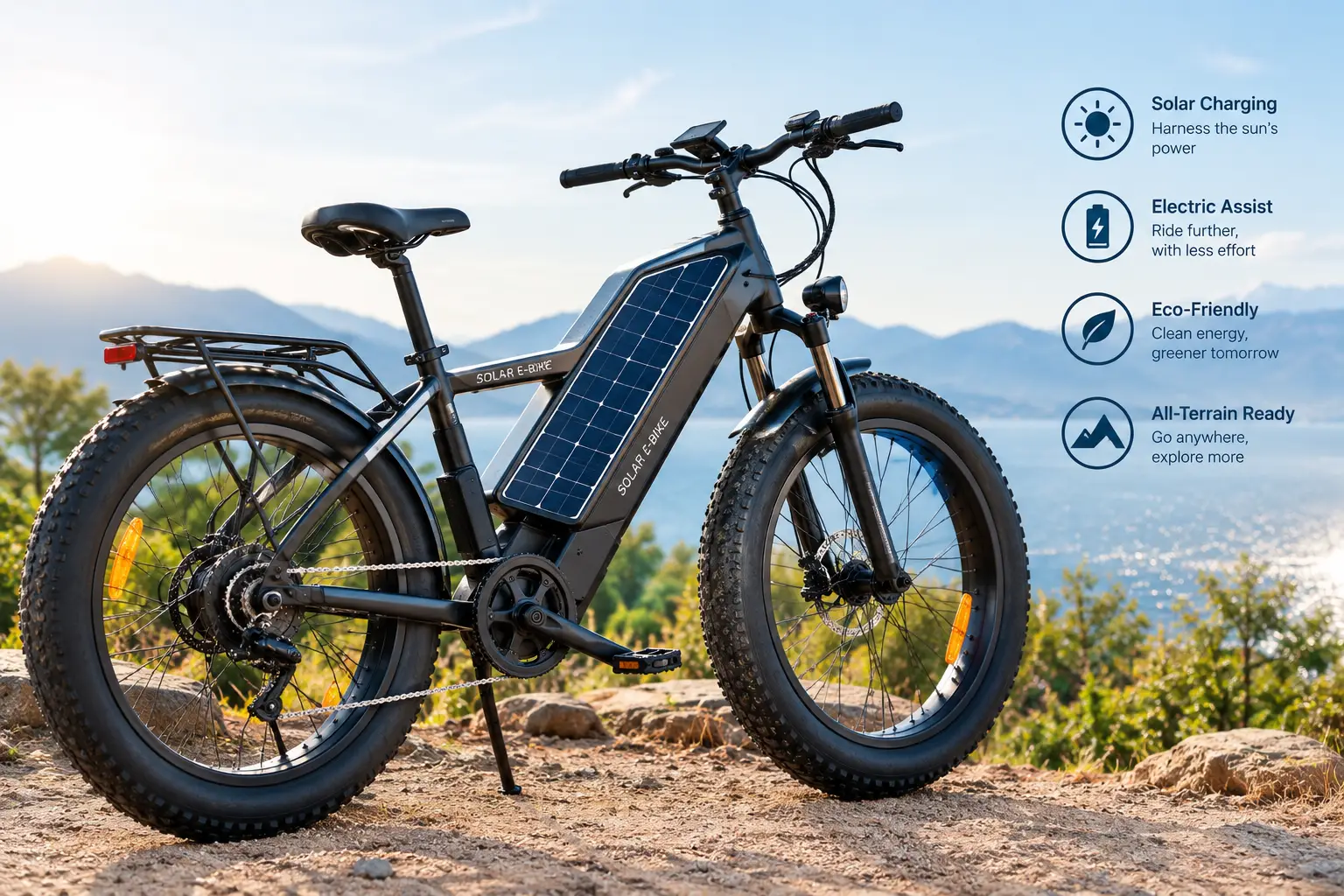
Picture this: you ride 30 miles into a national forest, set up camp, unfold a panel on a sunny rock, and by dinnertime your e-bike battery has clawed back a meaningful chunk of its charge. No outlet, no generator, no gas. That’s the promise of a solar power electric bike, and in 2026 it’s no longer a science-fair fantasy.
Here’s the honest part, though. A solar power electric bike in the real world almost never means “a bike with a solar panel bolted to the frame that charges while you ride.” Physics makes that a poor deal: a panel small enough to fit on a bike produces a trickle compared with what a 750W motor drinks. (One UK filmmaker proved the point the hard way, riding a homemade, 135-lb solar cargo bike roughly 800 miles through France and the Alps during the 2026 Sun Trip — impressive, but it took a rolling solar canopy and serious planning.) What actually works for everyday riders is a solar charging e-bike system: a solar-ready e-bike plus a foldable panel, sometimes with a portable power station in between.
That’s exactly what this guide covers. Based on comparing spec sheets, manufacturer documentation, and aggregated owner and reviewer feedback, we’ve put together seven picks that cover all three layers of the setup:
- ⚡ Solar-ready e-bikes with big batteries designed to accept solar input
- ☀️ Panels sized realistically for e-bike batteries
- 🔋 Power stations that bank sunshine so you can charge whenever you want
You’ll also get the charging math nobody prints on the box, a step-by-step setup guide, U.S. safety standards to check, and the mistakes that turn a solar dream into a dead battery. If you’re new to how photovoltaic cells turn light into power, the overview of solar panels on Wikipedia is a solid primer before we dive in.
What Is a Solar Power Electric Bike?
A solar power electric bike is an e-bike whose lithium-ion battery can be recharged from solar panels instead of (or in addition to) a wall outlet. In practice, that usually means a foldable portable panel that charges the bike’s battery directly through a compatible inverter or controller, or indirectly through a portable power station that stores the solar energy first.
That definition matters, because “solar powered ebike” gets used loosely online. You’ll see three distinct things sold under the same label:
- Integrated solar bikes — panels mounted on the frame, rack, or trailer. Mostly DIY builds, cargo trikes, and commercial delivery vehicles; rare on amazon.com and rarely practical for commuters.
- Solar-ready e-bikes — production bikes (like the Mokwheel lineup below) whose makers sell a matching panel and inverter so the battery can be charged from the sun.
- Universal solar charging setups — any e-bike plus a power station plus panels. This is the most flexible route because it works with the bike you already own.
The second and third categories are where the value is in 2026, and they’re what this guide focuses on. The key mental shift: think of solar as your fuel station, not your engine. You park, you harvest, you ride.
Quick Comparison: 7 Solar Power Electric Bike Picks at a Glance
| Product | Type | Key spec | Approx. price range | Best for |
|---|---|---|---|---|
| Mokwheel Basalt 2.0 | Solar-ready fat-tire e-bike | 48V 19.6Ah (940Wh), 750W | ~$1,500–$2,000 | Mokwheel Basalt 2.0: all-around off-grid riding |
| Mokwheel Scoria 2.0 | Solar-ready compact utility e-bike | 940Wh, 20″ x 4″ tires | ~$1,500–$1,900 | Mokwheel Scoria 2.0: errands, shorter riders |
| Mokwheel Obsidian 2.0 | Solar-ready full-suspension e-bike | 940Wh, 1300W peak | ~$2,000–$2,600 | Mokwheel Obsidian 2.0: rough trails |
| Mokwheel Foldable Solar Panel | Brand-matched panel | 100W or 230W, ~22% cells | Low-to-mid hundreds | Mokwheel Foldable Solar Panel: Mokwheel owners |
| Jackery Explorer 1000 v2 | Portable power station | 1,070Wh LiFePO4, 400W solar in | ~$450–$800 | Jackery Explorer 1000 v2: any e-bike, stored solar |
| Jackery SolarSaga 100W | Foldable panel | 100W bifacial | ~$150–$300 | Jackery SolarSaga 100W: light packing |
| EcoFlow NextGen 220W Bifacial | Foldable panel | 220W front, TOPCon cells | ~$350–$550 | EcoFlow NextGen 220W Bifacial: fastest harvest |
Reading the table as a system rather than a shopping list is the trick. The three Mokwheel bikes share the same 940Wh battery, so your choice between them is purely about ride style, not solar capability. The Jackery Explorer 1000 v2 is the “universal adapter” of the group: it lets the Jackery SolarSaga 100W or the EcoFlow NextGen 220W Bifacial charge almost any e-bike, because your bike plugs in using its own factory charger.
💬 One click helps other shoppers make an informed choice too! 😊
Top 7 Solar Power Electric Bike Picks: Expert Analysis
1. Mokwheel Basalt 2.0 — best all-around solar-ready e-bike
The Mokwheel Basalt 2.0 is the bike that essentially defined the “power-station e-bike” category, and it’s the most balanced way to get into solar charging.
Its 48V 19.6Ah battery holds roughly 940Wh — about 40–50% more than the 500–700Wh packs common on commuter e-bikes. In practice, that big tank is what makes solar viable: you can ride, then refill over a day or two of sunshine without range anxiety in between. The 750W rear hub (1100W peak, 90Nm+ torque), torque sensor, and 26″ x 4.0″ fat tires mean sand, gravel, and steep fire roads aren’t a problem. Mokwheel also sells an optional inverter that turns the battery into a mini power bank for phones, lights, or small tools.
Based on comparing the specs, this is the pick for riders who want one bike for neighborhood errands, camping trips, and light trails. It’s Class 3-capable (pedal assist up to 28 mph, adjustable), with a 20 mph default.
Independent testing helps calibrate expectations: Electric Bike Report measured roughly 37–63 miles against Mokwheel’s “up to 80,” and Electric Bike Review logged about 60 miles on low assist and 35 on max. Reviewers consistently praise the hill-climbing and brakes.
Pros:
- ✅ Big 940Wh battery makes multi-day solar refills practical
- ✅ Optional inverter doubles the battery as a power bank
- ✅ Torque sensor feels natural and stretches range
Cons:
- ❌ Heavy fat-tire frame is hard to lift onto racks
- ❌ Solar panel and inverter are extra-cost add-ons
Usually in the $1,500–$2,000 range (check the current price) — strong value for a bike that doubles as off-grid power.
2. Mokwheel Scoria 2.0 — compact cargo hauler with solar option
The Mokwheel Scoria 2.0 packs the same solar-ready battery into a smaller, step-through utility frame that’s easier to live with day to day.
It shares the Basalt’s 48V 19.6Ah pack and 750W (1100W peak) motor, but rides on 20″ x 4.0″ wheels with a 16″ standover height. Smaller wheels mean more effective torque at the rear hub — reviewers at Electrified Reviews called it one of the torquiest cargo-category bikes they’d ridden — and a lower center of gravity for loaded grocery runs. The solid-wood rear shelf and 350 lb payload make it a genuine utility bike, not a toy.
What most buyers overlook: the Scoria’s compact footprint matters for solar life too. A smaller bike is easier to park next to your panel in a campsite or tight patio corner. It’s ideal for riders roughly 4’8″ to 6’0″, seniors who want an easy step-through, and anyone using solar to cut errand costs.
On Mokwheel’s own store, the Scoria 2.0 carries a very high average rating across well over a thousand reviews (store reviews, not independently verified). Third-party roundups like BikeRide.com flag its ~81 lb weight and mixed customer-support reports as the main caveats.
Pros:
- ✅ Low 16-inch standover makes mounting easy
- ✅ Wood rear shelf carries bulky everyday loads
- ✅ Same 940Wh solar-ready battery as bigger models
Cons:
- ❌ Around 80 lbs makes stairs a real chore
- ❌ Customer-support experiences reported as inconsistent
Typically $1,500–$1,900 at the time of writing — fair value for a solar-ready utility bike with this much battery.
3. Mokwheel Obsidian 2.0 — full suspension for rugged off-grid trails
The Mokwheel Obsidian 2.0 is the solar-ready pick for riders whose campsites sit at the end of rough, rocky trails.
Mokwheel rates its rear hub at 750W, with roughly 1000W continuous, 1300W peak, and 105Nm+ torque — noticeably punchier than the Basalt. Full suspension (130mm adjustable fork plus a rear air shock) and a Shimano 10-speed drivetrain translate into more comfort and better gearing on long climbs. The battery is the same 48V 19.6Ah (~940Wh) pack, so solar charging works identically.
Here’s what to weigh: that extra torque and suspension cost range on hard terrain. Expect to land on the lower end of the advertised 60–80 miles on dirt, which means your solar setup has more work to do each day. Pair it with a larger panel (200W+) rather than a 100W unit if you’re doing multi-day trips.
Owner reviews and video reviewers consistently describe it as stable and planted off-road, while noting the weight (claimed around 77 lb, with some testers measuring closer to 82 lb). Note that one dealer lists it with a mid-drive motor; Mokwheel’s own spec sheet lists a rear hub, so trust the manufacturer listing.
Pros:
- ✅ Full suspension smooths washboard roads and roots
- ✅ 105Nm torque handles steep, loose climbs
- ✅ 10-speed gearing gives you better pedaling options
Cons:
- ❌ Heaviest-feeling ride of the three Mokwheels
- ❌ Burns more energy, so needs bigger solar input
Usually $2,000–$2,600 (prices may vary) — worth it only if your rides genuinely leave the pavement.
4. Mokwheel Foldable Solar Panel — the brand-matched plug-and-play option
The Mokwheel Foldable Solar Panel is the simplest way for Mokwheel owners to get a working solar charging e-bike setup without decoding voltages.
Available in 100W and 230W versions with cells rated at about 22% efficiency, it outputs 5V USB plus a 19.4V DC port, and ships with a 3m 5521 cable and adapters. The important fine print: to charge a Mokwheel e-bike battery, the panel must connect through Mokwheel’s inverter, sold separately. Mokwheel estimates roughly 4–5 hours to charge the battery in full sun.
On paper, that 4–5 hour estimate only works with the 230W version under ideal light. A 940Wh battery divided by a realistic 150–170W of real-world output from a 230W panel is closer to 6 hours of strong sun; with the 100W panel, plan on two sunny days. That’s not a dealbreaker — it just means the 230W is the one to buy if solar is your primary charging source.
We couldn’t find a large, independent pool of customer reviews specific to this panel, so we’re relying on specs and Mokwheel’s documentation here. What’s verifiable is the compatibility logic, which is the real reason to choose it.
Pros:
- ✅ Designed specifically for Mokwheel batteries and inverter
- ✅ Folds compactly for rack or pannier storage
- ✅ USB ports charge phones directly in sunlight
Cons:
- ❌ Requires the separately sold Mokwheel inverter
- ❌ 100W version is slow for a 940Wh pack
Generally in the low-to-mid hundreds depending on wattage (check the current price) — buy the 230W if you can.
5. Jackery Explorer 1000 v2 — the universal solar bridge for any e-bike
The Jackery Explorer 1000 v2 solves solar’s biggest headache: it lets you charge any e-bike using the charger that came with it.
It holds 1,070Wh in LiFePO4 cells rated for 4,000 cycles to 70% capacity, delivers 1,500W AC (3,000W surge), and accepts up to 400W of solar input through an MPPT controller. Practically, that means you harvest sunshine all day into the station, then plug your e-bike’s standard charger into its AC outlet whenever you want — at night, in the rain, or right before you ride. At roughly 24 lb, it’s also light enough to live in a car trunk.
Based on the specs, this is the right pick for owners of non-Mokwheel bikes, households with two e-bikes, and anyone who wants solar backup for the house during outages. After inverter and charger losses, expect the 1,070Wh to put roughly 750–850Wh into an e-bike battery — enough to refill most 500–700Wh packs completely.
Reviewers generally praise the 1-hour emergency AC charging and compact size. The Solar Lab criticized Jackery marketing that implied higher solar input than the 400W printed on the unit, and measured about 4.5 hours to recharge from solar in good conditions.
Pros:
- ✅ Works with virtually any e-bike’s factory charger
- ✅ LiFePO4 chemistry lasts thousands of cycles
- ✅ Stores sun so you charge on your schedule
Cons:
- ❌ Solar input capped at 400W total
- ❌ Capacity isn’t expandable with add-on batteries
Often in the $450–$800 range depending on promotions — excellent value since it doubles as home backup.
6. Jackery SolarSaga 100W — lightest-packing panel for bikepackers
The Jackery SolarSaga 100W is the panel to pick when every pound on your rear rack counts.
Jackery sells several 100W SolarSaga variants: the classic folding model weighs about 7.9 lb with cells rated around 24.3% efficiency, while the newer “Light” bifacial version listed on amazon.com comes in at about 4.5 lb with an IP68 rating. Bifacial cells pick up some reflected light from the back side, which helps a little on sand, snow, or light-colored concrete. The panel also has USB-A and USB-C outputs for phones.
Here’s what to weigh honestly: 100W is a supplementary panel, not a primary e-bike charger. In real conditions it typically produces 60–80W, so topping off a 940Wh pack takes well over 12 hours of good sun. Paired with the Jackery Explorer 1000 v2, though, it becomes a steady daily trickle that adds roughly 300–400Wh per sunny day — about 20 miles of moderate pedal assist.
Aggregated feedback across retailer and review sites is positive on portability and build quality; the most common complaint is that panels rarely hit their full rated wattage, which is normal for all solar panels.
Pros:
- ✅ Featherweight versions fit easily in panniers
- ✅ Bifacial design captures extra reflected light
- ✅ Matched connectors for Jackery power stations
Cons:
- ❌ Too slow to be your only e-bike charger
- ❌ Can’t connect directly to a 48V bike battery
Usually $150–$300 depending on version — great value as a lightweight add-on.
7. EcoFlow NextGen 220W Bifacial — fastest solar harvest per setup
The EcoFlow NextGen 220W Bifacial is the panel that makes solar charging feel like a real alternative to the wall outlet, not a hobby.
It uses N-type TOPCon cells rated at 25% efficiency, with 220W on the front and up to 175W on the rear, plus an integrated 30–60° adjustable stand and solar angle guide. In practice, that angle guide is underrated: tilting a panel correctly toward the sun can boost output dramatically versus laying it flat. At roughly 15.4 lb, it’s portable for car camping, though too bulky for most bike racks. IP68 protection means a surprise rainstorm won’t end your trip.
Based on comparing the specs, this is the pick for riders who charge from a campsite, RV, or backyard rather than carrying the panel on the bike. Two of these on a Jackery Explorer 1000 v2 would max out its 400W input, refilling the station in roughly 3–4 hours of strong sun. Check connectors: EcoFlow ships an XT60 cable, so you may need an MC4 adapter for non-EcoFlow stations.
Retailer and reviewer feedback consistently highlights the sturdy tempered glass and fast charging; weight and price are the usual knocks.
Pros:
- ✅ 25% TOPCon cells lead this group in efficiency
- ✅ Built-in stand and angle guide boost output
- ✅ IP68 rating shrugs off rain and dust
Cons:
- ❌ Too heavy to carry on most e-bikes
- ❌ Proprietary cable may need an adapter
Usually $350–$550 (prices may vary) — the best value per watt if you charge from a base camp.
Head-to-Head: Comparing the Top 7 Solar Power Electric Bike Picks
| Product | Battery / Capacity | Solar input or output | Weight | Rating snapshot | Best for |
|---|---|---|---|---|---|
| Mokwheel Basalt 2.0 | 940Wh | Via Mokwheel inverter + panel | Fat-tire class, ~80 lb | Strong expert reviews | Mokwheel Basalt 2.0: all-purpose rider |
| Mokwheel Scoria 2.0 | 940Wh | Via Mokwheel inverter + panel | ~81 lb | High store rating | Mokwheel Scoria 2.0: utility & shorter riders |
| Mokwheel Obsidian 2.0 | ~940Wh | Via Mokwheel inverter + panel | ~77–82 lb | Positive off-road reviews | Mokwheel Obsidian 2.0: trail riders |
| Mokwheel Foldable Solar Panel | — | 100W / 230W output | Light, foldable | Limited independent data | Mokwheel Foldable Solar Panel: Mokwheel owners |
| Jackery Explorer 1000 v2 | 1,070Wh LiFePO4 | Up to 400W input | ~24 lb | Positive, with marketing caveat | Jackery Explorer 1000 v2: any e-bike |
| Jackery SolarSaga 100W | — | 100W output | ~4.5–7.9 lb | Positive on portability | Jackery SolarSaga 100W: bikepacking |
| EcoFlow NextGen 220W Bifacial | — | 220W front / 175W rear | ~15.4 lb | Positive on durability | EcoFlow NextGen 220W Bifacial: base-camp charging |
Looking at the table, the decision really splits into two paths. If you’re buying a new bike, any of the three Mokwheels plus the 230W Mokwheel Foldable Solar Panel gives you a brand-matched system with one support contact. If you already own an e-bike, the Jackery Explorer 1000 v2 paired with either panel is the more flexible route — and it keeps working if you upgrade bikes later.
⚡ Ready to build your sun-powered ride?
🔍 Take your off-grid adventures to the next level with this carefully curated lineup. Click a highlighted item to check current pricing and availability. These picks will help you ride farther, spend less on charging, and enjoy the freedom of the open trail!
How to Solar Charge an E-Bike: A Step-by-Step Setup Guide
Getting solar right on day one comes down to sequence. Here’s a practical workflow for both setup types.
Setup A: Brand-matched direct charging (Mokwheel)
- Confirm the parts. You need the bike, the Mokwheel Foldable Solar Panel, and Mokwheel’s inverter. The panel won’t charge the battery without it.
- Remove the battery if you can, and place it in shade on a dry surface. Lithium-ion packs dislike heat, and the panel needs sun — they shouldn’t share the same hot spot.
- Aim the panel. Face it south (in the continental U.S.) and tilt it roughly toward the sun. Re-angle every couple of hours if you’re around.
- Connect panel → inverter → battery, then check that the inverter display shows input.
Setup B: Universal stored charging (any e-bike)
- Charge the power station from solar first. Plug the panel into the station’s solar input and let it harvest all day.
- Plug your factory e-bike charger into the station’s AC outlet whenever you’re ready.
- Charge in the cool part of the day — evening or early morning is ideal.
First-30-days tips
- ☀️ Log a few days of real output. The station’s display shows actual watts; that number, not the label, is your planning baseline.
- 🧽 Wipe panels with a soft, damp cloth. Dust and pollen can quietly cut output.
- 🔋 Avoid draining the bike battery to 0% on purpose; partial cycles are gentler on lithium-ion cells.
If you want the science behind panel angles and sun exposure, the U.S. Department of Energy’s explainer on how solar works is short and genuinely useful.
Real-World Scenarios: Matching the Right Setup to Your Ride
Specs are abstract until you map them to a life. Here are three realistic buyer profiles.
🏕️ The weekend camper (budget: ~$2,500–$3,000)
Maria rides 20–30 miles on Saturday trips to state-park campgrounds and returns Sunday. Her best fit is the Mokwheel Basalt 2.0 with the 230W Mokwheel Foldable Solar Panel and inverter. Why: a 940Wh battery covers Saturday’s ride with margin, and one sunny afternoon at camp replaces most of it. The inverter also charges her phone and camp lights, so she skips buying a separate power bank.
🏡 The suburban commuter (budget: ~$700–$1,200, already owns a bike)
James commutes 8 miles each way, five days a week, on a 672Wh e-bike he already loves. He doesn’t need a new bike — he needs the Jackery Explorer 1000 v2 and one EcoFlow NextGen 220W Bifacial on his back patio. At around 16–20 Wh per mile, his 80-mile workweek needs roughly 1.3–1.6 kWh, which a 220W panel can harvest over four to five sunny days. Bonus: the station keeps his fridge running during summer outages.
🦌 The backcountry hunter (budget: ~$3,000+)
Dana rides rough logging roads before dawn and stays out multiple days. The Mokwheel Obsidian 2.0 gives her the suspension and torque, while a two-panel approach — the 230W Mokwheel panel on the bike, plus a Jackery SolarSaga 100W for her phone and GPS — keeps everything topped up. Her advice to herself: plan rides around the energy she harvested yesterday, not the battery’s best-case range.
Problem → Solution: Fixing Common Solar Charging Headaches
Even a good setup hits snags. Here are the five most common, with fixes.
Problem 1: “My 100W panel only shows 55–70W.” ✅ Normal. Rated wattage is measured in lab conditions. Tilt the panel toward the sun, keep it cool (heat lowers output), and remove any partial shade — even a branch shadow across one cell row can sink production.
Problem 2: “The panel won’t charge my e-bike battery at all.” ✅ Most portable panels output about 18–22V, while e-bike batteries charge at roughly 54.6V for a 48V pack. You need a boost controller, the brand’s inverter (like Mokwheel’s), or a power station in between. Never wire a panel straight into a battery port.
Problem 3: “Cloudy days kill my plan.” ✅ This is exactly what the Jackery Explorer 1000 v2 is for. Bank surplus energy on sunny days so overcast ones don’t strand you.
Problem 4: “Charging takes forever.” ✅ Calculate it: battery Wh ÷ real panel watts = hours of strong sun. If the answer is longer than your daylight window, add a panel or switch to the EcoFlow NextGen 220W Bifacial.
Problem 5: “My battery gets hot while charging outside.” ✅ Move the battery or bike into shade and let only the panel bake. Lithium-ion batteries should charge within the temperature range in your manual — usually well below midday summer heat on blacktop.
How to Choose a Solar Power Electric Bike
Use these seven steps to narrow your options quickly.
- Start with battery capacity (Wh), not motor watts. A larger pack (800Wh+) gives solar time to catch up between rides.
- Decide: direct or stored charging. Brand-matched direct charging is simpler; a power station is more flexible and works at night.
- Size the panel to your daily miles. Multiply daily miles by ~20 Wh, then divide by your panel’s real output to estimate sun hours needed.
- Check connector and voltage compatibility. Confirm cables (XT60, MC4, 5521) and input voltage ranges before buying.
- Verify UL certification. Look for UL 2849 on the e-bike system and UL 2271 on standalone batteries.
- Match the frame to your terrain. Fat tires for sand and snow, full suspension for rocky trails, compact frames for errands.
- Weigh portability honestly. A 15-lb panel belongs at base camp; a 5-lb panel can ride with you.
Each step flows into the next: capacity determines panel size, panel size determines weight, and weight determines whether the panel lives on the bike or at camp.
Solar Charging E-Bike Math: How Many Panels Do You Really Need?
This is the section most solar charging e-bike guides skip, and it’s the one that saves you money. The core formula is simple: battery capacity (Wh) ÷ realistic panel output (W) = hours of strong sun needed. “Realistic” usually means 65–75% of the label rating once you account for heat, angle, and controller losses.
| Panel setup | Realistic output | Time to fill a 940Wh e-bike battery | Best for |
|---|---|---|---|
| 1 × Jackery SolarSaga 100W | ~65–75W | ~13–15 hours of strong sun (2 days) | Jackery SolarSaga 100W: daily top-ups |
| 1 × 230W Mokwheel Foldable Solar Panel | ~150–170W | ~6 hours | Mokwheel Foldable Solar Panel: one-day refills |
| 1 × EcoFlow NextGen 220W Bifacial | ~150–180W (plus rear gain) | ~5.5–6.5 hours | EcoFlow NextGen 220W Bifacial: base-camp charging |
| 2 × EcoFlow NextGen 220W Bifacial into Jackery Explorer 1000 v2 | ~300–400W (station max 400W) | ~3–4 hours to fill station | Jackery Explorer 1000 v2: two-bike households |
The analysis here is blunt: a single 100W panel works only as a supplement, while 200W+ is the threshold where solar can realistically be your main fuel source. Remember that most of the continental U.S. averages only around 4–6 peak sun hours a day, so a “6 hours of strong sun” estimate often means a full day or more of real daylight. If you ride 20+ miles daily, plan for at least 200–400W of panels.
Direct Solar Charging vs. Power Station Charging
Both paths work. They just suit different riders.
Direct charging (panel → inverter/controller → battery)
Why it wins: fewer devices, less weight, and less energy lost along the way. With the Mokwheel Foldable Solar Panel and inverter, you’re converting energy once rather than twice. For bikepackers, that efficiency and lighter kit matter.
Where it struggles: you can only charge while the sun is up, and the battery has to sit somewhere near the panel — ideally in shade, which takes planning. It’s also brand-locked: the setup is engineered for Mokwheel’s battery, not your neighbor’s bike.
Stored charging (panel → power station → e-bike charger → battery)
Why it wins: flexibility. The Jackery Explorer 1000 v2 accepts sun all day, then charges any e-bike at any time, using the same charger and charge profile the manufacturer designed. That’s a quiet safety advantage, because the battery management system sees exactly what it expects.
Where it struggles: efficiency and bulk. You lose roughly 15–25% between the station’s inverter and the bike’s charger, and a 24-lb station isn’t riding along on a day trip.
The verdict
If you own one Mokwheel and travel light, go direct. If you own any other bike, two bikes, or want home backup, go stored. Many serious riders eventually own both — a panel on the bike for trail top-ups and a station at home or in the car.
Solar Charging vs. Traditional Alternatives
| Charging approach | Running cost | Works off-grid? | Noise & emissions | Best for |
|---|---|---|---|---|
| Wall outlet (grid) | Lowest per charge | ❌ No | Silent, grid-dependent | Daily urban commuting |
| Gas generator | Fuel + maintenance | ✅ Yes | Loud, exhaust fumes | Rarely ideal for e-bikes |
| Solar + Jackery Explorer 1000 v2 | Near-zero after purchase | ✅ Yes | Silent, zero on-site emissions | Jackery Explorer 1000 v2: flexible off-grid |
| Solar + Mokwheel Foldable Solar Panel | Near-zero after purchase | ✅ Yes | Silent | Mokwheel Foldable Solar Panel: light, brand-matched |
The comparison makes one thing clear: solar isn’t trying to beat the wall outlet on cost per charge in a city apartment — grid power for a 940Wh battery costs well under a dollar in most U.S. states. Solar wins wherever outlets don’t exist or generators are unwelcome: campgrounds with quiet hours, hunting land, beaches, and power outages.
Features That Actually Matter (and Ones That Don’t)
✅ Features that matter
- Battery watt-hours. This is the single biggest factor in whether solar keeps up. Every bike in this guide sits around 940Wh for a reason.
- Torque sensor. It adds assist in proportion to your pedaling, which tends to stretch range compared with cadence-only systems — and every mile you save is solar you don’t need.
- MPPT controller (on stations). Maximum power point tracking squeezes more energy out of a panel in changing light. The Jackery Explorer 1000 v2 uses one.
- Panel tilt stands. The EcoFlow NextGen 220W Bifacial‘s 30–60° stand is a genuine output booster, not a gimmick.
- IP ratings. IP68 panels and an IPX6/IPX7-rated bike and battery mean weather won’t end your trip.
❌ Features that matter less than marketing suggests
- “Up to 80 miles” range claims. Independent tests landed closer to 35–63 miles. Plan around the lower number.
- Peak motor wattage. A 1300W peak sounds exciting, but it says little about efficiency and nothing about solar needs.
- Bifacial rear-side ratings. Rear cells help on reflective ground, but on dark soil or grass the gain is modest. Treat it as a bonus.
- Frame-mounted mini solar panels. Small panels on a bike frame or helmet produce too little to move the needle on a 48V pack.
Long-Term Cost and Maintenance
The real economics of a solar powered ebike come from how long the parts last, not from “free sunshine.”
What you’ll actually spend
- Upfront: expect roughly $1,800–$3,000 for a solar-ready bike plus brand panel and inverter, or $600–$1,300 to add a station and panel to a bike you own.
- Electricity savings: modest. Grid charging a 940Wh battery costs very little, so solar rarely pays for itself on fuel savings alone in a city.
- Hidden value: the power station and panels double as emergency home backup and camping power. That’s where the ROI lives.
What lasts — and what doesn’t
- LiFePO4 power stations like the Jackery Explorer 1000 v2 are rated for 4,000 cycles to 70% capacity — over a decade of regular use.
- E-bike lithium-ion batteries typically degrade noticeably after several hundred to around a thousand full cycles. Budget for a replacement pack eventually, and buy bikes from brands that sell spares.
- Panels degrade slowly; EcoFlow claims less than 10% output loss over 10 years for its earlier bifacial line.
Maintenance schedule
- 🗓️ Weekly: wipe panels, check cable connectors for dirt.
- 🗓️ Monthly: check tire pressure (fat tires waste energy when soft), inspect brake pads.
- 🗓️ Seasonally: store batteries partially charged (around 40–60%) in a cool, dry place during off-season months.
Safety, Regulations, and Standards
Solar adds new wires and new heat sources to a lithium-ion system, so safety deserves real attention.
UL certification is quickly becoming non-negotiable
In the U.S., UL 2849 covers an e-bike’s full electrical system (battery, charger, motor, controller), while UL 2271 covers standalone light-electric-vehicle batteries. The Mokwheel bikes in this guide list UL 2849 certification and UL-compliant batteries. Federal rules are tightening: in June 2026 the CPSC published a proposed safety standard for lithium-ion batteries in micromobility products, which would build on these UL standards with added requirements such as tamper-resistant enclosures and protection against incompatible chargers.
Why that matters for solar
- Never use DIY wiring to bypass the battery management system. The BMS is the last line of defense against overcharging.
- Use the bike maker’s charger or approved inverter. Stored charging through a power station preserves this automatically.
- Charge away from flammable materials, and never leave a battery charging unattended in a hot tent or car.
E-bike classes and where you can ride
Most U.S. states use a three-class system: Class 1 and 2 bikes assist up to 20 mph, while Class 3 bikes assist up to 28 mph. The Mokwheels default to 20 mph but can be set to Class 3 speeds — which may restrict access to some trails and bike paths. Check your state’s rules with the PeopleForBikes e-bike law guide before unlocking higher speeds.
Common Mistakes to Avoid When Buying a Solar Power Electric Bike
- Buying a “solar bike” with a tiny frame-mounted panel. These look clever but produce a trickle. Prioritize battery size and a proper foldable panel instead.
- Assuming any solar panel for an ebike battery plugs right in. Most portable panels output around 18–22V; a 48V e-bike battery needs a controller, inverter, or station in between.
- Undersizing the panel. A 100W panel feels like a deal until you realize it needs two sunny days to fill a 940Wh pack. Do the Wh math first.
- Ignoring connector types. XT60, MC4, and barrel connectors aren’t interchangeable. Budget for adapters if you mix brands.
- Trusting best-case range numbers. Plan your solar needs around independently tested range, not the advertised maximum.
- Skipping UL certification. An uncertified battery charged in unusual conditions (outdoors, heat, variable input) is exactly the scenario safety standards were written for.
- Forgetting weight. A heavy fat-tire bike plus a 20-lb panel and 24-lb station changes how you travel. Decide in advance what rides on the bike and what stays in the car.
Avoid these seven, and an e-bike solar charger setup becomes one of the most satisfying upgrades in cycling.
FAQ About Solar Power Electric Bike Setups
❓ Can I charge an e-bike with a regular solar panel?
❓ What size solar panel do I need for an e-bike?
❓ Is a solar powered ebike worth it for commuting?
❓ Can I leave my e-bike battery charging in the sun?
❓ Do power stations work as an e-bike solar charger?
Conclusion: Is a Solar Power Electric Bike Right for You?
A solar power electric bike in 2026 is less about strapping panels to a frame and more about building a smart little energy system: a big-battery bike, a properly sized panel, and — if you want flexibility — a power station to bank the sunshine.
Here’s the short version of our picks:
- 🚴♂️ Best all-around: Mokwheel Basalt 2.0, with the 230W Mokwheel Foldable Solar Panel.
- 🛒 Best for errands and shorter riders: Mokwheel Scoria 2.0.
- ⛰️ Best for rough trails: Mokwheel Obsidian 2.0.
- 🔋 Best for any bike you already own: Jackery Explorer 1000 v2 paired with the EcoFlow NextGen 220W Bifacial for speed or the Jackery SolarSaga 100W for portability.
Whatever you choose, start with the math — battery watt-hours, real panel output, and your daily miles — and confirm UL certification and connector compatibility before you buy. Get those right, and solar stops being a gimmick and becomes your own private fuel station, quietly topping you up wherever the road (or trail) takes you.
🌞 Your sun-powered adventures start here!
✨ Ready to ride farther without hunting for outlets? Click any highlighted product above to check current pricing and availability on Amazon, and build the solar setup that fits your rides. Clean miles, quiet campsites, and fewer charging worries are waiting!
Recommended for You
- Best Battery for Camper Trailer: 7 Proven Picks for 2026
- Best Battery for Solar Panels: 7 Proven Picks for 2026
- Best Inverter Generator for Home Backup: 7 Proven Picks (2026)
Disclaimer: This post contains affiliate links. As an Amazon Associate, I earn from qualifying purchases made through these links, at no additional cost to you.
✨ Found this article helpful? Share it with someone who needs it! 💬🤗
