In This Article
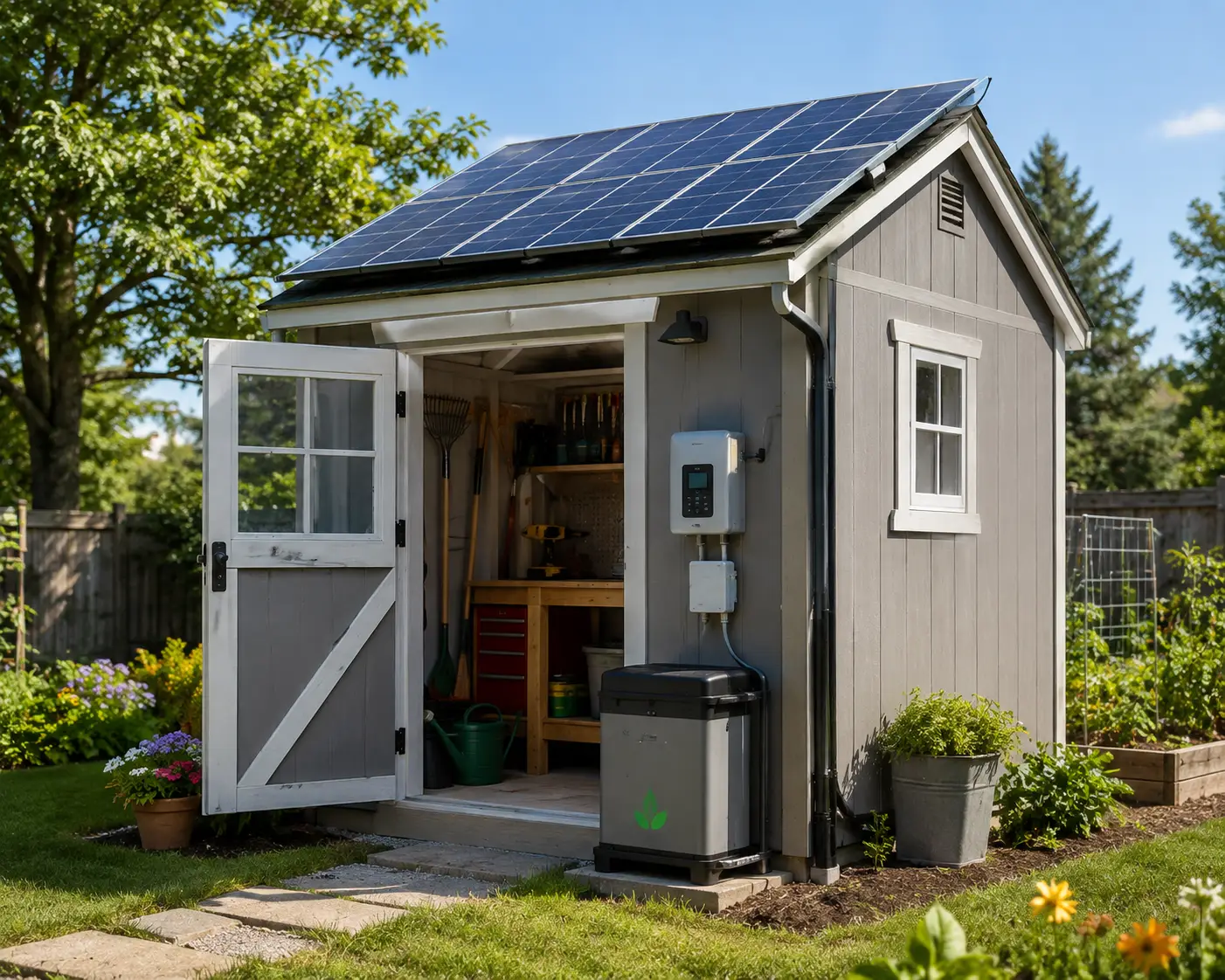
Turning a dark, powerless shed into a functional space doesn’t require an electrician or a trench full of conduit. A solar shed setup — whether that means a single motion-sensor light or a full off-grid power kit — lets you add illumination, charge tools, or even run a mini-fridge without touching your home’s wiring. The appeal is obvious: no permits, no monthly utility bump, and no cord snaking across the yard for someone to trip over.
But “solar shed” covers a surprisingly wide range of products, and picking the wrong one is a common (and expensive) mistake. A $25 pendant light will never power a table saw, and a 2,000-watt-hour power station is overkill if all you need is to see your garden tools at dusk. According to the U.S. Department of Energy, photovoltaic panels convert sunlight directly into electricity through semiconductor cells — the same basic principle whether you’re looking at a $20 pendant lamp or a $1,700 whole-shed battery system. What changes is scale, storage capacity, and how much real-world power you can pull back out.
This guide breaks down seven real, currently available products spanning entry-level lighting to high-capacity off-grid power, with honest analysis of who each one is actually built for. We’ll cover setup, common mistakes, long-term costs, and safety standards — the kind of practical detail that a bare product listing never gives you. As an Amazon Associate, this site earns from qualifying purchases, and every recommendation below is based on genuine spec comparison and aggregated customer feedback, never fabricated reviews or invented testing claims.
Quick Comparison: Solar Shed Options at a Glance
Before diving into full reviews, here’s a fast overview of how these seven products stack up by category, output, and best use case.
| Product | Category | Power Output | Best For |
|---|---|---|---|
| Deogos Solar Pendant Light | Lighting | 1,000 lumens | Budget interior lighting |
| ICOFRU Solar Shed Light | Lighting | Adjustable, 5 modes | Warm/cool light flexibility |
| VOPHICHO Solar Shed Light | Lighting | 244 LEDs, 360° | Large sheds & workshops |
| ECO-WORTHY 120W Solar Panel Kit | Power kit | 120W panel | First-time off-grid power |
| Renogy 400W Solar Panel Starter Kit | Power kit | 400W (4×100W) | Running small tools/battery bank |
| Jackery Explorer 300 Plus | Power station | 288Wh battery | Portable, no-wiring backup |
| BLUETTI AC200MAX | Power station | 2,048Wh (expandable) | Whole-shed backup power |
Looking at the table above, the split is really between lighting-only products (Deogos, ICOFRU, and VOPHICHO) and true power systems that can run appliances (the remaining four). If you just need to stop fumbling for a flashlight in your shed, stop at the top three — anything beyond that is solving a problem you don’t have yet. Buyers who want to charge power tools, run a fan, or keep a chest freezer alive during an outage should skip straight to the panel kits and power stations, where the real differentiator is watt-hours of storage, not lumens.
💬 One click helps other shoppers make an informed choice too! 😊
Top 7 Solar Shed Products: Expert Analysis
1. Deogos Solar Pendant Light — brightest budget pick for shed interiors
The Deogos Solar Pendant Light is built around a simple idea: mount the panel outside, hang the 180-LED fixture inside, and get usable light without running a single wire through the wall.
At 1,000 lumens across 180 LEDs, this fixture throws enough light to actually work by — not just find the door — and the dual-head design (motion sensor mode plus a steady “work light” mode) means it adapts to how you use the shed. The included remote lets you switch brightness levels and set a timer from across the room, which matters more than it sounds once you’re standing in a dark shed at 6 a.m. trying to find a rake.
Based on comparing the spec sheet against competing pendant lights in this price bracket, the separate solar panel (rather than a built-in panel on the fixture itself) is the real advantage here — you can mount the panel on the roof for full sun exposure while keeping the light itself in a shaded interior spot, which most all-in-one solar shed lights can’t do.
Reviews consistently report that the remote’s range is reliable indoors but can be finicky through thick barn wood or metal siding, and that winter performance drops noticeably in northern climates with fewer daylight hours — a limitation of solar lighting generally, not this product specifically.
Pros:
- ✅ Separate panel mount allows optimal sun placement
- ✅ Remote control with adjustable brightness and timer
- ✅ Motion sensor extends runtime on cloudy days
Cons:
- ❌ Signal range drops through metal or thick wood walls
- ❌ Noticeably dimmer output during short winter days
Priced in the $25-$35 range, the Deogos Solar Pendant Light delivers strong value for anyone whose only shed problem is “I can’t see in here” — check the current price and availability before buying, as pricing on solar lighting fluctuates seasonally.
2. ICOFRU Solar Shed Light — best adjustable color temperature
The ICOFRU Solar Shed Light stands out from similar pendant-style solar lights by letting you dial in color temperature as well as brightness, switching between warm and cool white depending on the task.
Its 5 lighting modes cover everything from a dim “night light” setting (useful if the shed doubles as a chicken coop or animal shelter) to a bright, cool-white “task” mode for detailed work. The adjustable brightness and color combination is a genuinely practical feature, not just a marketing checkbox — warm light at low brightness is far less disruptive to animals or neighbors than a stark white floodlight.
What most buyers overlook with this model is that the color/brightness memory doesn’t always persist through a full battery drain, meaning after a multi-day cloudy stretch you may need to re-select your preferred mode. That’s a minor annoyance rather than a dealbreaker, and it’s consistent with what aggregated customer feedback describes as generally reliable performance with occasional mode-reset quirks after extended low-light periods.
Owners in colder regions note that battery capacity — like most small solar lighting products — tapers in winter, so treat published runtime figures as summer-sun best-case numbers rather than year-round guarantees.
Pros:
- ✅ Five lighting modes including warm and cool white
- ✅ Brightness and color both remote-adjustable
- ✅ Good fit for chicken coops and animal shelters
Cons:
- ❌ Mode settings can reset after full battery drain
- ❌ Runtime drops meaningfully in low-sun winter months
At around $25-$40 depending on the size variant, the ICOFRU Solar Shed Light is a smart step up for anyone who wants more control over ambiance, not just raw brightness — prices may vary by bundle size, so check the current listing.
3. VOPHICHO Solar Shed Light — most LEDs for large workspaces
For sheds that double as workshops, the VOPHICHO Solar Shed Light is the brightest lighting-only option on this list, using 244 LEDs and a 360-degree lens to fill a larger footprint than the single-direction pendant lights above.
The 360° lighting pattern means you’re not stuck aiming one fixture at a workbench while the rest of the shed stays dark — a real advantage in workshops where you move between tool storage, a bench, and a doorway. Combined with 5 lighting modes and a built-in timer, it’s designed for people who spend real time in their shed, not just grab-and-go visits.
Based on comparing feature sets across this category, the tradeoff for that extra brightness is a larger panel requirement and a higher price point — this isn’t the cheapest option, and it’s not meant to be. Aggregated reviews describe the motion sensor as more sensitive (in a good way) than smaller competitors, triggering reliably even for a person standing still near a bench rather than walking past.
Where feedback gets more mixed is mounting: several buyers note the multi-head bracket needs a sturdier ceiling anchor than expected given the fixture’s weight, so plan your mounting hardware accordingly.
Pros:
- ✅ 360° coverage suits larger shed workspaces
- ✅ More sensitive, reliable motion detection
- ✅ Five modes plus built-in timer function
Cons:
- ❌ Heavier fixture needs a sturdier mounting anchor
- ❌ Higher price than single-head pendant competitors
Expect to pay in the $35-$55 range for the VOPHICHO Solar Shed Light — a reasonable premium if your shed function doubles as an actual workspace rather than pure storage.
4. ECO-WORTHY 120W Solar Panel Kit — simplest true off-grid starter
Once lighting alone isn’t enough, the ECO-WORTHY 120W Solar Panel Kit is the most approachable entry point into real off-grid power — a 12V monocrystalline panel, 30A PWM charge controller, cabling, and mounting brackets in one box.
At 120 watts, this kit won’t run power tools directly, but paired with a 12V deep-cycle battery (sold separately), it’s enough to trickle-charge a battery bank that runs LED lighting, charges phones and small tools, or keeps a security camera running continuously. The PWM controller is a budget-friendly charge-management technology — less efficient than the MPPT controllers on pricier kits, but perfectly adequate at this power level where the efficiency gap translates to only a few extra watts either way.
Here’s what to weigh: this is explicitly a starter kit. Monocrystalline cells mean better efficiency-per-square-foot than cheaper polycrystalline panels, which matters if your shed roof has limited usable space. Aggregated buyer feedback frequently praises the straightforward included instructions, making this a popular first off-grid project even for people with no prior solar experience.
The most common complaint in customer reviews centers on the fact that a compatible battery isn’t included — a frequent point of confusion for first-time buyers who assume the “complete kit” branding means plug-and-play power.
Pros:
- ✅ Complete hardware kit minus the battery
- ✅ Monocrystalline panel maximizes limited roof space
- ✅ Beginner-friendly instructions for a first solar project
Cons:
- ❌ Compatible deep-cycle battery sold separately
- ❌ PWM controller less efficient than MPPT alternatives
Priced roughly between $100 and $160, the ECO-WORTHY 120W Solar Panel Kit is the logical next step once you’ve outgrown standalone solar lights — just budget separately for a battery.
5. Renogy 400W Solar Panel Starter Kit — most expandable power system
The Renogy 400W Solar Panel Starter Kit — four 100-watt monocrystalline panels plus a 30A Wanderer PWM charge controller — is built for shed owners who want meaningful power now and room to scale later.
At 400 watts, this system can realistically keep a modest battery bank topped up for running shed lighting, charging cordless tool batteries, powering a small fan, or running a Wi-Fi security setup continuously, even on shorter winter days. What most buyers overlook is that Renogy’s individual 100W panel modules are the real advantage: you can add a fifth or sixth panel later using the same connectors, rather than replacing the whole system when your power needs grow.
Based on comparing this against the single-panel ECO-WORTHY kit above, the modularity here is the deciding factor for anyone who suspects their shed’s power needs will grow — a chest freezer, a mini-split AC unit, or a workshop full of corded tools down the line. Reviews consistently mention Renogy’s customer support and documentation as stronger than average for the category, which matters when you’re troubleshooting a DIY install.
The tradeoff is complexity: four panels mean more mounting points, more cable runs, and a steeper first-time setup than a single-panel kit.
Pros:
- ✅ Modular panels expand without full system replacement
- ✅ Strong documentation and manufacturer support
- ✅ Enough capacity for tools, fans, and networking gear
Cons:
- ❌ More complex mounting and wiring than single-panel kits
- ❌ Requires a separately purchased battery bank and inverter
Typically priced between $350 and $450, the Renogy 400W Solar Panel Starter Kit offers strong long-term value for anyone planning to grow their shed’s power system over time.
6. Jackery Explorer 300 Plus — best portable, no-wiring power station
Unlike the panel kits above, the Jackery Explorer 300 Plus skips permanent wiring entirely — it’s a 288Wh LiFePO4 battery station with a 300W AC outlet that you charge (via an optional SolarSaga panel, wall outlet, or car charger) and simply carry into the shed when needed.
The appeal here is flexibility: no mounting brackets, no cable runs through walls, and no commitment to one location. Plug in a shop light, charge a phone, run a small fan, or top off cordless tool batteries, then unplug and bring the unit back inside overnight if you’re worried about temperature extremes. LiFePO4 (lithium iron phosphate) battery chemistry is worth understanding here — it’s the same chemistry used across most modern power stations because it handles hundreds more charge cycles than older lithium-ion designs before capacity starts to fade.
What the spec sheet doesn’t say, but reviews reveal, is that the 300-watt continuous output is the real ceiling to plan around — it comfortably runs LED work lights, chargers, and small fans, but will trip on higher-draw tools like a circular saw. Buyers frequently praise the compact size and near-silent operation compared to a gas generator, a meaningful upgrade for anyone who’s dealt with fumes or noise complaints from neighbors.
Pros:
- ✅ No permanent wiring or mounting required
- ✅ Near-silent, fume-free operation versus gas generators
- ✅ LiFePO4 battery rated for hundreds of charge cycles
Cons:
- ❌ 300W ceiling rules out higher-draw power tools
- ❌ Solar panel typically sold separately from the station
Expect a price in the $300-$400 range for the station alone, with the SolarSaga panel usually adding another $150-$250 — a fair trade for genuine portability.
7. BLUETTI AC200MAX — highest capacity for whole-shed backup
For anyone treating their shed as a genuine off-grid workspace — or a backup power hub during outages — the BLUETTI AC200MAX is the highest-capacity option here: 2,048Wh of LiFePO4 storage, a 2,200W pure sine wave inverter, and the ability to expand to 8,192Wh with add-on battery modules.
That capacity gap versus the Jackery Explorer 300 Plus is enormous — roughly seven times the base storage — and the 2,200W inverter can run genuinely demanding equipment: a mini-fridge, a shop vac, power tools, or several devices simultaneously. Based on comparing the specs against smaller stations, the expandability is what separates this from a “bigger power bank” into a legitimate backup power system: adding battery modules later means you’re not locked into your initial capacity decision.
Reviews consistently point to two things: genuinely quiet operation even under heavy load, and a companion app that lets you monitor charge status remotely — handy for a detached shed you’re not walking out to check every hour. The tradeoff, unsurprisingly, is size and weight; this is not something you casually carry back and forth like the Jackery unit.
Common feedback in aggregated reviews also flags that full solar recharge time depends heavily on how many panels you pair with it — expect several hours under ideal sun with a single panel, meaningfully less with two or more.
Pros:
- ✅ Massive expandable capacity up to 8,192Wh
- ✅ 2,200W inverter runs genuinely demanding equipment
- ✅ Remote monitoring app for a detached shed
Cons:
- ❌ Significant size and weight versus portable stations
- ❌ Solar panels and expansion batteries sold separately
Pricing typically runs between $1,400 and $1,800 for the base unit — a serious investment, but one that functionally replaces a small gas generator for most shed use cases.
How to Set Up Solar Power in Your Shed
Getting a solar shed system running correctly the first time avoids the two most common early mistakes: poor panel placement and undersized wiring.
Start with orientation. South-facing placement (in the Northern Hemisphere) captures the most consistent sun across the day; east- or west-facing panels still work but lose 10-20% of potential output. Before committing to panel placement, it’s worth spending five minutes with a free tool like NREL’s PVWatts calculator, which estimates real-world output for your specific zip code, roof angle, and shading conditions — far more useful than the “ideal lab conditions” numbers printed on the box.
For lighting-only products like the Deogos or ICOFRU units, mounting is simple: panel outside in direct sun, fixture inside, done. For panel kits like the ECO-WORTHY or Renogy systems, undersized wire gauge between panel and controller is the single most common setup mistake — thin wire over a long run causes voltage drop that silently robs you of charging power. Match wire gauge to your run length and amperage using the charge controller’s manual, not guesswork.
Finally, angle your panels close to your latitude for year-round performance, or steeper (closer to vertical) if you’re optimizing for winter sun, when the sun sits lower in the sky and daylight hours shrink. A ten-minute adjustment twice a year meaningfully improves output compared to a fixed flat mount.
Which Solar Shed Setup Fits Your Situation?
The weekend gardener. If you’re storing tools and occasionally working in the shed after sunset, a single lighting fixture like the Deogos Solar Pendant Light or ICOFRU Solar Shed Light solves the entire problem for under $40 — there’s no reason to buy a power station for this use case.
The homesteader with a chicken coop or animal shelter. Here, the ICOFRU Solar Shed Light‘s adjustable color temperature is genuinely useful — warm, dim light disturbs animals less than a bright motion-triggered floodlight, and the timer function supports predictable lighting schedules that matter for coop management.
The weekend workshop user. Someone running a drill, charging tool batteries, and occasionally using a small fan needs real stored power, not just light. The ECO-WORTHY 120W or Renogy 400W kits paired with a deep-cycle battery cover this comfortably, with Renogy’s expandability suiting anyone who expects to add tools over time.
The remote or off-grid property owner. If the shed is genuinely off-grid — no nearby outlet, used for extended stretches, or serving as backup during outages — the BLUETTI AC200MAX‘s expandable capacity and high-wattage inverter is built for exactly this, functionally replacing a small gas generator.
What Is a Solar Shed Setup?
A solar shed setup is any combination of solar panels, batteries, and fixtures used to power lighting or electrical devices inside a shed without connecting to grid electricity. It ranges from a single self-contained solar light to a full off-grid system with panels, a charge controller, a battery bank, and an inverter for AC devices.
The core components stay consistent across scale: a photovoltaic panel captures sunlight, a charge controller regulates the current going into a battery (preventing overcharge damage), and — for anything beyond basic lighting — an inverter converts the battery’s stored DC power into the AC power that standard tools and appliances need.
How to Choose the Right Solar Shed System
- Define your actual power need first. Lighting only, occasional tool charging, or running appliances during outages each point toward a completely different product category — don’t buy power station capacity you’ll never use.
- Check your shed’s sun exposure. A heavily shaded shed roof undermines even the best panel; consider a longer cable run to a sunnier mounting spot if needed.
- Match battery chemistry to your climate. LiFePO4 batteries (used in the Jackery and BLUETTI units) tolerate temperature swings and repeated cycling far better than older lead-acid batteries.
- Size your inverter to your heaviest single load, not your average use — a system that averages low draw can still trip if one power tool momentarily spikes above the inverter’s rated wattage.
- Plan for expansion before you need it. Modular kits like the Renogy 400W system cost slightly more upfront but avoid a full system replacement later.
- Factor in mounting and wiring complexity honestly. A portable station like the Jackery Explorer 300 Plus trades some capacity for dramatically simpler setup — worth it if you’re not confident running cable and mounting hardware yourself.
- Verify certifications before buying. Look for UL-listed components, discussed further in the safety section below.
Solar Shed Lighting vs. Full Solar Power Kits
The core difference isn’t really about brightness — it’s about what you’re actually solving for. Lighting-only products like the Deogos, ICOFRU, and VOPHICHO fixtures are self-contained: panel, battery, and LED array built into one purchase, with no separate components to size or wire together.
Full power kits and power stations solve a fundamentally different problem: delivering usable AC or DC power to run tools, chargers, or appliances, not just illuminate a space. This requires more components (panel, controller, battery, often an inverter), more upfront cost, and more setup complexity — but unlocks capability that no lighting fixture can match, regardless of how many LEDs it packs in.
| Factor | Lighting-Only Products | Power Kits & Stations |
|---|---|---|
| Typical price | $25-$55 | $100-$1,800 |
| Setup complexity | Minimal — mount and go | Moderate to advanced |
| Can run tools/appliances | No | Yes |
| Best for | Illumination only | Tools, charging, backup power |
Looking at this comparison, the decision point is simple: if “I can’t see in my shed” is your only problem, spending more than $50 is solving a problem you don’t have. If you need to actually run something with a plug, lighting products can’t help regardless of price.
🔍 Ready to brighten or power up your shed? Compare current prices on today’s top picks and find the setup that matches your actual needs — not just your budget!
Common Mistakes to Avoid When Buying Solar Shed Equipment
Buyers new to solar shed products consistently make a handful of avoidable errors. First, assuming higher wattage always means better value — a 400W panel kit is wasted money if you only ever needed a single light fixture. Second, ignoring shade: even partial shading on a portion of a panel array can disproportionately cut total output, an effect worse than most buyers expect.
Third, skipping the battery in the budget entirely. Kits like the ECO-WORTHY 120W system are marketed as “kits,” but a compatible deep-cycle or LiFePO4 battery is almost always a separate purchase — factor that into your real total cost before comparing prices across brands.
Fourth, underestimating winter performance. Every solar product on this list, without exception, produces meaningfully less power during short, low-angle winter days — plan capacity around your worst season, not your best one, especially if reliable year-round lighting or backup power matters to you.
Long-Term Cost and Maintenance
Solar shed equipment has a favorable long-term cost profile compared to running new electrical wiring to a detached structure, which frequently runs into thousands of dollars in trenching, conduit, and electrician labor even for a short distance. That said, it isn’t zero-maintenance.
Panels benefit from an occasional wipe-down — dust, pollen, and bird debris measurably reduce output over a season, and a five-minute cleaning restores most of that lost efficiency. Batteries are the real long-term cost variable: lead-acid batteries typically need replacement every 2-4 years under regular use, while the LiFePO4 chemistry used in the Jackery and BLUETTI units is rated for a substantially longer cycle life, which offsets their higher upfront price over a multi-year ownership horizon.
Charge controllers and connectors rarely fail outright but are worth a visual inspection each season for corrosion, particularly in coastal or high-humidity climates where connector corrosion is the most common source of mysterious “my panel stopped charging” complaints.
Safety, Regulations, and Standards
Solar equipment sold in the US should carry recognized safety certifications, and it’s worth checking for them before buying rather than after something goes wrong. Solar panels and related components are commonly tested under UL Solutions’ PV module certification programs, which verify that panels meet recognized safety and performance standards for the US market — look for UL or ETL marking on panels, controllers, and inverters.
Battery safety deserves separate attention, especially for the higher-capacity lithium products on this list. The Consumer Product Safety Commission advises keeping lithium-ion batteries away from extreme heat, avoiding physical damage or punctures, using only the charger and cables the manufacturer supplies, and never covering a charging battery with anything that traps heat. These aren’t unique risks to solar power stations specifically, but they apply directly to the Jackery and BLUETTI units reviewed above, and to any spare battery bank paired with the panel kits.
For permanent panel installations, check whether your municipality or HOA has requirements around mounting or roof penetrations — rules vary significantly by state and county, and a quick call to your local permitting office avoids problems well before installation day.
Features That Actually Matter (and Ones That Don’t)
Cutting through marketing language: watt-hours (Wh) of battery capacity and continuous inverter wattage are the two numbers that actually determine what a power station can do — nearly everything else is secondary. A high “peak” or “surge” wattage figure looks impressive on packaging but matters only for the split second a motor starts; sustained (continuous) wattage is what determines whether your tool keeps running.
MPPT charge controllers do measurably outperform cheaper PWM controllers, but mostly at higher panel wattages and larger temperature swings — at the sub-150W scale of the ECO-WORTHY starter kit, the real-world difference is small enough that it shouldn’t be a dealbreaker.
Conversely, flashy app features and Bluetooth connectivity, while genuinely convenient for a detached shed (as noted with the BLUETTI AC200MAX), don’t affect actual power delivery at all — treat them as a nice-to-have, not a deciding factor over capacity and inverter rating.
FAQ: Solar Shed Questions Answered
❓ What's the best solar light for a shed?
❓ How many solar panels do I need to power a shed?
❓ Can I run power tools in my shed with solar power?
❓ Do solar shed lights work in winter or cloudy weather?
❓ Is a solar shed setup worth it compared to running electricity from the house?
Conclusion
A solar shed setup doesn’t have to be complicated, and it doesn’t have to be expensive unless your actual needs demand it. For pure lighting, the Deogos Solar Pendant Light, ICOFRU Solar Shed Light, and VOPHICHO Solar Shed Light each solve that problem well at different price points and brightness levels. Once you need real stored power — for tools, charging, or backup during an outage — the ECO-WORTHY 120W and Renogy 400W panel kits, or the Jackery Explorer 300 Plus and BLUETTI AC200MAX power stations, scale up to match genuinely demanding use cases.
The right choice comes down to being honest about what you’re actually trying to solve, checking your shed’s real sun exposure, and sizing battery capacity around your worst season rather than your best one. Whichever tier fits your situation, prioritize UL-listed components and proper battery handling — the safety fundamentals matter regardless of budget.
🔍 Take your shed to the next level with this carefully curated lineup. Click a highlighted item to check current pricing and availability. These picks will help you get reliable, off-grid power the whole family will enjoy!
Recommended for You
- Van Solar Panels: 7 Best Picks for Off-Grid Power (2026)
- 12V Generator Battery: 7 Best Picks for Reliable Starts (2026)
- Smallest Diesel Generator Guide: 7 Best Compact Picks for 2026
Disclaimer: This post contains affiliate links. As an Amazon Associate, I earn from qualifying purchases made through these links, at no additional cost to you.
✨ Found this article helpful? Share it with someone who needs it! 💬🤗