
In This Article
If you’ve spent any time shopping for backup power, you already know the frustration: gas generators are everywhere, but a genuinely compact, reliable smallest diesel generator is surprisingly hard to pin down. Diesel engines are famous for outlasting gasoline counterparts by thousands of hours, sipping fuel at a fraction of the rate, and shrugging off the ethanol-related carburetor problems that plague gas units sitting in a shed for months. The catch? Diesel engines don’t shrink as easily as gasoline ones, which is why the “smallest” options on the market still start in the 5,000-watt range rather than the ultra-light 1,000-watt inverter category gas shoppers are used to.
Affiliate Disclosure: This article contains affiliate links. As an Amazon Associate, we earn from qualifying purchases made through these links, at no additional cost to you.
That trade-off is exactly what this guide untangles. You’ll get an honest, spec-driven look at seven real, currently available diesel generators — from a genuinely portable 252-pound unit you can lift into a truck bed to industrial-grade “WhisperWatt” machines built for job sites and film sets. Every pick here is evaluated on the numbers that actually matter for a compact diesel generator: weight, fuel tank size, runtime per gallon, noise output, and total cost of ownership — not just marketing copy. Whether you need a portable diesel generator for hurricane season, an RV trip, or a quiet backup for sensitive home electronics, you’ll walk away knowing exactly which size class fits your situation and why.
What Is the Smallest Diesel Generator You Can Actually Buy?
The smallest diesel generator realistically available to U.S. consumers is a single-cylinder, air- or liquid-cooled unit rated between roughly 5,000 and 6,500 running watts, weighing 250–400 pounds. Unlike gas inverter generators, diesel engines rarely go below this threshold because compression-ignition designs need more mass and displacement to run reliably at low output…
That’s a very different starting point than most people expect, and it matters because it shapes every buying decision that follows. A Consumer Reports generator testing program has repeatedly found that engine type — not just brand — is the single biggest predictor of long-term reliability and fuel economy, which is exactly why diesel keeps showing up on contractors’ and homeowners’ short lists despite the higher upfront price.
Quick Comparison: 7 Smallest Diesel Generators at a Glance
| Product | Rated Watts | Weight | Noise (dB) | Best For | Price Range |
|---|---|---|---|---|---|
| Generac XD5000E | 5,000 / 5,500 surge | 252 lbs | Not published | Best all-around compact pick | ~$3,700–$3,900 |
| All Power America APGG3203 | 5,000 / 6,500 surge | 377 lbs | Not published | Budget-friendly entry point | ~$1,900–$2,600 |
| Winco W6010KE | 5,160 | ~400+ lbs (est.) | Not published | Contractors wanting Kohler durability | ~$5,500–$6,500 |
| Kubota GL7000 | 6,500 prime / 7,000 standby | 550 lbs | 66 dB @ 23 ft | Quietest true-portable diesel | ~$7,800–$8,600 |
| Kubota GL11000 | 10,000 prime / 11,000 standby | 650 lbs | 66 dB @ 23 ft | Whole-home backup on a budget | ~$11,300–$12,800 |
| Kubota GL14000 | 12,000 prime / 14,000 surge | 904 lbs | 65–67 dB @ 23 ft | Premium liquid-cooled reliability | ~$14,600–$16,000 |
| Multiquip DCA25SSIU4F | 20,000 prime / 22,000 standby | 1,795 lbs dry | 65 dB @ 23 ft | Professional jobsite/production power | High five figures |
Looking at the table, the size jump from the Generac XD5000E to the Multiquip DCA25SSIU4F is almost tenfold in weight, which tells you these aren’t interchangeable products — they’re really three different buyer categories (portable, mid-size contractor, industrial) wearing the same “diesel generator” label. Weight and noise track together more than price does: the Kubota lineup holds noise remarkably flat (65–67 dB) even as wattage climbs, because liquid cooling and enclosure design matter more than raw displacement. If portability is your top priority, the first two rows are your realistic shortlist; everything below that is genuinely stationary or trailer-mounted equipment.
💬 One click helps other shoppers make an informed choice too! 😊
Top 7 Smallest Diesel Generators: Expert Analysis
1. Generac XD5000E — best all-around compact diesel
The Generac XD5000E (model 6864) is the closest thing to a mainstream, Amazon-available “smallest diesel generator” that most homeowners will actually find. At 5,000 running watts and 5,500 surge watts, it covers a refrigerator, a well pump, and several circuits simultaneously without breaking a sweat.
Under the hood is a Yanmar-based 435cc air-cooled, direct-injection diesel engine that’s EPA Tier 4 compliant, paired with a 12-gallon steel fuel tank. In practice, that combination is what sets this unit apart: it’s rated for roughly 32.4 hours of runtime at 50% load, compared to the 6–9 hours typical of similarly sized gasoline units. That’s not a marginal improvement — it’s the difference between refueling once a shift versus refueling four times a day during an extended outage.
Reviewers at Pro Tool Reviews scored the XD5000E 8.5 out of 10, specifically calling out the exceptional runtime and noting that diesel’s lack of a carburetor means none of the ethanol gumming issues that plague gas units left sitting between uses. Their main criticism was value-related: the battery and wheel kit are sold separately, which stings a bit at this price point. Total harmonic distortion under 6% also means it’s safe for laptops, medical equipment, and other sensitive electronics — something plenty of budget gas inverters can’t claim.
Pros:
- ✅ Best-in-class runtime at roughly 32 hours per tank at half load
- ✅ Clean power (under 6% THD) safe for electronics
- ✅ Genuinely available and orderable on Amazon
Cons:
- ❌ Battery and wheel kit sold separately at this price
- ❌ Air-cooled design runs louder than Kubota’s liquid-cooled options
At around $3,700–$3,900 depending on configuration, the Generac XD5000E earns its price through fuel savings alone if you’ll run it more than a handful of times a year.
2. All Power America APGG3203 — lightest budget entry point
If your priority is the absolute lowest cost of entry into diesel power, the All Power America APGG3203 is the pick to know about. Rated at 5,000 running watts with a 6,500-watt surge rating, it’s built around a compact single-cylinder diesel engine with a digital control panel and electric start with an included battery — a feature some pricier competitors skip.
At 377 pounds, it’s heavier than the Generac but still small enough for two people to load into a truck bed, and its outlet configuration (dual 120V AC, a 120V locking plug, a 120/240V locking plug, and a 12V DC port) covers most home-backup and jobsite needs without an aftermarket adapter.
Aggregated buyer feedback tells a more mixed story here than with the premium brands. Reviews collected on Northern Tool’s product listing average 2.7 out of 5 stars across 10 reviews — a signal worth taking seriously. Based on comparing that sentiment with the unit’s budget positioning, the common thread in complaints tends to center on customer support responsiveness and parts availability rather than the core engine itself, which is a pattern typical of smaller-volume import brands competing on price.
Pros:
- ✅ Lowest realistic entry price for true diesel power
- ✅ Electric start with battery included out of the box
- ✅ Digital control panel simplifies monitoring
Cons:
- ❌ Aggregated review sentiment (2.7/5) is notably lower than premium peers
- ❌ Parts and support network is thinner than Generac or Kubota
Priced typically in the $1,900–$2,600 range, the All Power America APGG3203 delivers real diesel economics for buyers who can live with a smaller support network — always check the current listing price since availability shifts by season.
3. Winco W6010KE — rugged Kohler-powered workhorse
The Winco W6010KE is built for buyers who care more about decades of duty cycle than sticker price. Rated at 5,160 watts and powered by a 9.1-horsepower Kohler diesel engine, it represents Winco’s long-standing reputation in the agricultural and contractor equipment space — a brand you’ll find recommended repeatedly on equipment forums by people who’ve run generators professionally for years.
What most buyers overlook with industrial-branded units like this is that the “5kW” rating understates the build quality behind it: Winco’s W-series line is generally built around heavy welded steel cradles, copper-wound alternators, and low-oil automatic shutoff protection — engineering choices aimed at continuous-duty use rather than occasional emergency backup. Configurations exist in both single-phase (household-friendly 120/240V) and three-phase variants for commercial equipment, so it’s worth confirming you’re ordering the right voltage configuration for your panel.
Based on comparing the spec sheet to competitors in this class, the Kohler engine’s main advantage is parts availability — Kohler’s dealer network is one of the largest in North America, which matters enormously when a generator breaks down during an actual outage.
Pros:
- ✅ Kohler diesel engine backed by an extensive dealer network
- ✅ Available in both single-phase and three-phase configurations
- ✅ Industrial-grade construction built for continuous duty
Cons:
- ❌ Heavier and pricier than comparably rated consumer diesel units
- ❌ Harder to find in big-box retail; mostly sold through equipment dealers
Expect to pay roughly $5,500–$6,500 for the Winco W6010KE, a price that reflects its positioning as equipment rather than an emergency appliance.
4. Kubota GL7000 — quietest true-portable diesel
The Kubota GL7000 is where “smallest diesel generator” starts to mean something closer to “smallest professional-grade diesel generator.” Rated for 7.0 kW standby and 6.5 kW prime power, it’s driven by Kubota’s own Z482 two-cylinder, liquid-cooled diesel engine — a design lineage with a well-documented reputation for running tens of thousands of hours with basic maintenance.
The 7.4-gallon tank delivers 10 hours of runtime at full load and stretches to roughly 20 hours at a quarter load, which is a meaningful advantage for anyone running it overnight unattended. What most spec sheets don’t emphasize is the noise figure: 66 dB(A) at 23 feet is genuinely quiet for a diesel unit this size — closer to a normal conversation than the drone most people associate with diesel equipment, largely thanks to liquid cooling replacing the noisier cooling fan found on air-cooled competitors.
Owner discussions on equipment forums like TractorByNet and Smokstak consistently describe Kubota GL-series units accumulating several thousand hours of service life with routine oil and filter changes — the kind of longevity track record that’s difficult to manufacture through marketing alone.
Pros:
- ✅ Liquid-cooled Z482 engine known for long service life
- ✅ Genuinely quiet at 66 dB(A) — comfortable for close-proximity use
- ✅ Extended runtime up to 20 hours at partial load
Cons:
- ❌ At 550 lbs, it needs a dolly or vehicle to move, not a true carry
- ❌ Premium price compared to consumer-brand alternatives
At approximately $7,800–$8,600, the Kubota GL7000 commands a real premium, but the liquid-cooled reliability story is hard to match at this wattage.
5. Kubota GL11000 — best mid-size step-up for whole-home backup
Stepping up from the GL7000, the Kubota GL11000 delivers 10.0 kW prime and 11.0 kW standby power — enough headroom to run a central AC compressor alongside kitchen and home-office circuits simultaneously, which is where a lot of 5,000-watt units start to struggle.
The tradeoff for that extra capacity is runtime per gallon: with the same 7.4-gallon tank as the GL7000, full-load runtime drops to about 7 hours, though it climbs back to 12.7 hours at a quarter load — a reminder that generator sizing should match your actual continuous draw, not just your peak demand. Powered by Kubota’s D722 three-cylinder liquid-cooled diesel producing a continuous 12.2 kW (16.3 HP), it maintains the same 66 dB(A) noise rating as the smaller GL7000, which is a genuinely impressive engineering feat — adding four kilowatts of capacity without adding noise.
What most buyers overlook here is that the additional cylinder count (three versus two) generally translates to smoother running and less vibration, a detail that matters if the generator is mounted near living space or a sleeping area.
Pros:
- ✅ Smoother three-cylinder engine with no noise penalty over the GL7000
- ✅ Handles whole-home circuits including AC compressors
- ✅ Consistent 66 dB(A) rating across the load range
Cons:
- ❌ Full-load runtime drops to about 7 hours per tank
- ❌ At 650 lbs, this is stationary or trailer-mounted equipment
Priced around $11,300–$12,800, the Kubota GL11000 is the clearest “step-up” pick for buyers who tested a smaller unit and found it undersized.
6. Kubota GL14000 — premium liquid-cooled flagship
The Kubota GL14000 LowboyPro sits at the top of Kubota’s true-portable diesel lineup, rated for 12 kW continuous and 14 kW surge power. It’s built around the D902 three-cylinder liquid-cooled diesel engine — an EPA Tier 4 Final and CARB-certified powerplant that meets the strictest emissions standards currently applied to nonroad diesel equipment in the United States.
At 904 pounds enclosed, this is unambiguously stationary equipment, but the payoff is a 9.62-gallon tank delivering 11-plus hours at half load and a noise rating that holds at 65 dB no-load and 67 dB at rated load — remarkably tight given the power jump from the GL11000. The outlet layout (dual 120V 20A GFCI duplexes, a 120/240V 50A twist-lock, plus a terminal block for hardwired transfer switch setups) signals this unit is designed to be the centerpiece of a real home standby system, not just an emergency backup you wheel out occasionally.
Here’s what the spec sheet doesn’t say outright: the two-year limited manufacturer warranty is longer than what most competitors in this class offer, which reflects Kubota’s confidence in the D902’s documented reliability record across agricultural and industrial applications.
Pros:
- ✅ EPA Tier 4 Final and CARB certified for nationwide legality
- ✅ Two-year limited warranty, longer than most competitors
- ✅ Transfer-switch-ready terminal block for permanent installs
Cons:
- ❌ At 904 lbs, this requires equipment to move at all
- ❌ Highest price point among the true-portable Kubota lineup
At roughly $14,600–$16,000, the Kubota GL14000 is a serious investment, best justified if you’re building toward a permanent standby setup rather than shopping for occasional backup.
7. Multiquip DCA25SSIU4F WhisperWatt — quietest professional-grade diesel
The Multiquip DCA25SSIU4F represents the ceiling of this comparison — and it’s here specifically because “smallest diesel generator” searches often lead people toward professional-grade equipment once they realize how much power a job site, event, or film production genuinely needs. Rated at 20 kW prime and 22 kW standby, it’s built around an Isuzu 4LE2T turbocharged, water-cooled diesel engine.
What makes the WhisperWatt line famous in the film and event production industry is right there in the name: 65 dB(A) at 23 feet is an extraordinary noise figure for a generator this powerful, achieved through a sound-attenuated enclosure that Multiquip has refined across multiple generations of the DCA series. The 41.7-gallon tank and fuel consumption ranging from 0.67 gallons per hour at a quarter load to 1.62 gallons per hour at full load translate into multi-day runtimes between refuels — a genuinely different use case than emergency home backup.
Based on comparing this unit against everything else on this list, the honest assessment is that most residential buyers don’t need this much machine. But for contractors, event producers, or anyone running continuous multi-day power at a remote site, the reliability and near-silent operation justify the dramatically higher investment.
Pros:
- ✅ Exceptionally quiet at 65 dB(A) despite 20+ kW output
- ✅ 41.7-gallon tank supports multi-day continuous operation
- ✅ Trusted industry standard for film, TV, and event production
Cons:
- ❌ At nearly 1,800 lbs dry, this requires a trailer or forklift
- ❌ Far beyond what typical home backup scenarios require
Pricing sits well into five figures depending on configuration — this is specialized rental-grade equipment, and most buyers should check current dealer quotes rather than expect a fixed sticker price.
How to Choose the Smallest Diesel Generator for Your Needs
Picking the right size comes down to matching real, measured demand to a generator’s continuous rating — not its surge number. Here’s the process an experienced buyer actually follows:
- Add up your essential running watts first. List the appliances you must run simultaneously (fridge, well pump, a few outlets) and sum their running — not starting — wattage from their nameplates.
- Add 20–25% headroom for motor starting surge. Compressors and pumps draw 2–3× their running watts for a split second at startup; your generator’s surge rating needs to absorb that.
- Weigh portability against runtime. Lighter units like the Generac XD5000E trade tank size for mobility; heavier Kubota units trade mobility for multi-hour unattended runtime.
- Check noise ordinances before you buy. Many municipalities cap nighttime generator noise around 60–65 dB at the property line — verify local rules if you’re near neighbors.
- Confirm CARB and EPA compliance if you live in California or a state that follows CARB rules. Non-compliant units can’t legally be sold or, in some cases, operated there.
- Price out the total fuel and maintenance cost, not just the sticker price. A diesel unit that costs $1,000 more but uses half the fuel often wins within two or three real outages.
- Match voltage configuration to your intended use. Single-phase 120/240V covers virtually all home use; three-phase variants are strictly for commercial equipment.
Common Mistakes to Avoid When Buying a Small Diesel Generator
The single most common mistake is undersizing based on advertised “peak” or “surge” watts instead of continuous running watts — a generator rated 6,500 surge watts might only sustain 5,000 watts reliably, and running it near that ceiling for hours shortens engine life. A close second is ignoring weight entirely: buyers see “portable” in a product description and assume two hands can lift it, when in reality most of the units on this list require a dolly, ramp, or second person at minimum.
Another frequent error is skipping the fuel tank size and runtime numbers in favor of comparing sticker prices alone. As the comparison table above shows, a cheaper unit with a smaller tank can cost more in refueling trips and lost sleep during a multi-day outage than a pricier unit with a larger tank. Buyers also commonly forget to budget for accessories — battery, wheel kit, and a transfer switch for whole-home hookup are often sold separately, as the Generac XD5000E review noted.
Finally, don’t skip researching CARB compliance if you’re in California, Colorado, or another state that has adopted CARB emissions rules — a generator that’s perfectly legal in most of the country can be unsellable or unusable there. The Environmental Protection Agency’s nonroad diesel emissions program is the authoritative reference if you want to verify a specific engine’s Tier rating before buying.
Smallest Diesel Generator vs. Gasoline and Inverter Generators
| Factor | Diesel Generator | Gasoline Generator | Gas Inverter Generator |
|---|---|---|---|
| Typical smallest size | ~5,000W / 250+ lbs | ~1,000W / 20+ lbs | ~1,000W / 20–30 lbs |
| Fuel efficiency | Excellent (30+ hrs common at half load) | Fair (6–9 hrs typical) | Good (6–10 hrs typical) |
| Fuel storage stability | Very stable long-term | Degrades without stabilizer | Degrades without stabilizer |
| Upfront cost | Higher | Lower | Moderate |
| Best For | Extended outages, jobsites | Budget backup, occasional use | Camping, sensitive electronics |
The clearest takeaway from this table is that diesel wins decisively on total cost of ownership for anyone who’ll actually use the generator regularly, while gas inverters win on sheer portability and low upfront price for occasional or recreational use. If your use case is truly occasional — a weekend camping trip once or twice a year — a gas inverter’s lower weight is hard to argue with. But for anyone anticipating multiple extended outages per year, the fuel stability and runtime advantages of even the smallest diesel generator options here tend to pay for themselves.
What to Expect: Everyday Performance and Runtime
On paper, runtime numbers look great, but what do they translate to in practice? A Generac XD5000E running your essentials at half load — fridge, a few lights, a phone charger, maybe a window AC unit — will realistically run overnight and well into the next day before needing fuel, which is a genuinely different experience than setting an alarm to refuel a gas generator every 6–8 hours.
Starting is another area where diesel surprises first-time buyers: electric-start diesel units like every product on this list crank reliably in cold weather better than many gas engines, since diesel fuel doesn’t suffer the same cold-start carburetor issues. That said, diesel does gel in extreme cold (typically below 15°F without a winter blend), so buyers in northern climates should ask their fuel supplier about a winter-blended diesel or additive during the coldest months. Vibration and noise in real-world use also tend to be more consistent than gas units, since diesel engines run at a steadier RPM under load rather than surging to meet demand spikes.
Safety, Regulations, and Standards for Diesel Generators
Every generator on this list, regardless of size, produces carbon monoxide, and the Consumer Product Safety Commission has repeatedly warned that portable generators must only be run outdoors, at least 20 feet from windows and doors, and never in a garage even with the door open. This isn’t optional guidance — CO poisoning deaths spike every year during storm-related outages specifically because people run generators too close to living spaces.
Beyond CO safety, buyers should understand two regulatory layers: EPA nonroad diesel emissions tiers (Tier 2 through Tier 4 Final, with newer units like the Kubota GL14000 meeting the strictest Tier 4 Final standard) and CARB certification, which California and several other states require independently of federal EPA rules. Units without CARB certification legally cannot be sold or, in some jurisdictions, operated in those states — always confirm certification status before ordering if you live somewhere CARB rules apply. Look for UL or ETL listing on the unit and any included transfer switch hardware, since that certification indicates the equipment has passed independent electrical safety testing rather than just the manufacturer’s own claims.
Long-Term Cost and Maintenance: Total Cost of Ownership
| Cost Factor | Compact Diesel (5–7kW) | Mid-Size Diesel (10–14kW) | Comparable Gas Unit |
|---|---|---|---|
| Oil change interval | ~100–200 hrs | ~200–500 hrs | ~50–100 hrs |
| Fuel cost per running hour (est.) | Lower | Moderate | Higher |
| Expected engine life | 3,000–5,000+ hrs | 5,000–10,000+ hrs | 500–2,000 hrs |
| Best For | Homeowners, light contractor use | Whole-home backup, small business | Occasional/recreational use |
The math here consistently favors diesel once you’re past a few hundred hours of cumulative use: even though a unit like the Kubota GL7000 costs roughly double a comparable gas generator upfront, its documented multi-thousand-hour service life and lower oil-change frequency mean the effective cost per operating hour is often lower within the first two or three years of regular use. That said, a diesel unit sitting unused for years still needs periodic exercise runs — fuel injectors and glow plugs can gum up from inactivity just like any engine, so “buy it and forget it” isn’t realistic for either fuel type.
✨ Ready to compare real-time pricing on these picks? ✨
🔍 Take Your Backup Power Plan to the Next Level
Click through on any of the highlighted models above to check current availability and pricing. Whether you’re preparing for hurricane season, outfitting a jobsite, or just tired of gas station runs during a storm, these seven diesel picks cover every practical size class — and getting the right one now beats scrambling during the next outage.
Getting Started: Your First 30 Days With a New Diesel Generator
The first thing to do before you ever start a new diesel generator is check and top off the oil — most units ship with oil already in the crankcase, but levels can settle during shipping, and running low is the single fastest way to void a warranty. Next, run the “break-in” cycle most manufacturers recommend: typically a few hours at light-to-moderate load rather than immediately maxing it out, which lets rings and bearings seat properly.
During week one, run the generator under real load for at least 30 minutes to confirm every circuit you plan to use actually works, rather than discovering a problem during an actual outage. Log your hour meter reading on day one so you can track the manufacturer’s recommended oil-change interval accurately. By day 30, schedule your first oil and filter change if you’ve used the unit more than a handful of hours — new engines often need an earlier-than-normal first oil change to clear out break-in metal particles. Finally, store extra fuel properly: diesel keeps far longer than gasoline, but long-term diesel storage research still recommends a sealed, UV-protected container with periodic rotation, since even diesel degrades faster once water contamination or microbial growth sets in.
Real-World Scenarios: Which Small Diesel Generator Fits Your Life?
The hurricane-prone homeowner: If you live somewhere that loses power for days at a time during storm season and need to run a fridge, some lights, and a window AC unit, the Generac XD5000E hits the sweet spot — its 32-hour runtime at half load means you’re not refueling in the middle of the night during a storm, and it’s genuinely available on Amazon rather than a specialty dealer order.
The weekend contractor with a tight budget: For someone running power tools occasionally on small jobs and prioritizing upfront cost over polish, the All Power America APGG3203 delivers real diesel economics without the premium-brand price tag — just budget for the possibility of thinner customer support if something goes wrong.
The family building toward whole-home standby power: If your goal is eventually wiring a transfer switch for automatic whole-home backup covering AC and major appliances, the Kubota GL11000 or Kubota GL14000 make more sense as a long-term investment than a smaller unit you’ll outgrow within a year or two.
Problem → Solution: Fixing Common Small Diesel Generator Issues
Problem: The generator won’t start in cold weather. Diesel fuel can gel below roughly 15°F. Solution: switch to a winter-blended diesel or add an anti-gel additive before temperatures drop, and make sure glow plugs (standard on units like the Kubota GL7000) are functioning — they preheat the combustion chamber for cold starts.
Problem: Runtime is shorter than the spec sheet promised. Published runtime figures assume a specific load percentage, usually 50%. Solution: recalculate your actual running watts against the generator’s continuous rating — running closer to full capacity always shortens runtime proportionally.
Problem: Unexpected voltage drops when a motor starts. This usually means the generator’s surge capacity is being pushed to its limit. Solution: stagger high-draw appliance startups manually rather than switching everything on simultaneously, or step up to a higher-capacity unit like the Kubota GL11000.
Problem: The generator seems louder than its published dB rating suggests. Sound readings are typically measured at 23 feet on a hard, reflective surface. Solution: placement on soft ground, distance, and even reflection off nearby walls all affect perceived noise — moving the unit just a few extra feet can make a noticeable difference.
Compact Diesel Generators for RV, Camping, and Off-Grid Living
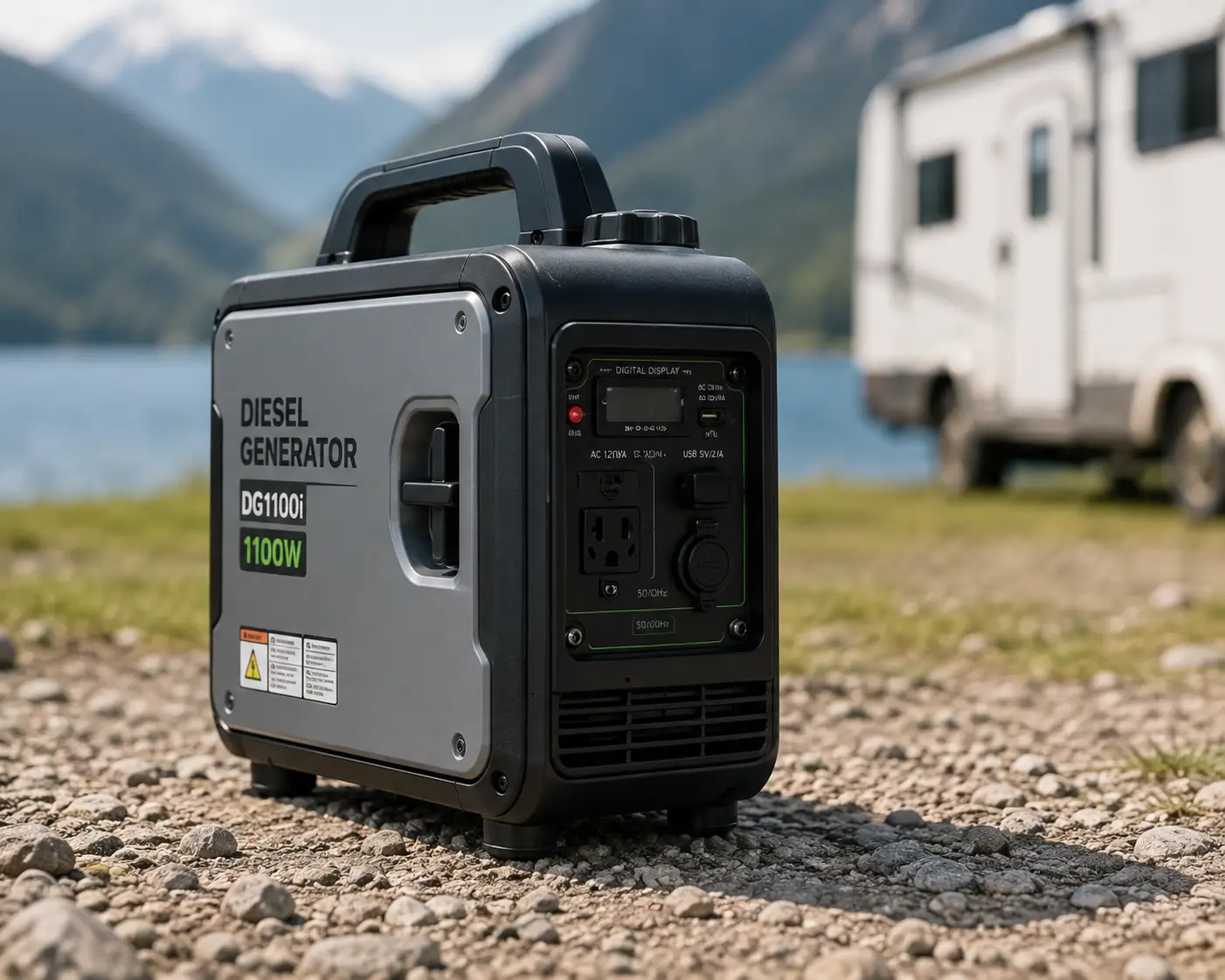
A diesel generator for RV or off-grid use faces different demands than a home standby unit: weight and noise matter more than raw capacity, since most RV electrical systems don’t need anywhere near 5,000 watts continuously. Among the picks here, the Generac XD5000E is the most realistic option for RV or off-grid installation thanks to its comparatively low 252-pound weight and long runtime — a genuine advantage for boondocking trips where refueling access is unpredictable.
What most RV owners overlook is that diesel’s superior fuel stability is arguably more valuable off-grid than at home: gasoline degrades within a month or two without a stabilizer, which is a real problem if a generator sits unused between trips, while diesel can sit safely for six months to a year with proper storage. The tradeoff is that even the lightest true diesel generator is still meaningfully heavier than a comparable gas inverter, so buyers should confirm their RV’s cargo capacity and tongue weight ratings before committing to a diesel setup.
Frequently Asked Questions
❓ What is the smallest diesel generator you can buy in the U.S.?
❓ How many watts do I need from a small diesel generator for home backup?
❓ Is a diesel generator better than a gas generator for home use?
❓ How long will a small diesel generator run on a full tank?
❓ Do small diesel generators need CARB certification in California?
Conclusion
Choosing the smallest diesel generator that fits your actual needs comes down to being honest about two things: how much power you truly need continuously, and how much weight and noise you’re willing to live with in exchange for diesel’s fuel efficiency and longevity advantages. For most homeowners, the Generac XD5000E offers the best balance of portability, runtime, and mainstream availability, while budget-conscious buyers can get real diesel economics from the All Power America APGG3203. Anyone planning toward whole-home standby power should look seriously at the Kubota GL11000 or Kubota GL14000, and professionals running multi-day jobsite or event power should consider the Multiquip DCA25SSIU4F despite its size and cost.
Whichever size class fits your situation, the numbers in this guide — weight, tank size, runtime, and noise — matter more than any marketing claim on a product box. Cross-check them against your actual power needs, confirm CARB and EPA compliance for your state, and you’ll end up with a generator that earns its keep during the outage that matters, not just the one on the showroom floor.
✨ Don’t Miss These Diesel Power Picks!
🔍 Take your backup power planning to the next level with this carefully researched lineup. Click a highlighted model above to check current pricing and availability before the next storm season — or job — arrives.
Recommended for You
- Replacement Solar Light Parts: 7 Best Picks to Fix Yours in 2026
- Renogy 100W Solar Panel: 7 Best Picks & Buying Guide (2026)
- Battery Pack for Holiday Light: 7 Best Picks for a Brighter 2026 Season
Disclaimer: This post contains affiliate links. As an Amazon Associate, I earn from qualifying purchases made through these links, at no additional cost to you.
✨ Found this article helpful? Share it with someone who needs it! 💬🤗