
In This Article
A 12v generator battery is a small sealed lead-acid or lithium battery, usually in the compact “Group U1” size, that powers the electric starter on a portable or standby generator so you don’t have to pull-start it by hand. When yours dies — usually at the worst possible moment, mid-storm, with the lights out — you’re stuck yanking a recoil cord in the dark instead of just pressing a button.
That’s the scenario that sends most people searching for a replacement. The good news is that a 12 volt generator battery is one of the cheapest, most impactful upgrades you can make to a backup power setup, and you don’t need to be an electrician to swap one in. The trick is knowing which group U1 generator battery actually fits your machine, how AGM compares to newer lithium options, and which brands hold up once the honeymoon period wears off.
Below, we break down seven real, currently available options — from budget sealed lead-acid batteries to premium lithium upgrades — with honest analysis pulled from spec sheets and aggregated customer feedback, not marketing copy. According to Consumer Reports, a dead or neglected battery is one of the most common reasons a home backup generator fails to start when it’s actually needed, which is exactly why getting this one component right matters more than it seems.
Quick Comparison: 7 Best 12V Generator Batteries at a Glance
| # | Product | Battery Type | Capacity | Best For |
|---|---|---|---|---|
| 1 | Mighty Max Battery ML35-12 | AGM (sealed) | 12V 35Ah | All-around replacement |
| 2 | UPG UB12350 | AGM/SLA (sealed) | 12V 35Ah | Budget-conscious buyers |
| 3 | Weize 12V 35Ah AGM | AGM (sealed) | 12V 35Ah | Broad OEM compatibility |
| 4 | ExpertPower EXP1235 | AGM (sealed) | 12V 35Ah | Flexible terminal setups |
| 5 | VMAX V35-857 | AGM deep-cycle | 12V 35Ah | Frequent, repeated discharge |
| 6 | Odyssey PC680 | Premium AGM | 12V, compact case | Cold-weather cranking |
| 7 | ExpertPower EP1235 LiFePO4 | Lithium (LiFePO4) | 12V 35Ah | Long-term lithium upgrade |
Looking at the table above, the first four entries are essentially interchangeable Group U1 sealed AGM batteries that will fit the vast majority of Generac, Champion, Predator, and Briggs & Stratton portable and inverter generators — the real differences show up in build quality and warranty support, not raw specs. The VMAX V35-857 and Odyssey PC680 step up in price because they’re engineered for harder duty cycles and temperature extremes, while the ExpertPower EP1235 LiFePO4 represents a completely different chemistry that trades a higher upfront cost for a dramatically longer service life.
💬 One click helps other shoppers make an informed choice too! 😊
Top 7 12V Generator Batteries: Expert Analysis
1. Mighty Max Battery ML35-12 — most trusted all-around replacement
The Mighty Max Battery ML35-12 has become something of a default recommendation in generator forums, and once you look at the spec sheet, it’s easy to see why. It’s a 12V 35Ah sealed AGM battery in the standard Group U1 footprint, offered with either nut-and-bolt (NB) or internal-thread (INT) terminals, so it slots into most Champion, Generac, and Troy-Bilt portable units without any adapter hunting.
Being AGM (absorbed glass mat) means the electrolyte is held in a fiberglass mat rather than sloshing around as free liquid, which is what makes it spill-proof and safe to mount in almost any orientation — a genuinely useful trait on a generator that might get tilted during transport. Because it’s valve-regulated, it also doesn’t need periodic water top-offs like an old-style flooded battery would.
Based on comparing the spec sheet against its closest competitors, this model earns its popularity mainly through consistency of manufacturing rather than any one standout number — the terminal-style flexibility and wide cross-compatibility with OEM part numbers make it a low-risk pick for someone who just wants their generator to start. Reviews consistently report smooth drop-in fitment and reliable first-year performance; the most common complaint in aggregated feedback is a shorter-than-hoped lifespan when the battery sits unused for months without a maintainer attached — which, to be fair, is true of every sealed lead-acid battery, not just this one.
Pros:
- ✅ Fits the vast majority of Group U1 generator battery trays
- ✅ Spill-proof AGM construction, mountable at an angle
- ✅ Available in NB or INT terminal styles for easy matching
Cons:
- ❌ Self-discharges over months of storage without a maintainer
- ❌ Standard AGM lifespan (roughly 3-5 years) versus premium options
At around $55-$70 depending on terminal style and pack size, the Mighty Max Battery ML35-12 lands squarely in fair-value territory for a mainstream sealed AGM replacement.
2. UPG UB12350 — best budget-friendly pick
If price is the deciding factor, the UPG UB12350 from Universal Power Group is one of the most widely stocked sealed 12V 35Ah U1 batteries on the market, and it’s sold under enough OEM cross-reference numbers that it’s practically an industry default for replacement parts suppliers.
It’s a straightforward sealed lead-acid (SLA) design, valve-regulated so it’s maintenance-free, with the same 35Ah capacity and U1 footprint as the pricier options on this list. What you’re not paying for is a brand story — UPG positions this as a functional workhorse rather than a premium product, and the spec sheet reflects that: no fancy cycle-life claims, just a dependable capacity rating in a well-tested case size.
Here’s what most buyers overlook with a budget SLA battery like this one: the chemistry inside a $50 U1 battery and a $70 U1 battery is often nearly identical AGM/SLA construction, so for a generator that starts a handful of times a year, the cheaper option can be the smarter buy. Reviews consistently describe this as “does exactly what it says,” with occasional aggregated complaints about slightly inconsistent capacity between individual units — a known tradeoff with high-volume budget manufacturing.
Pros:
- ✅ One of the lowest-priced genuine Group U1 batteries available
- ✅ Sealed, maintenance-free AGM/SLA construction
- ✅ Extensive OEM cross-reference compatibility
Cons:
- ❌ No standout cycle-life or performance claims versus rivals
- ❌ Some unit-to-unit capacity variance reported in aggregated reviews
Priced in the $45-$60 range, the UPG UB12350 delivers solid value for anyone who just needs a reliable starter battery without paying for extras they won’t use.
3. Weize 12V 35Ah AGM Battery — widest OEM compatibility
The Weize 12V 35Ah AGM Battery shows up constantly in generator, mobility scooter, and solar-storage buying guides for one simple reason: its listing explicitly cross-references an unusually long list of OEM equivalents, including 33Ah, 34Ah, and 36Ah rated batteries, plus specific model matches like Power Patrol SLA1156 and Ritar RA12-33.
That breadth matters in practice. A lot of buyers don’t know their generator’s exact original battery part number — they just know the compartment size and roughly how big the old battery was. Weize’s sealed AGM deep-cycle build tolerates that ambiguity better than most, and its terminal hardware is compatible with the same NB mounting bolts used across the Group U1 category.
What the spec sheet doesn’t say, but aggregated review data suggests, is that Weize batteries perform comparably to other mid-tier AGM brands in day-to-day use, with the brand’s main selling point being confidence in fitment rather than a performance edge. That’s a legitimate reason to choose it if you’ve been burned before by a “close enough” battery that didn’t actually fit the tray. Common feedback themes include easy installation and accurate labeling of terminal orientation, with occasional notes about slower charge acceptance compared to the VMAX and Odyssey options further down this list.
Pros:
- ✅ Cross-references an exceptionally wide range of OEM part numbers
- ✅ Sealed AGM deep-cycle design, safe for angled mounting
- ✅ Consistent terminal orientation and labeling per reviews
Cons:
- ❌ No meaningful performance advantage over similarly priced AGM rivals
- ❌ Charge acceptance reported as slightly slower than premium AGM options
Expect to pay around $50-$65, which is competitive for a battery this easy to size correctly on the first try.
4. ExpertPower EXP1235 — most versatile terminal options
ExpertPower EXP1235 (also sold as EXP35) stands out for one practical reason: ExpertPower sells this same 12V 35Ah capacity across sealed AGM, gel, and lithium (LiFePO4) chemistries, plus multiple terminal configurations, so you can match your generator’s exact connection style instead of adapting to whatever a single fixed SKU offers.
For a generator application specifically, the standard AGM version is the relevant pick, and it delivers the same core benefits as the rest of the sealed AGM field: spill-proof construction, valve regulation, and a compact Group U1-compatible case. The NB terminal variant is the one most portable generator owners will want, since it matches the bolt-style connectors used by Champion, Predator, and most Generac portable units.
Based on comparing this line against the other AGM entries here, ExpertPower’s real advantage is flexibility rather than raw performance — if you’re outfitting multiple pieces of equipment (a generator, a mobility scooter, a small solar setup) you can standardize on one brand across different chemistries. Reviews consistently highlight straightforward installation and accurate capacity delivery in the first year; a recurring theme in aggregated feedback is that, like most sealed AGM batteries, performance can taper noticeably after 2-3 years of hard seasonal use, particularly for buyers who run their generator regularly rather than just for emergencies.
Pros:
- ✅ Available across AGM, gel, and lithium chemistries under one brand
- ✅ NB terminal version matches most portable generator brackets
- ✅ Straightforward installation reported across aggregated reviews
Cons:
- ❌ Performance tapering after 2-3 years of frequent, heavy use
- ❌ Premium lithium version (covered below) costs significantly more
The AGM version typically runs $55-$70, putting it right in line with other mainstream Group U1 replacements.
5. VMAX V35-857 — best for deep, repeated discharge
The VMAX V35-857 is marketed specifically as a deep-cycle AGM battery rather than a general-purpose sealed lead-acid unit, and that distinction matters if your generator sees frequent starts, extended runtime, or gets tapped for accessory power beyond just cranking the starter motor.
Deep-cycle AGM construction generally uses thicker internal plates than standard SLA batteries, which trades a bit of peak burst performance for meaningfully better tolerance of repeated partial discharge-and-recharge cycles — exactly the pattern a generator battery experiences if it’s also running lights, a charge controller, or sits through frequent test-starts. VMAX positions this line for marine and trolling-motor use as well, which is a good proxy for how demanding a duty cycle it’s built to survive.
What most buyers overlook with deep-cycle-rated batteries is that the extra durability is really an investment in reduced replacement frequency, not a bigger jolt of starting power. If your generator only starts a few times a year for brief test runs, you likely won’t notice the difference versus a standard AGM battery — but if you run a standby generator through regular exercise cycles or use a portable unit for extended power outages, the deep-cycle build is where the extra cost earns its keep. Aggregated reviews consistently mention strong build quality and reserve capacity, with occasional complaints about the higher price relative to basic U1 batteries.
Pros:
- ✅ Thicker AGM plates built for repeated partial discharge cycles
- ✅ Strong reserve capacity for extended runtime scenarios
- ✅ Reputation for durability in demanding marine/trolling-motor use
Cons:
- ❌ Premium pricing versus basic sealed AGM U1 batteries
- ❌ Overkill for generators that only start occasionally for short runs
Priced around $90-$115, the VMAX V35-857 is a meaningful step up in cost, but it’s a reasonable one for anyone whose generator earns its keep more than a few times a year.
6. Odyssey PC680 — best cold-weather cranking power
The Odyssey PC680 (also sold under the model code ODS-AGM16L) has a well-earned reputation in the powersports and off-grid communities for extreme-temperature performance and a service life that can stretch well beyond a typical sealed lead-acid battery. It’s worth noting upfront: the PC680’s physical case is more compact than a standard Group U1 battery, so it’s essential to check your generator’s battery tray dimensions before ordering — this is a premium pick for generators with flexible mounting, not a guaranteed universal U1 drop-in.
Odyssey’s pure-lead AGM construction is the reason for the price premium. Pure-lead plates pack more surface area into the same footprint than conventional lead-alloy plates, which translates into higher burst cranking performance and better cold-weather starting — a genuinely useful trait if your generator lives in an unheated shed through a Midwest or Northeast winter. The tradeoff is a case size that doesn’t universally match every U1 battery compartment.
Based on comparing Odyssey’s published design specs against the other AGM entries here, this battery is the right call specifically when starting reliability in cold conditions is non-negotiable — think whole-house standby generators that need to fire up instantly during a winter storm outage. Reviews consistently praise long service life and dependable cold starts; the most common critique in aggregated feedback is the price tag and the need to double-check fitment before buying, since it isn’t interchangeable with every U1 tray.
Pros:
- ✅ Pure-lead AGM construction built for strong cold-weather starts
- ✅ Reputation for long service life versus standard sealed AGM
- ✅ Well-suited to demanding standby/whole-house generator duty
Cons:
- ❌ Compact case size may not match every U1 battery tray
- ❌ Significantly pricier than standard Group U1 AGM batteries
Expect a price range of roughly $150-$200 — a real investment, but one that’s aimed squarely at buyers who can’t afford a failed cold start.
7. ExpertPower EP1235 LiFePO4 — lightest, longest-lasting upgrade
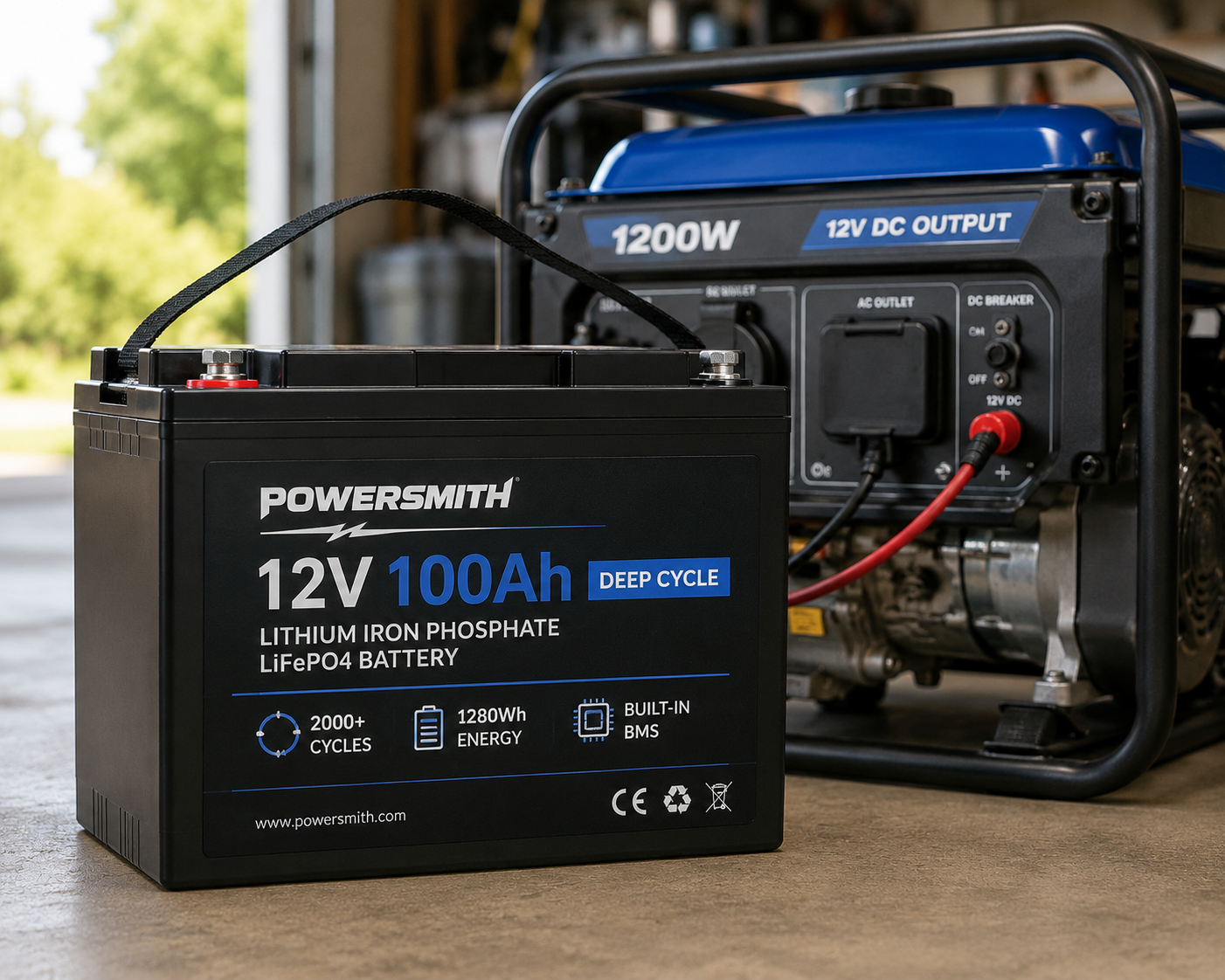
The ExpertPower EP1235 represents the newest chemistry on this list: lithium iron phosphate (LiFePO4) in the same 12V, 35Ah, Group U1-compatible footprint as the AGM options above, with a built-in battery management system (BMS) and a manufacturer-stated cycle life in the thousands rather than the hundreds.
Lithium’s biggest practical advantage over lead-acid isn’t power output — it’s weight and longevity. A LiFePO4 battery in this capacity typically weighs roughly a third of an equivalent AGM battery, which matters if you’re lifting it in and out of a portable generator regularly. The built-in BMS also protects against over-discharge, which is one of the main things that kills lead-acid batteries left dead in storage over winter — a scenario that’s extremely common for generators that only get used during outages.
Here’s what the spec sheet doesn’t fully convey: lithium batteries generally hold their charge in storage far longer than AGM or SLA batteries, meaning a generator that sits idle for months is much more likely to start on the first pull (or first press of the button) after a long dormancy. That single trait may be the most valuable feature for anyone buying a battery specifically for emergency backup use rather than daily operation. Aggregated reviews consistently highlight the noticeable weight savings and long standby charge retention; the main critique is the significantly higher upfront price compared to any AGM option on this list.
Pros:
- ✅ Roughly one-third the weight of an equivalent AGM battery
- ✅ Built-in BMS protects against over-discharge damage
- ✅ Far better long-term charge retention during storage
Cons:
- ❌ Substantially higher upfront cost than AGM alternatives
- ❌ Not every older generator charging circuit is optimized for lithium
At roughly $130-$170, the ExpertPower EP1235 LiFePO4 costs more than double a basic AGM battery, but for a generator that mostly sits in standby readiness, the storage-retention advantage alone can justify the premium.
Detailed Comparison: Capacity, Chemistry, and Value
| Product | Chemistry | Ideal Use Case | Est. Price Range | Best For |
|---|---|---|---|---|
| Mighty Max Battery ML35-12 | AGM | General replacement | $55-$70 | Most portable generators |
| UPG UB12350 | AGM/SLA | Budget replacement | $45-$60 | Occasional-use generators |
| Weize 12V 35Ah AGM | AGM | Uncertain OEM fitment | $50-$65 | Cross-brand compatibility |
| ExpertPower EXP1235 | AGM | Mixed-terminal setups | $55-$70 | Multi-equipment households |
| VMAX V35-857 | AGM deep-cycle | Frequent runtime | $90-$115 | Standby/regular-use generators |
| Odyssey PC680 | Premium pure-lead AGM | Cold-climate starting | $150-$200 | Whole-house standby units |
| ExpertPower EP1235 LiFePO4 | Lithium (LiFePO4) | Long-term storage readiness | $130-$170 | Emergency-only backup use |
This table makes the tradeoff pattern clear: the first four products cluster tightly on price because they’re functionally similar AGM batteries, while the VMAX V35-857, Odyssey PC680, and ExpertPower EP1235 LiFePO4 each justify a higher price through a specific, honest advantage — deep-cycle durability, cold-weather cranking, or long-term storage retention, respectively. If you’re not sure which category you fall into, the “How to Choose” section below walks through the decision step by step.
<h4>✨ Don’t miss these exclusive deals!</h4>
🔍 Take your backup power setup to the next level with this carefully curated lineup. Click a highlighted battery to check current pricing and availability. These picks will help you get a generator that actually starts when your family needs it most!
How to Install and Maintain Your 12V Generator Battery
Installing a replacement 12v generator battery is one of the simplest DIY jobs in the backup-power world, but a few habits make the difference between a battery that lasts five years and one that dies in eighteen months.
Start by disconnecting the negative terminal first, then the positive — reversing that order on reinstall reduces the risk of a short circuit if a wrench brushes the generator’s frame. Match your new battery’s terminal style (NB or INT) to your generator’s existing cable ends before ordering; this is the single most common return reason across the AGM options above. Torque terminal bolts snugly but don’t overtighten, since stripped posts on a sealed AGM battery generally can’t be repaired.
Once installed, the maintenance schedule for a sealed AGM or lithium generator battery is refreshingly light: no water top-offs, ever. What it does need is periodic charging. According to Honda Power Equipment’s official generator battery guidance, even maintenance-free batteries benefit from a trickle charger or battery maintainer during long idle periods, since self-discharge is what kills most standby generator batteries — not age alone. A $20-$30 automatic float charger, left connected between test-runs, is the cheapest insurance policy available for any battery on this list.
Which 12V Generator Battery Fits Your Situation? Real-World Scenarios
The occasional-use homeowner: If your generator starts maybe four or five times a year for brief maintenance runs and short outages, a budget sealed AGM battery like the UPG UB12350 or Weize 12V 35Ah AGM is genuinely sufficient. You’re not stressing the battery with deep discharge cycles, so the extra durability of a deep-cycle or lithium option won’t pay for itself.
The whole-house standby owner: If you’ve got a permanently installed standby generator that runs weekly self-test cycles year-round, especially somewhere with harsh winters, the case for the Odyssey PC680 gets much stronger. Reliable cold starting and long service life matter more here than upfront cost, since a failed standby generator during a winter storm is exactly the scenario it exists to protect against.
The prepper or off-grid cabin owner: If your generator might sit completely unused for six months or longer between emergencies, storage-charge retention is your top priority — which makes the ExpertPower EP1235 LiFePO4 worth the premium. A lead-acid battery left dormant that long often needs replacing before it’s ever truly needed; a lithium battery is far more likely to still have a usable charge when you finally need it.
The contractor or heavy-use operator: If your portable generator runs for extended stretches on job sites, with frequent stop-start cycles and accessory loads, the VMAX V35-857‘s deep-cycle build is the practical choice — it’s engineered for exactly this kind of repeated partial-discharge pattern.
Common 12V Generator Battery Problems (and How to Fix Them)
Problem: The generator won’t crank at all. This is almost always a fully discharged or sulfated battery rather than a starter motor failure. Try charging it fully with a dedicated battery charger (not just the generator’s built-in charging circuit) before assuming the battery is dead — sometimes a deeply discharged AGM battery can be partially revived with a slow, low-amperage charge.
Problem: The battery holds a charge for only a few days. This usually points to age-related capacity loss or a parasitic drain somewhere in the generator’s control panel. If the battery is more than three years old, this is a strong sign it’s simply due for replacement rather than a wiring fault.
Problem: The new battery doesn’t fit the tray. This is the most preventable problem on the list — always confirm Group U1 dimensions (roughly 7.7 x 5.1 x 6.1 inches) and terminal style against your generator’s manual before ordering, especially with the more compact Odyssey PC680.
Problem: The battery corrodes at the terminals quickly. White or greenish crust at the terminals is typically a sign of minor acid seepage or humidity exposure. A light coating of dielectric grease on the terminals after installation prevents most corrosion before it starts.
Problem: The generator starts fine when warm but struggles in winter. Cold temperatures reduce a lead-acid battery’s effective cranking power significantly. If this happens every winter, it’s a sign you’d benefit from a cold-weather-optimized battery like the Odyssey PC680 rather than repeatedly replacing standard AGM units.
How to Choose a 12V Generator Battery
- Confirm your battery group size first. Most portable and inverter generators use Group U1; standby/whole-house units sometimes use larger automotive group sizes — check your owner’s manual before shopping by price alone.
- Match the terminal style exactly. NB (nut and bolt) and INT (internal thread) terminals aren’t interchangeable without an adapter, and this is the top cause of return requests across every AGM option above.
- Decide how often the generator actually runs. Occasional use favors a standard sealed AGM battery; frequent or extended use favors a deep-cycle-rated option like the VMAX V35-857.
- Factor in your climate. If winter starts are a recurring concern, prioritize cold-weather cranking performance over price, as with the Odyssey PC680.
- Weigh lithium if long dormancy is likely. Emergency-only generators that sit unused for months benefit disproportionately from the storage-retention advantage of the ExpertPower EP1235 LiFePO4.
- Check physical dimensions, not just the group name. Some premium AGM batteries, including the Odyssey PC680, use a more compact case than standard U1 — verify before ordering.
- Budget for a maintainer, not just the battery. A $20-$30 float charger meaningfully extends the life of any option on this list and is arguably as important as which battery you choose.
Common Mistakes to Avoid When Buying a 12V Generator Battery
The single most common mistake is buying strictly on price without confirming terminal style — a $45 battery that doesn’t fit isn’t actually cheap once you’ve paid return shipping and waited a week for a replacement. A close second is assuming “AGM” automatically means premium; as the comparison table above shows, most AGM batteries in this category are functionally similar, and the real premium features (deep-cycle plates, pure-lead construction, lithium chemistry) are specific, named upgrades rather than implied by the word “AGM” alone.
Another frequent misstep is skipping the maintainer. Buyers regularly blame a battery brand for a “short lifespan” when the real culprit was months of unmanaged self-discharge in storage — a problem that a $25 float charger solves regardless of which product you buy. Finally, some buyers assume a lithium battery is a drop-in match for any generator’s charging system; while most modern generators charge lithium batteries safely, it’s worth a quick check of your owner’s manual or manufacturer support line if your unit is older than roughly ten years.
12V Generator Battery: AGM vs Lithium (LiFePO4)
Choosing between AGM and lithium for a generator battery comes down to how you actually use your generator, not which chemistry is objectively “better.” AGM batteries, as the Wikipedia overview of valve-regulated lead-acid battery technology explains, use an absorbed glass mat to immobilize the electrolyte, which is what makes them sealed, spill-proof, and safe for angled mounting — a mature, well-understood technology with a lower upfront cost.
| Factor | AGM (e.g., Mighty Max Battery ML35-12) | Lithium (ExpertPower EP1235) |
|---|---|---|
| Upfront cost | Lower ($45-$115 range) | Higher ($130-$170 range) |
| Weight | Heavier | Roughly one-third the weight |
| Storage self-discharge | Faster, needs a maintainer | Much slower, better long dormancy |
| Typical service life | 3-5 years | Often 8-10+ years with proper BMS |
| Cold-weather cranking | Good to excellent (varies by model) | Generally good, some models de-rate in extreme cold |
Looking at the comparison above, AGM remains the practical default for most buyers because of its lower cost and universal compatibility, but lithium’s storage-retention and lifespan advantages make it a genuinely smart long-term investment for a generator that exists purely for emergency backup and might not run for months at a stretch.
What to Expect: Everyday Performance
On paper, every battery in this roundup shares a 12V, 35Ah (or comparable) rating, which can make them look interchangeable at a glance. In real-world use, the differences show up less in raw cranking power and more in consistency over time. A fresh sealed AGM battery from any of the first four products on this list will start a generator just as reliably as a premium option on day one — the gap widens after a year or two of storage, temperature cycling, and repeated partial discharges.
What most buyers notice first isn’t a dramatic performance difference; it’s how the battery behaves after sitting unused. A cheaper AGM battery left in an unheated garage over a mild winter with no maintainer may need a slow recharge before it’ll crank the starter — that’s normal sulfation from disuse, not necessarily a defective unit. The premium options on this list — the deep-cycle VMAX V35-857, cold-optimized Odyssey PC680, and long-retention ExpertPower EP1235 LiFePO4 — are specifically engineered to minimize exactly that failure mode, which is where their added cost quietly pays for itself over years two through five of ownership.
Choosing the Right 12V Generator Battery for Your Generator Type
Portable generators used for camping, tailgating, or occasional job-site power typically draw the least from their starter battery and are well served by any standard sealed AGM option, since they’re rarely left dormant for extended stretches between uses. Inverter generators, which tend to be smaller and more sensitive to voltage irregularities in their control electronics, generally pair well with any of the AGM batteries here, though it’s worth double-checking your specific model’s charging circuit compatibility if you’re considering the lithium ExpertPower EP1235.
Whole-house standby generators are the category where battery choice matters most, because these units are designed to start automatically, unattended, during a power outage — there’s no second chance to pull-start it if the battery fails. This is exactly the use case the Odyssey PC680 was built for, given its cold-weather cranking strength and long service life under the periodic self-test cycles standby units run automatically. If your standby generator sits in a detached, unconditioned structure through winter, cold-weather cranking performance should outweigh price in your decision.
Long-Term Cost and Maintenance
It’s tempting to compare these seven batteries purely on sticker price, but total cost of ownership tells a more useful story. A $50 budget AGM battery that needs replacing every 2-3 years works out to roughly $17-$25 per year of service. A $160 lithium battery that reliably lasts 8-10 years, by contrast, averages out to roughly $16-$20 per year — genuinely competitive with the budget option once you account for the total lifespan, and that’s before factoring in the convenience of not swapping batteries as often.
The VMAX V35-857 and Odyssey PC680 occupy a middle ground: their higher upfront cost is partly offset by longer expected service life under demanding conditions, though the exact payback period depends heavily on how hard your specific generator works. For most occasional-use households, a standard AGM battery paired with a $25 maintainer remains the lowest total-cost option; for standby systems and rarely-used emergency generators, the premium options increasingly make financial sense once you run the multi-year math rather than just comparing shelf prices.
Safety, Regulations, and Standards for 12V Generator Batteries
Sealed lead-acid and AGM batteries sold for generator use are generally evaluated against UL 1989, the safety standard covering valve-regulated and vented batteries with aqueous electrolytes — look for UL or ETL markings on the battery casing as a baseline indicator of independent safety testing. Beyond the battery itself, it’s worth remembering that the generator it powers carries its own safety requirements: the U.S. Consumer Product Safety Commission’s voluntary standards for portable generators cover carbon monoxide emissions and shutoff sensors, which is a critical reminder that a reliable starter battery is only one piece of safe generator operation — proper outdoor placement and CO detection matter just as much as which battery you buy.
Lithium batteries built with a genuine battery management system, like the ExpertPower EP1235, add protection layers against overcharge, over-discharge, and short circuits that older lead-acid designs simply don’t have, which is part of why reputable lithium replacement batteries tend to carry longer warranties than comparable AGM products. Whichever chemistry you choose, avoid storing a spare battery in direct sunlight or near open flame, and always recycle a spent lead-acid or lithium battery through a certified recycler rather than regular trash — most auto parts retailers accept both chemistries for free recycling.
Frequently Asked Questions
❓ What size battery does a portable generator need?
❓ Can I use a regular car battery in my generator?
❓ How long does a 12V generator battery last?
❓ Is AGM or lithium better for a generator battery?
❓ How do I know when to replace my generator battery?
Conclusion
Picking the right 12v generator battery really comes down to matching the product to how you actually use your generator, not chasing the highest spec sheet number. For most households running a portable generator a handful of times a year, a straightforward sealed AGM option like the Mighty Max Battery ML35-12 or budget-friendly UPG UB12350 will do the job reliably for years, especially paired with a cheap battery maintainer during long idle stretches.
If your situation calls for something more specialized — frequent, heavy-duty runtime, brutal winter cold starts, or long months of dormant standby readiness — the VMAX V35-857, Odyssey PC680, and ExpertPower EP1235 LiFePO4 each solve a specific, real problem rather than just carrying a bigger price tag. Whichever you choose, the single highest-leverage habit you can adopt is pairing it with a maintainer and checking your generator’s charging system annually, since even the best battery on this list will underperform if it’s left to self-discharge in storage. A generator is only as reliable as the battery that starts it — get that one part right, and the rest of your backup power plan falls into place.
Recommended for You
- Replacement Solar Light Parts: 7 Best Picks to Fix Yours in 2026
- Renogy 100W Solar Panel: 7 Best Picks & Buying Guide (2026)
- Battery Pack for Holiday Light: 7 Best Picks for a Brighter 2026 Season
Disclaimer: This post contains affiliate links. As an Amazon Associate, I earn from qualifying purchases made through these links, at no additional cost to you.
✨ Found this article helpful? Share it with someone who needs it! 💬🤗