
In This Article
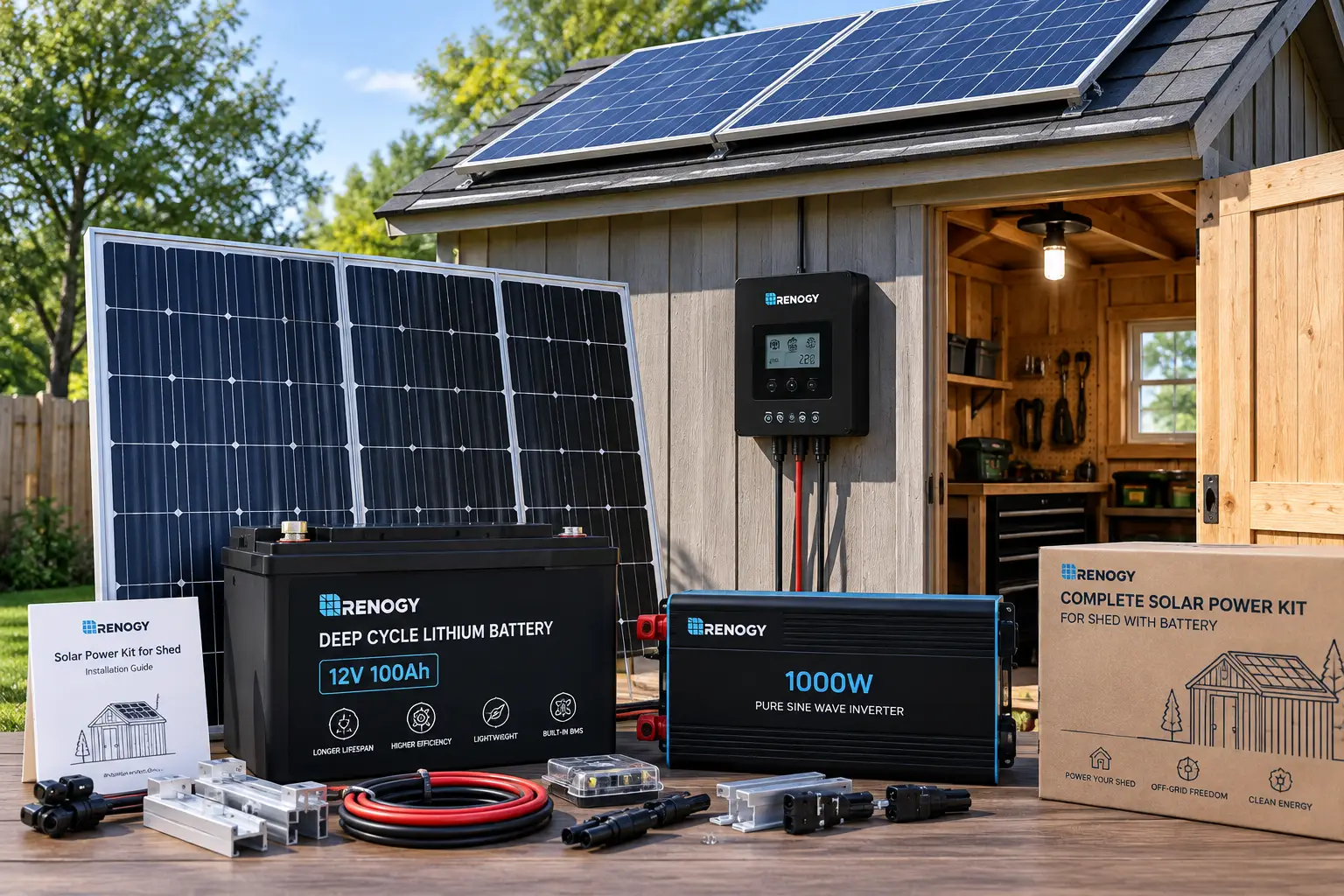
A solar power kit for shed with battery is a bundled system — solar panel(s), a charge controller, a battery, and usually an inverter — that lets you generate, store, and use electricity inside a shed, workshop, or outbuilding without running a trench of conduit back to your house panel. For anyone who’s ever strung an orange extension cord across the yard just to run a shop light, that single sentence explains why this category has exploded over the last few years.
You’re probably here because you want lights that don’t flicker, an outlet for a drill or a mini-fridge, and the peace of mind that comes from not depending on a 100-foot cord. The good news: 2026’s lineup of solar shed kits is genuinely better than it was even two years ago. Lithium iron phosphate (LiFePO4) batteries have become the default instead of the exception, MPPT charge controllers have gotten cheaper, and portable power stations now come bundled with folding panels sized specifically for casual outbuilding use.
This guide breaks down seven real, currently available kits — from a sub-$200 modular starter panel to a whole-shed 4.68kWh backup system — with honest analysis based on published specs and aggregated owner feedback, not fabricated reviews. As the U.S. Department of Energy explains, individual solar cells are wired together into larger panels specifically to boost usable power output — which is exactly the building block every kit below is made from. We’ll also cover sizing, installation reality, safety, and long-term costs so you can pick the right system instead of just the cheapest one.
Quick Comparison: Solar Power Kits for Shed With Battery at a Glance
Before diving into the full breakdown, here’s how the seven kits stack up on the numbers that matter most for shed use: panel wattage, battery capacity, and what kind of shed setup each one actually fits.
| Kit | Panel Output | Battery Capacity | Inverter | Best For |
|---|---|---|---|---|
| RICH SOLAR 200W Complete Kit | 200W | 100Ah / ~1.28kWh (12V) | 2000W | First-time DIY buyers |
| ECO-WORTHY 200W Complete Kit | 200W | 50Ah / ~0.64kWh (12V) | 600W | Tight budgets, light loads |
| Renogy 100W Starter Kit | 100W (expandable) | Sold separately | N/A (panel + controller only) | Modular, build-your-own setups |
| Jackery Solar Generator 1000 Plus Kit | 200W (2×100W) | 1,264Wh LiFePO4 | 2000W (2000W surge) | Portable, plug-and-play power |
| BLUETTI AC180 Solar Kit | ~200–350W (panel sold w/ bundle) | 1,152Wh LiFePO4 | 1800W | Balanced power-to-portability |
| ALLPOWERS R2500 + 200W Panel | 200W (expandable) | 2,016Wh LiFePO4 | 2500W (4000W surge) | Power tools and heavier loads |
| ECO-WORTHY 4.68kWh Complete Kit | 1,170W (6×195W) | 48V 50–100Ah LiFePO4 | 3500W | Whole-shed, near-off-grid living |
Looking at the table, the split is really between two philosophies: fixed DIY systems (RICH SOLAR, ECO-WORTHY, Renogy) that you wire into your shed’s own outlets, and portable power-station kits (Jackery, BLUETTI, ALLPOWERS) that you can carry, plug into, and take with you if you move. The ECO-WORTHY 4.68kWh Complete Kit sits in a category of its own — it’s less “shed accessory” and more “small off-grid electrical system.” Your choice mostly comes down to whether you want something permanently wired or something you can unplug and relocate.
💬 One click helps other shed owners make an informed choice too! 😊
Top 7 Solar Power Kits for Shed With Battery: Expert Analysis
1. RICH SOLAR 200 Watt Complete Solar Kit — best all-in-one for first-timers
If you want to skip the parts-shopping spreadsheet and buy one box that includes everything, this is the kit most first-time buyers land on. It pairs a 200W monocrystalline panel with a 20A MPPT charge controller, a 100Ah 12V lithium battery, and a 2000W pure sine wave inverter — meaning it’s genuinely ready to power outlets, not just charge a battery. The step up from PWM to MPPT charge control matters more than it sounds: MPPT controllers squeeze roughly 20-30% more usable power out of the same panel by constantly hunting for the optimal voltage point, which is the difference between “enough for LED lights” and “enough for lights plus a phone charger and a small fan.” Based on comparing the specs, this kit is aimed squarely at hobbyists, weekend woodworkers, and anyone lighting a detached garage or backyard studio. Reviews and product documentation consistently point to straightforward installation and a 25-year output warranty on the panel itself, which signals real manufacturer confidence in long-term performance rather than just marketing copy. What most buyers overlook is that a 100Ah 12V battery only stores about 1.2kWh usable — plenty for lighting and electronics, tight for power tools run back-to-back.
Pros:
- ✅ True all-in-one kit — panel, controller, battery, inverter included
- ✅ MPPT controller squeezes more power from limited roof space
- ✅ 25-year panel warranty backs long-term reliability
Cons:
- ❌ 100Ah battery is modest for anything beyond lighting and electronics
- ❌ 2000W inverter can surge-trip on high-draw power tools
Pricing typically lands in the $450 to $600 range (check the current price, as it fluctuates); for a fully bundled system with a lithium battery included, that’s solid value for the shed and workshop crowd.
2. ECO-WORTHY 200W 12V Complete Solar Panel Starter Kit — lightest on the wallet
This is the budget on-ramp into shed solar. You get a 200W panel array, a 30A charge controller, a 50Ah LiFePO4 battery, and a 600W inverter — smaller numbers across the board than the RICH SOLAR kit above, but also a noticeably lower price. What most buyers overlook with entry kits like this is that the 600W inverter is the real ceiling, not the battery or panel: it can run LED lighting, charge phones and laptops, and power small fans comfortably, but it will trip instantly on a circular saw or a space heater. Buying guides covering this class of kit consistently position it as an entry-level bundle suited to cabins, RVs, and remote outbuildings, with a realistic daily output somewhere around 800Wh given roughly four hours of solid sun — which lines up with what you’d expect from a 200W array. The LiFePO4 chemistry is the standout feature at this price — older lead-acid kits at similar cost degrade far faster and can’t be discharged as deeply. Here’s what to weigh: this kit is best for a shed used mainly after dark for a few hours of lighting and device charging, not as a workshop power source.
Pros:
- ✅ Lowest entry price among complete kits with a lithium battery
- ✅ LiFePO4 battery outlasts lead-acid alternatives significantly
- ✅ Compact enough for a small shed or garden building
Cons:
- ❌ 600W inverter can’t handle most power tools
- ❌ 50Ah battery limits you to light, short-duration use
Expect a price in the $300 to $420 range at the time of writing — among the more affordable ways to get a lithium-backed kit rather than an aging lead-acid setup.
3. Renogy 100W 12V Solar Starter Kit — most flexible for building your own system
Unlike the previous two, this kit ships as panel-plus-controller only — no battery, no inverter — and that’s actually its appeal for a specific type of buyer. Renogy’s 100W monocrystalline panel pairs with a 30A PWM Wanderer charge controller, and the company backs the panel with a 10-year product warranty plus a 25-year performance warranty, numbers that hold up well against the rest of this list. What the spec sheet doesn’t say, but the modular design implies, is that this is the kit for someone who already has (or wants to separately choose) their own 12V battery — whether that’s a 100Ah AGM deep-cycle unit for budget reasons or a lithium battery for longevity. Based on comparing the specs, pairing this panel with a 100Ah lithium battery gets you roughly the same real-world output as the RICH SOLAR kit above, just assembled piece by piece instead of boxed together. Reviews of Renogy’s starter kits consistently describe the documentation as clear enough for a competent do-it-yourselfer to finish installation in a single weekend. The system is also expandable up to 400W with the same controller, so it can grow with your shed’s needs.
Pros:
- ✅ Backed by a 10-year product and 25-year performance warranty
- ✅ Expandable up to 400W without replacing the controller
- ✅ Lets you choose your own battery chemistry and capacity
Cons:
- ❌ Battery and inverter must be purchased separately
- ❌ PWM controller is less efficient than MPPT alternatives
The panel-and-controller kit alone typically runs under $200, with a compatible 100Ah lithium battery adding roughly $150 to $300 on top — still competitive once you total the build, and more flexible than a sealed bundle.
4. Jackery Solar Generator 1000 Plus Kit — best plug-and-play portable power
Rather than wiring a fixed system into your shed’s walls, this kit hands you a self-contained power station with two folding 100W SolarSaga panels. The Explorer 1000 Plus holds 1,264Wh in a LiFePO4 battery rated by the manufacturer for more than a decade of service and roughly 4,000 charge cycles, and it’s expandable — Jackery’s own materials note that up to three extra battery packs can be added, scaling total capacity from 1.25kWh up to a full 5kWh for multi-day backup. What sets this apart from the fixed kits above is charging flexibility: you can top it off from a wall outlet in roughly 1.7 hours, from a car port in about 7 hours, or from the included panels in around 18 hours of good sun. Based on comparing the specs, this is the kit for someone who wants shed power today and doesn’t want to touch a wire nut — you set the panels outside, run a cable in, and plug the power station in like an appliance. Real-world buyer accounts of using Explorer-series units to finish out backyard shed and outbuilding projects describe straightforward setup and reliable output for lights and small appliances. The trade-off is weight: at roughly 32 pounds, it’s portable in the sense of “movable,” not “backpack-friendly.”
Pros:
- ✅ Expandable from 1.25kWh up to 5kWh with add-on batteries
- ✅ Fast AC charging as a backup to slower solar charging
- ✅ Zero wiring — functions like a plug-in appliance
Cons:
- ❌ At 32 lbs, it’s not a grab-and-go lightweight unit
- ❌ Full solar charging takes roughly 18 hours in typical sun
Kits bundling the Explorer 1000 Plus with two SolarSaga 100W panels are generally priced in the $1,400 to $1,800 range — a premium over the DIY kits above, but you’re paying for portability and near-zero installation effort.
5. BLUETTI AC180 Solar Generator Kit — best balance of power and portability
The AC180 occupies the middle ground between Jackery’s Explorer 1000 Plus and the smaller entry-level kits, and independent testers have been notably impressed with it. One independent review gave the AC180 top marks, calling it highly portable, plenty powerful, and well-equipped with ports for daily use, while also flagging that its real-world weight runs slightly higher than the spec sheet suggests — closer to 35.6 pounds against an advertised 32.6 pounds. With 1,152Wh of LiFePO4 capacity and 1,800W continuous output, it comfortably handles small kitchen appliances, hair dryers, and space heaters, and can double as an uninterruptible power supply for sensitive electronics during a grid outage. Here’s what to weigh: the AC180 supports up to 500W of solar input, so pairing it with a single 200W-class folding panel is a modest match, while two panels get you closer to a full charge in a single sunny afternoon. What most buyers overlook is that Bluetti also sells the AC180 through a subscription model in some channels — worth knowing about, though most shed owners will do better buying outright for long-term cost.
Pros:
- ✅ Independently tested and rated highly for portability and power
- ✅ Supports up to 500W of solar input for faster daytime recharging
- ✅ Doubles as UPS backup for sensitive electronics
Cons:
- ❌ Actual weight runs heavier than the advertised spec
- ❌ Solar panel(s) often sold separately from the base unit
Bundled with a solar panel, expect a price in the $700 to $1,200 range depending on panel wattage chosen — frequently discounted, so it’s worth checking the current price before buying.
6. ALLPOWERS R2500 + 200W Solar Panel Kit — best for power tools and heavier loads
If your shed doubles as a real workshop — table saw, air compressor, welder on light duty — this is the kit in the lineup built to handle it. The R2500 power station holds 2,016Wh in a LiFePO4 pack and delivers 2,500W continuous output with a 4,000W surge rating, which is enough headroom to start motor-driven tools that spike hard on startup. The 1,000W max solar input is the standout spec here: paired with the right panel configuration, ALLPOWERS states the unit can reach a full charge from solar alone in about two hours, which is dramatically faster than the smaller kits on this list. Based on comparing the specs, this kit’s UPS function is also genuinely useful in a workshop context, switching over in milliseconds if grid power to a nearby outlet cuts out, so sensitive tools or a computer don’t lose their work. What the spec sheet doesn’t say, but the outlet count does, is that with four AC outlets, dual USB-C, and a dedicated 30A RV-style port, this kit is built for running multiple devices simultaneously rather than one appliance at a time — a meaningfully different design goal from the single-outlet-focused entry kits.
Pros:
- ✅ 2,500W continuous / 4,000W surge handles real power tools
- ✅ Fast solar recharge — around 2 hours with the max-rated input
- ✅ Millisecond UPS switchover protects sensitive equipment
Cons:
- ❌ Among the pricier portable options on this list
- ❌ Larger solar panel configurations sold separately at added cost
Bundled with a single 200W panel, pricing generally falls in the $1,100 to $1,500 range; larger panel bundles push closer to $2,000, so match the panel size to your actual daily sun exposure before upgrading.
7. ECO-WORTHY 4.68kWh Solar Power Complete Kit — best for whole-shed, near-off-grid power
This is the kit for a shed that’s functionally a small off-grid building — think a converted workshop, a guest studio, or a shed running a mini-fridge and multiple tools throughout the day. Instead of a portable power station, you get six 195W N-type bifacial panels (1,170W total), a 48V lithium battery bank, and a 3,500W inverter with an 80A MPPT controller built in. Manufacturer specs describe roughly 4.68kWh of daily output given about four hours of full sunlight, with the system explicitly sized for home, shed, and cabin use, and positioned to handle appliances like air conditioning, a TV, a refrigerator, and a microwave — a genuinely different power class than anything else on this list. Based on comparing the specs, the built-in 20ms UPS switching and WiFi monitoring add real convenience for a system this size, letting you check battery state from your phone instead of walking out to the shed. What most buyers overlook is that this kit comes in more than one battery configuration — some listings pair it with a single 100Ah battery, others split it across two 50Ah units — so it’s worth confirming which configuration you’re ordering, since usable capacity differs.
Pros:
- ✅ Enough capacity and output for genuinely appliance-heavy sheds
- ✅ Built-in 80A MPPT controller and WiFi monitoring included
- ✅ 20ms UPS switching protects connected devices during outages
Cons:
- ❌ Six-panel array needs real roof or ground-mount space
- ❌ Battery configuration varies by listing — confirm before ordering
Pricing generally runs in the $1,800 to $2,600 range depending on battery configuration — the highest upfront cost here, but also the only kit realistically capable of running a refrigerator and power tools on the same day.
Comparing the Full Lineup: Capacity, Output, and Value
| Kit | Usable Battery Capacity | Continuous Output | Price Range | Best For |
|---|---|---|---|---|
| RICH SOLAR 200W Complete Kit | ~1.2kWh | 2000W | $450–$600 | All-in-one starter |
| ECO-WORTHY 200W Complete Kit | ~0.6kWh | 600W | $300–$420 | Lighting-only budgets |
| Renogy 100W Starter Kit | Battery not included | N/A | $150–$500* | Custom modular builds |
| Jackery 1000 Plus Kit | 1.26kWh (expandable to 5kWh) | 2000W | $1,400–$1,800 | Plug-and-play portability |
| BLUETTI AC180 Kit | 1.15kWh | 1800W | $700–$1,200 | Balanced power/portability |
| ALLPOWERS R2500 Kit | 2.02kWh | 2500W | $1,100–$1,500 | Power tools, heavy loads |
| ECO-WORTHY 4.68kWh Kit | 2.4–4.8kWh | 3500W | $1,800–$2,600 | Whole-shed, appliance use |
*Renogy price range includes a compatible 100Ah lithium battery purchased separately.
The pattern that jumps out is that price scales almost linearly with continuous output wattage, not battery capacity alone — which makes sense once you remember the inverter, not the battery, is usually what limits what you can actually plug in and run. If your shed only needs lighting and phone charging, the ECO-WORTHY 200W kit delivers that at the lowest cost per watt. If you’re running tools, the jump to ALLPOWERS or the ECO-WORTHY 4.68kWh system is less optional than it looks on paper — a 600W or even 2000W inverter will trip constantly under tool loads with high startup surge.
How to Size a Solar Power Kit for Your Shed
Sizing mistakes are the single biggest reason people end up disappointed with a solar shed kit — not bad products, just mismatched expectations. Here’s a practical approach that doesn’t require an electrical engineering degree.
Start by listing what you actually want to run and for how long: LED shop lights (10-30W each), a phone or laptop charger (20-60W), a small fan (30-50W), a mini-fridge (60-150W running, higher on startup), and any power tools (500W to 1,800W, often with a 2-3x startup surge). Add up the wattage of things you’d realistically run at the same time, then multiply by the hours you’d use them daily to get your daily watt-hour need. A shed running LED lights for four hours and charging devices might need under 300Wh a day — well within the ECO-WORTHY 200W kit’s range. A shed running a mini-fridge continuously plus occasional tool use easily climbs past 1,500Wh a day, pushing you toward the ALLPOWERS or ECO-WORTHY 4.68kWh tier.
Next, size the panel to your sun exposure, not just your battery size — a panel rated for 200W only produces that under ideal, direct, unshaded sun, and real-world output is commonly 70-85% of the rating even on a clear day. Sheds with partial tree shade or a north-facing roof should plan for a larger array than the “on paper” numbers suggest, or lean on a kit with fast AC charging as a backup, like the Jackery 1000 Plus or BLUETTI AC180.
Real-World Scenarios: Matching a Kit to Your Shed Setup
If you’re a hobbyist who uses the shed a few evenings a week for light woodworking and wants overhead lighting plus a phone charger, the ECO-WORTHY 200W kit is sized correctly for that use — you’d be overpaying for capacity you won’t use with a bigger system. Budget-conscious buyers in this profile should note that stretching to the RICH SOLAR kit adds real headroom for an occasional small tool without doubling the price.
If you’re a remote worker who’s converted a shed into a backyard office and needs to run a laptop, monitor, small space heater in winter, and reliable lighting five days a week, the BLUETTI AC180 kit or Jackery 1000 Plus kit fit that daily-use, moderate-load pattern well — both offer fast AC top-ups for cloudy stretches, which matters when your income depends on staying powered.
If you’re running an actual side-business workshop — welding on light-gauge metal, running a table saw, a shop vac, and an air compressor in the same session — the ALLPOWERS R2500 or the ECO-WORTHY 4.68kWh system are the only two kits on this list with enough continuous wattage and surge capacity to avoid nuisance trips. Budget for the higher upfront cost here; undersizing this use case leads to constant frustration and possible inverter damage from repeated overload trips.
Problem → Solution: Fixing Common Shed Solar Issues
Problem: The battery drains faster than expected. This is almost always a phantom-load issue — inverters and charge controllers draw a small trickle of power even with nothing plugged in. Solution: switch the inverter off (not just standby) when the shed isn’t in use, and check for anything left plugged in on standby, like a charger with no device attached.
Problem: The panel isn’t producing its rated wattage. Dust, pollen, and bird droppings can cut output by 10-25% within a few months outdoors. Solution: wipe panels down monthly with water and a soft brush, and check the charge controller’s display (most MPPT units, including the ones in the RICH SOLAR and ECO-WORTHY kits, show live wattage) to catch underperformance early.
Problem: The system can’t keep up on cloudy days. Solution: kits with AC charging as a backup — the Jackery, BLUETTI, and ALLPOWERS kits — can top off from a wall outlet inside the house in a couple of hours, which fixed-panel-only systems like the Renogy kit can’t do without adding a separate AC charger.
Problem: Power tools trip the inverter. Solution: check the tool’s startup surge rating (often listed on the nameplate), not just running wattage, and match it against the inverter’s surge capacity — this is exactly where the ALLPOWERS R2500’s 4,000W surge rating earns its higher price over the 600-2000W inverters in the entry kits.
Off-Grid Solar Kit for Shed vs. Grid-Tied Extension
The alternative to any kit on this list is running a trenched electrical line from your house panel out to the shed — and it’s worth being honest about the trade-offs rather than assuming solar automatically wins.
| Factor | Off-Grid Solar Kit | Grid-Tied Extension |
|---|---|---|
| Upfront cost | $300–$2,600 (kit only) | Often $1,500–$5,000+ (trenching, conduit, permit, electrician) |
| Installation time | Hours to a weekend, DIY-friendly | Days to weeks, typically licensed-electrician required |
| Ongoing cost | None (sunlight is free) | Adds to monthly electric bill |
| Power ceiling | Limited by battery/inverter size | Effectively unlimited (whole panel capacity) |
| Outage resilience | Keeps working during grid outages | Goes down with the house during outages |
A grid-tied extension wins decisively if your shed needs to run continuous heavy loads — a full HVAC system, a large chest freezer running 24/7, serious power tools all day — because no battery-based kit matches a hardwired circuit’s sustained capacity. But for the majority of hobbyist, workshop, and light-appliance use cases covered by the seven kits above, solar wins on installation cost, install time, and the fact that it keeps working when a storm knocks the neighborhood’s power out. That resilience factor is a genuinely underrated advantage: a solar shed kit doesn’t care if the grid is down.
How to Choose a Solar Shed Kit With Battery Backup
- Start with your daily watt-hour need, calculated from the sizing section above, and don’t round down — most people underestimate.
- Check the inverter’s continuous and surge wattage against your highest-draw device, not just its average draw.
- Confirm the battery chemistry is LiFePO4, not older lithium-ion or lead-acid, for cycle life and safety margin.
- Match panel wattage to your realistic sun exposure, accounting for shade, roof angle, and your region’s average sun hours.
- Decide fixed vs. portable up front — a fixed system like the ECO-WORTHY 4.68kWh kit needs mounting space and basic wiring; a portable kit like the Jackery or BLUETTI just needs floor space and an outlet.
- Factor in expandability if your needs might grow — the Renogy panel and the Jackery battery system are both built to scale up later without a full replacement.
- Read the warranty terms carefully, especially on the battery — a 10-year panel warranty means little if the battery itself is only covered for 1-2 years.
Common mistakes worth avoiding: buying based on panel wattage alone while ignoring inverter capacity, assuming rated wattage equals real-world output on a shaded roof, and skipping a fuse or breaker between the battery and inverter, which most complete kits include but DIY modular builds (like pairing the Renogy panel with a separately purchased battery) can miss if you’re not careful.
Portable Power Station vs. Fixed Solar System: Best Solar Generator for Shed Setups
The “best solar generator for shed” question really splits into two different products wearing similar marketing language. A portable power station — the Jackery, BLUETTI, and ALLPOWERS kits here — is a battery-inverter-charger combo in one case that you carry in, set panels outside, and plug appliances into directly. A fixed solar system — the RICH SOLAR, ECO-WORTHY, and Renogy kits — gets wired into your shed’s actual outlets and lighting circuits, more like a miniature version of a home solar setup.
Portable systems win on flexibility: no wiring knowledge required, and you can pull the unit out for camping or a power outage inside the house. Fixed systems win on cost-per-watt and permanence: once wired in, switches and outlets work like normal household ones, and you’re not unplugging anything to take it elsewhere. As CNN Underscored’s testing team notes, a solar generator makes sense for anyone who wants backup power during outages without dealing with the fuel, noise, or exhaust of a traditional generator — a fair summary of the portable category’s core appeal, and one that applies just as well to a shed as it does to home backup.
For most shed owners without existing electrical wiring skills, a portable kit is the lower-friction choice. For anyone comfortable running a short 12V or 120V circuit (or hiring a handyman for an afternoon), a fixed kit like the RICH SOLAR or ECO-WORTHY options typically delivers more capacity per dollar spent.
What to Expect: Everyday Performance From a Solar Panel and Battery Kit for Outbuilding
On paper, wattage and watt-hour numbers tell you what’s theoretically possible. In daily use, a few things shift the experience. Mornings and late afternoons produce noticeably less power than midday, even on clear days, because of the sun’s lower angle — plan heavier tasks for midday if you’re running close to your system’s limits. Cold weather actually helps LiFePO4 battery efficiency slightly, but very cold temperatures (below freezing) can slow charging rates, something worth knowing if your shed sits somewhere with real winters. Inverters hum and generate mild heat under sustained load — normal, but worth accounting for ventilation, especially with the higher-output kits like ALLPOWERS and ECO-WORTHY’s 4.68kWh system.
What most buyers overlook is that the “rated” battery cycle count (2,500-4,000+ cycles for the LiFePO4 packs across this list) refers to discharging down to about 20% and back, not to zero — treating the battery gently in daily use meaningfully extends real-world lifespan beyond the spec sheet number.
Long-Term Cost and Maintenance
Total cost of ownership matters more than sticker price for anything that’s supposed to last a decade. Lithium iron phosphate (LiFePO4) batteries, standard across every complete kit on this list, are rated for 2,500 to 4,000+ charge cycles to 80% capacity — at one cycle a day, that’s roughly 7 to 11 years before meaningful capacity loss, though most shed use involves partial cycles most days, stretching that further. Maintenance costs are genuinely low: an occasional panel wipe-down, checking cable connections for corrosion once or twice a year, and keeping the battery within its rated temperature range. Unlike a gas generator, there’s no fuel to buy, no oil to change, and no engine to service — the entire long-term cost is essentially the upfront purchase price plus, eventually, a replacement battery a decade or more out. Between the seven kits here, the Renogy modular approach has a real cost advantage if a component fails: you replace just the panel or just the battery, not an integrated unit where one dead cell can mean replacing the whole power station.
Safety, Regulations, and Standards
Lithium battery safety deserves real attention, not just a footnote. The Consumer Product Safety Commission warns that lithium-ion batteries are behind a growing number of serious fires nationwide, and while LiFePO4 chemistry (used in every complete kit reviewed here) is meaningfully more thermally stable than older lithium-ion formulations, sensible precautions still apply: keep batteries away from direct heat sources, don’t charge unattended overnight in a fully enclosed space with no ventilation, and stop using any unit that shows swelling, unusual heat, or a burning smell. Look for UL-listed components where available — several of the higher-capacity systems on this list, including ECO-WORTHY’s larger complete kits, reference UL 1741 and UL 1973 certification on their inverter and battery components, which indicates independent third-party safety testing rather than just a manufacturer’s own claim.
On the regulatory side, most portable kits (Jackery, BLUETTI, ALLPOWERS) require no permit since they’re plug-in appliances, not permanent electrical installations. Fixed kits wired into a shed’s circuits may fall under local electrical permit requirements depending on your municipality — worth a quick call to your local building department before wiring in a system like the ECO-WORTHY 4.68kWh kit, especially if it’s feeding fixed outlets or lighting circuits rather than just charging a standalone battery.
FAQ: Solar Power Kits for Shed With Battery
❓ How much does a solar power kit for a shed with battery cost?
❓ What size solar kit do I need to power a shed?
❓ Can I run power tools in my shed with a solar battery kit?
❓ Do I need a permit to install a solar power kit in a shed?
❓ How long do lithium batteries in solar shed kits last?
Conclusion
The right solar power kit for a shed with battery really comes down to matching continuous wattage and battery capacity to what you actually plan to run — not chasing the biggest number on the box. For simple lighting and device charging, the ECO-WORTHY 200W kit or RICH SOLAR 200W kit deliver real value without overspending. For plug-and-play convenience with zero wiring, the Jackery 1000 Plus and BLUETTI AC180 kits hit a comfortable middle ground of power and portability. For a shed that functions as a genuine workshop or near-off-grid living space, the ALLPOWERS R2500 and ECO-WORTHY 4.68kWh systems bring the continuous output and surge capacity that lighter kits simply can’t match. And if you’d rather build a custom setup piece by piece, the Renogy starter panel remains one of the most trusted, well-warrantied building blocks in the category.
Whichever tier fits your shed, the honest advice is the same across all seven: size for your real daily use, not your best-case guess, and lean toward LiFePO4 battery chemistry every time — it’s the single upgrade that pays for itself in longevity across this entire list.
✨ Don’t miss these exclusive deals!
🔍 Take your shed’s power setup to the next level with this carefully curated lineup. Click a highlighted pick above to check current pricing and availability, and get the lights, tools, and devices in your shed running reliably — rain, shine, or grid outage.
Recommended for You
- Solar Panel Parts and Components: 7 Must-Have Essentials for a Powerful Solar System
- 100 Watt Solar Panel Kit: 7 Best Picks for 2026 (RV & Off-Grid)
- Shop RV Generators: 7 Best Quiet Picks for 2026
Disclaimer: This post contains affiliate links. As an Amazon Associate, I earn from qualifying purchases made through these links, at no additional cost to you.
✨ Found this article helpful? Share it with someone who needs it! 💬🤗