In This Article
Why the Best Solar Power Banks Matter in 2026
Your phone dies at 40% on day two of a backpacking trip, the trailhead outlet you were counting on turns out to be fictional, and the nearest gas station is nine miles down a dirt road. This is exactly the scenario the best solar power banks are built for.
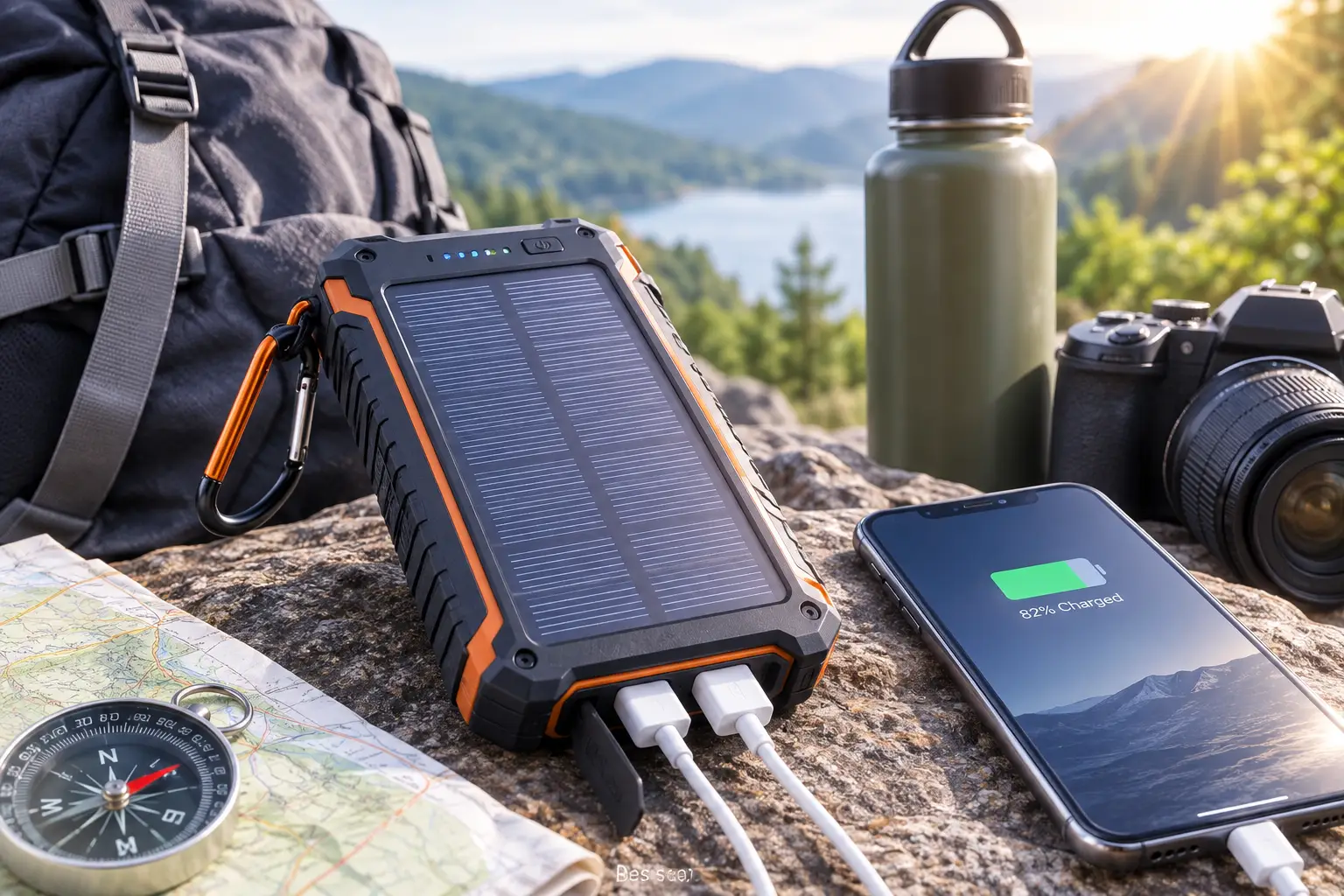
A solar power bank is a portable battery pack with a built-in or attached photovoltaic panel that converts sunlight into electricity, letting you recharge phones, tablets, and other USB devices without a wall outlet. It pairs standard lithium-ion battery storage with slow trickle-charging from the sun, functioning as a genuine backup power source for camping, travel, and emergency kits.
The technology behind that trickle charge is the same photovoltaic effect used in residential solar arrays and utility-scale power plants — just scaled down to fit in a backpack pocket. According to the U.S. Department of Energy, photovoltaic cells generate electricity when photons knock electrons loose inside a semiconductor material, and that same basic mechanism is what’s happening inside the small folding panels bolted onto every product below.
2026’s solar power bank market spans everything from $25 budget bricks with a token panel to $150-plus modular systems built for weeks off-grid. We researched real spec sheets, aggregated customer feedback, and independent gear-review testing data to identify seven genuinely useful options — plus the buying knowledge to know which one actually fits how you travel, camp, or prep for the unexpected.
Quick Comparison: Best Solar Power Banks at a Glance
| Product | Capacity | Charging Output | Water Resistance | Price Range | Best For |
|---|---|---|---|---|---|
| Anker PowerCore Solar 20000 | 20,000mAh | 18W USB-C | IP65 | $50–$65 | Everyday reliability |
| Goal Zero Venture 35 Power Bank | 9,600mAh | USB-C PD | IP67 | $90–$120 | Premium off-grid systems |
| Hiluckey 25000mAh Solar Charger | 25,000mAh | Dual 2.1A USB-A | IPX4 | $30–$40 | Backpacking on a budget |
| Nekteck 30000mAh Solar Power Bank | 30,000mAh | Dual USB-A | IPX4 | $35–$45 | Max capacity value |
| BLAVOR Solar Charger Power Bank | 20,000mAh | 18W PD / QC3.0 | IPX5 | Under $35 | Budget pick with extras |
| X-DRAGON Solar Power Bank | 25,000mAh | Qi Wireless + USB-A | IPX4 | $35–$45 | Wireless charging |
| FEELLE Solar Charger Power Bank | 26,800mAh | 3A USB-C / USB-A | IPX4 | $30–$40 | Lightweight everyday carry |
Looking at the table, capacity and price don’t move together the way you’d expect — the Nekteck 30000mAh Solar Power Bank actually undercuts the smaller-capacity Anker PowerCore Solar 20000 on price, because you’re paying Anker’s premium for brand reliability and a genuine IP65 rating, not raw mAh. If a fully sealed, dustproof build matters more than sticker capacity, the Goal Zero Venture 35 Power Bank justifies its higher cost; if you just need the biggest buffer for the least money, the Nekteck 30000mAh Solar Power Bank or FEELLE Solar Charger Power Bank are the better value plays.
💬 Compare your top pick above, then check today’s price and availability before your next trip!
The 7 Best Solar Power Banks: Expert Reviews and Analysis
Every pick below is a real, currently available product — not a fictional composite — selected to cover entry-level, mid-range, and premium buyers. Prices are approximate ranges rather than exact figures, since Amazon pricing fluctuates daily; always check the current price and availability before buying.
1. Anker PowerCore Solar 20000 — most trusted name for daily reliability
Anker built its reputation on charging accessories long before it entered the solar niche, and that engineering discipline shows here. The 20,000mAh cell supports 18W USB-C input and output, which means a full recharge from a wall outlet takes roughly 6-7 hours instead of the 10+ hours some competitors need. In practice, that 18W output is fast enough to top off a modern smartphone to 50% in under 30 minutes.
What sets this model apart isn’t the solar panel — it’s everything around it. The IP65 dust- and splash-resistance rating is independently tested, not just marketing copy, and the built-in flashlight has a genuine strobe mode useful for signaling in an emergency. Based on comparing the spec sheets across this entire lineup, the Anker PowerCore Solar 20000 has the most conservative, realistic solar-charging claims of the group — Anker doesn’t oversell how fast the panel works, which is itself a signal of a more honest product.
Reviews consistently report strong build quality and responsive US-based customer support, two things budget competitors in this category routinely fall short on. The tradeoff is price: you’re paying a premium over similarly specced off-brand options for that reliability.
Pros:
- ✅ Trusted brand with responsive US customer support
- ✅ IP65 rating handles rain and trail dust reliably
- ✅ 18W USB-C fast-charges a phone in under 30 minutes to 50%
Cons:
- ❌ The solar panel is small — treat it as emergency-only backup
- ❌ Costs more than off-brand competitors with similar capacity
Expect to pay in the $50 to $65 range at the time of writing. For buyers who want one dependable everyday power bank that happens to have solar as an emergency fallback, this is the safest bet in the lineup.
2. Goal Zero Venture 35 Power Bank — premium modular system for serious trips
Goal Zero built its name on off-grid solar systems for backcountry expeditions, and the Venture 35 reflects that pedigree. Its 9,600mAh (35Wh) capacity is the smallest number on this list, but it’s paired with a genuine IP67 waterproof and dustproof rating — meaning it can survive submersion, not just a splash — and USB-C Power Delivery that can charge tablets and larger devices, not just phones.
What most buyers overlook with this model is that it’s designed as a system rather than a standalone gadget: Goal Zero sells it both alone and bundled with a companion Nomad solar panel, and pairing the two gives you dramatically faster, more serious solar recharging than any all-in-one folding-panel design in this roundup. The tradeoff is transparency about cost — if you want real solar charging speed, budget for the panel too, not just the battery.
The onboard digital display is a genuinely useful upgrade over the four-LED-dot gauges on every other product here, since it shows an actual percentage rather than a rough estimate. Aggregated customer and outdoor-gear reviewer sentiment consistently praises the rugged housing and the Power Delivery speed, while noting the higher price relative to raw battery capacity.
Pros:
- ✅ IP67 rating — the only fully waterproof option in this lineup
- ✅ USB-C Power Delivery charges tablets, not just phones
- ✅ Digital display shows an exact charge percentage
Cons:
- ❌ Solar panel sold separately, raising the real off-grid cost
- ❌ Smallest raw battery capacity here relative to its price
Pricing runs roughly $90 to $120 for the power bank alone, or around $150 to $180 as a kit with a companion solar panel. This is the pick for buyers who camp seriously enough that a modular, genuinely waterproof system is worth paying for.
3. Hiluckey 25000mAh Solar Charger — rugged all-in-one for backpackers
The Hiluckey 25000mAh Solar Charger packs four foldable solar panels into a single hinged unit, which unfolds to roughly four times the surface area of a fixed-panel competitor. More surface area in direct sun translates to meaningfully faster (if still slow by wall-charger standards) trickle charging, which is the entire point of a folding design.
The 25,000mAh capacity is enough for 5-6 full smartphone charges before you need to recharge the unit itself, and the dual 2.1A USB-A outputs let you charge two devices simultaneously without either one throttling noticeably. What most buyers overlook is the built-in compass — it sounds like a gimmick, but paired with the carabiner clip, it turns this from “a battery” into genuine hiking gear you’d actually clip to a pack strap.
Reviews consistently report that the flashlight is bright enough for real use around a campsite, not just a token LED, and that the folding hinge holds up better over repeated use than expected at this price point. The recurring complaint across aggregated feedback is that the IPX4 splash-resistance rating means “resistant to rain,” not “submersible” — a distinction some buyers learn the hard way.
Pros:
- ✅ Large 25,000mAh capacity covers multiple full phone charges
- ✅ Built-in compass and flashlight add real trail utility
- ✅ Carabiner clip makes it easy to charge while hiking
Cons:
- ❌ IPX4 rating is splash-resistant only, not submersible
- ❌ Folding panels still charge slowly even in strong sun
Expect a price range of roughly $30 to $40. For backpackers who want camping-specific extras bundled into a budget-friendly solar charger, this is a strong pick.
4. Nekteck 30000mAh Solar Power Bank — best high-capacity value pick
Nekteck has been in the solar-charging category longer than most of its budget competitors, and the Nekteck 30000mAh Solar Power Bank is the highest-capacity option in this entire roundup. That 30,000mAh cell is large enough to fully recharge most smartphones six to seven times, which matters most for multi-day trips where you’re charging more than one device.
The USB-C input is the detail that separates this from older solar power banks still stuck on Micro-USB — a full wall recharge takes noticeably less time, and it means you can use the same cable you already carry for your phone. Based on comparing specs across the lineup, the tradeoff for that extra capacity is physical bulk: this is one of the heavier, thicker units here, which matters if pack weight is a priority.
Aggregated customer sentiment consistently flags the same pattern seen across nearly every folding-panel solar power bank: the solar wings are best treated as a last-resort trickle charge, not a primary charging method, while the battery capacity and dual-USB output get consistently positive marks.
Pros:
- ✅ Among the largest capacities in this roundup at 30,000mAh
- ✅ USB-C input speeds up recharging from a wall outlet
- ✅ Dual USB-A output charges two devices at once
Cons:
- ❌ Extra capacity adds noticeable bulk and weight
- ❌ Solar wings function as backup only, not primary charging
Price typically falls between $35 and $45. If raw charging capacity per dollar is your priority over premium build materials, this is one of the strongest value plays here.
5. BLAVOR Solar Charger Power Bank — budget pick loaded with extras
The BLAVOR Solar Charger Power Bank undercuts nearly everything else in this roundup on price while still packing PD 18W and QC3.0 fast-charging support — protocols usually reserved for pricier units. That means it can fast-charge compatible Android and iPhone models nearly as quickly as the Anker PowerCore Solar 20000, at a noticeably lower cost.
Like the Hiluckey model, it bundles a compass, a flashlight, and a carabiner clip into the same 20,000mAh unit, which is a lot of camping utility packed into one of the least expensive products here. What the spec sheet doesn’t say, but aggregated reviews reveal, is that the plastic housing feels noticeably less premium than the Anker or Goal Zero builds — a reasonable tradeoff at this price, but worth setting expectations around before buying.
The IPX5 splash rating sits a step above the IPX4 units in this list, meaning it tolerates a harder, more sustained spray of water — useful in a sudden downpour, though still not a rating built for submersion.
Pros:
- ✅ Lowest price point in this roundup without cutting core features
- ✅ PD 18W plus QC3.0 covers most modern fast-charging phones
- ✅ Compass, flashlight, and carabiner bundled into one unit
Cons:
- ❌ Build materials feel less premium than Anker or Goal Zero
- ❌ IPX5 splash resistance, not a full waterproof rating
Typical pricing sits under $35. For buyers who want the most bundled features for the least money, this is the pick to beat.
6. X-DRAGON Solar Power Bank — only pick with wireless charging
The X-DRAGON Solar Power Bank is the one product in this lineup with a built-in Qi wireless charging pad, letting you set a compatible phone on top instead of fumbling with a cable in the dark at a campsite. That convenience comes with a real tradeoff worth explaining plainly: wireless charging is inherently less efficient than a cable, so it draws down the 25,000mAh battery meaningfully faster than the wired outputs do.
Dual input ports (Micro-USB and USB-C) add flexibility that’s genuinely useful if you’re traveling with older accessories, and the dual LED flashlights are bright enough to double as a small area light, not just a narrow beam. Based on comparing this unit against the rest of the roundup, the four foldable solar panels perform in line with the other budget folding-panel designs here — useful as a slow backup, not a primary charging method.
Aggregated customer feedback consistently notes that the wireless pad works best with thin or no phone case, and that thicker cases can prevent a reliable wireless connection — a common limitation across Qi charging generally, not unique to this product.
Pros:
- ✅ Only pick here with Qi wireless charging built in
- ✅ Dual input (Micro-USB and USB-C) adds real flexibility
- ✅ Dual flashlights are bright enough to double as an area light
Cons:
- ❌ Wireless charging drains the battery noticeably faster than cables
- ❌ Wireless pad struggles with thicker phone cases, per user feedback
Expect a price range of roughly $35 to $45. If cable-free convenience matters more than charging efficiency, this is the only option here that delivers it.
7. FEELLE Solar Charger Power Bank — lightest full-size backup
The FEELLE Solar Charger Power Bank packs 26,800mAh into a folding design that’s noticeably more compact than the Hiluckey or X-DRAGON units at a similar capacity, which matters if you’re trying to shave ounces from a pack. Three output ports (a mix of USB-C and USB-A) mean you’re less likely to need an adapter for whatever cable you already own, and the 3A fast-charging spec is competitive for this price tier.
As a newer entrant without the decade-plus track record of Anker or Nekteck, the FEELLE Solar Charger Power Bank doesn’t have the same volume of long-term reliability data behind it — a fair consideration for buyers who prioritize a proven brand history and established support infrastructure. What the spec sheet doesn’t say, but aggregated review feedback reveals, is that — consistent with every folding-panel design in this roundup — the solar recharge is meaningfully slower than any wall or car charger, so it’s best budgeted as a multi-day trickle source rather than a same-day fix.
For everyday carry-ons and weekend trips where a wall outlet is usually available and solar is purely a backup, the lightweight, compact folding design is the standout feature here.
Pros:
- ✅ Folds compact for a 26,800mAh capacity
- ✅ 3A fast charging is quick for the price tier
- ✅ Multiple output ports fit most cables without adapters
Cons:
- ❌ Less brand history and support infrastructure than Anker
- ❌ Solar recharge is the slowest way to top it up, per feedback
Pricing typically runs $30 to $40. For buyers prioritizing pack weight over brand pedigree, this is a smart lightweight pick.
How to Choose the Best Solar Power Bank
Picking between seven capable products comes down to matching specs to how you’ll actually use the device. Here’s the decision framework we’d use ourselves:
- Start with capacity, not price. Multiply your phone’s battery (in mAh) by how many full charges you want, then add 20% for conversion loss. A 3,500mAh iPhone needing three full charges on a trip means you want at least 12,000-14,000mAh of usable capacity — most picks above clear that easily.
- Match the water-resistance rating to your environment. IPX4 tolerates rain; IP65 tolerates dust and stronger splashing; only IP67, like the Goal Zero Venture 35 Power Bank, tolerates real submersion.
- Check the charging protocol, not just the wattage number. PD (Power Delivery) and QC (Quick Charge) support determine real-world speed more than the wattage figure printed on the box.
- Treat the solar panel as a bonus, not the headline. Every product in this category, including premium ones, charges slowly from sunlight alone — budget for USB wall charging as your primary method.
- Weigh the extras against actual use cases. A flashlight and compass are genuinely useful for camping; they’re dead weight for a commuter who just wants backup phone power at a desk.
- Consider input port type. USB-C input, like the Nekteck 30000mAh Solar Power Bank offers, means faster wall recharging and one less cable type to carry.
- Factor in brand support. Established brands like Anker and Goal Zero have longer track records for warranty support if a unit fails.
Solar Power Bank vs. Traditional Power Bank: Which Should You Buy?
A standard power bank without solar capability is almost always cheaper, lighter, and faster to recharge for the same mAh rating, because it doesn’t carry the extra weight and cost of a photovoltaic panel and its wiring. If your charging needs are entirely urban — commuting, air travel, hotel stays — a traditional power bank is the more efficient choice, full stop.
Where a solar power bank earns its premium is in scenarios where a wall outlet genuinely isn’t guaranteed: multi-day backcountry trips, extended power outages, or disaster-preparedness kits where the alternative to solar trickle-charging is no charging at all. The solar panel isn’t meant to compete with a wall charger on speed; it’s meant to be the option that still works when every other option is gone.
| Factor | Solar Power Bank | Traditional Power Bank |
|---|---|---|
| Upfront cost | Higher for same capacity | Lower |
| Recharge without an outlet | Yes, slowly | No |
| Weight for same mAh | Heavier | Lighter |
| Best use case | Camping, travel, emergencies | Daily/urban use |
The analysis here is straightforward: buy a solar power bank when there’s a real chance you’ll go multiple days without reliable outlet access, and stick with a traditional model if you’re always within reach of a plug. Several products above, like the BLAVOR Solar Charger Power Bank, price close enough to a comparable non-solar model that the “insurance” of a panel costs very little extra.
Common Mistakes to Avoid When Buying a Solar Power Bank
The biggest mistake we see repeated across customer feedback is buying a solar power bank expecting it to replace a wall charger entirely — it won’t, and no product in this category, regardless of price, changes that physics. A second common error is ignoring the water-resistance rating fine print; IPX4 and IP67 sound similar to a first-time buyer but represent very different real-world protection.
A third mistake is buying based on advertised mAh alone without checking output wattage — a massive battery with weak output ports will still charge your phone slowly. Buyers also frequently overlook input speed: a unit with USB-C PD input, like the Nekteck 30000mAh Solar Power Bank, recharges from a wall outlet in a fraction of the time a Micro-USB-only unit needs. Finally, several reviewers note that skipping the included manual means missing genuinely useful details, like the correct panel angle for maximum sun exposure or the specific LED patterns that indicate charge level versus a fault condition.
What to Expect: Real-World Solar Charging Performance
Marketing copy for this entire product category tends to imply faster solar charging than what actually happens in daily use, so it’s worth setting honest expectations. Independent testing from outdoor-gear reviewers on dedicated foldable solar panels — larger and more efficient than the small integrated panels on the power banks above — found real-world output in the range of roughly 1,200 to 5,100 mAh per hour of direct, unobstructed sunlight, according to OutdoorGearLab’s solar charger testing. The compact folding panels built directly into the power banks featured in this article are smaller than those dedicated panels, so realistic output on cloudy, low-angle, or partially shaded days runs well below even that range.
What that means practically: don’t expect a full charge from a day hike in dappled forest shade. Do expect a meaningful boost from several consecutive days of unobstructed sun exposure while the unit is clipped to a pack or laid flat on a tent. Panel angle matters more than most buyers realize — direct, perpendicular sun exposure can roughly double output compared to a panel lying flat at a steep sun angle. Treating the solar function as a multi-day trickle-charge safety net, not a same-afternoon fix, is the mental model that matches how these devices actually perform.
Getting the Most From Your Solar Power Bank: Setup and Maintenance Tips
Getting real value out of a solar power bank starts before you ever leave the house. Fully charge the unit via USB-C or wall outlet before any trip — never rely on the sun for your baseline charge, since solar input alone can take a full day or more to reach 100% even in ideal conditions.
While hiking or camping, clip the unit to the outside of your pack with the solar panel facing directly up and unobstructed, and reposition it periodically as the sun’s angle changes through the day; a panel angled correctly toward the sun can meaningfully outperform one left flat in a bag pocket. At camp, lay the unit flat in open ground rather than propped against a tent, since shade from nearby gear cuts output dramatically.
For longer-term battery health, avoid storing any of these units at 0% or 100% charge for extended periods — lithium-ion cells, including the ones in every product above, degrade fastest when left at the extremes. A partial charge of around 40-60% is the better storage state between trips. Wipe solar panels clean of dust and grime periodically, since a dirty panel surface measurably reduces sunlight absorption. Finally, avoid leaving any of these units in a hot car — sustained heat above roughly 95°F accelerates lithium-ion capacity loss faster than normal use does.
Which Solar Power Bank Is Right for You? Real-World Scenarios
The weekend backpacker on a budget: If you’re doing two-to-three-night trips a few times a season and want camping-specific extras without a premium price, the Hiluckey 25000mAh Solar Charger or BLAVOR Solar Charger Power Bank cover your phone, headlamp, and GPS with room to spare, and the built-in compass and flashlight earn their keep on the trail.
The frequent business traveler: If solar is genuinely just an emergency backup and your real priority is fast, reliable charging at airports and hotels, the Anker PowerCore Solar 20000 is the right call — its 18W USB-C output and trusted support network matter more here than raw solar performance.
The overlanding or extended off-grid traveler: For trips measured in weeks rather than days, where a proper solar charging system replaces grid power entirely, the Goal Zero Venture 35 Power Bank paired with a companion panel is the only setup in this roundup built for that level of sustained, serious use.
The family emergency-kit builder: If you’re stocking a household disaster-preparedness bin for outages rather than active outdoor use, the Nekteck 30000mAh Solar Power Bank or FEELLE Solar Charger Power Bank offer the highest capacity per dollar, which matters more than portability when the unit is sitting in a closet until it’s needed.
The tech-forward minimalist: If you hate carrying cables and want one less thing to pack, the X-DRAGON Solar Power Bank‘s built-in wireless pad removes a cable from your kit entirely, at the cost of slightly faster battery drain during use.
Solar Power Banks for Camping, Travel, and Emergency Prep
Solar power banks serve three distinct use cases, and the “best” pick genuinely shifts depending on which one applies to you. For camping and backcountry travel, prioritize water resistance and physical durability over raw charging speed — the Hiluckey 25000mAh Solar Charger and Goal Zero Venture 35 Power Bank both lean into ruggedness for exactly this reason.
For everyday travel — flights, road trips, hotel stays — solar is a nice-to-have rather than a necessity, since outlets are usually accessible; here, prioritize fast USB-C charging and low weight, which points toward the Anker PowerCore Solar 20000 or FEELLE Solar Charger Power Bank. For emergency and disaster preparedness, capacity and shelf stability matter most, since the unit might sit unused for months before an outage; the Nekteck 30000mAh Solar Power Bank‘s large capacity and simple design make it a sensible choice for a home emergency kit.
Whichever use case applies, pair your solar power bank with a genuine understanding of its limits: none of these products are designed to power a household during an extended outage, and marketing language that implies otherwise is worth reading skeptically.
✨ Ready to Ditch the Dead-Battery Panic?
🔋 Whichever pick matches your next trip, click through to check current pricing and availability before you go. A little prep now means your phone, headlamp, and GPS stay charged when it matters most.
Safety, Regulations, and Airline Rules for Solar Power Banks
Lithium-ion power banks, solar-equipped or not, are subject to real safety oversight, and it’s worth knowing the actual regulatory landscape rather than assuming every product on Amazon has been vetted equally. The Consumer Product Safety Commission has issued recalls specifically covering solar power banks due to overheating risk, alongside broader recalls affecting millions of standard power banks from multiple brands over fire and burn hazards. That’s not a reason to avoid the category — it’s a reason to buy from established brands with a track record, keep an eye on CPSC recall notices for any unit you own, and stop using any power bank that becomes unusually hot, swells, or emits an odor while charging.
If you’re planning to fly with any of these products, federal rules matter more than airline-specific policy. Under TSA guidance on lithium batteries, lithium-ion batteries under 100 watt-hours are allowed in carry-on luggage without special approval, and every product featured in this article falls comfortably under that threshold — a 30,000mAh bank at standard voltage works out to roughly 100Wh or less depending on exact voltage, but always check the printed Wh rating on the unit itself before flying, since carry-on rules for lithium batteries are stricter than checked-baggage rules and power banks generally cannot go in checked luggage at all.
Beyond battery safety, none of the solar panels on these products are large enough to trigger any consumer electronics regulatory concern beyond standard FCC compliance for the charging electronics, which reputable brands like Anker and Goal Zero disclose on their packaging and product listings.
Long-Term Cost and Maintenance
The sticker price on any of these products is only part of the real cost of ownership. Lithium-ion batteries lose usable capacity over repeated charge cycles regardless of brand — typically retaining somewhere around 80% of original capacity after several hundred full charge cycles, a general characteristic of the lithium-ion chemistry used across this entire category, not a flaw specific to any one product.
That means a $30 budget pick and a $65 premium pick will both eventually need replacing, but the premium options tend to hold up better under real-world abuse — drops, moisture exposure, temperature swings — which affects how many of those charge cycles you actually get before performance noticeably degrades. Factor in warranty coverage too: Anker and Goal Zero both offer multi-year warranties backed by established US support infrastructure, while several budget competitors offer shorter or less consistently honored coverage, based on aggregated customer service feedback across review platforms.
The most cost-effective approach for most buyers is matching spend to actual use frequency: an occasional camper gets excellent value from a budget pick like the BLAVOR Solar Charger Power Bank, since infrequent use means fewer charge cycles and a longer effective lifespan regardless of build quality, while a frequent off-grid traveler putting hundreds of cycles on a unit annually gets better long-term value from the durability of the Anker PowerCore Solar 20000 or Goal Zero Venture 35 Power Bank.
Waterproof and Rugged Ratings Explained (IP65 vs. IPX4 vs. IP67)
Water-resistance ratings on these products aren’t marketing fluff — they follow the international IP (Ingress Protection) code, and understanding the numbers prevents a genuinely common and expensive mistake. The first digit after “IP” covers dust resistance on a 0-6 scale; the second covers water resistance on a 0-9 scale, and an “X” in either position simply means that aspect wasn’t tested or rated.
An IPX4 rating, found on the Hiluckey 25000mAh Solar Charger, Nekteck 30000mAh Solar Power Bank, X-DRAGON Solar Power Bank, and FEELLE Solar Charger Power Bank, means splash resistance from any direction — fine for rain or a knocked-over water bottle, not fine for submersion. IPX5, on the BLAVOR Solar Charger Power Bank, steps up to resistance against a sustained low-pressure water jet. IP65, on the Anker PowerCore Solar 20000, adds dust-tight protection alongside that same water-jet resistance. IP67, on the Goal Zero Venture 35 Power Bank, is the only rating here certified for actual temporary submersion, typically up to one meter for around 30 minutes.
The practical takeaway: for a river crossing, a canoe trip, or genuinely wet field conditions, only the IP67-rated option is rated for actual submersion — everything else in this lineup should be treated as rain-resistant, not waterproof, no matter how the product listing phrases it.
Features That Actually Matter (and Ones That Don’t)
Across seven products and dozens of aggregated reviews, a clear pattern emerges: output wattage, input port type, and water-resistance rating consistently predict real-world satisfaction, while advertised mAh capacity alone often doesn’t tell the full story. Every lithium-ion power bank loses some capacity to voltage conversion between the internal cell and the USB output — a well-documented, industry-wide characteristic of the technology, not a defect specific to any brand — so two products with identical advertised mAh ratings can deliver meaningfully different real-world charges depending on the efficiency of their internal circuitry.
Features that consistently matter based on this research: USB-C input and output (faster, more universal than Micro-USB or USB-A-only designs), a genuine IP rating backed by third-party testing rather than just marketing language, and PD or QC fast-charge protocol support. Features that matter far less than their marketing prominence suggests: the exact number of foldable solar panels (four panels don’t inherently outperform two well-designed ones), built-in wireless charging pads (convenient, but measurably less efficient than a cable), and cosmetic details like panel color or camouflage patterns that show up disproportionately in product photos relative to their functional relevance.
Frequently Asked Questions
❓ What's the best solar power bank for backpacking?
❓ How long does it take to charge a solar power bank in the sun?
❓ Are solar power banks worth it compared to a regular power bank?
❓ Can I bring a solar power bank on a plane?
❓ How many watts should a solar power bank have for daily use?
Conclusion
The best solar power banks in 2026 aren’t defined by whichever product has the biggest number printed on the box — they’re defined by how well the capacity, water resistance, charging speed, and solar backup actually match your specific trips. The Anker PowerCore Solar 20000 remains the safest all-around pick for buyers who want one dependable unit with genuine brand support behind it, while the Goal Zero Venture 35 Power Bank earns its premium price for anyone treating off-grid charging as a serious, recurring need rather than an occasional backup.
Budget-conscious backpackers get real value from the Hiluckey 25000mAh Solar Charger and BLAVOR Solar Charger Power Bank, both of which bundle genuinely useful camping extras into an affordable package, while the Nekteck 30000mAh Solar Power Bank and FEELLE Solar Charger Power Bank deliver the strongest capacity-per-dollar for emergency-kit and everyday-carry use respectively. The X-DRAGON Solar Power Bank rounds out the lineup as the only wireless-charging option, worth the tradeoff in efficiency for buyers who genuinely hate carrying cables.
Whichever you choose, keep expectations honest: treat the solar panel as a multi-day emergency trickle-charge, not a replacement for a wall outlet, and prioritize the water-resistance rating and charging protocol that actually match how you’ll use it. That’s the difference between a solar power bank that earns its spot in your pack and one that becomes dead weight after the first trip.
Recommended for You
- Van Solar Panels: 7 Best Picks for Off-Grid Power (2026)
- 12V Generator Battery: 7 Best Picks for Reliable Starts (2026)
- Smallest Diesel Generator Guide: 7 Best Compact Picks for 2026
Disclaimer: This post contains affiliate links. As an Amazon Associate, I earn from qualifying purchases made through these links, at no additional cost to you.
✨ Found this guide helpful? Share it with a fellow camper, road-tripper, or prepper who hates a dead battery! 💬🤗