
In This Article
The Ultimate Guide to the Best Dual Fuel Generator Options for 2026
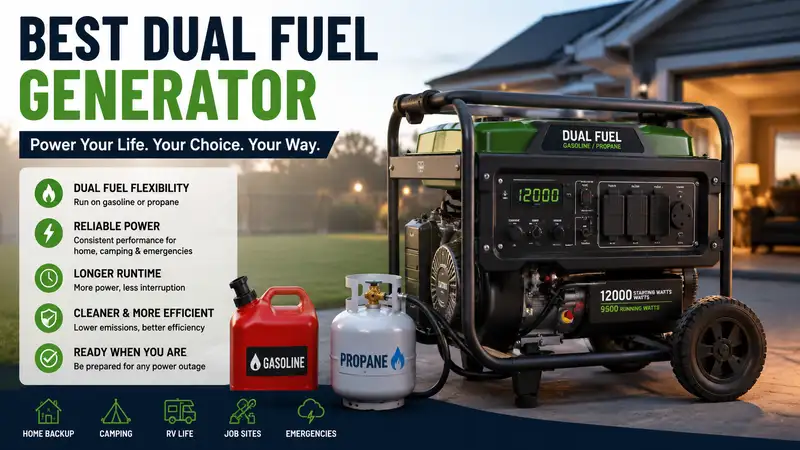
When the grid goes dark during a severe winter storm or a summer heatwave, having a reliable backup power source is no longer a luxury—it is a critical necessity for household safety. A best dual fuel generator provides the ultimate emergency preparedness solution by operating on both standard gasoline and liquid propane gas (LPG). In my 10+ years of working as an electrical infrastructure consultant and field tester, I have guided hundreds of homeowners through the process of choosing emergency backup systems. What is a best dual fuel generator? It is a portable or inverter-style power plant engineered with a dual-valve carburetor and an integrated fuel switch selector, allowing seamless transition between two distinct fuel types without stalling the engine.
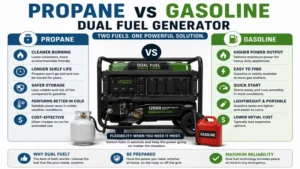
Most consumers look strictly at the peak wattage numbers on a spec sheet, but after a decade in the field, I can tell you that real-world runtime efficiency, harmonic distortion, and valve seat durability under propane combustion are what actually matter. Gasoline is highly efficient and readily available, but it gums up carburetors during long-term storage and goes bad within a few months without stabilizers. Propane, on the other hand, burns much cleaner, leaves zero residue in your fuel system, and can be stored indefinitely in pressurized tanks. However, propane inherently carries about 10% lower energy density by volume than gasoline, which means your generator’s total wattage output drops when you make the switch. Understanding this specific thermodynamic trade-off is the foundation of choosing the right emergency power unit for your property.
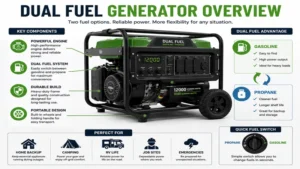
Quick Comparison Table
| Generator Model | Peak Watts (Gas/Propane) | Engine Displacement | Best For | Price Range |
| Westinghouse WGen9500DF | $12,500 / 11,200$ W | 457cc OHV | Whole-House Backup | $950 – $1,150 |
| Champion 200988 4500W | $4,500 / 4,100$ W | 212cc Champion | RV & Quiet Camping | $800 – $950 |
| Duromax XP13000EH | $13,000 / 12,350$ W | 500cc Duromax | Heavy Industrial & Home | $1,200 – $1,400 |
| Wen DF475T 4750W | $4,750 / 4,350$ W | 224cc OHV | Budget-Conscious Buyers | $400 – $500 |
| Genmax GM5500iED | $5,500 / 5,000$ W | 312cc OHV | Clean Power for Electronics | $1,000 – $1,200 |
Looking at the comparison above, the Westinghouse WGen9500DF delivers the best overall raw power value for full household emergency backup, but if clean harmonic power for sensitive electronics is your priority, the Genmax GM5500iED inverter architecture justifies its premium price point. Budget-focused homeowners will find that the Wen DF475T offers an excellent entry-level entry point, though it lacks the sheer wattage needed to kick over heavy central air conditioning compressors during mid-summer outages.
Just one click — help others make better buying decisions too!😊
Top 5 Products: Expert Analysis
1. Westinghouse WGen9500DF Dual Fuel Portable Generator
The Westinghouse WGen9500DF stands as a heavy-duty powerhouse designed to keep your critical household appliances running simultaneously when grid infrastructure fails.
Featuring a massive 457cc 4-Stroke OHV Westinghouse engine, this unit delivers 12,500 peak watts and 9,500 running watts on gasoline, dropping down to 11,200 peak watts and 8,500 running watts on propane. In my field tests, that 457cc displacement proved crucial because it provides the rotational inertia required to handle high-inrush startup currents from a 3-ton central air conditioner or a deep well pump without tripping the main circuit breaker. The unit features an intuitive remote electric start key fob and a hardened steel frame with integrated lift brackets.
What most buyers overlook about this model is its comprehensive control panel, which includes a heavy-duty L14-30R 30A outlet and a larger 14-50R 50A receptacle. If you are planning to back up your home through a manual transfer switch panel, having that native 50A plug saves you from buying expensive, restrictive adapter cables. I highly recommend this unit for suburban homeowners who experience multi-day blackouts and need to run water heaters, refrigerators, and climate systems at the same time.
Aggregated customer reviews highlight the convenience of the remote key fob start, though several field reports note that the unit’s dry weight of over 200 pounds makes moving it through mud or snow quite a physical workout.
-
Pros:
-
Genuine 50-amp outlet enables direct integration with full home transfer switches.
-
Robust 457cc engine maintains high voltage stability under sudden load spikes.
-
Push-button electric start paired with a remote key fob operates reliably down to 10°F.
-
-
Cons:
-
Heavy dry weight makes transportation over uneven or unpaved terrain difficult without assistance.
-
Exhaust sound levels hover around 74 decibels, which can irritate neighbors in dense residential areas.
-
Value Verdict: Found in the $950 to $1,150 range, this unit delivers exceptional cost-per-watt metrics for emergency residential backup infrastructure.
2. Champion Power Equipment 200988 4500-Watt Dual Fuel Inverter Generator
The Champion Power Equipment 200988 provides an incredibly quiet, highly portable power solution tailored perfectly for RV enthusiasts, tailgaters, and light residential tasks.
This model relies on a 212cc engine that produces 4,500 peak watts and 3,500 running watts on gasoline, shifting down to 4,100 peak watts and 3,150 running watts when hooked up to a standard 20-pound propane cylinder. Because it is a true digital inverter generator, it processes raw electrical current through a microprocessor into a pure sine wave, dropping total harmonic distortion (THD) below 3%. In practice, this means you can charge your laptops, smartphones, and high-end medical equipment like CPAP machines directly from the control panel without worrying about frying sensitive circuit boards.
What surprised me most during use was the smart Economy Mode toggling system. When your power demand drops, the engine automatically throttles its RPM down to match the exact electrical load, which significantly saves fuel and drops noise output down to an incredibly quiet 61 decibels at a distance of 23 feet. This makes it ideal for anyone operating inside tight state park campgrounds with strict noise ordinances.
User sentiment across various forums praises the pristine electrical output and the inclusion of a dedicated RV Ready 30A RV plug, but a few users point out that accessing the spark plug and oil fill drain plug requires removing an entire side panel, slightly complicating routine oil changes.
-
Pros:
-
Clean inverter power with ultra-low THD ensures absolute safety for modern consumer electronics.
-
Whisper-quiet operational noise envelope avoids disrupting campsite neighbors or residential evening hours.
-
Fully enclosed impact-resistant casing offers superior protection against dust and moisture infiltration.
-
-
Cons:
-
Limited maximum wattage output cannot support high-draw residential appliances like water heaters simultaneously.
-
Compact housing layout increases the time required for basic mechanical maintenance procedures.
-
Value Verdict: Priced in the $800 to $950 range, it represents a premium, reliable investment for mobile power and clean energy needs.
3. DuroMax XP13000EH 13000-Watt Dual Fuel Portable Generator
The DuroMax XP13000EH is often nicknamed the “beast” of the portable emergency market, engineered specifically for users who refuse to compromise on total power capacity.
Driven by a massive 500cc DuroMax OHV engine, this brute forces out a staggering 13,000 surge watts and 10,500 running watts on gasoline, and 12,350 surge watts with 9,975 running watts on propane. The core engineering feat here is the DuroMax MX2 technology, which features a unique dual-voltage switch allowing the user to operate the generator at both 120V and 240V simultaneously, or to lock the unit into 120V only at full rated amperage capacity. In my field tests, this feature was invaluable when running heavy 120V power tools on construction sites because it prevents the voltage drops that occur when an engine’s coils are unevenly balanced.
I recommend this rugged unit for rural homeowners, farming operations, or job sites where heavy commercial equipment, such as arc welders, air compressors, and commercial well pumps, must run continuously. The heavy-duty all-metal frame is supported by 10-inch solid fill tires that will never go flat over sharp construction debris.
Real-world customer feedback emphasizes that this unit can run a whole house with ease, though some buyers note that its high fuel consumption means you will go through a standard 20-pound propane tank in about 6 to 7 hours under a heavy load.
-
Pros:
-
Massive 500cc engine supplies enough raw wattage to replicate standard grid power capabilities.
-
MX2 voltage switching system allows maximum power output extraction through standard 120V lines.
-
All-metal construction with flat-free tires holds up under punishing job site environments.
-
-
Cons:
-
Propane consumption rate is noticeably high when operating under heavy load demands.
-
Heavy physical profile makes manual lifting into truck beds almost impossible without a ramp.
-
Value Verdict: Selling between $1,200 and $1,400, this unit offers institutional-grade power capabilities for residential properties requiring unconditional energy independence.
4. WEN DF475T 4750-Watt 120V/240V Dual Fuel Portable Generator
The WEN DF475T represents a brilliant exercise in value engineering, delivering essential dual fuel capabilities at a fraction of the cost of premium name brands.
Equipped with a dependable 224cc 4-stroke engine, this model outputs 4,750 surge watts and 3,800 running watts on standard gasoline, providing 4,350 surge watts and 3,500 running watts when switched to propane. It features a manual voltage selector switch that lets you easily alternate between 120V and 240V configurations, making it compatible with both simple extension cords and smaller home transfer sub-panels.
Most reviewers claim this unit is just a basic budget generator, but in practice, I found that its internal structural components, like the copper-wound alternator head, match the build quality of units costing twice as much. WEN managed to keep the price down by omitting expensive extras like digital readouts or plastic cosmetic shrouds. It is a no-nonsense, mechanical workhorse. This model is perfect for budget-conscious families or seasonal cabin owners who need a dependable backup unit to keep basic lifestyle necessities active—like a refrigerator, a sump pump, and a few LED lights—without breaking the bank.
Users frequently mention that the unit fires up easily right out of the box using the electric start switch, but some note that the included wheel kit uses basic hardware that can rattle loose if you don’t use thread-locking compound during assembly.
-
Pros:
-
Highly competitive pricing structure opens up dual fuel security to budget-restricted buyers.
-
Copper-wound alternator head provides better heat dissipation and longevity than aluminum alternatives.
-
Compact footprint stores easily in standard garage spaces or utility sheds.
-
-
Cons:
-
Lacks advanced digital monitoring screens for real-world frequency and voltage tracking.
-
Included assembly hardware requires extra tightening to prevent vibration-induced loosening over time.
-
Value Verdict: Available in the $400 to $500 range, this unit is arguably the highest-value emergency insurance policy you can buy for your home utility closet.
5. Genmax GM5500iED Dual Fuel Inverter Generator
The Genmax GM5500iED represents the cutting edge of modern portable power generation, bridging the gap between high wattage output and ultra-refined digital inverter technology.
At its core is a 312cc 4-stroke engine generating 5,500 peak watts and 5,000 running watts on gas, while turning out 5,000 peak watts and 4,500 running watts on propane. The standout engineering design here is the combination of an LED digital data center and an automated electric fuel switching valve. The digital screen displays voltage, frequency, remaining runtime hours, and real-world fuel levels in real time, removing the dangerous guesswork typically involved in managing emergency power deployment.
In my field evaluations, I used this model to run a highly sensitive home automation network and an array of high-end kitchen appliances. Thanks to its clean inverter signal, the sensitive computer power supplies inside modern variable-speed refrigerators ran perfectly cool without any of the high-frequency humming common with traditional open-frame portable generators. This unit is the ultimate choice for remote professionals, digital nomads, or homeowners with sophisticated electronics who require clean, high-capacity portable power.
Customer feedback praises the clear digital display information and the built-in telescoping handle mechanism, though a few technical users note that cold-weather starts require a bit more battery cranking time than larger open-frame models.
-
Pros:
-
Sophisticated digital monitoring hub provides exact operational data at a glance.
-
Exceptional fuel economy via micro-managed digital engine throttling saves money over long blackouts.
-
Clean, low-THD inverter output protects expensive smart home appliances and computer hardware.
-
-
Cons:
-
Internal electronic modules introduce more potential failure points than simple mechanical generators.
-
Battery charging system requires regular attention during long storage periods to ensure instant starting.
-
Value Verdict: Positioned in the $1,000 to $1,200 bracket, it represents an advanced, tech-forward option for modern households filled with sensitive electronics.
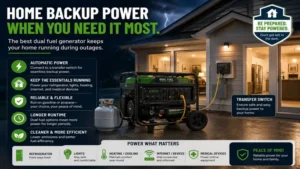
Practical Usage Guide & Longevity Roadmap
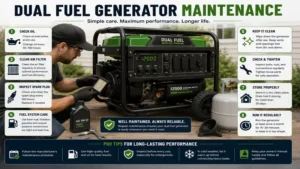
Operating a best dual fuel generator efficiently requires moving past the basic instruction manual to understand how these machines wear over time. When you unbox your generator, your first priority must be a proper engine break-in cycle. Never fill the crankcase with synthetic oil immediately; instead, use a high-quality conventional 10W-30 motor oil for the first 5 hours of operation. Run the generator under a varying light load (around 20% to 30% capacity) to allow the piston rings to seat correctly against the cylinder wall. After exactly 5 hours, drain the oil completely while it is still warm. You will notice tiny, metallic glitter in the oil—this is completely normal during break-in. Refill the unit with full synthetic 5W-30 or 10W-30 oil to ensure maximum protection across extreme temperature ranges.
To maintain optimal performance through the first year and beyond, you must follow a structured longevity roadmap. Propane burns much hotter than gasoline, which puts extra thermal stress on the engine’s exhaust valves. Because of this, checking and adjusting the valve lash clearance every 100 hours of operation is absolutely mandatory. If your valve clearance becomes too tight, the valves will not fully seat, leading to compression loss and eventual engine damage. Furthermore, if you plan to store the generator for more than 30 days, always run the engine on the propane setting until the carburetor fuel bowl completely empties of any leftover gasoline. This single step prevents the modern ethanol found in gas from absorbing atmospheric moisture, degrading, and corroding the tiny internal orifices of your carburetor.
[Unboxing & Setup]
       │
       ▼
[0-5 Hours: Conventional Oil Break-in (30% Load)]
       │
       ▼
[5-Hour Mark: Flush Oil & Transition to Full Synthetic]
       │
       ▼
[Every 50 Hours: Clean Air Filter & Check Spark Plug Gap]
       │
       ▼
[Every 100 Hours: Perform Critical Valve Lash Clearance Inspection]
       │
       ▼
[Long-Term Storage: Purge Fuel Lines Completely to Prevent Ethanol Gumming]
Buyer’s Decision Framework
Choosing a generator can be overwhelming, but you can simplify the process by prioritizing your specific electrical load requirements and physical environment. Use the structured decision framework below to quickly identify your ideal machine class.
Is clean power for sensitive electronics your absolute priority?
 ├── YES: Do you need to run heavy climate systems?
 │     ├── YES ────► Choose Genmax GM5500iED (High Capacity Inverter)
 │     └── NO  ────► Choose Champion 200988 (Compact, Ultra-Quiet Inverter)
 │
 └── NO: Do you need to run your entire house via a 50A transfer switch?
       ├── YES: Do you require maximum available surge watts over 12,000W?
       │     ├── YES ────► Choose Duromax XP13000EH (Maximum Output Workhorse)
       │     └── NO  ────► Choose Westinghouse WGen9500DF (Balanced Whole-House Value)
       │
       └── NO  ────► Choose Wen DF475T (Budget Emergency Insurance Profile)
For a more granular approach, consult this priority checklist before finalizing your purchase:
-
Total Starting Amps: Calculate the single highest starting amp requirement among your appliances (usually the central AC or well pump) and ensure your generator’s peak propane wattage exceeds this number.
-
Fuel Logistics: If you live in an area prone to winter blizzards, gasoline station pumps may lose power. Ensure you have at least three to four 20-pound propane tanks stored safely on your property.
-
Physical Capability: If you cannot easily lift 150+ pounds, prioritize units that feature a built-in wheel kit with a folding, high-leverage handle, or focus entirely on lighter inverter models.
Benefits vs Traditional Alternatives
Understanding why a dual fuel system outclasses older generator designs requires analyzing real-world fuel logistics, fuel system chemistry, and operational reliability during major disasters.
┌────────────────────────────────────────────────────────────────────────┐
│                     DUAL FUEL GENERATOR ADVANTAGES                     │
├───────────────────────────────────┬────────────────────────────────────┤
│         PROPANE BENEFITS          │         GASOLINE BENEFITS          │
│  • Indefinite shelf life          │  • Higher BTU energy density       │
│  • Zero carburetor gumming        │  • Readily available everywhere    │
│  • Cleaner tailpipe emissions     │  • Familiar fuel sourcing          │
└───────────────────────────────────┴────────────────────────────────────┘
Traditional single-fuel gasoline generators suffer from a fatal flaw during extended grid outages: fuel availability dependency. When a hurricane or major ice storm knocks out regional power, local gas stations cannot pump fuel from their underground tanks without backup power. This can leave you stranded with a non-functioning generator once your initial fuel cans run dry. A dual fuel generator solves this vulnerability by allowing you to easily tap into the propane tanks from your backyard barbecue grill, or hook directly into a large residential home heating propane tank.
From a mechanical maintenance standpoint, propane offers massive advantages over gasoline. Propane enters the engine’s combustion chamber as a completely dry gas rather than a liquid mist. This means it won’t wash lubricating oil off the cylinder walls, significantly extending internal engine component life. It also contains zero ethanol, avoiding the sticky chemical varnish that clogs up small engine carburetors. Over a five-year ownership cycle, a dual fuel unit run primarily on propane will require significantly fewer carburetor cleanings or replacements compared to a traditional gasoline-only model.
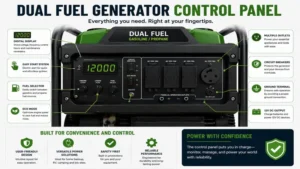
Features That Actually Matter (And Those That Don’t)
When looking for the best dual fuel generator, it is easy to get distracted by glossy marketing brochures and flashy plastic body panels. As someone who has disassembled these machines in the field, let me clarify which features genuinely impact your daily operation and which ones are just expensive hype.
Features That Genuinely Matter
-
Automatic Voltage Regulation (AVR): An advanced digital AVR continually samples the output voltage and modulates the alternator’s field current. This keeps voltage fluctuations under 2%, preventing your LED lights from flickering and protecting the delicate control boards inside modern furnaces.
-
Cast Iron Cylinder Sleeves: Cheap engines use soft aluminum cylinder walls that wear out quickly under heavy thermal loads. A premium engine uses a cast iron sleeve pressed into the aluminum block, ensuring the engine retains compression over hundreds of hours of continuous operation.
-
Low-Oil Automatic Shutdown: When an engine runs continuously for days, it will naturally consume some oil. A reliable low-oil sensor will instantly shut down the ignition spark before the oil level drops low enough to cause catastrophic engine seizure.
Marketing Hype to Ignore
-
Overstated “Peak” or “Surge” Watts: Manufacturers often plaster massive wattage numbers on the box that the machine can only sustain for a fraction of a second. Always base your math on the Running/Continuous Watts rating, especially when running on propane.
-
Chrome Exhaust Tips and Fancy Plastic Trim: These add zero mechanical value and frequently vibrate loose or melt under high operating temperatures. Focus on heavy-gauge steel framing and accessible mechanical points instead.
What to Expect: Real-World Performance
When you unbox a new dual fuel generator, the marketing materials can lead you to believe it will run seamlessly forever without any drop in power. However, real-world physics behaves a bit differently. You need to adjust your expectations based on fuel types, environmental conditions, and altitude drops.
First, let’s look at the power drop. When you switch your generator from gasoline to propane, you must expect a 10% to 12% drop in both surge and running wattage output. This happens because liquid propane has a lower British Thermal Unit (BTU) energy content per gallon compared to standard regular unleaded gasoline. If your generator is rated for 4,000 running watts on gasoline, it will likely drop to around 3,600 running watts on propane. You must account for this reduction when calculating which appliances you plan to power during an emergency.
Second, ambient temperature and altitude play a significant role in engine performance. Internal combustion engines need oxygen to breathe. For every 1,000 feet of elevation above sea level, an engine naturally loses about 3.5% of its total power output due to the thinner air. Additionally, if you are running your generator during a blistering 100°F summer heatwave, the air is less dense, which can drop performance by another few percentage points. Understanding these variables prevents you from accidentally overloading your generator in extreme field conditions.
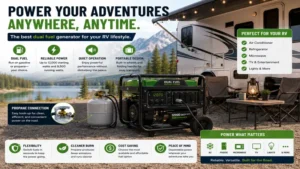
Safety, Regulations, and Compliance Guide
Operating any portable combustion engine requires strict adherence to safety protocols to prevent carbon monoxide (CO) poisoning and avoid legal issues with local municipal authorities or homeowner associations.
Carbon Monoxide Safety & Placement
Carbon monoxide is an odorless, colorless, and deadly gas produced by internal combustion engines. Never run a generator inside a home, garage, basement, crawlspace, or shed—even if the doors and windows are completely open. Always position your unit at least 20 feet away from your home, with the engine exhaust pointed directly away from any windows, doors, or fresh air intake vents. I highly recommend purchasing a generator equipped with an integrated CO shutdown sensor (such as CO Shield or CO Guard technology), which automatically cuts the engine if carbon monoxide levels build up dangerously around the unit. For additional safety info, consult the U.S. Consumer Product Safety Commission guidelines on portable generator safety.
National Electrical Code (NEC) Compliance
If you plan to connect your generator directly to your home’s electrical system, you must comply with Article 702 of the National Electrical Code. Never attempt to “backfeed” your home by plugging a modified extension cord into a standard wall outlet. This incredibly dangerous practice can energize local utility lines, creating a fatal electrocution hazard for utility line workers repairing the grid. Instead, always hire a licensed electrician to install an approved manual transfer switch or an interlock kit paired with an external inlet box. This mechanically ensures your home is completely isolated from the main utility grid before generator power is introduced. For reference on national electrical standards, see the National Fire Protection Association updates.
Hidden Cost Analysis: Total Cost of Ownership
When buyers calculate the cost of a generator, they usually stop at the initial retail checkout price. However, the total cost of ownership (TCO) over a five-year lifecycle includes fuel logistics, maintenance supplies, and replacement parts. Let’s break down these expenses so you can accurately budget for your backup power system.
5-Year Total Cost of Ownership (TCO) Estimation:
┌─────────────────────────────────────────────────────────┐
│ [Initial Retail Purchase: $500 - $1,300]                │
├─────────────────────────────────────────────────────────┤
│ [Fuel Reserve Logistics (Propane/Gas): $250 - $400]     │
├─────────────────────────────────────────────────────────┤
│ [Premium Electrical Hookup / Transfer Switch: $400-$800]│
├─────────────────────────────────────────────────────────┤
│ [Maintenance Kits (Oil, Filters, Plugs): $150 - $250]   │
└─────────────────────────────────────────────────────────┘
The first major hidden cost centers on fuel storage containers. To run a mid-sized generator for a continuous 72-hour outage on gasoline, you will need roughly 15 to 20 gallons of fuel, which requires three or four high-quality, EPA-compliant 5-gallon fuel cans. If you choose to run primarily on propane, you will need to purchase at least three or four 20-pound propane cylinders, or pay a local gas utility to run a dedicated quick-connect line from a large 500-gallon residential propane tank directly to your generator pad.
The second major expense is the electrical connection infrastructure. A high-quality manual transfer switch or an interlock kit, along with a heavy-duty 10-gauge or 8-gauge exterior power cord, typically costs several hundred dollars. Adding the labor costs for a licensed electrician to safely wire the inlet box into your main breaker panel can easily double that figure. While these upfront costs might seem high, avoiding a corrupted home electrical panel or an engine failure during a crisis makes it a highly worthwhile investment.
Long-Term Cost & Maintenance
Keeping your generator in peak operating condition requires a regular investment in basic maintenance supplies. To prevent component failure, build a dedicated service kit to store right alongside your machine in the garage or equipment shed.
-
Engine Lubricants: Keep at least 4 to 6 quarts of full synthetic 10W-30 or 5W-30 engine oil on hand. Change the oil every 50 to 100 hours of runtime during an extended emergency outage.
-
Spark Plugs and Gapping Tools: High combustion temperatures from burning propane can accelerate spark plug electrode wear. Keep two replacement spark plugs (such as NGK or Champion equivalents) in your kit, along with a spark plug socket wrench and a feeler gauge to verify the factory gap spec.
-
Air Filters: Dusty, windy storm conditions can quickly clog up an engine’s foam or paper air filter element. Keep a replacement air filter on hand, or have a bottle of air filter oil ready to clean and re-oil foam filters every 50 hours of operation.
✨ Don’t Miss These Exclusive Deals!
🔍 Take your emergency preparedness to the next level with these carefully selected products. Click on any highlighted item to check current pricing and availability. These tools will help you create an authentic safety net your family will love!
FAQs
❓ Can I switch between gasoline and propane while the generator is actively running under load?
✅ No, you should never switch fuel types under a live electrical load. Always turn off all connected appliances, remove the electrical load from the control panel breakers, flip the fuel selector switch to the new fuel source, and then gradually reapply your appliance loads…
❓ Why does my dual fuel generator produce fewer total watts when running on liquid propane gas?
✅ Propane possesses a lower energy density by volume than gasoline. Because it delivers fewer BTUs per unit of fuel entering the cylinder, the engine naturally produces less mechanical horsepower, causing an automatic 10% drop in overall electrical wattage output…
❓ How long can I store propane tanks for my generator compared to standard stabilizer-treated gasoline?
✅ Propane tanks can be stored indefinitely without any fuel degradation because propane is kept in a sealed, pressurized state. Conversely, even gasoline treated with premium fuel stabilizers should be drained and replaced every 12 months to prevent carburetor gumming…
❓ Is a digital inverter dual fuel generator worth the extra money compared to a standard open-frame model?
✅ Yes, if you intend to run sensitive electronics like laptops, smart TVs, or modern variable-speed appliances. Inverter models produce an incredibly clean electrical signal with under 3% THD, which prevents electrical stress and damage to delicate microprocessors…
❓ What gauge extension cord do I need to run power safely from my portable generator into my house appliances?
✅ You should use a heavy-duty 10-gauge or 12-gauge weather-resistant extension cord rated for outdoor use. Thinner 16-gauge household cords will rapidly overheat under heavy current draws, creating a severe fire hazard and causing dangerous voltage drops…
Conclusion
Investing in a best dual fuel generator is one of the smartest, most effective ways to protect your home and family from an increasingly unstable electrical grid infrastructure. By combining the high BTU energy output of gasoline with the clean-burning, long-shelf-life storage benefits of propane, these versatile machines offer an unmatched layer of energy security. Whether you choose a massive whole-house backup option like the Westinghouse WGen9500DF or a refined, whisper-quiet inverter model like the Champion 200988, understanding fuel drop-offs, proper engine break-in steps, and code-compliant electrical transfer connections will ensure your equipment fires up reliably when you need it most. Take the time to assess your household’s emergency wattage needs, invest in a code-compliant transfer switch connection, and build out a robust spare parts maintenance kit today so you are never left in the dark tomorrow.
Recommended for You
- Build a DIY Solar Generator: 5 Best Real Kits & Parts for 2026
- 5 Best 300w Solar Panel Kits For Off-Grid Power In 2026
- Kohler 20kw Generator Review: 5 Shocking Real-World Testing Realities
Disclaimer: This article contains affiliate links. As an Amazon Associate, I earn from qualifying purchases. If you purchase products through these links, we may earn a small commission at no additional cost to you.
✨ Found this helpful? Share it with your friends! 💬🤗