In this article
As an Amazon Associate I earn from qualifying purchases. Links in this article may be affiliate links. How we choose gear
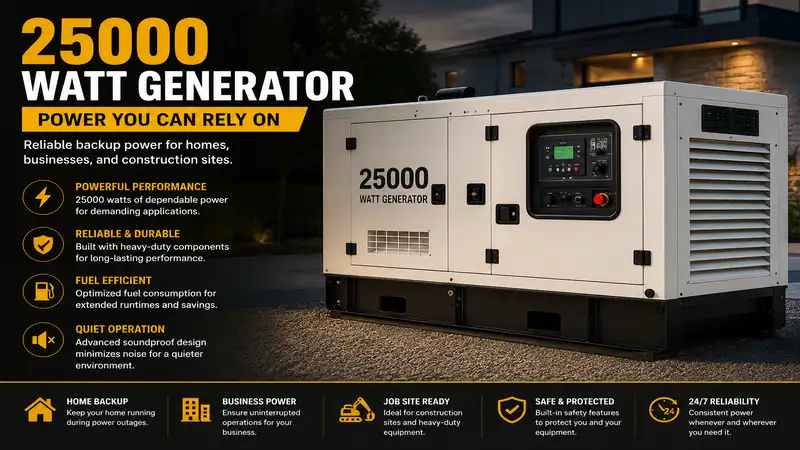
A 25 000 watt portable generator, read literally, would out-muscle the biggest gasoline portables the major brands list. The Westinghouse WGen20000, one of the largest sold in the US, carries 20,000 running watts and 28,000 peak watts on the maker’s page, and the largest GP-series unit from Generac, the Generac GP17500E, is rated at 17,500. Nothing in that class holds 25,000 watts hour after hour. Anyone chasing a 25 000 watt portable generator for a house is really choosing between a 20,000-watt gasoline machine and a permanently installed standby unit.
Maker spec sheets, dealer listings, buyer reviews on retail pages and safety guidance from the CPSC and Consumer Reports shape the advice below, which sorts five real machines by the situation each one fits, from a 20,000-watt home-backup unit down to a 1,200-watt hand-carry generator. The goal for 2027 is simple: leave with a generator whose running watts cover your load, not one with the biggest number on the box.
What the wattage on the box actually promises
Every generator carries two ratings. Running watts are what it can supply continuously; starting (or peak) watts are a short surge that lets a motor spin up. Norwall’s buyer guide describes starting watts as needed only for a few seconds, which is why the second number is the one that inflates a label.
The gap is easy to see in real listings. The DuroMax XP12000EH line is sold as a 12,000-watt generator but delivers 9,500 running watts, according to DuroMax’s spec sheet for the gasoline XP12000E. A Generac PowerRush listing at Ace Hardware pairs 10,000 starting watts with 8,000 running. Firman markets a “10,000-watt” unit with 8,000 running watts. A roundup at Gadgetsfeed puts the arithmetic bluntly: a unit with 20,000 starting watts might hold only 16,000 running.
Searches for a 25 000 kw portable gas generator carry a units slip on top of that. A kilowatt is 1,000 watts, so 25,000 kW would be 25 megawatts, the scale of a power plant rather than a backyard machine. The sensible reading is 25 kW, which equals 25,000 watts and lands in standby-generator territory.
Two more numbers separate otherwise similar machines. The first is voltage: big portables offer 120/240-volt outlets (the WGen20000 lists a 50-amp L14-50R receptacle), and a central air conditioner or electric dryer needs the 240-volt side. The second is power quality. Westinghouse rates the WGen20000 at under 5% total harmonic distortion, which matters for electronics and furnace boards.
A third number, the carbon monoxide standard, deserves a check of its own. Consumer Reports recommends looking on the packaging for ANSI/UL 2201 or ANSI/PGMA G300 certification, and its lab tests found that built-in CO safety features work differently depending on which of the two standards a generator meets. The details are in Consumer Reports’ portable generator safety coverage.
How many watts a portable generator needs to run a house
The question people type, “how many watts portable generator for house”, has a three-step answer: add up the running watts of everything that must work at once, add the largest single starting surge, and leave headroom. Portlandia Electric Supply’s sizing calculator suggests derating portable units to about 80% of their rating for reliable operation.
Generac’s sizing brochure gives the motor loads that decide most houses:
| Appliance | Running watts | Additional starting watts |
|---|---|---|
| Central AC, 24,000 BTU | 3,800 | 4,950 |
| Window AC, 12,000 BTU | 3,250 | 3,950 |
| Heat pump | 4,700 | 4,500 |
| Furnace fan blower, 1/2 HP | 875 | 2,300 |
| Air compressor, 1/2 HP | 1,000 | 2,000 |
Those figures come from a 2015 brochure, and newer high-efficiency units may draw less, so treat them as planning numbers. Even so, the table shows why a 7,500-watt portable cannot run a whole house: central air alone claims half of it at startup.
Sample calculation (stated assumptions, not a measured case): a house that must run a 24,000 BTU central air conditioner (3,800 W), a refrigerator (about 900 W, per Norwall’s example), lighting (100 W) and a microwave (1,000 W) needs 5,800 running watts. Add the air conditioner’s 4,950 additional starting watts and the generator must reach about 10,750 watts for a moment. Dividing 5,800 by 0.8 for the derating guideline gives roughly 7,250 running watts. A machine in the 9,500-running-watt class clears that with room to spare, and a 20,000-watt unit is far more than this load needs.
Lowe’s sizing guide draws the practical line: running an entire house instead of a few essentials points toward a whole-home generator rather than a portable one. A second guide, from Generators Direct, notes that most portable models deliver roughly 3,000 to 7,500 watts, enough for essentials during a short outage.
The numbers that separate these generators
Four details sort the picks that follow. Running watts must exceed your load total with headroom. The 240-volt outlets must match the biggest appliance. Weight and noise decide whether the machine can realistically be moved and run near neighbors. And the fuel (gasoline, propane, natural gas) determines how long an outage can be covered without a fuel run.
The sections below take the situations in order of size, starting with the loads that justify 20,000 watts.
Large homes with central air: 20,000 watts and up
1. Westinghouse WGen20000 — 28,000 peak watts for big homes
The maker’s page lists 28,000 peak watts and 20,000 running watts from a 999 cc V-twin engine, which makes this the closest real product to the figure shoppers type into search bars. At 240 volts, the running rating works out to 83.3 amps, enough to feed a transfer switch serving several large circuits.
Westinghouse specifies a 17.2-gallon tank, up to 11 hours of run time at half load, nine outlets, remote and electric start and transfer-switch readiness. Warranty coverage is three years for residential use and one year commercial. Dealer listings from Webstaurant Store and Portlandia Electric Supply place it between roughly $3,500 and $3,800.
Weight is the trade-off. Westinghouse lists a dry weight of 540 pounds, and dealers show shipping weights near 580. A reviewer on a Sam’s Club listing for a large Westinghouse WGen unit calls weight the only negative and says moving it down a slope by hand would be a worry. A buyer review on a Desertcart listing describes the crate as a big, heavy item and says a 7,550-watt generator used for years could not run central air or a 240-volt dryer, which is the kind of gap this model is built to close. Both are single-reviewer reports, not a measured trend.
Listings with a “c” suffix, such as the WGen20000c, are described as including a CO sensor, while the plain gasoline version is not. The spec sheet puts noise at 74 dBA, well above the 42 to 50 dB(A) Honda quotes for its small inverter.
2. Generac GP17500E — 17,500 watts for central air
For a house with a large air conditioner but no need for the last 2,500 watts, this is the step down. Generac’s own page calls it one of the largest portable generators available, and Norwall’s description says it can run up to a 5-ton air conditioner or up to 16 circuits. A Generac sizing brochure from the GP-series family lists the sibling GP15000E at 15,000 running and 22,500 starting watts, which shows how the line scales.
A Gadgetsfeed roundup lists the GP17500E at 26,250 surge watts, so the gap to the WGen20000 is about 2,500 running watts and under 2,000 surge. Outdoor Life’s 2026 portable generator roundup names it best overall. Build details from Norwall include a frame of 1¼-inch tubing, a fuel gauge and maintenance reminders on the hour meter. A dealer listing at Jondon claims up to 15 hours on a tank; that figure is the seller’s, not an independent measurement.
Gadgetsfeed also flags a mandatory break-in period with an oil change, a detail owners should plan around before an emergency rather than during one. Check the current price on Amazon.com.
What is the best 10000 watt portable generator for a typical house?
The sample calculation above lands squarely in the 10,000-watt class, and the evidence favors dual-fuel models there. Two separate roundups, Generator Mechanics and Power Supply Zone, both name the DuroMax XP12000EH as their top pick, a consensus of two sources rather than a broad survey.
3. DuroMax XP12000EH — dual-fuel 10,000-class workhorse
The gasoline XP12000E spec sheet lists 12,000 starting and 9,500 running watts, and the EH version adds propane. Outlets on the gasoline sheet include two 120-volt 20-amp GFCI receptacles, a 120-volt 30-amp twist-lock, a 120/240-volt 50-amp and a 120/240-volt 30-amp twist-lock, so a transfer-switch inlet and household cords both fit. Generator Mechanics lists the dimensions at about 30 by 29 by 26 inches and the weight at 224 pounds, a fraction of the 540-pound WGen20000.
DuroMax’s own XP12000E page flags a newer XP13000HX, so the version on the listing decides which numbers apply. Compare the exact model number before buying, because dual-fuel and gasoline variants carry different ratings.
Searches for a generac 12000 watt portable generator turn up two older machines. A distributor lists the Generac XP10000E at 12,000 starting and 10,000 running watts from a 530 cc engine with a 9.25-gallon tank. Generac’s owner’s manual covers the Ultra Source in 12,500-watt and 15,000-watt versions. Generac’s current portable page describes a range that tops out at 17,500 watts, so a new 12,000-class machine from another brand, such as this DuroMax, is the more available choice.
Confirm that the listing states running watts, not just a peak figure, before adding any 10,000-watt generator to your cart.
When 25 kW really is the target
4. Generac Guardian 24kW — whole-house power without extension cords
If the load truly approaches 25,000 watts, a portable machine is the wrong format. Tractor Supply lists the Guardian as a 24,000-watt dual-fuel (natural gas or LP) home standby generator with a 200-amp whole-house transfer switch and Wi-Fi monitoring, and calls it the largest air-cooled generator on the market. A Desertcart listing mentions a five-year warranty.
Consumer Reports explains the trade: portable models are much cheaper to buy and install but noisier, harder to use and less powerful, while a standby unit is installed by a professional and sits under an insulated cover that keeps noise down. Generac’s portable versus home standby comparison makes the same point from the maker’s side and notes that a portable can serve as a first step before a standby purchase.
Tractor Supply’s listing for the 24kW with the 200-amp switch sits above $7,000 before installation. Norwall’s catalog places the Guardian line in sizes from 14 kW up to 28 kW, so 24 kW is one point on a wider range.
A 1000 watt portable generator and 1,500 starting watts: the small end
5. Champion 1200-Watt Portable Generator — hand-carry power for small loads
A portable generator with 1,500 starting watts is a different tool from everything above. The Champion model 42436 lists 1,500 starting and 1,200 running watts from an 80 cc engine, up to 10 hours at half load, 65 dBA measured at 23 feet and a low-oil shutoff. Its shipping box is listed at 59.5 pounds, and Firman’s comparable P01201 is described at 61 pounds with a 1.7-gallon tank.
The limits are sharp. A refrigerator example in Norwall’s buyer guide draws 900 running watts but 2,100 starting watts, which exceeds a 1,500-watt peak, so small coolers and lights are the realistic loads. Firman’s own store lists a 1,500/1,200-watt open-frame unit at around $470.
Where clean power and low weight matter more than price, the 1000 watt portable generator class is inverter-based. The Honda EU1000i is rated at 900 running and 1,000 starting watts, weighs under 29 pounds, runs at 42 to 50 dB(A), and includes CO-Minder shutdown; Honda’s sheet says it runs up to 6.8 hours on 0.6 gallons and can be paralleled with a second unit. Tractor Supply’s listing puts it above $1,000. The Westinghouse iGen1200 delivers 1,000 running and 1,200 peak watts at 33 pounds, and the Pulsar PG1500iS lists 1,500 peak and 1,200 running watts at 27 pounds and 57 dB. The inverters cost more per watt and weigh about half as much as the 59.5-pound Champion box.
How the five compare on the numbers that matter
| Generator | Rated output | Peak or starting | Fuel | Fits |
|---|---|---|---|---|
| Westinghouse WGen20000 | 20,000 W | 28,000 W | Gasoline | Large home with central air |
| Generac GP17500E | 17,500 W | 26,250 W (per Gadgetsfeed) | Gasoline | Home with one big AC |
| DuroMax XP12000EH | 9,500 W | 12,000 W | Gasoline or propane | Essential circuits and a central AC |
| Generac Guardian 24kW | 24,000 W | — | Natural gas or LP | Whole-house permanent backup |
| Champion 1200-Watt Portable Generator | 1,200 W | 1,500 W | Gasoline | Camping, lights, small tools |
The table shows how thinly the market is populated around 25,000 watts: the nearest portable is 20,000 running watts, and only the permanent Generac Guardian 24kW crosses 24,000. Between those machines, the buying decision comes down to whether the sample load above looks more like 5,800 watts or 15,000.
Where oversized portable generators disappoint
Wattage is not the only risk. The CPSC reports that an average of about 100 consumers die each year in the US from carbon monoxide poisoning linked to portable generators, and its guidance is to run them outside only, at least 20 feet from the house, and not on a porch or in a carport. The agency’s carbon monoxide safety tips spell this out. A 540-pound machine also has to be rolled to that spot, over whatever surface the yard offers.
Wiring is the second trap. Honda’s EU1000i sheet states that connecting a generator to house power requires a transfer device, and the WGen20000 is advertised as transfer-switch ready for that reason. Cords through a window are not a substitute.
Third, break-in and maintenance steps (the Generac oil change, for example) are easy to skip until the outage arrives. Running a generator at 100% of its rating for hours also shortens its life; the 80% derating guideline above leaves a margin.
Starting watts, kW typos and house sizing: quick answers
Is there a 25,000 watt portable generator?
Is 25,000 kW the same as 25,000 watts?
How many watts does a portable generator need to run a house?
What is the best 10000 watt portable generator?
Can a portable generator with 1,500 starting watts run a refrigerator?
Which size to buy for your situation
A 25 000 watt portable generator does not exist as a sustained rating, so the useful question is which real machine matches your loads. For a large home with central air, the Westinghouse WGen20000 or Generac GP17500E carry the load; for essential circuits plus one air conditioner, the DuroMax XP12000EH class is the better value and far easier to move. If a permanent solution is the real goal, the Generac Guardian 24kW is the format built for it. For lights, a phone charger and a cooler, the Champion 1200-Watt Portable Generator or an inverter such as the Honda EU1000i is plenty.
Whichever size you pick, run it outdoors, 20 feet from the house, and wire it through a transfer device. Add your running watts, add the biggest startup surge, and buy for that total instead of for the number on the box.
Recommended for You
- 12 000 Watt Generator: 7 Best Picks for Whole-Home Backup (2026)
- 5 Best 25000 Watt Generator Models for 2026 Home Backup
- Portable Charger Rental: 7 Best Power Bank Rental Solutions
Wattage ratings and stock change quickly, so read the running-watt line on the product page before you order.