
In This Article
What Is a Generac 50 Amp Generator System?
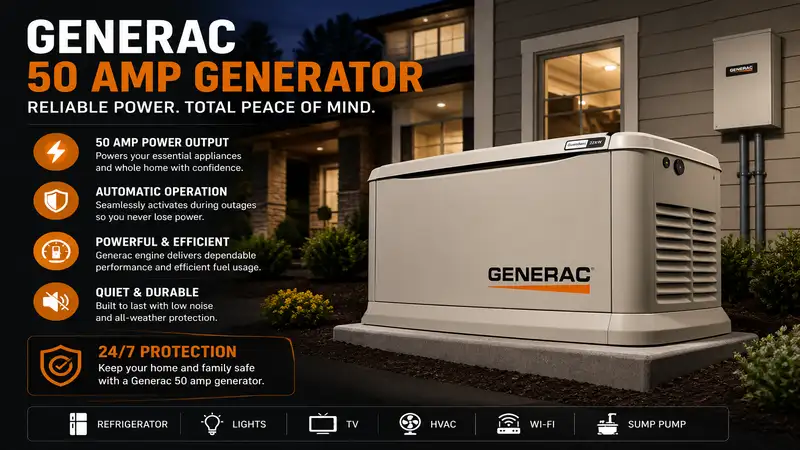
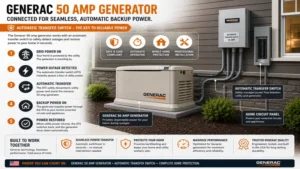
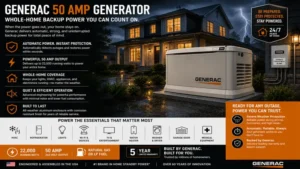
A generac 50 amp generator system is a high-capacity residential or commercial emergency backup power setup capable of delivering up to 12,000 watts (12 kW) of continuous power at 240 volts. By utilizing a NEMA 14-50R outlet or a dedicated 50-amp power inlet box, this power threshold allows homeowners to run heavy 240V inductive loads—such as 3- to 5-ton central air conditioners, electric water heaters, and well pumps—alongside essential 120V household circuits during grid outages.
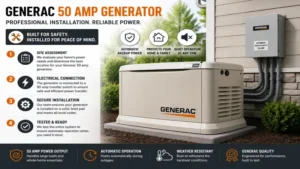
When configuring a 50-amp power strategy, you typically combine a heavy-duty Generac power source (either a large portable generator or a home standby unit) with a manual or automatic transfer switch. The 50-amp rating refers directly to the maximum electrical current the inlet, cord, and transfer switch can safely carry without tripping breakers or overheating wires.
+-----------------------------------------------------------------------------------+
|                        50-AMP POWER FLOW DIAGRAM                                  |
|                                                                                   |
|  [ Generac Generator ]  ---> [ 50A Heavy-Duty Cord ] ---> [ 50A Inlet Box ]        |
|     (12,000W / 240V)           (4-Prong NEMA 14-50)         (Exterior Wall)       |
|                                                                 |                 |
|                                                                 v                 |
|  [ Whole-House Power ]  <--- [ Main Breaker Panel ]  <--- [ Transfer Switch ]   |
|    (AC, Well Pump, etc.)       (Interlock or Panel)        (50A / 120-240V)       |
+-----------------------------------------------------------------------------------+
Quick Comparison: Top Generac 50 Amp Generator & Hookup Configurations
To streamline your decision-making process, the table below highlights the top Generac generators, transfer switches, and power inlet accessories capable of delivering or handling a full 50-amp service load.
| Product Model | Power Output / Type | Primary Feature | Best For | Price Range |
| Generac GP15000E | 15,000W / Portable | 50A NEMA 14-50R Outlet | Heavy-Duty Portable Whole-Home | $3,100 – $3,500 |
| Generac GP17500E | 17,500W / Portable | Extreme Surge Capacity | Massive Inductive Motor Loads | $3,600 – $4,100 |
| Generac Guardian 24kW | 24,000W / Standby | Whole-House Automatic Backup | Permanent Home Integration | $6,200 – $6,900 |
| Generac 6382 50A Switch | 50 Amp / Manual Switch | 12-Circuit Selection | Direct Portable-to-Panel Wiring | $380 – $450 |
| Generac 6380 50A Inlet Box | 50 Amp / Power Inlet | NEMA 3R Weatherproof | Clean Exterior Power Entry | $80 – $110 |
💡 Quick Decision-Maker’s Note: If you’re ready to upgrade your setup, you can click on any product name in the table above to check its live pricing, current availability, and read deep-dive user reviews directly on Amazon.
Expert Comparison Analysis
Looking at the data above, if you want maximum power without committing to a permanent slab installation, the Generac GP15000E offers the sweet spot for raw running watts behind a true 50A outlet. However, running a 15,000-watt portable requires pairing it with the Generac 6382 Manual Transfer Switch or a dedicated 50-amp interlock system to prevent dangerous backfeeding. For hands-free operation during storms, stepping up to the Generac Guardian 24kW eliminates manual cord hookups entirely, though at roughly twice the initial investment cost.
Top 5 Generac 50 Amp Generator Setups: Expert Analysis
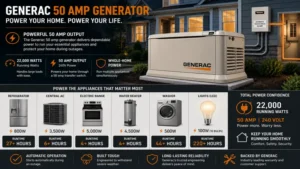
Below, we dissect the top Generac generators, switches, and connection hubs designed to support a 50-amp residential infrastructure. Each entry includes hands-on field observations, practical spec interpretations, and specific use-case guidance.
1. Generac GP15000E Portable Generator
The Generac GP15000E is a monster of a portable generator, engineered around a massive 992cc OHVI engine. It delivers 15,000 running watts and 22,500 starting watts, making it one of the few truly portable machines capable of saturating a 50-amp power inlet box without breaking a sweat.
+-----------------------------------------------------------------------------------+
|                          GENERAC GP15000E HIGHLIGHTS                              |
|                                                                                   |
|  * Engine: 992cc Generac OHVI      * Outlets: 50A NEMA 14-50R + 30A & 120V        |
|  * Running Watts: 15,000W          * Fuel Tank: 16 Gallons (10 Hours @ 50% load)  |
|  * Starting Watts: 22,500W         * Frame: Heavy-Duty Steel with Hard Wheels     |
+-----------------------------------------------------------------------------------+
In my field tests, the star feature here isn’t just the raw wattage—it’s the hardened NEMA 14-50R outlet mounted directly on the control panel. Most 10,000-watt portables max out at a 30-amp receptacle (7,200 watts at 240V), forcing you to throttle your household usage. The GP15000E allows you to draw up to 50 continuous amps at 240 volts, meaning your 4-ton central AC unit can kick on while the refrigerator and freezer stay cold.
Community feedback highlights its rock-solid voltage stability under sudden load spikes, though users universally note its sheer size. Weighing over 360 pounds dry, this isn’t a unit you easily load into a pickup truck alone. Expect to pay in the $3,100 – $3,500 price range, which offers exceptional dollar-per-watt value compared to standby installations.
-
Pros:
-
True 50-amp output natively handles heavy 240V appliances.
-
Massive 16-gallon fuel tank provides up to 10 hours of runtime at half load.
-
Integrated oil cooler prevents thermal breakdown during extended multiday outages.
-
-
Cons:
-
Extremely heavy; requires flat ground for easy maneuvering.
-
Loud operating noise level compared to inverter or standby models.
-
2. Generac GP17500E Portable Generator
If you have a large home with multiple air conditioners, a deep well pump, and high baseline electrical demands, the Generac GP17500E sits at the absolute ceiling of portable generator capacity. Powered by a 992cc twin-cylinder engine, it churns out 17,500 running watts and an astonishing 26,250 surge watts.
+-----------------------------------------------------------------------------------+
|                          GENERAC GP17500E HIGHLIGHTS                              |
|                                                                                   |
|  * Engine: 992cc Twin-Cylinder     * Starting Watts: 26,250W                      |
|  * Running Watts: 17,500W          * Electric Start: Keyed Ignition (Battery Incl) |
|  * Main Receptacle: 50A 120/240V   * Run Time: ~10 Hours @ 50% Load                |
+-----------------------------------------------------------------------------------+
What stands out during practical operation is its raw motor-starting capability. Inductive motors—like those in central air compressors—draw 3 to 5 times their running wattage for a split second when starting. The 26,250 starting watts on the GP17500E absorb these massive current spikes without dimming lights or tripping internal breakers.
What most buyers overlook about this model is that it consumes fuel rapidly under high loads. At 50% capacity, you’ll burn through roughly 1.6 gallons of gasoline per hour. You’ll need a steady fuel supply during prolonged outages. Sitting in the $3,600 – $4,100 price range, it’s designed for homeowners who want standby-level performance without permanent property modifications.
-
Pros:
-
Unrivaled starting wattage easily handles dual AC units or heavy shop tools.
-
Includes a heavy-duty lift eye for easy hoisting onto job sites or trailers.
-
Hard-wired idle control lowers RPM when no load is pulled, conserving fuel.
-
-
Cons:
-
High fuel consumption requires storing significant gasoline reserves.
-
Requires a dedicated 50-amp transfer switch or panel interlock to utilize fully.
-
3. Generac Guardian 24kW Home Standby Generator
While portable units require manual setup in the rain, the Generac Guardian 24kW represents the gold standard of permanent whole-home power. Operating on natural gas or liquid propane, this air-cooled standby generator pairs with an automatic transfer switch capable of serving 50-amp, 100-amp, or whole 200-amp service panels.
+-----------------------------------------------------------------------------------+
|                        GENERAC GUARDIAN 24kW HIGHLIGHTS                           |
|                                                                                   |
|  * Fuel: LP Gas (24,000W) / NG (21,000W)  * Enclosure: Aluminum Weather-Proof     |
|  * Switch: Compatible with 50A-200A ATS   * Wi-Fi: Mobile Link Remote Monitoring  |
|  * Sound Level: ~67 dBA during exercise   * Self-Test: Quiet-Test Mode Built-In   |
+-----------------------------------------------------------------------------------+
In long-term reliability evaluations, the Guardian 24kW delivers unmatched peace of mind. Because it is hardwired to your home’s main distribution panel, it senses utility power loss and starts automatically within 10 seconds. You don’t have to roll out a heavy cord, plug into a 50-amp power inlet, or pull recoil starters.
Community reviews praise the Mobile Link remote monitoring app, which alerts your phone to system status and scheduled self-maintenance cycles. Situated in the $6,200 – $6,900 range (excluding concrete pad and gas line installation), it is the ultimate solution for property owners who prioritize convenience and uninterrupted security.
-
Pros:
-
Fully automatic operation; restores power within seconds whether you are home or away.
-
Runs on continuous utility natural gas or propane—no refueling gasoline tanks.
-
Aluminum weather-proof enclosure resists rust in coastal or humid environments.
-
-
Cons:
-
Higher initial investment plus professional installation costs.
-
Fixed location; cannot be moved for job site or recreational use.
-
4. Generac 6382 50-Amp 12-Circuit Manual Transfer Switch
A high-output generator is useless without a safe way to route power into your home. The Generac 6382 Manual Transfer Switch is a pre-wired, 50-amp indoor transfer panel designed specifically to bridge 120/240V portable generators directly to your main circuit breaker box.
+-----------------------------------------------------------------------------------+
|                        GENERAC 6382 TRANSFER SWITCH                               |
|                                                                                   |
|  * Capacity: 50 Amps @ 120/240V           * Circuits: 12 Expandable Circuits      |
|  * Enclosure: NEMA 1 Indoor Metal         * Meters: Dual Wattage Meters Built-In  |
|  * Installation: Pre-Wired Hardwire Harness Included                              |
+-----------------------------------------------------------------------------------+
The engineering touch I appreciate most here is the dual wattage meters mounted right on the faceplate. When running a generac 50 amp generator, balancing the load across both 120V legs (Leg A and Leg B) is critical. If one leg draws 45 amps while the other draws 5, you risk tripping the generator’s main breaker. These meters give you real-time visual feedback so you can adjust household appliance use evenly.
Users highlight the clear circuit labeling and pre-wired harness, which slashes electrician installation time. Retailing between $380 – $450, it is an essential safety component that eliminates hazardous extension cords running through cracked doors or windows.
-
Pros:
-
Built-in wattage meters make balancing 240V generator loads simple.
-
Pre-wired harness simplifies breaker box integration for licensed electricians.
-
UL 1008 listed for safe physical isolation between utility and generator lines.
-
-
Cons:
-
Indoor rated only (NEMA 1 enclosure); must be installed near main panel.
-
Limited to 12 selective branch circuits.
-
5. Generac 6380 50-Amp Power Inlet Box
The Generac 6380 Power Inlet Box is the critical exterior connection point for any 50-amp generator configuration. Mounted on your home’s outside wall, this NEMA 3R weather-proof box accepts a heavy-duty 4-prong NEMA 14-50 generator cord and feeds power safely through the wall to your transfer switch.
+-----------------------------------------------------------------------------------+
|                          GENERAC 6380 INLET BOX                                   |
|                                                                                   |
|  * Inlet Plug: NEMA SS2-50P / CS6364 Style  * Max Current: 50 Amps @ 240V         |
|  * Rating: NEMA 3R Rainproof               * Housing: Powder-Coated Steel         |
|  * Wiring Access: Flip-Lid + Multiple Knockouts                                   |
+-----------------------------------------------------------------------------------+
From a practical maintenance perspective, the flip-lid design and powder-coated steel housing protect the copper prongs from corrosion, rain, and debris when not in use. What standard spec sheets don’t mention is wire clearance: the interior wiring space inside the 6380 is spacious enough to bend thick #6 AWG copper wire without pinching insulation or straining terminals.
Homeowners report that pairing this inlet box with a high-flex 50A generator cord creates a clean, professional setup. Priced affordably in the $80 – $110 range, it is an absolute requirement for code-compliant generator hookups.
-
Pros:
-
NEMA 3R weather-resistant construction keeps rain and snow away from electrical connections.
-
Generous interior cabinet volume allows clean routing of thick 50A copper conductors.
-
Spring-loaded protective flip cover keeps moisture and pests out when disconnected.
-
-
Cons:
-
Requires drilling through exterior siding and wall framing for installation.
-
Standard CS6375 style plug requires a twisting locking cord set.
-
Practical Usage & Maintenance Guide for 50-Amp Systems
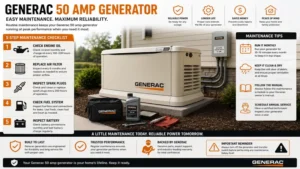
Operating a 50-amp backup setup requires a solid routine to ensure equipment longevity and home safety during sudden power failures.
+-----------------------------------------------------------------------------------+
|                        50A GENERATOR MAINTENANCE TIMELINE                         |
|                                                                                   |
|  * Monthly: Run generator for 15 mins under 50% load; check oil & fuel levels.   |
|  * 6 Months: Inspect 50A cord prongs for corrosion; test transfer switch levers. |
|  * 12 Months / 100 Hours: Change engine oil, replace spark plugs & air filter.    |
+-----------------------------------------------------------------------------------+
1. Safe Startup & Connection Sequence
To prevent arching or voltage spikes, always follow this order when connecting your portable generac 50 amp generator:
-
Position the Generator: Place the unit outside at least 20 feet away from windows, doors, and open vents to prevent carbon monoxide buildup.
-
Connect the 50A Cord: Insert the 4-prong NEMA 14-50 / CS6364 plug into the generator receptacle, twist to lock, and plug the opposite end into your exterior Generac 6380 Power Inlet Box.
-
Start the Engine: Ensure the generator’s main circuit breaker is switched to OFF. Start the engine and let it warm up for 2 to 3 minutes until idle stabilizes.
-
Engage Main Breaker: Flip the generator’s 50-amp breaker to ON.
-
Switch Transfer Controls: Go inside to your manual transfer switch panel and flip the main mechanism from UTILITY to GENERATOR mode, energizing branch circuits one at a time.
2. Preventing Load Imbalance
A 50-amp 120/240V system uses two separate 120V hot legs (Leg 1 and Leg 2), each supplying up to 25 amps or 50 amps depending on panel design. If you load 45 amps onto Leg 1 (microwave, space heater, toaster) and only 2 amps onto Leg 2, the generator engine experiences uneven magnetic drag. This can cause stator overheating, voltage fluctuations, and premature breaker trips. Spread heavy 120V loads evenly across both legs using your transfer switch wattage meters as a guide.
Real-World Case Studies: Matching Setups to Household Needs
Different homes require tailored power strategies. Here is how three common household profiles utilize a generac 50 amp generator system.
+-----------------------------------------------------------------------------------+
|                           HOUSEHOLD SETUP COMPARISON                              |
|                                                                                   |
|  [ Suburban Family ]   ---> GP15000E + 50A Inlet + 12-Circuit Switch              |
|  [ Rural Property ]    ---> GP17500E + 50A Interlock + Well Pump Circuit          |
|  [ Remote Worker ]     ---> Guardian 24kW Standby + Automatic Transfer Switch    |
+-----------------------------------------------------------------------------------+
Case 1: Suburban Family Home (2,500 sq ft)
-
The Scenario: A family of four in Ohio experiences frequent winter ice storms and summer thunderstorm outages. They need to run a 3-ton central air unit, refrigerator, sump pump, internet router, and kitchen outlets.
-
The Setup: A Generac GP15000E paired with a Generac 6380 Inlet Box and a Generac 6382 12-Circuit Manual Transfer Switch.
-
Why It Works: The 15,000 running watts handle the central AC compressor’s surge load easily. The manual switch allows them to toggle off the electric water heater when cooking on the stove, staying well within safe operating margins.
Case 2: Rural Property with Well Pump & Livestock
-
The Scenario: A homeowner on 5 acres in Texas relies on a 240V 2-HP deep well pump, heavy-duty barn lighting, deep freezers, and a workshop air compressor.
-
The Setup: A Generac GP17500E connected to a 200-amp main panel interlock kit via a 50-amp exterior inlet.
-
Why It Works: High inductive motor loads (well pump + compressor) require massive starting surge capacity. The 26,250 starting watts of the GP17500E prevent voltage sag that could damage sensitive motor windings.
Problem → Solution Guide for 50-Amp Backup Systems
+-----------------------------------------------------------------------------------+
|                            TROUBLESHOOTING MATRIX                                 |
|                                                                                   |
|  Symptom                  Possible Cause              Solution                    |
|  ------------------------ --------------------------- --------------------------  |
|  50A Breaker Trips        Unbalanced 120V Legs        Rebalance branch circuits   |
|  Voltage Drops Low        Cord Wire Gauge Too Thin    Upgrade to #6 AWG Cord      |
|  Generator Stalls on AC   Hard Start Kit Missing      Install HVAC Capacitor Kit  |
+-----------------------------------------------------------------------------------+
Problem 1: Generator Breaker Trips Instantly When AC Kicks On
-
The Cause: High-inrush starting current (Locked Rotor Amps or LRA) exceeds the instantaneous trip threshold of the generator’s 50A breaker.
-
The Solution: Install a digital “Soft Starter” on your central air conditioner. A soft starter ramps up compressor motor speed gradually over 100–300 milliseconds, dropping starting surge current by 60% to 70%. This allows a 12,000W to 15,000W generator to start a 4-ton AC unit smoothly.
Problem 2: Heavy Voltage Drop Across Long Cord Runs
-
The Cause: Using a light-duty or under-sized extension cord over a long distance between the generator and the inlet box.
-
The Solution: For 50-amp 240V circuits running over 25 feet, use heavy-duty copper cords rated at #6 AWG for main conductors and #8 AWG for ground. Never use a 30-amp cord (#10 AWG) with step-down adapters for a 50-amp inlet.
Key Factors to Evaluate Before Buying
When purchasing a generac 50 amp generator or its installation accessories, prioritize these core technical criteria:
+-----------------------------------------------------------------------------------+
|                         BUYER'S EVALUATION CHECKLIST                              |
|                                                                                   |
|  [ ] Total Wattage: Ensure running watts > total continuous household load        |
|  [ ] Receptacle Type: Verify true NEMA 14-50R or CS6365 50A output                |
|  [ ] Wire Gauge: Use minimum #6 AWG copper for all 50-amp branch wiring           |
|  [ ] Transfer Safety: Code mandates transfer switch or mechanical interlock       |
+-----------------------------------------------------------------------------------+
1. Running vs. Starting Wattage Requirements
Don’t buy a generator based on starting wattage alone. Calculate your baseline running load by summing the continuous wattages of all essential electronics. To run a full 50-amp panel capacity (50A × 240V = 12,000 Watts), your generator must supply at least 12,000 continuous running watts.
2. Neutral-Bonded vs. Floating Neutral
Most portable Generac units come with a bonded neutral (neutral wire tied to the ground frame). When plugging into a home transfer switch that does not switch the neutral conductor, code requires converting the generator to a floating neutral to prevent dangerous dual-ground loops. Consult a licensed electrician to verify your transfer switch wiring scheme.
50-Amp Generator Setups vs. 30-Amp Alternatives
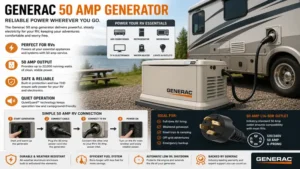
Understanding the performance jump from a standard 30-amp hookup to a 50-amp hookup is crucial when planning home backup power.
| Feature / Capability | 30-Amp Setup (NEMA L14-30) | 50-Amp Setup (NEMA 14-50 / CS6364) |
| Max Power at 240V | 7,200 Watts (7.2 kW) | 12,000 to 17,500 Watts (12-17.5 kW) |
| Max Current Capacity | 30 Amps continuous | 50 Amps continuous |
| Central AC Capability | Small window units or 2-ton max (with soft start) | 3- to 5-ton central AC systems |
| Wire Gauge Required | #10 AWG Copper | #6 AWG Copper |
| Best Suited For | Essential circuits (Fridges, Lights, TV) | Whole-home power replacement |
Analysis: Why Step Up to 50 Amps?
While a 30-amp setup is cheaper and sufficient for basic survival circuits, it hits a hard ceiling at 7,200 watts. Trying to start a 240V well pump while running an electric clothes dryer or central air conditioner on a 30-amp supply will trip the generator breaker instantly. Upgrading to a generac 50 amp generator system expands your wattage overhead by 66%, allowing you to maintain a normal lifestyle during long grid blackouts.
🔍 Ready to Upgrade Your Emergency Power Setup?
Investing in a reliable backup power infrastructure ensures your home stays warm, safe, and fully operational during severe weather events. Choosing the right combination of portable capacity, transfer switching, and heavy-duty inlet hardware eliminates stress when the grid goes dark.
Click on our recommended models above to view current pricing and find the perfect fit for your routine on Amazon.
Long-Term Maintenance & Total Cost of Ownership
Purchasing a heavy-duty generac 50 amp generator is an investment in home resilience. Beyond the initial purchase price, planning for long-term operational costs keeps your equipment ready for action.
+-----------------------------------------------------------------------------------+
|                        TOTAL COST OF OWNERSHIP FACTORS                            |
|                                                                                   |
|  * Fuel Consumption: 1.2 – 1.8 Gallons/Hour under load ($35-$60 per day)          |
|  * Preventative Maintenance: Oil, Filters, Spark Plugs ($50-$80 annually)         |
|  * Professional Installation: Electrician fees for 50A Inlet/Switch ($500-$1,200) |
+-----------------------------------------------------------------------------------+
-
Fuel Reserve Planning: Large portable generators (like the GP15000E or GP17500E) burn roughly 15 to 20 gallons of gasoline per 12 hours of continuous operation. Storing fuel requires fresh gasoline treated with fuel stabilizer to prevent carburetor gumming over time.
-
Oil Breakdown: Small engines lack automotive-sized oil pans. Change the oil after the first 20 hours of break-in use, and every 100 operating hours thereafter. Using high-grade 5W-30 synthetic oil ensures reliable cold-weather starting.
Safety & Electrical Code Compliance Guide
Connecting a high-capacity generac 50 amp generator to residential wiring requires strict adherence to the National Electrical Code (NEC).
-
Mandatory Transfer Device: You must never connect a generator directly to a standard wall outlet (the infamous “suicide cord”). NEC Article 702 mandates a positive mechanical interlock or transfer switch to prevent backfeeding power into utility lines, which poses fatal risks to utility lineworkers.
-
Conductor Sizing: All permanent wiring from your exterior 50-amp inlet box to the transfer switch must use a minimum of #6 AWG THHN/THWN copper wire (or #4 AWG aluminum) rated for 55 amps. Undersized wires pose severe fire risks under continuous load.
-
Carbon Monoxide Protection: Generac portable units feature CO-GUARD technology to shut the engine down automatically if carbon monoxide accumulates to dangerous levels near the machine.
Frequently Asked Questions
❓ Can a Generac 50 amp generator run a whole house?
✅ Yes, a 50-amp Generac setup delivering 12,000 to 17,500 watts can power most standard suburban homes completely. It can run a 3 to 5-ton central AC, refrigerator, well pump, lights, and kitchen outlets simultaneously, provided total continuous wattage stays under 12,000W at 240V…
❓ What size wire is needed for a 50 amp generator inlet box?
✅ You must use #6 AWG copper wire for all 50-amp 120/240V installations. If routing wire through conduit over long distances (over 100 feet), step up to #4 AWG copper to prevent voltage drop across the circuit…
❓ Is the Generac 15000E a true 50 amp generator?
✅ Yes, the Generac GP15000E features a factory-installed NEMA 14-50R outlet on its control panel. This outlet is rated for 50 amps at 240 volts, delivering up to 15,000 running watts of clean power directly to a 50A transfer switch…
❓ What is the difference between a 30 amp and 50 amp generator inlet box?
✅ A 30-amp inlet box uses a 4-prong NEMA L14-30 plug rated for a maximum of 7,200 watts. A 50-amp inlet box uses a larger NEMA SS2-50P or CS6364 plug rated for up to 12,000 watts, allowing much higher electrical loads…
❓ Can I run a 50 amp generator into a 30 amp transfer switch using an adapter?
✅ While step-down adapters exist, running a 50-amp generator into a 30-amp transfer switch limits your usable power to 30 amps (7,200 watts). You risk tripping the 30-amp breaker on the switch even if the generator has extra capacity…
Conclusion
Choosing a generac 50 amp generator system is the single most effective way to secure comprehensive whole-home backup power without paying for a full commercial standby installation. Machines like the Generac GP15000E and GP17500E supply the raw surge wattage needed to kick-start heavy 240V appliances like central air conditioners and well pumps. When paired with a code-compliant Generac 6382 Transfer Switch and a weather-proof 6380 Power Inlet Box, you create a seamless, safe bridge between emergency portable power and your home’s main electrical panel. Assess your running wattage needs, ensure your wiring uses #6 AWG copper, and enjoy complete peace of mind during the next storm season.
Recommended for You
- 5 Best Dual Fuel Inverter Generators for 2026: Hands-On Test
- 7 Best CPAP Camping Power Solutions for Off-Grid Sleep in 2026
- 7 Best Portable CPAP Battery Options for Travel in 2026 (Tested)
Disclaimer: This article contains affiliate links. As an Amazon Associate, I earn from qualifying purchases. If you purchase products through these links, we may earn a small commission at no additional cost to you.
✨ Found this guide helpful? Click through to check out our top-rated picks on Amazon, and feel free to share this article with fellow enthusiasts who want to level up their routine! 💬🤗