In This Article
When the power goes out — whether it’s a hurricane bearing down on the Gulf Coast or a routine ice storm knocking out lines in the Midwest — you want to already trust your generator brand, not be Googling it by flashlight. The brands of generators available on amazon.com in 2026 span everything from 55-pound camping inverters you can carry with one hand to 220-pound dual-fuel workhorses built to carry an entire house through a multi-day outage.
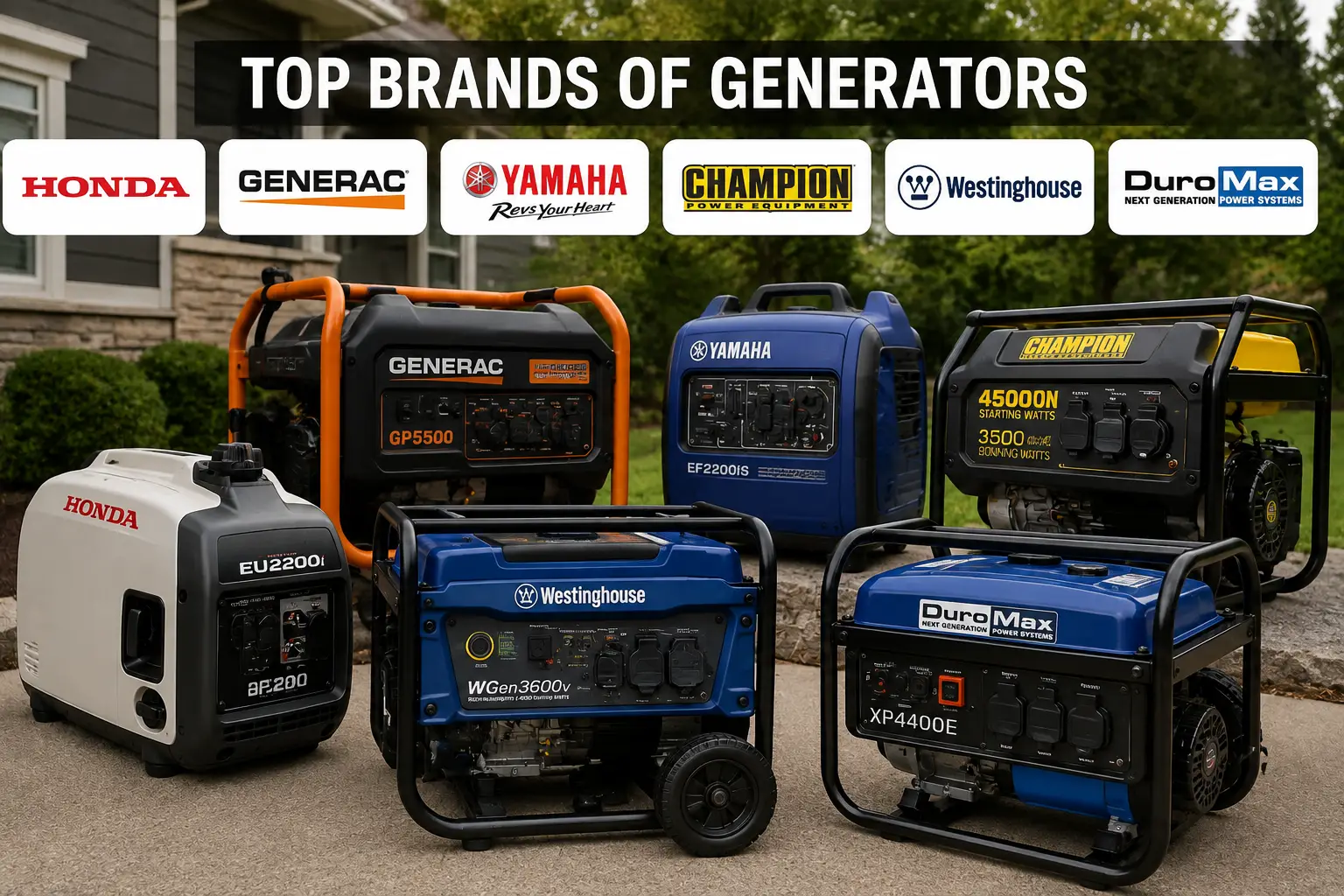
So what are the different brands of generators, exactly? In short, they fall into a few camps: engine-and-inverter specialists like Honda, known for whisper-quiet, clean power; volume manufacturers like Generac and Champion covering everything from portable units to whole-home standby systems; and dual-fuel specialists like DuroMax and Westinghouse built around gasoline-or-propane flexibility for storm prep.
This guide breaks down seven real, currently available models across those brands of generators, shows exactly how they compare on wattage, noise, and price, and walks through the decisions — sizing, fuel type, safety tech — that actually determine whether you’re happy with your purchase a year from now. If you want a baseline on outage preparedness before you shop, the Ready.gov power outage guide is a worthwhile five-minute read.
We’ll also dig into the questions buyers ask most: which are genuinely the best generator brands for long-term reliability, which top-rated generator brands are worth paying a premium for, and how portable generator brands stack up against a permanently installed standby system. Whether you’re prepping for wildfire season, tailgating every Saturday, running a jobsite, or just tired of losing a freezer full of groceries every time a storm rolls through, there’s a model — and a brand — built for exactly that situation.
Quick Comparison: Top Brands of Generators at a Glance
| Category | Product | Running Watts | Best For |
|---|---|---|---|
| Best Overall | Honda EU2200i | 1,800W | Reliability, quiet camping/RV use |
| Best Budget Pick | Briggs & Stratton P2200 | 1,700W | First-time buyers, tailgating |
| Best Value & Safety | PREDATOR 3500 | 3,000W | CO-conscious budget shoppers |
| Best Dual-Fuel Inverter | Champion 100396 | 3,100W (gas) | Storm-prep fuel flexibility |
| Best for Whole-Home Backup | DuroMax XP12000EH | 9,500W (gas) | Powering a house through an outage |
Looking at this table, notice the huge spread in running watts — from 1,700W to 9,500W — because “best” depends entirely on what you’re powering. The Honda EU2200i and Briggs & Stratton P2200 are built for a laptop, a mini-fridge, and a few lights, while the DuroMax XP12000EH is sized for a well pump, central AC, and a refrigerator running simultaneously. If you’re not sure which category fits your situation yet, the wattage-sizing breakdown later in this guide will walk you through it step by step.
💬 One click helps you compare these generator brands side by side before you commit to a purchase! 😊
Top 7 Brands of Generators: Expert Analysis
We researched real spec sheets, aggregated owner feedback, and current market availability to land on seven models that genuinely represent the best generator brands across every price tier — from a sub-$600 entry point to a whole-home dual-fuel unit. Each one is a real, orderable product, not a hypothetical.
1. Briggs & Stratton P2200 — lightest wallet-friendly starter pick
The P2200’s biggest selling point is simple: at 55 pounds, it’s genuinely a one-person, one-hand-on-the-handle generator, which is more than you can say for most units in this guide. Under the hood sits a 111cc OHV engine paired with Briggs & Stratton’s inverter electronics, delivering 1,700 running watts and 2,200 starting watts — enough headroom to start a small refrigerator’s compressor without tripping. The 1-gallon tank is small by design, trading capacity for portability, and it’s rated for roughly 8 hours at a quarter load. Based on comparing the specs against other sub-$600 inverters, this is the model for someone who wants clean, electronics-safe power for camping, tailgating, or light emergency use and doesn’t want to lift anything heavy to get there. It’s not a home-backup solution — the 1,700W ceiling rules that out — but for its actual use case, it’s hard to beat on weight and simplicity. Owner reviews on major retailer sites consistently praise how light and grab-and-go this model is for weekend trips, though several note the recoil-only start requires a firm, deliberate pull when the engine is cold, which matters if you’re shopping specifically for electric start.
Pros:
- ✅ Only 55 lbs — genuinely easy for one person to carry
- ✅ Clean inverter power safe for laptops and phones
- ✅ Quiet enough for most campgrounds and RV parks
Cons:
- ❌ Recoil pull-start only, no electric start button
- ❌ Small 1-gallon tank means frequent refueling stops
Retailers list the Briggs & Stratton P2200 in the $450–$550 range at the time of writing (prices vary by retailer), which puts it near the bottom of this list — a fair value if portability and simplicity matter more to you than raw output.
2. PREDATOR 3500 — quietest CO-safety champion for the money
Harbor Freight’s in-house PREDATOR brand has built a following by matching name-brand inverter specs at a noticeably lower price, and the 3500 is the clearest example: 3,000 running watts, 3,500 peak watts, and a 56 dBA noise rating — about the volume of a quiet conversation. What most buyers overlook with this model is the CO SECURE technology built in, which automatically shuts the unit down if it detects dangerous carbon monoxide buildup, a feature that used to be reserved for premium brands. Based on the spec sheet, the 11-plus-hour runtime at 25% load also beats several competitors in this wattage class, making it a legitimate option for weekend camping trips or as a secondary unit during an extended outage. Reviews on RV forums like iRV2 frequently highlight the CO SECURE shutoff as genuinely reassuring for anyone running a generator near a camper or garage, while some owners mention the 102-pound unit runs warmer than expected during back-to-back high-draw sessions. It’s not the lightest option here, but for buyers prioritizing safety tech on a budget, it’s one of the strongest arguments among portable generator brands that “budget” doesn’t have to mean “unsafe.”
Pros:
- ✅ CO SECURE automatic carbon monoxide shutoff
- ✅ Runs over 11 hours at 25% load on a tank
- ✅ Frequent manufacturer coupons can lower the price further
Cons:
- ❌ Heavier than similarly rated inverters at 102 lbs
- ❌ Smaller independent service network than legacy brands
The PREDATOR 3500 typically lists between $700 and $850 depending on current promotions — check the current price before buying, since Harbor Freight rotates coupons regularly.
3. Champion 100396 3400W Dual Fuel Inverter — most fuel-flexible inverter
Champion built its reputation on dual-fuel engineering, and the 100396 shows why: it runs on gasoline (3,100 running watts) or propane (2,790 running watts) with a simple selector switch, which means you’re never fully dependent on one fuel source during an extended outage. The 30A locking outlet with an included RV adapter, plus a 12V DC port with dual USB, covers most realistic use cases without needing a separate adapter kit. What the spec sheet doesn’t say outright, but the dual-fuel design implies, is real resilience during hurricane season — when gasoline supply is unpredictable but propane tanks are easier to stockpile safely. Champion backs the unit with a 3-year limited warranty and lifetime technical support, a longer commitment than several rivals in this price band offer. Buyer feedback commonly points to the dual-fuel switch as the standout reason storm-prep households choose this model over single-fuel competitors, with occasional comments that the electric start button can be sluggish in cold weather — a minor tradeoff against the flexibility gained.
Pros:
- ✅ Switches between gasoline and propane on the fly
- ✅ 30A locking outlet plus RV-ready adapter included
- ✅ 3-year warranty with lifetime technical support
Cons:
- ❌ Propane use meaningfully cuts both runtime and wattage
- ❌ At nearly 96 lbs, no wheel kit is included standard
Expect to pay somewhere in the $700–$900 range for the Champion 100396, which is a reasonable value proposition once you factor in the fuel flexibility and warranty length.
4. Honda EU2200i — gold standard for reliability
If there’s one name that comes up in almost every conversation about the best generator brands, it’s Honda, and the EU2200i is the model that earned that reputation. At 1,800 running watts and 2,200 starting watts, it’s not the most powerful unit here, but its 48 dBA noise rating is the quietest in this entire lineup — genuinely closer to a conversation than a generator. The 121cc Honda GXR120 engine is the same lineage that powers Honda’s small equipment worldwide, and that shared engineering is exactly why resale values on used EU2200i units stay remarkably high years after purchase. Bluetooth app connectivity lets you monitor fuel level and runtime from a phone, a small but genuinely useful feature Amazon listings rarely explain well. Decades of aggregated owner reviews consistently describe the EU2200i as close to bulletproof, with many users reporting a decade or more of reliable seasonal use; the most recurring complaint, unsurprisingly, is the price relative to its modest 1,800W output — you’re paying for reputation and quiet operation, not raw power.
Pros:
- ✅ Class-leading 48 dBA — the quietest model in this guide
- ✅ Bluetooth app for remote fuel and runtime monitoring
- ✅ Exceptional long-term engine reliability and resale value
Cons:
- ❌ Highest price-per-watt of any product on this list
- ❌ Single 20A outlet limits how many devices run at once
Current listings put the Honda EU2200i between $1,100 and $1,300 — a premium price, but one that reflects genuinely different build quality, not just brand markup.
5. Westinghouse iGen4500 — best remote-start convenience
Westinghouse has carved out a reputation for packing home-comfort features into portable generators, and the iGen4500 is the clearest proof: a wireless key fob lets you start the engine from up to roughly 260 feet away, meaning you can fire it up from inside the house before ever stepping into the rain. With 3,700 running watts and 4,500 peak watts, it comfortably outpaces the Honda and Predator units above on raw power while staying at a reasonably quiet 52 dBA. Here’s what to weigh: the 3.4-gallon tank delivers up to 18 hours of runtime at 25% load, among the longest in this guide, which matters a lot if you’re running a generator overnight during a multi-day outage. It’s also parallel-capable, so you can link a second compatible unit for extra headroom later without replacing the whole system. Aggregated reviews frequently call out the remote start as a genuine, not gimmicky, convenience during bad weather, though a portion of buyers note this base iGen4500 lacks the built-in CO sensor found on Westinghouse’s iGen4500c variant — worth checking if that feature is a priority.
Pros:
- ✅ Remote key-fob start from roughly 260 feet away
- ✅ Up to 18 hours of runtime at 25% load
- ✅ Parallel-capable for adding power later
Cons:
- ❌ No built-in CO auto-shutoff sensor on this base model
- ❌ At 93 lbs, the included wheel kit is essential for mobility
The iGen4500 generally falls in the $800–$1,000 range, positioning it as a strong middle ground between the Predator’s budget pricing and Honda’s premium tier.
6. Generac GP8000E — best power-per-dollar workhorse
Generac has spent over 60 years focused exclusively on generators, and the GP8000E (also sold under the related COSENSE-equipped variant) reflects that specialization: 8,000 running watts and 10,000 starting watts from a 420cc OHV engine, at a price that undercuts comparable output from several rivals. Four household 5-20R outlets plus a 30A twist-lock receptacle mean you can realistically run a refrigerator, a window AC unit, some lighting, and a few small appliances simultaneously — genuinely whole-house-adjacent power for storm season, provided you pair it with a properly installed transfer switch. Push-button electric start replaces the pull-cord fatigue you’d get on a unit this size. Based on comparing running-watt-per-dollar figures across this entire list, the GP8000E delivers some of the best raw value here, though that value comes with real tradeoffs in size and noise. Customer feedback trends toward praising the wattage-for-price ratio, with recurring notes that the unit is noticeably louder than any inverter model in this guide and is best positioned farther from windows and neighbors during use.
Pros:
- ✅ 8,000 running watts covers most essential home circuits
- ✅ Electric push-button start, no pull-cord required
- ✅ Four household outlets plus a 30A twist-lock receptacle
Cons:
- ❌ At 200 lbs, it needs the wheel kit and two people to load
- ❌ Noticeably louder than every inverter model on this list
Look for the Generac GP8000E in the $1,100–$1,300 range — strong value for the wattage, assuming you have somewhere to store and position a generator this large.
7. DuroMax XP12000EH — biggest output for whole-home backup
When the goal is genuinely powering a house — not just a few essentials — the DuroMax XP12000EH is built for that job specifically. Its 457cc cast-iron-sleeved engine produces 9,500 running watts on gasoline (8,075W on propane), with starting watts as high as 12,000, enough headroom to start a well pump, a central AC compressor, and a refrigerator without sequencing them carefully. The outlet selection is the most complete in this guide: a GFCI-protected duplex, a 30A locking outlet, a 120/240V 30A outlet, and — critically — a 120/240V 50A outlet, which is what most whole-home transfer switches are wired to accept. What the spec sheet doesn’t communicate on its own is how much this dual-fuel flexibility matters during an actual hurricane, when gasoline stations run dry but propane exchange tanks often stay stocked. Reviews across retailer sites consistently cite that exact dual-fuel resilience as the reason buyers choose this model for hurricane and winter-storm prep specifically, with some owners noting the 224-pound weight makes solo transport genuinely impractical — this is a generator you position once and leave in place for the outage’s duration.
Pros:
- ✅ 9,500 running watts on gasoline, dual-fuel capable
- ✅ Multiple outlet types including a 50A transfer-switch-ready plug
- ✅ Electric start with remote-start-ready wiring
Cons:
- ❌ 74 dBA is genuinely loud for close-in residential use
- ❌ At 224 lbs, it’s essentially immobile without its built-in cart
Expect the DuroMax XP12000EH to run between $1,400 and $1,700, which reflects both its output class and its position as the most home-backup-capable unit in this entire lineup.
Full Comparison of the Top 7 Generator Brands
| Product | Running / Peak Watts | Fuel Type | Noise Level | Price Range | Best For |
|---|---|---|---|---|---|
| Briggs & Stratton P2200 | 1,700W / 2,200W | Gasoline | 59 dBA | $450–$550 | Camping, tailgating |
| PREDATOR 3500 | 3,000W / 3,500W | Gasoline | 56 dBA | $700–$850 | Budget safety-conscious buyers |
| Champion 100396 | 3,100W / 3,400W | Gas or Propane | 59 dBA | $700–$900 | Storm-prep fuel flexibility |
| Honda EU2200i | 1,800W / 2,200W | Gasoline | 48 dBA | $1,100–$1,300 | Quiet reliability, RV/camping |
| Westinghouse iGen4500 | 3,700W / 4,500W | Gasoline | 52 dBA | $800–$1,000 | Mid-size home use, remote start |
| Generac GP8000E | 8,000W / 10,000W | Gasoline | Louder (uninsulated) | $1,100–$1,300 | Near-whole-home backup on a budget |
| DuroMax XP12000EH | 9,500W / 12,000W | Gas or Propane | 74 dBA | $1,400–$1,700 | Full whole-home backup power |
Scanning this table side by side, a clear pattern emerges among these brands of generators: noise and output move in opposite directions almost every time — the quietest units (Honda EU2200i, Westinghouse iGen4500) top out well under 5,000 watts, while the loudest (DuroMax XP12000EH, Generac GP8000E) are the only two capable of genuinely backing up a full house. Budget-conscious buyers should also note that the Champion 100396 and PREDATOR 3500 occupy a useful middle tier — enough wattage for small appliances plus fuel or safety features the cheapest options skip entirely.
✨ Don’t miss these exclusive deals!
🔍 Take your generator shopping to the next level with this carefully curated lineup. Click a highlighted product name above to check current pricing and availability. These picks will help you get dependable backup power the whole household can count on!
Your First 30 Days With a New Generator: Setup, Break-In, and Maintenance
Buying from a trusted brand is only half the job — how you set the unit up in its first month determines whether it still starts on the first pull three years from now. Start with the break-in period most manufacturers specify (commonly the first 20–25 hours of run time): avoid maxing out the rated wattage during this window, and change the oil after the first 20 hours even if the manual’s default interval is longer, since early metal shavings from engine break-in settle fastest in that first change. Store fuel with a stabilizer if the unit will sit for more than 30 days, since ethanol-blended gasoline degrades carburetors faster than most owners expect — this single step prevents the most common warranty-voiding failure across every brand in this guide. Always run any generator outdoors, at least 20 feet from windows and doors, per federal safety guidance; the OSHA portable generator safety guidelines lay out the exact placement and grounding rules worth reading once, thoroughly, before your first real outage. Finally, test-run the unit under an actual household load — not just idling — within the first two weeks of ownership, so you find out about any issue while you still have daylight and a return window, not during the storm you bought it for.
Which Generator Brand Fits Your Life? Real-World Buyer Scenarios
If you’re a grad student who tailgates on Saturdays and occasionally loses power in a dorm-adjacent rental, the Briggs & Stratton P2200 or PREDATOR 3500 covers your actual needs — light enough to carry solo, quiet enough not to draw complaints, and inexpensive enough that a bad outcome isn’t a financial disaster. If you’re a family of four in a hurricane-prone coastal state with a well pump and a chest freezer full of meat, you’re really shopping in the DuroMax XP12000EH or Generac GP8000E category — anything smaller leaves you sequencing appliances by hand during a multi-day outage, which gets old fast on day three. RV owners and weekend campers consistently gravitate toward the Honda EU2200i or Westinghouse iGen4500, both quiet enough for campground noise ordinances and light enough to load without a ramp. And if you’re a contractor running power tools intermittently on a jobsite, the mid-wattage, dual-fuel flexibility of the Champion 100396 tends to outperform pure camping inverters, since job sites rarely have reliable access to fresh gasoline every single day.
The Buyer’s Decision Framework: Matching Situations to Generator Types
Use this simple framework before comparing individual brands of generators further: if your priority is portability and quiet operation over raw output, choose an inverter generator like the Honda or Westinghouse — you’ll sacrifice wattage but gain electronics-safe power and campground-friendly noise levels. If your priority is whole-home backup during multi-day outages, choose a high-wattage dual-fuel unit like the DuroMax or Generac and budget separately for a licensed electrician to install a transfer switch — running extension cords through a window is both a fire risk and, in many jurisdictions, against code. If your priority is fuel security during hurricane or wildfire season specifically, prioritize dual-fuel capability above all else, since propane availability often outlasts gasoline during regional emergencies. And if your budget is the deciding factor, remember that the cheapest generator you actually use safely and correctly beats the expensive one that sits in a garage because it’s too heavy to move alone.
How to Choose the Best Generator Brands for Your Situation
- Calculate your actual wattage need first. Add up the running watts of everything you’d realistically power at once, then add the single highest starting-watt appliance (usually a refrigerator or AC compressor) on top — this number, not brand reputation, should drive your shortlist.
- Decide between inverter and conventional output. Inverter generators produce cleaner sine-wave power safe for laptops and medical equipment; conventional generators are usually cheaper per watt but riskier for sensitive electronics.
- Weigh fuel type against your regional risk. Dual-fuel models cost more upfront but hedge against the gasoline shortages that reliably follow major storms.
- Check the noise rating in dBA, not just marketing language. A 15-dBA difference sounds small on paper but is roughly perceived as twice as loud in practice.
- Confirm the outlet configuration matches your plan. A 50A outlet is useless without a compatible transfer switch, and a household outlet alone won’t run whole-circuit backup.
- Read the warranty terms, not just the length. A 3-year warranty with accessible service centers beats a 5-year warranty backed by a brand with no US repair network.
- Verify CO safety features if you’ll ever run the unit near enclosed spaces. Auto-shutoff sensors, like those in the PREDATOR 3500, add real protection that some premium brands still omit.
Independent lab testing from outlets like Consumer Reports’ portable generator reviews is worth cross-referencing against this list, since their testing conditions are standardized in ways individual owner reviews simply can’t replicate.
Top-Rated Generator Brands by Category
Not every “top-rated” list means the same thing, so it helps to sort by category rather than by a single overall winner. For quiet, RV-and-camping-focused power, Honda and Westinghouse consistently rank as the top-rated generator brands among reviewers and owners alike, largely due to noise engineering most competitors haven’t matched. For raw wattage per dollar, Generac and DuroMax dominate owner recommendations, especially among buyers who’ve lived through an extended outage and value output over portability. For budget-conscious first-time buyers, Briggs & Stratton and Champion earn consistent praise for balancing price against genuinely usable features rather than stripping everything down to hit a number. And for safety-forward shoppers specifically, Harbor Freight’s PREDATOR line has closed the gap with premium brands by building CO-detection technology into models hundreds of dollars cheaper than comparable competitors — a shift that’s reshaped what “top-rated” even means in the budget tier over the last few years.
Common Mistakes to Avoid When Buying a Generator
The single most common mistake is buying based on peak/starting watts alone, since that number only reflects a brief surge — running watts is what actually matters for sustained power, and manufacturers list starting watts first because it’s the bigger, more impressive number. A close second is skipping the transfer switch entirely and running extension cords through a cracked window or door; beyond the fire and tripping hazards, backfeeding power into your home’s wiring this way can electrocute utility workers repairing lines outside. Buyers also frequently underestimate storage needs — a generator that’s inconvenient to store tends to get used less often for routine maintenance runs, which shortens its usable life dramatically. Finally, many first-time buyers skip reading noise ratings until after delivery, then discover their HOA or campground has a decibel limit their new unit doesn’t meet; checking this single spec before ordering avoids an entirely avoidable return.
Portable Generators vs. Standby Generators
| Feature | Portable Generator Brands | Standby (Whole-Home) Generators |
|---|---|---|
| Installation | None required, plug-and-run | Professional installation required |
| Typical Cost | $450–$1,700 | $3,000–$10,000+ installed |
| Fuel Source | Gasoline, propane, or dual-fuel | Natural gas or propane, hardwired |
| Startup | Manual or remote start | Fully automatic during outages |
| Portability | Movable between locations | Permanently fixed in place |
The tradeoff here is straightforward once you see it laid out: portable generator brands like the ones in this guide cost a fraction of a standby system and require zero installation, but they demand your physical presence to start, fuel, and monitor them during an outage. Standby systems start automatically within seconds of a power loss and need no attention afterward, which matters enormously for anyone traveling frequently or physically unable to manage a portable unit during severe weather. For most households prioritizing budget and flexibility, though, a well-chosen portable model paired with a manual transfer switch delivers most of the practical benefit at roughly a tenth of the cost.
Long-Term Cost and Maintenance Across Generator Brands
The sticker price is only the beginning of what a generator actually costs over its lifetime. Fuel consumption varies meaningfully by brand and engine design — a 9,500W unit like the DuroMax XP12000EH burns considerably more gasoline per hour under load than a 1,800W Honda, so factor realistic run-hours into your annual fuel budget, not just the purchase price. Routine maintenance — oil changes, air filter swaps, spark plug replacement, and periodic carburetor cleaning if ethanol fuel sits unused — typically runs $50–$150 per year in parts regardless of brand, though labor costs disappear entirely if you’re comfortable doing it yourself using the manufacturer’s manual. Warranty coverage also affects long-term cost in ways that aren’t obvious upfront: Champion’s 3-year warranty with lifetime technical support, for instance, can save real money on a mid-life repair that a shorter 1-year warranty from a budget brand simply wouldn’t cover. Buyers who run their generator regularly for maintenance — even just 30 minutes monthly — consistently report fewer starting problems and longer engine life than those who let a unit sit untouched between emergencies, regardless of which brand they own.
Safety, Regulations, and Standards
Every generator sold in the US must meet mandatory carbon monoxide safety standards established after years of preventable deaths, and the CPSC’s generator safety warnings are updated annually ahead of hurricane season specifically because the danger spikes predictably every year. Never run any generator — regardless of brand — inside a garage, basement, or enclosed porch, even with doors and windows open; carbon monoxide from small engines builds to lethal concentrations faster than most people expect, often before symptoms are noticeable. Models with CO auto-shutoff technology, like the PREDATOR 3500 featured above, add a genuine layer of protection, but they’re a backup to correct placement, not a substitute for it. If you’re wiring a generator into your home’s electrical panel via a transfer switch, that installation should be performed by a licensed electrician and typically requires a local permit — skipping this step isn’t just risky, it can void your home insurance coverage in the event of a fire. Finally, check your specific state and local regulations before your first use, since noise ordinances, generator placement setback rules, and even fuel storage limits vary meaningfully by municipality.
Frequently Asked Questions
❓ What are the most reliable brands of generators?
❓ Which brands of generators are best for home backup power?
❓ Are cheaper generator brands like Predator actually any good?
❓ How much should I expect to spend on a quality generator?
❓ What size generator do I actually need for my home?
Conclusion
There’s no single “best” among the brands of generators covered here — there’s only the best match for your specific situation, budget, and risk profile. If quiet, dependable camping and RV power is the goal, the Honda EU2200i and Westinghouse iGen4500 are hard to beat. If you’re prioritizing safety technology on a tighter budget, the PREDATOR 3500 closes the gap with premium brands in a way that simply wasn’t possible a few years ago. And if the real goal is riding out a multi-day outage with your refrigerator, well pump, and a window AC unit all running, the DuroMax XP12000EH and Generac GP8000E are genuinely built for that job, provided you pair them with a transfer switch installed to code. Whichever direction you go, the fundamentals matter more than the logo on the case: size the wattage honestly, respect carbon monoxide safety rules without exception, and maintain the unit even when there’s no storm on the horizon. A generator you’ve never test-run is a bet you’re making blind — the products above are simply the ones worth placing that bet on.
Recommended for You
- Solar Electrical Outlet: 7 Best Options for Off-Grid Power in 2026
- Solar Panel for 12 Volt Battery: 7 Best Options for Reliable Charging
- USB Powered Solar Panel: 7 Best Options to Try in 2026
Disclaimer: This post contains affiliate links. As an Amazon Associate, I earn from qualifying purchases made through these links, at no additional cost to you.
✨ Found this article helpful? Share it with someone who needs it! 💬🤗