
In This Article
Generac 2000 Generator: What You’re Really Shopping For in 2026
You type “Generac 2000 generator” into a search bar, expecting a tidy product page. Instead, you land on discontinued listings, “currently unavailable” banners, and three different models that all claim to be “the 2,000-watt Generac.” Frustrating? Absolutely. Fixable? Also yes.
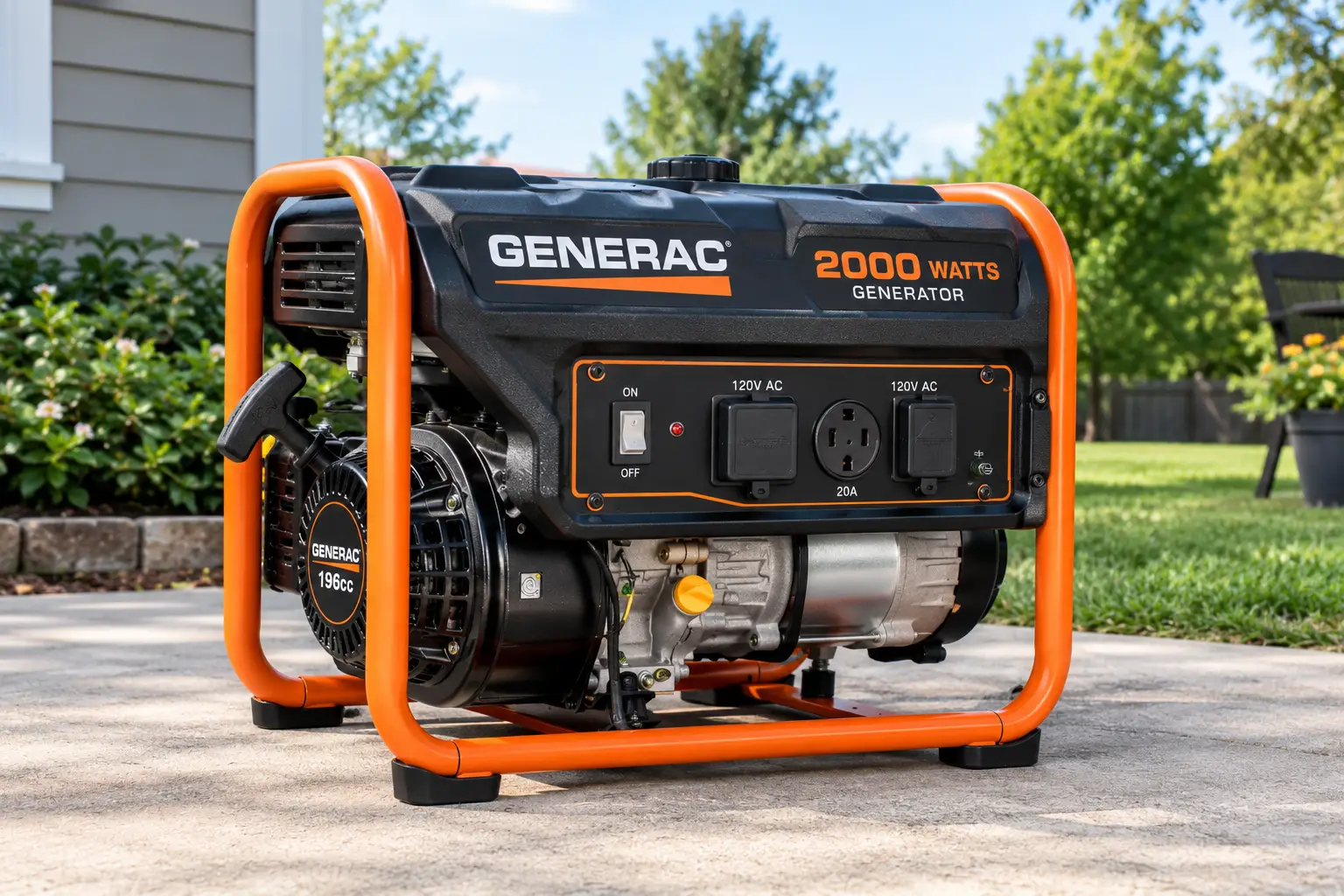
Here’s the short version. The original Generac 2000 generator most people remember, the Generac iQ2000, has been discontinued, and so has its successor, the GP2200i. Today, the closest thing Generac sells in that same compact, suitcase-style class is the Generac GP2500i, a slightly stronger inverter with COsense carbon monoxide shutdown. That shift matters, because it changes what you should compare, what you should pay, and which competitors deserve a seat at the table.
So this guide does three things. First, it explains what the Generac 2000 generator actually was and what replaced it. Second, it compares seven real, currently sold small inverter generators, including two Generac models and five strong rivals from Honda, Westinghouse, Champion, WEN, and Yamaha. Third, it gives you practical, buyer-side help: sizing your loads, starting a recoil engine without wrecking your shoulder, and staying safe from carbon monoxide.
Everything below is built from manufacturer spec sheets, owner’s manuals, and aggregated owner feedback. Nobody here is pretending to have run seven generators in a backyard. Instead, you get honest analysis of what the numbers mean for your campsite, tailgate, RV, or power outage. Ready? Let’s untangle this.
What Is a Generac 2000 Generator?
A Generac 2000 generator is a compact, gas-powered portable inverter generator from Generac that delivers about 2,000 starting watts of clean, low-distortion electricity. The name usually refers to the discontinued iQ2000; today, the GP2500i fills that lightweight, parallel-ready, camping-and-backup role with more power.
What makes these machines different from the big open-frame generators at the hardware store? An inverter generator produces raw AC power, converts it to DC, then electronically rebuilds it into a clean AC sine wave. If you want the engineering background, Wikipedia’s overview of the engine–generator explains the basic setup. In practice, that extra step does two useful things for you. It keeps total harmonic distortion (THD) low, usually under 3%, which is what laptops, phone chargers, CPAP machines, and modern TVs prefer. It also lets the engine throttle down when demand is light, which saves fuel and cuts noise.
That combination, clean power plus a quiet idle, is why the 2,000-watt class became the default “first generator” for campers, tailgaters, and apartment dwellers who need a few essentials running during an outage. A Generac 2000 watt generator isn’t meant to power your whole house. Rather, it’s meant to power the few things you truly can’t live without, quietly, for a long time, on about a gallon of gas.
Quick Comparison: Generac 2000 Generator and Top Alternatives
| Model | Running / Starting Watts | Weight | Runtime @ 25% Load | CO Shutoff | Best for |
|---|---|---|---|---|---|
| Generac GP2500i | 2,200 / 2,500 W | 48 lb | Up to 8 hrs | Yes (COsense) | Generac GP2500i: Generac fans who want the modern “2000” |
| Generac GP3300i | 2,500 / 3,300 W | 59.5 lb | Up to 7 hrs | Yes (COsense) | Generac GP3300i: small RVs and motor-heavy loads |
| Honda EU2200i | 1,800 / 2,200 W | ~47 lb | Up to 8.1 hrs | Yes (CO-MINDER) | Honda EU2200i: buyers who prioritize quiet and longevity |
| Westinghouse iGen2200c | 1,800 / 2,200 W | 47.4 lb | Up to 12 hrs | Yes | Westinghouse iGen2200c: long runtime on a budget |
| Champion 100692 | 1,700 / 2,000 W | 39 lb | Up to 11.5 hrs | Not advertised | Champion 100692: carrying it long distances |
| WEN 56203i | 1,700 / 2,000 W | 39 lb | Up to 10.8 hrs | Not advertised | WEN 56203i: lowest entry price |
| Yamaha EF2200iS | 1,800 / 2,200 W | 55.2 lb | Up to 10.5 hrs | Yes | Yamaha EF2200iS: RV owners wanting a built-in RV outlet |
Looking at the table, the Generac GP2500i quietly out-muscles most of the field on continuous power, with 2,200 running watts where the Honda EU2200i and Westinghouse iGen2200c stop at 1,800. On the other hand, the Westinghouse iGen2200c and Champion 100692 stretch a tank much further, which matters more than raw wattage if you’re running a fridge and a fan overnight. If weight is your dealbreaker, the Champion 100692 and WEN 56203i shave roughly 9 pounds off the Generac, a difference you’ll feel on every trip from the truck bed to the campsite.
💬 One click helps other shoppers make an informed choice too! 😊
Top 7 Picks: Expert Analysis of the Best Generac 2000 Generator Options and Rivals
1. Generac GP2500i — the modern Generac 2000 replacement
If you want a genuine Generac in the small inverter class today, the Generac GP2500i (model 8251 with COsense) is the direct heir to the old iQ2000. Its 98cc OHV engine produces 2,200 running and 2,500 starting watts, which means it can comfortably run a full-size refrigerator plus lights and phone charging, something a 1,600-watt iQ2000 had to strain for. The 1-gallon tank delivers up to 8 hours at 25% load, while Economy mode drops engine speed when demand is light.
Based on comparing the specs, this is the sweet spot for Generac loyalists: more continuous power than the Honda, CO shutdown included, and a price that undercuts the premium brands substantially. It’s best for weekend campers, tailgaters, and homeowners who want a light outage backup.
Owner reviews are genuinely mixed. Many buyers report quiet running and first- or second-pull starts, while a recurring complaint involves hard starting out of the box, sometimes traced by owners to a misadjusted choke cable. Some reviewers also criticize Generac’s parts and service support for small portables.
Pros:
- ✅ Highest running watts among the compact 2,000-class picks
- ✅ COsense automatic carbon monoxide shutdown built in
- ✅ Parallel-ready for doubling power with a second unit
Cons:
- ❌ Some owners report stubborn starts on a new unit
- ❌ Shorter runtime than Westinghouse or Champion on one tank
Expect it in roughly the $600–$750 range at the time of writing (check the current price), which is strong value for the wattage.
2. Generac GP3300i — extra surge for motors and small RVs
The Generac GP3300i (model 7153) is what you buy when a 2,000-class generator feels a little too tight. Its 149cc engine delivers 2,500 running and 3,300 starting watts, and Generac’s PowerRush technology is designed to provide over 50% more starting capacity. In plain terms, that’s the extra kick needed to start compressors, pumps, and smaller RV air conditioners without tripping the breaker.
Here’s what to weigh: you gain meaningful headroom, but you also gain about 11.5 pounds over the Generac GP2500i, landing at 59.5 pounds. Runtime is also modest for the class, with Generac’s manual listing 7 hours at 25% load and 4.5 hours at 50%. That makes it a better match for RV owners and DIYers than for backpack-to-campsite hauling.
We couldn’t verify a large body of owner reviews for this specific model. Editorial reviews, however, consistently frame it as a strong value-per-watt option, while flagging that its runtime trails the Honda.
Pros:
- ✅ PowerRush surge handles motor-driven loads better
- ✅ COsense carbon monoxide shutdown included
- ✅ Parallel kit can push combined output much higher
Cons:
- ❌ Heaviest Generac in this roundup at 59.5 pounds
- ❌ Below-average runtime per tank for its class
It typically sells in the $700–$850 range, prices may vary, and that’s good value if you genuinely need the surge.
3. Honda EU2200i — the benchmark for quiet and longevity
Nearly every 2026 roundup treats the Honda EU2200i as the yardstick, and the specs explain why. Honda’s commercial-grade GXR120 engine (121cc) produces 1,800 running and 2,200 starting watts, with a noise rating as low as 48 dBA at light load. For perspective, that’s quieter than most normal conversations, which is a big deal in campgrounds with quiet hours.
What the spec sheet doesn’t spell out, but owner feedback strongly suggests, is longevity. Honda’s engines have a long track record, and the company’s US dealer network makes parts and service easier to find than for many budget brands. The trade-off: a small 0.95-gallon tank limits runtime to about 8.1 hours at 25% load, and you’ll pay a significant premium.
Reviews consistently describe the Honda EU2200i as reliable and exceptionally quiet; the most common criticism is simply price. CO-MINDER automatic shutdown is standard on current units.
Pros:
- ✅ Among the quietest gas inverters in the class
- ✅ Proven engine durability and strong resale value
- ✅ Wide US dealer network for service and parts
Cons:
- ❌ Costs roughly double some capable rivals
- ❌ Small tank limits runtime versus competitors
It usually runs around $1,100–$1,300; check the current price. It’s worth it if you’ll run it for years.
4. Westinghouse iGen2200c — marathon runtime at a value price
The Westinghouse iGen2200c is the runtime champion of this group, rated for up to 12 hours at 25% load on a roughly 1.14-gallon tank. It produces 1,800 running and 2,200 starting watts from an 80cc engine, and the “c” in the name matters: it adds a CO sensor with automatic shutdown plus outlet covers, which the base Westinghouse iGen2200 lacks.
On paper, this means you can start it after dinner and still have power at breakfast without refueling, which is exactly what you want during an overnight outage. At 52 dBA and 47.4 pounds, it’s also neighbor-friendly and genuinely portable. Two household outlets and two USB ports cover most camping needs.
Aggregated reviews and editorial roundups consistently praise its runtime and value. Meanwhile, some reviewers note that build quality is a step below Honda and Yamaha, which may matter if you plan heavy, frequent use for many years.
Pros:
- ✅ Up to 12 hours of runtime on one tank
- ✅ CO sensor with automatic shutdown on the “c” model
- ✅ Three-year warranty with lifetime technical support
Cons:
- ❌ Long-term durability reputation trails the Japanese brands
- ❌ Lower continuous wattage than the Generac GP2500i
Expect around $500–$650 at the time of writing, excellent value for long, quiet runs.
5. Champion 100692 — lightest carry in the class
At roughly 39 pounds, the Champion 100692 is one of the lightest 2,000-watt inverters available, and that number changes how you’ll actually use it. Its 79cc engine produces 2,000 starting and 1,700 running watts, while a 1.1-gallon tank stretches to as much as 11.5 hours at 25% load.
Think about who benefits: someone hauling a generator down a trail to a tent site, an older buyer who struggles with 50-pound loads, or a tailgater crossing a parking lot. Nine pounds may not sound like much on a spec sheet, yet it’s the difference between carrying with one hand and needing two. Champion also includes a three-year warranty and lifetime technical support.
One honest caveat: Champion’s listings for this model advertise 53 dBA, but at least one retailer listing shows 58 dBA, so treat the noise figure as approximate. Reviews widely praise its weight and runtime. If you want CO shutdown, look at Champion’s dual fuel Champion 201230 variant, which adds CO Shield and propane capability.
Pros:
- ✅ About 39 pounds, easy one-handed carrying
- ✅ Up to 11.5 hours of runtime per tank
- ✅ Clip-on parallel kit option for extra power
Cons:
- ❌ CO shutdown isn’t advertised on this base model
- ❌ Lower running watts than Generac’s compact option
It typically sells in the $450–$600 range; prices may vary. That’s a smart buy for portability-first users.
6. WEN 56203i — budget pick that doesn’t sound cheap
The WEN 56203i proves you don’t need a premium badge to get a quiet inverter. Its 79cc engine delivers 1,700 running and 2,000 starting watts, it weighs around 39 pounds, and it’s rated as low as 51 dBA at quarter load. Its fuel shutoff feature also runs the carburetor dry before shutdown, which helps prevent gummed-up fuel passages during storage.
That fuel shutoff is more important than it sounds. Stale fuel in the carburetor is one of the most common reasons small generators won’t start after months in a garage, so this feature directly addresses the number-one failure point for occasional-use owners. Runtime reaches about 10.8 hours at 25% load on a 1-gallon tank.
Customer reviews frequently highlight how quiet it is for the money. However, one independent tester measured 53–54 dB on a windy day, slightly above the claim, which is a reminder that real-world conditions affect noise. CO shutdown is not advertised for this model.
Pros:
- ✅ Lowest typical entry price in this roundup
- ✅ Fuel shutoff helps protect the carburetor in storage
- ✅ Light and quiet for a budget inverter
Cons:
- ❌ No advertised carbon monoxide auto-shutdown
- ❌ Smaller service network than Honda or Generac
Expect roughly $400–$550 at the time of writing, which makes it outstanding value for occasional use.
7. Yamaha EF2200iS — RV-ready with a built-in TT-30 outlet
The Yamaha EF2200iS targets RV owners specifically. Unlike most rivals here, it includes a standard RV outlet, so you can plug in a 30-amp RV cord without hunting for an adapter. Its 79cc MZ80 engine delivers 1,800 running and 2,200 starting watts, and a 1.24-gallon tank yields up to 10.5 hours at quarter load.
Yamaha’s CO sensor was designed to meet the ANSI/PGMA G300-2018 standard; if it detects dangerous carbon monoxide levels, the engine shuts off and won’t restart for about five minutes. Practical touches like a fuel gauge and a three-point handle make it easier to live with day to day.
The trade-offs are real, though. At 55.2 pounds, it’s notably heavier than the Honda, and Yamaha’s own spec sheet lists 57–65 dBA, so it’s not the quietest choice. Reviews generally praise reliability and the RV outlet, while weight is the most common complaint.
Pros:
- ✅ Built-in RV outlet eliminates adapter hassles
- ✅ CO sensor shutdown with clear indicator lights
- ✅ Larger tank than the Honda EU2200i
Cons:
- ❌ Heaviest 2,200-watt unit in this roundup
- ❌ Louder rated noise than Honda or WEN
It’s usually priced around $950–$1,200; check the current price. Fair value for RV-focused owners.
Where Did the Generac iQ2000 and GP2200i Go?
If you’re specifically searching for the Generac iQ2000, here’s the honest picture. The Generac iQ2000 (model 6866) produced 1,600 running and 2,000 starting watts from a roughly 80cc engine, with a 1.06-gallon tank good for about 7.7 hours at 25% load and 5.7 hours at 50%. It was genuinely innovative for its time, offering a PowerDial start/run/stop control, a PowerBar wattage display, a fuel gauge, a runtime readout, and three operating modes (Economy, Standard, and Turbo). Retailers now list it as discontinued, and its Amazon listing shows it as currently unavailable.
Generac’s next small inverter, the GP2200i (model 7117), simplified things. It traded the fancy display for basic LED indicators and added a USB port, while keeping parallel capability and an 80cc engine with a 1.2-gallon tank rated for up to 10.75 hours at 25% load. It, too, is now discontinued.
What does this mean for you? First, if you find a “new” Generac iQ2000 for sale, verify the seller, the warranty status, and whether parts like the parallel kit are still obtainable. Second, used units can be a bargain, but a carburetor that sat with old fuel for years may need cleaning. Third, if you want a Generac inverter generator with a full warranty, the Generac GP2500i is the logical replacement, giving you more running watts and modern CO protection. The one thing you’ll miss is the iQ2000’s information-rich display, which, frankly, was ahead of its time.
Head-to-Head Specs: How the 7 Picks Really Compare
| Model | Engine | Tank | Noise (rated) | Outlets Highlight | Best for |
|---|---|---|---|---|---|
| Generac GP2500i | 98cc | 1.0 gal | Not consistently published | Duplex 5-20R, USB | Generac GP2500i: balanced Generac buy |
| Generac GP3300i | 149cc | ~1.06–1.14 gal | Not consistently published | Duplex, USB, parallel ports | Generac GP3300i: surge-heavy loads |
| Honda EU2200i | 121cc | 0.95 gal | 48–57 dBA | Duplex 5-20R | Honda EU2200i: quietest operation |
| Westinghouse iGen2200c | 80cc | ~1.14 gal | 52 dBA | 2× 5-20R, 2× USB | Westinghouse iGen2200c: overnight runtime |
| Champion 100692 | 79cc | 1.1 gal | ~53 dBA | Duplex 5-20R, 12V DC | Champion 100692: lightest carry |
| WEN 56203i | 79cc | 1.0 gal | 51 dBA | 2× 5-20R, 12V DC, 2× USB | WEN 56203i: tight budgets |
| Yamaha EF2200iS | 79cc | 1.24 gal | 57–65 dBA | Duplex + RV outlet | Yamaha EF2200iS: RV plug-and-play |
Reading this table, notice how engine size predicts behavior. The Generac GP3300i‘s 149cc engine and the Honda EU2200i‘s 121cc unit explain their stronger surge and smoother handling under load, while the 79–80cc engines in the WEN 56203i, Champion 100692, and Westinghouse iGen2200c reward light loads with long runtime. Also note that noise ratings aren’t always measured identically across brands, so treat a 2–3 dB difference as a hint rather than a verdict.
How to Choose a Generac 2000 Watt Generator (or a Rival)
Choosing well comes down to matching specs to your real life. Follow these steps in order:
- List what you’ll actually run. Add up running watts for everything you’ll use at once. A fridge, a few LED lights, and phone chargers often land well under 1,000 watts running, which leaves useful headroom.
- Find your biggest starting surge. Motors (fridges, pumps, AC units) can briefly draw two to three times their running watts. That single number decides whether a 2,000-class unit is enough or you need the Generac GP3300i.
- Prioritize CO shutoff. For home backup especially, choose a model with automatic CO shutdown, such as the Generac GP2500i, Honda EU2200i, Westinghouse iGen2200c, or Yamaha EF2200iS.
- Decide how far you’ll carry it. If it travels often, the 39-pound Champion 100692 or WEN 56203i will be far kinder to your back.
- Check runtime at realistic load. Generac’s GP2500i owner’s manual is a good example of how runtime drops as load rises, and it also notes that available power decreases about 3.5% per 1,000 feet of altitude, a key detail for mountain campers.
- Confirm emissions compliance for your state. Some versions are 49-state models; if you live in California, look for CARB-compliant or 50-state versions.
- Think about parallel capability. If you might later need more power, a parallel-ready unit lets you add a second generator instead of replacing the first.
Getting Started: First Start, Break-In, and Maintenance
A new Generac portable generator, or any small inverter, rewards a careful first hour. Here’s a practical routine.
Before the first start
- ✅ Add oil first. Most units ship dry, and starting without oil can damage the engine instantly; low-oil shutdown is a backstop, not a strategy.
- ✅ Use fresh, stabilized gasoline. Fuel older than about 30 days without stabilizer is a common reason for hard starts.
- ✅ Place the generator outdoors on level ground, far from doors and windows (see the safety section below).
The recoil start technique
Owner reviews of the Generac GP2500i repeatedly mention hard first starts, and some describe a fix worth knowing: several slow, gentle pulls to draw fuel into the carburetor, followed by one firm, full pull. Use the choke on a cold engine, then open it once the engine settles. If a new unit refuses to start despite correct technique, contact the manufacturer rather than forcing it, because some owners traced the problem to a choke adjustment that warranty service can address.
Break-in and early maintenance
- ✅ Run light loads (under 50%) for the first few hours.
- ✅ Change the oil early, as your owner’s manual specifies, because initial oil collects metal particles from the new engine.
- ✅ Check the spark plug and air filter seasonally.
Storage habits that prevent headaches
- ✅ Either run the carburetor dry (the WEN 56203i automates this) or use fuel stabilizer.
- ✅ Start the generator monthly for 10–15 minutes under a light load.
- ✅ Store it covered, dry, and upright.
These habits sound basic, yet they prevent the vast majority of “it won’t start when the power goes out” stories.
⚡ Ready to power your next adventure or outage? Explore the picks above and check current pricing and availability today! 🔋
Real-World Scenarios: Which Generator Fits Your Life?
Specs are abstract, so let’s put them into real situations. These are illustrative buyer profiles, not personal stories.
Scenario 1: The weekend tent camper
Imagine a couple tent camping 8–10 weekends a year, running a small electric cooler, LED string lights, and phone and camera chargers. Their load rarely exceeds 300–400 watts, and they often walk the generator from a parking area to a walk-in site. The Champion 100692 or WEN 56203i makes the most sense here: light, quiet, and capable of running all night at low load. Budget: roughly $400–$600.
Scenario 2: The suburban homeowner preparing for outages
Picture a family in a storm-prone area wanting to keep a full-size refrigerator, a chest freezer (alternating), a few lights, a Wi-Fi router, and a CPAP running. Combined running loads near 1,000–1,500 watts with fridge surges justify the Generac GP2500i or Westinghouse iGen2200c. The Generac offers more running watts; the Westinghouse offers longer overnight runtime. Both include CO shutdown, which is non-negotiable near a home.
Scenario 3: The small-trailer RV owner
Consider someone with a 20-foot travel trailer and an 11,000–13,500 BTU rooftop AC who camps monthly at sites without hookups. A single 2,000-class unit may struggle with the AC’s startup surge. The Generac GP3300i‘s PowerRush surge, or the Yamaha EF2200iS with its built-in RV outlet (potentially paired in parallel), are the stronger fits. Budget: $700–$1,200+.
The pattern is clear: load and surge decide the wattage, while how you move and use the generator decides weight, noise, and runtime priorities.
Problem → Solution: Common Generac Inverter Generator Headaches
Even good generators have bad days. Here are frequent problems and practical fixes.
Problem 1: It won’t start after storage. Solution: Old fuel is the likely culprit. Drain stale gas, add fresh stabilized fuel, and prime with several slow pulls before a firm one. If it still won’t fire, a carburetor cleaning may be needed. Prevention is easier: the WEN 56203i‘s fuel shutoff and a monthly run on any model help a lot.
Problem 2: The overload light trips when the fridge kicks on. Solution: You’ve exceeded starting watts. Turn off other loads before the compressor cycles, or disable Economy mode so the engine is already spinning faster when the surge hits. If it happens constantly, step up to the Generac GP3300i or run two units in parallel.
Problem 3: The generator shuts off and won’t restart. Solution: If it has CO shutdown, the sensor may have tripped because exhaust was pooling, such as near a wall or under an awning. Move the unit to an open area, away from structures. Yamaha notes its unit stays off for about five minutes after a CO trip, and other brands behave similarly.
Problem 4: Power seems weaker in the mountains. Solution: That’s physics, not a defect. Output drops at altitude (Generac cites about 3.5% per 1,000 feet), so size up for high-elevation camping.
Problem 5: The neighbors complain about noise. Solution: Use Economy mode for steady light loads, point the exhaust away from people, and add distance. Each doubling of distance meaningfully reduces perceived noise.
Inverter Generator vs Conventional Portable Generator
| Factor | Inverter (e.g., Generac GP2500i) | Conventional open-frame | Best for |
|---|---|---|---|
| Power quality | Clean, typically under 3% THD | Often higher distortion | Inverter: sensitive electronics |
| Noise | Roughly 48–65 dBA | Often noticeably louder | Inverter: campgrounds, neighborhoods |
| Fuel use | Engine throttles to match load | Runs at a fixed speed | Inverter: long, light-load runs |
| Max power per dollar | Lower | Higher | Conventional: heavy whole-home backup |
| Weight | About 39–60 lb in this class | Often much heavier | Inverter: portability |
The table shows why the Generac 2000 generator category exists: inverters win on cleanliness, quiet, and fuel efficiency at light loads, which describes most camping and essentials-only backup. Conventional generators still win on raw watts per dollar, so if you need to run a well pump, a central AC, and an electric range at once, a larger conventional unit with a transfer switch is the more rational tool. For everything else, the inverter is the better daily companion.
In practice, many households end up owning both: a small inverter like the Westinghouse iGen2200c for camping and quiet overnight duty, plus a larger generator for major storms. If you can only buy one and your needs are modest, start with the inverter.
Safety, Regulations, and Standards
This is the section that genuinely matters most. Portable generators produce carbon monoxide, a colorless, odorless gas that can kill in minutes. According to the CPSC’s proposed portable generator rule published in the Federal Register, generator-related CO poisoning averaged about 85 deaths per year in the United States across 2017–2019.
What the safety standards mean for your purchase
Two voluntary standards come up repeatedly: ANSI/PGMA G300-2018 and UL 2201. Both involve CO-related protections, and the CPSC has publicly encouraged consumers to look for generators with a CO shut-off feature. Among our picks, the Generac GP2500i and Generac GP3300i (COsense), Honda EU2200i (CO-MINDER), Westinghouse iGen2200c, and Yamaha EF2200iS advertise automatic CO shutdown. The Champion 100692 and WEN 56203i listings don’t advertise it, which is the single biggest reason to think twice before choosing them for home backup.
Non-negotiable placement rules
The CPSC’s 2026 winter weather safety guidance is clear: never run a generator inside a home, garage, basement, crawlspace, or shed, keep it at least 20 feet from the house, and direct exhaust away from doors and windows. Don’t run it on a porch or in a carport either. A CO sensor is a safety net, not permission to break these rules.
Electrical and emissions rules
- ✅ Never “backfeed” by plugging a generator into a wall outlet; it can endanger utility workers. Use a properly installed transfer switch or extension cords.
- ✅ Use outdoor-rated, adequately sized extension cords.
- ✅ In California, buy CARB-compliant (50-state) versions; some models are sold in 49-state configurations.
Finally, install battery-powered CO alarms inside your home. That inexpensive layer protects you even if something goes wrong outside.
Long-Term Cost and Maintenance
| Model | Typical Price Range | Runtime @ 25% | Ownership Notes | Best for |
|---|---|---|---|---|
| WEN 56203i | ~$400–$550 | ~10.8 hrs | Fuel shutoff reduces carb issues | WEN 56203i: lowest upfront cost |
| Champion 100692 | ~$450–$600 | ~11.5 hrs | Lifetime tech support | Champion 100692: value plus portability |
| Westinghouse iGen2200c | ~$500–$650 | ~12 hrs | Best fuel economy in group | Westinghouse iGen2200c: lowest fuel cost per hour |
| Generac GP2500i | ~$600–$750 | ~8 hrs | Mixed service reviews | Generac GP2500i: most watts per dollar |
| Honda EU2200i | ~$1,100–$1,300 | ~8.1 hrs | Strong resale, dealer support | Honda EU2200i: lowest long-term risk |
The real cost of a generator isn’t the sticker price; it’s purchase price plus fuel, oil, spark plugs, and any repairs, minus resale value. A long-runtime unit like the Westinghouse iGen2200c saves fuel on every overnight run, while the Honda EU2200i‘s high resale value can narrow its premium if you sell it in five or eight years. The Generac GP2500i sits in the middle, delivering the most running watts per dollar, though occasional reviews about parts support suggest budgeting for possible service time.
Routine maintenance is inexpensive across all seven: small amounts of oil (often well under a quart per change), periodic spark plugs, and an air filter. The expensive repair, by far, is a carburetor rebuild caused by stale fuel, which good storage habits almost entirely prevent. In other words, your habits have more influence on lifetime cost than the brand you choose.
Features That Actually Matter (and Ones That Don’t)
Marketing pages list dozens of features. Here’s an honest filter.
Features that matter
- ✅ CO shutdown: It addresses the leading cause of generator deaths. For home use, treat it as essential.
- ✅ Running watts (not just starting watts): Running watts determine what you can power continuously. The Generac GP2500i‘s 2,200 running watts are more meaningful than a big starting number.
- ✅ Runtime at 25% and 50% load: These tell you how often you’ll refuel in real use.
- ✅ Parallel capability: It offers an affordable upgrade path.
- ✅ Fuel shutoff or easy carb draining: It prevents the most common failure.
Features that matter less than you’d think
- ❌ Peak watts as a headline number: A model marketed as “2,500 watts” may run continuously at 2,200; always read both figures.
- ❌ Fancy displays: The old Generac iQ2000’s PowerBar was nice, but basic LED indicators do the essential job.
- ❌ Tiny noise differences: A 1–2 dBA gap between brands, measured under different conditions, is rarely noticeable in a campground.
Situational features
The Yamaha EF2200iS‘s RV outlet is a big deal if you tow a trailer and irrelevant if you don’t. Likewise, dual fuel (as on the Champion 201230 variant) is excellent for long outages when gasoline is scarce, but unnecessary for casual tailgating.
Common Mistakes to Avoid When Buying a Generac Portable Generator
Even savvy shoppers trip over the same issues. Avoid these:
- Buying by the model number’s headline wattage. The GP2500i’s “2500” is starting watts; its continuous output is 2,200. The iQ2000’s continuous output was only 1,600.
- Ignoring motor surge. A fridge or RV AC can need two to three times its running watts to start. Undersizing leads to tripped breakers and frustration.
- Skipping CO protection to save money. The savings are small compared with the risk, especially for home backup.
- Buying a discontinued “new” unit without checking warranty. Discontinued Generac iQ2000 listings may lack warranty coverage or parts availability.
- Forgetting state emissions rules. California buyers should verify CARB compliance before ordering.
- Underestimating weight. A 55- or 60-pound generator is manageable in a garage but tiring to carry across a campground.
- Never testing it before an emergency. The worst time to discover a gummed-up carburetor is during a storm. Run it monthly.
Avoiding these mistakes matters more than choosing between two otherwise excellent models.
FAQ: Generac 2000 Generator
❓ Is the Generac iQ2000 still sold new?
❓ Can a Generac 2000 watt generator run a refrigerator?
❓ Is the Generac GP2500i worth buying over a Honda EU2200i?
❓ Can I run a Generac inverter generator in the rain?
❓ Can two Generac GP2500i generators be connected?
Conclusion: Choosing the Right Generac 2000 Generator for You
The Generac 2000 generator you remember has evolved. The Generac iQ2000 and GP2200i are gone, and the Generac GP2500i now carries the torch with more continuous power and built-in COsense protection. For most Generac fans, that’s the clear starting point: it delivers the most running watts per dollar in the compact class.
That said, the best choice depends on how you’ll actually use it. If silence and decades of reliability matter most, the Honda EU2200i remains the benchmark. If you want all-night runtime at a fair price, the Westinghouse iGen2200c is hard to beat. Need to carry it far? The Champion 100692 and WEN 56203i are the lightest options. RV owners should look closely at the Yamaha EF2200iS for its built-in RV outlet, or the Generac GP3300i for extra surge capacity.
Whatever you choose, make three decisions deliberately: size for your largest starting surge, prioritize automatic CO shutdown for home use, and commit to simple storage habits. Do that, and your generator will start when you need it, run quietly, and keep the people around you safe.
✨ Don’t miss these top-rated picks!
🔍 Take your camping, tailgating, and outage preparedness to the next level with this carefully curated lineup. Click a highlighted item to check current pricing and availability. These picks will help you keep the lights on and the coffee brewing, the whole family will thank you!
Recommended for You
- Franklin Battery Price 2026: 7 Smart Home Backup Picks Compared
- Solar Power Electric Bike: 7 Best Picks That Actually Work (2026)
- DIY Home Battery Backup: 7 Essential Products for a Reliable Power System
Disclaimer: This post contains affiliate links. As an Amazon Associate, I earn from qualifying purchases made through these links, at no additional cost to you.
✨ Found this article helpful? Share it with someone who needs it! 💬🤗
