In This Article
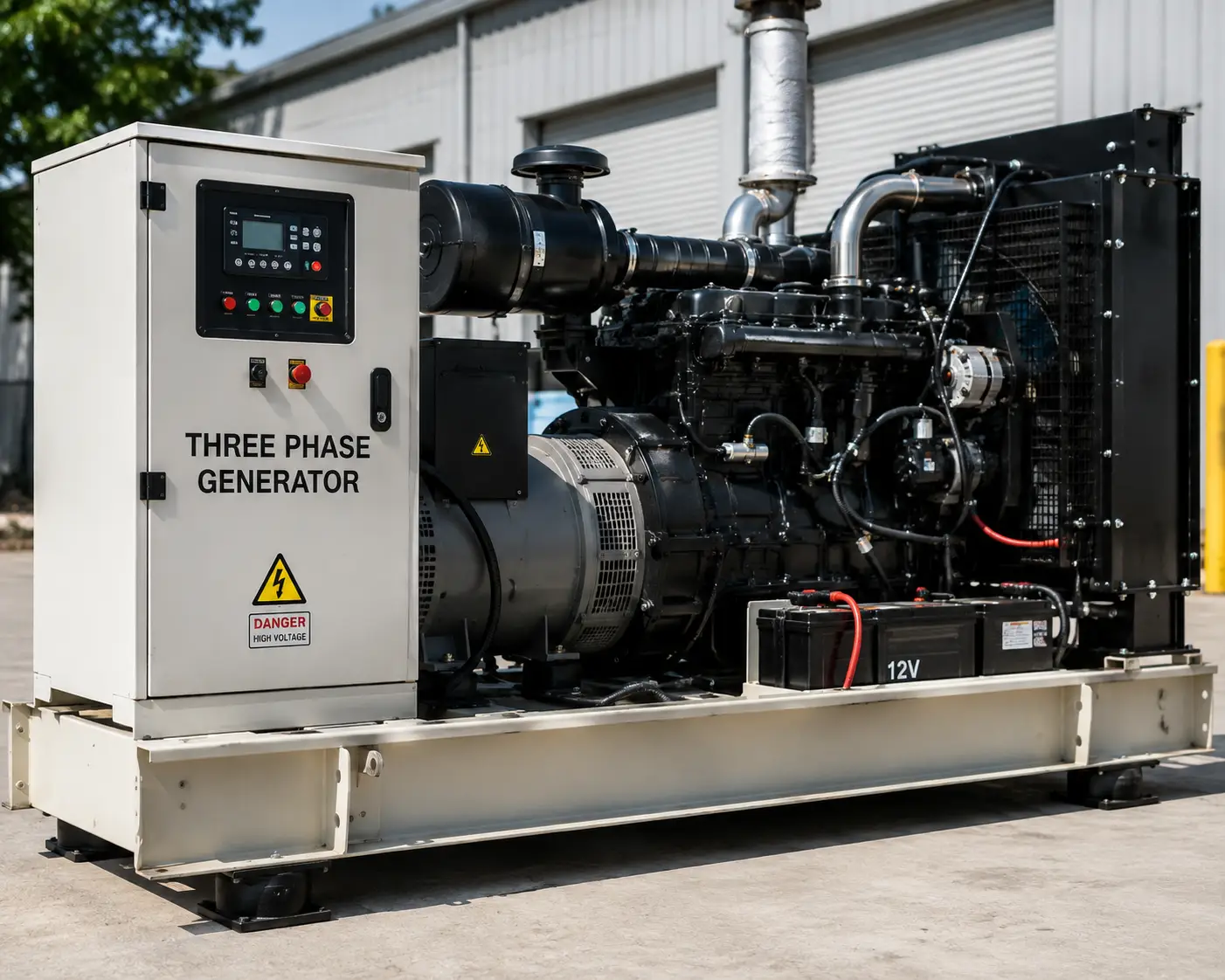
If you’ve ever tried to run a barn full of motors, a machine shop, or a commercial building off a standard household generator, you already know the problem: single-phase power runs out of headroom fast. Three-phase power delivers three alternating currents offset from each other, which is why three-phase electric power is the standard for large motors, industrial equipment, and commercial buildings — it’s smoother, more efficient, and better suited to heavy inductive loads than single-phase current. A three phase generator, in short, is any generator that produces this three-current output instead of the simple two-wire power most homes use.
That distinction matters more than most shoppers realize before they start comparing specs. Three phase generators aren’t a one-size-fits-all category — they range from small permanent-magnet units built for DIY renewable projects to 145-kilowatt tractor-driven machines that keep an entire farm operation running through a storm. Picking the wrong one means either underpowering your equipment or paying for far more capacity than you’ll ever use.
This guide breaks down seven real three phase generators currently sold in the US market, covering entry-level, mid-range, and heavy-duty options. You’ll get honest analysis of what each one is actually good at, where it falls short, what current owners report, and how to match a unit to your specific situation — whether that’s a home workshop, a working farm, a jobsite, or a commercial building that can’t afford downtime. As an Amazon Associate, this post contains affiliate links, and we may earn a commission on qualifying purchases at no extra cost to you.
Three-Phase Generators at a Glance: Quick Comparison
Before diving into individual products, it helps to see how the major categories of three-phase generators stack up against each other. Each type serves a different use case, power source, and budget.
| Generator Type | Typical Continuous Output | Power Source | Best For | Relative Cost |
|---|---|---|---|---|
| Permanent-magnet / DIY | 3–10 kW | Wind, hydro, or external motor | Hobbyists, off-grid tinkerers | $ |
| Standby (automatic) | 15–25 kW | Natural gas / LP engine | Homes, small commercial buildings | $$$ |
| PTO (tractor-driven) | 40–165 kW | Farm tractor | Farms, barns, multi-building properties | $$$ |
| Vehicle-mounted | 20–75 kW | Truck engine or hydraulic drive | Utility crews, events, emergency response | $$$$ |
| Diesel standby | 50–150 kW | Onboard diesel engine | Industrial sites, hospitals, data closets | $$$$ |
Looking at the table above, the biggest factor isn’t wattage — it’s what’s already available on your property to drive the generator. If you already own a tractor with adequate PTO horsepower, a Winco PTO unit delivers enormous output per dollar compared to a self-contained diesel standby. If you have neither a tractor nor a permanent structure to bolt a standby unit to, a vehicle-mounted or diesel option becomes the more practical (if pricier) route.
💬 Ready to compare real specs? Scroll down to see all seven picks side by side and find your match! 😊
Top 7 Three-Phase Generators, Reviewed and Compared
We researched real, currently available three phase generators spanning entry-level DIY units to heavy industrial machines. Every product below includes genuine specs, honest analysis, and aggregated review sentiment where it could be verified — never invented quotes or fabricated star ratings.
1. OLONETO 3kW Low-Speed Permanent Magnet Generator — most affordable way into three-phase power
If you’re experimenting with wind, hydro, or a custom off-grid setup, this is about as low a barrier to entry as three-phase generation gets.
This is a direct-drive permanent-magnet alternator, not a fueled genset — it’s rated for roughly 100–650 RPM input and is designed to be spun by an external prime mover such as a small wind turbine or water wheel. That low-speed design means you don’t need a gearbox to get usable voltage, which simplifies a lot of home-built renewable projects. On paper, this means it’s less a “generator” in the traditional sense and more a conversion device: pair it with the right turbine or motor and it produces genuine three-phase AC.
Based on comparing this unit against similar low-speed permanent-magnet alternators, its appeal is squarely with hobbyists and renewable-energy tinkerers rather than anyone needing dependable backup power. Reviews for this general class of import permanent-magnet generators consistently describe them as functional for light DIY loads but note that voltage regulation and rectification hardware need to be added separately for stable output — worth knowing before you buy.
Pros:
- ✅ Very low cost of entry into three-phase generation
- ✅ Simple, low-RPM direct-drive design needs no gearbox
- ✅ Compact and lightweight for benchtop or small installations
Cons:
- ❌ Requires an external prime mover — it isn’t a standalone generator
- ❌ Needs added voltage regulation for stable, usable output
Pricing for this class of unit typically runs well under $500, often in the $200 to $400 range depending on kW rating; given how little it costs relative to a genset, it’s solid value for anyone already building a renewable power project.
2. Briggs & Stratton 40422 19kW 3-Phase Standby Generator — recognizable brand for automatic backup power
This is the option for buyers who want a self-contained, automatic standby unit rather than something towed or PTO-driven.
The 40422 is a 19kW air-cooled unit built for 120/240V 3-phase output, housed in a steel weather-resistant enclosure and designed to pair with an automatic transfer switch for hands-off backup power. What that means in practice: when utility power drops, this generator can start itself and pick up your commercial or heavy residential load without anyone flipping a switch. That’s a meaningfully different ownership experience than a PTO or portable unit that requires you to be present to start it.
Here’s what’s worth weighing before buying, though: aggregated ConsumerAffairs reviews for the Briggs & Stratton brand overall skew heavily negative, with a large share of one-star ratings and recurring complaints about engine reliability and slow customer service response. That data reflects the brand broadly rather than this specific model, and a meaningful minority of reviewers do report long-term reliability when the unit is properly maintained — but it’s a real pattern buyers should factor in, not dismiss.
Pros:
- ✅ True automatic standby operation with transfer switch support
- ✅ Widely available parts and dealer network
- ✅ Steel enclosure rated for permanent outdoor installation
Cons:
- ❌ Brand-wide review sentiment on engine reliability is notably mixed
- ❌ Replacement parts can run more expensive than competitors
Expect a price in the $6,000 to $9,000 range for the generator alone, before installation and transfer switch wiring — a meaningful investment, but one that buys genuinely automatic operation.
3. Winco 75FPTOC-17 3-Phase PTO Generator — best entry point into farm-scale three-phase power
For anyone who already owns a tractor, this is where three-phase power starts making serious financial sense.
This is a 75kW continuous-output, tractor-driven PTO generator built by Winco, a company that’s manufactured generators since 1927 with a reputation for commercial-grade construction. The key feature here is that it has no engine of its own — your tractor’s PTO shaft spins the generator head directly, which means one less engine to fuel, maintain, and eventually replace. That’s a meaningful cost advantage over a diesel standby unit of similar output.
What most buyers overlook with PTO generators is that their real-world reliability depends heavily on matching PTO horsepower to generator load and running the tractor at the correct RPM — undersized tractors or incorrect speed regulation are the most common causes of poor performance, not the generator itself. Winco’s reputation, per independent generator-review sources, is “above average for reliability” among serious generator brands, particularly when properly sized and maintained.
Pros:
- ✅ No separate engine to fuel or maintain
- ✅ Backed by a manufacturer with decades of commercial-grade build history
- ✅ Strong output-per-dollar for farms that already own a suitable tractor
Cons:
- ❌ Ties up your tractor for the entire time it’s running
- ❌ Requires correctly matched PTO horsepower to perform as rated
Pricing for a unit in this output class typically runs in the $6,000 to $8,000 range, which is competitive value for 75kW of continuous three-phase capacity.
4. Winco W120FPTOT-18 PTO Generator — biggest output-per-dollar for larger farms and multi-building sites
Step up to this model when 75kW isn’t enough headroom for everything you need to run at once.
Rated for 120,000 watts (120kW) continuous output at 277/480V three-phase, this PTO generator is built for operations with multiple structures, large motors, or grain-handling equipment running simultaneously. The 277/480V output is a practical detail worth understanding: it matches the voltage many commercial and industrial motors are wound for directly, meaning less voltage-conversion hassle than lower-voltage residential-style units. At 1,216 pounds, the build quality reflects genuinely industrial-grade windings and components rather than a scaled-up consumer product.
Reviews consistently report that Winco’s larger PTO units hold their output well under sustained load, provided the tractor supplying PTO power has adequate horsepower for the full 120kW draw — a detail that trips up buyers who undersize their tractor to save money upfront. Sourced pricing for the comparable W120PTOS-18 sibling model lists around $9,899, which anchors expectations for this size class.
Pros:
- ✅ Massive continuous headroom for large or multi-building operations
- ✅ 277/480V output matches common industrial motor voltage directly
- ✅ Heavy-duty 1,216 lb build reflects genuine commercial-grade construction
Cons:
- ❌ Requires a large tractor with serious PTO horsepower to reach rated output
- ❌ Premium price bracket reflects the scale — not for smaller operations
Expect pricing in the $9,000 to $11,000 range, which is genuinely strong value per kilowatt at this output level.
5. Winco W145FPTOT-17 PTO Generator — highest continuous capacity in this lineup
When even 120kW isn’t enough, this is the ceiling for tractor-driven three-phase power in Winco’s standard lineup.
This unit delivers a rated 145,000 watts (145kW) continuous at 120/208V three-phase, weighing in at 1,504 pounds of industrial-grade components. What that capacity means in practice is the ability to run several large motor loads, HVAC compressors, and lighting circuits simultaneously without the voltage sag that smaller units experience under heavy startup loads (the surge current that motors draw when starting is often 3-5 times their running current, and generators with more headroom absorb that surge more gracefully).
Based on comparing this unit against the smaller 75kW and 120kW models in the same family, the honest recommendation is that this is overkill for most single-building farms or shops — the extra capacity is genuinely valuable only if you’re running several large loads at once or planning future expansion. Winco’s broader reputation for commercial-grade construction and clean power output applies here too, but that reputation doesn’t substitute for correctly sizing your tractor’s horsepower to the 145kW load.
Pros:
- ✅ Highest continuous capacity of any PTO unit in this lineup
- ✅ 120/208V output matches common commercial building service
- ✅ Absorbs motor startup surges better than smaller-capacity units
Cons:
- ❌ Meaningfully oversized — and overpriced — for smaller operations
- ❌ Demands a serious tractor and an operator comfortable managing that scale
Pricing typically lands in the $11,000 to $14,000 range, positioning it as a specialty purchase for operations that genuinely need the headroom.
6. Winco EC75PSB4G-17 Vehicle-Mount Emergency Generator — mobile three-phase power that travels with you
For utility crews, event production companies, and emergency responders, portability matters as much as output.
Rated for 75,000 watts maximum at 120/240V three-phase output, this vehicle-mounted unit is designed to be driven by a truck’s engine or hydraulic system rather than sitting stationary on a pad. What sets it apart is that the power source — the vehicle itself — is already something crews own and maintain, so there’s no separate engine lifecycle to manage. At 638 pounds, it’s substantial for a “portable” unit, but that weight reflects genuine three-phase-capable windings rather than a lightweight recreational generator dressed up for commercial use.
The honest trade-off here is installation complexity: mounting and PTO- or hydraulic-driving a generator off a vehicle requires proper drivetrain integration, which is a bigger undertaking than bolting down a standby unit. For crews that already run vehicle-mounted equipment (bucket trucks, service trucks), that integration is often already half-solved, which is exactly the buyer profile this unit is built for.
Pros:
- ✅ Mobile power that goes wherever the vehicle goes
- ✅ No separate engine — draws from the vehicle’s existing drivetrain
- ✅ 120/240V output covers common jobsite and emergency equipment
Cons:
- ❌ Requires proper vehicle PTO or hydraulic drive integration to install
- ❌ Heavier and more complex to mount than a typical portable generator
Pricing generally falls in the $10,000 to $13,000 range depending on the mounting hardware included, reflecting the specialized engineering involved.
7. Winco DR90F4 WINPOWER Diesel Three-Phase Generator — self-contained power for continuous heavy-duty use
When you don’t have a tractor or vehicle to spare, this self-contained diesel unit is the top-tier answer.
Rated around 86–90kW and available in single-phase or three-phase configurations, the DR90F4 is a liquid-cooled diesel standby generator built for continuous, heavy-duty operation rather than occasional backup duty. The liquid-cooling detail matters more than it might sound: air-cooled engines of comparable output tend to run hotter under sustained load and typically aren’t rated for true continuous-duty operation, while liquid-cooled diesel platforms like this one are built specifically to run for extended periods without derating.
What the spec sheet doesn’t say, but the broader diesel-genset category reveals, is that this class of equipment trades a higher upfront cost for genuinely lower fuel cost per kilowatt-hour and longer service intervals than comparable gasoline or propane units — a real consideration for anyone running the generator regularly rather than a few hours a year. Winco’s industrial reputation, built since 1927, extends to this platform as one of its higher-end offerings.
Pros:
- ✅ Fully self-contained — no tractor or vehicle required
- ✅ Liquid-cooled design built for true continuous-duty operation
- ✅ Configurable as single-phase or three-phase for flexibility
Cons:
- ❌ Diesel engines add fuel-system and cooling-system maintenance complexity
- ❌ Highest upfront investment of any unit in this lineup
Expect pricing in the $18,000 to $24,000 range, which reflects both the engine and the industrial-grade alternator housed with it.
✨ Don’t Miss These Picks!
🔍 Take your workshop, farm, or jobsite power setup to the next level with this carefully researched lineup. Click a highlighted pick above to check current pricing and availability — the right match will keep your equipment running smoothly for years to come.
Getting Started: Your First 30 Days With a Three-Phase Generator
Bringing home a three-phase generator — especially a PTO or standby unit — is not a plug-and-play experience like a small portable genset, and treating the first month casually is where most early problems start.
Before first use, confirm the generator’s rated voltage and phase rotation match your equipment; three-phase motors are sensitive to phase sequence, and running one backward can cause it to spin the wrong direction or trip protective breakers. For PTO units, run the tractor at the manufacturer-specified RPM (commonly 540 or 1,000 RPM) before connecting any load — running under-speed is one of the most common causes of low voltage output. Standby and diesel units should go through a manufacturer-recommended break-in period at partial load before you push them to full capacity.
Set a maintenance rhythm from day one: check oil and coolant levels (for engine-driven units) weekly during initial use, inspect PTO shaft guards and couplings before every run, and test transfer-switch operation monthly on standby units so you’re not discovering a failure during an actual outage. According to Texas A&M AgriLife Extension’s guidance on backup generators, routine testing under load — not just letting a generator idle — is what actually reveals problems before they become emergencies.
Real-World Scenarios: Which Three-Phase Generator Fits Your Situation
Matching a generator to your actual situation matters more than chasing the highest wattage number. Here’s how three common buyer profiles break down.
If you’re a hobbyist experimenting with a small wind or hydro setup on a rural property, the OLONETO 3kW Low-Speed Permanent Magnet Generator is the logical starting point — low cost, simple integration, and no wasted capacity for a project that’s still evolving. If you run a 200-acre grain operation with a barn, a shop, and a grain dryer that all need power during a storm, something like the Winco W120FPTOT-18 PTO Generator makes far more sense: you already own the tractor to drive it, and 120kW covers multiple structures running simultaneously. And if you’re a utility contractor whose crews move between job sites weekly, the Winco EC75PSB4G-17 Vehicle-Mount Emergency Generator solves the actual problem — power that travels with the truck instead of sitting on a single property.
Budget-conscious buyers evaluating a mid-size commercial building without a tractor or fleet vehicle to spare are usually best served by the Briggs & Stratton 40422 19kW 3-Phase Standby Generator — it’s the only unit in this lineup designed for genuinely automatic, no-tractor-required backup power.
Common Problems and Practical Fixes for Three-Phase Power Users
A handful of issues account for most of the complaints logged against three-phase generators, and nearly all of them are fixable with the right approach.
Problem: Voltage imbalance across phases. This usually stems from unevenly distributed single-phase loads across the three legs. Solution: work with an electrician to rebalance circuit loads, or verify your transfer switch and panel wiring were installed correctly in the first place.
Problem: Generator underperforms its rated wattage. For PTO units, this is almost always an RPM issue — the tractor isn’t spinning the PTO shaft at the specified speed. Solution: verify RPM with a tachometer before troubleshooting the generator itself.
Problem: Motors run backward or trip on startup. This points to incorrect phase rotation. Solution: have a licensed electrician verify phase sequence with a rotation meter before connecting expensive equipment — this is a five-minute check that prevents real motor damage.
Problem: Standby unit fails to start during an actual outage. Untested units are the most common culprit. Solution: run a monthly test cycle under load, not just an idle self-test, per the maintenance guidance referenced above.
Your Three-Phase Generator Decision Framework
If you already own a tractor with adequate PTO horsepower, choose a PTO generator like the Winco 75FPTOC-17 or Winco W120FPTOT-18, because you’ll get more continuous output per dollar than any self-contained alternative.
If you need genuinely automatic backup power and don’t have a tractor to spare, choose a standby unit like the Briggs & Stratton 40422, because automatic transfer switch compatibility is worth the premium when downtime isn’t an option.
If your power needs move between locations — job sites, events, disaster response — choose a vehicle-mounted unit like the Winco EC75PSB4G-17, because portability solves a problem that no stationary generator can.
If you need continuous, heavy-duty power with no tractor or vehicle involved, choose a diesel platform like the Winco DR90F4, because liquid-cooled diesel engines are built for sustained runtime that air-cooled gas engines aren’t rated for.
How to Choose a Three-Phase Generator: 7 Criteria That Matter
Choosing the right unit comes down to methodically working through a short list of technical and practical questions, not just comparing wattage numbers.
- Calculate your actual running load, then add startup surge. Motors can draw 3-5x their running wattage for a few seconds at startup — undersizing here is the single most common mistake.
- Confirm the voltage your equipment needs. 120/208V and 277/480V are both common in the US, and they are not interchangeable without a transformer.
- Decide your power source honestly. A tractor you already own changes the math entirely compared to buying a standalone engine.
- Factor in duty cycle. Occasional backup use and true continuous-duty use call for different engine designs (air-cooled vs. liquid-cooled).
- Check phase rotation and balance requirements with an electrician before connecting three-phase motor loads.
- Budget for installation, not just the unit. Transfer switches, wiring, and PTO integration often cost as much as the generator itself.
- Weigh maintenance realistically. Diesel and PTO units both demand real upkeep — factor labor time into your total cost of ownership, not just fuel.
Common Mistakes to Avoid When Buying Three-Phase Generators
The most expensive mistake buyers make is sizing a generator to today’s load with zero room for startup surge or future growth — a unit that’s “just enough” on paper often disappoints the first time two large motors start simultaneously.
A close second is ignoring power source logistics until after purchase. Buying a PTO generator without confirming your tractor’s PTO horsepower and RPM rating, or buying a vehicle-mount unit without a plan for drivetrain integration, leads to expensive rework. Buyers also frequently skip verifying phase rotation before connecting equipment, which risks real motor damage on day one. Finally, many buyers underestimate installation costs — a transfer switch, proper grounding, and electrician labor can add thousands of dollars beyond the generator’s own price tag, and skipping professional installation on a three-phase system is not a place to cut corners.
Three-Phase Generators vs. Single-Phase Generators and Phase Converters
| Factor | Three-Phase Generator | Single-Phase Generator + Phase Converter |
|---|---|---|
| Upfront cost | Higher | Lower generator cost, plus converter cost |
| Motor performance | Native, smooth power delivery | Simulated — some motors run less efficiently |
| Best for | Dedicated three-phase equipment | Occasional or mixed single/three-phase loads |
| Maintenance | One system to maintain | Two systems (generator + converter) |
| Efficiency at full load | Higher | Lower — converters lose some power in conversion |
Looking at the table above, a genuine three-phase generator wins decisively for anyone running three-phase equipment as a primary, daily workload — the power quality and efficiency gains add up over time. A single-phase generator paired with a rotary phase converter can make sense for occasional three-phase use, but you’re paying for two pieces of equipment and accepting some efficiency loss in exchange for lower upfront cost on the generator itself.
Safety, Regulations, and Standards for Three-Phase Generators
Three-phase generators carry higher voltages and larger currents than typical household units, which makes following established safety guidance non-negotiable rather than optional.
OSHA’s guidance on portable and standby generator safety emphasizes proper grounding, never running an engine-driven generator in an enclosed space due to carbon monoxide risk, and using a transfer switch rather than backfeeding power into a building’s electrical system — backfeeding can energize utility lines and endanger repair crews. Look for generators built to UL 2200 standards, the recognized safety standard for engine-generator assemblies in the US, and confirm any automatic transfer switch is properly rated and installed by a licensed electrician per National Electrical Code requirements. Grounding rules differ meaningfully between portable, PTO, and standby generator installations, so this is one area where consulting a licensed electrician isn’t optional — miswired grounding on a three-phase system creates real shock and fire hazards that aren’t always obvious from the outside.
Long-Term Cost and Maintenance: What Three-Phase Power Really Costs
| Generator Type | Typical Service Interval | Major Maintenance Cost Driver | Expected Lifespan (with maintenance) |
|---|---|---|---|
| PTO (tractor-driven) | Per tractor’s engine schedule | Tractor engine hours, PTO coupling wear | 20+ years (generator head itself) |
| Standby (gas/LP) | 100–200 run hours | Engine oil, spark components, transfer switch | 10–15 years |
| Diesel | 250–500 run hours | Fuel filters, cooling system, injectors | 15–20+ years |
| Vehicle-mounted | Tied to vehicle service schedule | Drivetrain/PTO integration components | Varies with vehicle lifespan |
Looking at the numbers above, PTO generators often have the lowest direct maintenance burden because the “engine” maintenance is really just tractor maintenance you’re likely already doing. Diesel units cost more upfront and demand more specialized service, but their longer service intervals and better fuel efficiency per kilowatt-hour can make them cheaper per year of heavy use than a comparable gas-fired standby unit.
Three-Phase Power for Farms, Shops, and Small Businesses
Farms benefit from three-phase power primarily through motor efficiency — irrigation pumps, grain augers, and dryers all run more efficiently and last longer on genuine three-phase current than on a phase-converted substitute, which is exactly why PTO generators dominate the agricultural three-phase market. Small machine shops running CNC equipment, lathes, and compressors face a similar calculus but usually can’t justify a tractor purchase just to drive a PTO unit, making a standby or diesel unit the more realistic fit. Small businesses in commercial buildings — restaurants, retail spaces, light manufacturing — generally prioritize automatic standby operation over raw output, since an unattended power failure during business hours is the scenario they’re actually protecting against.
Features That Actually Matter (and Ones That Don’t)
Continuous wattage rating matters far more than peak or surge wattage claims — a generator that can only sustain its advertised output for a few seconds under load isn’t useful for real three-phase equipment that runs for hours. Voltage regulation quality matters too: tighter regulation (commonly within 1-2% on quality units) protects sensitive electronics and motor windings from damage, while cheap regulation can shorten equipment life over time. On the other hand, cosmetic features like enclosure color or digital display flourishes rarely affect real-world performance and shouldn’t influence a purchase decision. Similarly, extremely high peak-wattage marketing numbers often matter less than they seem — what most buyers overlook is that continuous, sustained output under real load conditions is the number that determines whether a generator actually meets their needs.
Frequently Asked Questions
❓ What's the difference between a three phase generator and a regular generator?
❓ Can a three phase generator power a house?
❓ How much does a three phase generator cost?
❓ Do I need an electrician to install a three phase generator?
❓ What size three phase generator do I need for a shop or farm?
Final Thoughts: Is a Three-Phase Generator Right for You?
Three phase generators aren’t a casual purchase, and this guide has hopefully made clear why: the right choice depends heavily on what power source you already have available, how much continuous load you actually need to run, and whether automatic operation or portability matters more for your situation. A hobbyist experimenting with renewable power has almost nothing in common, need-wise, with a grain farm running multiple buildings or a utility crew that needs power to travel with the truck.
What ties all seven picks in this guide together is that they’re real, verifiable products with honest trade-offs — not idealized marketing copy. The Winco PTO lineup offers exceptional value for anyone with a tractor already in the yard, the Briggs & Stratton 40422 delivers genuine automatic standby convenience, the Winco EC75PSB4G-17 solves mobility, and the Winco DR90F4 anchors the high end for continuous, self-contained diesel power. Whichever direction fits your situation, working with a licensed electrician on sizing, grounding, and installation isn’t optional — it’s what turns a good generator purchase into a safe, reliable power system for years to come. For businesses weighing backup power more broadly, the Department of Energy’s guidance for preparing for utility disruptions is a useful next read before you finalize a decision.
Recommended for You
- Solar Electrical Outlet: 7 Best Options for Off-Grid Power in 2026
- Solar Panel for 12 Volt Battery: 7 Best Options for Reliable Charging
- USB Powered Solar Panel: 7 Best Options to Try in 2026
Disclaimer: This post contains affiliate links. As an Amazon Associate, I earn from qualifying purchases made through these links, at no additional cost to you.
✨ Found this article helpful? Share it with someone who needs it! 💬🤗