As an Amazon Associate I earn from qualifying purchases. Links in this article may be affiliate links. How we choose gear
Why the Sportsman Inverter 1000 Keeps Showing Up in Camping Carts
Picture this: you’re three hours from the nearest outlet, your phone is at 4%, the drone batteries are dead, and someone in camp really wants coffee from the little drip maker they swore they’d use. That’s the exact moment a small inverter generator earns its keep, and it’s why the sportsman inverter 1000 has quietly become one of the most-searched budget generators in the US.
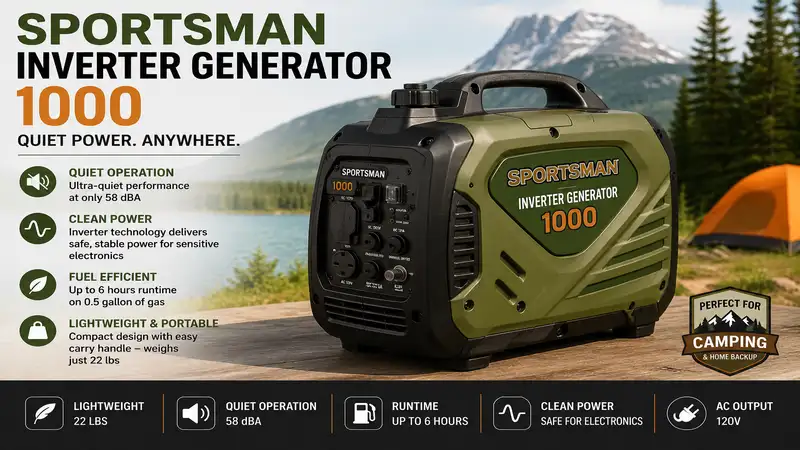
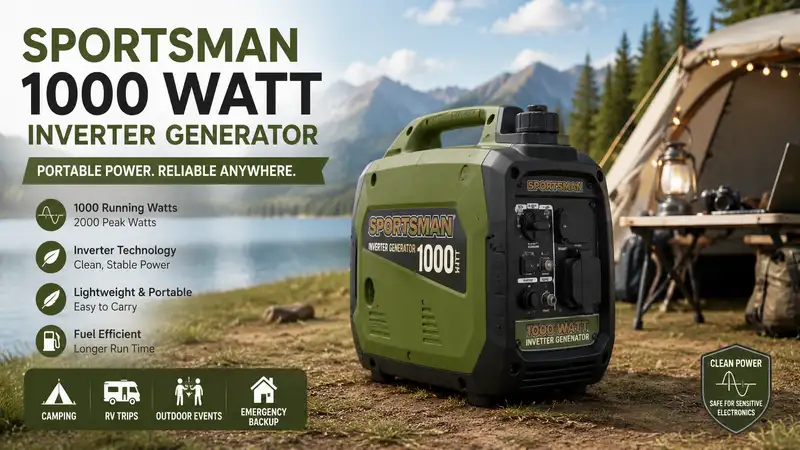
The appeal is simple. The sportsman inverter 1000 (sold as the Sportsman GEN1000i) weighs about 20 pounds, makes clean power that’s safe for laptops and phones, and costs a fraction of what the big-name 1000-watt models do. However, “cheap and light” always comes with trade-offs, and those trade-offs matter a lot more when the lights go out than when you’re tailgating.
So here’s what this guide does differently. Instead of rewording a product listing, it digs into the actual owner’s manual specs, compares the sportsman inverter 1000 against six real alternatives, and translates every number into something you can use: how long a tank really lasts, what you can and can’t plug in, and when you’d be smarter spending more (or less).
You’ll find:
A quick comparison table you can scan in 30 seconds
Honest analysis of 7 real 1000-watt-class options, including two Sportsman variants
A first-30-days setup guide, real-world buyer scenarios, and fixes for common problems
Safety rules that genuinely save lives (carbon monoxide is no joke)
No invented test stories, no fake reviews. Just specs, aggregated owner feedback, and straight reasoning, so you can decide whether a 1000 watt inverter generator from Sportsman fits your plans.
What Is a Sportsman Inverter 1000?
A sportsman inverter 1000 is a compact gasoline inverter generator, model GEN1000i, rated at 1,000 surge watts and 800 running watts. Its 40cc four-stroke engine feeds an electronic inverter that produces stable, low-distortion 120V power, making it safe for phones, laptops, TVs, and other sensitive electronics while staying light enough to carry one-handed.
That’s the short answer. The longer one is about how it works. A conventional engine-generator spins an alternator at a fixed speed and sends that raw AC straight to your outlets. An inverter design does something smarter: it makes AC, converts it to DC, then rebuilds a clean AC sine wave electronically. Because the output no longer depends on engine speed, the engine can throttle down when your load is light. That’s what the “economy” switch on the sportsman inverter 1000 does, and it’s the reason these units sip fuel and run quieter than old-school open-frame generators.
In practice, the sportsman gen1000i sits in the “personal power” tier. It’s built for charging, lighting, fans, small TVs, CPAP-sized loads, and the occasional small kitchen gadget, not for a refrigerator, a space heater, or a microwave. Keep that frame in mind and the rest of this guide will make a lot more sense.
Quick Comparison: Sportsman Inverter 1000 vs. the Field
Model
Surge / Running (W)
Weight
Fuel / Battery
Price Range
Best for
Sportsman GEN1000i
1,000 / 800
~20 lb
0.55 gal gas
~$170–$300
Sportsman GEN1000i: budget campers
Sportsman GEN1000i-PL
1,000 / 800
~24 lb
Gas
~$300–$450
Sportsman GEN1000i-PL: future parallel setups
WEN 56125i
1,250 / 1,000
~31.6 lb
0.7 gal gas
~$330–$400
WEN 56125i: two-outlet users
Westinghouse iGen1200
1,200 / 1,000
~33 lb
Gas
Under ~$500
Westinghouse iGen1200: quiet campgrounds
Honda EU1000i
1,000 / 900
~29 lb
0.6 gal gas
~$1,000+
Honda EU1000i: long-term reliability
Champion 100692
2,000 / 1,700
~39 lb
1.1 gal gas
~$350–$550
Champion 100692: small appliances
Jackery Explorer 1000 v2
3,000 / 1,500
~23.8 lb
1,070Wh LiFePO4
~$450–$800
Jackery Explorer 1000 v2: tents and indoor-safe use
Prices are approximate ranges at the time of writing and change often; check the current price before buying.
Reading this table, the Sportsman GEN1000i wins on pure weight-per-dollar, and nothing else here comes close to its entry price. Step up to the WEN 56125i or Westinghouse iGen1200 and you gain roughly 200 running watts plus a second outlet, at the cost of about 12 extra pounds. The Jackery Explorer 1000 v2 is the wild card: more output than any gas unit here, zero fumes, but a fixed energy budget instead of a refillable tank.
Top 7 Sportsman Inverter 1000 Picks and Alternatives
This is the original sportsman inverter 1000, and its biggest selling point is that it costs less than many cooler-and-chair combos.
Under the hood sits a 40cc four-stroke OHV engine feeding 1,000 surge and 800 running watts. In practice, 800 watts covers a laptop, string lights, a box fan, phone chargers, and a small TV at the same time, with room to spare. The 0.55-gallon tank is rated for 6.3 hours at 50% load (about 400 watts), so one fill typically carries you through an evening and a good chunk of the night. Sportsman’s manual lists 56 dB at no load from 23 feet, and you get one 120V outlet plus a 12V/4A DC port for battery top-ups.
Based on comparing the specs, this is the right tool for occasional campers, hunters, and tailgaters who need clean power for electronics a few weekends a year. It’s not the right tool for anyone who expects to run it daily or at high altitude: the manual says it isn’t recommended above 3,000 feet.
On Tractor Supply’s listing, the GEN1000i holds roughly a 4.4-out-of-5 average across several hundred reviews at the time of writing. Owners commonly praise its weight and say it handles laptops and devices on camping trips without fuss.
Pros:
About 20 pounds, easy one-hand carry
Clean inverter power safe for laptops and phones
Economy switch stretches fuel on light loads
Cons:
Only one 120V AC outlet
One-year limited consumer warranty is short
Typically around $170–$300, which makes it the best value-per-pound in this roundup.
Sportsman GEN1000i —See current price, sizes and reviews on Amazon.
The Sportsman GEN1000i-PL is the same 1,000-surge-watt platform with one meaningful upgrade: a parallel power port.
That port lets you link two identical units with a parallel kit (sold separately) and roughly double your available watts. Translation: one unit for the solo trip, two linked units when you need about 1,600 running watts for a small appliance. Camping World lists the PL version at roughly 24 pounds, about four pounds heavier than the base model, which still keeps it in easy carry territory.
Here’s what to weigh. Parallel capability only pays off if you’re genuinely likely to buy a second unit. If you are, buying two PL units is often cheaper than one premium 2,000-watt generator. If you’re not, the base Sportsman GEN1000i gives you the same day-to-day output for less.
Verified review volume on this specific variant is thin, so treat the base model’s owner feedback as the closer guide; the engine and output specs are shared.
Pros:
Parallel port enables a two-unit setup later
Same 800 running watts as the base model
Still light enough for one-person carrying
Cons:
Parallel kit costs extra
Small pool of verified owner reviews
Usually in the $300–$450 range; worth it only if a second unit is in your plans.
Sportsman GEN1000i-PLSee current price, sizes and reviews on Amazon.
3. WEN 56125i — two outlets and more running watts
The WEN 56125i is the most direct rival to the sportsman inverter 1000, trading a few pounds for noticeably more usable power.
Its 60cc engine produces 1,250 surge and 1,000 running watts, which is 25% more continuous power than the Sportsman. That extra 200 watts is the difference between running a 700-watt coffee maker alone and running it while your phone and lights stay plugged in. It also adds two 120V outlets and two USB ports, so you need fewer adapters and power strips. The trade-off is weight: about 31.6 pounds, and its 0.7-gallon tank runs about 5 hours at half load.
This is the pick for buyers who already know 800 watts will feel tight, such as small groups or anyone mixing a small cooking appliance with electronics. It’s also CARB compliant, which matters if you live in or ship to California.
Verified US owner reviews for this exact model were limited at the time of writing, so the analysis above leans on spec comparison rather than review sentiment.
Pros:
1,000 running watts beats most budget rivals
Two AC outlets plus two USB ports
CARB compliant for California buyers
Cons:
About 12 pounds heavier than the Sportsman
Shorter runtime than larger-tank competitors
Generally $330–$400; solid value if 800 watts won’t cut it.
WEN 56125iSee current price, sizes and reviews on Amazon.
The Westinghouse iGen1200 is for buyers who care about neighbors as much as watts.
Westinghouse rates it at 52 dBA at 25% load and 58 dBA at 50%, measured with a double-insulated acoustic enclosure. For context, 52 dBA is roughly quieter than normal conversation, which helps at campgrounds with quiet hours. Output is 1,200 surge and 1,000 running watts from a 54cc engine, and it includes dual USB ports. It can also be paralleled with other Westinghouse inverters using the brand’s parallel cord.
The catch is weight. At about 33 pounds it’s the heaviest of the 1,000-watt-running gas units here. So the decision comes down to priorities: if you carry your generator a long way from the car, the Sportsman GEN1000i is easier; if it sits beside your RV or tent pad all weekend, the quieter iGen1200 is arguably the better neighbor.
Verified US review data for this specific model was limited during research, so this assessment is based on manufacturer spec sheets.
Pros:
As low as 52 dBA at quarter load
Parallel-capable with other Westinghouse inverters
Dual USB ports for direct device charging
Cons:
Heaviest gas unit in this group
Stock availability varies by retailer
Typically under about $500 when in stock; check the current price, as it fluctuates.
Westinghouse iGen1200See current price, sizes and reviews on Amazon.
The Honda EU1000i is the generator every budget 1000 watt inverter generator gets compared against, and for good reason.
Honda’s GXH50 engine (49.4cc) delivers 1,000 maximum and 900 rated watts, so you get 100 more continuous watts than the sportsman inverter 1000 in a 29-pound package. Honda lists 42 to 50 dB(A), which is remarkably quiet. Runtime is up to about 7 hours at quarter load on 0.6 gallons. Newer versions add CO-MINDER, which shuts the engine down if carbon monoxide builds up nearby, and two identical units can be paralleled for up to 2,000 watts.
The honest analysis: you’re paying for engineering refinement, dealer support, and a long track record, not for more power. If your generator is a once-a-year toy, that premium is hard to justify. If it’s for frequent RV trips or an elderly parent’s medical device during outages, the reliability margin is the whole point.
Honda’s inverter line has a long-standing reputation for longevity among RV owners, a theme you’ll see repeated across forums and dealer reviews.
Pros:
Extremely quiet at 42–50 dB(A)
CO-MINDER automatic shutdown on newer units
Strong dealer and parts network nationwide
Cons:
Costs several times more than the Sportsman
Same single-digit-hours runtime class
Often around $1,000 or more; the premium choice for heavy, long-term use.
Honda EU1000iSee current price, sizes and reviews on Amazon.
The Champion 100692 is what you buy when you realize 1,000 watts was never going to be enough.
Its 79cc engine delivers 2,000 surge and 1,700 running watts, more than double the sportsman inverter 1000. That headroom means a 1,000-watt microwave, a small electric skillet, or a portable fridge become realistic loads. The 1.1-gallon tank is rated for up to 11.5 hours at 25% load, nearly double the Sportsman’s endurance, and Champion lists 53 dBA. It’s also parallel-capable.
What the spec sheet doesn’t say loudly enough is the weight: 39 pounds. That’s manageable for car camping but noticeable if you hike it to a campsite. Based on comparing the specs, this is the best value for anyone who wants one generator for both camping and light outage backup without paying Honda prices.
Champion’s three-year limited warranty is also longer than the Sportsman’s one-year coverage, which counts for a lot over a generator’s lifetime.
Pros:
1,700 running watts handles small kitchen appliances
Up to 11.5 hours on one tank
Three-year limited warranty
Cons:
Nearly double the Sportsman’s weight
Overkill if you only charge devices
Usually $350–$550; excellent value per running watt.
Champion 100692See current price, sizes and reviews on Amazon.
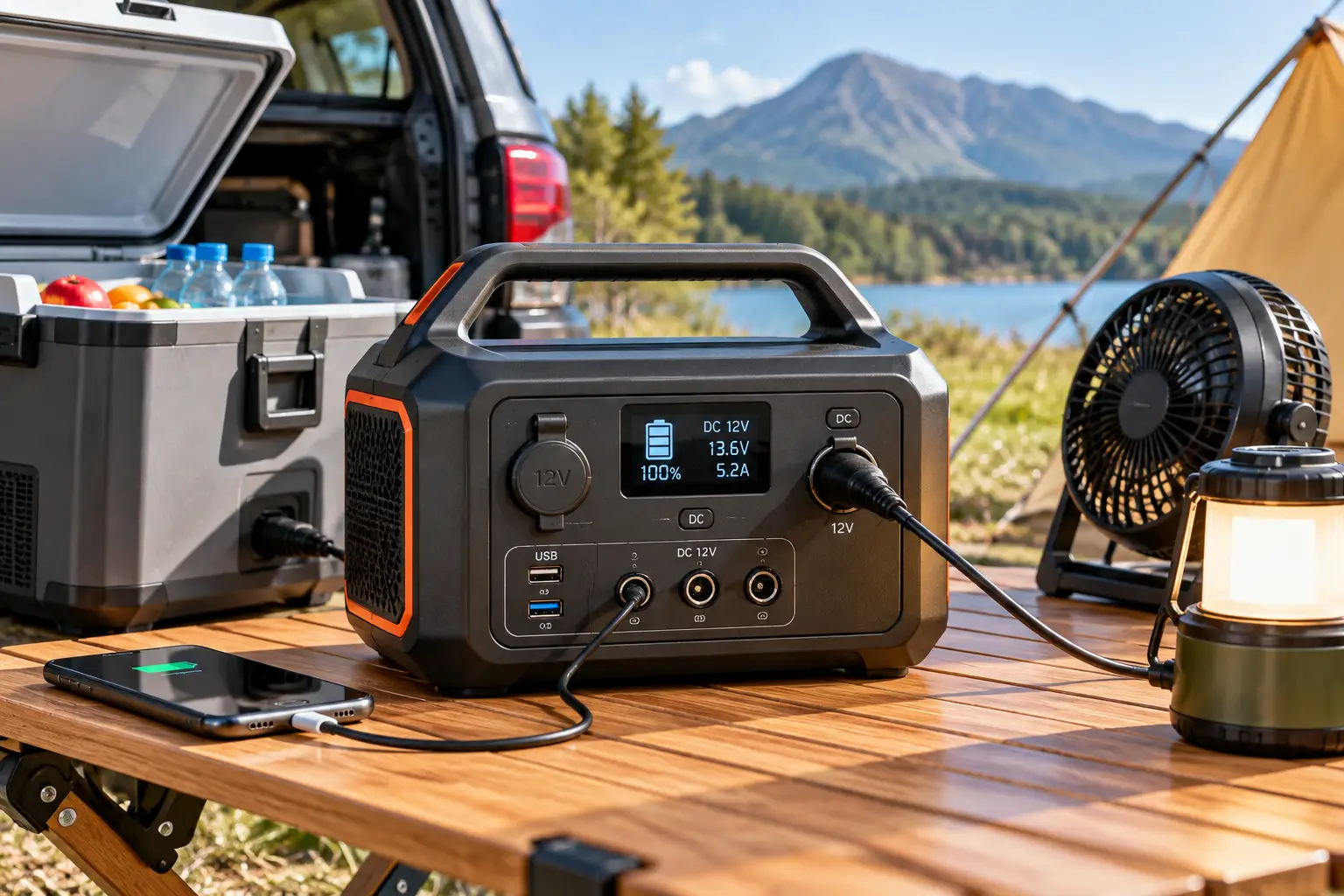
The Jackery Explorer 1000 v2 isn’t a generator in the gas sense at all. It’s a 1,070Wh LiFePO4 battery with a built-in 1,500-watt inverter, and that changes the entire safety equation.
Because it produces no exhaust, you can use it inside a tent, cabin, or home, which you can never do with any sportsman inverter 1000. Jackery rates it at 1,500 watts continuous with a 3,000-watt surge, and the LiFePO4 cells are rated for 4,000 cycles to 70% capacity. At 23.8 pounds, it’s in the same weight class as the gas models. The limit is energy: 1,070Wh runs a 400-watt load for roughly 2 to 2.5 hours after conversion losses, versus about 6 hours per tank on the Sportsman.
Owner feedback on the Explorer 1000 v2 commonly reports it running a microwave and starting a refrigerator compressor without issue, along with appreciation for silent overnight operation.
Pros:
Zero fumes, safe for indoor use
1,500 running watts beats every gas unit here except Champion
Fast recharge via app-enabled emergency mode
Cons:
Finite energy without solar or wall power
Higher upfront cost than the Sportsman
Typically $450–$800 depending on promotions; a smart pairing with a gas unit.
Jackery Explorer 1000 v2See current price, sizes and reviews on Amazon.
Side-by-Side Specs: Which 1000-Watt-Class Option Fits You?
Model
Running Watts
Noise (claimed)
Runtime (claimed)
Outlets
Best for
Sportsman GEN1000i
800
56 dB (no load)
6.3 hr @ 50%
1 AC + 12V DC
Sportsman GEN1000i: light loads on a budget
WEN 56125i
1,000
Not verified
~5 hr @ 50%
2 AC + 2 USB
WEN 56125i: mixed device + appliance use
Westinghouse iGen1200
1,000
52 dBA @ 25%
Not verified
AC + 2 USB
Westinghouse iGen1200: quiet campsites
Honda EU1000i
900
42–50 dB(A)
~7 hr @ 25%
Duplex AC + DC
Honda EU1000i: frequent RV trips
Champion 100692
1,700
53 dBA
11.5 hr @ 25%
AC + 12V DC
Champion 100692: small appliances
Jackery Explorer 1000 v2
1,500
Near silent
~2–2.5 hr @ 400W
2 AC + USB-C/A
Jackery Explorer 1000 v2: indoor-safe backup
The data shows a clear pattern: noise and runtime improve as you move up in price, but running watts don’t track price at all. The Champion 100692 gives the most continuous power per dollar, while the Honda EU1000i spends its premium on quietness and durability instead. Note that manufacturers measure noise at different loads, so compare decibel figures with caution.
Don’t miss these smart power picks!
Take your camping and tailgating to the next level with this carefully curated lineup. Click a highlighted item to check current pricing and availability. These picks will help you keep devices charged and nights comfortable for the whole crew!
Your First 30 Days With a Sportsman Inverter 1000: Setup and Break-In Guide
Most early problems with a sportsman inverter 1000 trace back to the first hour of ownership, not to the generator itself. Here’s how to get it right.
Step 1: Add oil before anything else
The GEN1000i ships without engine oil and won’t start without it. The manual calls for SAE 10W-30 at about 10 ounces. Keep the unit level while filling, because tilting it can overfill the crankcase.
Step 2: Use the right fuel
Stick to fresh unleaded gasoline with no more than 10% ethanol (E10). Small 40cc carburetors are fussy, and stale or high-ethanol fuel is the number-one cause of hard starts on small engines.
Step 3: Start empty, then load up
Start with nothing plugged in. Let the engine warm up for a few minutes, move the choke back to run, then connect devices one at a time, biggest load first. Turn the economy switch off for anything with a motor or compressor, since those need a burst of starting current.
Step 4: Do the first oil change early
The maintenance chart calls for the first oil change at 1 month or 20 hours. That first change flushes out break-in metal particles, and it’s the cheapest longevity insurance you’ll ever buy.
Step 5: Store it properly between trips
For storage beyond a few weeks, drain the tank and the carburetor bowl, as the manual describes. Then keep the unit upright in a dry, ventilated space.
Common first-month mistakes: running it on a slope, skipping the warm-up, and leaving fuel in the carb over the off-season. Avoid those three and your sportsman 1000 watt inverter generator will start on the first or second pull far more often.
Real-World Scenarios: Matching the Right Generator to Your Life
Specs only matter in context. Here are three common buyer profiles and the reasoning behind each match.
The weekend tent camper (budget under $300)
You camp six to eight weekends a year, mostly for phones, a speaker, lights, and a CPAP-sized load overnight. Total draw rarely tops 300 watts. The Sportsman GEN1000i is the natural fit: light, cheap, and the economy mode stretches one tank through most of a night. Just check the campground’s generator hours and quiet rules before you go.
The tailgater with a small crew (budget $300–$550)
You want a TV, a phone-charging station, and maybe a small electric griddle or slow cooker. That cooking load can blow past 800 watts. The Champion 100692 or WEN 56125i makes more sense here, since the extra running watts let the TV and the cooker share power without tripping the overload light.
The apartment or suburban outage prepper (budget $450–$800)
You mainly want to keep phones, Wi-Fi, a fan, and lights going during a storm outage, and you may not have a safe outdoor spot 20 feet from the house. The Jackery Explorer 1000 v2 is the safer primary choice because it can run indoors. Federal guidance on preparing for power outages also stresses having backup power plans for medical devices and keeping refrigerator doors closed, both of which favor a quiet, indoor-safe battery. If outages run for days, pair it with a sportsman inverter 1000 outdoors to recharge the battery.
Problem → Solution: Fixing Common Sportsman Inverter 1000 Issues
Even a well-maintained 1000 watt inverter generator hiccups now and then. These are the issues owners raise most, with the fixes the manual and basic small-engine logic point to.
Problem 1: It won’t start
Solution: Check the obvious first. Is there oil? The low-oil sensor blocks starting when the level is low. Then confirm the fuel valve is on, the tank cap vent is open, and the engine switch is on. If it still won’t fire, old fuel or a gummed carburetor is the usual suspect; drain and refill with fresh gas.
Problem 2: The overload light comes on and power cuts out
Solution: You’ve exceeded 800 running watts, or a motor’s startup surge spiked past 1,000 watts. Unplug everything, stop and restart the engine to reset output, then reconnect with a smaller load. Turn the economy switch off for motorized devices.
Problem 3: It surges or hunts on light loads
Solution: A little engine-speed change in economy mode is normal. Persistent hunting usually points to a partially clogged fuel filter or carburetor jet, so clean the fuel tank filter first.
Problem 4: Power drops at elevation
Solution: The manual says the GEN1000i isn’t recommended above 3,000 feet. For mountain trips, consider a model offering a high-altitude kit or a battery power station instead.
Problem 5: The 12V port won’t charge a battery
Solution: Turn economy mode off while charging and check the DC circuit protector; press it to reset if it tripped.
How to Choose a Sportsman Inverter 1000 (or Any 1000-Watt Inverter)
Choosing well comes down to seven questions, answered in this order:
Add up your running watts. List every device you’ll run at once and total the wattage labels. Keep that total under about 80% of the generator’s running rating; for the sportsman inverter 1000, that means staying near 640 watts for comfortable, cooler operation.
Check starting surge. Anything with a motor (fans, pumps, small fridges) briefly pulls two to three times its running watts. A 1,000-watt surge ceiling rules out most compressors.
Confirm clean power. Laptops and CPAP machines want low distortion. Inverter units typically keep total harmonic distortion low, which is the whole reason to buy one over a cheap open-frame model.
Weigh the weight. Under 25 pounds is a one-hand carry; over 35 pounds starts to feel like luggage.
Count your outlets. One outlet means a power strip; two plus USB means fewer adapters.
Think about runtime. Divide tank size by your load. Want an overnight run at 300–400 watts? Look for six-plus hours per tank.
Read the warranty and altitude notes. One year versus three years, and an altitude limit, can matter more than 100 extra watts.
Inverter Generator vs. Traditional Generator vs. Power Station
The sportsman generator review question most people really mean is, “Is a small inverter the right type of power for me?” Here’s how the three types compare.
Factor
Inverter (e.g., Sportsman GEN1000i)
Traditional open-frame
Battery station (e.g., Jackery Explorer 1000 v2)
Power quality
Clean, electronics-safe
Rougher, varies with engine
Clean pure sine wave
Noise
Low to moderate
Loud
Near silent
Fuel efficiency
Engine throttles to load
Runs at constant speed
No fuel
Indoor use
Never
Never
Yes
Runtime limit
Refill anytime
Refill anytime
Fixed until recharged
Best for
Sportsman GEN1000i: camping, tailgating
Job sites, heavy tools
Jackery Explorer 1000 v2: tents, apartments
The takeaway is that inverters win on the balance of clean power, quietness, and endless refueling, while battery stations win decisively on safety and silence. Traditional generators only make sense when raw wattage for tools matters more than noise or electronics safety. Many experienced campers end up owning one inverter and one battery, using each for what it does best.
Long-Term Cost and Maintenance: What You’ll Really Spend
The purchase price is only the first bill. Here’s a rough per-hour comparison using the manufacturers’ claimed runtimes, an assumed gas price of about $3.25 per gallon, and an assumed electricity rate of about $0.17 per kWh. Your local prices will differ.
Model
Claimed fuel use
Est. energy cost per hour
Upkeep
Best for
Sportsman GEN1000i
0.55 gal / 6.3 hr @ 50%
~$0.28
Oil every 50–100 hr, plug yearly
Sportsman GEN1000i: low upfront cost
Honda EU1000i
0.6 gal / ~7 hr @ 25%
~$0.28
Similar, dealer service widely available
Honda EU1000i: lowest repair risk
Champion 100692
1.1 gal / 11.5 hr @ 25%
~$0.31
Similar, three-year warranty
Champion 100692: watts per dollar
Jackery Explorer 1000 v2
~0.45 kWh per hr @ 400W
~$0.08
Essentially none
Jackery Explorer 1000 v2: lowest running cost
The numbers show that fuel cost per hour is nearly identical among the gas units, so efficiency shouldn’t drive your choice. The real long-term variables are warranty length and how often you’ll need repairs. A Sportsman GEN1000i used a few weekends a year might run a decade on cheap oil changes, while a heavily used unit could justify the Honda EU1000i‘s premium within a few seasons.
Safety, Regulations, and Standards Every Owner Should Know
This is the section that matters most. Carbon monoxide from portable generators kills dozens of Americans every year, and a CO-free design like a battery station is the only fully safe indoor option.
The U.S. Consumer Product Safety Commission’s generator safety guidance is blunt: run portable generators outside only, at least 20 feet from the house, with the exhaust pointed away from doors, windows, and vents. Notably, that’s farther than many owner’s manuals suggest.
A few more rules worth taping to your sportsman inverter 1000:
Never run it in a garage, shed, tent, or RV interior, even with the door open.
Install and test battery-powered CO alarms monthly.
Never backfeed a house through a wall outlet; it can electrocute utility workers. Use a transfer switch installed by a licensed electrician.
Use properly rated outdoor extension cords, and never a male-to-male “suicide cord.”
Keep it dry and shut it down before refueling.
On the regulatory side, the GEN1000i’s engine is certified to EPA small off-road engine emission standards. If you live in California, also check CARB status before buying, since compliance varies by model and version.
Features That Actually Matter (and Ones That Don’t)
Marketing pages love feature lists. Here’s an honest cut.
Features that genuinely matter:
CO shutoff sensors. Units like the Honda EU1000i with CO-MINDER add a real safety layer; this matters more than any wattage figure.
Economy mode. It’s the main reason inverters are quieter and cheaper to run on light loads.
Low-oil shutdown. It prevents the single most expensive engine failure.
Parallel capability, but only if you’ll realistically buy a second unit.
Features that matter less than you’d think:
Peak watts on the box. Running watts decide what you can actually power; surge only covers a split second.
App connectivity on gas units. Nice, but rarely a deal-breaker for a 1000-watt class generator.
Claimed decibels without a load figure. A “52 dB” claim at no load isn’t comparable to one at 25% load.
The biggest buying mistake follows from this list: choosing by the largest number on the box. A sportsman 1000 watt inverter generator labeled “1,000” delivers 800 watts continuously, and planning around 1,000 is how people end up tripping the overload light at the worst possible moment.
FAQ: Sportsman Inverter 1000 Questions Buyers Ask Most
Can a sportsman inverter 1000 run a refrigerator?
Usually not a full-size fridge. Compressor startup surge often exceeds the 1,000-watt ceiling, and running draw eats most of the 800 continuous watts. A small, efficient mini-fridge may work alone, but a 1,700-watt unit or a battery station is the safer bet.
Can I run a CPAP on a sportsman gen1000i?
Yes, most CPAP machines draw well under 100 watts, and inverter power is clean enough for them. Turn the humidifier off to cut the load further, and always place the generator at least 20 feet from your tent or camper.
Who makes Sportsman generators?
The GEN1000i's manual lists Buffalo Corp (Buffalo Tools) as the warranty provider, and retail listings show the unit is manufactured in China. Warranty service goes through the company's customer service line, not the store where you bought it.
Is the sportsman inverter 1000 worth it compared to a Honda?
For occasional campers, usually yes: it delivers similar clean power for a fraction of the price. For frequent use, outages involving medical equipment, or buyers who want dealer service and CO shutoff, the Honda EU1000i justifies its premium.
Can I use a 1000 watt inverter generator in the rain?
Not unprotected. Manufacturers warn against wet operation because of shock risk. Use an open, canopy-style cover that keeps rain off without enclosing the unit, and never move it into a garage or porch to stay dry.
Conclusion: Is the Sportsman Inverter 1000 Right for You?
The sportsman inverter 1000 does one job very well: it delivers clean, electronics-safe power in a 20-pound package for less than almost anything else in its class. For tent campers, hunters, and tailgaters who mainly charge devices and run lights, fans, or a CPAP, the Sportsman GEN1000i is genuinely hard to beat on value.
Its limits are just as clear. With 800 running watts, one outlet, a one-year warranty, and a 3,000-foot altitude recommendation, it isn’t built for refrigerators, heavy outage duty, or mountain trips. If you’ll want a second unit later, the Sportsman GEN1000i-PL keeps that door open. If you need more continuous power now, the WEN 56125i or Champion 100692 are the logical next steps. If quiet matters most, look at the Westinghouse iGen1200 or, budget permitting, the Honda EU1000i. And if you might need power indoors, the Jackery Explorer 1000 v2 is the only safe answer in this lineup.
Whatever you choose, size it to your real running watts, keep it 20 feet from any building, and do that first oil change early. Do those three things, and a small inverter will repay you every time the outlet is miles away.
Ready to power your next adventure?
Pick the generator that matches your real wattage needs, click the highlighted model to check current pricing and availability, and head out knowing your devices, and your crew, are covered!
Disclaimer: This post contains affiliate links. As an Amazon Associate, I earn from qualifying purchases made through these links, at no additional cost to you.
Found this article helpful? Share it with someone who needs it!