As an Amazon Associate I earn from qualifying purchases. Links in this article may be affiliate links. How we choose gear
Why a 10000 Watt Solar Generator Is the New Home-Backup Benchmark
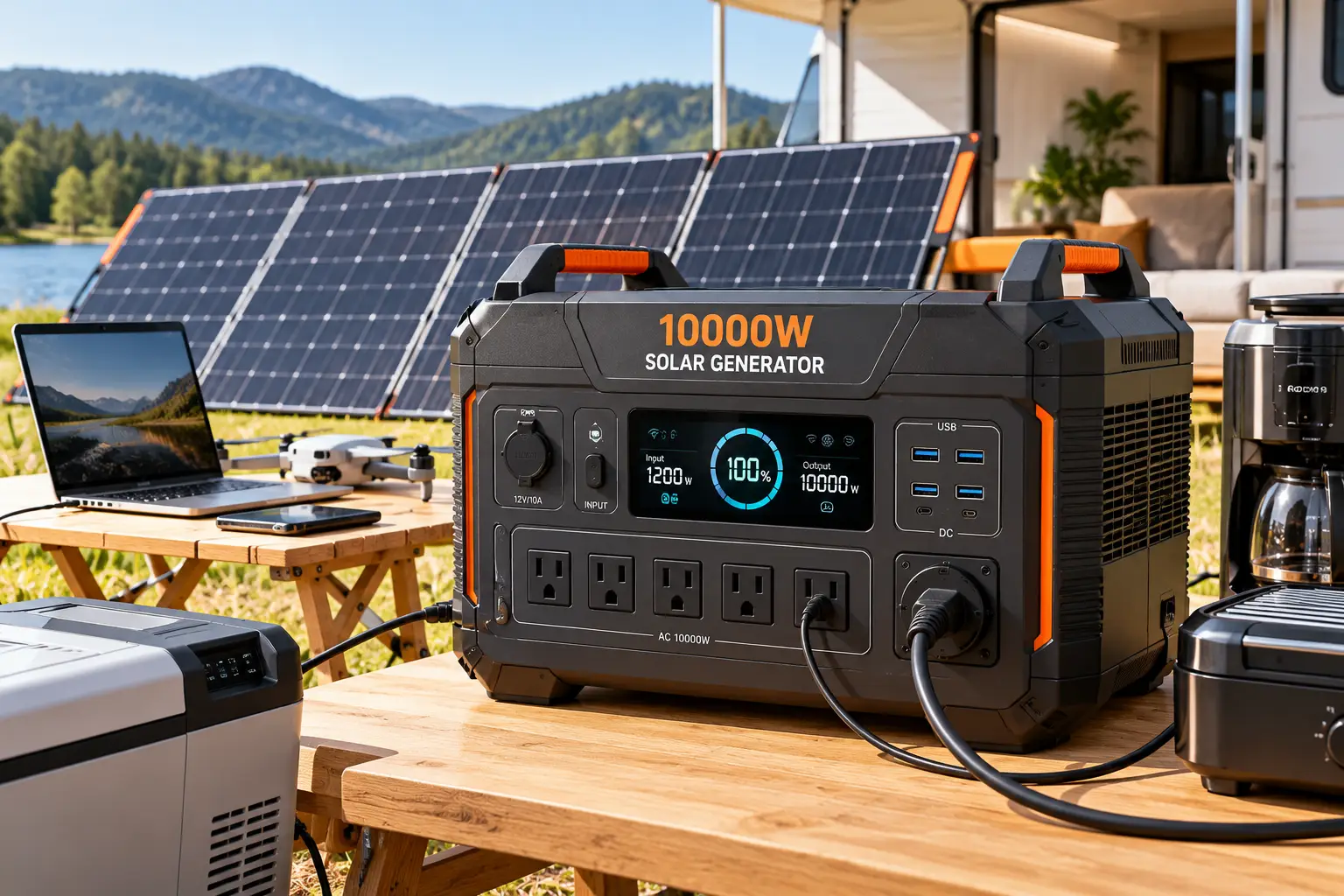
Picture the third night of a winter outage. The fridge is fine, the phones are charged, but the furnace blower, the well pump, and the electric dryer all want power at the same time — and a 2,000W camping power station simply taps out. That gap is exactly why the 10000 watt solar generator has moved from niche curiosity to serious home-backup category in 2026.
A 10000 watt solar generator sits in a very different league from the portable boxes you’d toss in a camper. At this level, you’re no longer asking “Can it run my laptop?” You’re asking “Can it start my 3-ton central air, keep the well pump cycling, and still run the kitchen?” The honest answer is: yes, if you pick the right architecture and size the battery bank correctly.
Here’s the catch most product pages gloss over. Very few systems deliver a true 10,000 watts of continuous output from one box. Some reach it in a single inverter, some reach it with surge capacity only, and others get there by linking two or three units together. Those differences change how much you’ll pay, how much installation you’ll need, and what your home can actually run.
This guide breaks it all down. We compared seven real systems sold to US buyers — from EcoFlow, Jackery, Anker SOLIX, BLUETTI, and Pecron — using manufacturer spec sheets, independent reviews, and aggregated customer feedback. You’ll also get a first-30-days setup plan, buyer scenarios, a gas-versus-solar breakdown, and a cost-of-ownership analysis. Nearly every system here uses lithium iron phosphate (LiFePO4) battery chemistry, which matters a lot for safety and lifespan — more on that below.
What Is a 10000 Watt Solar Generator?
A 10000 watt solar generator is a battery-based backup system — inverter, lithium battery bank, and solar charge controller — that can supply around 10,000 watts (10kW) of AC power, usually at both 120V and 240V. It recharges from solar panels, wall power, or a gas generator, with no fumes or fuel.
In practice, “10000 watt” can describe three different setups, and knowing which one you’re looking at saves you from expensive surprises:
Native 10kW+ continuous: one inverter delivers 10,000W or more all day long. This is the premium tier.
10kW+ surge: the unit runs at 5,000–7,200W continuously but can briefly push 10,000–14,400W to start big motors like AC compressors and well pumps.
Paralleled 10kW systems: two or three units are linked through a hub to combine their output into one larger system.
Wattage (W) is how much you can run at once. Watt-hours (Wh) is how long you can run it. A 10kW solar generator with only 5kWh of battery can power a lot at once — but only for about half an hour at full blast. That relationship is the single most important thing to understand before you buy.
Quick Comparison: 10000 Watt Solar Generator Options at a Glance
If you only have two minutes, this table shows how each system reaches the 10kW class and who it fits best. Prices are approximate ranges at the time of writing and change often, so always check the current listing.
System
Continuous output (one unit)
How it reaches 10kW+
Base battery
Approx. price (base unit)
Best for
EcoFlow DELTA Pro Ultra X
12,000W
Native, single inverter
12.3kWh (2 batteries)
$8,000+ (bundle)
EcoFlow DELTA Pro Ultra X: true whole-home backup
Jackery Explorer 5000 Plus
7,200W
14,400W surge; 2 units = 14.4kW
5.04kWh
$3,000–$4,300
Jackery Explorer 5000 Plus: big loads, simple setup
EcoFlow DELTA Pro Ultra
7,200W
10,800W surge; 3 units = 21.6kW
6.1kWh
$4,100–$5,800
EcoFlow DELTA Pro Ultra: proven, certified platform
Anker SOLIX F3800 Plus
6,000W
2 units = 12kW
3.84kWh
$2,300–$3,500
Anker SOLIX F3800 Plus: generator-hybrid homes
BLUETTI Apex 300
3,840W
3 units = 11.5kW
2.76kWh
$1,500–$1,700
BLUETTI Apex 300: build-as-you-go budgets
PECRON F5000LFP
7,200W (240V)
2 units in larger setups
5.12kWh
$2,000–$2,300
PECRON F5000LFP: best value per watt-hour
BLUETTI AC500 + B300S
5,000W
10,000W surge; 2 units = 10kW split-phase
3.07kWh
$2,600–$3,000
BLUETTI AC500 + B300S: modular 10kW kits
Reading the table, the EcoFlow DELTA Pro Ultra X is the only pick that hits 10kW-plus continuous from a single inverter — and its price reflects that. If your big loads are motors that only need a few seconds of extra punch at startup, the Jackery Explorer 5000 Plus delivers 14,400W surge for roughly half the money. Budget-minded buyers should look at the PECRON F5000LFP and the BLUETTI Apex 300, which trade single-box muscle for a lower cost of entry and a clear upgrade path.
Top 7 10000 Watt Solar Generator Systems
Every pick below is a real, shipping system with published US specs. We ranked them by how well they deliver 10kW-class performance for a typical American home, then weighed price, expandability, and what owners and independent reviewers actually report. Where we couldn’t verify customer feedback, we say so.
If you want a genuine 10kW-plus system without stacking anything, this is the one to beat. The EcoFlow DELTA Pro Ultra X pushes 12,000W of continuous 120V/240V power from a single inverter, and you can parallel up to three inverters for 36kW.
The standard bundle pairs the inverter with two 6,144Wh LFP batteries for about 12.3kWh, expandable to 61.4kWh on one inverter. In practice, 12kW means you can run central AC, an electric range, and a well pump at the same time without load-shedding gymnastics. Solar input tops out at 10kW across two high-voltage ports (80–500V), so a mid-size rooftop array can refill the bank in a single sunny day.
Based on comparing the specs, this is a home-energy system that happens to have wheels, not a portable power station. It needs EcoFlow’s Smart Home Panel 3 or Smart Gateway for automatic whole-home switching, which adds cost and an electrician visit. It’s best for homeowners who want to replace a standby generator outright.
Because the X launched recently, independent long-term owner reviews are still limited at the time of writing; early coverage centers on its 60% power jump over the original DELTA Pro Ultra and its premium price.
Pros:
True 12kW continuous output from one inverter
Huge 10kW solar input for fast daily recharging
Works with existing DELTA Pro Ultra batteries
Cons:
Premium price before panels or installation
Requires Smart Home Panel 3, not Panel 2
Expect to pay roughly $8,000 for the base bundle and over $10,000 with the home panel — steep, but cheaper than many installed standby systems.
EcoFlow DELTA Pro Ultra XSee current price, sizes and reviews on Amazon.
The Jackery Explorer 5000 Plus is the strongest pick for homes whose big loads are motors that need a hard shove to start. It delivers 7,200W continuous and a 14,400W surge from a single 5,040Wh LiFePO4 unit.
That surge headroom is the real story: compressors in central AC units and submersible well pumps can draw several times their running watts for a second or two, and 14.4kW covers nearly any residential motor. Dual 120V/240V output handles dryers and water heaters, and two units linked together reach 14.4kW continuous. Solar input is 4,000W, and charging through Jackery’s Smart Transfer Switch reaches 4,000W, refilling the battery in under two hours.
What most buyers overlook is that 5kWh disappears fast at 7kW of load — roughly 40 minutes. So treat the expansion packs as part of the purchase, not an afterthought.
Independent reviewers describe it as quiet under heavy load, with one tester measuring the fan around 44 dB. On the negative side, a recurring theme in Amazon customer reviews is frustration with the warranty-claim process when something does go wrong.
Pros:
14,400W surge starts large compressors easily
Simple plug-in transfer switch option
Generous 5-year plus 2-year warranty coverage
Cons:
About 134 lb, so moving it takes two people
Mixed customer experiences with warranty service
At roughly $3,000 to $4,300 for the base unit, it’s strong value for surge-heavy homes.
Jackery Explorer 5000 PlusSee current price, sizes and reviews on Amazon.
Before the X arrived, the EcoFlow DELTA Pro Ultra defined this category, and it remains the safer bet for buyers who prefer a platform with more time in the field. It delivers 7,200W continuous and 10,800W surge, with a 6kWh battery per module.
You can stack up to five batteries per inverter (30kWh) and link three inverters for 21.6kW and up to 90kWh. Solar input reaches 5.6kW per unit, which is well above most portable competitors. It is also certified to UL 1973 and UL 9540, standards many local inspectors look for when a battery system is tied to a home’s wiring.
Here’s what to weigh: the inverter weighs about 70 lb and each battery module more than 110 lb, so this is a semi-permanent garage or utility-room install. It is best for buyers who want certification paperwork and a path to 20kW-plus over time.
We couldn’t verify a large pool of US owner reviews for current configurations, so lean on its spec sheet and certifications rather than star ratings.
Pros:
UL 9540 certification simplifies permitting conversations
10,800W surge handles most HVAC startups
Scales to 21.6kW with three inverters
Cons:
Heavy modules make it effectively stationary
Not compatible with the newer Smart Home Panel 3
At roughly $4,100 to $5,800 with one battery, it’s fair value for a certified, expandable system.
EcoFlow DELTA Pro UltraSee current price, sizes and reviews on Amazon.
The Anker SOLIX F3800 Plus is built for homeowners who already own a gas generator and want to make it smarter. It outputs 6,000W at 120V/240V from a 3,840Wh LFP battery, and two units joined with Anker’s Double Power Hub reach 12,000W.
Its standout feature is a 6,000W, 240V generator bypass: your gas generator can feed the house and refill the battery at the same time, so the engine runs fewer hours. Dual MPPT controllers accept up to 3,200W of solar, and built-in NEMA L14-30 and TT-30 ports make it easy to power an RV or charge an EV. Capacity expands to about 26.9kWh per unit, or 53.8kWh across two.
In independent testing coverage, AppleInsider concluded that it performs best as the core of a larger system with expansion batteries and a home panel, and is weaker as a standalone unit compared with rivals. That matches the spec sheet: 3.84kWh alone is modest for a 6kW inverter.
Pros:
6,000W generator bypass reduces engine runtime
Direct EV and RV charging ports built in
Pairs into a 12kW system with one hub
Cons:
Base 3.84kWh capacity feels small for the output
About 137 lb, heaviest per kWh here
Typically listed between $2,300 and $3,500, it’s a smart buy if you’re adding to a generator.
Anker SOLIX F3800 PlusSee current price, sizes and reviews on Amazon.
The BLUETTI Apex 300 is the most flexible way to grow into a 10000 watt solar generator without paying for it all on day one. Each unit provides 3,840W continuous, 7,680W surge, and 2,764.8Wh of LiFePO4 storage with 120V/240V output.
Link three units through BLUETTI’s Hub A1 and you get roughly 11,520W, with up to 58kWh using expansion batteries. Each unit takes 2,400W of solar, and three units with the optional SolarX 4K controllers reach a combined 19.2kW of solar input. Reviewers repeatedly highlight its roughly 20W idle drain, which means the battery doesn’t quietly empty itself while it waits for an outage.
The trade-off: the Apex 300 has no USB ports, and ESS News noted that its long accessory list can confuse buyers expecting an all-in-one box. It suits planners who’ll start with one unit for essentials and add more each year.
Pros:
Lowest entry price into the 10kW class
Very low idle drain preserves stored energy
Rated for about 6,000 charge cycles
Cons:
No USB outputs on the main unit
Hub and accessories add cost and complexity
At about $1,500 to $1,700 per unit, it’s excellent value if you’re patient about scaling.
BLUETTI Apex 300See current price, sizes and reviews on Amazon.
The PECRON F5000LFP is the value pick, packing 5,120Wh and 7,200W of 240V output into one unit that often sells for less than rivals’ smaller batteries.
The detail that matters: its 120V outlets are split into two 3,600W banks, so a single 120V circuit can’t draw the full 7,200W. That’s normal for split-phase designs, but it affects how you plan loads. Solar input is rated up to 6,400W, AC charging with the 30A cable takes about 1.8 hours, and you can add six batteries for 35.84kWh. It also offers 0ms UPS switching and battery heating for cold-weather charging.
On paper, this is a lot of hardware for the money. It suits budget buyers who want a big battery for refrigerators, freezers, and 240V pumps. Long-term US owner reviews are still thin at the time of writing, so we can’t confirm durability trends; deal communities have shown strong interest at its sale prices.
Pros:
Lowest cost per watt-hour in this lineup
Very high solar input for its class
0ms UPS for routers and medical devices
Cons:
120V side limited to 3,600W per bank
Shorter 3+2-year warranty than most rivals
Around $2,000 to $2,300 for the base unit, it’s the best capacity-per-dollar value here.
PECRON F5000LFPSee current price, sizes and reviews on Amazon.
The BLUETTI AC500 + B300S is the veteran of the group, and it still earns a place because it reaches 10,000W in two clear ways. One AC500 gives 5,000W continuous and 10,000W surge; two AC500s in split-phase mode deliver 10,000W at 240V.
The AC500 is an inverter only, so you need at least one 3,072Wh B300S battery, and up to six per inverter (18.4kWh). Solar input is 3,000W per inverter, and the B300S self-heats in cold weather — a real advantage for northern garages. One caveat: with a single B300S, AC charging is limited to 4,500W.
This is a sensible pick for buyers who find a good bundle price on a 10kW kit, though the newer BLUETTI Apex 300 is BLUETTI’s more modern path. We couldn’t verify a meaningful set of recent US customer reviews, so judge it on specs and bundle pricing.
Pros:
10,000W surge from a single inverter
Self-heating batteries for cold climates
Lightweight 66 lb inverter is easy to move
Cons:
Single unit offers 120V outlets only
Older platform with fewer smart-home features
At roughly $2,600 to $3,000 per inverter-and-battery kit, it’s fair value when bundled well.
BLUETTI AC500 + B300SSee current price, sizes and reviews on Amazon.
EcoFlow DELTA Pro Ultra X: standby-generator replacement
Jackery Explorer 5000 Plus
4,000W
Up to 60kWh (system)
Yes
Jackery Explorer 5000 Plus: motor-heavy homes
EcoFlow DELTA Pro Ultra
5,600W
30kWh per unit, 90kWh system
Yes
EcoFlow DELTA Pro Ultra: certified expandable install
Anker SOLIX F3800 Plus
3,200W
26.9kWh per unit, 53.8kWh pair
Yes
Anker SOLIX F3800 Plus: gas-plus-battery hybrid
BLUETTI Apex 300
2,400W (19.2kW with 3)
58kWh (system)
Yes
BLUETTI Apex 300: phased upgrades
PECRON F5000LFP
6,400W
35.84kWh
Yes
PECRON F5000LFP: budget whole-house essentials
BLUETTI AC500 + B300S
3,000W
18.4kWh per inverter
No (240V needs two)
BLUETTI AC500 + B300S: discounted 10kW kits
This table shows why solar input deserves as much attention as output. The EcoFlow DELTA Pro Ultra X and PECRON F5000LFP can absorb far more sunshine than the others, which shortens recovery between outages. Meanwhile, the BLUETTI Apex 300 only closes that gap if you invest in three units plus controllers, so factor that into its low sticker price.
Don’t miss these exclusive deals!
Take your home backup power to the next level with this carefully curated lineup. Click a highlighted item to check current pricing and availability. These picks will help you keep the lights, heat, and fridge running the whole family will appreciate!
Getting Started: Your First 30 Days With a 10000 Watt Solar Generator
A 10kW solar generator rewards a little setup work up front. Here’s a practical plan that no product listing will give you.
Day 1 — charge fully and update firmware. Run the battery to 100% on wall power, then install app updates. Manufacturers frequently refine charging logic and UPS behavior through firmware, so start on the latest version.
Days 2–5 — audit your real loads. Use the app’s live wattage readout while you switch appliances on one at a time. Write down running watts and the startup spike for your AC, well pump, and fridge. This is your sizing truth, and it beats any online calculator.
Week 2 — plan the home connection. Whole-home or multi-circuit backup requires a transfer switch, inlet box, or smart panel installed by a licensed electrician. Ask about permits early; some jurisdictions want them before the first power-up.
Week 3 — set your reserve. Most apps let you hold back a backup reserve (say 30–50%) while using the rest for time-of-use savings. That way the battery earns its keep daily but is never empty when a storm hits.
Week 4 — run an outage drill. Flip the main breaker on a mild day and live on battery for two hours. You’ll discover which loads surprise you before it matters.
Maintenance tip: keep the unit between roughly 50°F and 85°F when possible, dust the fan intakes monthly, and check solar connectors after big storms.
Real-World Scenarios: Which 10kW Solar Generator Fits Your Home?
Numbers come alive when you attach them to real households. Here are three common US buyer profiles and the reasoning behind each match.
The Gulf Coast family with central air
A four-person household in hurricane country runs a 3-ton AC, two fridges, and a pool pump, with multi-day outages a real possibility. The Jackery Explorer 5000 Plus with one or two expansion packs fits a $5,000–$8,000 budget, and its 14,400W surge handles the compressor kick. If the budget stretches past $10,000, the EcoFlow DELTA Pro Ultra X removes load-juggling entirely.
The rural homestead with a well pump and a gas generator
This owner already has a 240V gas generator and a deep-well pump. The Anker SOLIX F3800 Plus makes sense here: its generator bypass lets the engine top up the battery while powering the house, cutting fuel use and noise during long outages.
The first-time homeowner on a tight budget
A Midwest buyer with about $2,000 to spend wants fridge, furnace blower, and internet covered now, with whole-home backup later. Start with one BLUETTI Apex 300 and add units over time, or choose the PECRON F5000LFP for the biggest battery today.
Problem → Solution: Fixing Common 10kW Solar Generator Headaches
Even the best 10000 watt solar generator can trip up new owners. These are the issues that show up most often in owner discussions and reviews, with practical fixes.
The unit overloads when the AC compressor starts
The startup surge exceeds the inverter’s limit for a split second. Install a soft starter on the AC condenser, which can cut inrush current dramatically, or choose a high-surge unit like the Jackery Explorer 5000 Plus.
The battery drains even when nothing is plugged in
Inverters consume power just by being on. Turn the AC inverter off between outages, or pick a low-drain model; the BLUETTI Apex 300 is reported at about 20W idle.
Solar charging is far below the rated input
Shade, panel angle, and voltage mismatches all cut harvest. Wire panels so the string voltage sits inside the controller’s window, and remove even partial shade from any panel.
The battery won’t charge in a cold garage
Lithium cells shouldn’t charge below freezing. Choose a unit with self-heating, such as the PECRON F5000LFP or BLUETTI AC500 + B300S, or move the battery indoors.
How to Choose a 10000 Watt Solar Generator
Choosing the right 10000 watt solar generator comes down to seven decisions, in this order:
Add up running watts, then find your biggest surge. Your continuous rating must cover everything running at once; your surge rating must cover the largest motor starting on top of it.
Size the battery in hours, not watts. Multiply your average load by the hours you want covered. A 1,500W average for 24 hours needs about 36kWh.
Confirm true 240V support. US homes use split-phase power, and well pumps, dryers, and many AC units need both legs. Check that 240V works from one unit or what it takes to get it.
Match solar input to your roof or yard. High solar input only helps if you have room for the panels to feed it.
Plan the home connection. A transfer switch or smart panel decides whether you back up a few circuits or the whole house.
Check expansion limits. Know the maximum batteries and units per system before you buy.
Read the warranty terms. Five years is the norm; look at cycle ratings and how claims are handled.
Common Mistakes to Avoid When Buying a 10kW Solar Generator
The most expensive mistake is buying output without capacity. A 10000w solar generator with 5kWh of storage is like a sports car with a two-gallon tank: thrilling for a few minutes, then stranded.
The second mistake is ignoring how 120V outlets are split. Several units, including the PECRON F5000LFP, divide their 120V output into separate banks, so the headline wattage only appears at 240V.
Third, buyers skip the installation budget. Expect electrician labor, an inlet or transfer switch, and possibly a permit — often a meaningful add-on to the hardware price.
Fourth, many shoppers compare sticker prices without comparing ecosystems. The BLUETTI Apex 300 looks cheap until you price three units, a hub, and solar controllers. Likewise, the EcoFlow DELTA Pro Ultra X requires Smart Home Panel 3 rather than the older panel.
Finally, don’t treat a whole house solar generator as a set-and-forget appliance. Firmware updates, reserve settings, and seasonal storage temperatures all affect how well it performs when the grid fails.
10kW Solar Generator vs Gas Generator: Which Is Smarter?
A 10,000-watt gas generator costs far less up front, but the comparison changes once you look at safety, noise, and fuel.
Factor
10kW solar generator
10kW gas generator
Best for
Upfront cost
High ($2,000–$10,000+)
Low to moderate
Gas: tight budgets
Fuel during outages
Sun, wall, or generator
Gasoline or propane
Solar: long or fuel-scarce outages
Indoor/garage use
Yes, no exhaust
Never; CO risk
Solar: safety-first homes
Noise
Near-silent to quiet fan
Loud engine
Solar: neighborhoods, night use
Runtime
Limited by battery size
As long as fuel lasts
Gas: multi-week outages
Maintenance
Minimal
Oil, plugs, fuel stabilizer
Solar: low-effort owners
The table shows the real trade-off: gas wins on raw runtime and upfront price, while solar wins on safety, noise, and daily usefulness. The safety gap is serious — the CPSC’s report on generator carbon monoxide deaths warns that one portable generator can emit as much CO as hundreds of cars. That’s why hybrids like the Anker SOLIX F3800 Plus, which run a gas generator outside only as a battery charger, are gaining traction.
Long-Term Cost and Maintenance of a Whole House Solar Generator
Sticker price tells half the story. What matters over ten years is cost per usable kilowatt-hour and how many cycles the battery survives.
System
Approx. base price
Base capacity
Approx. cost per kWh
Best for
PECRON F5000LFP
$2,000–$2,300
5.12kWh
$390–$450
PECRON F5000LFP: lowest storage cost
BLUETTI Apex 300
$1,500–$1,700
2.76kWh
$545–$615
BLUETTI Apex 300: low entry price
Jackery Explorer 5000 Plus
$3,000–$4,300
5.04kWh
$595–$855
Jackery Explorer 5000 Plus: surge per dollar
Anker SOLIX F3800 Plus
$2,300–$3,500
3.84kWh
$600–$910
Anker SOLIX F3800 Plus: hybrid setups
EcoFlow DELTA Pro Ultra X
$8,000+ (bundle)
12.3kWh
About $650+
EcoFlow DELTA Pro Ultra X: output per dollar
Read this alongside cycle ratings. The BLUETTI Apex 300 is rated around 6,000 cycles and the PECRON F5000LFP above 4,000, while the Anker SOLIX F3800 Plus lists 3,000-plus. More cycles spread the purchase over more years of daily use, which matters if you plan time-of-use arbitrage.
Maintenance is light: keep firmware current, avoid storing at 100% in heat, and exercise the battery monthly.
Features That Actually Matter (and Ones That Don’t)
Marketing pages list dozens of features. Only a handful change your outage experience.
Matter a lot:
Surge rating: decides whether your AC and well pump start at all.
Native 240V output: essential for many US heavy appliances.
Solar input and voltage window: determines recovery speed between outages.
UPS switchover time: 0–20ms keeps computers and routers from rebooting.
Idle drain: low standby draw preserves stored energy for days.
Matter less than you’d think:
Wireless phone-charging pads and dozens of USB ports — handy, but irrelevant to whole-home backup.
Huge maximum-capacity claims you’ll never afford to fill.
Touchscreen size; the app does the real work.
Safety, Regulations, and Standards for 10000 Watt Solar Generators
Battery systems avoid exhaust, but they still deserve respect. Look for UL 9540 (energy storage system) and UL 1973 (battery) certifications; the EcoFlow DELTA Pro Ultra carries both, which can smooth conversations with local inspectors. FCC compliance covers radio interference from the inverter and Wi-Fi modules.
Any connection to your home’s wiring should follow the National Electrical Code and local permit rules, and should be done by a licensed electrician through a proper transfer switch or panel. Never backfeed through a dryer outlet with a “suicide cord” — it can energize utility lines and endanger line workers.
If you also keep a gas generator for long outages, follow the CPSC’s power-outage safety guidance: run it outdoors only, far from windows, and keep battery-backed CO alarms on every level. Finally, store lithium units in a dry, ventilated space within the manufacturer’s temperature range, and keep vents clear.
FAQ: 10000 Watt Solar Generator Buying Questions
How much does a 10000 watt solar generator cost in 2026?
Entry paths start around $1,500 per modular unit, while single-box systems with 10kW-plus continuous output run roughly $8,000 to $10,000 or more. Add expansion batteries, panels, and electrician labor for a realistic budget.
Can a 10000 watt solar generator run a whole house?
Yes, for most average US homes, as long as the battery bank is large enough and it connects through a transfer switch or smart panel. Electric heat and multiple AC units may still require load management.
How many solar panels do I need to recharge a 10kW solar generator?
To refill about 10kWh in a sunny day, plan on roughly 2,500–3,000W of panels, or six to eight 400W panels. Shade, season, and angle can change that number considerably.
How long will a 10kW solar generator run a refrigerator?
A typical modern fridge uses about 1.5–2kWh per day. A 5kWh battery covers it for roughly two to three days on its own, and far longer with daily solar recharging.
Can I use a 10000w solar generator indoors?
Yes. Battery systems produce no exhaust, so they're safe in a garage or utility room. Follow the manufacturer's ventilation and temperature limits, and keep vents clear of storage boxes.
Conclusion: Picking Your 10000 Watt Solar Generator
The right 10000 watt solar generator isn’t simply the one with the biggest number on the box. It’s the system whose continuous output, surge, battery size, and home connection match the way your household actually uses power.
If you want genuine single-inverter 12kW performance and plan to replace a standby generator, the EcoFlow DELTA Pro Ultra X is the benchmark. Homes with big motor loads get excellent surge value from the Jackery Explorer 5000 Plus, while buyers who want a certified, expandable platform should look hard at the EcoFlow DELTA Pro Ultra.
Already own a gas generator? The Anker SOLIX F3800 Plus turns it into a smarter hybrid. On a budget, the PECRON F5000LFP gives you the most storage per dollar, and the BLUETTI Apex 300 lets you grow toward 11.5kW one unit at a time. The BLUETTI AC500 + B300S remains a sensible pick when a 10kW kit is well discounted.
Whichever path you choose, start with a load audit, budget for installation, and size the battery in hours. Do that, and your solar generator for home backup will feel less like an emergency gadget and more like quiet insurance that pays you back every day.
Ready to power through the next outage?
Click any highlighted system above to check current pricing and availability, then pick the setup that keeps your home running comfortably, storm after storm!
Disclaimer: This post contains affiliate links. As an Amazon Associate, I earn from qualifying purchases made through these links, at no additional cost to you.
Found this article helpful? Share it with someone who needs it!