As an Amazon Associate I earn from qualifying purchases. Links in this article may be affiliate links. How we choose gear
Introduction: Why a Solar Powered Rechargeable Battery Is Worth a Second Look in 2026
Picture the last time the power went out. Your phone sat at 14%, the fridge went quiet, and the garden lights you bought “for the vibe” stopped glowing after one rainy week. A solar powered rechargeable battery is the fix for all three problems — but only if you buy the right kind for the job.
Here’s the catch most shopping lists skip. The phrase “solar powered rechargeable battery” covers three very different products: small NiMH cells for solar garden lights, pocket-sized solar power banks for phones, and full-blown portable power stations paired with folding panels. Mixing them up is the fastest way to waste money. A $25 power bank will not run a CPAP machine, and a $700 power station is overkill for a pathway light.
So this guide does the sorting for you. We compared real spec sheets, read through aggregated customer feedback and independent reviews, and translated the numbers into plain-English advice. You won’t find invented test stories here — just honest analysis of what each spec means when the sun is low and your devices are hungry.
You’ll also get practical extras Amazon listings never cover: a first-30-days setup routine, a troubleshooting guide, real cost-per-cycle math, and the safety and recycling rules that apply in the US.
What Is a Solar Powered Rechargeable Battery?
A solar powered rechargeable battery is a reusable energy cell or battery pack that can be refilled with electricity from photovoltaic (solar) panels instead of — or in addition to — a wall outlet. It ranges from 1.2V NiMH AA cells in garden lights to lithium power banks and LiFePO4 power stations charged by folding panels.
That last chemistry matters more than it looks. Most modern power stations now use lithium iron phosphate (LiFePO4) cells, which trade a little energy density for better thermal stability and far more charge cycles than the lithium-cobalt cells inside most cheap power banks. In practice, that’s the difference between a gadget you replace in two years and one you hand down.
Quick Comparison: The 7 Best Solar Powered Rechargeable Battery Options at a Glance
Product
Category
Capacity
Solar charging
Price range (at time of writing)
Best for
Tenergy Solla AA
NiMH cells for solar lights
1,000mAh per cell
Via the light’s own panel
Around $15–$25 (12-pack)
Tenergy Solla AA: garden and pathway lights
Panasonic eneloop AA
Low self-discharge NiMH
2,000mAh typical
Factory pre-charged with solar; recharge in any NiMH charger or light
Around $20–$30 (8-pack)
Panasonic eneloop AA: emergency kits and mixed devices
BLAVOR 10,000mAh Solar Power Bank
Pocket power bank
10,000mAh
Small built-in panel (backup only)
Around $25–$40
BLAVOR 10,000mAh Solar Power Bank: day hikes, glovebox
Hiluckey 25,000mAh Solar Charger
Power bank with 4 fold-out panels
25,000mAh
Roughly 5–6W per listings
Around $30–$50
Hiluckey 25,000mAh Solar Charger: multi-day camping
Jackery Solar Generator 300 Plus
Compact power station + 40W panel
288Wh LiFePO4
40W panel included
In the $300–$450 range
Jackery Solar Generator 300 Plus: car camping, small backup
EcoFlow RIVER 3 Plus
Compact power station
286Wh LiFePO4 (expandable)
Up to 220W input
Around $250–$450 (panel extra)
EcoFlow RIVER 3 Plus: fast solar refills, home UPS
Anker SOLIX C1000
Mid-size power station
1,056Wh LiFePO4 (expandable)
Up to 600W input
Roughly $400–$800 depending on promotions
Anker SOLIX C1000: outages, RVs, off-grid cabins
Looking at the table, the real dividing line isn’t brand — it’s the gap between “mAh” products and “Wh” products. The Tenergy Solla AA and Panasonic eneloop AA keep small devices alive cheaply, while the BLAVOR 10,000mAh Solar Power Bank and Hiluckey 25,000mAh Solar Charger are phone-scale insurance. If you need to run anything with a plug, only the Jackery Solar Generator 300 Plus, EcoFlow RIVER 3 Plus, and Anker SOLIX C1000 genuinely qualify, and the Anker SOLIX C1000 is the only one big enough for a fridge during a long outage.
Click any highlighted product name to check current pricing and availability.
Top 7 Solar Powered Rechargeable Battery Picks
The lineup runs from cheapest and smallest to most capable. Specs come from manufacturer documentation and independent reviews; review sentiment is aggregated, never invented.
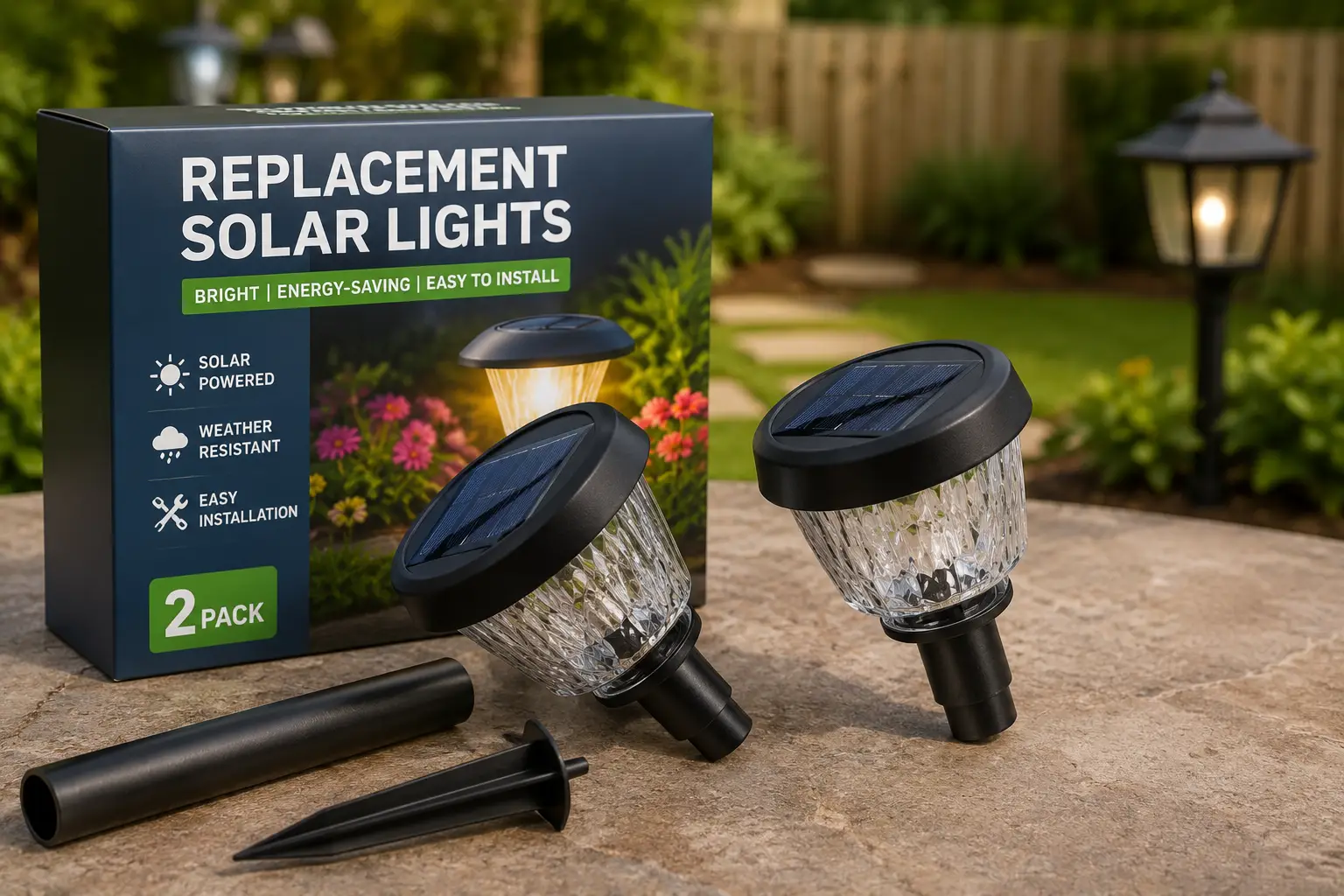
Most “solar batteries” are generic NiMH cells with a sun printed on the label; the Tenergy Solla AA is one of the few designed around how solar lights actually behave.
Tenergy rates the cells at 1,000mAh and claims up to 2,000 charge cycles, plus what it calls Solar PRO technology to resist leaking from summer overcharging and dying during long cloudy stretches. In practice, that targets the two classic failure modes of yard lights: swollen, crusty cells in August and dead lights in November. The cells are UL certified, which matters when something sits outside charging unsupervised for years.
Based on comparing the specs, this is the pick for anyone replacing the cheap 600mAh cells that ship with most solar path lights. The 1,000mAh rating is a sweet spot: high enough for longer runtimes, low enough that a small light panel can realistically fill it on a sunny day.
Reviews consistently report reliable all-season performance, though a minority of buyers say the cells lasted no longer than generic replacements.
Pros:
Engineered for the overcharge cycles of solar lights
UL certified for outdoor peace of mind
Claimed 2,000 cycles beats typical solar cells
Cons:
Lower capacity than general-purpose NiMH cells
Some buyers saw no lifespan gain over generics
Usually around $15–$25 for a 12-pack — excellent value if it spares you yearly replacements.
Tenergy Solla AASee current price, sizes and reviews on Amazon.
The Panasonic eneloop AA earns its spot through a quiet superpower: it barely loses charge sitting in a drawer.
Panasonic states these cells are pre-charged at its factory in Japan using solar-generated power, deliver 2,000mAh typical (1,900mAh minimum), recharge up to 2,100 times, and retain about 70% of their charge after 10 years in storage. They’re also rated down to −4°F. What that means for you: a flashlight in your go-bag still works when the storm hits, even if you forgot about it since last hurricane season.
Here’s what to weigh honestly. The “solar” part is mostly the factory pre-charge; day to day, you’ll recharge them in a standard NiMH charger or a solar AA charger. Inside a basic garden light with a tiny panel, the high capacity may rarely fill completely — the Tenergy Solla AA is the better fit there.
We couldn’t verify a current aggregated review score for this exact pack, so lean on the published specs and Panasonic’s long track record.
Pros:
About 70% charge retained after 10 years
Up to 2,100 recharge cycles per cell
Works in freezing weather down to −4°F
Cons:
Costs more per cell than solar-light batteries
Small light panels may never fully charge them
Typically around $20–$30 for an 8-pack — the best long-term value for emergency kits.
Panasonic eneloop AASee current price, sizes and reviews on Amazon.
The BLAVOR 10,000mAh Solar Power Bank is what most people picture when they hear “solar charger”: a rugged brick that fits a jacket pocket.
It pairs a 10,000mAh lithium-cobalt cell with 20W USB-C fast charging, Qi wireless charging, dual flashlights, and an IPX5 water-resistance rating. Translation: it fully tops up a typical smartphone roughly twice, survives rain on a trail, and doubles as a camp light.
Now the honest part. A panel this small produces a trickle, and BLAVOR’s own listings advise using a cable as the main charging method and solar as an emergency backup. Treat the panel as a top-up for a dead-battery emergency, not a way to refill the whole bank.
Aggregated reviews praise the fast charging, flashlight, and build quality; the common complaints are slow solar charging, more weight than expected, and inconsistent wireless charging for some phones.
Pros:
20W USB-C charges phones quickly
IPX5 rating handles rain and dust
Qi wireless pad frees you from cables
Cons:
Solar panel is a backup, not a primary charger
Wireless charging can be finicky with some cases
Usually around $25–$40 — a fair price for a rugged everyday bank with a solar safety net.
BLAVOR 10,000mAh Solar Power BankSee current price, sizes and reviews on Amazon.
Where the BLAVOR 10,000mAh Solar Power Bank has one panel, the Hiluckey 25,000mAh Solar Charger (model HI-S025) unfolds four, which changes the math noticeably.
Who is it for? Backpackers and campers who spend three or more days away from outlets and want to claw back some energy each afternoon. On paper, a full solar refill of 25,000mAh still takes several sunny days, so start every trip at 100% from the wall.
Reviews and testers agree it works, but flag the weight, durability of the hinges, the lack of built-in cables, and the fact that the battery sits in the sun’s heat while charging.
Pros:
Four panels collect far more than single-panel banks
Large 25,000mAh capacity for long trips
Built-in flashlight for camp and emergencies
Cons:
Heavy and bulky for ultralight packs
Battery heats up while sitting in the sun
Typically around $30–$50 — strong value per watt-hour among solar power banks.
Hiluckey 25,000mAh Solar ChargerSee current price, sizes and reviews on Amazon.
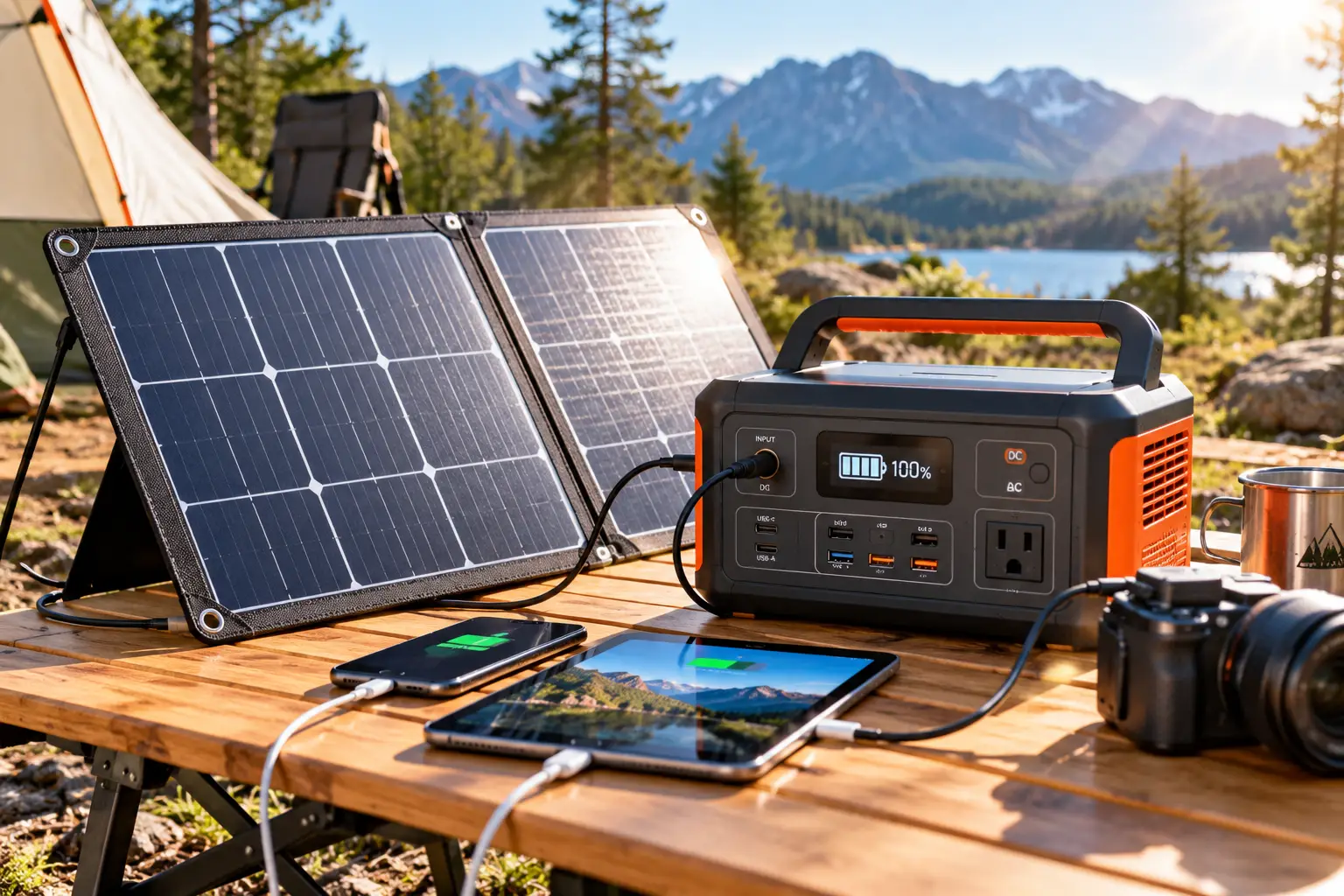
The Jackery Solar Generator 300 Plus bundles the Explorer 300 Plus power station with a book-sized SolarSaga 40W Mini panel, and it’s the smallest kit here that runs things with a wall plug.
The station stores 288Wh in LiFePO4 cells and delivers 300W continuous (600W surge) through a pure sine wave inverter, plus a 100W USB-C port. That’s enough for a laptop, CPAP, string lights, or a Wi-Fi router — not a coffee maker or space heater. The station weighs about 8.3 lb (3.75 kg), and the bundle comes in around 11 lb, so it truly fits a backpack. It also has Wi-Fi and Bluetooth app control.
What most buyers overlook: the included 40W panel needs roughly 9.5 hours of good sun for a full charge, versus about 2 hours from the wall. It’s a trickle-and-top-up setup unless you add a bigger SolarSaga panel. Note that published cycle ratings vary by listing (Jackery commonly cites 3,000 cycles to 80%); check the current spec sheet before buying.
Independent reviewers consistently praise how portable it is for its capacity, while noting it’s built for small electronics rather than appliances.
Pros:
Genuinely backpack-portable at about 11 lb
LiFePO4 cells built for long service life
100W USB-C powers most laptops directly
Cons:
40W panel is slow for full recharges
300W limit rules out kitchen appliances
Usually in the $300–$450 range depending on bundle — fair for a complete, ready-to-go kit.
Jackery Solar Generator 300 PlusSee current price, sizes and reviews on Amazon.
The EcoFlow RIVER 3 Plus matches the Jackery Solar Generator 300 Plus on capacity but doubles its muscle and drinks sunlight far faster.
It holds 286Wh of LiFePO4 storage rated for 3,000 cycles to 80%, outputs 600W (1,200W with X-Boost for resistive loads), and accepts up to 220W of solar input — EcoFlow quotes a full solar charge in as little as 1.5 hours with enough panel. It also acts as a UPS with a sub-10ms switchover, runs under 30dB, weighs 10.4 lb, and expands to 858Wh with an extra battery.
Based on comparing the specs, this is the one for people who want a single unit to guard a home router or desktop during short outages and recharge quickly from solar during the day. The ratio of solar input to capacity is the standout.
Reviews back this up: one hands-on review found a small 45W panel needed close to eight hours from 10%, while testers praised how fast it refills with bigger panels. Critics note two of the three AC outlets sit on the back and that X-Boost claims oversell what it can run.
Pros:
220W solar input refills remarkably fast
Under-10ms UPS protects routers and PCs
Expandable to 858Wh as needs grow
Cons:
Panel usually sold separately or in bundles
Rear-facing AC outlets are awkward in tight spaces
Roughly $250–$450 for the station alone — excellent value for its solar speed.
EcoFlow RIVER 3 PlusSee current price, sizes and reviews on Amazon.
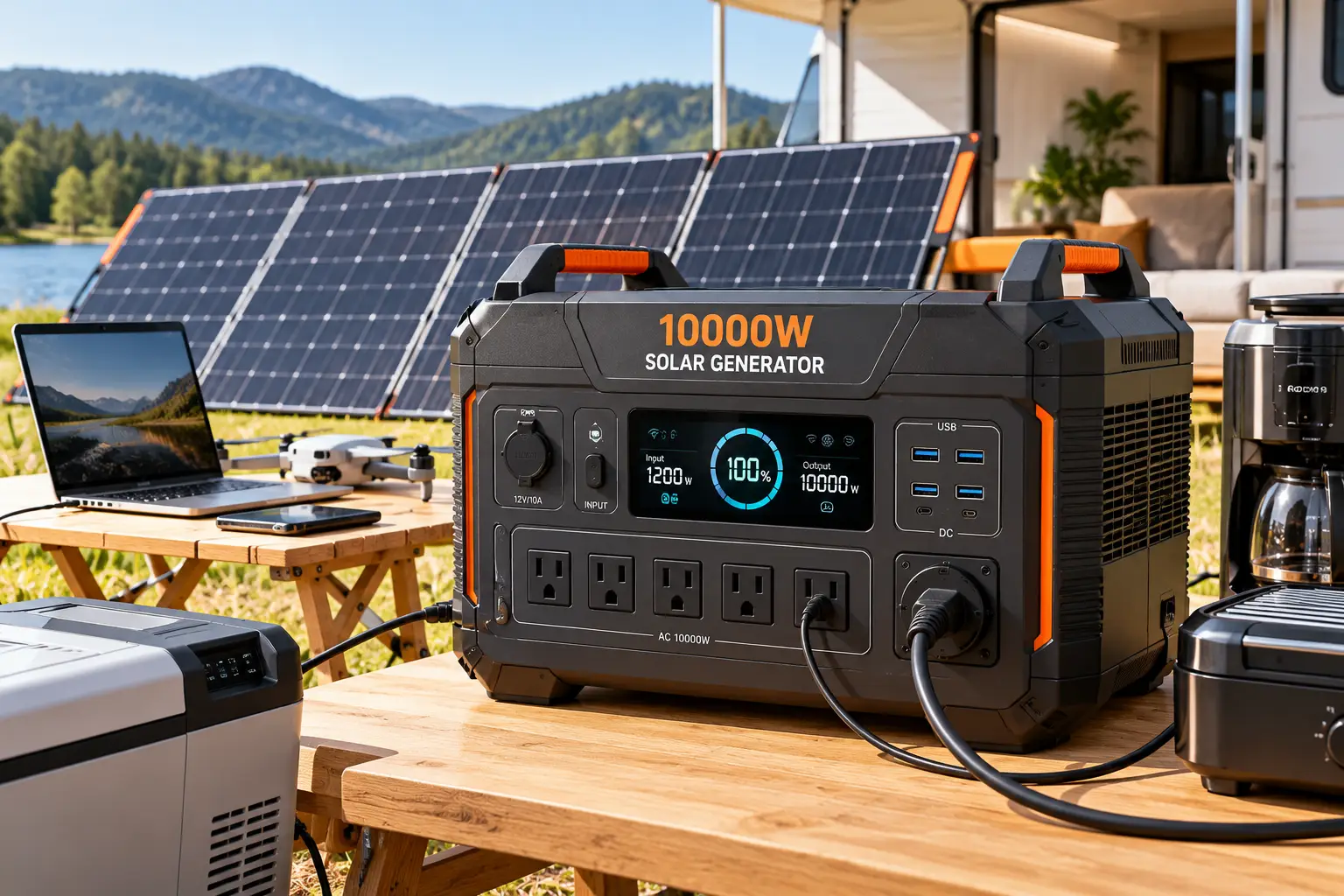
The Anker SOLIX C1000 is the heavyweight here, and the only pick built to keep a refrigerator, sump pump, or small power tool running through a long outage.
It packs 1,056Wh of LiFePO4 rated for 3,000 cycles to 80%, delivers 1,800W continuous (2,400W with SurgePad for compatible loads), and accepts up to 600W of solar through an 11–60V MPPT input — Anker quotes a full solar recharge in about 1.8 hours with enough panels, and 58 minutes from the wall. A UPS switchover under 20ms, expansion to 2,112Wh, and a 5-year warranty round it out. Anker states it’s certified to UL 1012, UL 1778, UL 1973, and UL 60730 by SGS.
The tradeoff is weight: 28.44 lb is portable in the “car trunk” sense, not the “hiking trail” sense. On paper, 1,056Wh can run a typical modern fridge for a large part of a day, depending on its actual draw.
Reviewers frequently rank it among the best all-round solar generators. Note a Gen 2 version also exists; compare both before buying.
Pros:
1,800W output handles real household appliances
600W solar input recharges in under two hours
Five-year warranty signals long-term confidence
Cons:
28 lb makes it a car-or-home unit
Needs costly panels to use full solar input
Frequently between $400 and $800 depending on promotions — check the current price; outstanding value per watt-hour.
Anker SOLIX C1000See current price, sizes and reviews on Amazon.
Jackery Solar Generator 300 Plus: light car camping
EcoFlow RIVER 3 Plus
LiFePO4
3,000 to 80%
10.4 lb
220W
EcoFlow RIVER 3 Plus: fast solar, home UPS
Anker SOLIX C1000
LiFePO4
3,000 to 80%
28.44 lb
600W
Anker SOLIX C1000: outages, RVs
The cycle column tells a quiet story: every LiFePO4 station is rated for thousands of cycles, while the two power banks don’t clearly publish theirs — a hint that long life isn’t their selling point. The solar column is even more decisive. The EcoFlow RIVER 3 Plus and Anker SOLIX C1000 can actually live on sunshine, whereas the power banks treat solar as an emergency trickle.
Don’t miss these smart picks!
Take your backup power to the next level with this carefully curated lineup. Click a highlighted product to check current pricing and availability — the right pick keeps your lights, phones, and fridge running when the grid doesn’t!
Getting Started: Your First 30 Days With Solar Rechargeable Batteries
The first month decides whether your new gear lasts a decade or disappoints by spring. Here’s a simple routine that works for every category above.
Days 1–2: Charge from the wall first
Top up power banks and power stations to 100% on AC or USB-C before relying on the sun. Small panels are for maintenance, not first fills. For NiMH cells, give the Panasonic eneloop AA a full charger cycle if they’ve been stored; drop the Tenergy Solla AA straight into your lights on a sunny morning.
Days 3–7: Learn your real solar numbers
Set the panel facing south (in the US), tilted toward the sun, with zero shade on any cell — even a branch shadow can slash output. Check the input wattage shown on the EcoFlow RIVER 3 Plus or Anker SOLIX C1000 display at noon. That number, not the panel’s label, is your planning baseline.
Weeks 2–3: Do a mock outage
Unplug your router, charge two phones, and run a lamp from the station for one evening. Note the remaining percentage. Now you know your real runtime instead of guessing during a storm.
Week 4: Set a maintenance rhythm
Store lithium gear around 50–80% charge if unused for months
Top up stations every three months, as manufacturers generally recommend
Wipe panels with a damp cloth; dust quietly steals output
Swap all cells in a solar light at once, never one old with one new
Common first-month mistakes: leaving a power bank baking on a car dashboard, charging lithium gear below freezing, and assuming the panel’s “40W” means 40W all day. Real-world output is usually well below the label.
Real-World Scenarios: Which Solar Battery Fits Your Life?
Specs are abstract until you map them onto a real week. Here are three common US buyer profiles and the reasoning behind each match.
The suburban homeowner (budget: under $40)
You have 12 solar path lights that fade by 9 p.m. and a junk drawer of dead AAs. Swap the light cells for the Tenergy Solla AA, then keep an 8-pack of Panasonic eneloop AA charged for flashlights and remotes. Use frequency: nightly lights, occasional emergencies. Total spend stays modest, and both chemistries tolerate years of slow cycling.
The weekend camper (budget: $40–$450)
You camp two or three weekends a month and want phones, a headlamp, and a speaker alive for three days. A Hiluckey 25,000mAh Solar Charger covers phones on short hikes. If you car-camp and want to run a CPAP or laptop, step up to the Jackery Solar Generator 300 Plus — the included 40W panel slows the drain, and the 288Wh battery covers a typical CPAP for a night or two, depending on humidifier use.
The outage-prone household (budget: $400–$1,000+)
You lose power several times a year, sometimes for a full day. The Anker SOLIX C1000 can run a fridge, lights, and phone charging, and its 600W solar input means real recharging between outages. If your concern is mostly a router and a work laptop, the EcoFlow RIVER 3 Plus with its fast UPS switchover is the leaner, cheaper answer.
Problem → Solution: Fixing Common Solar Battery Headaches
Most “broken” solar gear isn’t broken at all. Here are five frequent complaints and what usually fixes them.
Solar lights die after an hour. The factory cells are likely tired 600mAh NiCd or NiMH. Replace them with the Tenergy Solla AA and clean the light’s panel — a hazy cover can cut charging substantially.
My power bank barely charges in the sun. That’s physics, not a defect. A small built-in panel collects only a trickle, so a full refill of the BLAVOR 10,000mAh Solar Power Bank from sunlight alone can take many sunny days. Charge from the wall before trips; treat solar as backup.
The power station shows far less solar input than the panel’s rating. Check for shade, heat, and angle. Panels lose efficiency when hot, and a flat panel at noon in winter underperforms. Tilt it toward the sun and re-aim every couple of hours.
The device shuts off when I plug in a kettle. You’ve exceeded the inverter’s continuous rating. The Jackery Solar Generator 300 Plus tops out at 300W; heating appliances need something like the Anker SOLIX C1000.
NiMH cells seem to lose charge in storage. Standard NiMH self-discharges faster than low self-discharge types. For drawers and go-bags, use the Panasonic eneloop AA, which holds most of its charge for years.
How to Choose a Solar Powered Rechargeable Battery
Choosing well comes down to matching energy, power, and solar speed to what you’ll actually run. Follow these seven steps in order.
List your devices and their watts. A phone needs roughly 10–20Wh per charge; a laptop maybe 50–100Wh; a fridge can use well over 1,000Wh a day. This one list eliminates most wrong choices.
Pick the category. Cells for lights and remotes, a solar power bank for phones, a portable solar generator for anything with a plug.
Size capacity with a buffer. Add about 20% to your daily total, because inverters and conversions lose energy along the way.
Check continuous output, not surge. The continuous rating must exceed your biggest device’s draw. Surge only covers startup spikes.
Compare solar input to capacity. A 220W input on a 286Wh battery, as on the EcoFlow RIVER 3 Plus, means same-day refills; a tiny panel on a big bank means days.
Prefer LiFePO4 for anything you’ll keep. It’s rated for thousands of cycles and runs cooler than lithium-cobalt.
Verify safety listings and warranty. UL certification and a multi-year warranty, like the five years on the Anker SOLIX C1000, signal a maker that expects the product to last.
Common Mistakes to Avoid When Buying Solar Rechargeable Batteries
The most expensive mistakes are rarely about brand. They’re about expectations.
Mistake 1: Trusting the panel to do the heavy lifting on a power bank. Manufacturers themselves, including BLAVOR, describe built-in panels as backup charging. If you need real solar independence, buy a separate folding panel and a station with proper input.
Mistake 2: Mixing mAh and Wh. A “25,000mAh” bank sounds bigger than a “288Wh” station, but at a nominal 3.7V that bank stores roughly 92Wh — about a third of the Jackery Solar Generator 300 Plus. Always convert to watt-hours before comparing.
Mistake 3: Buying rechargeable batteries for solar lights by capacity alone. A 2,500mAh cell in a light with a tiny panel may never fill up, which can shorten its life. Match the capacity to the panel; the Tenergy Solla AA at 1,000mAh exists for exactly this reason.
Mistake 4: Ignoring weight. The Anker SOLIX C1000 is superb, but at over 28 lb it won’t go up a trail. Buy for where the battery will actually live.
Mistake 5: Chasing “peak” numbers. Surge, X-Boost, and SurgePad modes help with startup spikes or resistive loads; they don’t turn a 600W unit into a 1,200W one for everything.
Solar Power Bank vs. Portable Solar Generator vs. Traditional Alternatives
Solar gear competes with two old habits: disposable alkaline batteries and gas generators. Here’s how they stack up.
Option
Fuel cost
Noise
Indoor use
Lifespan
Best for
Disposable alkaline AA
Buy new every time
Silent
Yes
Single use
Rarely used remotes
Panasonic eneloop AA / Tenergy Solla AA
Sun or outlet
Silent
Yes
Up to ~2,000 cycles
Panasonic eneloop AA: everyday small devices
Hiluckey 25,000mAh Solar Charger
Sun or outlet
Silent
Yes
Typically a few hundred cycles for lithium banks
Hiluckey 25,000mAh Solar Charger: phones off-grid
Anker SOLIX C1000
Sun or outlet
Near-silent (fans)
Yes
3,000 cycles to 80%
Anker SOLIX C1000: home backup
Gas generator
Ongoing gasoline
Loud
Never — carbon monoxide risk
Engine maintenance
Very high, sustained loads
The clearest advantage of a solar powered rechargeable battery over a gas generator is safety: battery stations produce no exhaust, so they can sit indoors beside the fridge. Gas generators still win on sheer sustained power and refueling speed, but for most households the Anker SOLIX C1000 covers essentials without the fumes. Against alkalines, rechargeables like the Panasonic eneloop AA win on cost after only a handful of charges.
The written verdict
A solar power bank is a phone insurance policy; a portable solar generator is a small energy system. If you’re torn between the BLAVOR 10,000mAh Solar Power Bank and the Jackery Solar Generator 300 Plus, ask one question: “Do I need a wall outlet?” If yes, only the station answers it.
Features That Actually Matter (and Ones That Don’t)
Marketing pages shout about everything. Here’s where to focus.
Matters a lot:
MPPT charge controller. It squeezes more energy from panels in changing light; the Anker SOLIX C1000 and EcoFlow RIVER 3 Plus both advertise MPPT input.
Pure sine wave AC. Sensitive electronics like CPAP machines and laptop chargers run cleanly on it.
UPS switchover time. Under 20ms keeps most PCs and routers from rebooting during a blackout.
Low self-discharge (for cells). It’s why the Panasonic eneloop AA is ready when you need it.
Matters less than you think:
Built-in solar on small power banks. Nice in an emergency, irrelevant for daily charging.
App control. Handy for monitoring, but the buttons work fine.
Wireless Qi charging. Convenient, yet slower and less efficient than a cable.
One underrated feature: a dedicated solar battery charger for AA/AAA cells. Pairing a small USB solar panel with a quality NiMH charger lets you refill Panasonic eneloop AA cells off-grid — a lightweight alternative to carrying a power station.
Long-Term Cost and Maintenance: The Real Value Math
Sticker price misleads. Cost per cycle tells you what you actually pay for stored energy over the product’s life.
Product
Approx. price used
Rated cycles
Approx. cost per full cycle
Best for
Tenergy Solla AA
~$20 / 12 cells
2,000 (claimed)
Well under 1¢ per cell
Tenergy Solla AA: lowest running cost
Panasonic eneloop AA
~$25 / 8 cells
2,100
Under 1¢ per cell
Panasonic eneloop AA: storage-heavy use
EcoFlow RIVER 3 Plus
~$350
3,000
About 12¢
EcoFlow RIVER 3 Plus: frequent small loads
Anker SOLIX C1000
~$600
3,000
About 20¢
Anker SOLIX C1000: most energy per dollar
These figures use mid-range prices at the time of writing and assume you reach the rated cycle count, which real-world heat and storage habits can reduce. Even so, the pattern holds: the Anker SOLIX C1000 stores almost four times the energy of the EcoFlow RIVER 3 Plus for well under twice the per-cycle cost, making it the stronger buy if you’ll use the capacity. For cells, both NiMH options pay for themselves after a few dozen charges versus disposables.
Maintenance that protects your investment: keep lithium gear between roughly 32°F and 104°F when charging, avoid storing it at 0% or 100% for months, and inspect cables and ports twice a year. Panels last longest when stored dry and folded, out of direct summer heat.
Safety, Regulations, and Standards in the US
Lithium batteries store a lot of energy in a small space, so certification and handling matter.
Look for third-party listings. UL standards like UL 2056 (power banks), UL 2743 (portable power packs), and UL 1973 (stationary batteries) indicate independent safety testing. Anker, for example, lists UL certifications for the Anker SOLIX C1000, and Tenergy notes UL certification on the Tenergy Solla AA. FCC compliance covers electromagnetic interference.
Check recalls before you buy. The Consumer Product Safety Commission publishes a searchable database of recalled products, including power banks and lithium battery packs. A two-minute search can prevent a costly — or dangerous — purchase.
Charge smart:
Use the charger and cables supplied or approved by the maker
Don’t charge on beds, sofas, or other flammable surfaces
Stop using any battery that swells, smells, or gets unusually hot
Keep power banks out of hot cars in summer
Flying with batteries: under FAA rules, spare lithium batteries and power banks belong in carry-on bags, and those up to 100Wh are generally allowed without airline approval. The BLAVOR 10,000mAh Solar Power Bank and Hiluckey 25,000mAh Solar Charger fall under that line; power stations like the Jackery Solar Generator 300 Plus exceed it and typically can’t fly.
FAQ: Solar Powered Rechargeable Battery Buying Questions
Can I use regular rechargeable batteries in solar lights?
Yes, as long as the chemistry and voltage match — most solar lights use 1.2V NiMH. Avoid swapping in alkaline cells, which can't recharge. Purpose-built cells like the Tenergy Solla AA are sized for small light panels, so they fill more completely each day.
How long does a solar power bank take to charge in the sun?
Usually several days for a full charge. A built-in panel produces only a trickle, so a 10,000mAh bank may need many sunny days from empty. Charge it from the wall before trips and use the sun to top up.
Is a portable solar generator worth buying for power outages?
For most households, yes. A 1,000Wh-class unit like the Anker SOLIX C1000 keeps a fridge, lights, and phones going for part of a day, runs safely indoors, and recharges from panels between outages without buying fuel.
Can I bring a solar power bank on a plane in the US?
Generally yes, in carry-on only. FAA rules allow lithium power banks up to 100Wh without airline approval, which covers the BLAVOR 10,000mAh Solar Power Bank. Larger power stations usually exceed limits, so check your airline before flying.
Do solar rechargeable batteries work in winter?
They work, but more slowly. Shorter days and low sun angles cut panel output, and cold reduces battery performance. NiMH cells like the Panasonic eneloop AA handle cold well; avoid charging lithium gear below freezing.
Conclusion: Pick the Battery That Matches Your Real Needs
The best solar powered rechargeable battery isn’t the biggest one — it’s the one sized to your actual devices and your actual sunshine.
If your goal is brighter yard lights, the Tenergy Solla AA is a cheap, purpose-built fix, and the Panasonic eneloop AA is the smartest cell for emergency kits thanks to its long shelf life. For phones on the go, the BLAVOR 10,000mAh Solar Power Bank is a rugged everyday carry, while the Hiluckey 25,000mAh Solar Charger suits multi-day trips — just treat their panels as backup.
Once you need real outlets, the math changes. The Jackery Solar Generator 300 Plus is the most portable complete kit, the EcoFlow RIVER 3 Plus is the speed champion for solar refills, and the Anker SOLIX C1000 is the one to trust when the grid goes down for a day.
Whichever you choose, buy UL-listed gear, check for recalls, and plan for the end of its life too. When a lithium battery finally wears out, follow the EPA’s guidance on used lithium-ion batteries: take it to a battery collection site or household hazardous waste drop-off, never the trash or curbside bin.
Ready to power up with the sun?
Take your energy independence to the next level with this carefully curated lineup. Click a highlighted product to check current pricing and availability. These picks will help you stay charged, connected, and comfortable — whatever the grid decides to do!
Disclaimer: This post contains affiliate links. As an Amazon Associate, I earn from qualifying purchases made through these links, at no additional cost to you.
Found this article helpful? Share it with someone who needs it!