In This Article
What Is a USB Powered Solar Panel?
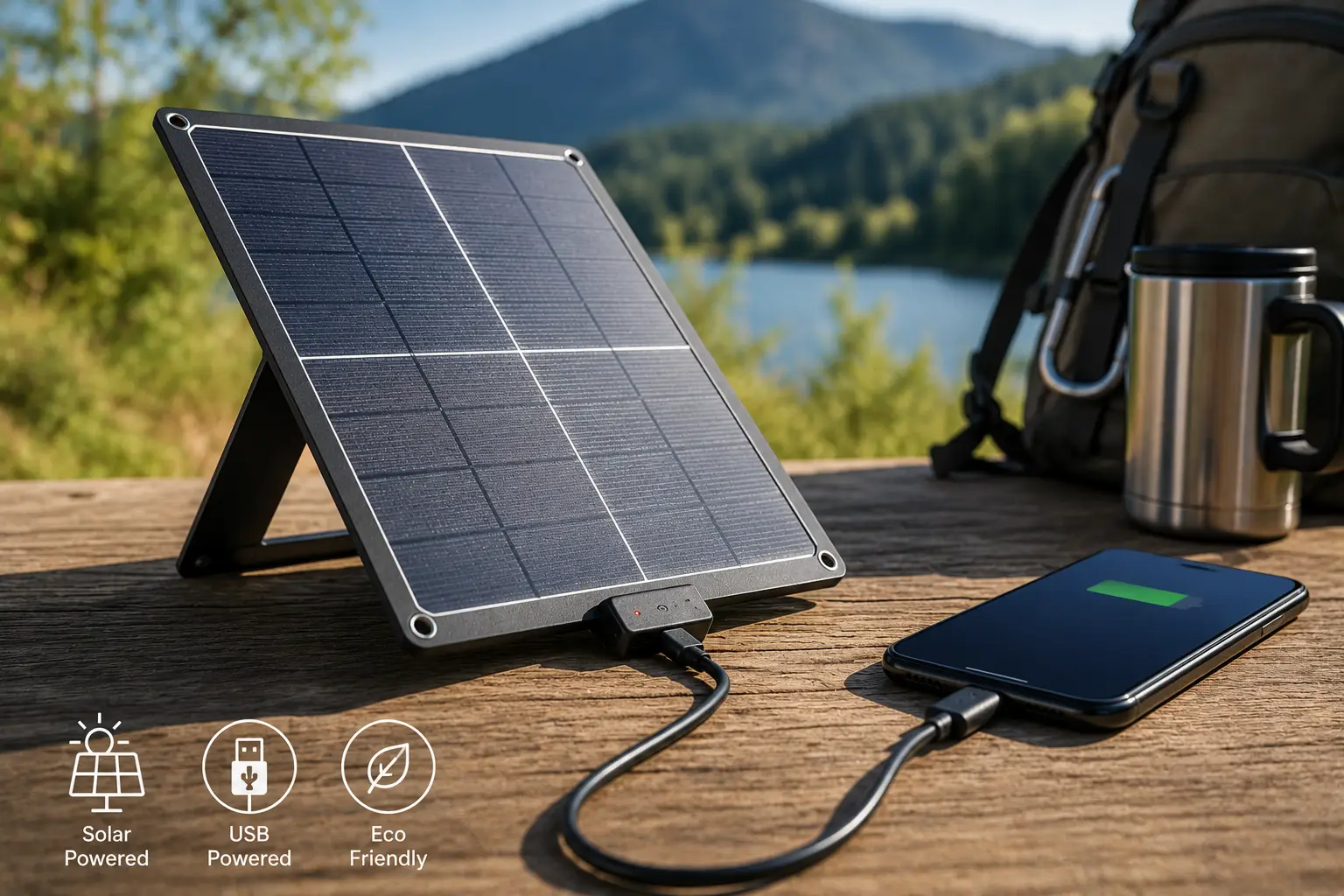
A USB powered solar panel is a portable solar panel designed to convert sunlight into electrical power that can be delivered through a USB-A or USB-C connection. Unlike a traditional rooftop solar system, these compact panels are designed primarily for portable electronics such as smartphones, tablets, GPS devices, cameras, and power banks.
The biggest advantage is portability. You don’t need a wall outlet when you’re camping, hiking, traveling, or dealing with a temporary power outage. Place the panel in direct sunlight, connect a compatible USB cable, and it can provide power to your device.
However, a solar panel doesn’t behave exactly like a wall charger. Its output changes with sunlight, panel angle, cloud cover, temperature, and shading. Current portable-solar testing also emphasizes that the rated wattage is not necessarily the wattage you’ll see continuously in real-world conditions. (GearLab)
Some USB powered solar panels are extremely compact, such as 5W panels designed for lightweight travel. Others use multiple foldable panels and can provide 20W, 28W, 60W, or more for larger devices and power stations.
For example, Goal Zero’s Nomad 5 provides 5W through a USB output, while OSRAM’s BATTERYcharge SOLAR 20W provides USB-A and USB-C charging and is designed for portable off-grid use. (Goal Zero)
The key is choosing the right output for your actual device. A small panel may be perfect for maintaining a power bank during a hike but frustrating if you’re expecting it to charge a laptop quickly.
This guide compares seven USB powered solar panel options and explains what actually matters: wattage, USB output, portability, weather resistance, charging speed, panel efficiency, direct-sunlight performance, and whether you should connect the panel directly to your device or use a power bank as an intermediary.
Quick Comparison: Top USB Powered Solar Panel Options at a Glance
| Product | Output | Main Feature | Best For |
|---|---|---|---|
| Goal Zero Nomad 5 | 5W | Compact USB panel | Backpacking |
| Choetech SC005 | 22W | Dual USB output | Phones & tablets |
| BigBlue SolarPowa 28 | 28W | Foldable multi-panel design | Camping |
| OSRAM BATTERYcharge SOLAR 20W | 20W | USB-A + USB-C | Travel |
| Choetech SC007 | 80W | USB + DC outputs | Camping & RV |
| Choetech SC008-V2 | 120W | USB-C PD + USB-A + DC | Power stations |
| Choetech SC010 | 160W | High-output foldable panel | Off-grid power |
The table shows that the most important difference isn’t simply price — it’s output and intended use.
A 5W panel is lightweight and easy to carry but isn’t designed to power demanding devices quickly. A 20–30W panel is more versatile for phones, tablets, and power banks, while 80W–160W panels are better suited to camping setups and portable power stations.
For example, the Choetech SC007 provides an 80W DC output alongside USB-A and USB-C outputs, while the SC008-V2 increases the maximum rated output to 120W and adds USB-C PD up to 60W. (Choetech Vietnam Official Store)
💬 Bookmark this comparison — it’s the fastest way to see which USB powered solar panel matches your device, travel style, and required charging speed.
Top 7 USB Powered Solar Panel Options: Expert Analysis
1. Goal Zero Nomad 5 — best compact USB powered solar panel
The Goal Zero Nomad 5 is one of the simplest options if portability matters more than charging speed.
It uses a 5W monocrystalline panel and includes a built-in kickstand and USB output. Goal Zero specifically positions it as a lightweight solution for charging devices outdoors. (Goal Zero)
The compact size makes it particularly attractive for backpacking, hiking, and emergency kits where every gram and centimeter matters.
The main limitation is output. Five watts is enough for maintaining smaller devices or charging a power bank in suitable sunlight, but you shouldn’t expect the performance of a large 100W portable panel.
Goal Zero also recommends pairing the Nomad 5 with a Flip 12 power bank, highlighting an important concept with portable solar: storing energy in a battery can make your charging experience more reliable when sunlight changes. (Goal Zero)
Pros:
- ✅ Very portable
- ✅ 5W monocrystalline panel
- ✅ Built-in kickstand
- ✅ USB output
- ✅ Simple setup
- Cons:
- ❌ Limited power output
- ❌ Not ideal for multiple devices
- ❌ Best suited to small electronics
If you’re looking for the smallest practical USB powered solar panel, this is a strong starting point.
2. Choetech SC005 22W — best for phones and tablets
The Choetech SC005 offers substantially more output than a small 5W panel while remaining designed for portable use.
The manufacturer lists it as a 22W foldable solar charger with two USB outputs and support for USB devices including phones, tablets, GPS devices, GoPro cameras, and digital cameras. It also uses a Smart IC system with protections against overcharging, overheating, and short circuits. (Choetech Vietnam Official Store)
The foldable construction is useful because you can carry it like a compact panel and unfold it when you need solar power.
The dual USB output is particularly useful when two small devices need charging at the same time, although actual solar output will depend heavily on sunlight.
Pros:
- ✅ 22W rated output
- ✅ Dual USB ports
- ✅ Foldable design
- ✅ Smart IC protection
- ✅ Suitable for phones and tablets
- Cons:
- ❌ Solar output varies with conditions
- ❌ Direct charging can fluctuate
- ❌ Not intended for large power stations
For everyday travel and camping, the SC005 is a practical middle ground between tiny panels and much larger solar arrays.
3. BigBlue SolarPowa 28 — best camping option
The BigBlue SolarPowa 28 is designed for users who want more output without jumping all the way into large 60W or 100W panels.
Current 2026 portable-solar comparisons identify the SolarPowa 28 as a strong USB-focused option for camping, with a 28W rating and multiple USB outputs. (Daily Vanguard)
Its foldable multi-panel format gives you more solar collection area while remaining portable enough for camping and travel.
The larger output also makes it more appropriate for maintaining multiple small devices than a 5W panel.
However, as with any portable solar charger, the 28W rating represents a maximum under suitable conditions rather than a guaranteed continuous charging rate.
Pros:
- ✅ 28W rated output
- ✅ Foldable design
- ✅ Multiple USB outputs
- ✅ Good for camping
- ✅ More power than compact 5W–10W panels
Cons:
- ❌ Larger than ultralight panels
- ❌ Output varies with sunlight
- ❌ Direct phone charging can be inconsistent in changing weather
If you want a versatile USB powered solar panel for camping, 28W is a useful capacity to consider.
4. OSRAM BATTERYcharge SOLAR 20W — best travel option
The OSRAM BATTERYcharge SOLAR 20W is a compact foldable panel designed for portable off-grid charging.
OSRAM lists a 20W monocrystalline panel with USB-A and USB-C outputs, 5V/2.4A charging, an integrated stand, and an IP65-rated water-resistant enclosure. The unit weighs approximately 0.8 kg. (Osram)
One particularly useful feature is the integrated stand. Panel positioning matters significantly because the amount of energy collected depends on how effectively the panel is exposed to sunlight.
OSRAM also states that the product can provide power in overcast conditions, although cloudy conditions will generally affect available solar energy and charging performance. (Osram)
Pros:
- ✅ 20W solar output
- ✅ USB-A and USB-C
- ✅ IP65 water resistance
- ✅ Lightweight
- ✅ Integrated stand
- Cons:
- ❌ 20W is limited for large electronics
- ❌ Cloud cover still reduces available power
- ❌ Best suited to smaller devices
For travel, hiking, and emergency charging, this is a balanced USB powered solar panel.
5. Choetech SC007 80W — best for camping and RV use
If you need considerably more power, the Choetech SC007 moves into a different category.
The manufacturer rates it at 80W and provides a DC output alongside USB-A and USB-C connections. It includes a foldable design and kickstands for positioning the panel outdoors. (Choetech Vietnam Official Store)
The SC007 is particularly interesting because it can charge both ordinary USB devices and compatible portable power stations.
Choetech lists a USB-C PD output up to 30W, a QC 3.0 USB output up to 18W, an additional USB output, and an 80W DC output. (Choetech Vietnam Official Store)
This makes it considerably more versatile than a phone-only solar charger.
Pros:
- ✅ 80W rated solar output
- ✅ USB-A and USB-C
- ✅ DC output
- ✅ Foldable
- ✅ Suitable for power stations
- Cons:
- ❌ Heavier and larger
- ❌ More expensive
- ❌ Overkill for simple phone charging
If you’re building a serious camping or RV charging setup, 80W is a much more useful capacity than a tiny USB panel.
6. Choetech SC008-V2 120W — best high-output USB panel
The Choetech SC008-V2 is designed for users who need significantly more portable solar power.
The manufacturer lists 120W maximum output, 23% cell efficiency, USB-C PD up to 60W, USB-A QC 3.0 up to 18W, and a DC output rated up to 120W. (Choetech Vietnam Official Store)
It also includes multiple connectors intended for portable power stations.
The foldable design allows the panel to be transported relatively easily compared with a rigid 120W panel.
The important distinction is that this is no longer just a “phone charger.” It is closer to a portable solar power system that happens to include USB outputs.
Pros:
- ✅ 120W rated output
- ✅ USB-C PD up to 60W
- ✅ USB-A QC 3.0
- ✅ DC output
- ✅ 23% stated cell efficiency
- Cons:
- ❌ Larger and heavier
- ❌ More expensive
- ❌ Unnecessary for basic phone charging
For portable power stations, laptops, and multi-device camping setups, the SC008-V2 offers considerably more headroom.
7. Choetech SC010 160W — best for high-demand off-grid use
The Choetech SC010 is the highest-output option in this lineup.
Its 160W foldable design is aimed at users who want substantial portable solar generation rather than a small emergency USB charger.
Current product specifications list USB-A output up to 5V/2.4A and USB-C output supporting multiple voltage levels up to 20V/2.25A. The folded dimensions are approximately 545 × 351 × 20 mm and the listed net weight is 6.6 kg. (Choetech Vietnam Official Store)
The weight illustrates the trade-off clearly: more solar collection area means more material to carry.
This type of panel makes sense for extended camping, RV use, emergency power, and portable power-station systems.
Pros:
- ✅ 160W rated output
- ✅ USB-A and USB-C
- ✅ High-output portable design
- ✅ Foldable
- Cons:
- ❌ Much heavier than small USB panels
- ❌ Less suitable for backpacking
- ❌ Higher purchase cost
If your priority is maximum portable output rather than minimal size, the SC010 is the strongest option in this group.
How to Choose a USB Powered Solar Panel
Choosing the right USB powered solar panel starts with your device and charging requirements.
- Check your device’s input. Determine whether you need USB-A, USB-C, or another connection.
- Estimate your required wattage. Phones require much less power than laptops or power stations.
- Choose panel size. Smaller panels are easier to carry but produce less power.
- Look for USB-C PD if needed. USB-C PD can provide higher charging power on compatible devices.
- Consider a power bank. A battery can store energy when the sun is strong and charge your device later.
- Check weather resistance. Outdoor panels should be designed for their intended environment.
- Look at panel efficiency. Higher efficiency can provide more power from a similar physical area.
- Check the foldable dimensions. A panel that is powerful but too large to transport won’t be useful.
- Consider multiple outputs. This matters if you regularly charge several devices.
- Check compatibility with power stations. Larger panels often include DC connectors in addition to USB.
A useful rule is that more watts generally means more size and weight. Don’t buy a 160W panel if all you want to do is keep your phone topped up during a weekend hike.
Common Mistakes to Avoid When Buying a USB Powered Solar Panel
The biggest mistake is assuming that the number printed on the panel is the charging speed you’ll always get.
A panel rated at 28W won’t necessarily produce 28W when placed under a tree, behind a windshield, or under thick clouds. Real-world portable-solar testing shows that output can be substantially lower than rated capacity depending on conditions. (Daily Vanguard)
Another mistake is plugging a phone directly into the panel and expecting uninterrupted charging. Clouds can cause output fluctuations.
For more reliable charging, using a solar panel to charge a power bank first can create a buffer between changing sunlight and your device.
Don’t overlook connector compatibility either. A panel may have USB-A but not the USB-C PD output your laptop requires.
Finally, don’t buy a large high-output panel simply because the wattage looks impressive. For backpacking, a 5W–28W panel may be far more practical than a 120W or 160W system.
USB Powered Solar Panel vs. Solar Power Bank
| Feature | USB Solar Panel | Solar Power Bank |
|---|---|---|
| Direct solar generation | Excellent | Limited |
| Built-in battery | Usually no | Yes |
| Portability | Varies | Excellent |
| Charging in sunlight | Good | Usually slower |
| Night-time charging | No | Yes |
| Best for | Extended outdoor use | Emergency backup |
| Output consistency | Variable | More consistent |
A USB powered solar panel generates electricity when sunlight is available.
A solar power bank adds a battery, which means it can store energy for later.
For serious outdoor use, combining the two can be more practical than relying on direct panel-to-phone charging.
Goal Zero explicitly explains this concept for its Nomad 5: the panel produces power in sunlight but doesn’t itself store energy, so pairing it with a power bank can help keep devices charged when sunlight disappears. (Goal Zero)
USB Powered Solar Panel vs. Portable Power Station
| Feature | USB Solar Panel | Portable Power Station |
|---|---|---|
| Stores electricity | Usually no | Yes |
| USB output | Yes | Usually |
| AC output | Usually no | Yes |
| Portability | Excellent on small models | Moderate |
| Solar input | Built in | Requires solar panel |
| Best for | Small electronics | Larger appliances/electronics |
The distinction is important.
A USB solar panel is a power source.
A portable power station is a battery system that can store energy and provide multiple forms of output.
Larger USB solar panels can feed portable power stations through DC connections. Choetech’s SC007 and SC008-V2, for example, include DC outputs and connectors designed for portable power stations. (Choetech Vietnam Official Store)
USB Powered Solar Panel for Camping
Camping is one of the best use cases for portable solar.
For a lightweight backpacking trip, a 5W or 10W panel may be enough to maintain a phone or small power bank.
For car camping, a 20W–30W foldable panel gives you more flexibility.
For RV trips or extended off-grid stays, 80W–160W panels make more sense because they can feed larger power stations.
Panel positioning matters enormously. Put the panel in unobstructed sunlight and adjust its angle as the sun moves.
Avoid placing it behind glass if maximum performance is the priority. Direct outdoor exposure generally gives the panel better access to available sunlight.
USB Powered Solar Panel for Phones
Phones are among the easiest devices to charge with a portable solar panel.
A small 5W panel can work for maintaining a phone battery, while 14W–28W models provide more useful charging potential.
However, direct phone charging has one major weakness: the phone expects relatively stable power, while solar output can fluctuate.
If clouds repeatedly pass over the panel, charging can slow down or stop.
For that reason, a small power bank can be a useful intermediary:
Solar panel → power bank → phone
This lets the panel collect energy when conditions are favorable while the power bank provides more consistent output to the phone.
USB Powered Solar Panel for Emergency Use
A portable solar panel can also be useful during power outages.
A small panel can maintain phones and USB power banks during daylight.
A larger panel can recharge a compatible portable power station.
The important thing is to have the system ready before an emergency occurs. Keep the cables, adapters, power bank, and panel together so you don’t have to search for compatible accessories when the electricity is already out.
OSRAM’s 20W model, for example, is explicitly positioned for off-grid use and outdoor conditions, while larger Choetech panels are designed to work with portable power stations. (Osram)
How to Get the Most Power From a USB Powered Solar Panel
The panel’s rated wattage isn’t the only factor determining performance.
Direct sunlight is the biggest factor.
Panel angle matters because better alignment with the sun can increase the amount of usable solar energy reaching the cells.
Shade can significantly reduce output.
Heat can also affect solar-panel performance.
Cable resistance becomes more relevant at higher power levels.
Device demand matters too. If your phone is already nearly full, its charging system may reduce the power it draws.
Current field testing of portable solar chargers emphasizes exactly these real-world variables, noting that rated output and actual campsite output can differ substantially. (Daily Vanguard)
Features That Actually Matter
Marketing specifications can make solar panels look complicated, but a few features matter more than everything else.
Wattage tells you how much power the panel is designed to generate under suitable conditions.
USB-C PD matters if you want faster charging or need to support compatible higher-power devices.
Panel efficiency matters when physical size is limited. Choetech’s SC008-V2, for example, lists 23% cell efficiency. (Choetech Vietnam Official Store)
Foldability matters for travel.
Weight matters for backpacking.
Weather resistance matters for outdoor use.
Multiple outputs matter if you need to charge several devices.
And finally, connector compatibility matters if you’re connecting the panel to a power station.
Don’t choose a panel simply because it has the highest wattage. Choose the panel that delivers enough power without becoming impractical to carry.
Long-Term Cost and Maintenance
A USB powered solar panel has a major advantage over disposable battery solutions: sunlight is free.
The main long-term concerns are physical durability, connectors, cables, hinges, and weather exposure.
Foldable panels should be stored carefully to avoid damaging the cells or hinges.
Don’t leave a portable panel exposed to extreme weather beyond its stated rating.
Keep USB and DC connectors clean and dry.
If the manufacturer specifies that certain electronic components are not waterproof, protect those areas even if the exterior fabric or panel surface is water-resistant.
For example, Choetech notes that the junction box on its SC008-V2 is not waterproof and recommends keeping it dry. (Choetech Vietnam Official Store)
Safety and Outdoor Use
Solar panels themselves are relatively straightforward, but the connected electronics still require care.
Don’t expose non-waterproof connectors or junction boxes to rain.
Use cables and adapters rated for the intended power.
Avoid damaged cables.
Don’t place panels where they can be stepped on or bent excessively.
When connecting to a portable power station, verify the station’s accepted input voltage and current range before plugging it in.
Also remember that a solar panel can generate electricity whenever it’s exposed to light. Treat the output connectors as live electrical connections while the panel is illuminated.
What to Expect: Everyday Performance
The best USB powered solar panel should give you useful charging independence without pretending to replace the electrical grid.
On a bright day, a properly positioned panel can steadily generate power for phones, power banks, and other compatible USB devices.
Under clouds or partial shade, charging will be slower.
A small panel is excellent for lightweight travel but won’t replace a large solar generator.
A 20W–30W panel offers a practical middle ground for many campers.
An 80W–160W panel becomes much more useful when you’re feeding a power station or running several devices.
Current 2026 portable-solar testing continues to favor matching panel size to the actual use case rather than choosing solely by rated wattage. (GearLab)
Frequently Asked Questions
❓ Can a USB powered solar panel charge a phone directly?
❓ What size USB powered solar panel is best for a phone?
❓ Can a USB solar panel work on cloudy days?
❓ Do USB solar panels have built-in batteries?
❓ Is a higher-watt USB solar panel always better?
Conclusion
The best USB powered solar panel depends on how much power you actually need and how far you’re willing to carry it.
For ultralight travel, the Goal Zero Nomad 5 is a compact 5W option with a USB output and built-in kickstand. (Goal Zero)
For phones and tablets, the Choetech SC005 22W provides dual USB outputs in a foldable design. (Choetech Vietnam Official Store)
The BigBlue SolarPowa 28 offers more output for camping, while the OSRAM BATTERYcharge SOLAR 20W provides a useful combination of USB-A, USB-C, portability, and weather resistance. (Itechguides)
For more demanding outdoor setups, the Choetech SC007 80W, SC008-V2 120W, and SC010 160W provide progressively greater output and can be used with compatible portable power stations. (Choetech Vietnam Official Store)
The biggest lesson is simple: don’t shop by wattage alone. Consider your device, USB requirements, portability, sunlight conditions, charging strategy, and whether you need a power bank between the panel and your electronics.
For the most reliable portable setup, think of the panel as the energy source and a power bank or power station as the buffer. That combination can make solar charging much more practical when sunlight changes throughout the day.
✨ Don’t miss these exclusive deals! 🔍 Take your outdoor charging setup to the next level with this carefully curated lineup. Compare wattage, USB-A and USB-C outputs, portability, weather resistance, panel efficiency, and power-station compatibility before choosing the USB powered solar panel that best fits your needs!
Recommended for You
- Van Solar Panels: 7 Best Picks for Off-Grid Power (2026)
- 12V Generator Battery: 7 Best Picks for Reliable Starts (2026)
- Smallest Diesel Generator Guide: 7 Best Compact Picks for 2026
Disclaimer: This post contains affiliate links. As an Amazon Associate, I earn from qualifying purchases made through these links, at no additional cost to you.
✨ Found this article helpful? Share it with someone who needs it! 💬🤗