As an Amazon Associate I earn from qualifying purchases. Links in this article may be affiliate links. How we choose gear
Why a 100w pv panel Is Still the Smartest First Step Into Solar
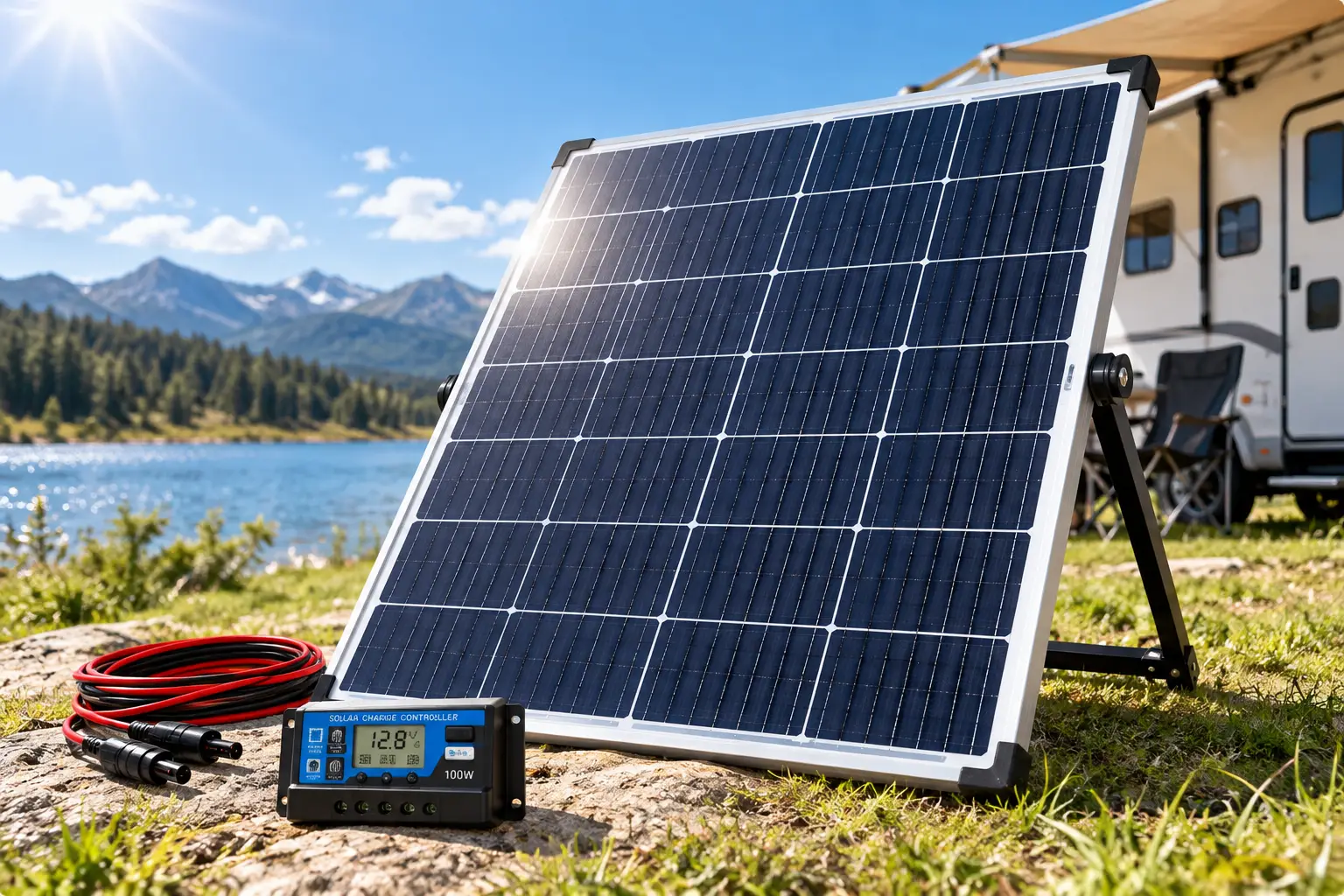
A 100w pv panel is the “starter pack” of solar power, and in 2026 it’s a better deal than ever. You can bolt one onto a camper roof, prop one up beside a tent, or keep one in the garage as insurance against the next storm-season outage. It won’t run your central air, but it will quietly refill a battery while you go about your day, with no fuel, no noise, and no fumes.
Here’s the catch: shopping for a 100 watt solar panel looks simple until you open Amazon and find hundreds of listings that all claim “25% efficiency,” “IP68,” and “perfect for RVs.” Some are rigid glass panels built to live on a roof for two decades. Others are foldable fabric chargers designed for weekend trips. A few are thin, bendable sheets that stick to a curved van roof. Pick the wrong type, and you’ll either overpay for features you don’t need or end up with a panel that can’t survive how you actually use it.
What is a 100w pv panel? It’s a photovoltaic module rated to produce 100 watts under standard lab test conditions: 1,000 watts of sunlight per square meter at a cell temperature of 77°F (25°C). Most are “12V-class” panels meant to charge 12-volt batteries or portable power stations through a charge controller. If you want the underlying science, the overview of photovoltaics on Wikipedia is a solid primer.
In this guide, you’ll find seven real panels available on amazon.com, honest analysis drawn from spec sheets and aggregated buyer feedback, setup and troubleshooting help, and the math you need to know what one panel can actually power.
Quick Comparison: 7 Best 100w pv panel Picks at a Glance
Before the deep dives, here’s the short version. Prices are approximate ranges at the time of writing; always check the current price.
Panel
Type
Key Spec
Approx. Price
Best for
Renogy 100W N-Type 16BB
Rigid glass
25% cell efficiency, N-type
$100–$130
Renogy 100W N-Type 16BB: hot-climate RV roofs
BougeRV 100W 9BB Mono
Rigid glass
21.9% efficiency, half-cut cells
$60–$90
BougeRV 100W 9BB Mono: tight budgets
Rich Solar MEGA 100
Rigid glass
5,400 Pa snow load rating
$110–$130
Rich Solar MEGA 100: cabins and ground mounts
EcoFlow 100W Flexible
Semi-flexible
~5.1 lbs, IP68
$150–$200
EcoFlow 100W Flexible: curved van roofs
Jackery SolarSaga 100W
Foldable portable
USB-A + USB-C onboard
$200–$300
Jackery SolarSaga 100W: Jackery owners
BougeRV Yuma 100W CIGS
Thin-film flexible
~4.3 lbs, shade-tolerant
$230–$280
BougeRV Yuma 100W CIGS: partial shade
Renogy 100W Solar Suitcase
Suitcase kit
20A PWM controller included
$200–$260
Renogy 100W Solar Suitcase: plug-and-play beginners
Looking at the table, the split is really about where the panel lives. If it’s going on a roof permanently, the three rigid options deliver the most watts per dollar, with the BougeRV 100W 9BB Mono winning on price and the Renogy 100W N-Type 16BB winning on heat performance. If it needs to travel, you’re paying a premium for portability, and the Renogy 100W Solar Suitcase is the only pick here that ships with its own controller.
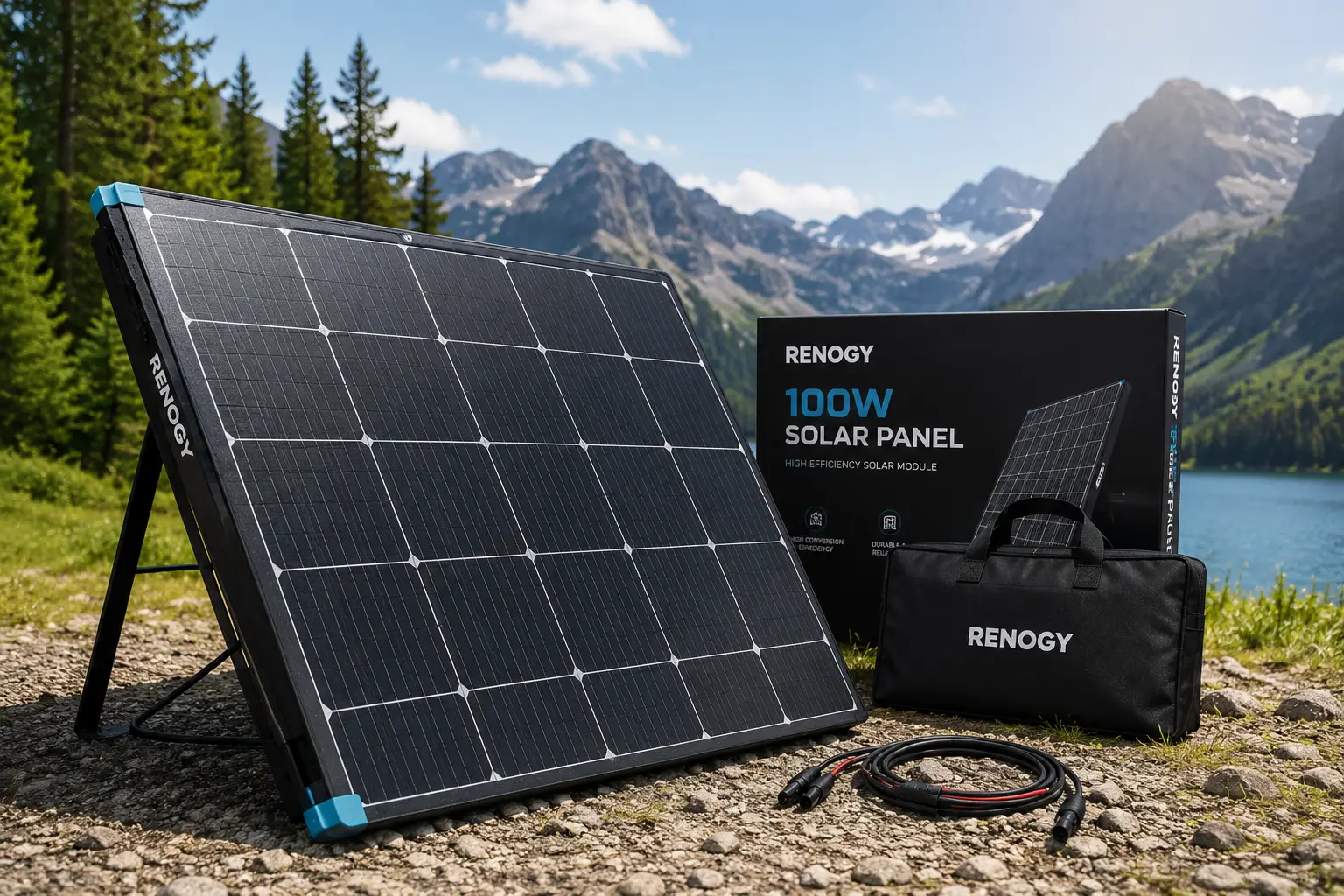
This is the panel that tends to top Amazon’s 100-watt sales rankings, and the spec sheet explains why. Renogy rates its N-type TOPCon cells at 25% efficiency with a temperature coefficient of -0.29%/°C, which matters more than the headline number: on a summer roof where cells hit 113°F (45°C), that coefficient means you lose roughly 6% of output instead of the 8% a typical -0.39%/°C panel loses. Renogy also says it’s 11% smaller and 8% lighter than its older PERC equivalent, which helps when roof space is crowded with vents and AC units.
Based on comparing the specs, this is the default choice for full-timers and weekenders in hot states like Arizona, Texas, and Florida who want one rigid panel now and plan to add more later. The low-iron tempered glass, IP67 connectors, and aluminum frame are standard fare for a roof-mount panel, but the N-type cells should also degrade more slowly than older P-type designs.
Aggregated buyer sentiment, reflected in its sustained best-seller ranking on Amazon, centers on dependable output and easy wiring; the most common caveat is that real-world numbers land below 100W, which is normal physics, not a defect.
Pros:
Excellent temperature coefficient for hot climates
Compact footprint for crowded RV roofs
Easy to expand into a larger array
Cons:
Costs more than basic mono panels
Needs separate controller, cables, and mounts
At around $100–$130, it’s fair value for anyone in a sunny, hot region.
Renogy 100W N-Type 16BBSee current price, sizes and reviews on Amazon.
If your goal is the most watts for the fewest dollars, this is the panel to beat. The BougeRV 100W 9BB Mono uses nine-busbar, half-cut monocrystalline cells rated at 21.9% efficiency. In practical terms, more busbars shorten the path electrons travel, which cuts resistance losses, while half-cut cells reduce the damage a single shaded cell can do to overall output. It also comes with pre-drilled mounting holes, so standard Z-brackets bolt right on.
Here’s what to weigh: 21.9% is a few points below the N-type leaders, so the panel is physically a little larger for the same wattage. That’s irrelevant on a ground mount or shed roof, and only matters if every inch of your RV roof is spoken for. For first-time DIYers building a two- or four-panel array, the savings add up fast.
Deal-hunter discussions show this panel frequently selling in the $60s on promotion, and owners repeatedly praise BougeRV’s customer service, including reports of free replacements for panels damaged in shipping. One recurring complaint is low measured output, usually traced to flat mounting, heat, or testing without a load.
Pros:
Very low cost per watt
Half-cut cells soften partial-shade losses
Well-reviewed customer service
Cons:
Lower efficiency means a larger footprint
Glass panels occasionally arrive damaged in transit
Typically $60–$90, it’s the best pure value in this lineup.
BougeRV 100W 9BB MonoSee current price, sizes and reviews on Amazon.
The Rich Solar MEGA 100 (model RS-M100) is the panel for people whose solar lives outdoors year-round. Its spec sheet lists a 5,400 Pa snow load and 2,400 Pa wind load rating, which translates to handling heavy, wet snow piled on a cabin roof without flexing the cells. It also uses AR-coated tempered glass, an IP67 junction box, and 12 AWG leads with MC4 connectors, the thicker wire gauge helping cut voltage loss on longer runs.
Electrically, it posts a Vmp of 18.6V and a Voc of 22.8V, which is classic 12V-class territory and plays nicely with almost any 12V charge controller. At about 39 x 21.3 inches and 15 lbs, it’s slightly heavier than the Renogy, which is a fair trade for its rugged rating. Rich Solar also sells a MEGA 100 SLIM variant (roughly 50 x 15.8 inches) for narrow van roofs, which is a smart option if your roof layout is long and skinny.
Honest note: we couldn’t verify a large pool of aggregated Amazon reviews specific to this model at the time of writing, so lean on its spec sheet and Rich Solar’s long industry presence rather than crowd sentiment.
Pros:
High snow and wind load ratings
Thick 12 AWG leads reduce voltage loss
Slim variant fits narrow roofs
Cons:
Heavier than N-type competitors
Fewer verifiable buyer reviews
At roughly $110–$130, it’s good value for cabins and four-season setups.
Rich Solar MEGA 100See current price, sizes and reviews on Amazon.
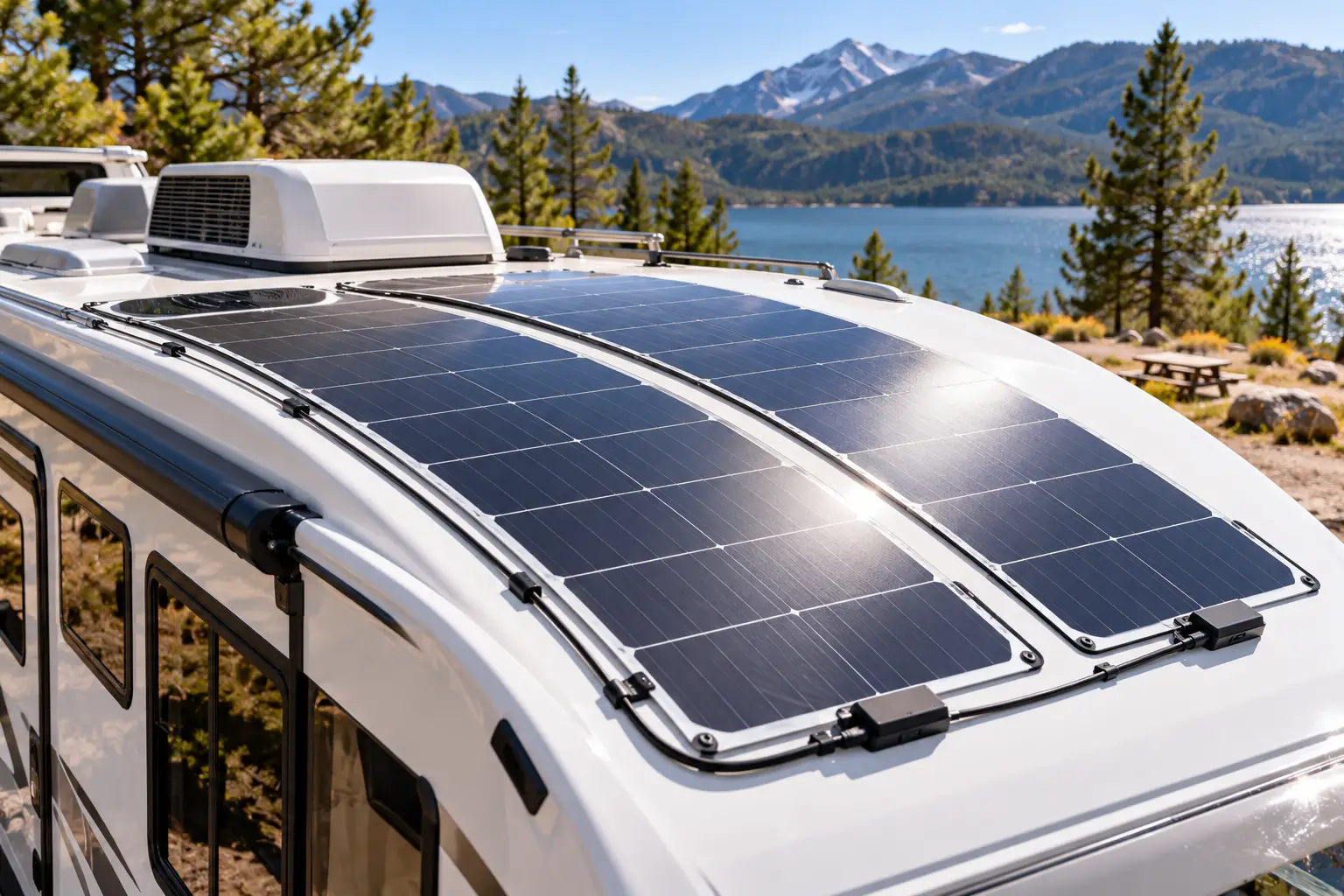
The EcoFlow 100W Flexible weighs about 5.1 lbs, which is roughly a third of a glass panel. That’s the whole point: it’s designed to follow the curve of a van roof and attach with adhesive or through grommets, with no drilled brackets and no aerodynamic “sail” effect at highway speed. EcoFlow rates it at 23% efficiency with integrated bypass diodes and IP68 protection, and it ships with a solar-to-XT60 cable for direct connection to EcoFlow power stations.
What the spec sheet doesn’t emphasize is heat. Flexible panels mounted flat against a metal roof can’t shed heat through an air gap the way framed panels can, so expect more summer output loss than with a rigid panel. Its Voc of 20.3V is lower than most rigid 12V-class panels, which is helpful when wiring several in series into a power station with a tight voltage window.
This panel makes the most sense for EcoFlow owners and stealth-van builders who prioritize low weight and a low profile. We couldn’t verify enough Amazon review volume specific to this flexible model to summarize sentiment reliably, so treat the specs as your guide.
Pros:
Very light and low-profile
IP68 protection with bypass diodes
Native XT60 cable for EcoFlow stations
Cons:
Runs hotter when glued flat to roofs
Pricier per watt than rigid glass
Around $150–$200, it’s worth it mainly when weight or a curved roof forces your hand.
EcoFlow 100W FlexibleSee current price, sizes and reviews on Amazon.
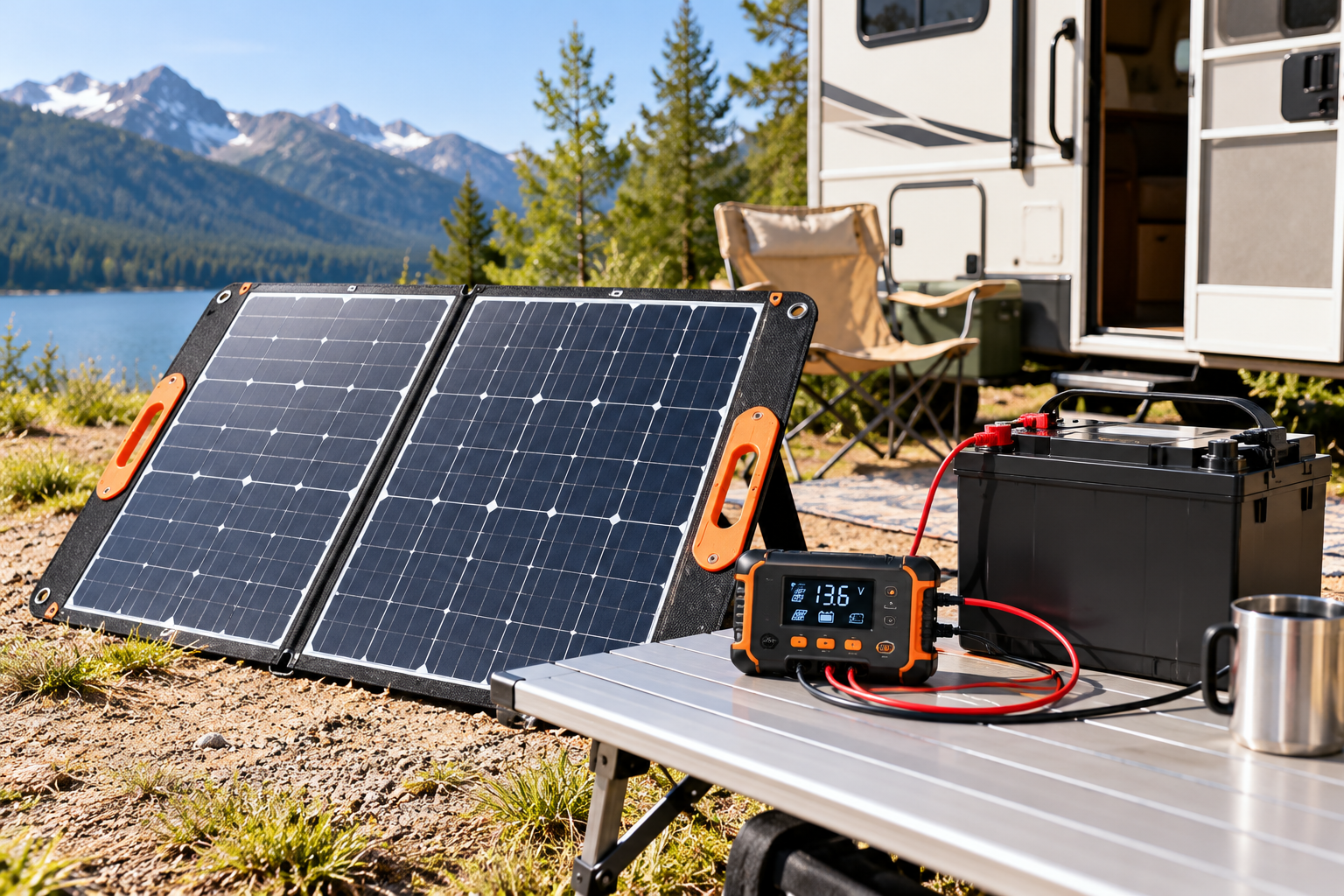
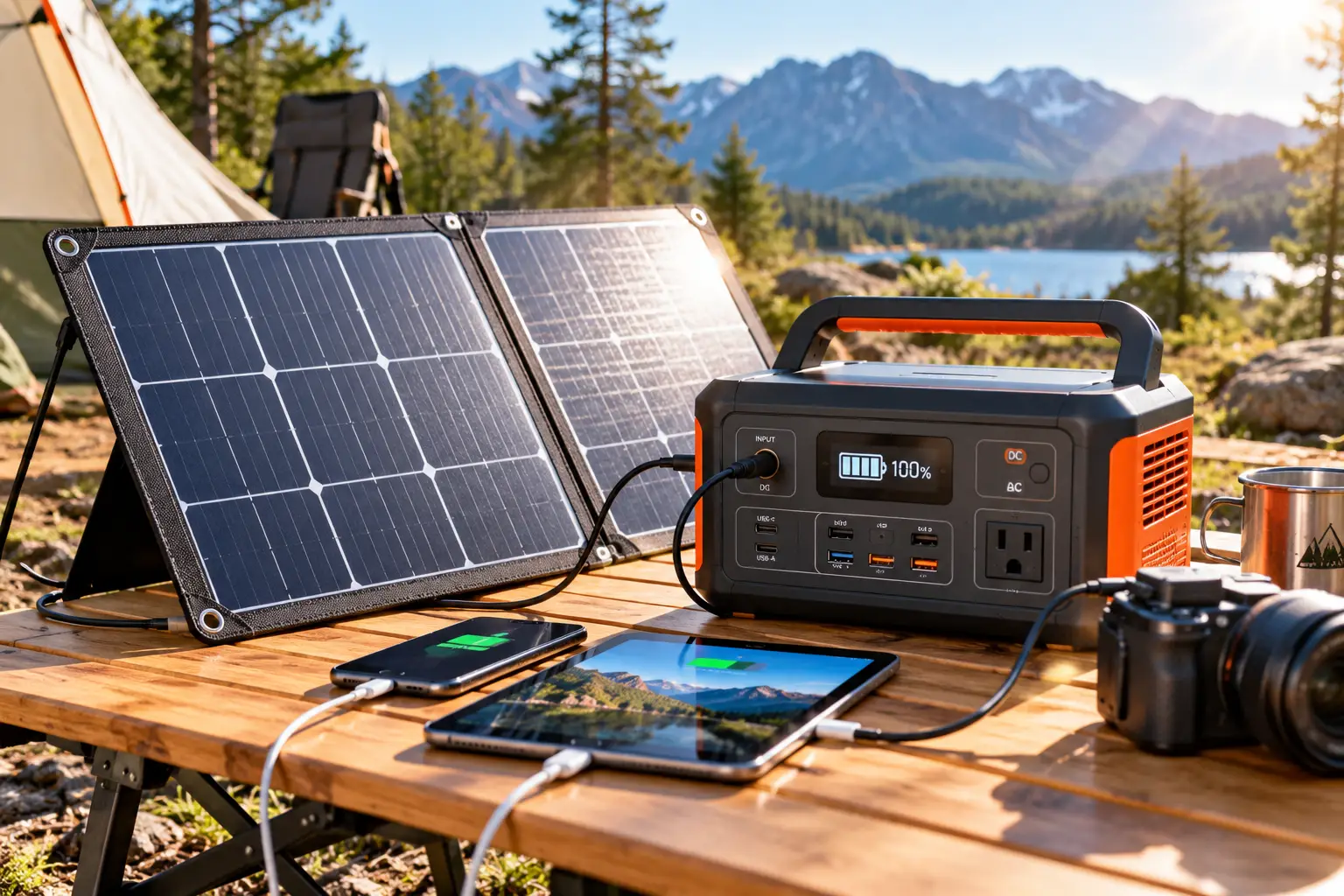
The Jackery SolarSaga 100W is a folding, briefcase-style panel built around the Jackery Explorer ecosystem. It unfolds to about 48 inches wide, stands on two kickstands, and folds back to roughly 24 x 21.7 inches with a carry handle. Jackery has advertised conversion efficiency of up to 23%, and recent revisions are listed with higher figures and bifacial cells, so check the specific listing you’re buying. Weight is a little over 10 lbs.
Its secret weapon is convenience: a USB-C (5V/3A) and a USB-A (5V/2.4A) port on the back let you charge a phone directly from the panel, even without a power station. Jackery lists compatibility with Explorer 240, 300, 500, 1000, and 1500-series models, among others.
Reviewers consistently praise how quickly it sets up and how well it packs into a truck for overlanding. The flip side, repeated across reviews and Jackery’s own FAQ, is that it’s splash-resistant, not a panel to leave out in the rain or mount permanently.
Pros:
Seconds to set up with kickstands
Direct USB charging for small devices
Seamless pairing with Jackery stations
Cons:
Not built for permanent outdoor mounting
High price per watt versus rigid panels
Usually $200–$300; worth it if you already own a Jackery station.
Jackery SolarSaga 100WSee current price, sizes and reviews on Amazon.
The BougeRV Yuma 100W CIGS uses copper indium gallium selenide thin-film cells instead of silicon wafers. That gives it an unusual set of traits: it can bend far more than a silicon flexible panel, weighs around 4.3 lbs in the compact tape-on version, and its long, narrow cell strips tend to lose less power when a branch or roof vent shades part of the surface. The tradeoff is efficiency, which sits around 16–17%, so it’s physically larger than a silicon panel of the same wattage.
Why choose it, then? Because conventional silicon flexible panels have a reputation for developing micro-cracks and failing after a few years on a vibrating, flexing RV roof. CIGS doesn’t use brittle wafers, which is the core of its durability case. Buyers echo exactly this: several reviewers say they switched to the Yuma after cheaper flexible panels died within two to three years, and they value its stability in heat and partial shade. Independent hands-on reviews also note it produces less than a folding mono panel side by side, consistent with its lower efficiency rating.
Warranty terms have varied by listing, so confirm what’s offered before you buy.
Pros:
Handles partial shade gracefully
No brittle wafers to crack
Extremely thin and light
Cons:
Lower efficiency needs more surface area
Expensive per watt
Around $230–$280, it’s a premium choice that pays off on shaded, curved surfaces.
BougeRV Yuma 100W CIGSSee current price, sizes and reviews on Amazon.
The Renogy 100W Solar Suitcase isn’t just a panel; it’s a small solar system. You get two 50W monocrystalline panels hinged into a suitcase, an adjustable aluminum stand, a 20A Voyager PWM charge controller with an LCD screen, and a cable with alligator clips that clamp straight onto a 12V battery. In practice, that means you can top up a trailer’s house battery or a boat’s starting battery without buying or wiring anything else.
The controller is the honest weak point. PWM is simpler and cheaper than MPPT, but it can’t convert extra panel voltage into extra amps, so you’ll harvest less energy than an MPPT setup, especially in cold weather. Renogy notes the 20A controller can accept one additional 100W suitcase, so expansion is limited. The full package, including the case, weighs around 26 lbs, which is heavy for hiking but fine for car camping.
Renogy also offers an N-type version of the kit, so compare model numbers. We couldn’t confirm enough aggregated Amazon reviews for the current version to summarize sentiment reliably, so judge it on its included hardware.
Pros:
Controller and clips included out of the box
Adjustable stand for better sun angles
Charges 12V batteries directly
Cons:
PWM controller leaves energy on the table
Heavy for a 100-watt system
Roughly $200–$260; good value if you’d otherwise buy a controller separately.
Renogy 100W Solar SuitcaseSee current price, sizes and reviews on Amazon.
The pattern is clear: every pound you save costs you money or efficiency. The BougeRV Yuma 100W CIGS is the lightest but the least efficient, while the rigid glass panels are heavy yet deliver the best value. Remember that “25%” on the Renogy 100W N-Type 16BB is a cell rating; the whole module, including frame and gaps, lands closer to 19–20%, which is still excellent.
Don’t miss these exclusive deals!
Take your off-grid power to the next level with this carefully curated lineup. Click a highlighted item to check current pricing and availability. These picks will help you get reliable, quiet solar energy the whole family will enjoy!
How to Choose a 100w pv panel
Use these seven steps in order; each one narrows the field.
Decide where it will live. Permanent roof or ground mount means rigid glass. Travel means foldable or suitcase. Curved roof means flexible.
Estimate your daily energy need. Add up watt-hours (device watts × hours used). One panel typically yields 300–450 Wh on a good day.
Check your local sun. The free NREL PVWatts calculator estimates output for your ZIP code, tilt, and season, which beats guessing.
Match the voltage to your controller or station. Confirm the panel’s Voc stays below your controller’s maximum input, with a cold-weather margin.
Confirm the connector. MC4 is the standard; power stations often need XT60, Anderson, DC7909, or DC8020 adapters.
Weigh temperature performance. In hot regions, a lower temperature coefficient (closer to zero) is worth paying for.
Read the warranty fine print. Rigid panels often carry 25-year output warranties; flexible and portable panels usually carry far shorter material warranties.
Follow these steps and you’ll avoid the most expensive mismatch: a great panel that simply can’t plug into, or safely feed, the system you already own.
Getting Started: Setting Up Your First 100w pv panel
Your first week with solar is mostly about getting the basics right, because small mistakes here cost you the most energy.
Step 1: Test before you mount. Lay the panel in full sun and use a multimeter to read open-circuit voltage at the leads. A 12V-class panel should read close to its listed Voc, usually 20–24V. Do this before drilling anything, so a shipping defect is easy to return.
Step 2: Wire in the right order. Connect the charge controller to the battery first, so the controller can detect system voltage, then connect the panel. Disconnect in reverse. Cover the panel with a blanket while wiring to keep the leads “dead.”
Step 3: Add a fuse. Place an appropriately rated fuse or breaker between the controller and the battery, as close to the battery as practical. Most spec sheets list a maximum series fuse rating; respect it.
Step 4: Tilt when you can. A flat roof panel is convenient but rarely optimal. Tilting portable panels toward the sun, and re-aiming them two or three times a day, can noticeably increase daily harvest.
Step 5: Keep it clean. Dust, pollen, and bird droppings cut output. Rinse with plain water and a soft cloth; skip abrasive pads that scratch glass or ETFE coatings.
Common first-30-day mistakes: using undersized wire on long runs, leaving portable panels out in storms, mounting flexible panels without any airflow, and panicking when a 100W panel shows 70W at noon. That last one is normal, as the troubleshooting section explains.
Which 100 Watt Solar Panel Fits Your Life? Three Real-World Scenarios
Specs only matter in context, so here are three common buyer profiles.
The Weekend Camper With a Power Station
A weekend camper owns a mid-size power station and camps two weekends a month at state parks, mostly to run a 12V fridge, lights, and phones. They need something that packs into an SUV and sets up in minutes. The Jackery SolarSaga 100W fits them perfectly if their station is a Jackery; otherwise, a universal foldable panel with the right adapter works. Budget: about $200–$300. Usage: a few days a month, stored indoors between trips.
The Full-Time Van Dweller
Derek lives in a converted high-roof van in the Southwest, works remotely, and runs a laptop, Starlink-style internet, and a compressor fridge daily. Heat is his enemy and roof space is precious. Two Renogy 100W N-Type 16BB panels on tilt mounts, feeding a 30A MPPT controller and a LiFePO4 battery, give him the best output per square foot in high temperatures. If his roof is curved, the EcoFlow 100W Flexible is the lighter alternative, accepting some heat loss. Budget: roughly $250–$400 for panels. Usage: every single day.
The Homeowner Building Outage Insurance
A homeowner lives in a hurricane-prone part of the Gulf Coast and wants a way to keep phones, a CPAP-capable battery, and a few LED lights going during multi-day outages. They don’t need portability, just reliability at a low cost. Two or four BougeRV 100W 9BB Mono panels on a simple ground frame, stored in the garage until needed, give them maximum watts per dollar. Budget: about $120–$360 for panels. Usage: a few days a year, but those days really matter.
Troubleshooting: 5 Common 100w pv panel Problems and Fixes
Problem 1: “My 100-watt panel only makes 60–75 watts.” Solution: That’s typical. The 100W rating assumes ideal lab light at a cool cell temperature. Real sun, heat, dust, and angle push output down. Tilt the panel toward the sun and keep it cool with an air gap underneath.
Problem 2: Output collapses when a small shadow appears. Solution: Cells in a silicon panel are wired in series, so one shaded section drags down the string. Move the panel, trim the shade, or choose a shade-tolerant design like the BougeRV Yuma 100W CIGS or a half-cut-cell panel like the BougeRV 100W 9BB Mono.
Problem 3: The power station shows “overvoltage” or won’t charge. Solution: Panels in series may exceed the station’s input limit, especially on cold mornings when voltage rises. Check the combined Voc against the station’s maximum, then rewire in parallel if needed.
Problem 4: The battery never reaches full charge. Solution: You may simply need more watts than one panel delivers. Do the math in the next section. If it’s close, upgrading from PWM to MPPT can recover meaningful energy.
Problem 5: The panel connector doesn’t fit the station. Solution: Buy the manufacturer’s recommended adapter (MC4 to XT60, Anderson, or DC7909, for example) and double-check polarity before plugging in. A cheap mismatched adapter can damage equipment.
100w pv panel vs Gas Generator: Which Backup Makes Sense?
For small loads, a panel plus battery and a gas generator solve the same problem very differently.
Factor
100W panel + battery
Small gas generator
Best for
Fuel cost
Free sunlight
Ongoing gasoline cost
Panel: long-term savings
Noise
Silent
Loud enough to bother neighbors
Panel: campgrounds
Indoor safety
No exhaust
Carbon monoxide risk
Panel: storage and safety
Peak power
Limited by battery/inverter
High surge capacity
Generator: big appliances
Bad-weather output
Drops on cloudy days
Steady with fuel
Generator: multi-day storms
The takeaway is that the two complement each other more than they compete. A 100-watt panel shines for silent, everyday trickle charging and for keeping a battery topped up between trips, while a generator remains the fallback for heavy loads and long cloudy stretches. Many experienced RVers carry both and run the generator far less often once solar is installed.
Rigid vs Flexible vs Portable: Which 100w Solar Panel Type Wins?
There’s no universal winner, only a best match for your situation.
Rigid glass panels like the Renogy 100W N-Type 16BB, BougeRV 100W 9BB Mono, and Rich Solar MEGA 100 are the long-haul workhorses. Tempered glass and aluminum frames shrug off hail, UV, and decades of weather. The frame also creates an air gap under the panel when bracket-mounted, which keeps cells cooler and output higher. Their only real downsides are weight, a raised profile, and the need to drill.
Flexible panels like the EcoFlow 100W Flexible and BougeRV Yuma 100W CIGS solve a specific problem: curved or weight-sensitive surfaces. Think fiberglass camper roofs, boat biminis, or aluminum vans where you don’t want holes. The tradeoffs are heat (glued flat, they run hot) and lifespan, since silicon flexible panels are generally considered less durable than glass ones. CIGS reduces the cracking risk but costs efficiency.
Portable panels like the Jackery SolarSaga 100W and Renogy 100W Solar Suitcase trade dollars for freedom. You can chase the sun, park in the shade while the panel sits in the light, and pack everything away when you leave. That flexibility often offsets their lower value per watt, because a well-aimed portable panel can out-harvest a flat roof panel.
A practical rule: if you’ll use it most days in the same spot, go rigid. If you move around and set up camp, go portable. If you have a curved roof, go flexible.
What to Expect: Everyday Performance From a 100w pv panel
This is where expectations meet math. Most of the continental U.S. gets roughly 4 to 6 “peak sun hours” per day in summer, fewer in winter. Multiply panel wattage by sun hours, then apply a realistic loss factor of around 75–85% for heat, wiring, and controller losses.
So a single 100-watt panel in a sunny location typically delivers about 300–450 watt-hours per day. Here’s what that buys you:
A smartphone (about 15 Wh per charge): 20+ full charges
A laptop (about 60 Wh): roughly 5–7 charges
A 12V compressor fridge (often 300–600 Wh per day): about one day of runtime in good sun, less in heat
LED camp lights (5–10W): practically all night, every night
The battery side is just as important. A 12V 100Ah LiFePO4 battery stores about 1,280 Wh, so refilling it from empty with one panel takes three to four sunny days. That’s why many people start with one 100w pv panel and add a second within months.
Winter is the reality check. Shorter days and a lower sun angle can cut daily harvest roughly in half in northern states, so if winter use matters, plan for more panel capacity or a steeper tilt.
Features That Actually Matter (and Ones That Don’t)
Matters: temperature coefficient. It’s the quiet spec that decides summer performance. Panels near -0.29%/°C hold output noticeably better in heat than panels at -0.39%/°C.
Matters: connector and cable gauge. MC4 compatibility and 12 AWG leads save headaches and reduce voltage drop. A mismatched connector can leave you stranded.
Matters: warranty structure. Look at both the output warranty (often 25 years for rigid panels) and the materials warranty, which can be as short as one year on some flexible panels.
Overrated: headline efficiency. A higher efficiency number only makes a panel smaller; it doesn’t make 100 watts produce more than 100 watts. If roof space isn’t tight, a cheaper 21–22% panel delivers nearly identical daily energy.
Overrated: “IP68 waterproof” on portable panels. The cells may be sealed, but connectors, fabric, and onboard USB ports still need protection. Don’t treat any folding panel as rain-proof furniture.
Overrated: built-in USB ports. Handy for phones in a pinch, but they deliver small amounts of power. If you own a power station, you’ll rarely use them.
Matters more than people think: bypass diodes and cell layout. Half-cut cells and bypass diodes decide how gracefully a panel handles a passing shadow, which is a daily reality at most campsites.
Long-Term Cost and Maintenance of a 100w pv panel
The sticker price is only part of the story. Here’s how cost per watt and expected lifespan compare.
Panel
Approx. Price
Cost per Watt
Expected Service Life
Best for
BougeRV 100W 9BB Mono
$60–$90
$0.60–$0.90
Decades (rigid glass)
BougeRV 100W 9BB Mono: maximum value
Renogy 100W N-Type 16BB
$100–$130
$1.00–$1.30
Decades (rigid glass)
Renogy 100W N-Type 16BB: heat and slow degradation
EcoFlow 100W Flexible
$150–$200
$1.50–$2.00
Shorter (flexible)
EcoFlow 100W Flexible: weight savings
Jackery SolarSaga 100W
$200–$300
$2.00–$3.00
Moderate (portable)
Jackery SolarSaga 100W: convenience
The numbers show why rigid panels dominate permanent installs: the BougeRV 100W 9BB Mono costs a fraction per watt of portable options and should outlive them. Portable and flexible panels earn their premium only when mobility, weight, or roof shape is the deciding factor.
Maintenance is refreshingly light. Rinse panels every few weeks in dusty or pollen-heavy areas, inspect connectors and seals every season, and check that mounting bolts stay tight, since road vibration loosens hardware on RVs. Over a 10-year horizon, a well-installed rigid panel producing around 350 Wh a day generates more than 1,200 kWh of energy, which is free electricity you’d otherwise buy as fuel or campground hookups.
Safety, Regulations, and Standards for 100 Watt Solar Panels
Small panels are low-risk, but “low voltage” doesn’t mean “no risk.” Batteries can deliver huge currents into a short circuit, and DC arcs are harder to extinguish than AC ones.
Certifications to look for: UL 61730 or IEC 61730 covers module safety, while IEC 61215 covers performance and durability testing. Some panels are also ETL listed, which shows testing by a nationally recognized lab. Certification matters especially for anything mounted on a home or near living spaces.
Wiring codes: If a panel ties into a home’s electrical system, the National Electrical Code (NEC Article 690) and local permits apply, and some jurisdictions require a licensed electrician. Purely portable setups feeding a power station generally fall outside permitting, but follow the manufacturer’s instructions. The Department of Energy’s homeowner’s guide to going solar is a useful starting point if you’re thinking beyond a small off-grid setup.
Practical safety rules:
Fuse every battery connection close to the battery
Use wire rated for outdoor UV exposure and the expected current
Never exceed a controller’s maximum input voltage, including cold-weather Voc rise
Secure roof panels against highway wind loads
Treat these as the minimum, and your solar setup will be safer than most of the gear in your garage.
Common Mistakes to Avoid When Buying a 100w pv panel
Mistake 1: Buying the panel before the battery plan. A panel without storage only powers things while the sun shines. Decide on your battery or power station first, then match the panel to it.
Mistake 2: Ignoring connector compatibility. Many shoppers discover at the campsite that their panel’s MC4 plugs don’t fit their station’s input. Confirm adapters before you leave home.
Mistake 3: Expecting 100 watts at all times. Planning around the nameplate number leads to dead batteries. Plan around 300–450 Wh per day in good sun, and less in winter.
Mistake 4: Choosing flexible when rigid would work. Flexible panels cost more per watt and generally don’t last as long. Unless weight or a curved roof forces the choice, rigid glass is the smarter long-term buy.
Mistake 5: Skimping on the charge controller. A cheap PWM controller with a panel array that could benefit from MPPT quietly wastes energy every day. For permanent setups of 200 watts or more, MPPT usually pays for itself.
Avoid these five and you’ll sidestep most of the regret stories that show up in one-star reviews.
FAQ About the 100w pv panel
How much does a 100w pv panel cost in 2026?
Rigid 100-watt panels typically run from about $60 to $130, while flexible and portable models generally range from about $150 to $300. Prices fluctuate often, so check the current listing before buying.
Can a 100w pv panel run a refrigerator?
It can support a small 12V compressor fridge in strong sun when paired with a battery, but a household refrigerator needs far more power. Most fridge setups use 200 watts or more of panels for reliability.
How long does a 100 watt solar panel take to charge a 100Ah battery?
A 12V 100Ah lithium battery holds about 1,280 Wh, so one panel producing 300–450 Wh daily needs roughly three to four sunny days from empty. Two panels cut that roughly in half.
Do I need a charge controller with a 100w solar panel?
Yes, when charging a battery directly, because panel voltage runs well above battery voltage. Portable power stations have controllers built in, so you can usually plug the panel straight in with the right adapter.
Is a portable 100w solar panel waterproof?
Most are water-resistant rather than fully waterproof, even when the cells are sealed. Connectors, fabric, and USB ports remain vulnerable, so fold portable panels up and store them before heavy rain.
Conclusion: Picking the Right 100w pv panel for You
A single 100w pv panel won’t power your whole life, but it’s the most affordable, lowest-risk way to stop depending on fuel, hookups, or the grid for your small daily loads. The key is matching the panel type to how you actually live.
If you want the strongest all-around rigid panel for hot climates, the Renogy 100W N-Type 16BB is the benchmark. If you’re stretching every dollar, the BougeRV 100W 9BB Mono delivers the best cost per watt in this lineup. For snowy cabins and four-season mounts, the Rich Solar MEGA 100 brings rugged load ratings. Curved van roof? The EcoFlow 100W Flexible keeps weight down, while the BougeRV Yuma 100W CIGS is the specialist for partial shade. Campers who want plug-and-play simplicity should look at the Jackery SolarSaga 100W for Jackery stations or the Renogy 100W Solar Suitcase for direct battery charging.
Whatever you choose, plan around realistic output, protect your wiring with proper fuses, and size up later if your needs grow. Solar is wonderfully modular: start with one panel, learn how your energy use really looks, and expand with confidence.
Ready to power up with the sun?
Your quiet, fuel-free energy upgrade starts with one panel. Click a highlighted product above to check current pricing and availability, and find the 100-watt setup that keeps your batteries full wherever the road takes you!
Disclaimer: This post contains affiliate links. As an Amazon Associate, I earn from qualifying purchases made through these links, at no additional cost to you.
Found this article helpful? Share it with someone who needs it!