As an Amazon Associate I earn from qualifying purchases. Links in this article may be affiliate links. How we choose gear
Why Electric Panels for Tiny Homes Deserve More Thought Than Their Size Suggests
Here’s the funny thing about tiny living: you can shrink the kitchen, the closet, and the bathroom, but you can’t shrink physics. A 1,500-watt space heater pulls the same current in 200 square feet as it does in a 2,600-square-foot suburban colonial. That’s why choosing between electric panels for tiny homes is one of the few decisions in a small build where “smaller” isn’t automatically “better.”
Get it right, and your breaker box becomes the quiet, invisible guardian of every outlet, mini-split, and water heater in the house. Get it wrong, and you’ll be resetting breakers in the dark every time the kettle and the heater overlap — or worse, you’ll own a panel your inspector won’t sign off on.
The challenge is that tiny homes live in two different worlds. Tiny houses on foundations are increasingly treated like conventional dwellings: the International Code Council’s Appendix Q for tiny houses defines them as dwellings of 400 square feet or less and folds them into the residential code. Tiny houses on wheels, meanwhile, usually plug in like an RV through a 30-amp or 50-amp inlet. Each world calls for a different kind of panel.
In this guide, you’ll find seven real electric panels for tiny homes — from a palm-sized 6-space load center to an all-in-one RV power center that handles both 120V AC and 12V DC. Every pick comes with honest analysis grounded in spec sheets and real customer feedback (never invented testing), plus setup advice, problem-solving tips, and a buyer framework you can actually use. Let’s wire this up.
What Are Electric Panels for Tiny Homes?
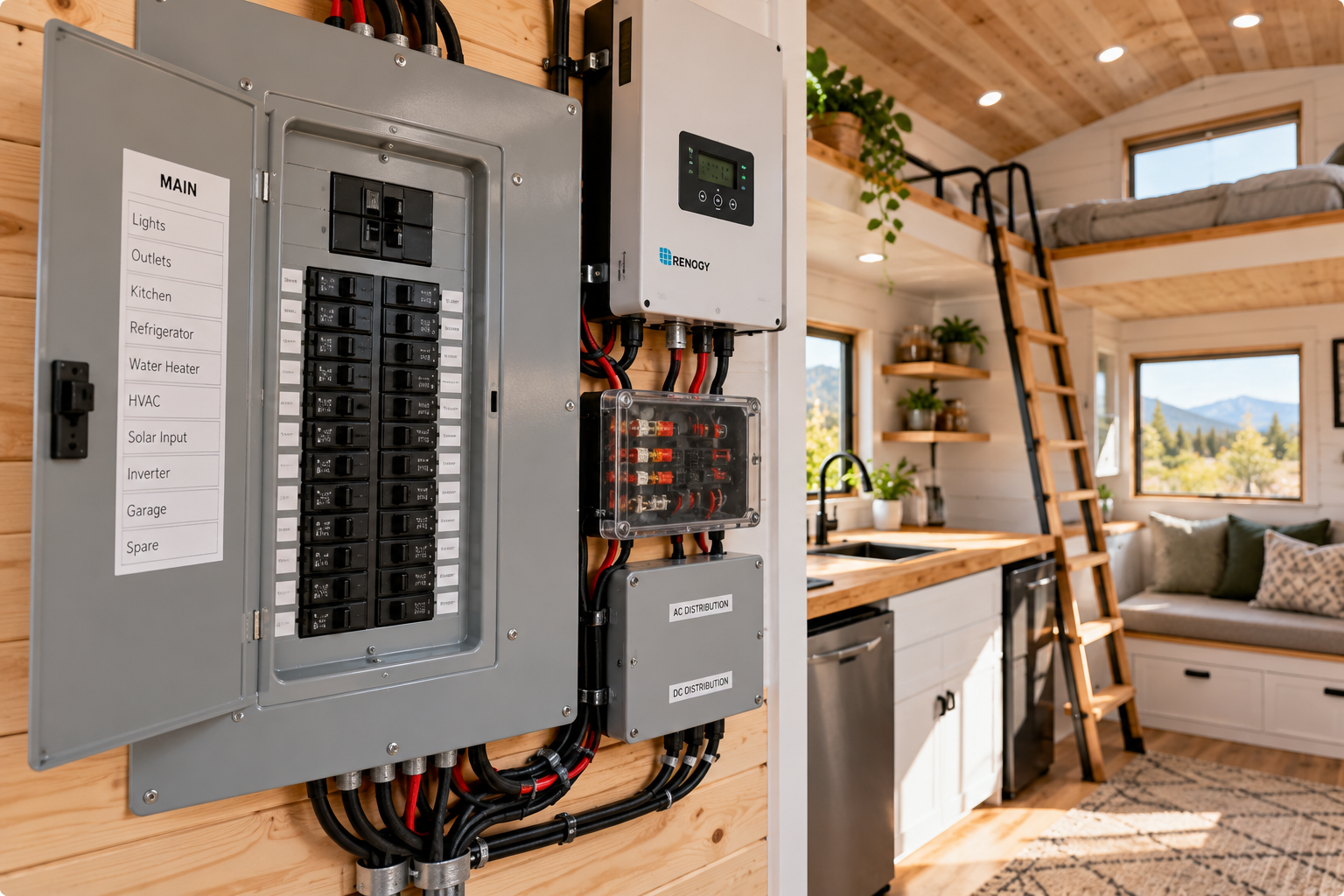
Electric panels for tiny homes are compact load centers (breaker boxes) that receive incoming power — from a utility service, an RV-style inlet, a generator, or solar inverter — and split it into protected branch circuits. Most use 100-125A residential enclosures with 6-20 breaker spaces, or 30A RV power centers on wheeled builds.
That definition hides one important distinction: main breaker versus main lug. A main breaker panel contains its own shutoff and can act as a service disconnect. A main lug panel has no master breaker, so it’s typically used as a tiny home subpanel fed from a breaker somewhere upstream — at a pole, a pedestal, or a host home’s main panel.
Most tiny house builders also run into a second, quieter variable: voltage. A standard 30-amp RV inlet delivers 120V only, which rules out 240V appliances like most electric tankless water heaters and many mini-splits. A 50-amp RV connection or a hardwired feeder delivers split-phase 120/240V, which opens up those appliances but requires heavier cable and a panel that accepts two-pole breakers. Keep that in mind as you scan the products below — “amps” alone never tells the whole story.
Quick Comparison: 7 Best Electric Panels for Tiny Homes at a Glance
Panel
Type
Amps / Spaces
Indoor or Outdoor
Best for
Square D Homeline HOM612L100SCP
Main lug
100A / 6 spaces (12 circuits)
Indoor
Square D Homeline HOM612L100SCP: budget tiny home subpanel
Square D QO QO816L100DS
Main lug
100A / 8 spaces (16 circuits)
Indoor
Square D QO QO816L100DS: premium compact subpanel
Square D Homeline HOM816M100PC
Main breaker
100A / 8 spaces (16 circuits)
Indoor
Square D Homeline HOM816M100PC: indoor panel with built-in shutoff
Square D Homeline HOM816M100PRB
Main breaker
100A / 8 spaces (16 circuits)
Outdoor (NEMA 3R)
Square D Homeline HOM816M100PRB: exterior-mounted panel on foundation builds
Eaton BR816L125RP
Main lug
125A / 8 spaces (16 circuits)
Outdoor (NEMA 3R)
Eaton BR816L125RP: weatherproof subpanel with headroom
Siemens SN2040B1100
Main breaker
100A / 20 spaces (40 circuits)
Indoor
Siemens SN2040B1100: all-electric tiny homes and ADUs
Progressive Dynamics PD4045KV
RV power center
30A AC + 45A DC converter
Indoor (dry location)
Progressive Dynamics PD4045KV: tiny houses on wheels with batteries
Looking at this table, the real split isn’t brand — it’s where your power comes from. If you’re plugging in like an RV and want 12V lighting or a battery bank, the Progressive Dynamics PD4045KV solves two problems in one box. If your tiny home sits on a foundation with its own service, a main-breaker panel such as the Square D Homeline HOM816M100PC or the outdoor Square D Homeline HOM816M100PRB gives you the disconnect inspectors expect, while the Siemens SN2040B1100 is the pick when you’re running an induction range, heat pump water heater, and mini-split all on electricity.
If wall space is your scarcest resource, the Square D Homeline HOM612L100SCP is about as compact as a real residential load center gets.
It’s a 100-amp, single-phase, main lug panel with 6 spaces and up to 12 circuits when you use tandem breakers, housed in a surface-mount steel enclosure with knockouts on both the top and bottom. In practice, those dual knockouts matter more than they sound: in a tiny house, your feeder might come up through the floor while branch circuits run up into the walls, and you won’t have to fight the box to route both.
Based on the spec sheet, this panel is for people who need a straightforward tiny home subpanel — fed from a pole-mounted main, a host home, or an RV-style inlet with upstream protection. It’s not a service disconnect on its own, and six spaces fill fast once you add a two-pole breaker for a 240V appliance.
Customer reviews consistently describe it as heavy-duty, with knockouts that come out cleanly, and several buyers report using it as a subpanel in a bus conversion, shed, barn, or workshop. The most common practical complaints: it ships without a separate ground bar (subpanels need one, since neutral and ground must stay isolated) and without knockout grommets, and it only accepts Homeline breakers.
Pros:
Very compact enclosure for tight tiny house walls
Top and bottom knockouts simplify feeder routing
Made in the USA with a sturdy steel box
Cons:
Ground bar must be purchased separately for subpanel use
Only six spaces leave little room to expand
Usually priced under $100 (check the current price) — excellent value if your circuit count is genuinely small.
Square D Homeline HOM612L100SCPSee current price, sizes and reviews on Amazon.
The Square D QO QO816L100DS pairs a small footprint with Square D’s premium QO breaker line, which many electricians reach for when reliability matters.
This is a 100-amp main lug load center with 8 spaces (up to 16 circuits with tandems), a NEMA 1 indoor enclosure, and a surface cover with a door. Its listed dimensions — roughly 8.9 inches wide, 12.6 inches tall, and 3.8 inches deep — make it narrower than most 8-space panels, which is a meaningful win when you’re fitting it between studs near a loft ladder. The door also keeps breakers from being bumped in a high-traffic tiny house hallway.
On paper, the QO’s appeal is the breaker ecosystem: QO breakers include a visible trip indicator, so you can spot the tripped circuit at a glance instead of flipping every handle. That’s genuinely handy when the panel sits in a dim closet.
There’s one honest caveat in the spec sheet: the short-circuit rating is 10 kA, versus 22 kA on the Homeline main-breaker models below. For most tiny houses fed through a long feeder or RV cord, that’s typically adequate, but if you sit close to a large utility transformer, ask your electrician to confirm available fault current.
Verified Amazon review data for this exact model number is limited, so we won’t summarize sentiment that isn’t there; QO is, however, frequently recommended in skoolie and RV-conversion forums.
The Square D Homeline HOM816M100PC is the panel to consider when your tiny house needs its own master shutoff inside the wall.
It’s a 100-amp main breaker load center with 8 spaces and 16 circuits, a plug-on neutral design, a 22 kA short-circuit rating, and a combination flush/surface cover. The listed size is about 14.9 inches tall, 14.25 inches wide, and 3.74 inches deep. That shallow depth is the quiet hero here: it fits inside a standard 2×4 wall cavity with room to spare, so you can flush-mount it and keep the panel from stealing an inch of your precious floor space.
Plug-on neutral matters more in a tiny house than you’d think. Modern codes require AFCI or dual-function breakers on many circuits, and plug-on neutral breakers clip straight onto the neutral bar — no coiled pigtails stuffing a small enclosure. The main breaker is also convertible, per the manufacturer’s description, giving installers flexibility.
Honestly, this is the right fit for a foundation-built tiny home or a well-planned tiny house on wheels where you want a true main disconnect at the panel. Verified Amazon reviews tied to this specific catalog number are scarce, so treat any star rating you see with caution and lean on the spec sheet.
Pros:
Built-in 100A main breaker acts as a disconnect
Plug-on neutral keeps AFCI wiring tidy
Shallow 3.74-inch depth flush-mounts in 2×4 walls
Cons:
Wider than the QO model at about 14.25 inches
Accepts only Homeline breakers
Prices vary widely by seller, from roughly $150 to well over $400 — check the current price before committing.
Square D Homeline HOM816M100PCSee current price, sizes and reviews on Amazon.
The Square D Homeline HOM816M100PRB is essentially the outdoor twin of the previous pick, designed to live on the exterior wall.
It keeps the same 100-amp main breaker, 8 spaces, 16 circuits, plug-on neutral design, and 22 kA rating, but moves everything into a NEMA 3R rainproof enclosure measuring about 18.9 inches tall, 14.75 inches wide, and 4.5 inches deep. Its lugs accept 6 AWG to 2/0 AWG aluminum, which gives your electrician the option of using less expensive aluminum feeder for a long run from the meter.
Why mount outside? Because in a 200-square-foot home, the code-required clear working space in front of a panel — typically 30 inches wide and 36 inches deep — is a real chunk of your living room. Forum veterans in tiny-build communities often recommend exterior panels for exactly this reason. Put it outside, and that clearance comes from the yard instead of your kitchen.
Based on the specs, this is ideal for tiny homes on foundations, backyard ADUs, or semi-permanent placements where the panel can double as the outdoor disconnect. Verified Amazon review data for this model is thin, so we are not going to manufacture a consensus.
Pros:
NEMA 3R enclosure frees up indoor clearance space
Accepts aluminum feeder up to 2/0 AWG
Main breaker works as an exterior disconnect
Cons:
Ground bar not included per distributor specs
Usually pricier than indoor equivalents
Commonly in the $400-$550 range at electrical distributors; check Amazon’s current price, which can differ.
Square D Homeline HOM816M100PRB —See current price, sizes and reviews on Amazon.
The Eaton BR816L125RP gives you an outdoor-rated subpanel with more bus capacity than most small boxes.
It’s a 125-amp main lug load center with 8 spaces and 16 circuits in a NEMA 3R enclosure, roughly 13 inches tall, 11 inches wide, and 3.56 inches deep, weighing about 11.8 pounds. It accepts #14 to #1 AWG wire, uses a tin-plated aluminum bus, and ships with hub closure plates for the rainproof cover. Breakers are not included.
What does the 125A rating mean in practice? It doesn’t mean your tiny house gets 125 amps — the upstream feeder breaker decides that. What it does give you is headroom: the bus is rated beyond a 100A feed, so you’re never pushing the panel’s own limits, and a future upgrade (say, adding a heat pump) won’t require a new box.
The compact outdoor size makes this a strong pick for tiny houses on wheels that want an exterior distribution point next to a 50-amp inlet, or for a foundation build fed from a main disconnect at the pole. Since it’s main lug, you need a properly sized breaker upstream.
Retail listings show little or no verified customer feedback on this exact model, so we can’t honestly summarize review sentiment; Eaton’s BR line is, however, widely stocked at big-box stores, which makes replacement breakers easy to find.
Pros:
Compact NEMA 3R box rated for outdoor mounting
125A bus offers headroom for future loads
BR breakers are easy to find locally
Cons:
No main breaker, so upstream protection is required
Breakers sold separately
Typically in the $60-$130 range depending on the retailer — strong value for an outdoor-rated box.
Eaton BR816L125RPSee current price, sizes and reviews on Amazon.
The Siemens SN2040B1100 is the pick when your tiny home is ambitious: induction cooktop, heat pump water heater, mini-split, washer, and dedicated circuits everywhere.
It’s a 100-amp main breaker load center with 20 spaces and up to 40 circuits, plug-on neutral, an aluminum bus, a 22 kAIC rating, and a NEMA 1 indoor enclosure. Siemens advertises more than 4 inches of wire bending space plus its Insta-wire feature and trim tabs designed to speed installation.
Here’s what that means in practice: every 240V appliance eats two spaces, and modern code requires AFCI or GFCI protection on many circuits — so an all-electric tiny house can burn through 8 spaces faster than you’d expect. Twenty spaces means you’ll never be forced into tandem breaker gymnastics or a second panel. The generous bending space also makes the wiring cleaner, which helps the inspection go smoothly.
The trade-off is physical size. This is a full-height residential panel, so it suits larger tiny homes (think 300-400 square feet), backyard ADUs, or builds where a utility closet can house it. Verified Amazon reviews for this model are limited, so we are relying on the manufacturer’s specs rather than invented sentiment.
Pros:
20 spaces handle all-electric appliance loads
Plug-on neutral simplifies AFCI and GFCI breakers
Over 4 inches of wire bending space
Cons:
Too large for the smallest tiny house walls
Indoor-only NEMA 1 enclosure
Usually between $100 and $215 depending on the seller — outstanding per-circuit value.
Siemens SN2040B1100See current price, sizes and reviews on Amazon.
The Progressive Dynamics PD4045KV “Mighty Mini” is the most tiny-house-on-wheels-friendly panel on this list because it manages both your 120V AC circuits and your 12V DC system.
Its AC side is rated for 120 VAC at 30 amps with room for up to 7 branch circuits. The built-in Inteli-Power converter delivers 45 amps of DC output (13.6-14.6 VDC) with a four-stage Charge Wizard, a lithium-compatible switch, and 12 DC fuse holders (two for 30A fuses, ten up to 20A). It measures about 12.3 by 8.9 by 7.25 inches and weighs roughly 5.6 pounds — light enough that trailer weight budgets won’t flinch.
What that means in practice: if your tiny house runs LED lights, a water pump, and fans on 12V while charging a battery bank from shore power, this replaces a separate panel, charger, and fuse block. The trade-off is that a 30A RV connection is 120V only — no 240V appliances. Also note that the manufacturer specifies a dry location and horizontal mounting.
Feedback on RV retailer sites tends to focus on two strengths: the converter section can be swapped out without replacing the whole panel, and the lithium mode makes battery upgrades easier.
Pros:
Combines AC breakers, DC fuses, and charger
Lithium-compatible four-stage charging built in
Light 5.6-pound unit suits trailer weight limits
Cons:
30A, 120V only — no 240V appliances
Not rated for wet or damp locations
Generally in the low-to-mid hundreds of dollars — check the current price; strong value considering it replaces three components.
Don’t miss these smart power picks!
Take your tiny house electrical setup to the next level with this carefully curated lineup. Click a highlighted panel to check current pricing and availability. These picks will help you get safe, reliable power your whole household will appreciate!
Progressive Dynamics PD4045KVSee current price, sizes and reviews on Amazon.
Head-to-Head Specs: Size, Ratings, and Real-World Fit
Panel
Approx. Size (H × W × D)
Short-Circuit Rating
Main Disconnect
Best for
Square D Homeline HOM612L100SCP
Compact surface box
Not verified for this listing
No (main lug)
Square D Homeline HOM612L100SCP: tightest budgets
Square D QO QO816L100DS
12.6″ × 8.9″ × 3.8″
10 kA
No (main lug)
Square D QO QO816L100DS: narrow interior walls
Square D Homeline HOM816M100PC
14.9″ × 14.25″ × 3.74″
22 kA
Yes
Square D Homeline HOM816M100PC: flush-mount indoors
Square D Homeline HOM816M100PRB
18.9″ × 14.75″ × 4.5″
22 kA
Yes
Square D Homeline HOM816M100PRB: exterior service
Eaton BR816L125RP
13″ × 11″ × 3.56″
Check spec sheet
No (main lug)
Eaton BR816L125RP: outdoor subpanel
Siemens SN2040B1100
Full-height residential
22 kAIC
Yes
Siemens SN2040B1100: all-electric builds
Progressive Dynamics PD4045KV
8.9″ × 12.3″ × 7.25″
RV-rated
30A main
Progressive Dynamics PD4045KV: hybrid AC/DC
Reading across the table, depth is the stat most buyers overlook. The Square D Homeline HOM816M100PC and Eaton BR816L125RP both sit under 4 inches deep, so they can tuck into or onto a 2×4 wall without eating floor space, while the Progressive Dynamics PD4045KV is deeper because it houses a converter and cooling fan. If you need a disconnect at the house, only the three main-breaker panels deliver one — the main lug options always depend on protection upstream.
How to Get Started: First-Time Setup and Maintenance
A tiny house electrical panel rewards a careful first 30 days. Here’s a practical playbook — and a reminder up front: panel installation is work for a licensed electrician in most US jurisdictions, and a permit is often required.
Before installation
Do a load calculation first. List every appliance’s wattage, flag what runs simultaneously, and divide by voltage. A 1,500W heater plus a 1,200W kettle on 120V is already 22.5 amps — nearly maxing out a 30A RV feed.
Buy the accessories that don’t come in the box. For subpanels like the Square D Homeline HOM612L100SCP, that typically means a separate ground bar kit, knockout bushings, and the correct brand of breakers.
Label circuits before closing the walls. In a tiny house, circuits often double up (one for “loft + bathroom fan”), so clear labeling saves headaches later.
First-week checks
Run your heaviest realistic combination — heater, kettle, and water heater together — and watch for nuisance trips.
Press the test button on every AFCI and GFCI breaker; they’re designed to be tested monthly.
On a hybrid system like the Progressive Dynamics PD4045KV, confirm the lithium switch matches your battery chemistry before the first full charge.
Ongoing maintenance
Monthly: test GFCI/AFCI breakers.
Every few months (wheeled homes): after any tow, have connections inspected — road vibration can loosen terminations over time.
Yearly: look for discoloration, corrosion, or a warm cover, especially on outdoor panels like the Eaton BR816L125RP. Any sign of heat means calling an electrician, not tightening things yourself.
Common first-month mistakes
Bonding neutral and ground in a subpanel, using the wrong brand of breaker because “it fits,” and running a 30A inlet off an undersized extension cord top the list.
Real-World Scenarios: Matching the Panel to Your Tiny Life
Specs only make sense when they meet a real lifestyle. Here are three common tiny-house profiles and the reasoning behind each match.
Profile 1: The weekend wanderer (24-foot THOW, moved seasonally)
Picture a couple who tows their 24-foot tiny house on wheels between campgrounds and a relative’s property a few times a year. They have propane cooking, a small battery bank, and 12V LED lighting. Their budget for the panel is a few hundred dollars.
Best match: the Progressive Dynamics PD4045KV. It accepts standard 30A shore power, distributes it to up to seven AC circuits, and charges the batteries while feeding 12V loads. Since nearly every campground offers 30A hookups, they’re never stuck hunting for a 50A pedestal.
Profile 2: The backyard ADU (380 square feet on a foundation)
A homeowner is building a rental cottage behind their house, fully electric, with an induction cooktop, heat pump water heater, and ducted mini-split. It will be permitted and inspected.
Best match: the Siemens SN2040B1100 indoors, fed by a dedicated feeder from the main house. Twenty spaces leave room for every two-pole appliance plus AFCI/GFCI circuits without tandem breakers, and the inspector gets a clean, uncrowded panel.
A solo builder on rural land has a new utility service and plans to add solar later. Inside space is precious.
Best match: the Square D Homeline HOM816M100PRB mounted on the exterior wall. It provides a main disconnect, keeps the mandatory clearance zone outdoors, and leaves room for a future solar breaker. If the budget is tighter and power is already disconnected at the pole, the Eaton BR816L125RP works as a lower-cost outdoor tiny home subpanel.
Problem → Solution: Fixing Common Tiny Home Subpanel Headaches
Even a perfectly chosen breaker box for tiny house living can cause frustration if the system around it isn’t thought through. Here are the problems that come up most often — and how to solve them.
Problem 1: “The main breaker trips whenever the heater and microwave run together.”
Solution: This is almost always a supply problem, not a panel problem. A 30A, 120V supply provides about 3,600 watts total. Either stagger heavy loads, switch the heater to a lower setting, or upgrade to a 50A, 120/240V feed — which means moving from a panel like the Progressive Dynamics PD4045KV to a split-phase load center such as the Square D Homeline HOM816M100PC.
Problem 2: “I can’t find a way to run a 240V water heater.”
Solution: A 30A RV inlet is 120V only. You’ll need a 50A RV inlet or hardwired feeder plus a split-phase panel with two-pole breakers. Alternatively, choose a 120V point-of-use or heat pump water heater designed for lower-amperage circuits.
Problem 3: “My GFCI breakers trip randomly.”
Solution: In subpanels, this often traces back to neutral and ground being bonded together, which creates parallel current paths. Have an electrician verify that the neutral bar is isolated and a separate ground bar is installed — a step that matters on main lug panels like the Square D QO QO816L100DS.
Problem 4: “I ran out of breaker spaces.”
Solution: Some panels accept tandem breakers, but they aren’t allowed on every circuit type. The cleaner fix is planning ahead — choose 8-plus spaces, or step up to the Siemens SN2040B1100 if you’re going all-electric.
Problem 5: “There’s moisture inside my outdoor panel.”
Solution: Confirm the enclosure is NEMA 3R, that unused knockouts and hubs are properly closed, and that conduit entering from above is sealed.
How to Choose Electric Panels for Tiny Homes
Choosing among electric panels for tiny homes comes down to seven decisions, in this order:
Identify your power source. A 30A RV inlet, 50A RV inlet, or hardwired utility feeder each points to a different panel type; start here, because everything else depends on it.
Run a load calculation. Add up the wattage of what runs at the same time. Your panel must match the realistic peak, not the theoretical maximum of every outlet.
Decide on 120V or 120/240V. If you want electric tankless water heating, a 240V mini-split, or an electric dryer, you need a split-phase supply and a residential load center.
Pick main breaker or main lug. If the panel is your disconnecting point, choose a main breaker. If there’s a breaker upstream, a main lug tiny home subpanel saves money.
Count spaces with a 30% buffer. Remember that 240V loads take two spaces. Buying slightly bigger is the cheapest future-proofing you’ll ever do.
Match the enclosure to the location. NEMA 1 for dry indoor spaces; NEMA 3R for exterior mounting.
Check breaker availability. Panels accept only their own breaker family, so choose a line you can buy locally.
For deeper background on how panels and breakers fit into the code, the National Electrical Code overview on Wikipedia is a helpful primer on how the NEC is structured and adopted state by state.
Common Mistakes to Avoid When Buying a Breaker Box for Tiny House Builds
A breaker box for tiny house living is a small purchase with outsized consequences. These are the mistakes that cost builders the most:
Buying for square footage instead of load
A 200-square-foot tiny house with an electric water heater and mini-split may draw more than a 1,000-square-foot apartment with gas appliances. Size the panel to your appliances, never to your floor plan.
Ignoring the working clearance zone
Code generally requires clear space in front of a panel. In a tiny house, that can conflict with a staircase, closet, or kitchen counter. Map the clearance zone before framing — or mount outside with a model like the Square D Homeline HOM816M100PRB.
Assuming all RV panels are interchangeable with house panels
An RV power center like the Progressive Dynamics PD4045KV is designed around Article 551-style RV wiring and 30A, 120V supply. If your local authority treats your tiny house as a dwelling, it may expect a residential load center instead. Ask before buying.
Choosing “too small” to save $40
The difference between a 6-space and an 8-space panel is modest in price, but adding a second panel later costs far more in labor.
Mixing breaker brands
Even if another brand “fits,” it isn’t listed for that panel. That can void listings and fail inspection.
Forgetting about mobility
If your tiny house moves, every termination experiences vibration. Plan for periodic inspection and use enclosures designed to stay latched, like the snap-lock cover on the Progressive Dynamics PD4045KV.
Residential Load Center vs RV Power Center: Which Belongs in Your Tiny House?
This is the single biggest fork in the road for a tiny house electrical panel, and it deserves more than a table.
A residential load center — like the Square D Homeline HOM816M100PC or Siemens SN2040B1100 — is built for split-phase 120/240V power, standard residential breakers, and permanent dwellings. It shines when your tiny home sits on a foundation, gets inspected under a residential code, or runs 240V appliances.
An RV power center — like the Progressive Dynamics PD4045KV — is built for mobility, 30A shore power, and mixed AC/DC systems. As the Tiny House Blog’s guide to wiring tiny homes points out, a 30-amp RV plug or 120V twist-lock input is among the most common tiny house setups, precisely because it plugs in almost anywhere.
Factor
Residential load center
RV power center
Best for
Voltage
120/240V split-phase
120V (30A models)
Siemens SN2040B1100 for 240V appliances
12V DC handling
Separate system needed
Built in
Progressive Dynamics PD4045KV for battery builds
Plug-in flexibility
Usually hardwired
Plugs into most campgrounds
Progressive Dynamics PD4045KV for travelers
Inspection on foundations
Familiar to inspectors
May raise questions
Square D Homeline HOM816M100PC for permitted homes
Expansion
8-40 circuits
About 7 AC circuits
Siemens SN2040B1100 for growth
The pattern is clear: if you move your tiny house even occasionally, the RV approach buys flexibility at the cost of voltage and circuit count. If your home is staying put, a residential panel wins on capacity, inspector familiarity, and future upgrades. Some builders combine both — a 50A inlet feeding a residential load center, with a separate DC fuse block for 12V loads.
Long-Term Cost and Maintenance: What Your Panel Really Costs
The sticker price of a tiny house electrical panel is only part of the bill. Here’s how ownership costs typically play out.
What adds to the cost
Breakers: AFCI and dual-function breakers often cost several times more than standard breakers, and a modern tiny house may need several. A 20-space panel full of them can cost more than the panel itself.
Accessories: ground bars, bushings, hub kits, and surge protection.
Labor and permits: typically the largest share of the total, and highly variable by region.
Feeder cable: a 50A feed over a long distance requires heavier — and much pricier — conductors than a 30A setup.
Panel
Typical price range
Upfront value
Long-term value
Best for
Square D Homeline HOM612L100SCP
Under $100
Excellent
Limited by 6 spaces
Square D Homeline HOM612L100SCP: small fixed loads
Eaton BR816L125RP
$60-$130
Excellent
Strong 125A headroom
Eaton BR816L125RP: outdoor subpanel savings
Siemens SN2040B1100
$100-$215
Very good
Best expansion
Siemens SN2040B1100: future upgrades
Progressive Dynamics PD4045KV
Low-to-mid hundreds
Good
Replaces charger + fuse block
Progressive Dynamics PD4045KV: battery systems
Reading this table, the cheapest panel isn’t always the cheapest choice. The Siemens SN2040B1100 costs more than the Square D Homeline HOM612L100SCP, but it avoids the cost of a second panel later. Likewise, the Progressive Dynamics PD4045KV looks expensive until you remember it replaces a separate converter charger and DC fuse block. Prices may vary — check current pricing at the time of purchase.
Safety, Regulations, and Standards for Tiny House Electrical Panels
Electricity in a small space leaves little margin for error, so this section matters more than any spec sheet.
Which rules apply?
Tiny homes on foundations generally fall under the International Residential Code, including Appendix Q (Appendix AQ in later editions), plus your state’s adopted version of the National Electrical Code. Appendix Q only applies where a jurisdiction adopts it.
Tiny homes on wheels often occupy a regulatory gray area. Some are built to RV standards (NFPA 1192 and NEC Article 551), while others are treated as park model RVs or accessory structures, depending on local rules.
If your tiny house will plug into RV parks, it helps to understand what pedestals provide. Leviton’s explainer on NEC Article 551 RV site requirements outlines how sites must offer 20A, 30A, and 50A receptacles in set proportions — useful context when deciding between a 30A and 50A inlet.
Safety checklist
UL listing: every panel in this guide is described by its manufacturer or distributors as UL Listed. Never buy an unlisted panel.
AFCI/GFCI protection: required on many circuits in modern code cycles; plan breaker spaces accordingly.
Neutral-ground separation: in any subpanel, neutral and ground must stay separate.
Location rating: NEMA 1 for indoor dry areas, NEMA 3R for outdoors; RV power centers like the Progressive Dynamics PD4045KV are not rated for wet or damp locations.
Licensed installation: many states require a licensed electrician and permit for panel work.
Features That Actually Matter (and Ones That Don’t)
Marketing copy for load centers loves big numbers. Here’s how to cut through it when comparing electric panels for tiny homes.
Features that matter
Number of spaces: the most common regret is running out. Eight spaces is a realistic floor for most tiny houses with any 240V loads.
Plug-on neutral: a genuine time-saver that keeps AFCI-heavy panels neat, as on the Square D Homeline HOM816M100PC and Siemens SN2040B1100.
Enclosure depth: under 4 inches lets you flush-mount in standard walls — a real space win.
Main breaker: matters if your panel is the disconnect point.
Integrated DC handling: essential for battery-based builds, which is why the Progressive Dynamics PD4045KV stands apart.
Features that matter less than you’d think
Bus amperage far above your feed: a 125A bus on a 30A feed doesn’t add power — just headroom.
Maximum circuit count with tandems: the “40 circuits” figure assumes tandem breakers, which can’t be used everywhere.
Brand loyalty: choose based on breaker availability near you, not logos.
In short, pay for spaces, depth, and the right disconnect; skip paying extra for numbers you’ll never use.
FAQ About Electric Panels for Tiny Homes
What size electric panel does a tiny house need?
Most tiny houses do well with a 100A panel fed by a 30A or 50A supply. The panel size sets your capacity ceiling, while the feed determines usable power. Base the choice on a load calculation of what runs simultaneously.
Can I use an RV breaker box for tiny house living on a foundation?
Possibly, but many inspectors expect a residential load center for permanent dwellings. RV power centers are designed around 120V, 30A shore power. Check with your local building department before buying to avoid failed inspections.
Do electric panels for tiny homes need a separate ground bar?
If the panel is a subpanel, yes — neutral and ground must stay isolated, and many compact main lug panels ship without a ground bar. A main panel at the service point is handled differently.
Is a 30 amp or 50 amp hookup better for a tiny house?
A 30A hookup gives about 3,600 watts at 120V and plugs in almost anywhere. A 50A hookup provides split-phase 120/240V and far more capacity, but requires heavier cable and a compatible panel.
Can I install a tiny home subpanel myself?
Some states allow homeowner electrical work with a permit, but many require a licensed electrician. Panel work involves lethal voltages, so hiring a pro is the safest choice for most owners.
Conclusion: Power Your Tiny Home the Smart Way
Electric panels for tiny homes aren’t one-size-fits-all — and that’s actually good news. Once you know where your power comes from, the right choice tends to reveal itself.
If you travel and want batteries in the mix, the Progressive Dynamics PD4045KV is the most elegant all-in-one solution. If your home is permanent and inspection-bound, the Square D Homeline HOM816M100PC gives you a tidy indoor main disconnect, while the Square D Homeline HOM816M100PRB moves that disconnect outside to save precious interior space. Building all-electric? The Siemens SN2040B1100 will never leave you short of breaker spaces. On a tighter budget, the Square D Homeline HOM612L100SCP, Square D QO QO816L100DS, and Eaton BR816L125RP are excellent tiny home subpanel options when protection already exists upstream.
Whatever you choose, do three things: run a real load calculation, plan for at least 30% spare spaces, and bring in a licensed electrician to handle installation and permits. A tiny house electrical panel is small, but it’s the backbone of everything that makes your home livable — warm showers, hot coffee, and lights that stay on when you need them most.
Ready to power up your tiny home?
Compare the highlighted panels above, check current pricing and availability, and pick the one that fits your build. The right panel today saves rewiring headaches for years to come!
Disclaimer: This post contains affiliate links. As an Amazon Associate, I earn from qualifying purchases made through these links, at no additional cost to you. This article is for general information only and is not a substitute for advice from a licensed electrician or your local building authority.
Found this article helpful? Share it with someone who needs it!