
In This Article
Introduction: What Are Windmill Generators for Home Use?
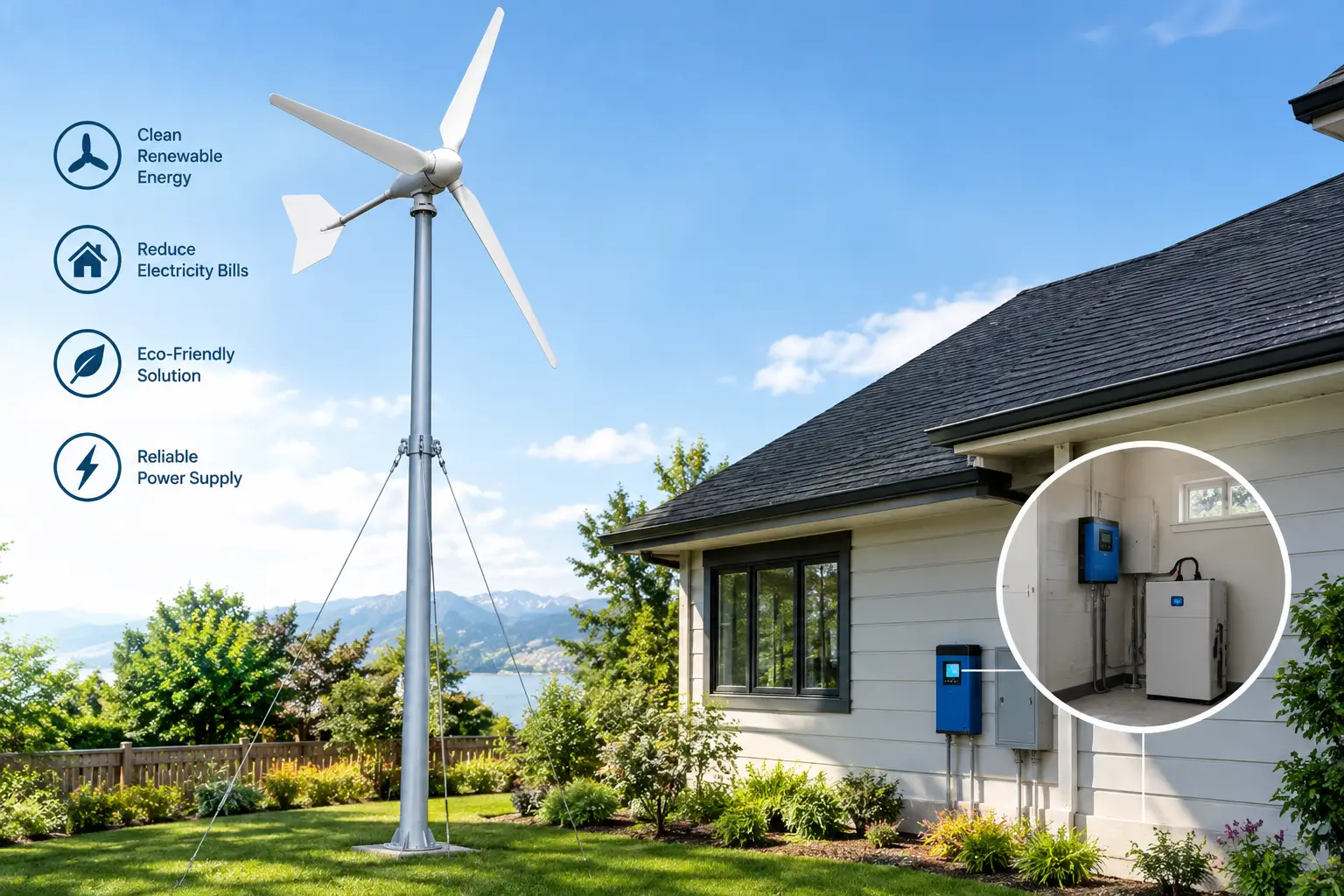
Windmill generators for home use are small wind turbines, usually 400 to 2,000 watts for DIY kits, that turn moving air into electricity to charge a battery bank or trim your utility bill. Each one pairs a rotor, a permanent-magnet alternator, and a charge controller, and each one lives or dies by the wind at your specific site.
That last part is the whole story, so let’s be upfront about it. Small wind is wonderful on a breezy ridge, a prairie homestead, or a shoreline lot. It’s disappointing behind a row of oaks in a cul-de-sac. The physics is unforgiving: the power available in wind rises with the cube of wind speed, so a site averaging 12 mph has roughly twice the energy of one averaging 9.5 mph. A great turbine in a poor spot will lose to a mediocre turbine in a great spot every single time.
That’s why the Department of Energy’s WINDExchange Small Wind Guidebook starts with questions about your wind resource, your energy use, and your local rules before it ever mentions hardware. We’ll follow the same logic. In this guide, you’ll get:
- ✅ Seven real turbines and kits, from a sub-$250 starter to a 1,500W tower-top unit
- ✅ Plain-English translations of the spec sheets (what “cut-in speed” actually means for your batteries)
- ✅ Honest review sentiment, including the complaints sellers would rather you skip
- ✅ A 30-day setup plan, three real-world buyer profiles, and a problem-solving guide
One more 2026 reality check: the 30% federal residential clean energy credit that used to cover small wind no longer applies to new purchases, which changes the payback math. We’ll cover that in the cost section. Ready? Let’s find the turbine that actually fits your yard.
Quick Comparison: 7 Home Wind Turbines at a Glance
| Turbine | Rated Output | System Voltage | Listed Start-Up Wind | Approx. Price Range | Best for |
|---|---|---|---|---|---|
| Automaxx Windmill 1500W | 1,500W | 24V / 48V | ~5.6 mph | $1,500–$2,300 | Automaxx Windmill 1500W: serious off-grid supplement |
| Primus Wind Power AIR 40 | Modest nameplate, ~40 kWh/mo at 12 mph | 12V / 24V / 48V | ~7 mph | $1,000–$1,300 | Primus Wind Power AIR 40: quiet, proven residential use |
| Automaxx Windmill 600W | 600W | 12V / 24V | ~4.5 mph | $700–$950 | Automaxx Windmill 600W: first “real” home system |
| Nature Power 70701 2000W | 2,000W | 24V | Not clearly published | $1,300–$2,200 | Nature Power 70701 2000W: coastal and marine sites |
| ECO-WORTHY 800W Solar Wind Kit | 400W wind + 390W solar | 12V | ~5.6 mph | $900–$1,300 | ECO-WORTHY 800W Solar Wind Kit: all-in-one hybrid starter |
| VEVOR 500W Wind Turbine | 500W (peak) | 12V | ~5.6 mph | $150–$250 | VEVOR 500W Wind Turbine: budget tinkering |
| Pikasola 400W 5-Blade Kit | 400W (peak) | 12V | ~5.6 mph | $150–$250 | Pikasola 400W 5-Blade Kit: RVs, sheds, hybrid add-ons |
Prices are approximate ranges at the time of writing; check the current price before you buy.
Reading across the table, the biggest gap isn’t wattage; it’s system voltage. The Automaxx Windmill 1500W and Nature Power 70701 2000W assume a 24V or 48V battery bank, which means they belong in a deliberate off-grid build, while the 12V kits like the VEVOR 500W Wind Turbine and Pikasola 400W 5-Blade Kit slot into RV-style setups. Meanwhile, the Primus Wind Power AIR 40 is the odd one out: a small nameplate number that, according to the manufacturer’s energy curve, punches well above it in moderate wind.
💬 One click helps other shoppers make an informed choice too! 😊
Top 7 Windmill Generators for Home Use: Expert Analysis
1. Automaxx Windmill 1500W — most muscle for off-grid homes
If you want a turbine that can make a measurable dent in household consumption, this is the strongest DIY-friendly option on Amazon. The Automaxx Windmill 1500W comes in 24V and 48V versions, with a listed cut-in speed of about 5.6 mph (2.5 m/s). In practice, that low cut-in means the blades start trickle-charging on ordinary breezy afternoons, not just during storms. The kit pairs the three-blade rotor with an MPPT controller, and the Bluetooth versions add an app that shows live voltage and wattage, which is genuinely useful when you’re trying to figure out whether your tower height is working.
Based on comparing the specs, this is a turbine for someone who already owns (or is building) a 24V/48V battery bank with a hybrid inverter; Automaxx recommends 200Ah or more of battery capacity. It weighs about 57 pounds, so tower-top installation is a two-person job with a proper mast, not a rooftop afternoon project. Automaxx also advises maintenance checks every six months and lists bearings rated for up to 10 years.
Reviews and roundups consistently report solid build quality and praise the monitoring, while noting that 1,500W is a peak figure only reached in strong wind.
Pros:
- ✅ Highest usable output among DIY-friendly kits here
- ✅ Bluetooth monitoring makes site tuning far easier
- ✅ Automatic and manual braking for storm protection
Cons:
- ❌ Heavy enough to require a serious tower
- ❌ Overkill unless you have a 24V/48V system
At roughly $1,500 to $2,300 depending on version, it’s the best value per watt only if your site averages well above 10 mph.
2. Primus Wind Power AIR 40 — quietest proven residential workhorse
The Primus Wind Power AIR 40 is the veteran of this list: the AIR series has been sold since 1995, with more than 150,000 units installed according to the manufacturer (some retailers now list it under Ryse Energy). It has a 46-inch rotor, weighs just 13 pounds, and starts producing at about 7 mph. Its headline number is energy, not watts: Primus rates it at roughly 40 kWh per month at a 12 mph average wind speed.
Here’s what most buyers overlook: a small nameplate rating doesn’t mean small production. The AIR 40 is tuned to produce in the 10–15 mph range where residential sites actually spend their time, rather than chasing a big number at 28 mph. It also has a built-in, microprocessor-based regulator, so you wire it straight to the battery bank without a separate controller box. It’s CSA-listed and available in 12V, 24V, and 48V.
Owner feedback and dealer notes consistently highlight quiet operation and easy installation. The important caveat, stated by the dealers themselves, is that the AIR 40 isn’t built for sustained high winds and should be stopped during major storms.
Pros:
- ✅ Decades of field history and dealer support
- ✅ Lightweight, simple direct-to-battery wiring
- ✅ Quiet blades suit neighbors and suburbs
Cons:
- ❌ Needs manual stopping in prolonged storms
- ❌ Not rated for salty coastal air
Expect roughly $1,000 to $1,300; you’re paying for reliability and documentation rather than raw wattage, which is a fair trade.
3. Automaxx Windmill 600W — smartest first home system
The Automaxx Windmill 600W is the “step up from toys” turbine: it carries the same brand engineering as the 1500W model in a size that suits a 12V or 24V system. It ships with an MPPT charge controller that displays amps, volts, and watts, plus automatic and manual braking. Its listed cut-in speed is around 4.5 mph, among the lowest here.
On paper, this means two practical things. First, the built-in display lets you watch output change as you adjust mast height or orientation, so you learn your site quickly. Second, 12V/24V flexibility lets you start with a modest 12V battery and move to 24V later without replacing the turbine. That makes it a natural pick for a weekend cabin, a workshop, or a homeowner who wants a meaningful backup trickle without committing to a full off-grid build.
Customer review volume for this model is more modest than for the budget kits, and we couldn’t verify a strong, consistent complaint pattern; roundups generally treat it as the best-value Automaxx. As always, treat 600W as the output in strong wind, not a daily average.
Pros:
- ✅ Very low listed cut-in wind speed
- ✅ Controller display shows real-time production
- ✅ Works on both 12V and 24V banks
Cons:
- ❌ Fewer verified reviews than budget rivals
- ❌ Still needs a tall, clear mounting pole
In the $700 to $950 range, it’s the best balance of proven brand support and manageable install effort.
4. Nature Power 70701 2000W — built for salt air and storms
The Nature Power 70701 2000W targets the toughest environments: it has a cast-aluminum body, a marine-grade coating, carbon-fiber blades, and a rated survival wind speed of 110 mph. Nature Power positions it for charging 24V battery systems on land or at sea, and it includes a wind charge controller. You’ll need to supply a minimum 1.5-inch Schedule 40 steel pipe for mounting.
What the spec sheet doesn’t spell out is that “marine grade” matters far beyond boats. If you live within a few miles of the coast, salt-laden air chews through uncoated aluminum housings and cheap bearings. A coated body like this one is the difference between a turbine that lasts and one that seizes after two seasons. Its 2,000W rating also gives it headroom for gusty coastal sites where wind regularly exceeds 20 mph.
Honest note: verified review data is thin. Major US retailers show only a handful of ratings, so we can’t summarize a reliable sentiment pattern. Buyers should rely on the published specs, the 1.5-inch pipe mounting standard, and the retailer’s return window.
Pros:
- ✅ Marine-grade coating resists coastal corrosion
- ✅ 110 mph survival rating for storm-prone areas
- ✅ High 2,000W ceiling for strong-wind sites
Cons:
- ❌ Very limited independent customer reviews
- ❌ Locks you into a 24V battery system
Around $1,300 to $2,200 depending on retailer, it’s good value only if corrosion and high wind are your real enemies.
5. ECO-WORTHY 800W Solar Wind Kit — easiest all-in-one hybrid
The ECO-WORTHY 800W Solar Wind Kit solves the “what else do I need?” problem. According to its manual, the kit bundles a 400W wind turbine, two 195W monocrystalline solar panels, a hybrid wind/solar charge controller, a 12V 100Ah lithium battery, and an 1,100W inverter. ECO-WORTHY’s 400W turbine listing gives a start-up speed of about 5.6 mph and a maximum wind rating of 78.3 mph.
Here’s what to weigh. The bundle’s real strength is the solar side: sun and wind tend to peak in different seasons and at different times of day, so pairing them smooths your charging. The weaker link is the turbine’s lower wind rating compared with the 110 mph units above, so storm-prone sites need a plan for braking or lowering the mast.
Reviews consistently praise the solar panels, while a recurring complaint is that the turbine needs stronger wind to spin up than expected and can vibrate on a light pole. Some buyers also report difficulty reaching customer support. It’s a strong starter for a shed, tiny home, or RV pad, provided you treat wind as the bonus, not the backbone.
Pros:
- ✅ Includes battery, inverter, and hybrid controller
- ✅ Solar panels carry the load on calm days
- ✅ Simplest path to a working system
Cons:
- ❌ Turbine has a lower storm rating
- ❌ Mixed reports on customer support response
In the $900 to $1,300 range, it’s solid value because the battery and inverter alone account for a big share of the price.
6. VEVOR 500W Wind Turbine — cheapest way to learn wind
The VEVOR 500W Wind Turbine is a 12V, five-blade unit with an MPPT controller, a listed 2.5 m/s (about 5.6 mph) start-up speed, an adjustable windward direction, and blades rated from -40°F to 176°F (-40°C to 80°C). For the price of a nice dinner out for a family of four, you get a complete turbine-plus-controller package.
The MPPT controller is the standout at this price. Cheaper kits often ship with basic controllers that waste low-wind energy; MPPT tracking squeezes more charge from the in-between breezes that dominate most sites. That said, five-blade rotors like this one start easily but tend to top out lower in real output, so the 500W figure is best read as a peak at rated wind, not a daily expectation.
Aggregated sentiment is split: many buyers find it a fun, functional battery charger for a shed, boat, or farm outbuilding, while roughly one review in seven is one-star, often citing output below expectations or hardware issues. Treat it as an affordable learning platform and you’ll likely be satisfied.
Pros:
- ✅ MPPT controller included at a budget price
- ✅ Low start-up speed catches light breezes
- ✅ Wide operating temperature range
Cons:
- ❌ Real output well below 500W peak
- ❌ Noticeable share of one-star reviews
At roughly $150 to $250, it’s excellent value as an experiment, not as a home power plan.
7. Pikasola 400W 5-Blade Kit — best compact RV and shed add-on
The Pikasola 400W 5-Blade Kit is one of the most-reviewed small turbines on Amazon. It’s a 12V unit with nylon-carbon-fiber blades, a 2.5 m/s (about 5.6 mph) start-up speed, a yaw tail that keeps the rotor facing the wind, and an included charge controller. Pikasola designs it explicitly for hybrid solar-wind setups.
Based on comparing the specs and owner feedback, its sweet spot is topping off batteries at night and during cloudy stretches when your solar panels are idle. It’s light enough for a portable mast at a campsite or a pole beside a workshop. What most buyers overlook is the gap between nameplate and reality: roundups estimate a 400W turbine in typical 8–12 mph residential wind produces on the order of tens of watt-hours per day, not 400 watts continuously.
Reviews consistently describe it as quiet and praise Pikasola’s support for sending replacement parts. On the other hand, a common complaint is that output in strong wind falls far short of 400W, and some owners note there’s no built-in way to slow it down in high winds.
Pros:
- ✅ Quiet, light, and easy to mount
- ✅ Well-suited to hybrid solar-wind systems
- ✅ Responsive support for replacement parts
Cons:
- ❌ Lacks robust high-wind braking
- ❌ Peak output rarely matches the rating
In the $150 to $250 range, it’s a fair-value supplement as long as you buy it for battery maintenance, not household power.
Side-by-Side: Build, Protection, and Review Sentiment
| Turbine | Blades | Storm Protection | Controller | Review Sentiment | Best for |
|---|---|---|---|---|---|
| Automaxx Windmill 1500W | 3 | Auto + manual brake | MPPT, Bluetooth (select versions) | Positive on build and monitoring | Automaxx Windmill 1500W: windy rural homes |
| Primus Wind Power AIR 40 | 3 | Electronic regulation; manual stop in storms | Built-in regulator | Long-standing positive track record | Primus Wind Power AIR 40: quiet suburbs-to-rural |
| Automaxx Windmill 600W | 3 | Auto + manual brake | MPPT with display | Limited but favorable | Automaxx Windmill 600W: cabins and workshops |
| Nature Power 70701 2000W | 3 | 110 mph survival rating | Included wind controller | Too few reviews to judge | Nature Power 70701 2000W: coastal lots |
| ECO-WORTHY 800W Solar Wind Kit | 3 | 78.3 mph max listed | Hybrid wind/solar | Solar praised, turbine mixed | ECO-WORTHY 800W Solar Wind Kit: tiny homes |
| VEVOR 500W Wind Turbine | 5 | Basic | MPPT | Split; notable 1-star share | VEVOR 500W Wind Turbine: hobbyists |
| Pikasola 400W 5-Blade Kit | 5 | Limited | Included controller | Quiet, but output below rating | Pikasola 400W 5-Blade Kit: RVs and sheds |
Looking at this table, storm protection is the quiet dividing line between “investment” and “experiment.” The three-blade units with real braking or survival ratings, like the Automaxx Windmill 1500W and Nature Power 70701 2000W, are built to survive years on a tower, while the five-blade budget kits trade that resilience for easy starts and low prices. If your area sees regular 50+ mph gusts, that column should outweigh every wattage number.
How to Set Up Your Home Wind Turbine: A First-30-Days Guide
Most small wind disappointments trace back to the first month, not the hardware. Here’s a practical sequence.
Week 1: Measure before you mount. Put an inexpensive anemometer on a temporary pole at your intended height and log readings for at least a week (a full season is better). Check your property against the DOE’s classic siting rule of thumb: the bottom of the rotor should clear anything within about 300 feet (trees, roofs, barns) by roughly 30 feet.
Week 2: Build the electrical side first. Install the battery bank, charge controller, and any dump load before the turbine goes up. A spinning turbine connected to nothing can over-speed and damage itself. Always connect the battery to the controller first, then the turbine to the controller, and follow your kit’s sequence exactly.
Week 3: Raise the turbine. Use the mast spec your manual calls for (for example, the Primus Wind Power AIR 40 and Nature Power 70701 2000W both mount on 1.5-inch Schedule 40 pipe). Guy wires, not willpower, keep a tower vertical in a storm. Torque every bolt and use thread-locker where the manual allows.
Week 4: Watch, log, and tune. Record daily output from your controller display or app. If the turbine spins but barely charges, the problem is almost always height or turbulence, not the generator.
⚡ Common first-month mistakes:
- ❌ Mounting on the roof, where turbulence kills output and vibration travels into the house
- ❌ Undersized wire on long runs, which wastes power as heat
- ❌ Skipping the brake/stop switch test before the first storm
After day 30, settle into a six-month inspection rhythm: check blade edges for chips, listen for bearing noise, and re-torque the mounting hardware.
Real-World Scenarios: Matching Turbines to Homeowners
Specs only make sense next to a real life. Here are three common profiles and how the logic plays out.
🏡 Profile 1: The Kansas homestead (budget: ~$2,500–$4,000 total system)
You live on open farmland, your local airport reports year-round averages near 12 mph, and you already run a 48V solar array with a hybrid inverter. Winter is your weak season for solar. The Automaxx Windmill 1500W in 48V fits here because it matches your existing bank voltage and delivers its best output exactly when your panels struggle. Budget for a tilt-up tower and quality wire; they’ll cost almost as much as the turbine.
🌊 Profile 2: The coastal Maine cabin (budget: ~$1,500–$2,500)
Your weekend cabin sits on a bluff above the ocean, with steady onshore wind and salty air. You use the place mostly in shoulder seasons. The Nature Power 70701 2000W makes sense for its marine coating and 110 mph rating, assuming you build a 24V bank. If you prefer a quieter, proven option and your bank is 12V, the Primus Wind Power AIR 40 is attractive, but note that Primus recommends its marine models, not the AIR 40, for salt-spray locations.
🚐 Profile 3: The suburban tinkerer and RV owner (budget: under $500)
Your backyard is surrounded by houses and trees, so wind is weak and turbulent. Honestly, a home-scale turbine won’t pay off here. But for your RV, which you park on breezy campgrounds, the Pikasola 400W 5-Blade Kit or VEVOR 500W Wind Turbine on a portable mast can top off batteries overnight. It’s a fun, educational project, and you’ll learn wind behavior before committing to anything bigger.
The common thread? Each choice starts with where the wind is and what battery voltage you already have, not with the biggest wattage on the box.
✨ Ready to put the wind to work?
🔍 Take your home energy setup to the next level with this carefully curated lineup. Click a highlighted turbine to check current pricing and availability. These picks will help you get cleaner, more resilient power your whole family will appreciate!
Problem → Solution: Fixing Common Small Wind Turbine Headaches
Problem 1: The turbine spins, but the battery barely charges. Solution: Your blades are reaching start-up speed but not the speed where charging actually begins. Raise the mast; even 10 extra feet can move you into smoother, faster air. An MPPT controller, like those on the Automaxx Windmill 600W and VEVOR 500W Wind Turbine, also helps harvest low-wind energy.
Problem 2: Loud humming or vibration. Solution: Check blade balance and bolt torque first. Vibration on thin poles, a common complaint with the ECO-WORTHY 800W Solar Wind Kit, often disappears with a heavier mast and proper guy wires. Never mount directly to a house frame.
Problem 3: Output drops in winter. Solution: Ice on blades kills aerodynamics and unbalances the rotor. Stop the turbine during icing events, then inspect blades afterward for chips. Some owners report manufacturers like Pikasola will send replacement blades.
Problem 4: The turbine over-speeds in storms. Solution: Use the brake. Units like the Automaxx Windmill 1500W have automatic and manual braking; the Primus Wind Power AIR 40 uses a stop switch. For kits without strong braking, such as the Pikasola 400W 5-Blade Kit, plan to lower the mast or short the controller per the manual before major storms.
Problem 5: Batteries overcharge on windy, sunny days. Solution: Confirm your dump (diversion) load is wired correctly. A hybrid controller needs somewhere to send excess energy, or it will brake the turbine hard and stress the batteries.
How to Choose a Residential Wind Turbine Kit
Here’s the decision sequence, in order of importance:
- Check your average wind speed. If your site can’t sustain roughly 9–10 mph annually, small wind rarely makes economic sense, no matter the brand.
- Match your battery voltage. Buy a 12V, 24V, or 48V turbine that matches your existing (or planned) bank, so you don’t have to rebuild your system later.
- Prioritize energy at your wind speed, not peak watts. Look for a monthly kWh figure at 10–12 mph, like the one Primus publishes, rather than a headline wattage at 28 mph.
- Confirm storm protection. A survival wind rating and a real brake protect your investment from the one storm that matters.
- Look at the controller. MPPT beats basic PWM for squeezing power from variable wind, and a display or app makes tuning possible.
- Plan the tower before the turbine. Height and clear airflow do more for output than any blade design.
- Verify support and parts. Replacement blades, bearings, and a real warranty matter because every turbine is a spinning machine exposed to weather.
If you want a deeper engineering background on rotor sizing and the difference between horizontal- and vertical-axis designs, the overview of small wind turbines on Wikipedia is a solid starting point.
Common Mistakes to Avoid When Buying a Wind Turbine Generator Kit
The small wind market rewards skepticism. These are the traps that catch most first-time buyers.
Believing the wattage on the box. A “400W” rating is usually measured at about 28 mph, a wind speed most backyards rarely see. Because power scales with the cube of wind speed, at 14 mph you’d expect roughly one-eighth of rated power. That’s why owner reviews of budget kits so often mention output far below the label.
Ignoring the tower budget. A quality mast, guy wires, concrete anchor, and heavy-gauge wire can rival the turbine’s price, especially for the Automaxx Windmill 1500W. Budget for them upfront.
Falling for “12,000W” vertical-axis listings. You’ll see inexpensive vertical turbines with enormous wattage claims and tiny rotors. Rotor swept area, not marketing, determines energy capture, and those numbers don’t add up.
Buying for the house instead of the battery. Most kits on Amazon are battery chargers. Connecting them to your home’s main panel requires a grid-tie inverter, utility approval, and code-compliant wiring.
Skipping the rules. Height limits, setbacks, and HOA covenants can stop a project after you’ve bought the hardware. Call your zoning office before you click “buy.”
Assuming 2025 incentives still apply. The federal 30% credit ended for new expenditures after 2025, so older payback calculators you find online may be overly optimistic.
The pattern behind all six mistakes is the same: small wind fails on expectations, not engineering.
Home Wind Turbine vs. Solar Panels: Which Fits Your Property?
Most homeowners comparing windmill generators for home use are really asking a bigger question: wind, solar, or both? Here’s how the options stack up.
| Factor | Small Wind Turbine | Solar Panels | Hybrid (Wind + Solar) |
|---|---|---|---|
| Works at night | ✅ Yes | ❌ No | ✅ Yes |
| Best season | Winter, stormy periods | Summer | Year-round balance |
| Site sensitivity | Very high (height, obstructions) | Moderate (shade, orientation) | High |
| Moving parts | Yes; needs regular inspection | None | Some |
| Permitting complexity | Higher (height, setbacks) | Lower | Higher |
| Best for | Open, windy rural land | Most sunny rooftops | Off-grid homes, e.g., ECO-WORTHY 800W Solar Wind Kit |
The table points to a clear conclusion: for most suburban homes, solar is simpler and more predictable, while wind earns its place on open land and in winter-heavy climates where panels underperform. The hybrid column is where small turbines shine brightest; a modest unit like the Pikasola 400W 5-Blade Kit or the Primus Wind Power AIR 40 can fill nighttime and cloudy-day gaps that would otherwise drain your batteries.
Put simply, wind and solar aren’t rivals so much as shift workers. Solar covers the long summer days, and wind tends to pick up during winter fronts and overnight. If you can only afford one, choose the resource your site has more of. If you’re off-grid, combining both usually means a smaller battery bank and fewer generator hours.
What to Expect: Everyday Performance of a Small Wind Turbine for Home
Let’s translate spec sheets into daily life. The most useful number available for any turbine here is the Primus Wind Power AIR 40 rating of about 40 kWh per month at a 12 mph average. That’s roughly 1.3 kWh a day: enough to run an efficient fridge, LED lighting, and device charging in an off-grid cabin, but only a small slice of a typical US home’s monthly use, which the EIA puts in the neighborhood of 850–900 kWh.
For the budget 400–500W kits, set your expectations lower. In average residential wind of 8–12 mph, independent roundups estimate daily production measured in tens of watt-hours. That’s phone charging, a few LED lights, or keeping an RV battery from slowly draining, not running appliances.
The larger Automaxx Windmill 1500W and Nature Power 70701 2000W can deliver meaningful energy on genuinely windy sites, but their output still swings day to day. A calm week produces almost nothing; a stormy weekend might fill your bank.
🔋 Practical everyday takeaways:
- Output is “lumpy”: batteries smooth it out
- Night and winter production are wind’s real strengths
- Noise is usually a soft whoosh; vibration on poor mounts is the bigger annoyance
Think of a home turbine like a rain barrel: it collects when nature delivers, and your battery is the barrel.
Long-Term Cost and Maintenance
The sticker price is only the beginning. Here’s what total cost of ownership looks like across the range.
| Cost Item | Budget Kit (VEVOR / Pikasola) | Mid-Range (Automaxx 600W / AIR 40) | High-End (Automaxx 1500W / Nature Power) |
|---|---|---|---|
| Turbine | $150–$250 | $700–$1,300 | $1,300–$2,300 |
| Tower, guy wires, anchor | $100–$400 | $400–$1,500 | $1,000–$3,000+ |
| Batteries (if needed) | $200–$600 | $800–$2,000 | $2,000–$5,000+ |
| Maintenance per year | Low, but parts wear faster | Six-month inspections | Six-month inspections, possible crane/tilt-up access |
| Best for | Pikasola 400W 5-Blade Kit: learning | Primus Wind Power AIR 40: steady supplement | Automaxx Windmill 1500W: off-grid offset |
All figures are rough planning ranges, not quotes; local labor and materials vary widely.
The analysis here is sobering but useful: the tower and battery bank often cost more than the turbine itself, which is why a cheap turbine on a bad tower is the worst value of all. Mid-range systems tend to offer the best long-term value because their bearings and controllers are designed for years of service, while budget kits may need replacement blades or controllers sooner.
The incentive picture changed, too. According to the IRS instructions for Form 5695, residential clean energy credits can’t be claimed for expenditures made after December 31, 2025, although taxpayers can still carry forward unused credit from earlier qualifying installations. For 2026 purchases, look instead at state programs, local utility rebates, and net-metering rules, which vary widely by state.
Safety, Regulations, and Standards
A home turbine is a tall, spinning machine connected to a battery bank, so treat it with the same respect as a roof or electrical project.
Zoning and permits. Many counties regulate tower height, setbacks from property lines, and noise. HOAs may prohibit turbines outright. Get approvals in writing before buying.
Electrical code. The National Electrical Code includes Article 694 specifically for wind electric systems, covering disconnects, wiring, and overcurrent protection. If you’re connecting to your home’s panel or the grid, hire a licensed electrician and contact your utility about interconnection.
Product certification. The DOE encourages buyers to look for turbines certified for safety and performance by an accredited organization under the small wind standard (ANSI/ACP 101-1, formerly AWEA 9.1). Electrical listings like UL 6142 or CSA also signal tested safety. Among these picks, the Primus Wind Power AIR 40 is CSA-listed; we couldn’t verify similar certifications for the budget kits, so weigh that accordingly.
Physical safety. Never climb a tower with the turbine spinning. Use the brake or stop switch, then lower tilt-up towers for service. Keep a fall zone at least equal to tower height clear of people, kids’ play areas, and power lines.
The DOE’s consumer guide to small wind energy systems walks through these siting and safety questions in more detail and is worth reading before you finalize a location.
Features That Actually Matter (and Ones That Don’t)
Marketing copy for small turbines is crowded with impressive-sounding features. Here’s how to separate signal from noise.
Features that actually matter:
- ✅ Low cut-in speed paired with MPPT control. A turbine that starts at 5–6 mph is only useful if the controller can harvest that low-wind trickle.
- ✅ Survival wind rating and braking. The Nature Power 70701 2000W and its 110 mph rating, or the Automaxx Windmill 1500W with automatic and manual braking, protect your investment.
- ✅ Published energy curves. Monthly kWh at a given average wind is far more honest than a peak watt figure.
- ✅ Corrosion resistance if you’re near the coast.
- ✅ Real parts availability, especially blades and bearings.
Features that matter less than you’d think:
- ❌ More blades. Five-blade designs start easily but don’t automatically produce more energy than efficient three-blade rotors.
- ❌ Huge wattage numbers on tiny rotors. Swept area sets the limit.
- ❌ “Maglev” or “noiseless” claims on unbranded vertical-axis units without published data.
- ❌ Color and styling. Red blades look great; they don’t change physics.
The short version: pay for protection, control, and transparency. Skip the marketing adjectives.
Off-Grid Wind Power for Cabins, RVs, and Rural Homes
Off-grid wind power is where small turbines truly earn their keep, because every kWh you make offsets fuel for a generator rather than cheap grid electricity.
For rural homes off the grid: Wind is your winter insurance. Pair a mid- or high-end turbine with solar so you’re charging day and night. Size the battery bank to cover a few calm days, and keep a backup generator for long still spells.
For weekend cabins: Unattended operation is the priority. Choose a turbine that protects itself, like the Primus Wind Power AIR 40 with its built-in regulation (paired with a stop switch), and set up remote monitoring if your controller allows it. The Automaxx Windmill 600W works well here too, especially if you can check its display on each visit.
For RVs and boats: Portability and weight matter most. A light unit like the Pikasola 400W 5-Blade Kit on a removable mast tops off house batteries overnight at windy campsites. For saltwater use, choose coated, marine-rated hardware.
For tiny homes and sheds: A bundled kit such as the ECO-WORTHY 800W Solar Wind Kit removes guesswork by including the battery and inverter.
Across all four, the rule holds: a home wind turbine is most valuable where grid power is unavailable or expensive, and least valuable where it competes with cheap, reliable utility electricity.
FAQ: Windmill Generators for Home Use
❓ Can windmill generators for home use power an entire house?
❓ How much does a home wind turbine cost to install in 2026?
❓ What size wind turbine do I need for an off-grid cabin?
❓ Are vertical-axis wind turbines better for homes?
❓ Do I need a permit to put a wind turbine in my backyard?
Conclusion: Choosing the Right Windmill Generator for Your Home
The best windmill generators for home use aren’t the ones with the biggest wattage on the box; they’re the ones matched to your wind, your battery voltage, and your tolerance for maintenance. Here’s the quick recap:
- 🏆 Automaxx Windmill 1500W: the strongest option for windy rural sites with 24V/48V banks
- 🔇 Primus Wind Power AIR 40: the quiet, proven choice for steady residential supplement
- ⚡ Automaxx Windmill 600W: the smartest first “real” system
- 🌊 Nature Power 70701 2000W: built for coastal corrosion and storms
- ☀️ ECO-WORTHY 800W Solar Wind Kit: the simplest all-in-one hybrid
- 💸 VEVOR 500W Wind Turbine: the budget learning platform
- 🚐 Pikasola 400W 5-Blade Kit: the compact RV and shed add-on
Before you buy, measure your wind, plan your tower, and check local rules. With the federal credit gone for new purchases, honest site assessment matters more than ever, and it’s the difference between a turbine that hums along for a decade and one that becomes a lawn ornament. Pair wind with solar wherever you can; together they cover each other’s weak seasons beautifully.
🌬️ Harness your own breeze today!
🔍 Take your home energy independence to the next level with this carefully curated lineup. Click a highlighted turbine to check current pricing and availability. These picks will help you get reliable, cleaner power your whole family will enjoy!
Recommended for You
- Electric Generator Brands: 7 Best Picks You Can Trust in 2026
- Generator for Travel Trailer AC: 7 Best Picks That Won’t Trip (2026)
- Generator for RV Air Conditioner: 7 Best Picks That Won’t Quit (2026)
Disclaimer: This post contains affiliate links. As an Amazon Associate, I earn from qualifying purchases made through these links, at no additional cost to you.
✨ Found this article helpful? Share it with someone who needs it! 💬🤗
