
In This Article
What Is the Cost of a Generac Whole House Generator in 2026?
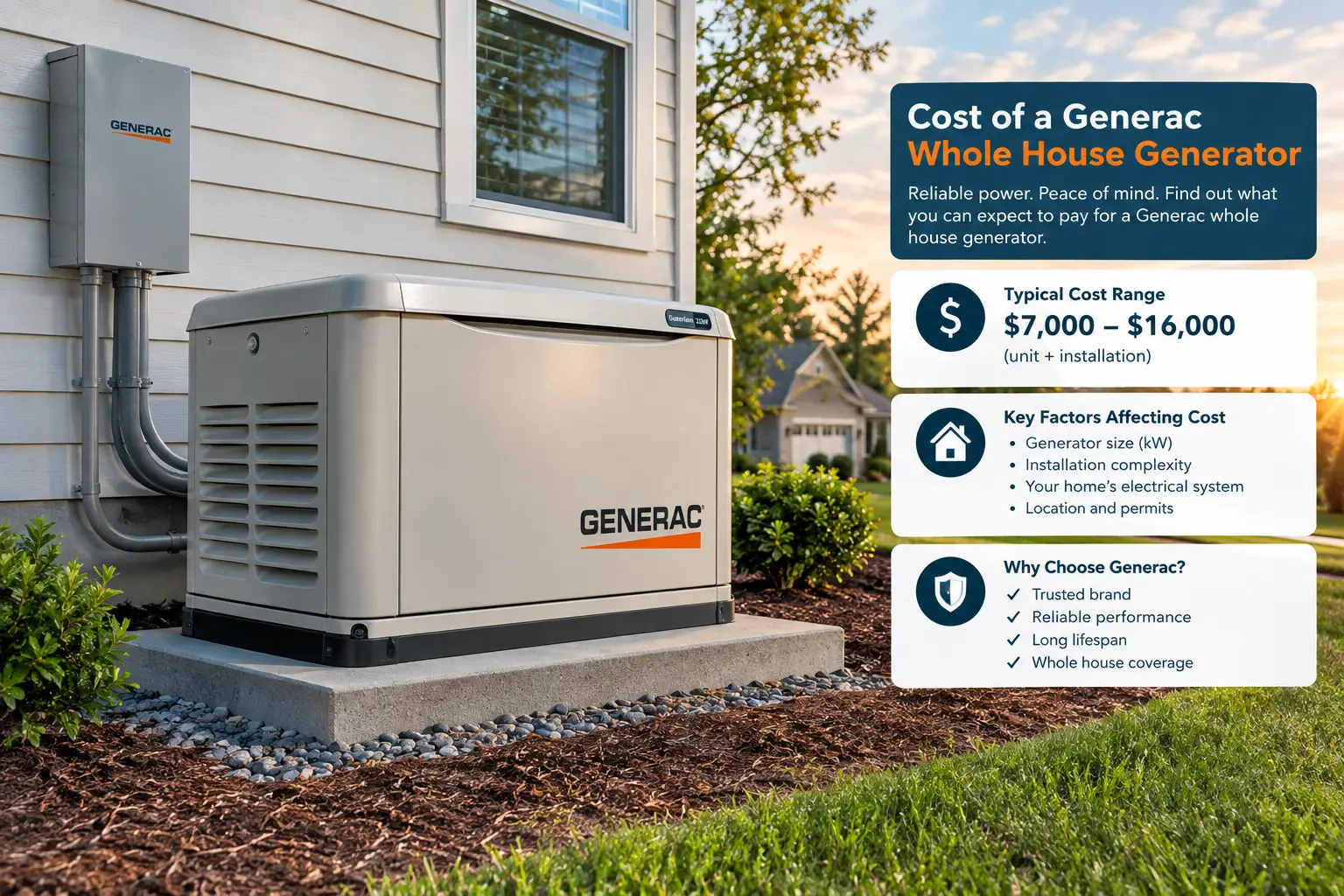
The cost of a generac whole house generator in 2026 typically lands between $8,000 and $16,000 installed for an average home, and the generator itself is only about a third of that bill. Unit-only prices run from roughly $3,000 for a 10kW Guardian to around $8,500 for the 26kW flagship, before labor, permits, and fuel work.
Here’s the part the big-box product page never shows you: the box on the shelf is the cheap part. Industry cost guides that cite Generac’s own installation guidance put the generator at roughly 37% of the total project, with the remaining 63% going to the transfer switch, materials, electrical work, gas piping, the pad, and permits. That’s why two neighbors with the exact same model can pay wildly different totals.
So why are so many homeowners pricing these systems right now? Outages are getting longer. According to the U.S. Energy Information Administration’s analysis of 2024 outage data, the average U.S. electricity customer went without power for about 11 hours in 2024, nearly double the average of the previous decade, with hurricanes driving roughly 80% of those lost hours. Routine, non-storm outages still average only about two hours a year, which tells you something important: a home standby generator is mostly insurance against the big, rare, multi-day event.
In this guide, you’ll get a clear look at what each Guardian model really costs, what drives the installed price up or down, how much you’ll spend over 10 years, and how to pick the right size without overpaying. You’ll also find practical playbooks for getting honest quotes and avoiding the cost surprises that blindside first-time buyers. Every price below is a range, because generator pricing moves constantly — always check the current price before you commit.
Quick Comparison: Generac Guardian Models and Price Ranges at a Glance
Before diving into each model, here’s the 30-second version. Output is listed as liquid propane (LP) / natural gas (NG), since every air-cooled Guardian makes a little less power on natural gas.
| Model | Output (LP / NG) | Transfer Switch | Typical Unit Price Range* | Best for |
|---|---|---|---|---|
| Generac Guardian 7171 10kW | 10kW / 9kW | Not included | ~$3,000–$4,500 | DIY-minded buyers with a separate switch plan |
| Generac Guardian 7172 10kW | 10kW / 9kW | 100A, 16-circuit | ~$4,000–$5,000 | Essential circuits in smaller homes |
| Generac Guardian 7225 14kW | 14kW (LP) | 200A whole-house | ~$6,000–$7,500 | Gas-heated homes under ~2,000 sq ft |
| Generac Guardian 7228 18kW | 18kW / 17kW | 200A whole-house | ~$6,500–$8,000 | Mid-size homes with one central AC |
| Generac Guardian 7043 22kW | 22kW / 19.5kW | 200A service-entrance rated | ~$6,500–$8,000 | Most 2,000–4,000 sq ft homes |
| Generac Guardian 7210 24kW | 24kW / 21kW | 200A service-entrance rated | ~$6,000–$7,500 | Larger homes with heavy electric loads |
| Generac Guardian 7291 26kW | 26kW / 22.5kW | 200A whole-house | ~$7,000–$8,500 | Big homes, two AC systems, all-electric kitchens |
*Unit/package prices only, at the time of writing; installation is extra. Prices may vary — check the current price.
Looking at the table above, the price ladder is surprisingly flat at the top: the Generac Guardian 7043 22kW, Generac Guardian 7210 24kW, and Generac Guardian 7291 26kW often sit within about $1,000–$1,500 of each other, while installation costs barely change between them. That’s why the 22kW-to-26kW tier usually delivers the lowest cost per kilowatt. Budget buyers should note that the Generac Guardian 7172 10kW saves real money upfront, but its 16-circuit switch means you choose which circuits stay on — it is not true whole-house coverage.
💬 One click helps other shoppers make an informed choice too! Share this comparison with a neighbor who’s pricing a generator. 😊
Top 7 Generac Whole House Generators: Expert Price and Value Analysis
Every model below is a real, currently listed Guardian Series unit. To anchor the pricing, it helps to look at a neutral reference: a New York State Office of General Services contract price list shows Generac’s list prices for these generator packages climbing from a little over $5,000 for the 10kW to about $9,500 for the 26kW, before contract discounts. Street prices are usually lower than list, which is why the ranges below sit beneath those figures. The analysis is based on comparing published spec sheets and the owner feedback we could actually verify — not on invented test results.
1. Generac Guardian 7171 10kW — lowest entry price for essentials
The Generac Guardian 7171 10kW is the cheapest way into a genuine automatic standby system, because it ships without a transfer switch. It makes 10kW on propane and 9kW on natural gas from a 460cc G-Force 400 engine, which in practice covers a refrigerator, furnace blower, sump pump, lights, Wi-Fi, and a few outlets — but not a central air conditioner running alongside an electric range. At 61 dBA, it’s noticeably quieter than the 67 dBA bigger Guardians, a real plus if your setback puts it near a bedroom window.
What most buyers overlook: “no switch included” is only a saving if you already have a compatible switch or your electrician recommends a specific one, such as a smart load-managing switch. Otherwise you’ll simply buy the switch separately and land near the price of the Generac Guardian 7172 10kW. Owner discussions on deal forums repeatedly stress that installation often roughly doubles the equipment cost, and that warning applies with full force here.
Pros:
- ✅ Lowest upfront unit price in the Guardian line
- ✅ Quietest model at 61 dBA during operation
- ✅ Flexible pairing with a switch your installer prefers
Cons:
- ❌ Transfer switch must be bought and installed separately
- ❌ Too small to run central AC with other loads
Expect roughly $3,000–$4,500 for the unit at the time of writing — strong value only if your switch plan is already settled.
2. Generac Guardian 7172 10kW — the turnkey essentials package
The Generac Guardian 7172 10kW is the same 10kW/9kW generator as the 7171, bundled with a 100-amp, 16-circuit automatic transfer switch. That switch is the key detail: your electrician moves up to 16 chosen circuits into it, and only those circuits get backup power. Think of it as a “keep the house livable” package rather than a “keep the house normal” package.
On paper, the 460cc engine burns about 1.48 gallons of propane per hour at full load and roughly 0.97 gallons at half load, so a 500-gallon propane tank filled to its usual 80% can carry it for well over a week of moderate use. On natural gas, consumption runs about 101–127 cubic feet per hour, depending on load. Mobile Link Wi-Fi monitoring is standard, so you can check status and maintenance alerts from your phone.
Owner feedback on the 10kW Guardians is generally positive about reliability, but the recurring complaint is about expectations: buyers who assumed “whole house” learned the 16-circuit switch forces trade-offs. Plan your circuit list before the install, not during it.
Pros:
- ✅ Switch included, so the package price is predictable
- ✅ Very modest fuel use for multi-day outages
- ✅ Compact footprint fits tight side yards
Cons:
- ❌ Only 16 circuits can be backed up
- ❌ Not a fit for homes with large electric loads
Typically around $4,000–$5,000 at the time of writing — the best-value pick for essential-circuit backup.
3. Generac Guardian 7225 14kW — the budget whole-house bridge
The Generac Guardian 7225 14kW is where “whole house” starts to become realistic, because it pairs a 14kW generator with a 200-amp whole-house transfer switch. Instead of choosing 16 circuits, your entire panel stays connected; what you manage is how many big appliances run at once.
Rated at 14kW on propane (check the spec sheet for the natural gas figure in your configuration), it suits homes with gas heat, a gas water heater, and a modest central AC unit. In practice, that means the furnace, fridge, lights, electronics, and a 2- to 3-ton air conditioner can usually coexist, especially if your installer adds Generac’s load-management modules to keep the AC from starting at the same moment as the well pump or dryer.
We couldn’t verify a large pool of model-specific owner reviews for this exact SKU, so treat broad claims about it cautiously. What is verifiable is that it shares the Guardian platform’s 5-year limited warranty, Mobile Link connectivity, and low-speed Quiet-Test exercise mode, which reviews across the line consistently describe as a welcome noise reduction.
Pros:
- ✅ Whole-house switch at a mid-range price
- ✅ Enough output for most gas-heated homes
- ✅ Shares the proven Guardian controls and warranty
Cons:
- ❌ Needs load management for larger AC systems
- ❌ Limited model-specific review volume to verify
Expect roughly $6,000–$7,500 at the time of writing — solid value if your home leans on gas appliances.
4. Generac Guardian 7228 18kW — central air without the flagship bill
The Generac Guardian 7228 18kW fills the gap between “careful whole-house” and “don’t think about it.” Rated at 18kW on propane and 17kW on natural gas, with a 200-amp whole-house switch, it gives you enough headroom for a single central air conditioner up to roughly 4 tons alongside normal household loads.
Here’s what to weigh: the price gap between this model and the Generac Guardian 7043 22kW is often only a few hundred dollars, while installation costs are nearly identical. If your load calculation lands anywhere near 16–18kW, the 22kW frequently becomes the smarter dollar-per-kilowatt buy. The 18kW makes the most sense when your gas service is limited, because smaller engines need less fuel volume — and a gas meter upgrade can easily cost more than the generator price difference.
As with the 14kW, verified owner reviews specific to this SKU are thinner than for the 22kW. The feedback we could confirm on the 18kW tier echoes the Guardian line overall: dependable automatic starts and appreciation for the app alerts, with complaints mostly about dealer scheduling rather than the hardware.
Pros:
- ✅ Handles one central AC with normal loads
- ✅ Lower fuel demand than the 22kW–26kW tier
- ✅ Whole-house switch included in the package
Cons:
- ❌ Price gap to the 22kW is often small
- ❌ Fewer verifiable model-specific reviews
Typically around $6,500–$8,000 at the time of writing — good value when gas supply, not budget, is your constraint.
5. Generac Guardian 7043 22kW — best value per kilowatt
The Generac Guardian 7043 22kW is the model most installers quote first, and the spec sheet explains why. It produces 22kW on propane and 19.5kW on natural gas from a 999cc G-Force 1000 engine, and the package includes a 200-amp service-entrance-rated transfer switch, which can simplify wiring in homes where the meter and main disconnect sit outside.
In real-world terms, 19.5kW on natural gas covers most 2,000- to 4,000-square-foot homes with gas heat, including a central AC, refrigerator, freezer, sump or well pump, and home office. Full-load natural gas consumption is about 306 cubic feet per hour, so your gas meter and piping must be sized for it — a detail that drives many surprise costs. Sound is rated at 67 dBA at about 23 feet, roughly comparable to a conversation-level background hum. The cabinet measures about 48 x 25 x 29 inches.
Reviews consistently report satisfaction on dealer sites, with owners frequently saying it runs their entire house during outages. A few long-time owners noted it’s an incremental update over the previous 22kW generation rather than a revolution — which is reassuring rather than disappointing.
Pros:
- ✅ Lowest cost per kilowatt in the air-cooled lineup
- ✅ Service-entrance-rated switch can simplify wiring
- ✅ Strong, consistent owner feedback on whole-house coverage
Cons:
- ❌ Needs a gas meter sized for about 306 cfh
- ❌ Louder than the 10kW models at 67 dBA
Expect roughly $6,500–$8,000 at the time of writing — the strongest overall value for typical homes.
6. Generac Guardian 7210 24kW — extra headroom for all-electric homes
The Generac Guardian 7210 24kW adds a little more muscle to the 22kW formula: 24kW on propane and 21kW on natural gas, with a 200-amp service-entrance-rated transfer switch. That extra 1.5–2kW sounds small, but it’s exactly what an electric range or heat pump needs to start without dimming every light in the house.
Fuel use is the trade-off to plan around. Published specs list about 3.9 gallons of propane per hour at full load and roughly 2.5 gallons at half load. Over a 24-hour outage at half load, that’s around 60 gallons of propane — so a propane-fed home will want a 500-gallon tank or larger and a delivery contract that prioritizes storm season. On natural gas, consumption at full load matches the 22kW at about 306 cubic feet per hour.
Owner sentiment is mostly positive, but it’s worth noting that retailer review pages include at least one complaint about repeated engine failures and a slow warranty resolution. Problems like that seem uncommon, yet they underline why your dealer’s service reputation matters as much as the model you choose. Deal-forum owners also echo the theme that installation roughly doubles the equipment cost.
Pros:
- ✅ More starting headroom for electric ranges and heat pumps
- ✅ Often priced close to the 22kW package
- ✅ Service-entrance-rated switch included
Cons:
- ❌ Heavy propane consumption during long outages
- ❌ Service experience depends heavily on your dealer
Typically around $6,000–$7,500 at the time of writing — excellent value when promotions bring it near 22kW pricing.
7. Generac Guardian 7291 26kW — the air-cooled ceiling
The Generac Guardian 7291 26kW is the most powerful air-cooled home standby generator Generac makes: 26kW on propane and 22.5kW on natural gas, paired with a 200-amp whole-house switch (the 7290 is the generator-only version). Beyond this size, you move into liquid-cooled Protector Series units, which cost dramatically more and need bigger installations.
Based on comparing the specs, the 26kW draws about 333 cubic feet per hour of natural gas at full load and around 188 at half load, or roughly 3.6 and 2.1 gallons of propane per hour, respectively. It shares the 999cc G-Force 1000 engine, the 67 dBA sound rating, and the 5-year limited warranty with the 22kW. In practice, this is the unit for 4,000-plus-square-foot homes, houses with two AC systems, or all-electric homes where the heat pump, range, and water heater may overlap.
Verified owner reviews specific to the 26kW are less plentiful than for the 22kW. Because it shares the same engine family, the reliability themes reported for the 22kW are a reasonable — though not guaranteed — guide.
Pros:
- ✅ Maximum output without going liquid-cooled
- ✅ Handles two AC systems with smart load management
- ✅ Same proven engine as the popular 22kW
Cons:
- ❌ Highest fuel demand in the Guardian lineup
- ❌ Overkill and overspend for average-size homes
Expect roughly $7,000–$8,500 at the time of writing — strong value only if you truly need the headroom.
Side-by-Side Spec Comparison of the Top 7
| Model | Engine | Sound Rating | Full-Load Fuel Use (NG / LP) | Switch Type | Best for |
|---|---|---|---|---|---|
| Generac Guardian 7171 10kW | 460cc G-Force 400 | 61 dBA | ~127 cfh / ~1.5 gph | None | Custom switch setups |
| Generac Guardian 7172 10kW | 460cc G-Force 400 | 61 dBA | ~127 cfh / ~1.5 gph | 100A, 16-circuit | Essentials on a budget |
| Generac Guardian 7225 14kW | G-Force series | Check spec sheet | Check spec sheet | 200A whole-house | Gas-heated smaller homes |
| Generac Guardian 7228 18kW | G-Force series | Check spec sheet | Check spec sheet | 200A whole-house | One central AC |
| Generac Guardian 7043 22kW | 999cc G-Force 1000 | 67 dBA | ~306 cfh / ~4 gph | 200A SE-rated | Most typical homes |
| Generac Guardian 7210 24kW | 999cc G-Force 1000 | 67 dBA | ~306 cfh / ~3.9 gph | 200A SE-rated | Electric-heavy homes |
| Generac Guardian 7291 26kW | 999cc G-Force 1000 | 67 dBA | ~333 cfh / ~3.6 gph | 200A whole-house | Large homes, two ACs |
The biggest takeaway from this table is that the jump from 10kW to 22kW triples fuel demand at full load, which is exactly why gas meter capacity and propane tank size belong in your budget from day one. Notice too that the 22kW, 24kW, and 26kW share one engine and one sound rating, so moving up within that tier is about headroom and fuel, not noise or durability. If your load calculation sits comfortably under 19kW, the Generac Guardian 7043 22kW remains the efficient middle ground.
✨ Don’t miss the right fit for your home!
🔍 Take your backup power plan to the next level with this carefully curated lineup. Click a highlighted model to check current pricing and availability. These picks will help you keep the lights, heat, and fridge running the whole family depends on!
How to Get an Accurate Generac Generator Installation Cost Quote
The generac generator installation cost is where budgets break, so treat quoting like a project, not a phone call. Here’s a practical playbook.
- Gather your numbers first. Photograph your electrical panel, main breaker size (usually 100A or 200A), gas meter, and the outdoor spot you’re considering. Note your biggest loads: central AC tonnage, well pump horsepower, electric range, and heat pump.
- Ask for a load calculation, not a guess. A good installer measures or calculates your actual demand. If someone quotes a 26kW over the phone without seeing your home, that’s a red flag in either direction.
- Get three itemized quotes. Each one should list the generator, transfer switch, pad, electrical labor, gas piping, permits, startup, and any meter upgrade separately. A single lump sum hides where the money goes.
- Call your gas utility early. Ask whether your existing meter can handle a 22kW-class generator’s roughly 300-plus cubic feet per hour on top of your furnace and water heater. Utilities sometimes upgrade meters for free; sometimes they don’t.
- Confirm permit and inspection timing. Many jurisdictions need electrical and gas permits, and some require HOA approval. Ask who pulls permits and whether inspection fees are included.
- Clarify warranty registration and the first service visit. Ask who registers the unit, whether an extended warranty is offered, and what the first-year maintenance visit costs.
Compare quotes line by line rather than by the bottom line. A cheaper quote that omits the gas run or the permit often ends up the more expensive one.
Real-World Scenarios: Matching a Generac to Your Home and Budget
Specs only matter when they meet real houses, so here are three common profiles and the reasoning behind each pick.
Scenario 1: The 1,600 sq ft ranch with gas heat and a basement sump
Budget: about $7,000–$10,000 all-in. This household mainly worries about a flooded basement and a spoiled freezer during spring storms. The Generac Guardian 7172 10kW covers the sump pump, fridge, freezer, furnace blower, lights, and internet with modest fuel use. Choosing 16 circuits wisely means nothing important is left dark, and the lower generator cost leaves room for the gas run.
Scenario 2: The 2,800 sq ft two-story with central AC and a home office
Budget: about $11,000–$15,000 all-in. Someone works from home, summer outages bring heat, and a well pump runs the water. The Generac Guardian 7043 22kW handles the AC, office, kitchen, and well pump together without a circuit triage. If the gas meter can’t support it, the Generac Guardian 7228 18kW with load management is the fallback.
Scenario 3: The 4,200 sq ft all-electric home with two heat pumps
Budget: about $14,000–$20,000 all-in, especially if propane tanks are needed. Electric heat, an induction range, and two HVAC systems create big simultaneous loads. The Generac Guardian 7291 26kW paired with smart load-management modules keeps both systems usable by staggering starts. The Generac Guardian 7210 24kW is worth comparing when promotions narrow the price gap.
The pattern across all three: size for the loads you can’t live without, then let load management handle the rest. That approach usually saves more than any discount.
Problem → Solution: Fixing the 5 Most Common Cost Surprises
Even careful buyers hit snags. Here are the five that show up most often, with practical fixes.
Problem 1: “My gas meter is too small.” ✅ Solution: Ask your utility about a meter upgrade before you sign. If it’s expensive or slow, consider a smaller unit such as the Generac Guardian 7228 18kW, or switch to propane with a dedicated tank.
Problem 2: “The generator has to go far from the meter and panel.” ✅ Solution: Long gas and conduit runs add labor and materials quickly. Ask the installer to price two or three locations; moving the unit even 20 feet closer can trim hundreds of dollars.
Problem 3: “My 200A panel needs more power than my budget allows.” ✅ Solution: Load-management modules let a 14kW–18kW unit cover a whole-house switch by shedding big loads automatically. It’s often cheaper than jumping two sizes.
Problem 4: “Propane costs more than I expected.” ✅ Solution: Compare buying versus leasing a tank, and set up automatic delivery before storm season. A model with lower fuel use, like the Generac Guardian 7172 10kW, stretches every gallon.
Problem 5: “The quote I accepted keeps growing.” ✅ Solution: Insist on an itemized, fixed-scope contract listing permits, pad, gas, electrical, and startup. Change orders should require your written approval.
Each of these issues is solvable, but only if you raise it before installation day. Surprises cost the most when they’re discovered with a trench already open.
How to Choose a Generac Whole House Generator
Choosing well comes down to seven steps, in this order:
- List your must-run loads. Furnace or heat pump, AC, well or sump pump, refrigerator, medical equipment. These decide your minimum size.
- Get a professional load calculation. Peak starting loads, especially from AC compressors, matter more than square footage.
- Confirm your fuel source. Natural gas means no refueling but needs adequate meter capacity; propane works anywhere but requires a properly sized tank.
- Pick the switch type. A 16-circuit switch saves money for essentials; a 200A whole-house switch keeps life normal.
- Plan load management. Smart modules can let a smaller generator cover a whole-house switch safely.
- Check placement and clearances. Local code and the installation manual dictate distances from windows, doors, and vents, which can affect your trenching costs.
- Compare total cost, not sticker price. Add installation, fuel, and 10 years of maintenance before deciding.
Following these steps prevents the two most expensive mistakes: buying too small and paying for it in frustration, or buying too big and paying for capacity you’ll never use. When in doubt between two sizes, the cost difference within the 22kW–26kW tier is small enough that the larger unit can be the safer call — provided your gas supply supports it.
Generac Whole House Generator Installed Cost: Line-by-Line Breakdown
The generac whole house generator installed cost is the sum of several separate trades, and seeing them side by side explains why quotes vary so much.
| Cost Component | Typical Range | What Drives It | Best for Saving |
|---|---|---|---|
| Generator + transfer switch | ~$3,000–$8,500 | Size (kW), switch type | Right-sizing with load management |
| Electrical labor and materials | ~$1,500–$4,000 | Distance to panel, wire gauge, panel condition | Shorter runs, closer placement |
| Gas piping / propane setup | ~$500–$3,500+ | Pipe length, meter upgrade, tank purchase or lease | Early utility consultation |
| Pad and site prep | ~$200–$1,200 | Composite pad vs. poured concrete, grading | Using the included composite pad where allowed |
| Permits and inspections | ~$100–$1,000+ | Local fees, HOA approvals | Asking who pulls permits upfront |
| Startup, registration, first service | ~$0–$500 | Dealer policy | Bundled first-year service |
Reading this table, the electrical and gas lines together often rival the generator’s own price — which is why the cost of a generac whole house generator can double between an easy suburban install and a complicated one. Industry reports from HomeGuide and Angi data place a typical 22kW natural gas install in roughly the $10,000–$15,000 range. Regional labor matters too: guides consistently describe the Northeast and West Coast as pricier than the Midwest and Southeast.
How Much Is a Generac Generator by Size?
If you’re asking “how much is a generac generator,” the honest answer is “which size, and how complicated is your install?” Still, size tiers follow a fairly predictable pattern.
- 10kW (essentials): about $3,000–$5,000 for the unit or package, often $7,000–$10,000 installed.
- 14kW–18kW (careful whole-house): about $6,000–$8,000 for the package, often $9,000–$13,000 installed.
- 22kW–26kW (full whole-house): about $6,500–$8,500 for the package, often $10,000–$16,000+ installed.
What jumps out is how little the price climbs at the top. Moving from 14kW to 22kW can add as little as $1,000 on the equipment side, while the labor stays roughly the same. That’s why the per-kilowatt cost drops sharply as you go up the Guardian line — and why salespeople often steer buyers toward the 22kW.
The catch is fuel. Larger units need more gas flow, and if that forces a meter upgrade or a bigger propane tank, the “cheap” extra kilowatts suddenly aren’t cheap. So when someone asks how much is a generac generator, the most useful follow-up question is: “What can your gas supply support?” Answer that, and the right size — and the right budget — usually becomes obvious.
Generac 22kW Generator Price: Why It’s the Market’s Sweet Spot
The generac 22kW generator price typically falls in the $6,500–$8,000 range for the Generac Guardian 7043 22kW package at the time of writing, with installed totals most often landing between about $10,000 and $15,000. That combination makes it the default recommendation for a reason.
First, it’s the size where most homes stop making compromises. With 19.5kW on natural gas, a typical gas-heated home can run central air, the kitchen, laundry, and electronics together. Second, the installation for a 22kW costs essentially the same as for an 18kW — same pad, similar wiring, same permits — so the extra capacity rides almost free on the labor side.
Third, the service-entrance-rated switch included with this package can simplify installation where the main disconnect needs to move to the switch, potentially saving labor compared with a separate disconnect.
Where the generac 22kW generator price stops making sense: small homes with gas everything, where a 14kW does the job, and all-electric homes where the Generac Guardian 7210 24kW or Generac Guardian 7291 26kW gives needed headroom for heat pumps. Think of the 22kW as the right answer for the middle of the market, not every house.
Generac Standby vs. Portable Generator vs. Battery Backup
A Generac standby unit isn’t the only way to keep the lights on, so it’s worth comparing the main alternatives honestly.
| Feature | Generac Home Standby | Portable Generator + Interlock | Whole-Home Battery |
|---|---|---|---|
| Typical installed cost | ~$8,000–$16,000 | ~$1,500–$4,000 | ~$12,000–$20,000+ |
| Starts automatically | ✅ Yes, within seconds | ❌ No, manual setup | ✅ Yes, near-instant |
| Multi-day outage runtime | ✅ Unlimited on natural gas | ⚠️ Needs constant refueling | ⚠️ Limited without solar |
| Whole-house coverage | ✅ 22kW–26kW models | ❌ Usually essentials only | ⚠️ Depends on battery count |
| Best for | Frequent, long outages | Occasional, short outages | Solar homes, quiet operation |
The standby generator wins on long outages because natural gas doesn’t run out and the system needs no human intervention — a big deal if you travel or have elderly family at home. Portables are far cheaper but demand gasoline storage and careful placement, while batteries shine with solar but can run short during multi-day storms. If your area sees several long outages a year, the higher upfront cost of a standby unit usually justifies itself in convenience and safety.
Long-Term Cost and Maintenance: The 10-Year Whole Home Generator Cost
The upfront check is only the beginning; the whole home generator cost over a decade includes maintenance, fuel, and the occasional repair.
Maintenance: Generac’s own guidance on yearly home standby generator maintenance recommends changing the engine oil at least every two years regardless of run hours, using 5W-20 full synthetic, and notes that dealer maintenance pricing is set by each dealer. Owner reports commonly put annual dealer service plans in the roughly $150–$400 range, while confident DIYers spend far less on a maintenance kit with oil, filter, and spark plugs.
Fuel for exercise cycles: Quiet-Test runs the engine at low speed for about 5 or 12 minutes on a schedule, so routine fuel use is small.
Fuel during outages: Here’s the math most buyers skip. A 22kW-class unit at half load burns roughly 200 cubic feet of natural gas per hour — about 50 therms per day. At typical residential rates of roughly $1.20–$2.00 per therm, that’s around $60–$100 per day. On propane, the Generac Guardian 7210 24kW at half load uses about 60 gallons per day, which can mean $150–$200 or more daily depending on your propane price.
Ten-year picture: Add maintenance (about $1,500–$4,000), a battery replacement or two, and outage fuel. For most homes, the 10-year whole home generator cost lands roughly $3,000–$7,000 above the installed price — worth budgeting now.
Features That Actually Matter (and Ones That Don’t)
Generator marketing throws a lot of features at you. Here’s how to separate the useful from the decorative.
Features that matter:
- ⚡ Load management capability: Lets a smaller unit cover a whole-house switch safely, often saving thousands.
- 🔋 Clean power (low harmonic distortion): Guardian units advertise under 5% total harmonic distortion, which protects sensitive electronics, variable-speed HVAC equipment, and appliances with control boards.
- 📶 Remote monitoring (Mobile Link): You’ll know about a failed exercise cycle or low battery before the next storm, not during it.
- 🔇 Low-speed exercise mode: The weekly or scheduled self-test runs quieter and uses less fuel, which matters for neighbor relations.
- 🛠️ Dealer service network: A strong local dealer matters more than a minor spec advantage. Warranty repairs are only as good as the people performing them.
Features that matter less than you’d think:
- Small differences in rated sound (a few dBA) once the unit is properly placed.
- “Largest air-cooled” bragging rights if your home doesn’t need the capacity.
- Cosmetic enclosure options that don’t change durability.
The smartest money goes into correct sizing, a good installer, and load management. Those three choices affect your experience far more than any brochure bullet point.
Safety, Regulations, and Standards
A home standby generator is a fuel-burning engine wired into your electrical service, so codes and safety rules exist for good reasons.
Carbon monoxide: Standby units are installed permanently outdoors with code-required clearances, which is a major safety advantage over portables. The Consumer Product Safety Commission’s report on generator-related carbon monoxide deaths estimates about 85 consumers die each year in the U.S. from CO poisoning tied to portable generators, and it urges running portables at least 20 feet from the house. Even with a standby unit, install battery-backed CO alarms on every level.
Electrical code: An automatic transfer switch prevents “backfeeding,” which can endanger utility line workers. Installations follow the National Electrical Code as adopted locally, which is why permits and inspections are standard.
Gas and placement codes: Gas piping must be sized for the generator’s full-load demand, and placement must respect the manufacturer’s clearances from windows, doors, and vents, along with local codes such as NFPA 37 for stationary engines. Some cities and HOAs add setback or noise rules.
Warranty requirements: Generac’s limited warranty depends on proper installation and maintenance. Keep records of every service visit.
Hiring a licensed electrician and plumber (or a certified Generac dealer) isn’t just about paperwork — it’s what makes the system safe, insurable, and warranty-protected.
FAQ: Cost of a Generac Whole House Generator
❓ Can I buy a Generac generator online and hire my own installer?
❓ Does Generac offer financing for whole house generators?
❓ How long does a Generac whole house generator last?
❓ Will a standby generator lower my homeowners insurance?
❓ Is it cheaper to buy a Generac generator in the off-season?
Conclusion: Is the Cost of a Generac Whole House Generator Worth It?
The cost of a generac whole house generator is a two-part number: a predictable equipment price of roughly $3,000–$8,500, and a variable installation bill shaped by your gas supply, electrical panel, placement, and local permits. Most homes end up somewhere between $8,000 and $16,000, and the best way to land on the lower end is preparation — a real load calculation, an early call to your gas utility, and three itemized quotes.
For most families, the Generac Guardian 7043 22kW remains the most balanced choice, delivering whole-house coverage at the lowest cost per kilowatt. Budget-focused households protecting essentials will get excellent value from the Generac Guardian 7172 10kW, while the Generac Guardian 7225 14kW and Generac Guardian 7228 18kW suit gas-heated homes that want a whole-house switch without flagship spending. Large or all-electric homes should compare the Generac Guardian 7210 24kW and Generac Guardian 7291 26kW, and DIY-savvy planners with a switch strategy can start with the Generac Guardian 7171 10kW.
Whatever you choose, remember that outages are getting longer, not shorter. A properly sized, properly installed generator turns a multi-day blackout from a crisis into an inconvenience — and that’s the real return on the investment.
🚀 Ready to power through the next outage?
⚡ Compare the highlighted Generac models above, check current pricing and availability, and pick the one that keeps your family comfortable, safe, and connected when the grid goes dark!
Recommended for You
- Electric Generator Brands: 7 Best Picks You Can Trust in 2026
- Generator for Travel Trailer AC: 7 Best Picks That Won’t Trip (2026)
- Generator for RV Air Conditioner: 7 Best Picks That Won’t Quit (2026)
Disclaimer: This post contains affiliate links. As an Amazon Associate, I earn from qualifying purchases made through these links, at no additional cost to you.
✨ Found this article helpful? Share it with someone who needs it! 💬🤗
