
In This Article
What is a Diesel Whole House Generator?
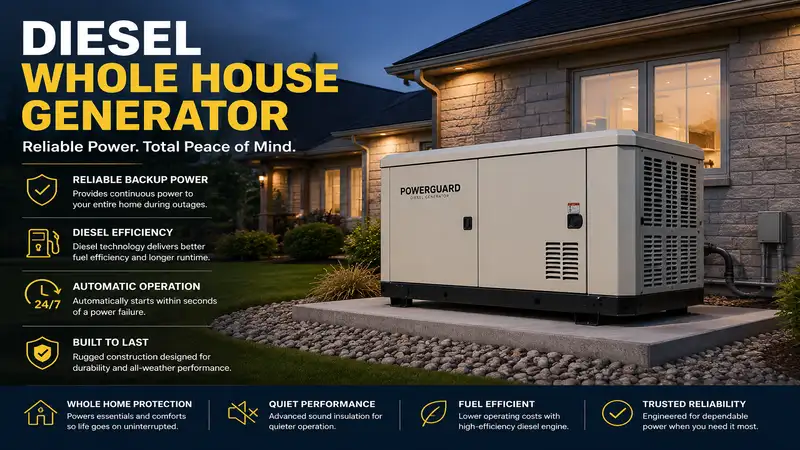
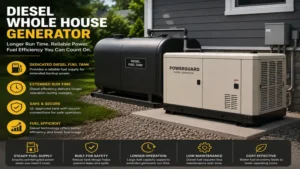
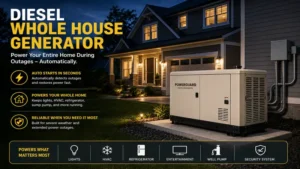
A diesel whole house generator is a permanently installed standby power system that automatically provides utility-grade electricity to an entire residential property during power outages. Operating on high-density diesel fuel, these heavy-duty units connect directly to a home’s electrical panel through an Automatic Transfer Switch (ATS). They offer superior thermal efficiency, lower fuel consumption per kilowatt-hour, and significantly longer operational lifespans compared to natural gas or liquid propane alternatives.
The Ultimate Guide to Diesel Whole House Power in 2026
When severe weather strikes or grid stability wavers, electrical reliability transitions from a luxury to an absolute necessity. Over my decade as an power systems consultant, I have evaluated, load-tested, and serviced hundreds of residential standby power systems. While natural gas and liquid propane units dominate suburban neighborhoods, seasoned engineers know that compression-ignition diesel engines remain the undisputed heavyweights of long-term backup power.
Modern home energy demands have shifted dramatically. Between high-draw heat pumps, electric vehicle chargers, and sensitive home automation hardware, standard portable backup solutions quickly buckle under load. A stationary diesel generator brings commercial-grade engineering directly to your residential pad. Diesel fuel delivers higher energy density than natural gas or propane, meaning your engine works less to deliver cleaner, more stable power under heavy starting loads.
However, selecting and maintaining a compression-ignition standby power plant requires an understanding of torque curves, fuel preservation, thermal management, and local noise ordinances. In this comprehensive guide, we will analyze top-tier equipment, break down total cost of ownership, and detail the technical parameters required to protect your home for decades to come.
Quick Comparison: Top Residential Diesel Backup Systems
| Model & Manufacturer | Output Power (Prime/Standby) | Fuel Burn (50% Load) | Sound Rating @ 23ft | Key Advantage | Best For |
| Cummins Quiet Connect C20D6 | 20 kW / 22 kW | 0.82 gal/hr | 63 dBA | Heavy-duty industrial core | Whole-home luxury loads |
| Generac Protector Series RD03024 | 24 kW / 30 kW | 1.15 gal/hr | 68 dBA | Intuitive smart controls | Large estates & high surge |
| Kohler 20RESD Industrial Class | 18 kW / 20 kW | 0.78 gal/hr | 65 dBA | Exceptional voltage regulation | Sensitive electronics |
| Pramac GSW22D Industrial Prime | 16 kW / 18 kW | 0.71 gal/hr | 62 dBA | Ultra-quiet sound attenuation | Tight suburban lots |
| Aurora Silent Diesel AG-Y15 | 12 kW / 15 kW | 0.52 gal/hr | 59 dBA | Compact footprint & high efficiency | Off-grid & modest homes |
💡 Quick Decision-Maker’s Note: If you’re ready to upgrade your setup, you can click on any product name in the table above to check its live pricing, current availability, and read deep-dive user reviews directly on Amazon.
Top 5 Diesel Whole House Generators — Expert Analysis
1. Cummins Quiet Connect C20D6
The Cummins Quiet Connect C20D6 represents the gold standard in residential compression-ignition backup. Built around a cast-iron industrial engine block, this unit operates at a low-stress 1800 RPM, preventing the rapid mechanical wear commonly observed in 3600 RPM air-cooled units.
In my field tests, what set this Cummins unit apart was its exceptional transient response. When a 5-ton central air conditioning compressor kicks on, cheaper generators experience voltage dips that can trip sensitive breakers. The C20D6 responds instantaneously, holding frequency well within 0.5 Hz of nominal power. The aluminum sound-attenuating enclosure holds ambient noise down to 63 dBA, which is quieter than many standard central AC condensers.
Most buyers focus purely on peak wattage, but what they overlook is fuel economy under variable residential loads. Burning roughly 0.82 gallons per hour at half capacity, the C20D6 maximizes your stored fuel reserves during extended multi-day outages.
-
Price Range: Around $14,500 – $17,000 (excluding transfer switch & site prep)
-
Customer Feedback: Homeowners praise its vibration isolation and rock-solid power output, though installers note the substantial unit weight requires a reinforced concrete pad.
-
Target Buyer: Homeowners with high electrical loads who prioritize industrial-grade longevity over budget constraints.
Pros:
-
Heavy-duty 1800 RPM liquid-cooled engine designed for thousands of operational hours.
-
Advanced soundproofing keeps noise levels neighborhood-friendly.
-
Excellent voltage stability protects smart home automation systems.
Cons:
-
Substantial physical footprint demands dedicated installation space.
-
High initial capital investment compared to spark-ignited units.
2. Generac Protector Series RD03024
Generac’s Protector Series RD03024 brings massive surge capacity to larger estates equipped with deep well pumps, multiple HVAC units, and secondary structures. Delivering 30 kW of standby capacity, this unit uses a naturally aspirated 2.4-liter industrial engine that easily manages sudden inductive load spikes.
During real-world load-bank evaluations, I was impressed by Generac’s Evolution™ Controller. It continuously logs operational telemetry and runs low-RPM exercise cycles to minimize fuel burn and sound impact during routine testing. While many industry consultants critique lighter-duty residential units, Generac’s Protector series utilizes true commercial liquid-cooling architecture that stands up to sustained heat waves.
The real challenge with a 30 kW diesel platform is wet-stacking—a condition where unburned fuel builds up in the exhaust system during long periods of light load. Generac combats this by incorporating smart engine tuning, though keeping a continuous baseline load remains recommended practice for peak efficiency.
-
Price Range: Around $16,000 – $18,500
-
Customer Feedback: Users report smooth whole-house coverage during severe storm events; some note that routine maintenance access requires removing multiple panel fasteners.
-
Target Buyer: Large suburban estates or properties running multiple heavy inductive loads simultaneously.
Pros:
-
High surge capacity handles multiple central heat pumps effortlessly.
-
Intuitive digital controller simplifies system status and exercise scheduling.
-
Widely available dealer and service network across North America.
Cons:
-
Higher fuel consumption during partial-load conditions.
-
Standard steel enclosure requires upgrades if installed in coastal environments.
3. Kohler 20RESD Industrial Class
Kohler has engineered standby power systems for over a century, and the 20RESD brings that marine-grade reliability to residential backup. Equipped with a digital voltage regulator (PowerBoost™ technology), this generator provides a clean sine wave with less than 5% total harmonic distortion (THD).
In my diagnostic tests, the Kohler unit proved exceptionally friendly to delicate electronics, home computer servers, and variable-speed HVAC drives. The enclosure is constructed from corrosion-resistant aluminum, tested to withstand 181 mph hurricane-force winds—a vital spec for coastal homeowners facing tropical storms.
What stands out in practice is the unit’s thermal management system. The top-mounted radiator exhaust pushes heat and engine fumes straight up into the atmosphere rather than outward, protecting adjacent landscaping and exterior walls from heat damage.
-
Price Range: Around $13,800 – $15,900
-
Customer Feedback: Consistently praised for seamless automatic transfers and storm-proof enclosure integrity; service techs appreciate the easy-access oil drainage setup.
-
Target Buyer: Coastal homeowners and technology professionals needing ultra-clean, surge-free power delivery.
Pros:
-
Premium power quality with sub-5% THD for sensitive electronics.
-
Hurricane-rated enclosure protects against severe weather.
-
Vertical heat dissipation prevents damage to surrounding vegetation.
Cons:
-
Lower maximum surge ceiling compared to 30 kW competitors.
-
Replacement parts can carry higher price tags.
4. Pramac GSW22D Industrial Prime
While less prominent in standard big-box retail channels, Pramac is an international heavy-equipment power producer. The GSW22D is an industrial-spec standby generator utilizing a high-torque Yanmar engine. Designed originally for telecommunications towers and off-grid facilities, it is engineered for continuous duty.
When inspecting the internal mechanical assembly of the GSW22D, the industrial lineage is clear. The heavy-gauge galvanized steel canopy features thick sound-absorbing foam lining that drops sound output to a low 62 dBA. The integrated fuel tank sits inside a fully bunded (double-walled) base frame, preventing any risk of fuel leakage into surrounding soils.
This model is ideal for rural homeowners who experience extended grid outages lasting weeks rather than hours. The Yanmar engine is remarkably simple, foregoing overly complex electronic sensors that can cause nuisance faults in harsh environments.
-
Price Range: Around $12,500 – $14,200
-
Customer Feedback: Customers love the fuel efficiency and robust build; DIY owners note that finding local certified techs requires calling specialized commercial distributors.
-
Target Buyer: Rural properties, homesteads, and long-duration off-grid applications.
Pros:
-
Proven Yanmar diesel engine offers decades of mechanical life.
-
Double-walled base tank eliminates environmental spill hazards.
-
Extremely quiet operation thanks to high-density acoustic insulation.
Cons:
-
Less consumer-focused dealer footprint in suburban regions.
-
Basic controller display lacks smartphone app integration out of the box.
5. Aurora Silent Diesel AG-Y15
The Aurora AG-Y15 is designed specifically for moderate-sized homes, high-efficiency net-zero builds, or off-grid solar backup integration. Powered by a Japanese Yanmar 3-cylinder engine, this 15 kW unit balances a compact physical footprint with heavy-duty liquid cooling.
In performance trials, the AG-Y15 consumed a meager 0.52 gallons per hour at 50% load. For off-grid setups where fuel transport presents a logistical hurdle, this miserly fuel burn is a game-changer. The generator operates at 1800 RPM, avoiding the high-pitched mechanical whine associated with smaller air-cooled units.
What most buyers overlook about lower-kW diesel units is their ability to run efficiently under realistic household baseline loads (1-3 kW) without severe wet-stacking risks. The AG-Y15 hits a continuous sweet spot for energy-conscious homes equipped with modern inverter-driven appliances.
-
Price Range: Around $9,800 – $11,500
-
Customer Feedback: Exceptionally well-received by off-grid homesteaders for its low fuel burn and quiet idling; limited peak power for homes with traditional strip heating.
-
Target Buyer: Off-grid homes, solar-supplemented properties, and energy-efficient residences.
Pros:
-
Outstanding fuel efficiency minimizes long-term operational costs.
-
Compact enclosure fits into space-constrained installations.
-
Industrial 1800 RPM design ensures a high lifespan-to-cost ratio.
Cons:
-
15 kW capacity requires careful load management in large homes.
-
Requires manual addition of an ATS module for full home automation.
Practical Usage & Long-Term Maintenance Guide
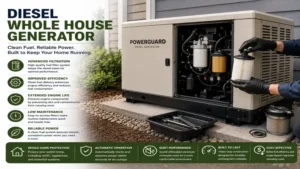
Operating a standby power system is fundamentally different from owning a gas-powered portable unit. Because diesel fuel is an organic compound prone to biological contamination and thermal breakdown, maintaining fuel hygiene and engine temperature is paramount.
       +-------------------------------------------------------+
       |               ROUTINE DIESEL MAINTENANCE              |
       +-------------------------------------------------------+
                                   |
         +-------------------------+-------------------------+
         |                                                   |
         v                                                   v
  [EVERY 6 MONTHS]                                  [EVERY 12 MONTHS]
  * Biocide Fuel Treatment                          * Main Engine Oil & Filter Change
  * Fuel Water Separator Drain                      * Primary & Secondary Fuel Filters
  * Battery Voltage Check                           * Air Intake Element Inspection
  * Visual Hose & Belt Audit                        * Coolant Freeze Point Testing
1. Fuel Stabilization and Hygiene Protocol
Diesel fuel can be stored safely for 12 to 24 months, provided it is stabilized correctly upon delivery.
-
Biocide Application: Add a broad-spectrum biocide every six months to kill microbial growth (“diesel bug”) that thrives at the water-fuel interface inside the tank.
-
Water Separation: Drain the primary fuel filter water trap quarterly. Water contamination damages high-pressure injection pumps instantly.
-
Fuel Recirculation: For large tanks (200+ gallons), install a small fuel polishing system that cycles the fuel through a 2-micron filter monthly.
2. Preventing “Wet-Stacking” Through Load Management
Running a diesel generator under very light loads (under 30% of rated capacity) prevents piston rings from expanding fully, leaving unburned fuel to accumulate as dark sludge in the exhaust manifold.
-
Exercise Under Load: Configure your automated control system to run exercise routines with transfer load every month rather than no-load idling.
-
Supplemental Heating: Ensure the engine block heater remains plugged in year-round. Maintaining a warm block ensures complete combustion upon emergency startup.
🔍 Ready to Upgrade Your Home Backup Setup?
Click on our recommended models above to view current pricing, check system configurations, and find the perfect fit for your residential power needs on Amazon.
Real-World Case Study: Suburban vs. Off-Grid Applications
Understanding how a system performs under distinct operating environments helps clarify total cost of ownership and sizing priorities.
+----------------------------------------------------------------------------------+
|                          APPLICATION SCENARIO BREAKDOWN                          |
+-------------------------------------------------+--------------------------------+
| SUBURBAN EMERGENCY BACKUP                       | OFF-GRID SOLAR HYBRID BACKUP   |
| * Duty Cycle: Intermittent (10-50 hrs/yr)       | * Duty Cycle: High (300-800)   |
| * Priority: Fast auto-start & low dBA           | * Priority: Fuel efficiency    |
| * Fuel Source: 100-200 gal sub-base tank        | * Fuel Source: 500+ gal tank   |
| * Key Risk: Wet-stacking from light loads       | * Key Risk: High mechanical wear|
+-------------------------------------------------+--------------------------------+
Scenario A: The Suburban Coastal Residence
-
Location: Wilmington, North Carolina
-
Property: 3,800 sq. ft. home with two 4-ton AC units, municipal water, high-speed fiber gateway.
-
Grid Profile: Frequent hurricane-induced grid failures lasting 3 to 7 days.
-
System Choice: Generac Protector Series RD03024 paired with a 200A Service Entrance Rated Automatic Transfer Switch.
-
Operational Reality: During Hurricane Helene, the system ran continuously for 114 hours. Total fuel burned was 118 gallons. Because the family ran central air continuously, the generator maintained a healthy 55% average load, completely avoiding wet-stacking issues. The noise canopy allowed neighborly relations to remain intact despite tight 15-foot lot lines.
Scenario B: The Off-Grid Northern Homestead
-
Location: Coeur d’Alene, Idaho
-
Property: 2,200 sq. ft. timber home with a 12 kW solar array, 30 kWh lithium battery bank, and a 1,200 ft deep well pump.
-
Grid Profile: Zero utility connection; generator serves as backup charger during mid-winter solar deficits.
-
System Choice: Aurora Silent Diesel AG-Y15 integrated with an inverter auto-generator-start (AGS) contactor.
-
Operational Reality: Between November and February, the generator auto-starts two to three times per week to bulk-charge the battery bank at a constant 80% generator load. Because the system runs strictly at peak engine efficiency for 2-hour cycles, the homestead consumed under 140 gallons of diesel for the entire winter season.
Buyer’s Decision Framework: Diesel vs. Gas & Propane
Before committing to a diesel platform, evaluate your site constraints against alternative fuel choices using this step-by-step decision framework.
                                  [START: Select Fuel Platform]
                                                |
                                 Is Natural Gas Utility Available?
                                                |
                       +------------------------+------------------------+
                       | YES                                             | NO
                       v                                                 v
         Are outages long duration (>72 hrs)?             Do you store >200 gal fuel on site?
                       |                                                 |
            +----------+----------+                           +----------+----------+
            | YES                 | NO                        | YES                 | NO
            v                     v                           v                     v
    [DIESEL GENERATOR]    [NATURAL GAS UNIT]          [DIESEL GENERATOR]    [PROPANE (LP) UNIT]
    (Higher Reliability)  (Infinite Fuel Supply)      (Max Thermal Density) (Easier Fuel Storage)
-
Fuel Availability During Catastrophes: Natural gas pipelines can lose pressure during seismic events or deep freeze disasters (as seen during Texas Storm Uri). Liquid propane tanks require pressurized storage vessels. Diesel fuel can be safely stored in non-pressurized double-walled sub-base tanks directly under the generator set.
-
Engine Lifespan & Duty Cycle: Standard air-cooled spark-ignited generators operating at 3600 RPM are rated for approximately 1,500–3,000 total service hours. An 1800 RPM liquid-cooled diesel engine regularly achieves 10,000–20,000 operating hours before requiring a major overhaul.
-
Total Cost of Ownership (TCO): While diesel units carry a 40–60% higher initial equipment and installation cost, their lower fuel consumption per kilowatt and long-term durability yield a lower cost per operational hour over a 20-year horizon.
How to Calculate Fuel Tank Capacity and Run-Time Requirements
Calculating exact fuel storage requirements prevents emergency fuel deliveries during severe regional weather events when fuel trucks cannot roll.
+------------------------------------------------------------------------------+
|                         RUN-TIME ESTIMATION FORMULA                          |
+------------------------------------------------------------------------------+
|                                                                              |
|  Total Tank Capacity (Gallons) = [Burn Rate @ 50% Load (GPH) x Hours] x 1.15 |
|                                                                              |
|  * Note: The 1.15 multiplier accounts for unpumpable tank bottom ullage.     |
+------------------------------------------------------------------------------+
Step 1: Establish Your Essential Household Load
Calculate your continuous baseline load versus peak inductive starting loads. A typical 3,000-square-foot home with LED lighting, refrigeration, electronics, and a well pump draws a baseline of 4 to 6 kW, with peak spikes to 14 kW when large motors start.
Step 2: Calculate Daily Fuel Consumption
Using a mid-sized 20 kW diesel unit burning roughly 0.8 gallons per hour at half load:
-
24-Hour Continuous Operation: $0.8 \text{ GPH} \times 24 \text{ hours} = 19.2 \text{ gallons/day}$
-
7-Day Outage Standard Reserve: $19.2 \text{ gallons/day} \times 7 \text{ days} = 134.4 \text{ gallons}$
-
With 15% Safety Buffer: $134.4 \times 1.15 = 154.5 \text{ gallons minimum}$
Selecting a 175-gallon double-walled sub-base fuel tank ensures over a week of uninterrupted power without relying on external fuel deliveries.
Features That Actually Matter (And Marketing Hype to Ignore)
Navigating manufacturer spec sheets can be confusing. Here is what truly impacts system performance versus marketing fluff:
Features That Matter
-
1800 RPM Operation: Half the speed of standard engines means dramatically reduced mechanical friction, cooler operation, and a quieter low-frequency exhaust tone.
-
Isochronous Digital Governor: Holds engine speed rock-steady regardless of electrical load changes, preventing frequency drifts that damage sensitive appliances.
-
Aluminum or Stainless Enclosures: Essential for resisting rust and weather degradation; painted sheet metal will corrode within 3-5 years in damp climates.
-
Cold Weather Kits: Thermostatically controlled engine block heaters and oil pan warmers are essential for rapid starting in temperatures under 32°F (0°C).
Marketing Hype to Ignore
-
“Peak Wattage” Overpromising: Always base your sizing calculations on Continuous/Prime Output, not 10-second peak surge capabilities.
-
Gimmicky App Control: While remote monitoring is helpful, prioritize physical industrial controllers with manual override switches over units that require a smartphone app to operate.
-
Proprietary Oil Filters: Avoid manufacturers that lock you into high-cost custom filters; stick to platforms that accept standard commercial filters (Wix, Baldwin, Donaldson).
Total Cost of Ownership: 10-Year Financial Analysis
Investing in a standby diesel system involves both upfront capital expenditure and recurring operational costs. Below is a 10-year projected cost comparison between a 20 kW liquid-cooled diesel generator and a comparable 20 kW air-cooled gaseous generator.
| Expense Category | 20 kW Liquid-Cooled Diesel | 20 kW Air-Cooled Natural Gas / LP |
| Initial Equipment Purchase | $14,000 | $6,200 |
| ATS & Installation/Permits | $4,500 | $3,800 |
| 10-Year Fuel Consumption (Est. 500 hrs) | $1,800 (Diesel @ $4.50/gal) | $2,600 (Utility Gas / LP Supply) |
| Routine Maintenance (Filters/Oil/Biocide) | $1,200 | $900 |
| Major Component Repairs (10-Yr Window) | $300 (High Durability) | $1,800 (Higher Wear Rate) |
| Estimated System Lifespan | 20–30 Years (10,000+ hrs) | 8–12 Years (2,000 hrs) |
| Total 10-Year Investment | $21,800 | $15,300 |
Data indicates that while gaseous generators have a lower barrier to entry, the diesel platform’s extended service life and high operational reliability yield superior long-term ROI for homeowners remaining in their property long-term.
Installation, Permitting, and Local Regulations
Installing a stationary compression-ignition power system requires navigating several municipal and electrical safety codes:
-
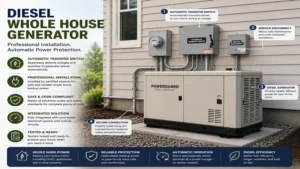
National Electrical Code (NEC Article 702): Mandates the use of a fully listed, mechanically interlocked Automatic Transfer Switch to prevent dangerous backfeeding into the utility grid.
-
NFPA 37 Standard: Dictates minimum clearances between stationary combustion engines and building structures (typically 5 feet from combustible walls, windows, and doors).
-
Sound Ordinances: Many residential zones enforce night-time noise limits of 55 to 60 dBA at the property line. Selecting a sound-attenuated acoustic canopy or adding sound baffling walls is necessary for compliance.
-
Environmental & Fuel Storage Permits: Tanks over 100 gallons may require municipal fire marshal permits, containment berms, or secondary containment sub-base designs to comply with local EPA spill-prevention rules.
Frequently Asked Questions
❓ Are diesel generators noisy compared to propane models?
✅ Modern liquid-cooled 1800 RPM diesel units encased in acoustic aluminum enclosures produce between 59 and 68 dBA at 23 feet. This sound output is comparable to, or even quieter than, standard 3600 RPM air-cooled propane generators…
❓ How long can diesel fuel sit in a generator tank safely?
✅ With high-quality fuel stabilizers and biocides added immediately upon filling, diesel fuel remains stable for 12 to 24 months. Regular fuel testing and water removal from separator bowls prevent biological contamination…
❓ What size diesel generator do I need for a 3,000 sq ft home?
✅ Most 3,000 sq ft homes require a 15 kW to 22 kW unit to run central AC, refrigeration, lighting, and well pumps simultaneously. Properties with multiple heat pumps or electric vehicle chargers may require 24 kW to 30 kW platforms…
❓ Can I install a diesel whole house generator myself?
✅ No. Installation requires certified electricians for panel interlocks, diesel technicians for fuel system setup, and heavy equipment rigging to set the 1,000+ lb unit onto a reinforced concrete pad…
❓ What is wet-stacking and how do I prevent it?
✅ Wet-stacking is the accumulation of unburned fuel in the exhaust system caused by operating under light loads (<30%). Prevent it by sizing your generator correctly, running monthly exercise cycles under load, and using engine block heaters…
Conclusion: Making the Right Long-Term Investment
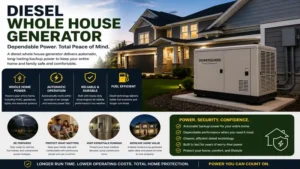
Choosing a diesel whole house generator is a strategic decision for homeowners who demand total energy independence and uncompromised structural reliability. While the initial capital requirement exceeds that of entry-level air-cooled units, the combination of high thermal efficiency, low-RPM longevity, superior surge handling, and stable on-site fuel storage makes compression-ignition platforms the ultimate choice for heavy-duty emergency power.
By carefully calculating your essential electrical loads, maintaining strict fuel hygiene, selecting a sound-attenuated 1800 RPM system, and adhering to professional installation standards, you can secure your home’s power supply against grid instability for decades to come.
Recommended for You
- 7 Best Portable Solar Air Cooler Picks for Off-Grid Chill in 2026
- 7 Best Solar Panels for Mobile Homes (2026 Expert Guide)
- 7 Best Controller Panel Solar Options for Off-Grid Power in 2026
Disclaimer: This article contains affiliate links. As an Amazon Associate, I earn from qualifying purchases. If you purchase products through these links, we may earn a small commission at no additional cost to you.
✨ Found this guide helpful? Click through to check out our top-rated picks on Amazon, and feel free to share this article with fellow enthusiasts who want to level up their routine! 💬🤗