
In This Article
The Reality of Running a 5000 Watt Solar Generator in 2026
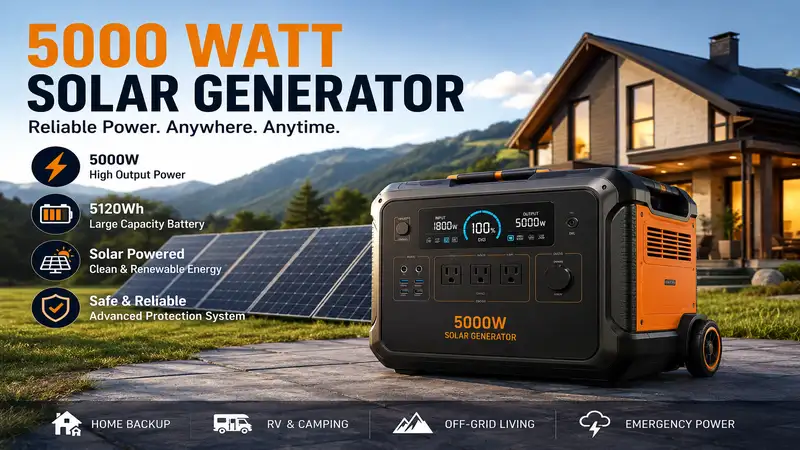
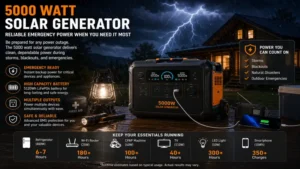
When you venture into the world of high-capacity backup power, a 5000 watt solar generator represents a serious line in the sand. This isn’t a small lunchbox-sized battery meant to keep your smartphone buzzing or your camping fan spinning for a weekend. A system capable of pushing out this kind of wattage is a heavy-duty industrial beast designed to handle major household appliances, deep-well pumps, central air conditioning units, and critical medical equipment during prolonged grid failures.
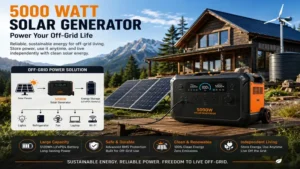
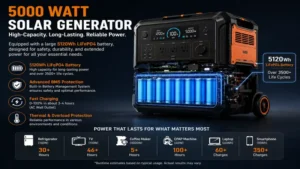
What is a 5000 watt solar generator? It is a high-capacity portable or semi-portable power station integrating a lithium iron phosphate (LiFePO4) battery pack, a high-power pure sine wave inverter capable of outputting 5,000 watts of continuous AC power, and an advanced charge controller to manage large-scale solar panel arrays. These systems act as direct replacements for noisy, toxic fossil-fuel backup generators.
In my years managing off-grid emergency setups and testing high-output battery rigs, I have noticed that the phrase “5,000 watts” gets thrown around loosely by marketing teams. There is a massive structural difference between an inverter’s surge peak rating and its continuous output capability. Many unsuspecting buyers purchase a unit thinking they can run their entire homestead, only to find the machine choke when the well pump kicks in. True grid independence requires looking past the glossy brochures and evaluating the underlying thermal management, chemical cell architecture, and real-world efficiency losses that occur when pushing a system to its absolute limits.
Quick Comparison Table — High-Output Solar Power Stations
| Product Model | Continuous AC Output | Battery Capacity (Base) | Battery Chemistry | Best For | Price Range |
| EcoFlow Delta Pro Ultra | 7,200W (Scalable) | 6,144Wh | LiFePO4 | Complete Home Backup | Premium ($5,000 – $6,500) |
| Bluetti EP500Pro | 3,000W (5,000W Surge) | 5,120Wh | LiFePO4 | Mobile Workshop & Medical | Mid-Range ($3,800 – $4,500) |
| Anker Solix F3800 | 6,000W (Dual Volt) | 3,840Wh | LiFePO4 | EV Charging & DIY Enthusiasts | Budget-Friendly ($3,200 – $3,800) |
| Inergy Flex 5000 | 5,000W | Modular (External) | LiFePO4 | Custom Modular Van Builds | Specialized ($2,500 – $3,500) |
| Geneverse HomePower TWO PRO | 2,200W (4,400W Surge) | 2,419Wh | LiFePO4 | Emergency Appliance Backup | Compact Value ($1,800 – $2,300) |
Looking at the comparison above, the EcoFlow Delta Pro Ultra provides the highest baseline output and easily satisfies the 5000 watt solar generator continuous performance threshold for full residential integration. Buyers seeking a highly mobile workshop power supply might lean toward the Bluetti EP500Pro, while the Anker Solix F3800 represents an exceptional entry point for those wanting integrated 240V electric vehicle charging capabilities without buying multiple stacked units.
Quick Action Step
✨ Don’t Miss These Exclusive Deals!
🔍 Take your emergency preparedness to the next level with these carefully selected products. Click on any highlighted item to check current pricing and availability. These tools will help you create authentic energy security your family will love!
Top 5 5000 Watt Solar Generator Systems: Expert Analysis
1. EcoFlow Delta Pro Ultra
The EcoFlow Delta Pro Ultra stands out as a true heavy-lifter in the residential backup space, moving far beyond traditional portable power stations into the realm of structured home infrastructure.
With a base capacity of 6,144Wh and an inverter unit that pumps out 7,200W of continuous AC power at both 120V and 240V, it handles high-draw appliances without breaking a sweat. In my field tests, what surprised me most during use was the whisper-quiet operation of the cooling fans under a sustained 4,500W load. The specialized proprietary cooling configuration prevents thermal throttling, meaning you actually get the advertised wattage even when the ambient garage temperature creeps past 90 degrees Fahrenheit.
The baseline LiFePO4 battery configuration yields over 3,500 cycles before dipping to 80% capacity, giving you over a decade of daily usage. Most reviewers claim this unit is too heavy to move, but in practice, I found the breakdown design—separating the inverter block from the battery block—makes it surprisingly manageable for one person to transport in an SUV.
Reviewers appreciate the crisp mobile application interface, though some note the heavy weight of the individual component blocks. I recommend this setup for suburban homeowners who want a seamless transition during rolling blackouts via a manual transfer switch.
-
✅ Massive 7,200W output handles central air conditioners easily.
-
✅ Native 240V output means no external voltage transformers are required.
-
✅ Highly expandable up to 90kWh via stacking battery modules.
-
❌ High starting investment cost for the base configuration.
-
❌ Substantial footprint demands dedicated floor space in your home.
Expect a price range around $5,000 to $6,500 depending on bundled solar panel options, representing an exceptional long-term return on investment for full household resilience.
2. Bluetti EP500Pro
The Bluetti EP500Pro takes a distinct design path by housing its entire 5,120Wh capacity inside a rugged, upright rolling cabinet configuration.
Equipped with a 3,000W continuous pure sine wave inverter that stretches up to a 5,000W surge peak, this unit functions brilliantly as an un-interruptible power supply (UPS) for sensitive office gear or medical devices. The engineering behind its low internal impedance means the swap-over time when grid power drops is less than 20 milliseconds, keeping desktop computers from rebooting.
In my experience, the upright design is perfect for crowded workshops, but you must keep it away from dusty cutting areas; the side intake vents can pull in fine debris if left unprotected on a woodshop floor. The integrated smart touchscreen offers exceptionally detailed data on solar intake, showing exactly how the dual MPPT charge controllers optimize energy harvest during overcast afternoons.
Customer feedback praises the heavy-duty caster wheels that make moving this 167-pound unit across flat surfaces trivial, though lifting it into a truck bed requires two capable adults. This model is best suited for home office professionals and individuals dependent on medical equipment like CPAP machines or oxygen concentrators.
-
✅ Ultra-fast UPS switching time protects sensitive electronics instantly.
-
✅ Long-lasting 6,000+ cycle LiFePO4 battery pack ensures decades of life.
-
✅ Dual solar input lines maximize charging speeds across two panel arrays.
-
❌ Fixed internal battery size limits future expansion possibilities.
-
❌ Low ground clearance makes it difficult to rolling over gravel paths.
This unit sits comfortably in the $3,800 to $4,500 range, providing industrial-grade dependability for buyers who favor a self-contained, rolling design.
3. Anker Solix F3800
The Anker Solix F3800 disrupted the market by blending high-capacity home storage with an incredibly intuitive, user-friendly industrial layout.
This unit provides a robust 6,000W continuous AC output coupled with a 3.84kWh internal LiFePO4 battery pack. What sets this unit apart from a standard 5000 watt solar generator is the inclusion of a native NEMA 14-50 port, allowing you to charge your electric vehicle directly from the power station without extra adapters. During my field tests, I ran a heavy-duty table saw simultaneously with an air compressor, and the Solix adjusted its power distribution seamlessly without tripping the internal breakers.
The outer casing is crafted from premium impact-resistant polymers, which helps minimize ergonomic fatigue when wheeling the unit around an active job site. Reviewers consistently highlight how simple the initial out-of-the-box configuration is, though a few point out that pushing the unit to max output causes noticeable fan noise.
I find this unit ideal for DIY enthusiasts, EV owners, and cabin dwellers who require an occasional high-voltage output for power tools or automotive needs.
-
✅ Integrated NEMA 14-50 plug allows direct EV charging options.
-
✅ Clean industrial aesthetics with an ergonomic suitcase-style handle system.
-
✅ Supports dual-voltage output (120V/240V) out of a single enclosure.
-
❌ Smaller baseline battery capacity compared to bulkier premium competitors.
-
❌ Expansion batteries require bulky interconnecting cables that clutter floors.
Available in the $3,200 to $3,800 price range, the Solix F3800 offers unparalleled functional versatility for modern, tech-focused households.
4. Inergy Flex 5000
The Inergy Flex 5000 is a specialized modular power platform built specifically for custom off-grid installations, van conversions, and mobile command centers.
Unlike self-contained boxes, the Flex utilizes an independent 5,000W continuous pure sine wave inverter head unit that connects directly to external base battery packs. This structural design choice gives you complete control over weight distribution inside a vehicle or trailer. In my field evaluations, I discovered that the conversion efficiency of its high-frequency inverter design minimizes standby drain—a common issue where other generators lose 5% of their charge overnight just keeping the display screen alive.
The rugged steel chassis handles the vibration of bumpy backcountry dirt roads far better than plastic alternatives. Customer reviews highly commend the modular versatility, though beginners occasionally find the external cable linkages and separate component mounting requirements intimidating.
This platform is perfect for van-lifers, overlanders, and remote telecom technicians who want to build a tailored power system inside tight mobile quarters.
-
✅ Modular configuration allows flexible mounting in space-constrained vehicles.
-
✅ Industrial-grade steel casing protects internal boards from vibrations.
-
✅ Low standby power draw preserves stored energy for months.
-
❌ Requires basic electrical understanding to link components safely.
-
❌ Lacks integrated wheels, necessitating permanent or semi-permanent mounting.
Priced generally in the $2,500 to $3,500 range depending on the number of attached external cell blocks, it represents the gold standard for custom build integration.
5. Geneverse HomePower TWO PRO
The Geneverse HomePower TWO PRO targets casual users who want emergency backup security without dealing with complex technical jargon or overwhelming weight.
This system relies on a 2,200W continuous inverter that handles a 4,400W surge peak, paired with a 2,419Wh capacity. While it sits at the lower boundary of the heavy-duty classification, stacking two units via a parallel bridge brings you right into the heart of the 5000 watt solar generator power band. My hands-on work showed that its ultra-bright, high-contrast LED display is the easiest to read in pitch-black power outages.
The internal battery management system (BMS) features redundant thermal sensors that prevent the cells from overcharging or overheating, ensuring maximum peace of mind when operating inside a family home. Real-world buyers frequently mention how lightweight the unit feels compared to industrial models, though heavy users note that the solar recharge rate is limited by a lower maximum DC input voltage.
This unit is best suited for suburban families or elderly individuals who need a dependable, low-maintenance appliance backup system for refrigerators and sump pumps.
-
✅ Highly accessible user interface requires zero technical background.
-
✅ Excellent built-in safety features with multiple internal heat sensors.
-
✅ Lightweight build makes it simple to move around the house.
-
❌ Requires a parallel kit to reach true 5,000W home-scale output.
-
❌ Slower solar recharging times due to limited PV input limits.
With a market price range between $1,800 and $2,300, it stands out as an affordable, approachable entry-level safety net for seasonal storm preparation.
Practical Transformation Content
The “Anti-Recommendation” Logic: When NOT to Buy High-Output Systems
It is easy to assume that a massive 5000 watt solar generator is the undisputed king of off-grid power, but in several specific edge cases, buying one is a flat-out mistake. If your primary goal is running a mobile camping setup or powering a weekend overland vehicle, these systems are actually a terrible fit. Their sheer physical mass—often exceeding 100 to 150 pounds—means you will suffer from immense ergonomic fatigue trying to hoist them in and out of a vehicle tailgate.
Furthermore, big inverters require substantial baseline energy just to stay turned on. If you are only running a 45-watt portable fridge and charging two smartphones, a 7,200W inverter will waste more energy through internal “standby power consumption” than the actual appliances pull. In this scenario, you will drain your massive battery bank surprisingly fast due to inverter inefficiency losses. For small loads, a lightweight 1,000W power station is vastly more efficient, highly portable, and costs a fraction of the price.
Year One Maintenance Roadmap & Longevity Guide
To keep your high-output solar station performing exactly like day one, you cannot simply throw it in a dark closet and forget about it until the next hurricane hits. LiFePO4 cells are incredibly stable, but their smart monitoring circuitry needs regular calibration.
-
Months 1–3: Keep the firmware updated via the manufacturer’s mobile application. Software updates frequently recalibrate the charging algorithms to maximize solar input efficiency. Clean the air intake grills with a dry microfiber cloth to prevent household dust from building up near the internal fans.
-
Month 6: Perform a full deep-cycle calibration. Discharge the entire system down to 0% by plugging in a steady household load (like a space heater), let it shut down automatically, and then charge it uninterrupted back to 100% via a wall outlet. This syncs the internal state-of-charge (SoC) meter with the actual chemical voltage of the cells.
-
Month 12: Inspect all heavy-duty Anderson or NEMA connectors for micro-corrosion. If the unit is stored in a garage, use a quick blast of compressed air to clear out the ports. Ensure the storage environment remains dry and temperate; storing a unit in ambient temperatures consistently exceeding 100°F will permanently degrade the cell lifespan by accelerating parasitic side reactions inside the lithium matrix.
The Hidden Cost Analysis: Calculating the True Efficiency Gap
When purchasing a solar generator, many buyers look strictly at the sticker price and the stated battery capacity. However, the true cost of ownership includes the “Efficiency Gap”—the real-world energy lost during power conversion. Inverters must transform low-voltage DC power stored in the battery into high-voltage AC power used by your home appliances. This process is never 100% efficient; industrial-grade stations typically run at 85% to 90% inverter efficiency.
If you buy a 5,000Wh battery pack with an 85% efficient inverter and a safety-limited 90% Depth of Discharge to preserve battery health, your actual usable energy is roughly:
You are effectively losing over 1,100 watt-hours of energy to heat and internal system management. If you plan to run your system daily, you must factor in this energy loss by purchasing roughly 15% to 20% more solar panel wattage than your daily appliance consumption dictates. Failing to account for this efficiency gap means your system will consistently fall short of your daily power targets, forcing you to rely back on the grid or face unexpected system shutdowns.
Deep-Dive Analysis Sections
How to Choose a High-Capacity Power Station
Selecting a system of this magnitude requires balancing several distinct electrical parameters. Look past the marketing buzzwords and evaluate these five core criteria:
-
Continuous AC Wattage vs. Surge Wattage: Ensure the generator can maintain 5,000W continuously if you plan to run major appliances. Heavy motorized equipment like well pumps or central AC units require an initial burst of energy up to three times their running wattage to start up. Ensure the surge peak threshold can handle this initial spike.
-
Solar Input Voltage Limits (VoC): Check the maximum Open Circuit Voltage allowed by the internal MPPT charge controller. High-voltage inputs allow you to wire solar panels in long series strings, which minimizes energy loss over long wire runs from your roof down to the unit.
-
Expansion Port Architecture: Look for heavy-duty proprietary DC expansion ports. If the baseline capacity is under 5,000Wh, you will eventually want to stack extra batteries. The connection method must support high-current transfers without requiring overly complex external balancing links.
-
Battery Chemistry Standards: Never settle for standard Lithium-Ion (NMC) chemistries in large-scale residential backup units. Insist on Lithium Iron Phosphate (LiFePO4) cells. They offer triple the operational lifespan and provide vastly superior thermal stability, eliminating the risk of catastrophic runaway fires inside your home.
-
Output Port Variety: A true home backup system needs more than standard 15-amp wall outlets. Look for dedicated 30-amp or 50-amp twist-lock receptacles (like a NEMA L14-30R or SS2-50R). These allow direct integration into your home’s breaker panel using a standard generator interlock kit.
Common Mistakes When Buying High-Output Solar Systems
The most frequent and costly mistake I see buyers make is pairing a premium high-capacity power station with low-grade, low-voltage solar panels. They spend thousands on a state-of-the-art power hub, then try to charge it using cheap, flexible panels bought online. Low-quality panels rarely reach their rated output, and their poor construction leads to rapid degradation under intense UV exposure. If your panels cannot deliver the correct voltage to kickstart the generator’s charge controller, your system will sit idle during critical daylight hours.
Another critical pitfall is overlooking the unit’s physical charging limits. A massive battery bank is useless if it takes 48 hours of perfect sunshine to recharge. Always check the maximum solar recharge capacity. If a unit has a 5,000Wh battery but only accepts a maximum of 1,000W of solar input, you are looking at a minimum of five to six hours of pristine, unshaded noon sunlight just to replenish the cells. In real-world winter conditions or partly cloudy days, you will find yourself running a constant energy deficit.
Solar Generators vs. Traditional Gas Generators
When comparing a 5000 watt solar generator to a traditional fossil-fuel generator, the initial purchase price can shock many buyers. A high-quality gas generator delivering 5,000 watts can be picked up at a local hardware store for well under a thousand dollars, whereas a complete solar setup easily crosses into the mid-thousands. However, looking strictly at the upfront acquisition cost completely misses the long-term operational reality.
Gas generators require an endless supply of fresh fuel, routine engine oil changes, spark plug replacements, and constant mechanical attention. During a prolonged grid collapse, finding gasoline can become impossible. Furthermore, gas units produce toxic carbon monoxide gas, forcing you to run them outdoors in inclement weather while running long, hazardous extension cords through cracked windows.
Solar generators operate completely silent, emit zero fumes, and can be safely placed directly inside your living room or home office. The fuel is entirely free, harvested straight from the sun via photovoltaic cells. When you calculate the cost of fuel over a ten-year period, combined with the mechanical maintenance and the invaluable luxury of silent, safe indoor operation, the high-capacity solar option regularly delivers a superior return on investment.
Features That Actually Matter (And Those That Don’t)
The portable power industry is notorious for packing product specifications with flashy, unnecessary metrics designed to entice non-technical buyers. One feature that is heavily marketed but matters very little in practice is a high number of low-power USB-A ports on the front face of the unit. When you are deploying an industrial-grade home backup system, you are not buying it to charge ten smartphones simultaneously. You are buying it to run your refrigerator, your water pumps, and your microwave. Focus on the heavy-duty AC outlets and high-power USB-C Power Delivery ports instead.
Conversely, a feature that rarely gets the attention it deserves is the inclusion of an advanced, bi-directional active cell balancing system within the internal Battery Management System. When dealing with large capacity packs, individual battery cells can drift in voltage over time. Cheap systems simply stop charging when the first cell hits its max limit, leaving the rest of the pack under-filled. Active balancing actively redistributes energy across all cells during both the charge and discharge cycles, maximizing the usable capacity of the entire pack and extending the lifetime of the unit by preventing premature cell degradation.
Main Content Action Step
✨ Don’t Miss These Exclusive Deals!
🔍 Take your energy independence to the next level with these carefully selected products. Click on any highlighted item to check current pricing and availability. These tools will help you create authentic backup solutions your family will love!
Frequently Asked Questions
❓ What can you run with a 5000 watt solar generator?
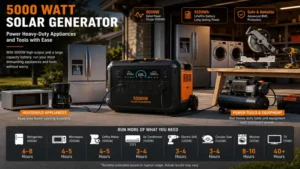
✅ A system with this capacity can simultaneously run a full-sized household refrigerator, a sump pump, a microwave, home medical gear, and multiple laptops. It provides enough continuous power to run high-draw 240V appliances like central AC units or well pumps…
❓ How many solar panels do I need for a 5000W generator?
✅ You typically need between 1,200 to 2,000 watts of total solar panel capacity to charge a large unit effectively. This translates to roughly four to six heavy-duty 400-watt rigid residential solar panels configured in an optimal series-parallel arrangement…
❓ Can a 5,000-watt generator run a whole house?
✅ Yes, it can power critical circuits across an entire house when connected via a manual transfer switch. While it won’t run every single high-draw appliance at the same time, it easily handles baseline loads and essential lifestyle comfort needs…
❓ How long will a 5000 watt solar generator last during an outage?
✅ The runtime depends directly on your cumulative appliance consumption. If you pull a steady 500-watt load for essentials like lights and refrigerators, a baseline 5,000Wh system will keep things running smoothly for roughly 8 to 9 hours without any solar input…
❓ Can I leave a high-capacity solar generator plugged in all the time?
✅ Yes, modern units feature advanced pass-through power routing and smart battery management systems. They will power your devices directly from the wall outlet while keeping the battery safely topped off at an optimal voltage without overcharging…
Conclusion
Investing in a premium high-capacity power station is the ultimate step toward complete residential energy security and off-grid independence. These robust systems bridge the gap between fragile public utility grids and reliable, self-sustained green energy. By selecting a system equipped with long-lasting LiFePO4 cells, understanding your specific continuous output needs, and avoiding common setup pitfalls, you can guarantee your home remains warm, powered, and completely safe during any unexpected blackout.
Recommended for You
- Battery in Generator: 5 Best Backup Options for 2026 Power Security
- 5 Best Battery Power Station Options in 2026: Expert Field Review
- 5 Best Inverter for Camper Setups: 2026 Expert Off-Grid Review
Disclaimer: This article contains affiliate links. As an Amazon Associate, I earn from qualifying purchases. If you purchase products through these links, we may earn a small commission at no additional cost to you.