
In This Article
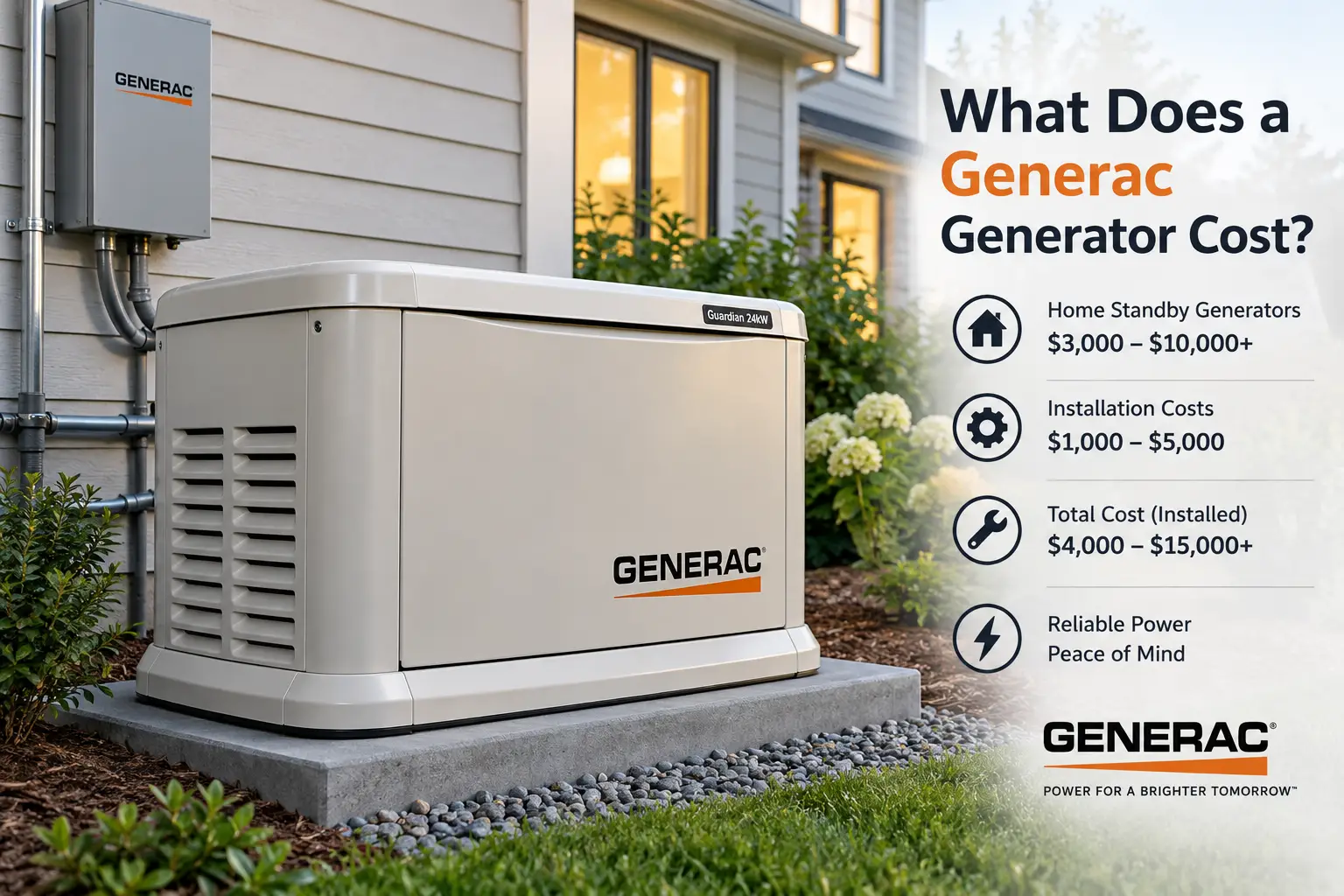
What Does a Generac Generator Cost? Here’s the Honest Breakdown
If you’ve started shopping and typed “what does a generac generator cost” into a search bar, you’ve probably already noticed the answer isn’t a single number — it’s a spread. A small portable Generac can run under $600, while a fully installed whole-house standby system can land north of $15,000. That’s not a marketing dodge; it’s just how differently these two product categories are built, sized, and installed.
Generac is the best-selling generator brand in the US for a reason — it covers nearly every price point, from grab-and-go portables for weekend storms to automatic standby systems that kick on the moment your power drops. But “Generac” isn’t one product with one price tag. It’s a full lineup, and what does a generac generator cost really depends on three things: the wattage you need, whether it’s portable or permanently installed, and what your home’s electrical setup requires to connect it safely.
This guide breaks down real 2026 pricing across seven actual Generac models — from the compact GP3600 to the flagship Guardian 22kW — with honest analysis of what each one is actually good for, what current owners say about them, and where the real costs hide (hint: it’s rarely the sticker price). We’ll also walk through installation costs, long-term maintenance, and a straightforward framework for figuring out which tier fits your budget and your power needs. Prices shown are ranges, not exact figures — always check current pricing before you buy, since generator prices shift with commodity costs, dealer promotions, and seasonal demand.
Quick Comparison: Generac Generator Cost by Category
| Category | Typical Unit Price | Installed Cost | Best For |
|---|---|---|---|
| Entry portable (2,000–4,000W) | Around $450–$650 | No install needed | Powering a fridge, lights, and a few essentials |
| Mid-size portable (5,000–7,500W) | Around $750–$1,100 | Manual transfer switch: $400–$900 | Running several rooms plus a window AC unit |
| Inverter/quiet portable (3,000–4,000W) | Around $900–$1,400 | No install needed | Sensitive electronics, camping, quiet neighborhoods |
| Large tri-fuel portable (7,500–9,500W) | Around $1,200–$1,700 | Manual transfer switch: $400–$900 | Job sites, larger outages, fuel flexibility |
| Entry standby (10–14 kW) | Around $2,800–$4,900 | $8,000–$14,000 total | Smaller homes, essential-circuit backup |
| Flagship air-cooled standby (20–24 kW) | Around $4,800–$7,500 | $10,000–$20,000+ total | Whole-house coverage, multiple A/C units |
Looking at the table above, the split between portable and standby Generac generators is really a split in what problem you’re solving. A portable Generac unit is cheap insurance against a short outage, while a standby system is a permanent home upgrade that runs itself. Buyers on a tight budget consistently gravitate toward the entry portable and mid-size tiers, while homeowners who’ve lived through multi-day outages tend to skip straight to standby once they’ve priced out the alternative of a hotel stay or spoiled freezer.
💬 Ready to compare real Generac models side by side? Scroll down to see all seven picks and find your fit.
Top 7 Generac Generators: Expert Analysis
1. Generac GP3600 — most affordable entry point
The Generac GP3600 is the generator most people picture when they think “backup power on a budget,” and it earns that reputation with a straightforward, no-frills design. It delivers 3,600 running watts and 4,500 starting watts, enough to keep a refrigerator, a few lights, and a sump pump running through a short outage. The included PowerRush technology adds over 40% more starting capacity than the running wattage alone would suggest, which matters because appliances with compressors and motors draw a surge the moment they kick on — a feature spec sheets rarely explain well.
What most buyers overlook with this model is the 3.7-gallon steel fuel tank, which is unusually generous for its size class and delivers roughly 9.3 hours of runtime at 50% load. Reviewers consistently point out that the recoil (pull) start keeps the price down but means there’s no electric-start convenience — something to weigh if you have mobility concerns or expect to be starting it in bad weather. Based on comparing the specs against similarly priced open-frame portables, the GP3600’s steel tube cradle and low-oil shutdown protection are the kind of durability features that usually only show up on pricier units.
Reviews consistently report reliable starts and solid performance for essential-circuit backup, with the CO sensor shutdown feature frequently singled out as reassuring for first-time generator owners. A common theme in aggregated feedback is that buyers appreciate the value but note the open-frame design means it’s noticeably louder than an inverter model — expected at this price, but worth knowing before you buy.
Pros:
- ✅ Very low price point for real backup power
- ✅ PowerRush technology boosts starting capacity by 40%+
- ✅ Built-in CO sensor shutdown for safety
Cons:
- ❌ Recoil start only — no electric start option
- ❌ High total harmonic distortion, not ideal for sensitive electronics
The Generac GP3600 typically runs in the $450–$650 range, making it one of the best value-for-money entry points in the entire Generac lineup if your goal is simply keeping the basics alive during a storm.
2. Generac IQ3500 — quietest for sensitive electronics
The Generac IQ3500 is Generac’s answer to buyers who don’t want their generator to sound like a lawnmower parked outside the bedroom window. As an inverter generator, it produces clean, stable power — under 5% total harmonic distortion in most independent testing — which matters if you’re running laptops, medical equipment, or a modern smart-home setup that can be sensitive to power spikes. Generac markets it as up to 40% quieter than comparable units, and independent reviewers have measured it around 55 decibels from 23 feet, which is closer to a conversation than a construction site.
Key features here translate directly into everyday usability: the PowerDial control consolidates start, run, and stop into a single dial, and PowerRush technology gives it 50% more starting capacity on tap, letting the compact 3,000-running-watt engine punch above its weight class. Based on comparing the specs against direct rivals, the fully enclosed steel housing is a genuine durability upgrade over open-frame competitors, though it does add to the unit’s 109-pound weight — noticeably heavier than some lighter inverter alternatives on the market.
Reviews consistently report that owners are surprised by how quiet it runs relative to its power output, and the three-year warranty (residential and commercial) is called out repeatedly as an unusually strong guarantee for this price tier. A recurring critique in aggregated feedback is that it’s not the lightest inverter generator available, so buyers prioritizing portability above all else sometimes look elsewhere.
Pros:
- ✅ Clean inverter power safe for electronics
- ✅ Notably quieter than standard portable generators
- ✅ Strong 3-year residential and commercial warranty
Cons:
- ❌ Heavier than many competing inverter models
- ❌ Premium price relative to non-inverter portables of similar wattage
Expect to pay somewhere around $900 to $1,400 for the Generac IQ3500, positioning it as a mid-tier investment that buys genuine noise reduction and electronics-safe power — a fair trade for RVers, campers, and anyone in a close-quarters neighborhood.
3. Generac GP6500E — best balance of power and price
The Generac GP6500E sits in the sweet spot for homeowners who want to power more than just the essentials without jumping straight to a standby system. Its 6,500 running watts (8,125 starting watts) is enough to simultaneously run a refrigerator, several lights, a window air conditioner, and a handful of electronics — a real step up in capability from the entry-level GP3600. The electric start is the headline practical upgrade here: turning a key beats yanking a recoil cord in the middle of a storm, especially for anyone managing this solo.
Like its smaller sibling, it carries PowerRush technology for extra starting surge capacity and COsense carbon monoxide detection that automatically shuts the unit down if CO levels build up nearby — a feature the CPSC has specifically called out as a meaningful safety differentiator among portable generators. What the spec sheet doesn’t say, but reviews reveal, is that the electric start battery needs periodic maintenance (a trickle charger helps) if the unit sits unused for long stretches, which is a small but real ownership cost buyers should plan for.
Reviews consistently report strong reliability for whole-home essential-circuit backup, with a 4.6-out-of-5 aggregate rating across more than 1,700 verified reviews reflecting genuinely high owner satisfaction. A common thread in feedback is praise for the fuel-efficient runtime, paired with occasional notes that, like most open-frame conventional generators, it runs louder than inverter models at full load.
Pros:
- ✅ Electric start for effortless startup in bad weather
- ✅ Enough capacity for AC plus multiple appliances
- ✅ Very high aggregate review scores from verified buyers
Cons:
- ❌ Louder operation than inverter-style Generac models
- ❌ Requires occasional battery maintenance for electric start
Pricing for the Generac GP6500E typically falls in the $750–$1,100 range, and based on the review volume and consistency, it’s one of the strongest value plays in Generac’s conventional portable lineup.
4. Generac GP9500E Tri-Fuel — most flexible fuel options
The Generac GP9500E Tri-Fuel is built for buyers who want insurance against fuel shortages as much as power outages — a real concern after the gas-station lines that follow major storms. This model runs on gasoline, propane, or natural gas, which means you’re not stuck if one fuel source becomes scarce or expensive. At 9,500 running watts, it’s one of the largest conventional portables in the Generac lineup, capable of powering a well pump, central air, and a full slate of household circuits simultaneously with a manual transfer switch.
The tri-fuel flexibility comes with a practical tradeoff worth understanding: gasoline delivers the highest wattage output, while propane and natural gas typically derate output by roughly 10–15%, so buyers planning to run primarily on propane should size up slightly to compensate. Electric start and CO-Sense shutdown are standard here too, and the larger frame means a correspondingly larger, heavier unit that’s better suited to a driveway or garage than a camping trip.
Reviews consistently report that owners value the fuel flexibility most during extended multi-day outages, when gasoline becomes hard to find but a propane tank sitting in the backyard keeps the generator running. A common critique in aggregated feedback is the higher price relative to single-fuel portables of similar output, along with the expected increase in size and weight that comes with nearly triple the running watts of the entry-level GP3600.
Pros:
- ✅ Runs on gasoline, propane, or natural gas
- ✅ Enough output for a well pump plus central AC
- ✅ Electric start and CO safety shutdown included
Cons:
- ❌ Output drops roughly 10–15% on propane or natural gas
- ❌ Bulkier and heavier than mid-size portables
The Generac GP9500E Tri-Fuel generally lists in the $1,200–$1,700 range, and for households in hurricane- or wildfire-prone areas where fuel access is unpredictable, that premium over a single-fuel model buys real peace of mind.
5. Generac Guardian 14kW — most affordable standby system
The Generac Guardian 14kW is Generac’s entry point into automatic, no-touch backup power, and it’s the model most homeowners land on when they want “essential circuits covered, automatically” without paying for whole-house capacity they don’t need. Rated to handle a 3-ton air conditioner, a well pump, or a water heater alongside everyday circuits, it runs on your home’s existing natural gas line or a propane tank, and — unlike every portable on this list — it starts itself within seconds of detecting an outage.
The Evolution Controller is the feature that separates standby units from portables in daily use: it runs weekly self-tests automatically, displays maintenance alerts on an LCD screen, and (on Wi-Fi-enabled versions) lets you check generator status from a phone anywhere in the world. Based on comparing this to the larger 22kW Guardian, the tradeoff for the lower price is capacity — the 14kW model is built for essential-circuit coverage, not simultaneous whole-house loads like multiple A/C units running at once, so homeowners with larger homes or heavy simultaneous loads typically need to size up.
Reviews consistently report satisfaction with the automatic operation and remote monitoring, with owners specifically noting the peace of mind of not having to manually start anything during a storm. A common complaint in customer reviews across the broader Guardian line involves installation timelines and permitting delays rather than the unit itself — a reminder that the generator is only part of a larger installed project.
Pros:
- ✅ Fully automatic — no manual startup required
- ✅ Wi-Fi remote monitoring and weekly self-testing
- ✅ Lowest-cost entry into Generac’s standby lineup
Cons:
- ❌ Limited to essential circuits, not full whole-house load
- ❌ Requires professional installation and permitting
Unit pricing for the Generac Guardian 14kW starts around $2,800–$4,900, but as with any standby system, the real number to budget for is the fully installed cost, which we’ll break down in the sections ahead.
6. Generac Guardian 22kW — best for full whole-house coverage
The Generac Guardian 22kW (model 7043) is Generac’s flagship air-cooled standby generator and the most widely installed whole-home backup system in the country — Generac states that roughly 7 out of 10 homeowners choosing a standby generator select this Guardian line. At 22kW on propane (19.5kW on natural gas), it’s rated to run four 5-ton air conditioners plus a full slate of household appliances, lights, and electronics simultaneously, which is the real headline benefit over the 14kW model: most homes can run everything at once without load management.
True Power Technology keeps total harmonic distortion under 5%, delivering clean enough power for sensitive electronics, and the G-Force engine is purpose-built and pressure-lubricated for the demands of extended standby use rather than adapted from a consumer lawn-and-garden engine. What the spec sheet doesn’t say, but independent reviews reveal, is that the 22kW is not the quietest option at its output level and doesn’t carry the engine-longevity reputation of premium competitors like Kohler or Cummins — but its MSRP-per-kilowatt remains the lowest of any air-cooled home standby generator on the market, which is exactly why it dominates market share.
Reviews consistently report strong satisfaction with day-to-day reliability and the user-friendly Evolution 2.0 controller, which displays operating status, maintenance alerts, and utility voltage at a glance. A common theme in customer feedback involves installer experience varying significantly by region — the unit itself earns consistently strong marks, while satisfaction with the installation process depends heavily on the local dealer.
Pros:
- ✅ Runs the whole house simultaneously, no load juggling
- ✅ Lowest cost-per-kilowatt among air-cooled standby units
- ✅ Highly rated Evolution 2.0 control interface
Cons:
- ❌ Not the quietest generator in its output class
- ❌ Engine longevity reputation trails premium rivals like Kohler
The Generac Guardian 22kW typically costs $4,800–$7,500 for the unit alone, with most fully installed projects — including the transfer switch, gas line, pad, and permits — landing between $13,000 and $23,000 depending on your region and site complexity.
7. Generac Guardian 24kW — most headroom for larger homes
The Generac Guardian 24kW is the step up for homeowners whose electrical demands outgrow even the flagship 22kW — think larger homes, multiple HVAC zones, pool equipment, or a workshop pulling meaningful power alongside everyday household circuits. It shares the same core Guardian architecture and Evolution controller as the 22kW model, so the day-to-day experience — automatic self-tests, remote monitoring, true power quality — carries over, but with more sustained capacity for homes that would otherwise need careful load management on a smaller unit.
The practical tradeoff of stepping up in size is one that’s easy to overlook until installation: larger generators demand more fuel throughput, more airflow clearance, and sometimes a gas meter or fuel-line upgrade to keep up with the higher demand, which can add meaningfully to the installed price beyond the unit cost itself. Based on comparing this to the 22kW model, buyers should treat “bigger” as a specific answer to a specific load calculation — not a default upgrade — since oversizing adds cost without adding real-world benefit if your home doesn’t need the extra capacity.
Reviews and dealer feedback consistently point to this tier being chosen deliberately, by homeowners who’ve already done a load calculation (often with an electrician) rather than buyers guessing at their needs. A common note across installer and owner feedback is that clearance and gas-supply requirements deserve extra attention at this size, since underestimating them during planning is the single most common cause of installation delays.
Pros:
- ✅ Extra headroom for large homes and heavy simultaneous loads
- ✅ Same trusted Evolution controller and remote monitoring
- ✅ Purpose-built G-Force engine shared with the flagship 22kW
Cons:
- ❌ May require gas meter or fuel-line upgrades to install
- ❌ Meaningful overkill — and added cost — for average-size homes
Expect the Generac Guardian 24kW unit to run somewhere in the $5,500–$8,500 range, with fully installed projects often reaching $15,000–$22,000+ once larger clearance, fuel, and electrical requirements are factored in.
Generac Generator Cost: The Full Installed Picture
Comparing unit prices only tells half the story, especially for standby models — so here’s what the complete installed project typically looks like once every line item is accounted for.
| Cost Component | Portable Setup | Standby Setup |
|---|---|---|
| Generator unit | $450–$1,700 | $2,800–$8,500 |
| Transfer switch | $400–$900 (manual) | $800–$2,000 (automatic) |
| Professional installation labor | Usually $0 | $3,000–$5,000 |
| Concrete pad | Not needed | Around $1,000 |
| Gas line / propane hookup | Not needed | $500–$2,000 |
| Permits and inspection | Rarely needed | $200–$800 |
| Typical total | $850–$2,600 | $8,000–$20,000+ |
Looking at the numbers above, the gap between “generator price” and “what you’ll actually pay” is almost entirely an installation story, not a Generac-specific markup. A portable Generac GP6500E with a manual transfer switch might run you under $2,000 all-in, while a Generac Guardian 22kW installed project commonly lands between $13,000 and $23,000 once the automatic transfer switch, gas line, pad, and local labor rates are folded in. Homeowners consistently underestimate the installation side of standby generators, so getting two or three local, itemized quotes — not just a “unit installed” flat number — is the single best way to avoid sticker shock partway through the project.
How to Choose a Generac Generator: 6 Questions to Answer First
- How many watts do you actually need? Add up the running wattage of everything you want to power simultaneously, then add the highest single starting-wattage appliance on top (usually a refrigerator, AC compressor, or well pump). This number, not your budget, should drive your search.
- Portable or standby? If you can tolerate manually starting a generator and rolling out cords during an outage, a portable saves thousands. If you travel often, have medical equipment, or simply want zero-effort backup, standby is worth the premium.
- What fuel source is realistic for your home? Natural gas offers unlimited runtime but isn’t available everywhere; propane requires tank storage and refills; gasoline is universally available but hard to source during regional emergencies.
- Do you need whole-house coverage or just essentials? Running everything at once (central AC, electric range, dryer) requires significantly more kilowatts than keeping the fridge, some lights, and Wi-Fi alive — and that difference can be a $5,000+ swing in installed cost.
- What does your local code require? Clearance distances from windows and doors, noise ordinances, and HOA rules all affect where a standby unit can be placed and whether your first-choice model is even viable on your property.
- What’s your realistic budget ceiling — unit plus installation? Decide this number before you start comparing models, since it’s easy to fall in love with a 24kW Guardian and forget the $15,000+ installed reality until a contractor quote arrives.
Getting Started: Your First 30 Days With a New Generac Generator
Buying the generator is the easy part — the first month of ownership is where most avoidable mistakes happen, and a little planning here saves real money and frustration later.
Start with the owner’s manual, even if you’re an experienced small-engine owner, since Generac models vary in break-in procedures, oil type, and initial startup steps. For portable units, run the generator under load for the first hour or two rather than idling it — this helps seat the engine properly and lets you confirm every outlet and breaker works before you actually need it in an emergency. Standby owners should confirm the Evolution controller’s weekly self-test is scheduled for a time that won’t be disruptive (early morning tests are a common source of first-week noise complaints from neighbors), and should walk through the mobile app setup immediately rather than waiting for the first real outage to figure it out.
The single most common first-30-days mistake with portable Generac generators is improper placement — running the unit too close to windows, doors, or an attached garage, which the CPSC identifies as the leading cause of carbon monoxide deaths tied to generator use. Position portable generators at least 20 feet from your home, with the exhaust facing away from windows and doors, regardless of what a shorter clearance the manual might suggest. For standby units, the equivalent early mistake is neglecting to confirm the propane tank size or natural gas line capacity matches the generator’s actual fuel consumption at full load — a gap that only becomes obvious during the first real outage, which is the worst possible time to discover it.
✨ Don’t wait for the next outage to figure out your setup!
🔍 Compare your options now and lock in the right size before storm season hits. A well-matched Generac generator, installed correctly today, saves you money, stress, and spoiled groceries the next time the grid goes down.
Real-World Scenarios: Which Generac Generator Fits Your Life?
The apartment-adjacent homeowner on a tight budget. If your outages are typically short (a few hours to a day) and your main concern is keeping a fridge and some lights running, the Generac GP3600 covers the essentials for well under $700, with no installation cost at all. This profile fits renters transitioning to homeownership, or households in areas with generally stable grid power who just want basic insurance.
The remote-work household with sensitive electronics. If your income depends on a laptop, a stable internet connection, and no power spikes frying your equipment, the Generac IQ3500‘s clean inverter power and quiet operation are worth the premium over a standard portable. This fits neighborhoods with HOA noise restrictions or close-set houses where a loud open-frame generator would draw complaints.
The family in a hurricane- or wildfire-prone region. Multi-day outages with unpredictable fuel access call for flexibility, which is exactly what the Generac GP9500E Tri-Fuel offers — the ability to switch fuel sources if gasoline becomes scarce is a real, not theoretical, advantage for households in the Gulf Coast, Florida, or California’s wildfire corridors.
The established homeowner who wants zero-effort backup. If you’re done manually starting generators and want the power to come back on whether you’re home or on vacation, a Generac Guardian 14kW or Generac Guardian 22kW — sized based on an actual load calculation — delivers automatic, whole-home-capable backup for a five-figure installed investment that many owners describe as one of the more worthwhile home upgrades they’ve made.
Common Mistakes to Avoid When Buying a Generac Generator
Oversizing without a load calculation is the most expensive mistake on this list — buyers frequently assume “bigger is safer” and pay thousands extra for standby capacity they’ll never use, when a properly sized 14kW or 18kW unit would have covered their actual needs. Underestimating installation costs is a close second: focusing on the unit price alone and being blindsided by a $10,000+ gap once the transfer switch, gas line, pad, and labor are quoted is one of the most common complaints among first-time standby buyers.
Skipping the transfer switch entirely — running extension cords directly from a portable generator into the house — is both a fire hazard and, more dangerously, a backfeed risk that can electrocute utility workers restoring power on your street; the CPSC’s generator safety guidance is explicit that a proper transfer switch, manual or automatic, isn’t optional for whole-circuit backup. Buying during an active storm, when panic-shopping leads to grabbing whatever’s in stock rather than the right size for your home, is another well-documented pattern — pricing and researching before hurricane or winter storm season gives you far more selection and far less pressure. Finally, neglecting routine maintenance — skipping annual service on a standby unit or letting a portable’s fuel go stale in the tank — is the quiet reason many “reliable” generators fail to start during the one outage that actually matters.
Generac Generator vs. Traditional Backup Alternatives
| Backup Option | Typical Cost | Runtime | Best For |
|---|---|---|---|
| Generac portable generator | $450–$1,700 | Hours (limited by fuel tank) | Short outages, essential circuits |
| Generac standby generator | $8,000–$20,000+ installed | Days to weeks (fuel-dependent) | Whole-home, automatic backup |
| Battery/solar power station | $500–$3,500 | Hours (limited by battery capacity) | Quiet, indoor-safe essentials backup |
| Utility-provided battery backup program | Varies (often subsidized) | Hours, grid-tied | Homes already on qualifying utility plans |
Compared to battery power stations, a Generac generator — portable or standby — offers essentially unlimited runtime as long as fuel is available, which matters enormously for outages lasting more than a day. Battery alternatives win on noise (silent operation) and indoor safety (no carbon monoxide risk), which is why many households now pair a small battery station for overnight essentials with a Generac portable or standby unit for sustained, higher-wattage backup. Neither option is strictly “better” — the right call depends on your outage frequency, your budget, and whether continuous multi-day power or quiet indoor-safe backup matters more to your household.
Long-Term Cost and Maintenance: What Ownership Really Costs
The purchase price is just the entry fee — every generator, portable or standby, carries ongoing costs that are easy to underestimate when you’re focused on the sticker price. Portable Generac units need periodic oil changes (typically every 100–200 hours of use), fresh fuel or stabilizer for stored gasoline, and occasional spark plug or air filter replacement — modest costs, usually well under $100 a year for a generator that only runs during outages.
Standby Generac generators carry a higher ongoing bill: most manufacturers and dealers recommend annual professional maintenance, typically running $150–$400 per visit, to keep the warranty valid and the unit ready to start on demand. Over a 10-year ownership period, that’s roughly $1,500–$4,000 in maintenance alone — a real number to factor into your total cost of ownership, not an afterthought. Fuel costs for standby units running on natural gas are relatively modest per hour of operation but add up during extended outages, while propane owners need to budget for periodic tank refills and monitor levels manually or via a connected sensor. The upside: a properly maintained Generac standby generator, according to the company’s own service literature, can reasonably be expected to deliver 20 or more years of service — meaning the annual maintenance cost, spread across two decades, is a small fraction of the total value delivered.
Safety, Regulations, and Standards for Generac Generators
Generator safety isn’t a footnote — it’s genuinely life-or-death, which is why federal regulators have spent years tightening standards specifically around carbon monoxide risk. According to the CPSC, portable generators are linked to roughly 100 CO poisoning deaths in the US every year, and a single generator can produce as much carbon monoxide as hundreds of running cars. That’s why every portable Generac model in this guide includes CO-Sense or COsense shutdown technology, which automatically stops the engine if dangerous CO levels are detected nearby — a feature that’s now considered close to mandatory for any generator purchase.
Beyond CO safety, standby installations are governed by local electrical and building codes: expect requirements around clearance from windows, doors, and property lines (commonly 5 feet from openings and 18 inches from the structure itself, though this varies by jurisdiction), permits, and inspection before the system can be legally operated. Reputable installers handle this as part of the project, but it’s worth confirming permits and inspections are included in any quote rather than assumed. On the advertising side, any content — including this article — that earns a commission from generator sales is required under FTC endorsement guidelines to clearly disclose that affiliate relationship, which is why you’ll see that disclosure below.
Features That Actually Matter (and Ones That Don’t)
Marketing copy tends to pile on feature after feature, so it’s worth separating what genuinely changes your day-to-day experience from what’s mostly a bullet point. CO shutoff sensors matter — non-negotiably, given the safety data above. Electric start matters more than it sounds like it would, especially if you’re starting a generator alone, in the dark, in bad weather. Wi-Fi monitoring on standby units is a genuine convenience, not a gimmick, since it tells you about a maintenance issue before an outage reveals it the hard way.
On the other hand, extra outlet types you’ll never plug anything into, marginal noise-level differences of 2–3 decibels between competing models, and paralleling capability (running two units together) matter enormously for a narrow slice of buyers and not at all for most everyone else. Total harmonic distortion is a real spec worth understanding if you’re running sensitive electronics, but for a household mainly worried about keeping the fridge and lights on, it’s far less critical than sizing the unit correctly in the first place.
Generac Generators for Different Buyer Profiles
First-time buyers generally do best starting with a mid-tier portable like the Generac GP6500E — enough capacity to matter, low enough cost to learn the ropes without a five-figure commitment, and simple enough to operate without a steep learning curve.
Experienced generator owners upgrading from an older, louder unit are the core audience for the Generac IQ3500 or Generac GP9500E Tri-Fuel — they already know their wattage needs and are optimizing for noise, fuel flexibility, or both rather than learning the basics for the first time.
Budget-conscious households should treat the Generac GP3600 as the honest floor of meaningful backup power — cheaper alternatives exist, but they typically compromise on safety features like CO shutoff that shouldn’t be negotiable.
Homeowners planning long-term — those who’ve decided this house is where they’re staying for a decade or more — are the clearest fit for standby models like the Generac Guardian 14kW, Generac Guardian 22kW, or Generac Guardian 24kW, since the automatic, install-once nature of a standby system rewards long ownership horizons far more than it rewards a household that might move in three years.
FAQ: What Does a Generac Generator Cost?
❓ What does a Generac generator cost on average?
❓ Is a Generac generator worth the money?
❓ How much does it cost to install a Generac standby generator?
❓ What size Generac generator do I need for my house?
❓ How long does a Generac generator last?
Recommended for You
- 7 Best Dual Fuel Inverter Generators for 2026 (No Regrets)
- Grid Tie Solar Kit: 7 Best Picks for 2026 (Pros & Cons)
- Portable Power Station for CPAP: 7 Best Picks for 2026
Conclusion: What Does a Generac Generator Cost — And Which One Is Right for You?
So, what does a Generac generator cost in 2026? Anywhere from under $500 for a basic portable to more than $20,000 for a fully installed whole-house standby system — and now you know exactly where each of the seven models covered here lands on that spectrum, and why. The Generac GP3600 and Generac GP6500E cover essential and near-whole-home portable backup at budget-friendly prices, the Generac IQ3500 and Generac GP9500E Tri-Fuel add quiet operation and fuel flexibility for specific needs, and the Generac Guardian 14kW, Generac Guardian 22kW, and Generac Guardian 24kW deliver automatic, install-once peace of mind for homeowners ready to make backup power a permanent part of their house.
The right choice isn’t the most expensive one or the cheapest one — it’s the one sized correctly for your actual electrical load, your outage patterns, and your budget for both the unit and the installation that comes with it. Whichever tier you land on, prioritize the CO safety features, get a proper load calculation before committing to a standby system, and remember that Consumer Reports’ independent testing consistently ranks correct sizing and CO shutoff technology above brand loyalty when it comes to what actually keeps a household safe and powered during an outage.
Disclaimer: This post contains affiliate links. As an Amazon Associate, I earn from qualifying purchases made through these links, at no additional cost to you.
✨ Found this article helpful? Share it with someone who needs it! 💬🤗