As an Amazon Associate I earn from qualifying purchases. Links in this article may be affiliate links. How we choose gear
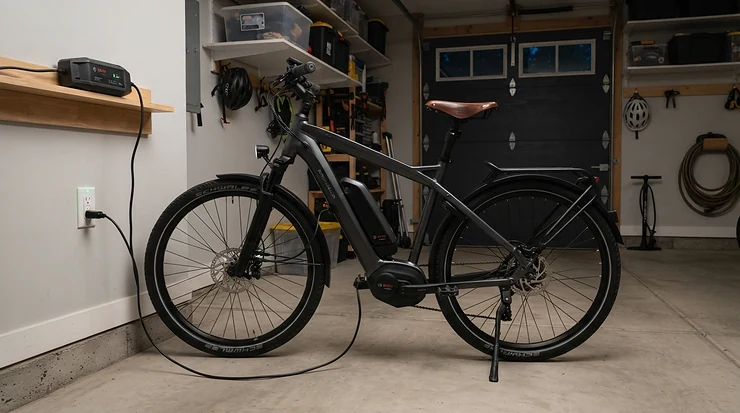
Picking the wrong ebike charging routine can cost more than a worn-out battery: a UL Standards & Engagement survey, reported by NJTPA’s InTransition magazine, found that 41 percent of micromobility owners routinely charge overnight, the habit UL’s own safety tips tell riders to avoid. Gear cannot fix that habit, but the right gear makes a measured, attended, off-grid charge easy, and that is what this 2027 shortlist is built around. The short answer on overnight charging is no, and the reasons come near the end.
Maker spec sheets, specialist-press reviews, safety-group guidance, and long owner threads on e-bike forums supply the figures below, and every finding names its source, so one owner’s report never gets dressed up as a consensus.
The short version: a power station around 1 kWh is the flexible core of a solar ebike setup. The Anker SOLIX C1000 Gen 2 offers the most ports and the highest solar input, the Jackery Explorer 1000 v2 is the lighter body, and the EcoFlow RIVER 3 Plus is a small trip companion that refills part of a pack. A panel such as the Renogy 100W Eclipse Solar Suitcase and a plug-in meter, the P3 Kill A Watt P4400, round out the kit.
Watt-hours, solar ceiling, wave form and weight: the specs that decide
Start with the pack. Anker’s own e-bike charging guide adds up every battery to be refilled and says the station’s capacity should exceed that total, because charging typically loses 10 to 15 percent along the way. Sample calculation with those assumptions: a 500 Wh e-bike battery needs roughly 550 to 575 Wh from the station, so a 1,070 Wh unit covers close to two full charges and a 286 Wh unit covers about half of one.
Second comes the solar ceiling. Anker’s UK guide notes that every station accepts a maximum solar wattage, and pairing a 200 W panel with a station that takes only 100 W leaves half the panel’s output unused. The three stations here accept up to 220 W (EcoFlow RIVER 3 Plus), 400 W (Jackery Explorer 1000 v2) and 600 W (Anker SOLIX C1000 Gen 2), according to the makers’ pages and reviews.
Third is the wave form. Posters in emtbforums and Electric Bike Review threads steer each other toward pure sine wave output for e-bike chargers, and one emtbforums poster adds that some inexpensive “pure sine” inverters produce rough waveforms. The charger’s manual has the final word.
Fourth is weight. The stations run from 10.4 lb (EcoFlow RIVER 3 Plus) to about 24.9 lb (Anker SOLIX C1000 Gen 2), and that matters most when the rig rides in a trailer or gets carried from a van to a campsite. Whatever the model, charging for bike batteries should go through the charger the maker supplied: Tern’s charging guide warns that unapproved third-party chargers may not regulate voltage correctly or communicate with the battery.
Capacity, solar ceiling and weight compared
Pick
Role
Capacity
Max solar input
Weight
EcoFlow RIVER 3 Plus
Trip top-ups
286 Wh
220 W
10.4 lb
Jackery Explorer 1000 v2
Lighter 1 kWh base
1,070 Wh
400 W
about 23.8 lb
Anker SOLIX C1000 Gen 2
Many devices at once
1,024 Wh
600 W
about 24.9 lb
Renogy 100W Eclipse Solar Suitcase
Portable panel
100 W rated
not applicable
20.5 to 26.6 lb (sources differ)
P3 Kill A Watt P4400
Plug-in meter
up to 15 A at 115 V
not applicable
about 5.6 oz
The three stations form a ladder more than a rivalry. The EcoFlow RIVER 3 Plus gives up capacity for weight, while the Jackery Explorer 1000 v2 and the Anker SOLIX C1000 Gen 2 sit within about 1 lb of each other and differ mostly in solar ceiling and outlets. The Renogy 100W Eclipse Solar Suitcase is the only panel in the group, so it is the part to size up if solar speed matters most.
Match the panel’s voltage to the station’s solar input window before ordering; each listing’s spec section has both numbers.
Two e-bike chargers and a laptop charger can plug in together here, because The Gadgeteer’s review counts ten ports: five AC outlets, one USB-A, three USB-C and a car socket. Anker lists 1,024 Wh, 2,000 W of output with a 3,000 W surge, LFP cells rated for 4,000 cycles, and a 600 W solar input limit. Its AC recharge takes about 49 minutes at the 1,600 W maximum input, and the same review puts the weight near 24.9 lb.
CleanTechnica’s review points to two things worth planning around. A standard panel needs an MC4-to-XT60 adapter to connect, and the fans get loud when the unit charges at its fastest rate.
Check the current price on Amazon.com. Anker’s FAQ says the C1000 Gen 2 does not support expansion, so 1,024 Wh is the ceiling.
Anker SOLIX C1000 Gen 2See current price, sizes and reviews on Amazon.
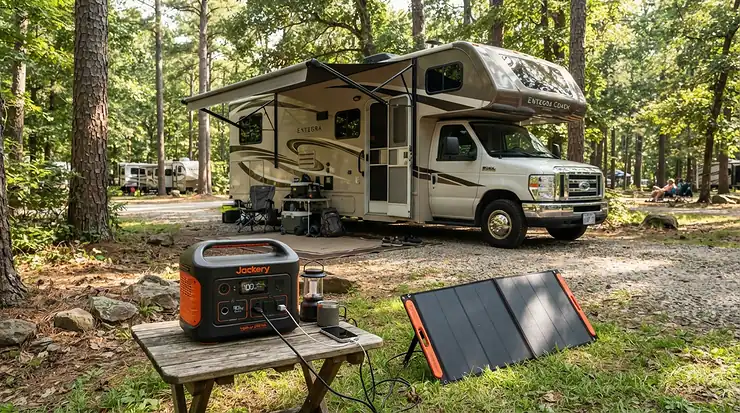
TechRadar put this station at roughly $500, and the maker’s own store lists it a little higher. It holds 1,070 Wh of LiFePO4 cells in most listings and in the manual, though one maker page shows 1,024 Wh. Output is 1,500 W continuous with a 3,000 W surge, and a retailer listing describes the AC output as pure sine wave. Solar comes in through two DC8020 ports, 100 to 400 W combined, according to Mr. Solar’s spec table, and Jackery gives the weight as about 23.8 lb.
OutdoorGearLab calls it plenty lightweight for off-grid camping, yet lists limited solar input and only three AC outlets with tight spacing among its drawbacks. Mr. Solar’s listing also notes that the unit is not compatible with the Explorer 1000 Plus battery pack.
Pros:
About 1 lb lighter than the Anker, going by the makers’ figures
Jackery’s page advertises a 0-to-100 percent emergency recharge in one hour
Rated for 4,000 cycles to 70 percent capacity
Cons:
A 400 W solar ceiling, which OutdoorGearLab considers limited
Three AC outlets, closely spaced
Jackery Explorer 1000 v2See current price, sizes and reviews on Amazon.
For a weekend loop where the charger only has to refill part of a pack, 286 Wh in a 10.4 lb body is easier to justify than a 24 lb brick. StorageReview lists LiFePO4 cells rated for 3,000 cycles to 80 percent, with a solar input of 220 W that EcoFlow says fills the unit in as little as 1.5 hours under ideal conditions. AC recharge takes about an hour, and output is 600 W (1,200 W with X-Boost).
Port counts conflict between sources: StorageReview describes two AC outlets on the rear panel, while some retailer pages list three. One US dealer, Offroad Tents, shows the station at around $300.
By the loss math above, 286 Wh refills about half of a 500 Wh pack. Stacking EcoFlow’s 572 Wh extra battery lifts the total to 858 Wh, still under the Jackery’s 1,070 Wh.
EcoFlow RIVER 3 PlusSee current price, sizes and reviews on Amazon.
Sources disagree on the weight: a retailer listing mirrored from Amazon shows 20.5 lb, while a gadget review puts the suitcase near 26.6 lb. Renogy describes two 50 W monocrystalline panels with an adjustable aluminum stand, latches, a handle and a soft carrying case. A dealer spec sheet lists 22 percent cell efficiency, a 20.3 V operating voltage and a 24.3 V open-circuit voltage, which falls inside the input windows quoted for the three stations here (11 to 55 V for the EcoFlow, 16 to 60 V for the Jackery, 60 V maximum for the Anker).
Kits that include a 20A PWM controller exist, but Anker’s guide says stations already contain the charge controller circuitry, so the version sold without one is the cleaner match. Renogy’s own store lists its suitcase kits in roughly the $145 to $240 range, depending on cell type and controller.
One owner on a retailer-mirror page reports 103 W from this suitcase in a driveway under ideal conditions, better than their rigid panels; that is a single report. Anker’s guide lists sunlight intensity and season among the factors that change real charging time, and 100 W alone means more than five hours of full output for a 500 Wh pack (500 ÷ 100). A second suitcase would still leave most of the Anker’s 600 W ceiling unused.
Renogy 100W Eclipse Solar SuitcaseSee current price, sizes and reviews on Amazon.
Between about $30 and $35 on two US dealer pages, OKAA Auto and Walmart, this plug-in meter costs far less than anything else here. P3’s datasheet lists readouts for volts, amps, watts, hertz and VA, a cumulative kWh counter and 0.2 percent accuracy, with ratings of 115 VAC and up to 15 A. The unit weighs about 5 ounces.
Plugged between a station’s outlet and the bike charger, it shows whether the charger’s wattage matches its label and how much energy the session actually used. Sample calculation: if a pack rated 500 Wh goes from empty to full and the meter reads 0.6 kWh, the gap of 0.1 kWh is the charger and conversion loss.
It only measures. The meter switches nothing off, so it does not replace staying nearby while a battery charges.
Compare each station’s solar input rating with the panel you plan to buy before you add either to the cart.
P3 Kill A Watt P4400See current price, sizes and reviews on Amazon.
Best solar charging station for multiple devices: where the Anker and Jackery split
For the best solar charging station for multiple devices, the Anker SOLIX C1000 Gen 2 has the edge on counts: five AC outlets against three on the Jackery Explorer 1000 v2, 600 W of solar input against 400 W, and a 49-minute AC recharge against about an hour in Jackery’s emergency mode. The Jackery Explorer 1000 v2 gives back roughly 1 lb in weight.
Port quality matters as much as count. OutdoorGearLab found the Jackery’s three AC ports tightly spaced, which can crowd bulky chargers, while CleanTechnica noted fan noise on the Anker at its fastest charge rate.
Devices running at the same time draw on what the panel supplies, so a long session with several loads needs either more panels or a station left to refill between uses. A hypothetical household charging two e-bikes plus a laptop and phones fits the Anker’s outlet count. A single rider topping up one bike at camp is closer to the Jackery or the smaller EcoFlow RIVER 3 Plus.
Solar ebike charging: sizing the panel and tracking the losses
Two routes exist for a solar powered ebike rig. The first sends panel power into a station, then runs the bike’s stock charger from the station’s AC outlet. It works with any bike but converts DC to AC and back to DC again. A poster on the Rad Power owners forum complains about that waste and recalls roughly 96 percent efficiency from a pure sine inverter in a car, which is one owner’s recollection and not a measurement of these stations.
The second route skips the inverter. Electrek describes JackRabbit’s Solar Charging Kit, a collapsible panel with a converter that outputs 42 V, as plugging straight into the company’s micro e-bikes, and estimates about 80 W of output, enough for roughly three hours on the 151 Wh battery. Electrek adds that building something similar yourself costs less, but the kit is designed around JackRabbit’s batteries. CleanTechnica cautions that e-bike makers use different connectors, battery voltages and motor systems, so a direct build has to be matched to one bike.
Sizing follows the earlier math. Spheral Solar’s buying guide expects 4 to 8 hours in good sun to fill a 500 Wh battery from a 150 W panel, and Jackery says a typical 48 V pack calls for at least 200 W of panels. A single 100 W suitcase is slower still, at five hours of full output before the 10 to 15 percent losses and any cloud.
Solar will not win on price. EIA’s national residential average sits near 18 cents per kWh in 2026, according to Utility Dive, so a 500 Wh battery costs roughly 9 cents from the wall (sample calculation: 0.5 kWh × $0.18, before charger losses). The case for a station and panels is off-grid charging for bike packs where no outlet exists, or keeping a bike usable in an outage. Ebike charging from the sun is a convenience purchase, not a savings plan.
Heavy duty trailer solar charging system: what builders report
Most trailer builds follow one pattern: a panel on the lid, a battery in the box, the bike’s own charger on the output. One Electric Bike Review poster describes a dog trailer with a 100-pound capacity carrying a 100 W panel and a 100 Ah LiFePO4 battery with an inverter, and says the stock charger charges and shuts off exactly as it does at home, with no special controllers. Another poster on the same forum insists a storage battery between panel and charger cannot be avoided, and reports that a 400 Wh station with a 100 W panel charges Bosch-based bikes.
Smaller rigs exist. An emtbforums poster runs a 50 W flexible panel, an MPPT controller and two 12 V lithium batteries totaling 42 Ah, and falls back on mains for a couple of hours when sun runs short. CleanTechnica’s write-up of the Solar Trails channel describes a 100 W panel on a trailer lid plus a 200 W panel stowed inside for use when parked.
Panel size is the recurring limit. An Electric Bike Review builder wanted more wattage than the 110 W, 4.4 lb semi-flexible panel he ordered, which already overhangs his trailer. On Endless Sphere, a builder reports that a minimal one-wheel trailer was so unstable after about 100 meters that the bike had to be walked back, and adds that for a simple build any bike trailer will do as long as cross-bars or a rigid backing support the panels.
Treat a heavy duty trailer solar charging system as a load-bearing build. Stay within the trailer maker’s rated payload and hitch limits, and keep the station (about 24.9 lb for the Anker SOLIX C1000 Gen 2, about 23.8 lb for the Jackery Explorer 1000 v2) low and strapped down.
What is regenerative charging in ebike motors, and how much does it return?
Regenerative charging means the motor acts as a generator while the bike slows or coasts downhill, sending current back into the pack. Pedaling alone does not charge a battery: a HOVSCO explainer says e-bikes do not recharge while you pedal.
Which drives can do it is narrower than marketing suggests. The ebikes.ca regen guide says regen is available on direct-drive hub motors and on geared hubs that do not freewheel, needs a regen-capable controller, and that mid-drives have essentially no path to it.
The figures vary by source. Ebikes.ca puts typical recovery on a direct-drive setup at about 3 to 8 percent of energy, near zero on flat steady rides, and about 20 percent for one staff rider on a recumbent trike. Retailer explainers from HOVSCO and Movinev quote 5 to 10 percent under ideal conditions, so the numbers overlap more than they conflict, and all agree regen will not replace the plug.
Regeneration also needs headroom. Leoguar’s explainer notes that on systems configured to reduce regeneration near the pack’s upper voltage limit, a descent straight after a full charge gives less regenerative slowing. Treat regen as a bonus and size the charging rig as if it did not exist.
Can I leave my ebike charging overnight?
No. UL Standards & Engagement’s safety tips say never to leave a battery unattended while charging or to charge overnight while sleeping, and Tern and the California Bicycle Coalition give the same advice. ULSE also says to avoid extreme heat or cold when charging, and the California Bicycle Coalition notes that most documented e-bike battery fires happened during charging, not while riding. If a battery gets hot, it advises unplugging and moving it outdoors. A Gulf Shores, Alabama fire-safety handout adds that extension cords, shared circuits and sunlit spots raise the risk.
A power station does not change the picture. The danger sits in the bike’s pack and charger, which behave the same whether the energy comes from a wall outlet or a LiFePO4 station, so campsite rules match home rules. Keep ebike charging to hours when someone is awake and nearby.
Fire-resistant charging bags split opinion. A c’t fire test reported by heise put a 375 Wh e-bike battery in a roughly 20-euro bag sold as fireproof; flames shot out shortly after the first cell failed, and only shreds remained. On the Electric Bike Review forum, several members doubt that bags suit large packs. One recommends a metal ammo can or a lined tool box instead, and another argues that a certified pack makes a bag unnecessary and may hinder cooling. A retailer page for the VLITEX bag says it was tried with batteries up to 400 Wh and only slows a fire’s spread.
Rules are tightening. On June 24, 2026, the Consumer Product Safety Commission published a proposed rule (91 Fed. Reg. 38,162) that would make UL 2849, UL 2272 and UL 2271 mandatory for e-bikes, replacement packs and aftermarket chargers, with added requirements, according to a Beveridge & Diamond summary. The agency’s record counts 227 incidents, 39 deaths and 181 injuries from 2019 through 2023, and many involved thermal runaway while charging. It remains a proposal, so the docket shows its current status.
Short answers on solar hookups, charge time, pedaling and inverters
Can I charge an e-bike battery straight from a solar panel?
Not directly in most setups. The bike's stock charger expects AC power, so panel output goes into a power station first and the charger plugs into its outlet. Direct builds exist, but CleanTechnica notes connectors and voltages differ by brand, so each is matched to one bike.
How long does it take to charge an e-bike battery?
Divide the battery's watt-hours by the charger's output watts, then add time for the slow final stretch. Sample calculation: a 500 Wh pack on a 144 W charger, which is 48 V at 3 A, needs about 3.5 hours before tapering. The charger label gives the real rating.
Do e-bikes recharge while you pedal?
No. A HOVSCO explainer says pedaling only propels the bike and generates no usable charge. Some direct-drive hub systems recover a small share of energy while braking or coasting downhill, but ebikes.ca puts typical recovery at about 3 to 8 percent, nowhere near a replacement for plugging in.
Do I need a pure sine wave inverter to charge an e-bike?
Posters in emtbforums and Electric Bike Review threads recommend it, because switching chargers can misbehave on modified sine output. Follow the charger manual first, and confirm the wave form on any station's spec sheet before plugging the stock charger in.
How big a solar panel does a solar ebike setup need?
Jackery says a typical 48 V battery needs at least 200 W of panels, while Spheral Solar expects 4 to 8 hours of good sun to fill a 500 Wh pack from 150 W. A 100 W panel is slower still, at over five hours of full output.
A simple plan before you spend anything
Good ebike charging starts with habit, then hardware. Charge while someone is awake and nearby, use the charger the maker supplied, and add a P3 Kill A Watt P4400 so the numbers on your own bike stop being guesses. When outlets are the problem, the Anker SOLIX C1000 Gen 2 is the better fit for two bikes plus other devices, the Jackery Explorer 1000 v2 suits a lighter carry, and the EcoFlow RIVER 3 Plus covers short trips where half a pack is enough. A Renogy 100W Eclipse Solar Suitcase keeps any of them topped up, slowly. Regen and bigger panels can wait until the basics work. Match the panel’s wattage to the station’s solar input before you order.