As an Amazon Associate I earn from qualifying purchases. Links in this article may be affiliate links. How we choose gear
A wall outlet and the charger that shipped with the bike are still the safest e bike charging station, and the picks below exist for the places where that outlet is missing. Trailhead lots, a van, a campsite, a commute that ends without a plug: each needs a different fix, and the wrong one can mean a stranded rider, a damaged pack, or a fire risk. The CPSC received 156 reports of fire and thermal incidents involving “universal” micromobility chargers between January 2023 and May 2024, according to its own warning on those chargers, so compatibility comes before convenience when you assemble an e bike charging station in 2027. Maker spec sheets, a year-long German magazine review, owner threads on forums, and agency notices shape every pick, and each finding names its source.
The short version: the Grin Cycle Satiator is the portable e bike charger for riders who carry their own, the EcoFlow DELTA 2 with the EcoFlow NextGen 220W Bifacial Portable Solar Panel covers e bikes with solar power and off-grid camps, the EVHIKING J1772 to NEMA 5-15/5-20 Adapter opens up public EV poles, and the Bosch PowerMore 250 replaces charging with extra energy on the bike.
Watt-hours, plug type, charger match: what separates the picks
Start with the pack, because every other choice follows from its size. Watt-hours equal volts times amp-hours, so the 48 V, 10.4 Ah removable battery in the Volpam K14 manual works out to about 499 Wh. Sample calculation with an assumed 15 percent conversion loss: refilling that pack from a station draws roughly 574 Wh, which means a 1,024 Wh unit covers about 1.8 refills.
Then comes the charger. The CPSC says chargers sold as “universal” or “suitable for use with e-bikes” may fit a battery and still be incompatible with it, since each micromobility battery has its own charging needs. Tern’s charging guide adds that unapproved third-party chargers may not regulate voltage correctly or communicate properly with the battery, and it points to UL 2271 for the battery and UL 2849 for the whole e-bike electrical system as the certifications to look for. Four of the five picks here keep the bike maker’s own charger in the loop. The fifth, the Grin Cycle Satiator, replaces it and hands the matching job to the buyer.
Last is the energy source: a wall, an EV pole, or the sun. The five picks sort themselves along that line.
Capacity, input, and weak spot for each pick
Pick
Situation it solves
Key figures from makers and reviewers
Weak spot
Grin Cycle Satiator
Fast charging on trips
360 W output, 100–240 V AC input, packs up to 63 V
Needs a charge profile matched to the pack
EVHIKING J1772 to NEMA 5-15/5-20 Adapter
Public EV poles
0.25 m cable, three sockets
The bike charger must accept 240 V
EcoFlow DELTA 2
Camp, van, outage base
1,024 Wh, 500 W max solar input, 27 lb
Fan noise while charging
EcoFlow NextGen 220W Bifacial Portable Solar Panel
Solar refills
220 W rated, 193 W measured by OutdoorGearLab, 15.9 lb
Setup score of 6.3 out of 10
Bosch PowerMore 250
Spare energy on the bike
250 Wh, about 1.5 kg
Bosch Smart System bikes only
Only the EcoFlow DELTA 2 stores energy here. The adapter and the charger move it, the panel collects it, and the Bosch PowerMore 250 sidesteps the problem by carrying more of it. Weight adds up quickly once a station and panel travel together: about 27 lb plus 15.9 lb.
Five places an outlet is missing, and the gear for each
Trailhead cafés, hotel rooms and friends’ garages share a problem: a typical 4 A charger needs hours. Grin Technologies’ product page says the Satiator’s 360 W output charges in half that time, delivering up to 8 A on 24 V and 36 V packs and 7 A on 48 V packs. The manual lists a 100–240 V AC input, which matters at EV poles, and the maker’s page describes up to 20 programmable profiles, including an 80 percent profile for daily use and a full-charge profile for long days.
Programmability cuts both ways. A forum reply in an Electric Bike Review thread expected the Satiator to fail on a Stromer battery because the pack’s CAN-bus communication would be missing, which is one poster’s expectation and not a measured result. A buyer review mirrored on a retailer page, by contrast, describes pairing it with a J1772 adapter on trips, again a single report. The CPSC’s warning concerned chargers marketed as “universal,” including two named 36 V models, and did not name the Satiator, but its advice still applies: confirm the charge profile with the bike’s maker before the first plug-in.
The ebikes.ca store lists the standard 48 V model from about $325 to $379 in US dollars depending on options, and says it is also sold on Amazon for US customers. Check the current price on Amazon.com.
Grin Cycle SatiatorSee current price, sizes and reviews on Amazon.
Only chargers that accept 240 V belong on this adapter, and the listing says so itself: it works as long as the charger is 240 V compatible, otherwise the device could be damaged. The adapter on that listing has a 0.25 m cable, three sockets and a one-year warranty. A poster in the Electric Bike Review thread below says this kind of adapter handles the signaling a public pole expects, and the bike’s own charger then plugs into it like a wall outlet.
An owner of two 500 Wh Bosch batteries described the setup in an Electric Bike Review thread: a 6 A charger on a free Volta Level 2 station added about 50 percent to the 1,000 Wh system in two hours, and a second owner reported the same rate. The first poster also noted that the batteries ended up unbalanced afterward, a single observation. The thread was not all praise. An EV owner argued that poles are meant for cars and warned that a nozzle left on the ground collects debris, and another poster described a station with a $5 minimum on its card reader. The original poster concluded that a regular outlet comes first and an EV pole is for when none exists.
Adapters of this type sell between roughly $40 and $100 on Alien Rides’ store and on dealer pages. Check current availability on Amazon.com.
EVHIKING J1772 to NEMA 5-15/5-20 AdapterSee current price, sizes and reviews on Amazon.
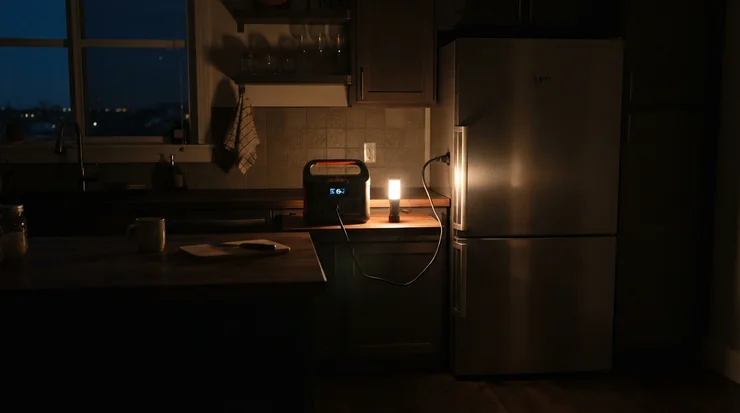
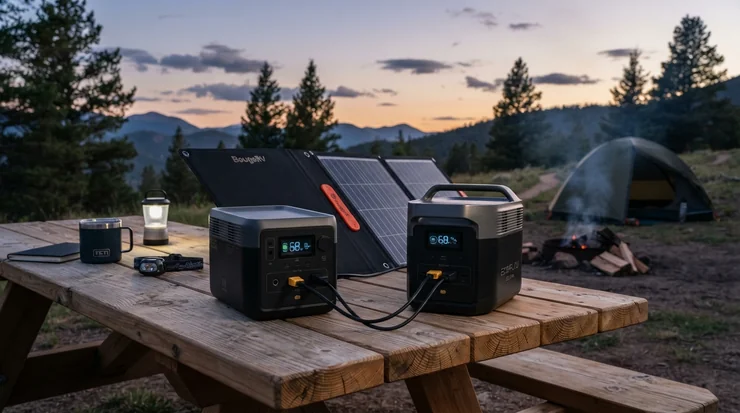
Watt-hours decide this one, not watts. The unit stores 1,024 Wh in LiFePO4 cells, outputs up to 1,800 W (2,700 W surge, according to MakeUseOf), and accepts up to 500 W of solar input between 11 V and 60 V, per StorageReview’s spec table. A bike charger draws a few hundred watts at most, so the constraint is capacity. By the sample calculation above, it refills about 1.8 packs of 499 Wh once, and EcoFlow sells extra batteries that stretch the total toward 3 kWh, according to Backup Power Hub.
Sources disagree on recharge time. PopSci reports a full charge from an outlet in 80 minutes, while Berger Camping’s listing puts 0–100 percent near two hours, so the maker’s current manual is the tiebreaker. MakeUseOf cites 3,000 cycles to 80 percent capacity, and Review Geek’s review lists fan noise while charging as a drawback, which matters at a quiet campsite.
At 27 lb, it is a car-trunk or van item, not a pannier item. Check the current price on Amazon.com.
EcoFlow DELTA 2See current price, sizes and reviews on Amazon.
OutdoorGearLab’s tests measured 193 W from a panel claimed at 220 W, an 88 percent measured efficiency, and called it the highest-output folding model it had tested. Its ease-of-setup score was 6.3 out of 10. A buyer review mirrored on a retailer page for a 220 W EcoFlow panel calls the mechanical design poor and says the panel barely justifies the hassle, a single report that matches the middling setup score.
Dealer pages list the NextGen at 15.9 lb with an IP68 rating, a 220 W front side and a rear side that harvests reflected light. The older EcoFlow 220W Bifacial panel is a different version, listed at 9.5 kg with a 155 W rear side, so the two differ in weight and rear output. The older version’s open-circuit voltage near 21.8 V sits well inside the EcoFlow DELTA 2 input window.
Sample calculation: a 499 Wh pack with 15 percent assumed loss needs about 574 Wh, and at the measured 193 W that is roughly three hours of steady peak sun. Clouds, season and angle stretch it.
EcoFlow NextGen 220W Bifacial Portable Solar PanelSee current price, sizes and reviews on Amazon.
Some routes never see a plug, and the answer there is more energy on the bike. This 250 Wh, 36 V, 6.7 Ah range extender measures 200 × 88 × 75 mm and weighs 1,497 g with its cable in BIKE magazine’s measurement; Bosch’s connection cable is a separate purchase. Charging at 4 A takes about 2.9 hours from empty, according to a US dealer listing.
BIKE magazine’s year-long review rated it among the most powerful range extenders but criticized the mount: dirt often made the battery jam on its rails, the mount showed play after about six months, and the main battery and extender cannot charge together while fitted. Electric Bike Report expected a 62.5 percent gain on a 400 Wh Norco Fluid and saw closer to 50 percent, one reviewer’s result on one bike.
It works only with the Bosch Smart System, and not every Smart System bike qualifies; a US dealer page says to look for PowerMore in the bike’s component list in the eBike Flow app first. European dealer pages show it between roughly €395 and €470. Check the current price on Amazon.com.
Bosch PowerMore 250See current price, sizes and reviews on Amazon.
How to charge an electric bike at a charging station, step by step
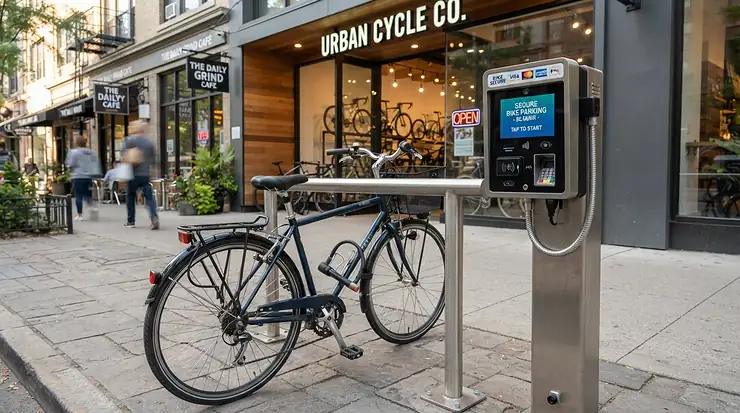
Two kinds of stations exist, and the steps differ. Dedicated e-bike stations are built for batteries; EV poles are built for cars and need an adapter.
Confirm what the station accepts. bike-energy’s own FAQ says its stations charge through a bike-energy cable and that the bike’s own charger is not required, and a Lübeck solar station says all standard e-bike batteries work.
Bring the matching cable or adapter. At an EV pole, that means a J1772-to-NEMA adapter plus a charger that takes 240 V.
Authenticate. Public systems use an app, a card or a phone scan, as in the solar card operated e bike stations covered below.
Plug in and confirm the session started. The Electric Bike Review poster above saw the Volta display read “Plugged in…” rather than “In use,” and guessed the low load might not trigger the two-hour limit.
Stay close, since the sources agree on unattended charging, and unplug when the pack is full.
Stow the nozzle off the ground, per the EV-owner warning in that thread.
A regular 120 V outlet is simpler than any of this, which is why that thread’s original poster kept EV poles as a fallback.
What an e bike charging station costs, from an adapter to a solar hub
Prices split into three tiers. Personal gear is the cheapest: the Grin Cycle Satiator runs about $325 to $379 on its maker’s store and an EV-pole adapter adds roughly $40 to $100. A power station and panel cost more, and the current price on Amazon.com is the figure to trust.
Public stations cost far more. Forbes, reporting on the Power Trip station outside Newcastle’s Cycle Hub, gives about $6,500 for a basic unit. Levy Electric’s catalog lists bike-energy’s TOWER at €5,016 to €6,588 with five charging ports and 250 W at 36 V, and lists Skyhook Solar’s off-grid D4, D6 and V6 hubs, deployed with Lyft and WE-cycle, at $28,000 to $34,500. For contrast, Qmerit puts commercial Level 2 car chargers at $3,500 to $15,000 per port.
Running cost is small. Sample calculation, assuming 18 cents per kWh: a 0.5 kWh pack costs about 9 cents from the wall before charger losses.
What is the best solar charging station in Europe?
The sources do not crown one winner, but they sort by need. Levy Electric credits bike-energy with Europe’s largest e-bike charging network, over 3,000 stations in 19 countries, and bike-energy’s own site claims more than five million charging processes and compatibility with over 95 percent of e-bikes. Its Charger Cube and solar-powered streetlight and bench options run from a panel and storage battery without a grid connection. Levy’s page also lists a higher price and a Europe-only focus as drawbacks.
For fully off-grid sites, other systems compete. Falco’s Solarcycle in the UK is sold as a modular off-grid unit with no mains connection. SunCrafter lists up to 1 kW of solar input and a 4.8 kWh battery for five scooters or e-bikes with GSM monitoring. And FHNW’s autonomous station in Gränichen, Switzerland, has run three ports on 100 percent local solar since autumn 2019. Victron’s write-up of a French cycle route says each solar station there can fill 6 to 12 e-bikes from 0 to 100 percent.
Solar card operated e bike stations: scan, plug in, ride
Card-operated stations solve the question of who pays and who gets in. At Power Trip, riders scan a card or phone and one of four charging ports opens, according to Forbes; the unit mixes about half a kilowatt of solar panels with about half a kilowatt of wind turbine, runs fully off-grid, and charges riders only pennies. A roughrideguide listing describes similar six-compartment stations with a lockable door on each.
In a Technology Scotland presentation, Tronius describes mobile EV charging units with RFID, contactless card and Apple Pay or Google Pay payment, a battery variant for off-grid or weak-grid sites, and setup in about 20 minutes on site, and it says e-bike charging can be integrated into them. In the US, WE-cycle says it pioneered the first operational solar-powered e-bike charging stations in Aspen, though those serve its share fleet and not private bikes.
E bikes with solar power: rechargeable from a panel on the bike or a station?
Panels mounted on the bike add little. The German Solarride 60WP kit puts a 60 Wp panel on the seat post and feeds a 36 V lithium pack through a handlebar charger, and NextPit reports about 10 km of added range per sun hour under ideal conditions, a weight just under 4 kg and prices of €349.99 or €699.99 for the complete system. NextPit also notes the kit is sold only in Germany, and its stated wattage figures are inconsistent.
An Endless Sphere poster advising touring riders warns that panels left to hold a pack at full charge daily, when only 10 to 20 percent is used, count as battery abuse, which is one poster’s view. A station and panel decouple charging from riding. They also let the bike’s own charger do the work, which keeps the compatibility question simple.
Volpom e bike extra battery: what a spare pack involves
The brand spells itself Volpam, and its K14 foldable is the model listed on Amazon. The maker’s page and manual list a 48 V, 10.4 Ah removable lithium-ion battery, a 500 W motor, up to 35 miles in pedal-assist, and 4 to 5 hours for a full charge. One dealer page repeats a UL 2849 claim from the listing text. The box holds one pack and one charger.
Spares vary by brand. Mokwheel’s store lists its packs at about $599 to $600, and Madsen sells a 614 Wh pack only with a new bike. For a spare Volpam pack, the safest route is asking the brand for a matching battery and connector, then charging it with the charger supplied, per the CPSC advice above. Alternatively, a station like the EcoFlow DELTA 2 can refill the stock pack away from home, and the extra battery becomes unnecessary.
Charging habits that matter more than the gear
No pick here makes overnight charging safe. The CPSC’s advice, repeated in AAA’s e-bike tips and in Tern’s guide, is to stay nearby while charging, avoid charging while asleep, and use the maker’s charger or one it approves. A power station changes nothing: the risk sits in the bike’s battery and charger, which behave the same on any power source.
Fire-resistant bags divide opinion. Tern says a certified battery from a reputable maker likely needs none, and warns that covering a battery during charging can trap the heat it generates. Charge in a dry, ventilated spot with a working smoke detector, away from direct sun. The CPSC also named two 36 V “universal” chargers sold on Amazon and eBay as fire hazards, so a charger’s listing description is no substitute for the bike maker’s approval.
Cost, EV plugs, solar and overnight charging: quick answers
How much does an e bike charging station cost?
A programmable charger such as the Satiator runs about $325 to $379 on its maker's store, and an EV-pole adapter adds roughly $40 to $100. Public stations cost far more: about $6,500 for a basic off-grid unit per Forbes, and from €5,016 for bike-energy's TOWER.
Can you charge an electric bike at an EV charging station?
Yes, with a J1772-to-NEMA adapter and a charger that accepts 240 volts. Owners in an Electric Bike Review thread report about 50 percent of a 1,000 Wh system added in two hours, and some stations enforce two-hour limits or card minimums.
Can an e-bike battery charge directly from a solar panel?
Most setups route panel power into a power station, then plug the bike's own charger into its outlet. Seat-post kits like Germany's Solarride 60WP feed 36 V packs directly, adding about 10 kilometers per ideal sun hour, though NextPit says it is sold only in Germany.
How long does a portable e bike charger take to fill a pack?
Divide watt-hours by charger watts, then allow time for the final taper. Sample calculation: a 499 Wh pack on a 360 W Satiator needs about 1.4 hours at full output, and the maker says a typical 4 A charger takes roughly twice as long.
Is it safe to leave an e-bike charging overnight?
No. CPSC advice, repeated by AAA and Tern, is to stay nearby, avoid charging while asleep, and use the maker's charger or one it approves. A power station does not change that, because the risk sits in the bike's own battery and charger.
Which setup to buy first
Build the e bike charging station around the rides, not the gadgets. The maker’s charger and a wall outlet cover home. The Grin Cycle Satiator suits riders who need fast top-ups away from home and are willing to confirm the charge profile with their bike’s maker first. The EcoFlow DELTA 2 with the EcoFlow NextGen 220W Bifacial Portable Solar Panel handles campsites and outages, and the EVHIKING J1772 to NEMA 5-15/5-20 Adapter is the fallback for a day with no outlet. Owners of Bosch Smart System bikes with a compatible frame can skip charging stops with the Bosch PowerMore 250. Choose by the gap in your route, and leave the rest alone.