As an Amazon Associate I earn from qualifying purchases. Links in this article may be affiliate links. How we choose gear
Verdict: match the cell type printed on the pack, replace every cell at once, and keep the box dry. That rule settles most problems with a battery for christmas lights in 2027, and the rest comes down to cold weather, runtime and the strings that really want a wall outlet.
Manuals from Home Depot’s holiday lines, spec sheets from Energizer and Panasonic, sizing guides from Duracell, EcoFlow and Goal Zero, iFixit repair pages and retailer buyer reviews supply the figures below. They cover opening a pack, changing cells, fixing a dead string, surviving a freeze and, for plug-in strings, running them from a solar-charged power station or a shed system.
What the label decides before you buy a single cell
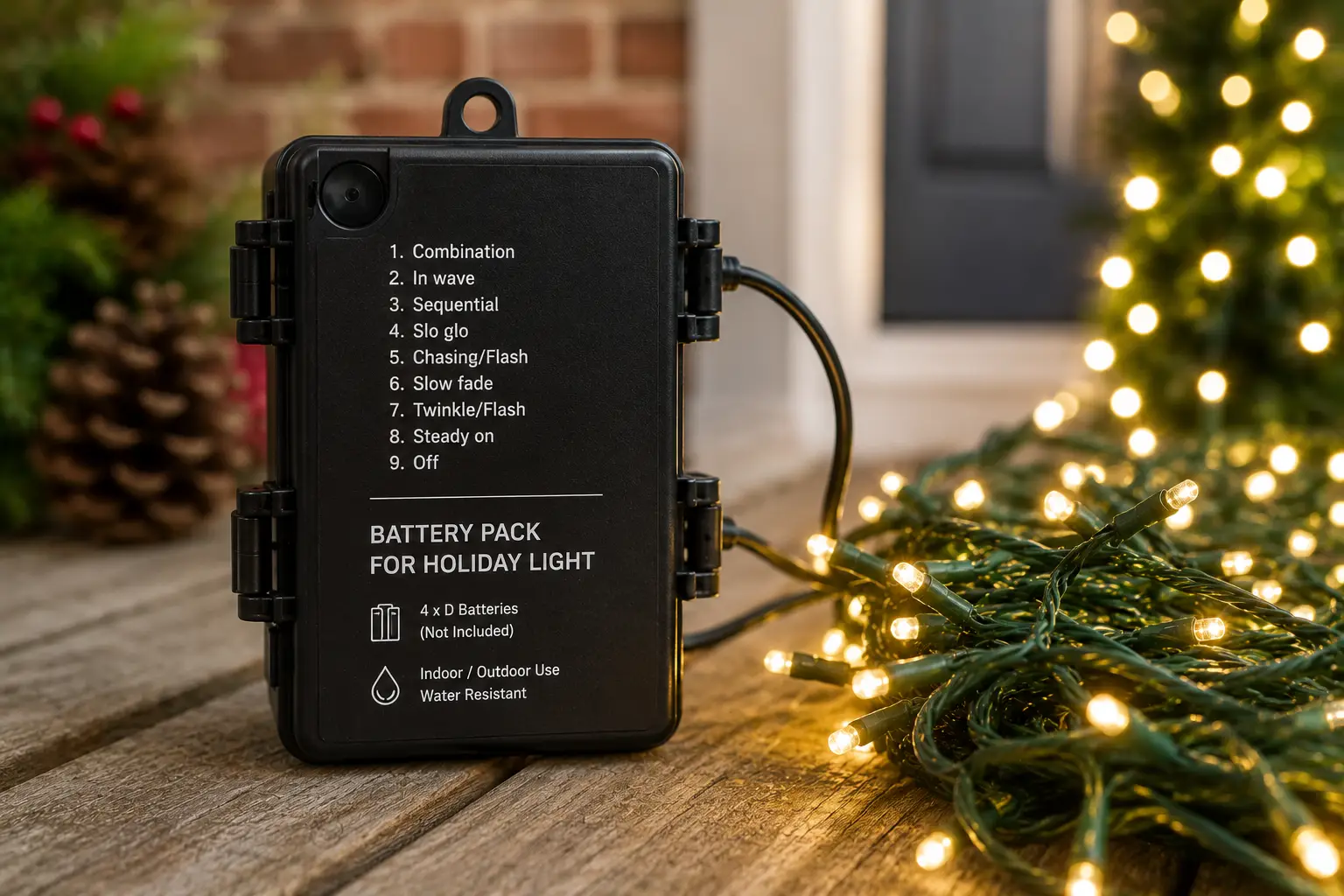
Three lines on the pack or in the manual settle most of the buying: how many cells and what size, which chemistry, and whether the box is rated for outdoors. A Home Depot control-box manual calls for three AA cells, allows only alkaline, and tells owners not to mix alkaline, carbon-zinc, lithium, rechargeable or old and new cells. The same manual describes a timer that lights the string for 6 hours, then switches it off for 18, repeating until the switch is set to off. It also marks the box as indoor-only.
Runtime depends on the string more than on the cell. Christmas Light Source puts micro-drop LED strings on thin wire above 100 hours per fresh set of three AA cells, and standard LED sets with thicker insulation and lens bulbs at 18 to 24 hours. A maker’s instruction sheet for a 25-LED mini string lists 150 hours, while Funboy says its three-AAA LED lights run about 10 to 12 hours of continuous use.
String type (source)
Cells
Hours per fresh set
Nights on a 6-hour timer (calculated)
Micro-drop LED on thin wire (Christmas Light Source)
3 AA
100+
about 16
25-LED mini string (maker’s instruction sheet)
3 AA
150
25
Standard LED set with lens bulbs (Christmas Light Source)
3 AA
18 to 24
3 to 4
LED light with remote (Funboy)
3 AAA
10 to 12
about 2
10 to 15 bulb incandescent string (Christmas Light Source)
C cells
3 to 6
up to 1
The nights column is simply hours divided by 6, rounded. The spread between the 150-hour mini string and the incandescent set is a factor of 50, so a string’s own hours-per-set figure is the number to compare before any cell brand.
How to open the battery pack for Christmas lights without cracking the lid
Pack designs differ, and the instruction sheet for the exact model beats any general rule. The releases documented by makers and repair guides fall into a few types.
Switch the string off first. On one maker’s sheet that takes three presses of the button, because the second press turns the timer off but leaves the lights on.
Find the release. That sheet says to release the latches on the side of each compartment, while a Home Depot manual says to gently open the top cover of the case. A remote tray works differently: Funboy says to press the circular release on the back with a pen or paperclip, squeeze the tray release and pull the tray out.
Read the polarity diagram before taking anything out. A Light My Bricks manual notes that the flat end of an AA cell goes against the spring side of the holder.
Lift the cells out. iFixit’s battery-box guide shows them pried free with a fingernail or a flathead tool such as a spudger.
Close the lid until it sits flat. A box sold as weather resistant is only as dry as its lid seal.
If the lid will not move, the model’s manual is the next stop; prying is how latches snap.
How to change the battery in Christmas lights: full sets, clean contacts, one timer press
A swap takes two minutes when the order is right, and most repeat failures trace back to skipping a step.
Press the button until the lights are completely off.
Remove all the cells. Home Depot’s manual says not to mix chemistries or old and new cells, and Funboy’s page says not to mix brands.
Clean the contacts before the new set goes in, a step that same manual lists. Wipe dull terminals with a dry cloth; white crust needs the vinegar method in the next section.
Insert a fresh matched set, following the diagram molded into the box.
Close the lid and press the button once to start the timer. On the maker’s sheet, a second press switches the timer off with the lights still on, and a third turns the string off.
Press at the hour the display should start. Because the 6-on, 18-off cycle repeats every 24 hours from that press, pressing at 5 p.m. gives 5 to 11 p.m. each evening, and Funboy’s page describes the same behavior for its timer.
Sources disagree on what goes inside. The Home Depot control-box manual allows only AA alkaline cells and warns against lithium and rechargeables, while Funboy permits fresh or rechargeable AAA cells in its lights. They describe different products, so the label on the pack settles it. Another Home Depot manual adds one more rule worth following in January: take the cells out at the end of the season to avoid leakage and corrosion.
How to fix battery operated Christmas lights that stay dark, flicker or dim
Work down this list in order; each step costs less than the one after it.
Fresh cells, correct direction. A red light that blinks or stays on tells Funboy owners the three AAA cells are depleted and the light is in low-power mode, where it ignores the remote until every cell is replaced.
Switch and timer state. The Home Depot manual says to slide the ON-OFF switch if the string does not light when the cover closes, and the maker’s sheet above cycles through timer, steady and off with the button.
Contacts. Dull or crusty terminals respond to a cotton swab dabbed with white vinegar or lemon juice, left for a minute or two and wiped away, according to Bob Vila’s cleaning guide; the compartment has to be dry before new cells go in.
The wire at the terminal. iFixit’s fairy-light repair guide has owners leave the cells in, switch the pack on, hold the detached wires against the terminals and swap them if nothing lights, which shows whether a pulled wire is the culprit.
A loose port inside the box. iFixit’s Christmas battery box repair guide treats a loose USB port as the cause of lights that glitch or lag.
A string that fails every step usually has a damaged wire run, and replacing the set costs less than chasing it.
Outdoor battery for christmas lights: cold, rain and the cell that copes
An outdoor battery for christmas lights has two enemies, and they need different fixes: low temperature drains the cells, while water gets into the box. Energizer’s sell sheet rates its Ultimate Lithium AA to operate from -40°F to 140°F. Panasonic rates its eneloop AA down to -4°F, and a B&H answer relayed from Panasonic adds that run times shorten at the extremes of the range.
Water ratings are a separate matter. Thewearify’s buying guide explains that IP65 covers low-pressure water jets and IPX7 allows short submersion of the battery box, and one maker’s sheet calls its mini strings weather resistant for indoor or outdoor use. Home Depot’s control-box manual says the opposite for that product: keep it away from moisture and use it indoors only. One buyer of an outdoor string on a retailer page says the timer never failed and the cells lasted as long as the lights were up, after the battery pack was kept dry inside a zip-top bag; that is a single report, but it fits the manual’s moisture warning.
For battery power christmas lights outdoor, the useful order is label first, then temperature rating, then water rating. Lithium cells widen the cold range only where the label allows them.
Solar power outlet for Christmas lights: a power station and a panel
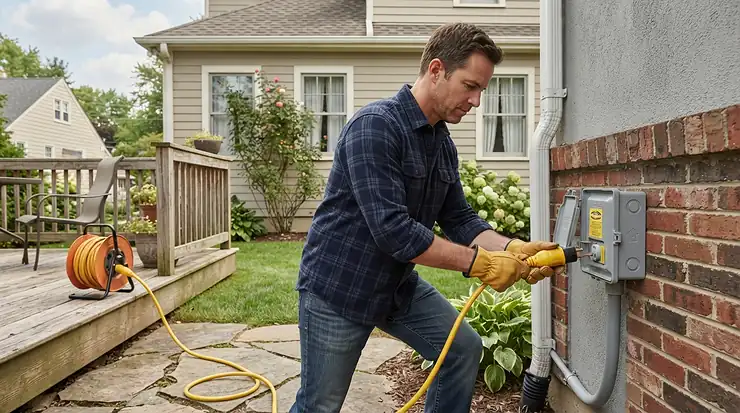
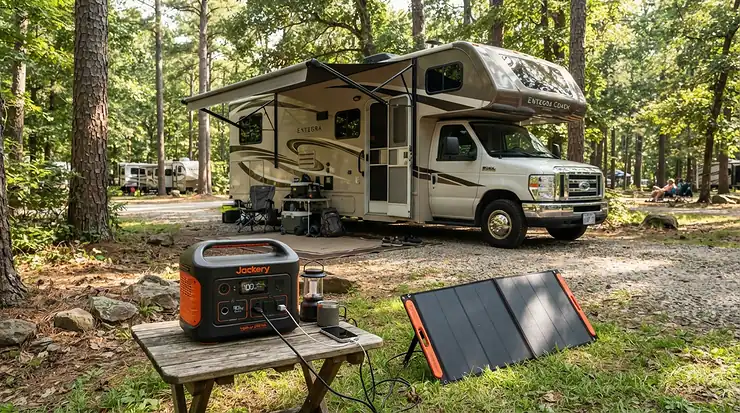
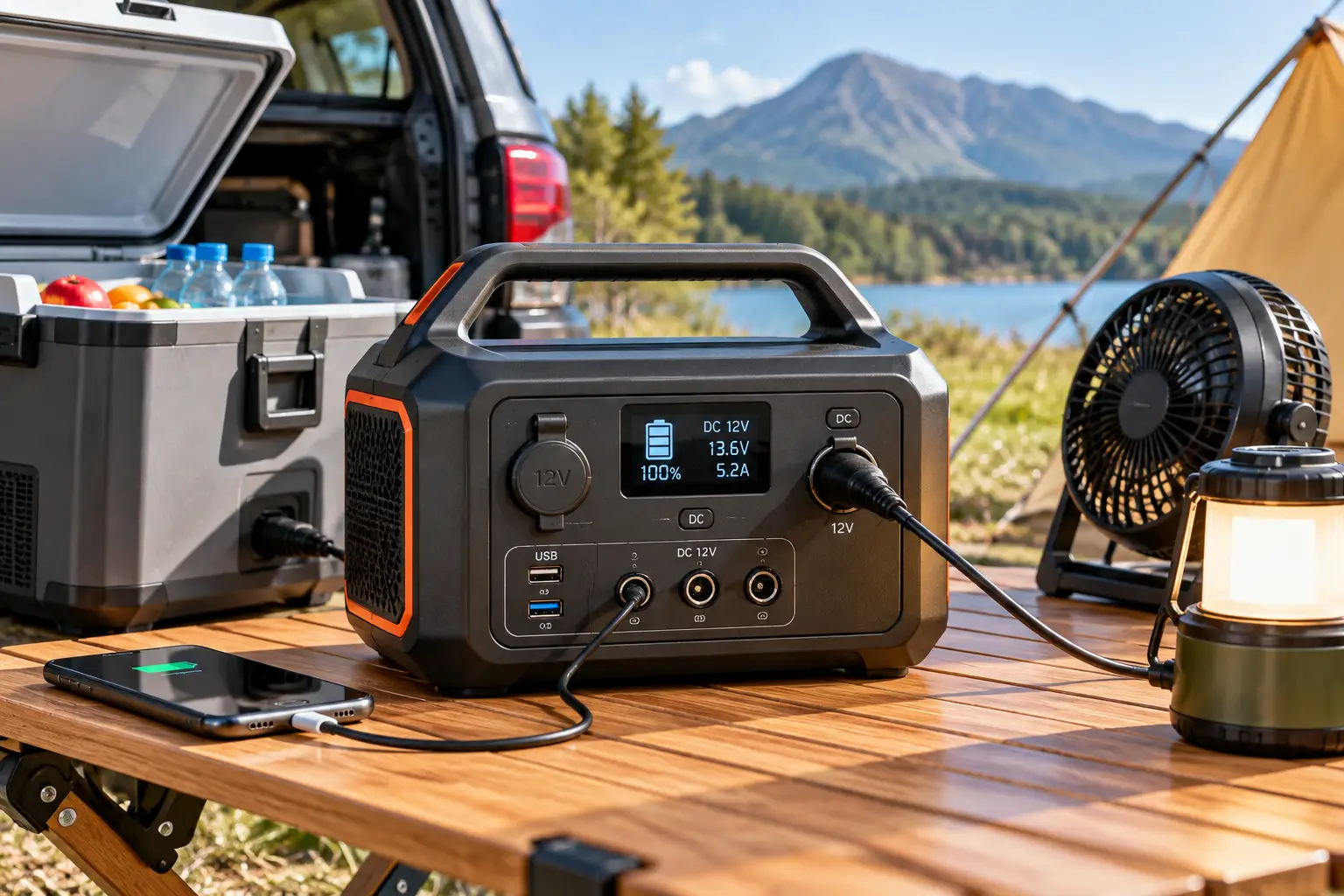
No product is sold as a true solar outlet for holiday strings. What Duracell and Goal Zero describe instead is a portable power station whose AC outlet runs the lights, with a solar panel refilling it by day. That setup suits plug-in strings in places an extension cord cannot reach.
Sizing starts with the string’s wattage. EcoFlow lists LED strings at 7 to 10 W for 50 feet and 12 to 18 W for 100 feet, and Goal Zero puts 100 LED lights under 5 W against 175 W for 25 incandescent bulbs. Duracell’s sizing guide says to pick a station with at least twice the total wattage of the lights, and gives the runtime formula as watt-hours divided by watts.
Sample calculation with a 256 Wh station like the Jackery Explorer 240 v2, ignoring conversion losses:
A 5 W string for 6 hours uses 30 Wh a night, so 256 ÷ 30 is about 8 nights.
A 100-foot string at EcoFlow’s 18 W top figure uses 108 Wh a night, about 2 nights.
Two such strings use 216 Wh a night, which leaves almost nothing for inverter overhead or a cold evening.
Refilling is the slow half. Duracell says a 100 W panel in full sun takes 5 to 8 hours to fill its 274 Wh G350, a similar size, and EcoFlow’s claim that panels can run a display indefinitely depends on steady sunlight, so treat it as optimistic for December. Duracell also notes that power stations are not waterproof, so the unit stays under cover. An etrailer answer about outdoor displays says a Goal Zero Yeti 150 would run only a couple of strands of C7 bulbs, at about 40 W per 25-bulb set, which is why the bulb type decides everything.
Solar panels, inverter and battery on a shed for Christmas lights
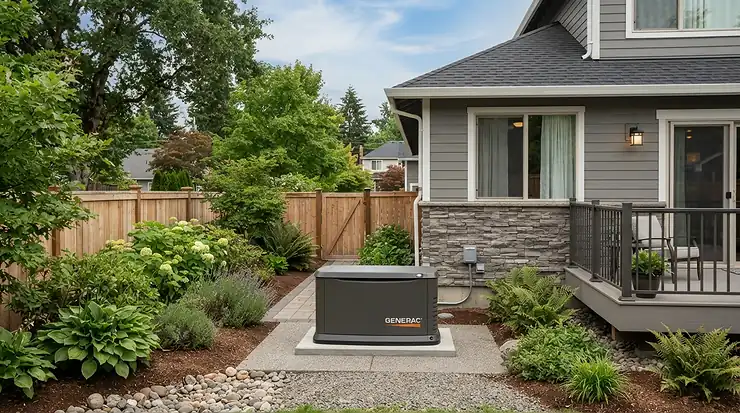
A shed system chains four parts: panels, a charge controller, a battery and, for 120V strings, an inverter. Renogy’s kit page describes the sequence plainly, with the panel feeding a controller that regulates current into a deep-cycle battery, and its inverter takes 12V DC in and gives 115V AC out. Lights that run on 12V DC do not need the inverter at all.
The load is tiny next to the hardware. Sample calculation with a 10 W display on a 6-hour timer: 10 × 6 = 60 Wh a night. A 3.6 kWh battery holds 3,600 Wh, nominally 60 nights of that load, before accounting for how much of the battery a given chemistry should be allowed to use. A system this size earns its place when the shed also runs tools or a fridge, and Christmas lights simply ride along.
Plug-in versus battery matters for the bill too. Energy.gov’s holiday savings page puts a 6-foot tree lit 12 hours a day for 40 days at about $0.27 with LEDs, against about $10 with incandescents. At those numbers, solar for a shed is a convenience and a resilience choice, not a way to save on a holiday light bill.
Mistakes that leave the porch dark by mid-December
Mixing old and new cells, or two chemistries, in one pack. Home Depot’s manual forbids it outright.
Leaving cells in the box all summer, which that retailer’s other manual links to leakage and corrosion.
Treating the power station’s watt-hours as the whole story. Duracell’s twice-the-wattage rule and etrailer’s note about 40 W per 25 C7 bulbs both point at the string’s draw as the limit.
Buying a set for its IP rating and ignoring the cell type on the label, which can rule out lithium or rechargeables entirely.
The cells and kits that solve each step
Each pick below ties to one stage of the method above. Read the cell type on the pack before you order any of them.
Labels come first: one Home Depot manual allows only alkaline cells, which rules lithium out for that box. Where the label permits it, the Energizer Ultimate Lithium AA matches the outdoor step, because Energizer’s sell sheet rates it to operate from -40°F to 140°F, and retailer listings describe leakproof construction under standard use. Nominal voltage is 1.5 V, the same as alkaline, per a bench review at lygte-info.dk.
A standard string pack takes three cells, so a four-pack covers one string with a spare. Storage claims vary by page, from 15 years on Energizer’s sell sheet to 20 and 25 years on retailer and OEM pages; none of that matters for a single season, but it does mean unused cells keep. Check the current price on Amazon.com.
Energizer Ultimate Lithium AASee current price, sizes and reviews on Amazon.
A string that runs every evening for a month is where rechargeable cells pay back, and the Panasonic eneloop AA is rated by Panasonic for up to 2,100 recharges, 70% charge held for up to 10 years and operation down to -4°F. The four-pack model BK-3MCCA4BA lists 2,000 mAh and 1.2 V on retailer spec sheets, and camera retailers PROCAM and Picture Line list it around $13 to $15 without a charger.
The voltage is the thing to watch. Rechargeable cells run 1.2 V against 1.5 V for alkaline, and a manual that allows only alkaline, like the Home Depot one, rules them out, while Funboy permits rechargeable AAA cells in its lights. Cold also shortens run time, per the B&H answer relayed from Panasonic.
Pros:
Recharge up to 2,100 times
Rated to -4°F
Cons:
Needs a separate charger
1.2 V may not suit alkaline-only packs
Panasonic eneloop AASee current price, sizes and reviews on Amazon.
Plug-in strings that must sit far from an outlet are the use case for the Jackery Explorer 240 v2. Jackery’s pages list 256 Wh from a LiFePO4 battery, 300 W of AC output with a 600 W surge, 3,000 cycles to 80% capacity and a weight near 8 pounds, and a UK page lists a single AC outlet alongside USB-A and USB-C ports. The USB-C input is rated at 100 W, which caps solar charging at that figure, and a review site lists about 3.3 hours of solar charging at the maximum.
Buyers on retailer pages describe the solar side in two ways: one rates it 4 stars and says it would be 5 if a USB-C solar adapter were included, and another reports charging it with both Jackery’s 40W mini panel and a 100W SolarSaga. Both are single reports. Jackery also sells other generations, so check which one the listing shows. As a power station it is not waterproof, per Duracell’s general warning, so it stays under cover. Check the current price on Amazon.com.
Jackery Explorer 240 v2See current price, sizes and reviews on Amazon.
This is the largest piece of hardware here and the least suited to a lone ten-watt display. Renogy’s kit page lists four 100 W N-type panels at 25% efficiency, a 3.6 kWh battery made of three 12V 100Ah units in lithium or AGM, a 3000 W pure sine inverter with 6000 W peak, a Rover 40A MPPT controller, fuses and a 500A battery monitor. The page describes it as designed for workshops and sheds, with coffee maker and TV as FAQ examples, and it does not name lights specifically.
Renogy’s own store lists the kit from about $1,900 to about $2,500, depending on the battery type. Reviews on that page include two that mention missing parts and one that calls the system a little undersized, so the packing list deserves a check on arrival.
Pros:
Battery, inverter, controller and fuses in one kit
Room for tools and a fridge beside the lights
Cons:
Far more capacity than a string of lights needs
Reviewers mention missing parts
Renogy 400W 12V Complete Solar Panel Kit with 3.6kWh BatterySee current price, sizes and reviews on Amazon.
Cells, runtime and solar charging: short answers before you buy
What battery do outdoor battery operated Christmas lights use?
Most packs described in the manuals above take three AA cells, with some AAA and C-cell sets, and the label names the allowed chemistry. One Home Depot manual allows only alkaline, so lithium or rechargeable cells belong only in packs whose label permits them.
How long do batteries last in battery operated Christmas lights?
It depends on the string. Christmas Light Source cites over 100 hours for micro-drop LED strings and 18 to 24 hours for standard LED sets on three AA cells, which on a 6-hour timer works out to roughly 16 nights versus 3 to 4.
Are rechargeable batteries safe to use in Christmas lights?
Only if the manual allows it. Funboy's page permits fresh or rechargeable AAA cells in its lights, while a Home Depot control-box manual allows alkaline only. Many rechargeable AA cells are rated 1.2 volts, against 1.5 volts for alkaline.
Why won't my battery operated Christmas lights turn on?
Start with fresh cells inserted to the polarity diagram, then check the switch or timer state, then clean the contacts. A red blinking light on Funboy's LEDs means depleted cells, and iFixit documents a loose port inside some battery boxes as a cause of glitching.
Can solar power run Christmas lights at night?
Yes, through storage. Duracell and Goal Zero describe charging a power station with a solar panel by day and running the lights from it after dark, though Duracell says full-sun charging takes 5 to 8 hours for a 274 watt-hour unit and that power stations are not waterproof.
Matching the cells to the string
Reading the label decides more than any brand: allowed chemistry, cell count and the box’s indoor or outdoor rating. For a freezing porch, lithium cells such as the Energizer Ultimate Lithium AA cover the widest temperature range where the label allows them, and the Panasonic eneloop AA suits a pack that runs every night. Plug-in strings that sit far from a wall belong on the Jackery Explorer 240 v2, and a shed that also runs tools can justify the Renogy 400W 12V Complete Solar Panel Kit with 3.6kWh Battery.
The simplest habits matter most: swap every cell at once, clean the contacts, press the timer at the hour you want evenings to begin, and take the cells out in January. A battery for christmas lights works best when the cell, the pack and the weather are matched on purpose, not by whatever was in the drawer. Pick the cell after the label, never before it.