As an Amazon Associate I earn from qualifying purchases. Links in this article may be affiliate links. How we choose gear
How many watts does a low watt ac really draw once the compressor starts on a 95°F afternoon? The sticker gives one number and a power meter often shows another: Jackery’s buying guide describes an older “900-watt” window unit that can pull about 1,100 W in that heat. That gap is why watts, not BTUs or brand, should drive any low watt ac purchase that has to run from a battery, a generator or a few solar panels.
Maker spec sheets, specialist-press measurements, solar-forum threads and retailer listings supply the figures here, and together they give a working answer for 2027: a 5,000 BTU window unit sits near 450 W, an inverter window unit or a battery-built portable can run in the 270 to 450 W range, and one maker’s newest portable quotes a range that starts at 150 W.
The plan follows the order a buyer needs: convert BTUs into watts, size the room, choose between a fixed-speed and an inverter compressor, check the power source, avoid the common mistakes, then pick from four units, each tied to one step.
What is the lowest watt ac unit you can actually buy?
Five units show the spread, from a plain window model to a battery-built portable.
Unit
Rated cooling
Running watts
Source of the figure
Midea MAW05M1WBL (fixed-speed window)
5,000 BTU
about 450 W
Retail listing; Midea lists 450 W for a sibling model
Midea U-Shaped 8,000 BTU (inverter window)
8,000 BTU
about 450 W averaged over an hour
TechGearLab measurement
EcoFlow WAVE 2 (portable)
5,100 BTU
270–300 W in eco mode, 370–400 W at maximum
NerdTechy review
Zero Breeze Mark 3 (portable)
5,280 BTU
150–500 W
Maker’s page
Zero Breeze Mark 2 (portable, discontinued)
2,300 BTU
240 W rated
Maker’s page
The smallest steady figure in the table, 240 W, belongs to the Zero Breeze Mark 2, and the maker’s own page says it is sold out with no further production planned. It also cools only 2,300 BTU, which the maker puts at roughly a quarter of a conventional car or rooftop unit. Divide 2,300 BTU by 240 W and you get about 9.6 BTU per watt; divide 5,000 by 450 for the Midea MAW05M1WBL and you get about 11.1. The lowest watt ac unit and the most efficient one are two different questions.
Among window models, PickHVAC puts the floor at a little over 400 W. Jackery’s comparison table lists 200 to 250 W for 5,000 to 6,000 BTU inverter bedroom units, but that is a vendor’s class range and not a model rating, so treat it as a best case. The same logic answers what is the lowest watt ac for one bedroom: an inverter window model in the 5,000 to 8,000 BTU range, measured against its own label, beats any promise of “low power” on a product page.
The two Midea rows deserve a second look. The 8,000 BTU inverter unit draws about the same average as the 5,000 BTU fixed-speed unit while rated for 60 percent more cooling, which is the clearest argument in this guide for an inverter compressor.
Reading wattage the way a power meter does
From BTU to watts
Efficiency ratings do the conversion. The Department of Energy’s room air conditioner guide says the higher the EER, the more efficient the unit, and EER is simply BTU per hour divided by watts.
Sample calculation, with stated assumptions: Midea’s page for the 5,000 BTU MAW05M1BWT lists an EER of 12.2, so 5,000 ÷ 12.2 gives about 410 W. At an EER of 11, the figure Filterbuy uses for its wattage chart, the same math gives about 455 W. Sources disagree on one sibling model: Midea’s page for its smart 5,000 BTU unit lists 450 W and 4.6 A, while a third-party spec database shows 5.04 A and 537 W for the MAW05M1BWT. The EnergyGuide label or the manual for the exact version settles it.
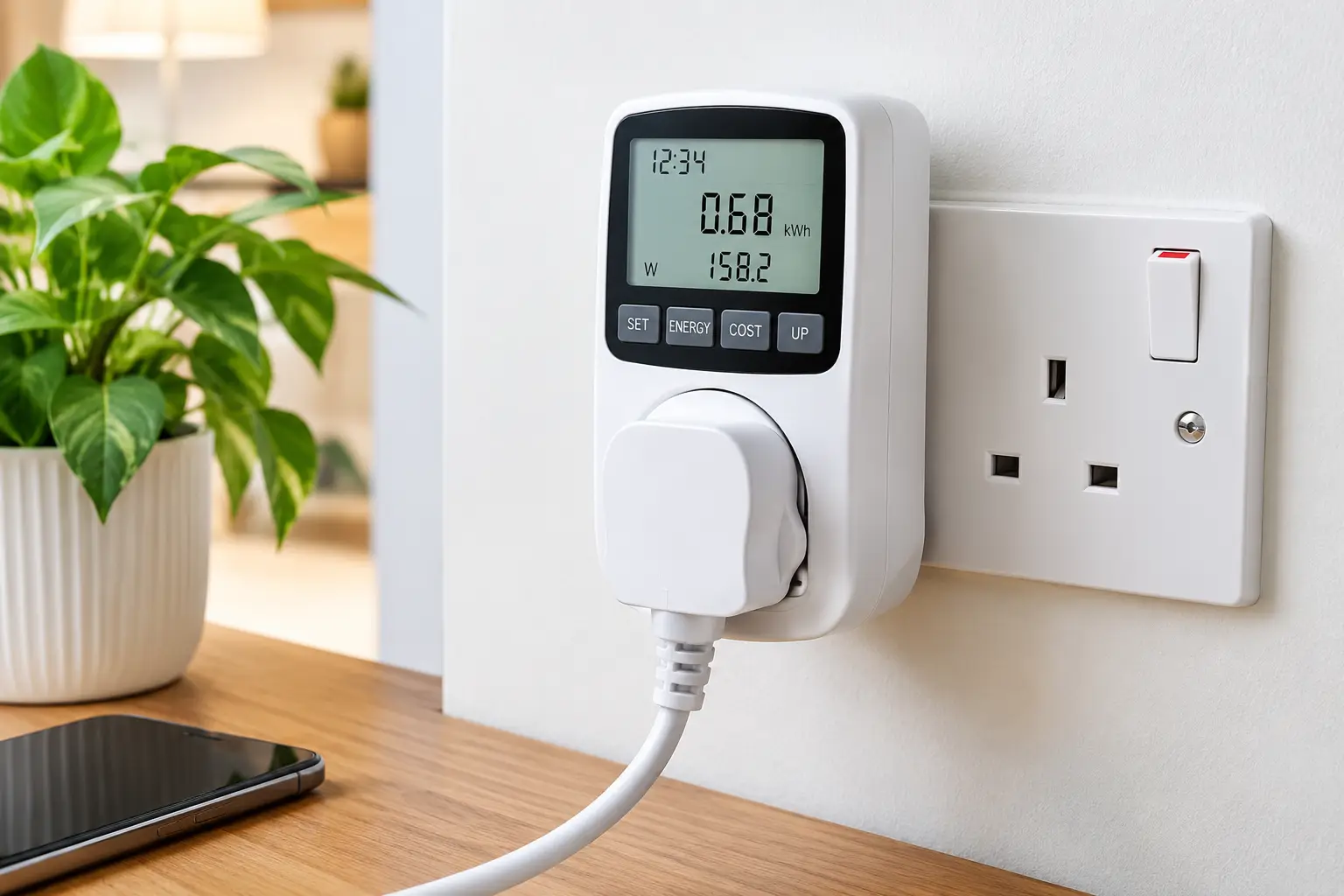
Why the sticker and the meter disagree
Three things pull the real number away from the label.
Heat comes first. Jackery’s guide says an old 900-watt unit can pull about 1,100 W on a 95°F afternoon, while a smart inverter model can cruise near 200 W on a cool evening.
Cycling pulls the other way. PickHVAC notes that window units turn on and off two or three times an hour, so a 1,000 W unit can average no more than about 650 W. Oukitel’s solar-generator guide gives the same pattern with different numbers: 800 W while running but only 60 percent of the time averages 480 W.
A dirty filter adds load. Jackery says a clogged filter can raise power draw by up to 15 percent, so cleaning it every two to four weeks is part of keeping a low power ac low-draw.
One owner report fits the label: a poster on Reddit’s r/skoolies says a small window unit in a roughly 100 square foot bus conversion runs at about 450 W on low.
What is low voltage ac power, and does it change the watt math?
AC can mean air conditioning or alternating current, so a search for low voltage ac power can land on either topic. Voltage is the supply level: a window unit plugs into 115 V, the Zero Breeze Mark 3 runs from 38 to 58.5 V DC, and the Mark 2 was a 24 V design. Watts measure what the appliance consumes, and amps follow from both.
A low-voltage unit is not automatically a low watt unit. The 115 V Midea above lists 450 W, while a 48 V portable can draw up to 500 W. For shopping, voltage only decides which source or adapter fits, and the watt figure sizes the battery, generator or panels.
Sizing the room so the compressor is not running flat out
A unit that is too small runs at full speed all afternoon, which defeats the point of a low watt air conditioner. One that is too large cools quickly and shuts off before it has removed much moisture. The Department of Energy page above says a smaller, properly sized unit running longer operates more efficiently than an oversized one.
Jackery’s sizing baseline is 5,000 BTU for up to 150 square feet, 8,000 BTU for up to 350 and 10,000 BTU for up to 450. Its adjustments are to add about 10 percent for a west-facing room with heavy afternoon sun, subtract about 10 percent for deep shade, and add 4,000 BTU for a kitchen. Midea’s page for the Midea MAW05M1WBL gives 100 to 150 square feet, and the retail listing for the 8,000 BTU U-shaped model says up to 350.
Portables need one more check. PickHVAC’s small-room roundup lists a portable sold as 8,000 BTU but rated at 5,000 SACC, and the lower figure is the one that describes cooling in the room. A low wattage portable ac with a hose also has to be compared on its SACC number, not on the headline BTU.
Compressor type matters for the next step too. ENERGY STAR says variable-speed compressors change motor speed to control temperature continuously, which is how an inverter unit settles into a low draw once the room is cool.
Fixed-speed or inverter: what happens in the first three seconds
A fixed-speed compressor takes its biggest gulp of power every time it starts. Sources disagree on how big. Jackery’s buying guide says start-up can double or triple running watts, a second Jackery sizing guide says 2.5 to 3 times, and PickHVAC, writing for generator buyers, puts it at 3.8 to 4.8 times. Size the source against the high end.
Inverter compressors ramp up over several seconds instead. Jackery says this removes the start-up spike, and Midea’s page for its U-shaped line says its inverter technology saves more than 35 percent of the energy of a traditional unit and that it was the first window model to earn ENERGY STAR Most Efficient recognition for 2020.
Owners on a solar forum add the practical side. In a thread on running a 5,000 BTU window unit, one owner started a fixed-speed unit on a 1,000 W pure sine inverter without a soft starter and now recommends 1,500 W, and another poster says a soft starter can allow a much smaller inverter. That is a consensus among a few posters and not a lab figure, but it matches the vendor ranges above.
Powering a low power ac from a battery or a few panels
Sample calculation, with stated assumptions: a 450 W window unit cooling for eight hours with the compressor running about 60 percent of the time uses 450 × 8 × 0.6 = 2,160 Wh. Jackery advises adding 10 to 15 percent for inverter losses, which lands at roughly 2,400 to 2,500 Wh of usable battery. Jackery’s own example is consistent: it says a 2,042 Wh station can run a 250 W inverter unit for up to eight hours.
Solar sizing runs larger than the running watts suggest. The forum thread above has one poster sizing the array at two to two and a half times the average running watts, which for 450 W means about 900 to 1,100 W of panels. A real-use report from the same thread: an owner ran a 5,000 BTU unit on 490 W of panels and a 318 Ah, 12 V battery bank, started it around 3 pm after the batteries reached absorb charging, and shut it off near 9 pm to keep the bank above 50 percent.
Panels alone may not carry the load. NerdTechy’s review of the EcoFlow WAVE 2 says a 400 W panel on its own generally cannot fully run the unit without the battery.
Mistakes that make a low watt air conditioning plan fall short
Reading runtime off the box
Claimed and measured runtimes differ. EcoFlow’s retail listing copy promises eight hours with the add-on battery, while NerdTechy measured about three to four hours at maximum cooling and six to eight in eco or night mode. For the Zero Breeze Mark 3, the maker says its 1,022 Wh battery runs the unit for five to seven hours, and Nomadic Supply’s battery page says four to six. Plan around the weaker figure.
Sizing the inverter from running watts
An inverter rated just above the running figure may trip at start-up on a fixed-speed unit. The forum owner above got a 5,000 BTU unit started on 1,000 W yet now recommends 1,500 W, so headroom matters even at that size.
Comparing watts without comparing cooling
A 240 W unit that cools 2,300 BTU is not the same buy as a 450 W unit that cools 8,000. Divide rated BTU by measured or listed watts before comparing, as in the table at the top.
Ignoring weight, drainage and installation
Handling costs show up after the box arrives. TechGearLab measured the 8,000 BTU Midea U-shaped unit at 52.5 pounds, and AppleInsider’s review warns that installation is a hurdle with that design. NerdTechy found the WAVE 2 leaks from its base unless it is tilted slightly toward the drain hole, and that its add-on battery cannot be charged on its own.
Four low watt air conditioner picks, each tied to one step
Each low watt ac unit below stands for one route through the plan above: a cheap fixed-speed baseline, an inverter window unit for batteries, and two cordless portables. Check current availability on Amazon.com before choosing, since bundles and versions change.
A bedroom or home office of 100 to 150 square feet with a wall outlet is the simple case for this unit. Midea’s page lists 5,000 BTU, 13.19 by 15.98 by 12.05 inches, 35.14 pounds, a one-year warranty, washable filter, included side panels, and cooling and ventilation with no heating or smart control. A retailer listing adds two cooling modes and two fan speeds, which means mechanical dials and nothing to schedule.
The watt picture is a mix of sources. A retail listing gives 450 W at 115 V, and Midea’s page for a sibling 5,000 BTU model lists 450 W and 4.6 A. The white version, the MAW05M1WWT, lists a CEER of 11 and 56 dB sound pressure on Midea’s page and is not ENERGY STAR certified. Check the current price on Amazon.com.
Because it is fixed-speed, it brings the start-up surge described earlier, so a generator or inverter needs the headroom the forum owner recommends. It covers one small room and nothing more.
Midea MAW05M1WBL 5,000 BTU Window Air ConditionerSee current price, sizes and reviews on Amazon.
Battery and generator owners get the most from this one, because an inverter compressor removes the worst of the start-up spike. TechGearLab’s review of the MAW08V1QWT measured 0.45 kWh averaged over an hour, one of the highest energy scores it has given a window unit and level with a 12,000 BTU sister model.
Retail listings add that it covers up to 350 square feet and list 710 W, while a buyer on one listing reports peaks around 450 W that fall back once the room reaches temperature. That gap between listed and observed watts is worth sizing for: plan the battery or generator around the higher figure and let the lower one be a bonus. Check the current price on Amazon.com.
Pros:
Inverter compressor with a gradual start
The window can still be opened while the unit is installed, per Midea
Rated for rooms up to 350 square feet on the listing
Cons:
52.5 pounds as measured by TechGearLab
AppleInsider’s review warns that installation is a hurdle
Midea U-Shaped 8,000 BTU Inverter Window Air ConditionerSee current price, sizes and reviews on Amazon.
Tents, vans and small sealed rooms are where a portable pays off, and this one cools 5,100 BTU and heats 6,100 BTU. It has no internal battery, so cordless use needs EcoFlow’s add-on battery, a power station, a car outlet or solar input up to 400 W, according to Nomadic Supply.
Reviewers land in the same range. Trusted Reviews cites 550 W on mains and 495 W on battery as rated figures and saw about 430 W at maximum. NerdTechy, whose author received a sample from EcoFlow, logged 370 to 400 W at maximum and 270 to 300 W in eco or night mode, and a Yahoo Tech review recorded 286 W for cooling and 4.3 W at idle. At NerdTechy’s 400 W reading, the rated 5,100 BTU works out to about 12.8 BTU per watt.
NerdTechy’s runtime figures are the practical limit: three to four hours at maximum and six to eight in eco mode on the add-on battery, which charges at about 700 W. The unit weighs 32 pounds, the battery another 17, and a Yahoo Tech reviewer measured 57.2 dBA from 36 inches. A listing at The Van Mart shows the unit alone between about $1,100 and $1,300.
EcoFlow WAVE 2 Portable Air ConditionerSee current price, sizes and reviews on Amazon.
Price and runtime shape the choice here. The maker’s store shows the bare unit between about $1,300 and $1,400, and Superarbor’s bundle with one battery sits between roughly $1,800 and $1,900, so the battery is a separate line item.
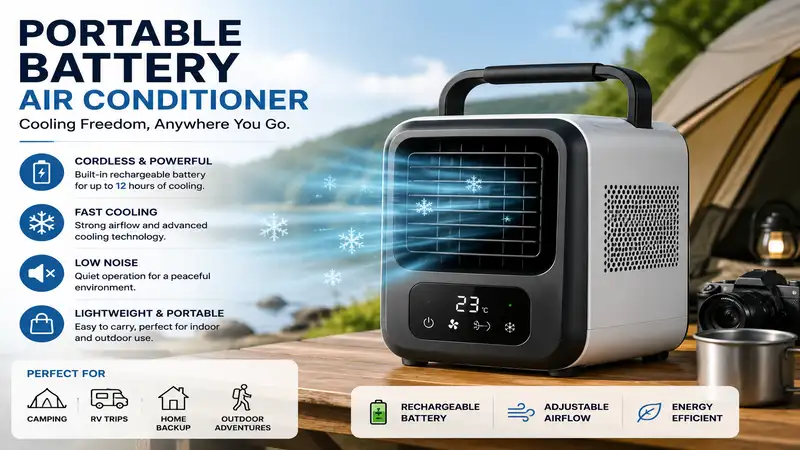
The maker says the Mark 3 consumes between 150 and 500 W depending on environment and setting, and that its 1,022 Wh battery runs it for five to seven hours. Nomadic Supply puts the same battery at four to six hours, which is why the weaker figure belongs in the plan. Cooling is 5,280 BTU, the unit weighs 22 pounds at 22 by 10 by 12 inches, and it works from 38 to 58.5 V DC. Backcountry’s listing says solar input is compatible up to 500 W. The maker’s own chart sets 500 W against 1,465 W for a traditional window unit.
The Mark 2 it replaces is sold out, per the maker, so the 240 W figure from the table is a history lesson and not a shopping option. Cooling one tent or one van bunk at a time is the job it is built for; a whole bedroom asks for more BTUs.
Zero Breeze Mark 3 Portable Air ConditionerSee current price, sizes and reviews on Amazon.
Among the units covered here, the lowest rated figure is 240 W for a 2,300 BTU portable that is now sold out. Among window models, PickHVAC puts the floor a little over 400 W, and one newer portable quotes a range starting near 150 W.
How many watts does a 5,000 BTU air conditioner use?
Roughly 400 to 550 W while the compressor runs, with efficient models near 450 W, according to Filterbuy. Midea lists 450 W and 4.6 A for one of its 5,000 BTU units, and dividing 5,000 BTU by an EER of 12.2 gives about 410 W.
Can a low wattage portable ac run from a power station?
Yes, if the station's continuous output covers the unit's running watts, its surge rating covers start-up, and its watt-hours cover the hours you need. Jackery says a 2,042 Wh station can run a 250 W inverter unit for up to eight hours.
What is low voltage ac power?
Voltage is the electrical supply level, such as 115 V at a wall outlet or 38 to 58.5 V DC for one portable unit, while watts measure what the appliance consumes. Voltage decides which source or adapter fits, and the watt figure sizes the battery, generator or panels.
Does an inverter air conditioner need a smaller power source?
Possibly a smaller inverter. Jackery's guide says soft-start compressors ramp up over several seconds instead of spiking, while a fixed-speed unit can surge to two or three times its running watts, so size the source against the higher figure.
Choosing your low watt ac
Start with the watt figure and the room’s square footage, then let the power source decide the rest. A fixed bedroom with a wall outlet points to the Midea MAW05M1WBL. The same room on a battery or a small generator points to the Midea U-Shaped 8,000 BTU, because its soft start spares the inverter and TechGearLab measured about 450 W averaged over an hour for 8,000 BTU. A tent, van or sleeping loft points to the EcoFlow WAVE 2 or the Zero Breeze Mark 3, which trade price and weight for cordless cooling.
For one room, the evidence favors an inverter window unit when a battery is involved and a plain fixed-speed unit when a wall outlet is guaranteed. Whatever the pick, a low watt ac is only as low as its label, so compare the exact model number before buying, since makers sell several versions of the same BTU size. Check current availability below.